

SUBSCRIBE TO OUR FREE NEWSLETTER
Daily news & progressive opinion—funded by the people, not the corporations—delivered straight to your inbox.
5
#000000
#FFFFFF
To donate by check, phone, or other method, see our More Ways to Give page.
Daily news & progressive opinion—funded by the people, not the corporations—delivered straight to your inbox.

Critics of a House appropriations bill that guts environmental agencies warn it's a sign of what the Republicans will do if they retake the Senate and the presidency next year.
Democrats and watchdog groups reacted with outrage on Friday as a U.S. House environmental subcommittee led by Republicans approved an appropriations bill that would reduce funding for two federal agencies and limit their ability to protect the environment.
The House Appropriations Interior, Environment, and Related Agencies Subcommittee voted to advance a bill to weaken the regulatory capacities of the Department of the Interior and the Environmental Protection Agency (EPA), cutting funding for conservation, climate action, national parks, and environmental justice initiatives.
"This bill sticks a finger in the eye of the American people who care deeply about clean air, climate change, endangered species, and responsible use of public lands," said Greta Anderson, deputy director of Western Watersheds Project. "It's a nasty wishlist to defund the priorities of protecting a livable future."
The fiscal year 2025 bill proposes a 20% cut to the EPA's annual budget, from $9.2 billion to $7.4 billion, including a $749 million cut to state and tribal assistance grants. It also proposes reductions to many Interior agency budgets, including a $210 million cut to the National Park Service and a $144 million cut to the U.S. Fish and Wildlife Service.
Taking aim at the government's ability to regulate industry, most of the Republicans' spending allocations are below fiscal year 2024 and almost all of them are below the amount requested by the Biden administration.
Rep. Chellie Pingree (D-Maine), the subcommittee's ranking Democrat, said in a statement that the proposed EPA cut was "irresponsible" and that she was "greatly disappointed and frustrated" by the bill, which "completely disregards the reality of a warming planet and ignores the need for us to do more, not less."
Pingree's Democratic colleague, Rep. Rosa DeLauro (D-Conn.), the ranking member of the full appropriations committee, agreed.
The bill "promotes dirty energy, taking the side of fossil fuel companies and those who deny the scientific reality rather than address the escalating risk to our economy and national security presented by the changing climate and growing number of extreme weather events," DeLauro said in the statement.
Critics of the bill also objected to the large number of "poison-pill" riders that seek to undo Biden administration rules and undermine the Endangered Species Act by naming specific animals for which listing can't be funded. Per a Trump-era Interior rule, the legislation also delists most gray wolf populations from the ESA.
"This proposal is a hatchet job of disastrous proportion that in an unprecedented scale, targets our nation's most imperiled species and the law saving them from extinction," Robert Dewey, vice president of government relations at Defenders of Wildlife, said in a statement.
The Republicans' bill includes proposed reductions to funding for clean water infrastructure projects, which Food and Water Watch (FWW) said was a step in the wrong direction—water and sewer systems need huge infusions of money just to meet current water quality standards.
"The proposed cuts would leave many with unsafe water and exacerbate the nation’s water affordability crisis, adding more pressure on household water bills at a time when families are already grappling with soaring costs for essential services," Mary Grant, a FWW campaign director, said in a statement, calling safe water "non-negotiable."
Grant said that to safeguard Americans' clean water from "foolishly political annual appropriations battles," Congress should pass the Water Affordability, Transparency, Equity, And Reliability (WATER) Act—a call she also made last year, when the same subcommittee advanced a similar bill.
The full appropriations committee will consider the bill on July 9. If the bill passes through the committee and then the full chamber, as last year's version did, it's unlikely to make headway in the Democratic-controlled U.S. Senate. However, critics of the bill warned that it's a sign of what the Republicans will do if they retake the Senate and the presidency.
Earlier this month, presumptive Republican nominee Donald Trump said that he plans to gut federal agencies dealing with climate, such as the Interior Department. A union of EPA workers rebuked Trump for the remarks.

A Center for Biological Diversity found 27 anti-wildlife measures in FY 2024 appropriations bills, the most since the Endangered Species Act was passed 50 years ago.
U.S. Lawmakers, mostly Republicans, have inserted a record number of anti-wildlife measures into the appropriations bills for fiscal year 2024, the Center for Biological Diversityreported Tuesday.
The attack comes despite the fact that scientists warn human activity may be triggering a sixth mass extinction, as species disappear at unprecedented rates. A September study found that vertebrate species groups are dying off at a rate 35 times higher than it would be without anthropogenic pressure.
"Republicans have weaponized the appropriations process to launch a full-blown assault on our natural heritage," Center for Biological Diversity senior policy specialist Stephanie Kurose said in a statement. "These heartless attacks would strip away lifesaving protections from our most imperiled creatures—from wolves to whales to freshwater mussels. If passed, these bills would put multiple species on a direct path to extinction."
"I hope the white-nose syndrome wipes all of them out," Rep. Ralph Norman (R-S.C.) said during a hearing in July. "We won't have to worry about it."
The center's report, titled Paving the Road to Extinction, found that 26 of the 27 "poison pill riders" placed in the appropriations bills were put there by Republicans. The last was introduced by Senate Democrats in an agreement to preserve preexisting measures. The total number of riders is more than Congress has added since the Endangered Species Act was passed 50 years ago.
"Republican members of Congress are trying to kill the Endangered Species Act," the center's endangered species program director Noah Greenwald posted on social media.
The report noted that Republican lawmakers have expressed outright hostility to the survival of endangered species. One rider, for example targeted the recent decision to list northern long-eared bats under the Endangered Species Act. The species has declined by 99% in 20 years due to white-nose syndrome, and human activity puts greater pressure on the survivors. But Rep. Michael Simpson (R-Idaho) added a rider barring any funding from enforcing those protections.
"I hope the white-nose syndrome wipes all of them out," Rep. Ralph Norman (R-S.C.) said during a hearing in July. "We won't have to worry about it."
Six of the measures—the most aimed at any one animal—targeted two critically endangered species of whales: Rice's whales and North Atlantic right whales. There are only around 50 Rice's whales left, and they live only in U.S. waters, while right whales are dying off so quickly they could be functionally extinct by 2040. Despite this, one rider would prevent the National Oceanic and Atmospheric Administration from finalizing a rule that would protect right whales from ship strikes, while another prohibits protections for Rice's whales from both ship strikes and oil and gas activity.
Another rider would effectively strip most gray wolves of Endangered Species Act protections in the Lower 48 states while a third would both end protections for Greater Yellowstone Ecosystem grizzly bears and prevent the courts from intervening.
The center noted that most anti-wildlife riders introduced in previous years were rejected before the bills passed. But it only takes a few to do real harm. To return to right whales, in 2022 Congress approved a measure that would postpone conservation efforts to protect the dwindling population from getting caught in fishing gear.
"With each successful rider, we're losing our ability to end extinction in the United States," Kurose said. "These attacks are deeply unpopular with the American public, who want to see our natural heritage protected for future generations to come."
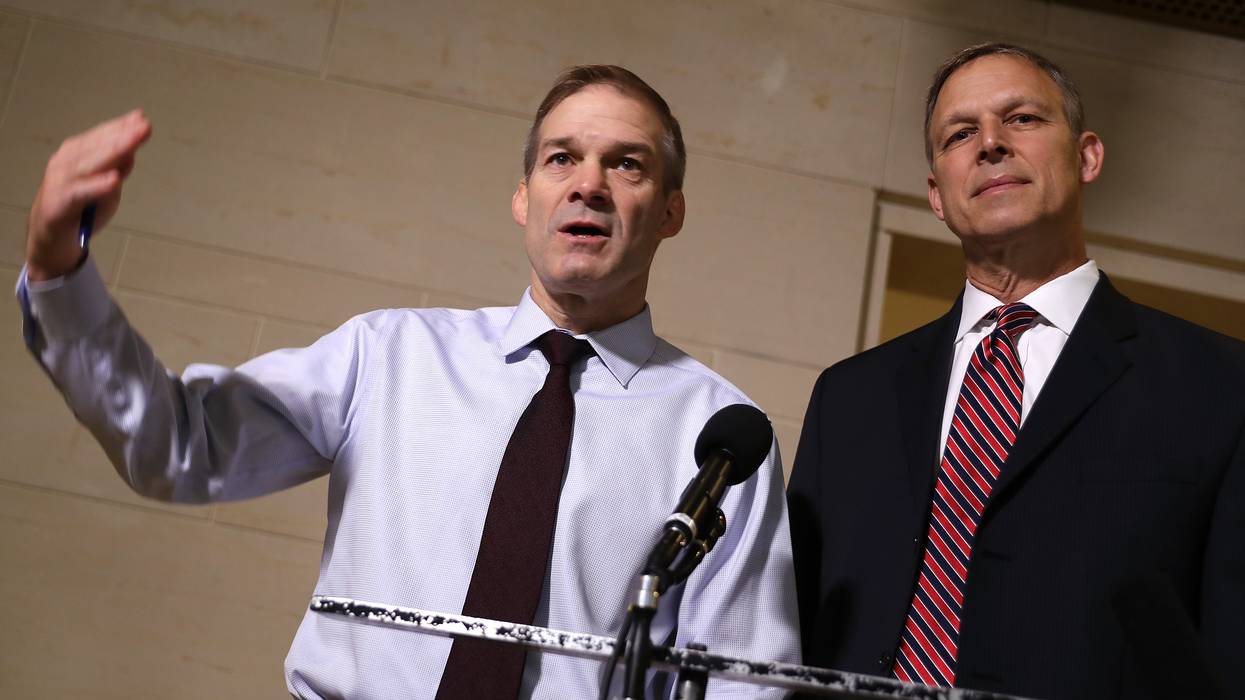
Senate Majority Leader Chuck Schumer warned that "if the House decides to go in a partisan direction it will lead to a Republican-caused shutdown."
With Congress on August recess, the far-right House Freedom Caucus on Monday issued expected but unlikely-to-be-met demands for a stopgap funding bill that would avert an October government shutdown.
Members of the Senate and House of Representatives are set to return to Capitol Hill on the first and second Tuesday of September, respectively—giving them little time to pass full-year appropriations legislation before funding runs out at the end of next month.
Considering the time crunch, both Senate Majority Leader Chuck Schumer (D-N.Y.) and House Speaker Kevin McCarthy (R-Calif.) have recently signaled support for a continuing resolution (CR) that would give lawmakers a few more months to pass a larger package.
So far, McCarthy's fractured conference has only passed one of 12 appropriations bills for fiscal year (FY) 2024. Among the GOP's "five families" is the House Freedom Caucus (HFC), which does not publicly list its members but is made up of a few dozen legislators, including Chair Scott Perry (R-Pa.) and Vice Chair Jim Jordan (R-Ohio).
In terms of the appropriations legislation for the next fiscal year, the HFC said in a statement Monday that "we remain committed to restoring the true FY 2022 topline spending level of $1.471 trillion without the use of gimmicks or reallocated rescissions to return the bureaucracy to its pre-Covid size while allowing for adequate defense funding."
"In the eventuality that Congress must consider a short-term extension of government funding through a continuing resolution, we refuse to support any such measure that continues Democrats' bloated Covid-era spending and simultaneously fails to force the Biden administration to follow the law and fulfill its most basic responsibilities," the caucus continued. "Any support for a 'clean' continuing resolution would be an affirmation of the current FY 2023 spending level grossly increased by the lame-duck December 2022 omnibus spending bill that we all vehemently opposed just seven months ago."
The HFC declared that its members will refuse to support any CR that does not include the House-passed Secure the Border Act, "address the unprecedented weaponization" of the U.S. Department of Justice (DOJ) and the Federal Bureau of Investigation, and "end the Left's cancerous woke policies in the Pentagon undermining our military's core warfighting mission."
The Pentagon language likely relates to U.S. military policies on abortion and gender-affirming care as well as diversity, equity, inclusion, and accessibility while the DOJ comment is widely seen as a reference to investigations of former President Donald Trump, who has been indicted in four cases this year—including in two probes led by Special Counsel Jack Smith, who was appointed by U.S. Attorney General Merrick Garland after the Republican announced his 2024 presidential campaign.
"We will oppose any attempt by Washington to revert to its old playbook of using a series of short-term funding extensions designed to push Congress up against a December deadline to force the passage of yet another monstrous, budget-busting, pork-filled, lobbyist handout omnibus spending bill at year's end and we will use every procedural tool necessary to prevent that outcome," the HFC added Monday. "Lastly, we will oppose any blank check for Ukraine in any supplemental appropriations bill."
Democrats in Congress quickly warned that the faction of Republicans was up to no good, with Schumer saying in a statement Monday that "if the House decides to go in a partisan direction it will lead to a Republican-caused shutdown."
Congresswoman Jennifer Wexton (D-Va.) said that "extreme House Republicans are now threatening to send us into a reckless government shutdown if they don't get their way. A shutdown would be a disaster for Virginians—from missed paychecks to lapses in essential government services that families rely on."
Referencing Trump's "Make America Great Again" slogan, House Minority Leader Hakeem Jeffries (D-N.Y.) wrote on social media that "House Republicans are determined to shut down the government and crash our economy. We will fight these MAGA extremists every step of the way. For. The. People."
The New Republic's Tori Otten also suggested that "tanking the economy" could be the goal, noting that the HFC made similar demands earlier this year before McCarthy struck a debt ceiling deal with Democratic President Joe Biden, who is seeking reelection:
The government shutdown in 2018 cost the United States $11 billion, including $3 billion in economic activity that will never be recovered, the Congressional Budget Office said at the start of the following year.
With a presidential election on the horizon, the Freedom Caucus could be looking for ways to undermine Biden any way it can. Destroying the economy he's helping to recover would do just that.
The Washington Post reported Monday that "White House spokesperson Olivia Dalton told reporters that she had no updates on whether Biden plans to sign a continuing resolution."
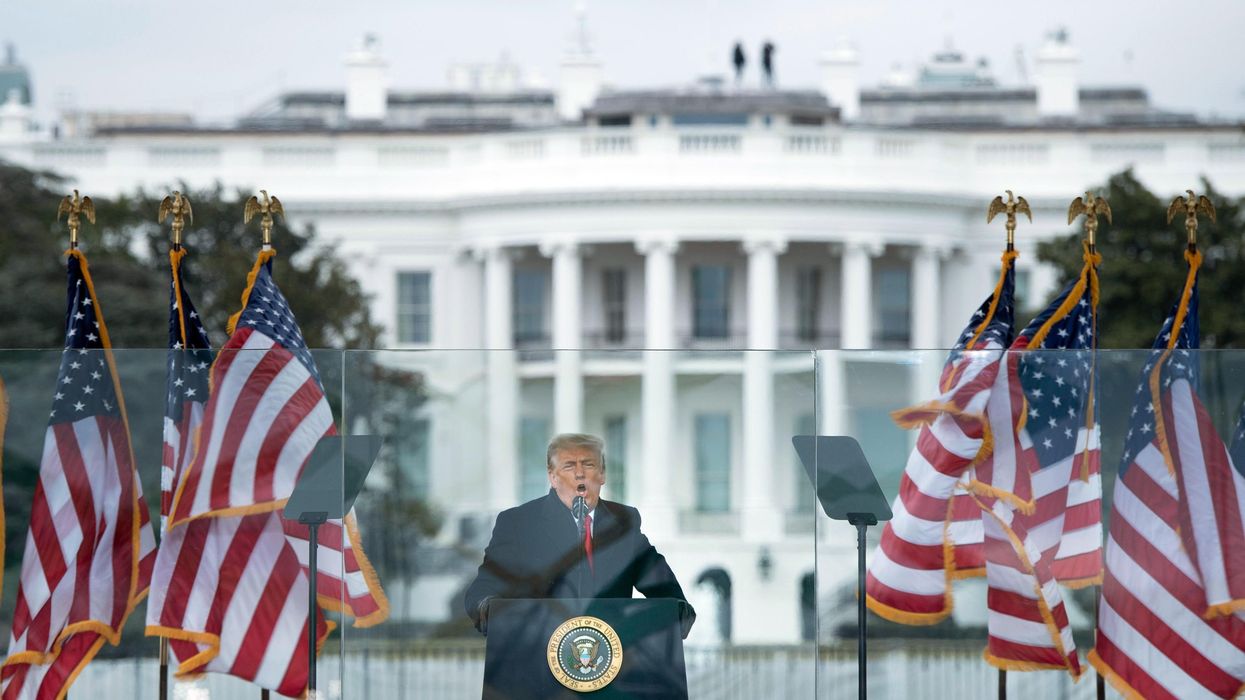
Two-and-a-half years after the insurrection, said one advocate, "these poison pills are an attempt to stymie our democracy by other means."
A coalition that has been monitoring Republican lawmakers' crafting of appropriations bills in the U.S. House in recent weeks warned on Wednesday that more than a dozen policy riders have been added to spending legislation with what appears to be the goal of limiting the government's ability to fight misinformation, extremism, and attacks on voting rights.
The Clean Budget Coalition—made up of nearly 260 advocacy groups including the Coalition for Sensible Safeguard and Public Citizen—said the slew of poison pills were the Republicans' January 6th policy riders, aimed at attacking democracy as former President Donald Trump and his backers did after the 2020 election.
"The attack on our democracy we saw on January 6th was a horrifically violent moment and an outgrowth of extremism, white nationalism, and anti-democratic rhetoric," said Lisa Gilbert, executive vice president of Public Citizen and co-chair of the Clean Budget Coalition, of the attempted insurrection at the U.S. Capitol in 2021. "We are seeing all of those trends continue in the culture war policies included in the GOP-drafted annual spending bills."
Tucked into appropriations bills ahead of what is expected to be a protracted spending fight on Capitol Hill this fall are riders banning certain types of spending by the federal government, including a "politically sensitive investigations" rider than would block funding for such probes unless the U.S. Department of Justice requires a nonpartisan career staffer to oversee them.
The coalition highlighted the inclusion of the rider a day after Trump was indicted by a federal grand jury in Special Counsel Jack Smith's investigation into the January 6, 2021 attack at the Capitol and the former president's attempts to overturn the 2020 election after his loss to President Joe Biden.
Republican lawmakers are also attempting to block funds from being used to classify any communications "by a U.S. person as misinformation, disinformation, or malinformation" or to appoint an inspector general to prevent and address "supremacist, extremist, and criminal gang activities by members of the Armed Forces."
In refusing to fund such investigations, said the Coalition for Sensible Safeguards, Republican lawmakers would foster "right-wing extremism, violence, disinformation, and conspiracy theories, while undermining fair elections, democracy, and the rule of law."
The Republicans have added at least two anti-voting rights riders to legislation, including one to prohibit the use of funds to sue a state or local government over redistricting and one to block the implementation of Biden's executive order to promote access to voting.
The 2021 order moved to ensure federal workers have time off to vote and that people with disabilities have equal access to voting, established a steering group to address voting rights for Native Americans, and took other steps to make voting easier.
For months prior to the January 6 attack, Trump and his supporters claimed Democrats would use measures make voting more accessible, including mail-in voting, to "rig" the 2020 election and sowed discord that helped fuel the violent insurrection.
More than two-and-and-half years after the assault on the Capitol, and as Trump is facing significant charges for his alleged incitement of the riot, the coalition said Republicans are continuing to weaken the government's ability to address similar attacks.
"These poison pills," said Gilbert, "are an attempt to stymie our democracy by other means."

The Republican majority’s latest in a series of attempts to hand over our public lands and waters to Big Oil, this bill strips away the Department of Interior’s land and ocean management discretion.
In their latest legislative attack on our climate, the Republican majority in the House has written a bill that is so detrimental to our environment and communities, it may rank as the worst appropriations bill in decades.
For both our shared public lands and oceans, the bill carves out giveaways for the fossil fuel industry that go against not only our climate goals but also common sense. Instead of recognizing that federally managed lands and oceans host a myriad of uses and industries and contribute in countless ways to the national economy, the House majority seems to view them as having one purpose: unabated production of oil, gas, and coal.
The Republican majority’s latest in a series of attempts to hand over our public lands and waters to Big Oil, this bill strips away the Department of Interior’s land and ocean management discretion. In doing so, it tips the scales toward congressional control of the oil and gas leasing process, dictates the number of lease sales the administration must offer, and overrides any commonsense considerations as to which areas should or should not be leased.
At a time when we need to act swiftly on climate, these congressional proposals to write fossil fuel interests into law undermine the progress we need to make to tackle the climate crisis.
For offshore ocean areas, House Republicans have proposed:
For onshore federal public lands, House Republicans have proposed:
At a time when we need to act swiftly on climate, these congressional proposals to write fossil fuel interests into law undermine the progress we need to make to tackle the climate crisis. To say these provisions would have devasting impacts to both climate and communities would be an understatement. This effort by the Republican House majority is a slap in the face to the millions of Americans suffering through weeks long heat waves and devastating floods and who are looking to Congress for solutions to meet this historic and challenging moment.