SUBSCRIBE TO OUR FREE NEWSLETTER
Daily news & progressive opinion—funded by the people, not the corporations—delivered straight to your inbox.
5
#000000
#FFFFFF
To donate by check, phone, or other method, see our More Ways to Give page.
Daily news & progressive opinion—funded by the people, not the corporations—delivered straight to your inbox.
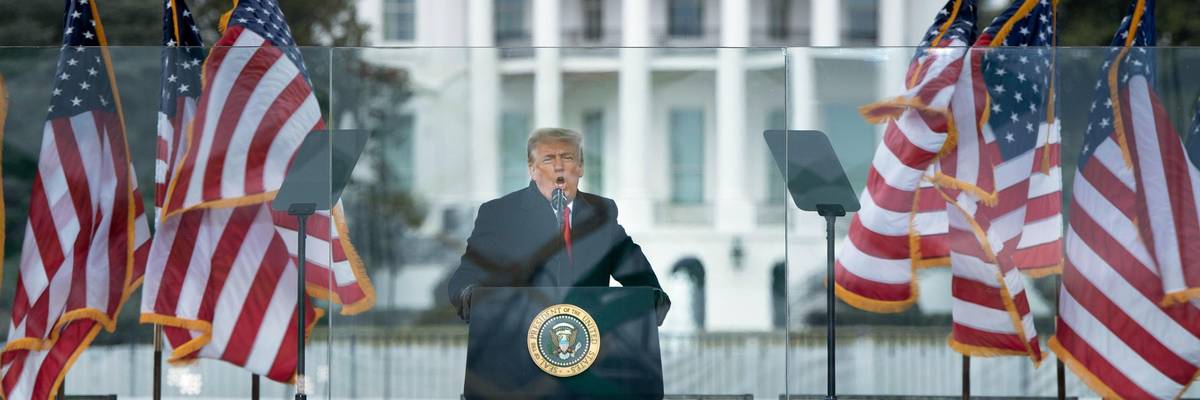
Then-U.S. President Donald Trump spoke to supporters near the White House on January 6, 2021, in Washington, D.C.
Two-and-a-half years after the insurrection, said one advocate, "these poison pills are an attempt to stymie our democracy by other means."
A coalition that has been monitoring Republican lawmakers' crafting of appropriations bills in the U.S. House in recent weeks warned on Wednesday that more than a dozen policy riders have been added to spending legislation with what appears to be the goal of limiting the government's ability to fight misinformation, extremism, and attacks on voting rights.
The Clean Budget Coalition—made up of nearly 260 advocacy groups including the Coalition for Sensible Safeguard and Public Citizen—said the slew of poison pills were the Republicans' January 6th policy riders, aimed at attacking democracy as former President Donald Trump and his backers did after the 2020 election.
"The attack on our democracy we saw on January 6th was a horrifically violent moment and an outgrowth of extremism, white nationalism, and anti-democratic rhetoric," said Lisa Gilbert, executive vice president of Public Citizen and co-chair of the Clean Budget Coalition, of the attempted insurrection at the U.S. Capitol in 2021. "We are seeing all of those trends continue in the culture war policies included in the GOP-drafted annual spending bills."
Tucked into appropriations bills ahead of what is expected to be a protracted spending fight on Capitol Hill this fall are riders banning certain types of spending by the federal government, including a "politically sensitive investigations" rider than would block funding for such probes unless the U.S. Department of Justice requires a nonpartisan career staffer to oversee them.
The coalition highlighted the inclusion of the rider a day after Trump was indicted by a federal grand jury in Special Counsel Jack Smith's investigation into the January 6, 2021 attack at the Capitol and the former president's attempts to overturn the 2020 election after his loss to President Joe Biden.
Republican lawmakers are also attempting to block funds from being used to classify any communications "by a U.S. person as misinformation, disinformation, or malinformation" or to appoint an inspector general to prevent and address "supremacist, extremist, and criminal gang activities by members of the Armed Forces."
In refusing to fund such investigations, said the Coalition for Sensible Safeguards, Republican lawmakers would foster "right-wing extremism, violence, disinformation, and conspiracy theories, while undermining fair elections, democracy, and the rule of law."
The Republicans have added at least two anti-voting rights riders to legislation, including one to prohibit the use of funds to sue a state or local government over redistricting and one to block the implementation of Biden's executive order to promote access to voting.
The 2021 order moved to ensure federal workers have time off to vote and that people with disabilities have equal access to voting, established a steering group to address voting rights for Native Americans, and took other steps to make voting easier.
For months prior to the January 6 attack, Trump and his supporters claimed Democrats would use measures make voting more accessible, including mail-in voting, to "rig" the 2020 election and sowed discord that helped fuel the violent insurrection.
More than two-and-and-half years after the assault on the Capitol, and as Trump is facing significant charges for his alleged incitement of the riot, the coalition said Republicans are continuing to weaken the government's ability to address similar attacks.
"These poison pills," said Gilbert, "are an attempt to stymie our democracy by other means."
Dear Common Dreams reader, It’s been nearly 30 years since I co-founded Common Dreams with my late wife, Lina Newhouser. We had the radical notion that journalism should serve the public good, not corporate profits. It was clear to us from the outset what it would take to build such a project. No paid advertisements. No corporate sponsors. No millionaire publisher telling us what to think or do. Many people said we wouldn't last a year, but we proved those doubters wrong. Together with a tremendous team of journalists and dedicated staff, we built an independent media outlet free from the constraints of profits and corporate control. Our mission has always been simple: To inform. To inspire. To ignite change for the common good. Building Common Dreams was not easy. Our survival was never guaranteed. When you take on the most powerful forces—Wall Street greed, fossil fuel industry destruction, Big Tech lobbyists, and uber-rich oligarchs who have spent billions upon billions rigging the economy and democracy in their favor—the only bulwark you have is supporters who believe in your work. But here’s the urgent message from me today. It's never been this bad out there. And it's never been this hard to keep us going. At the very moment Common Dreams is most needed, the threats we face are intensifying. We need your support now more than ever. We don't accept corporate advertising and never will. We don't have a paywall because we don't think people should be blocked from critical news based on their ability to pay. Everything we do is funded by the donations of readers like you. When everyone does the little they can afford, we are strong. But if that support retreats or dries up, so do we. Will you donate now to make sure Common Dreams not only survives but thrives? —Craig Brown, Co-founder |
A coalition that has been monitoring Republican lawmakers' crafting of appropriations bills in the U.S. House in recent weeks warned on Wednesday that more than a dozen policy riders have been added to spending legislation with what appears to be the goal of limiting the government's ability to fight misinformation, extremism, and attacks on voting rights.
The Clean Budget Coalition—made up of nearly 260 advocacy groups including the Coalition for Sensible Safeguard and Public Citizen—said the slew of poison pills were the Republicans' January 6th policy riders, aimed at attacking democracy as former President Donald Trump and his backers did after the 2020 election.
"The attack on our democracy we saw on January 6th was a horrifically violent moment and an outgrowth of extremism, white nationalism, and anti-democratic rhetoric," said Lisa Gilbert, executive vice president of Public Citizen and co-chair of the Clean Budget Coalition, of the attempted insurrection at the U.S. Capitol in 2021. "We are seeing all of those trends continue in the culture war policies included in the GOP-drafted annual spending bills."
Tucked into appropriations bills ahead of what is expected to be a protracted spending fight on Capitol Hill this fall are riders banning certain types of spending by the federal government, including a "politically sensitive investigations" rider than would block funding for such probes unless the U.S. Department of Justice requires a nonpartisan career staffer to oversee them.
The coalition highlighted the inclusion of the rider a day after Trump was indicted by a federal grand jury in Special Counsel Jack Smith's investigation into the January 6, 2021 attack at the Capitol and the former president's attempts to overturn the 2020 election after his loss to President Joe Biden.
Republican lawmakers are also attempting to block funds from being used to classify any communications "by a U.S. person as misinformation, disinformation, or malinformation" or to appoint an inspector general to prevent and address "supremacist, extremist, and criminal gang activities by members of the Armed Forces."
In refusing to fund such investigations, said the Coalition for Sensible Safeguards, Republican lawmakers would foster "right-wing extremism, violence, disinformation, and conspiracy theories, while undermining fair elections, democracy, and the rule of law."
The Republicans have added at least two anti-voting rights riders to legislation, including one to prohibit the use of funds to sue a state or local government over redistricting and one to block the implementation of Biden's executive order to promote access to voting.
The 2021 order moved to ensure federal workers have time off to vote and that people with disabilities have equal access to voting, established a steering group to address voting rights for Native Americans, and took other steps to make voting easier.
For months prior to the January 6 attack, Trump and his supporters claimed Democrats would use measures make voting more accessible, including mail-in voting, to "rig" the 2020 election and sowed discord that helped fuel the violent insurrection.
More than two-and-and-half years after the assault on the Capitol, and as Trump is facing significant charges for his alleged incitement of the riot, the coalition said Republicans are continuing to weaken the government's ability to address similar attacks.
"These poison pills," said Gilbert, "are an attempt to stymie our democracy by other means."
A coalition that has been monitoring Republican lawmakers' crafting of appropriations bills in the U.S. House in recent weeks warned on Wednesday that more than a dozen policy riders have been added to spending legislation with what appears to be the goal of limiting the government's ability to fight misinformation, extremism, and attacks on voting rights.
The Clean Budget Coalition—made up of nearly 260 advocacy groups including the Coalition for Sensible Safeguard and Public Citizen—said the slew of poison pills were the Republicans' January 6th policy riders, aimed at attacking democracy as former President Donald Trump and his backers did after the 2020 election.
"The attack on our democracy we saw on January 6th was a horrifically violent moment and an outgrowth of extremism, white nationalism, and anti-democratic rhetoric," said Lisa Gilbert, executive vice president of Public Citizen and co-chair of the Clean Budget Coalition, of the attempted insurrection at the U.S. Capitol in 2021. "We are seeing all of those trends continue in the culture war policies included in the GOP-drafted annual spending bills."
Tucked into appropriations bills ahead of what is expected to be a protracted spending fight on Capitol Hill this fall are riders banning certain types of spending by the federal government, including a "politically sensitive investigations" rider than would block funding for such probes unless the U.S. Department of Justice requires a nonpartisan career staffer to oversee them.
The coalition highlighted the inclusion of the rider a day after Trump was indicted by a federal grand jury in Special Counsel Jack Smith's investigation into the January 6, 2021 attack at the Capitol and the former president's attempts to overturn the 2020 election after his loss to President Joe Biden.
Republican lawmakers are also attempting to block funds from being used to classify any communications "by a U.S. person as misinformation, disinformation, or malinformation" or to appoint an inspector general to prevent and address "supremacist, extremist, and criminal gang activities by members of the Armed Forces."
In refusing to fund such investigations, said the Coalition for Sensible Safeguards, Republican lawmakers would foster "right-wing extremism, violence, disinformation, and conspiracy theories, while undermining fair elections, democracy, and the rule of law."
The Republicans have added at least two anti-voting rights riders to legislation, including one to prohibit the use of funds to sue a state or local government over redistricting and one to block the implementation of Biden's executive order to promote access to voting.
The 2021 order moved to ensure federal workers have time off to vote and that people with disabilities have equal access to voting, established a steering group to address voting rights for Native Americans, and took other steps to make voting easier.
For months prior to the January 6 attack, Trump and his supporters claimed Democrats would use measures make voting more accessible, including mail-in voting, to "rig" the 2020 election and sowed discord that helped fuel the violent insurrection.
More than two-and-and-half years after the assault on the Capitol, and as Trump is facing significant charges for his alleged incitement of the riot, the coalition said Republicans are continuing to weaken the government's ability to address similar attacks.
"These poison pills," said Gilbert, "are an attempt to stymie our democracy by other means."