

SUBSCRIBE TO OUR FREE NEWSLETTER
Daily news & progressive opinion—funded by the people, not the corporations—delivered straight to your inbox.
5
#000000
#FFFFFF
To donate by check, phone, or other method, see our More Ways to Give page.
Daily news & progressive opinion—funded by the people, not the corporations—delivered straight to your inbox.
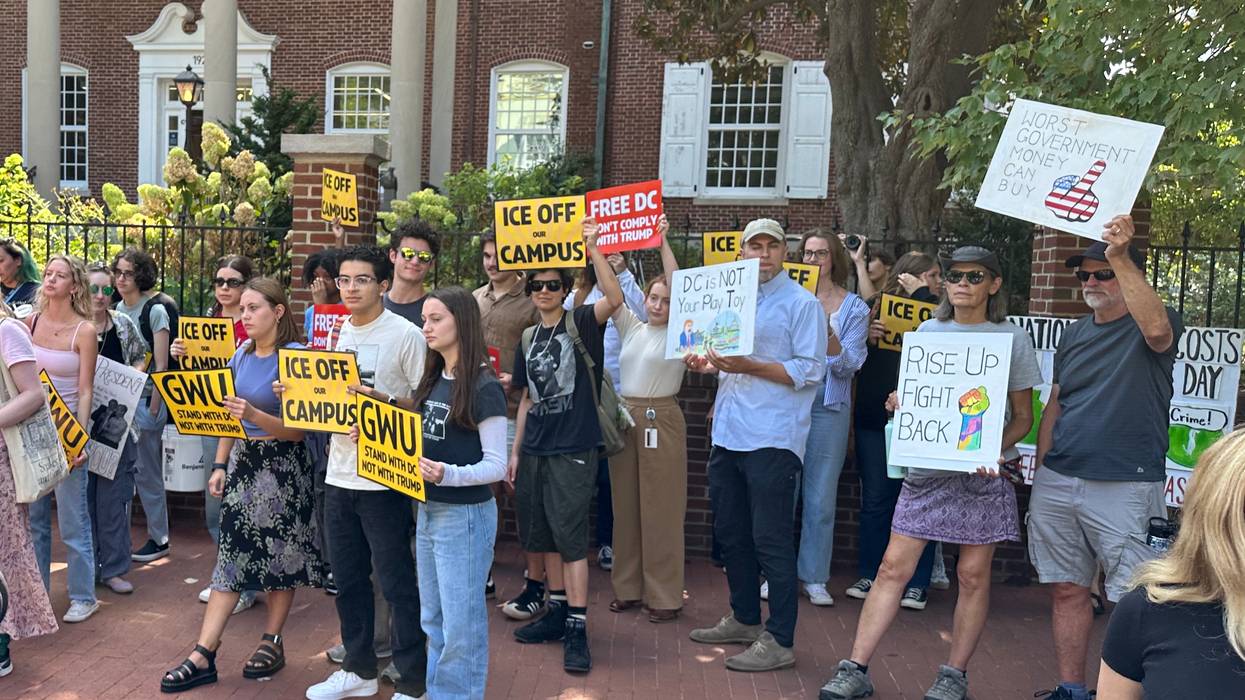
The fossil fuel industry is funding fascism because they know they lose in a democracy. Young people are ready to fight for both, because we see them as inseparable.
In early 2025, Sunrise launched a campaign to make polluters pay for the effects of climate disasters. This campaign had the usual strengths: a focused message, easy to villainize targets, and real opportunities for state-level wins. It allowed us to engage the public directly following climate disasters, when attention to the climate crisis is highest.
But taking the campaign from the drawing board to the streets felt like pulling teeth. It was hard to recruit young people, bring local hubs on board, and build organic momentum. Our leadership team felt unmotivated and lethargic. Ignoring the elephant in the room of escalating fascism was getting to all of us.
In response, our leadership team came together over the summer to reevaluate and reassess the broader landscape. We watched Immigration and Customs Enforcement escalate in Los Angeles, watched as President Donald Trump broke every rule in the book and rapidly consolidated power. He was gutting the Environmental Protection Agency (EPA), dragging us back into the coal era, joking about running in 2028, and threatening to cancel elections. It became very clear that running a Make Polluters Pay campaign was like bringing a knife to a gunfight (figuratively of course).
Here’s what we realized:
From a purely emissions perspective, we were losing. We could get a few polluters to pay for cleanup costs. In some states, like California or New York, state legislation mattered a good amount. But while we were focused on state-level policy, the Trump administration was opening the Arctic National Wildlife Refuge to drilling, reversing vehicle emission standards, withdrawing from international climate agreements again, eliminating the Inflation Reduction Act’s (IRA) tax credits, and staffing the EPA with fossil fuel executives. It was changing the green economy so that there was less incentive to build wind and solar, pausing IRA-funded projects, and actively driving up pollution. We were just being outstripped.
Many of our partner organizations decided to focus on local organizing for three years in order to prepare for what we wanted to win when we won back power. However, this approach depends on stable democratic systems, and the ability to organize freely. Both of which are increasingly unrealistic based on our assessment.
First, Trump may not leave office. He’s openly discussed ignoring term limits. He’s installing loyalists throughout the military and Justice Department. Republican state legislatures are passing laws that would allow them to override election results. Trump has looked at changing ID requirements to require proof of citizenship to vote, and has gerrymandered and mandated Republican states redraw districts. Even if he personally leaves, it’s very likely that he will change the rules of the game to make it basically impossible for a Democratic trifecta to come to power—and because of our levels of polarization, that’s the starting point for climate legislation.
Second, protest is being criminalized. Anti-protest laws passed in 17 states since 2024. Sunrise itself was going to be targeted. Our infrastructure was likely to walk out of the next few years weaker, not stronger.
We need a movement that can force Trump out of office. That won’t be a single-issue movement.
As we started to explore further, it became clear the links between rising fascism and the climate crisis.
Public opinion data currently shows that people support climate action by significant margins: 65% of Americans support regulating carbon dioxide as a pollutant; 72% support transitioning to clean energy. Majorities support Green New Deal-style investments.
In a functional democracy, that should translate to legislation, easily. But our fight for Build Back Better—what later got watered down into the Inflation Reduction Act—taught us that it wasn’t that simple. The broken link—the reality that our government is more bought out by pharmaceutical companies and fossil fuels than it is accountable to everyday people—is exactly how Donald Trump won, promising to be an un-buyable strongman.
And fossil fuel companies recognized that as well. The Biden administration was a clear lesson for fossil fuels: Under a democracy, they will lose their business model. So they’ve made a calculated decision to fund authoritarianism, because under authoritarianism, they win. Fossil fuel industry donations to Trump’s 2024 campaign reached record levels. Trump promised oil executives whatever they wanted in exchange for $1 million in campaign donations. Oil executives are staffing his administration at unprecedented rates. This is fossil-fueled fascism. If we want to stop the climate crisis, we need a democracy that can’t be bought.
The final reason came down to our base and organizing. At the end of the day, Sunrise has always been by and for young people, and the reality that we saw on the ground was that young people were deeply concerned about rising authoritarianism and didn’t know what to do about it. Running a climate-only campaign under these conditions felt like we were ignoring reality. Our members had an intuitive sense that to stop climate change, we needed to stop authoritarianism first.
The last six months have only confirmed that instinct. Students showed up in record numbers to fight for sanctuary campuses and to stop Donald Trump’s compacts with universities. Our hotel non-cooperation campaigns went viral, and since we’ve broadened our focus, young people have increasingly come to consider Sunrise their political home.
So we made a decision: Sunrise is pivoting to end authoritarianism and win a democracy capable of addressing the climate crisis.
We’re still a climate movement, but this moment requires the acknowledgment that climate action is impossible under authoritarianism. Winning democracy is a precondition for winning climate policy. The fossil fuel industry is funding fascism because they know they lose in a democracy. Young people are ready to fight for both, because we see them as inseparable.
Our strategy is ambitious, reflecting the scale of the challenge, with three main goals:
It’s ambitious, but it’s the only path that works.
This piece was first published on the Sunrise Movement Substack.
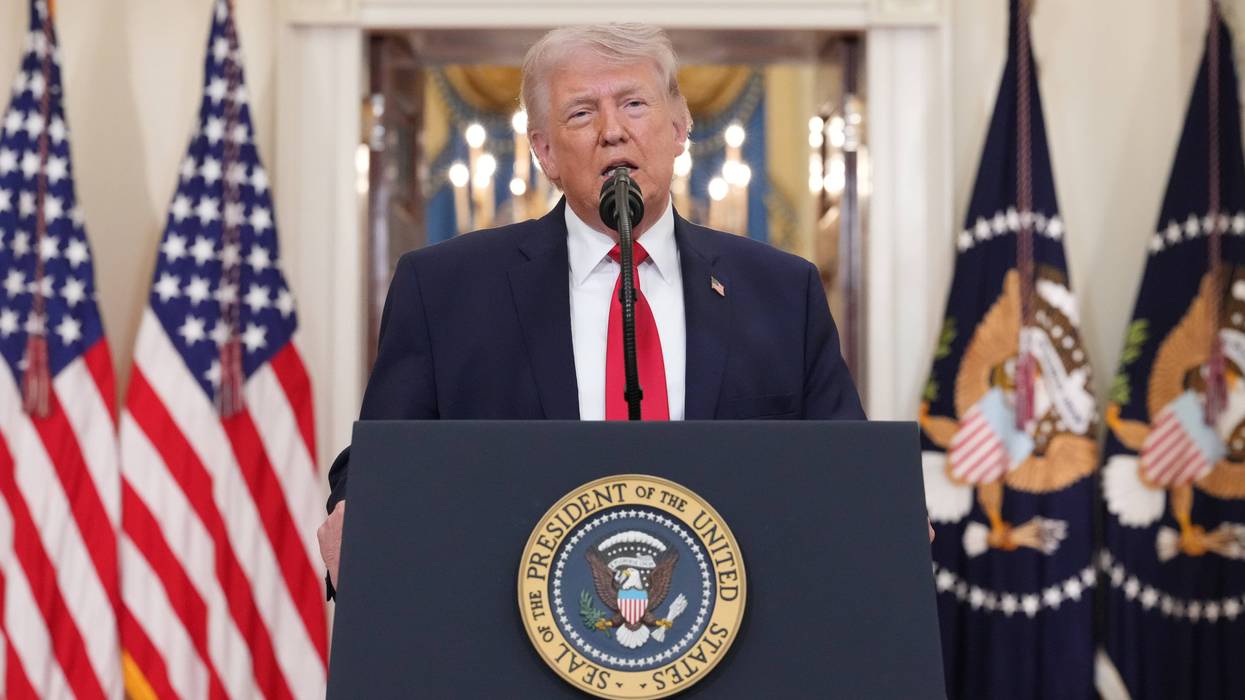
Fact-checking the bald-face lies in a morally obscene address by the most criminally corrupt and morally bankrupt US president in the history of the nation.
We were waist deep in the Big Muddy
The big fool said to push on
—Pete Seeger
On April Fool’s evening, the US president who has been comparing himself to Jesus Christ finally gave a speech in which he attempted to win support for his and Israel’s disastrous and failing war against Iran. He failed miserably, but his minions and military remain obedient.
Lies may have outnumbered contradictions. President Trump apparently has yet to appreciate Abraham Lincoln’s admonition that “You can’t fool all of the people all of the time.” Among others, oil and stock markets saw through the flimflam. Energy prices soared once again while stock markets from Manhattan to Manila took a dive.
One has to wonder when the billionaires behind Trump, Vance, and their mandarins will conclude that it’s time to pull the plug, to insist on US regime change via the 25th amendment, for Congress to refuse to pick up the bill, or for the generals, admirals, and troops who have tolerated Secretary Hegseth’s white nationalist cheerleading to finally say one simple word: "No."
And if they won’t, it’s up to us to end the nationally self-destructive war on Iran and the rest of the world.
Some version of textual analysis may be in order. So taking it from near the top of Trump’s teleprompter:
Warfare and battlefield victories have never been all about military hardware and muscular warriors. Knowledge of history, geography, and culture can be as if not more, decisive. Think in terms of Alexander the Great and others failing to conquer Persia, of Iran’s geographical advantages along the Strait of Hormuz, the power of Persian nationalism, and resistance to Crusader Christianity that have endured across the ages.
On the subject of safety Trump seems to have forgotten that back in June he claimed that US and Israeli air strikes had “obliterated” Iran’s nuclear program. Further evidence of his short-term memory loss or historic dishonesty—take your pick. His refusal to read his intelligence briefings may be one reason he didn’t honor the intelligence community’s conclusion that Iran posed no imminent threat to the United States. And recall that the Oman mediators of the Witkoff/Kushner-Iranian February negotiations reported that significant progress had been made and that an agreement was in reach. That was the before our Dear Leader launched a war for the second time in a matter of months while in the midst of peace and disarmament negotiations.
Each of the other eight nuclear weapons states have made such preparations and threats at least once. There are, in fact, no good hands to hold nuclear weapons. And as Japan’s survivors of US atomic weapons warn us: "human beings and nuclear weapons cannot coexist.”
If we are on the verge of winning, why the need to escalate the war? Is “them” the majority of the Iranian people who oppose but have not yet been able to remove their unrepresentative and repressive government?
Regime change has failed. History has demonstrated you can’t bomb a country into regime change. Iran’s highly enriched uranium is inaccessible to an invading military. Aerial destruction of Iran’s oil infrastructure and desalinization plants will result in tit for tat destruction of Saudi and GCC infrastructures. And destroying desalinization plants, leading to untold numbers of people dying from thirst would be among the worst possible crimes against humanity.
Finally, forget the idea of a ground war. Sending in the Marines and Special Forces to seize Iran’s oil and gas infrastructure or to dig for Tehran’s highly enriched uranium will leave US forces vulnerable, sitting ducks for Iran’s drones and remaining missiles in something worse than a quagmire.
The Big Fool is leading our nation and the world ever deeper into the desert version of the Big Muddy. Resistance and envisioning how we reconstruct constitutional democracy and our nation’s place in the world are the only ways forward.
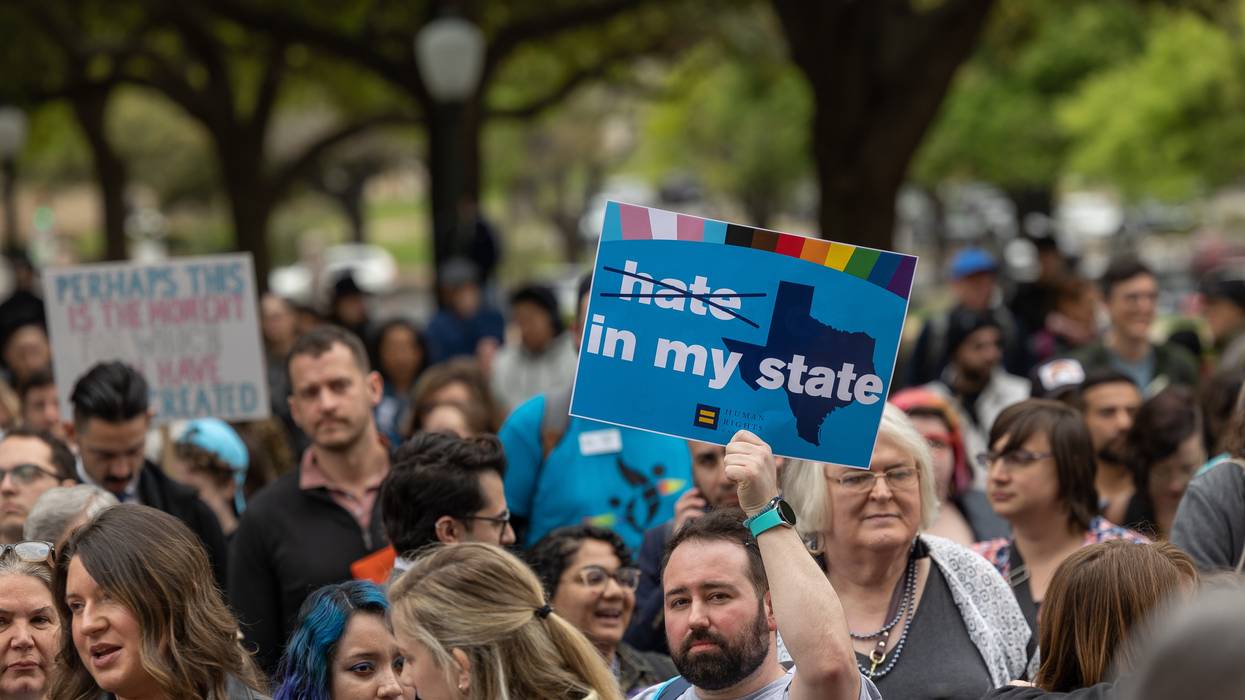
Mostly, they’re hoping you won’t notice the precedents they’re setting to take away your healthcare and invade your privacy.
It’s a distressing time to be a trans person just trying to mind your business.
This March, the Lemkin Institute for Genocide Prevention issued its third “red flag” warning about the risk of “anti-trans genocide” in the United States, warning about laws and policies designed to “criminalize” the entire trans community “based solely on its existence.”
In February, Kansas invalidated the IDs of all trans people in the state with a single day’s notice. Finally, just recently, the International Olympic Committee mandated that all persons competing in women’s events must submit to genetic screening—which will also ban all trans women and many intersex people from participating in Olympic sports.
As a trans person trying to walk my dog, pay my bills, and answer work emails in time to fold the laundry and make dinner, it’s profoundly stressful to say the least.
Dozens and dozens of peer-reviewed, scientifically valid studies in dozens of countries and contexts show that letting people make their own choices about how they live their own lives in their own bodies is very good for their well-being.
But it’s been this way for years. The tide of contemporary anti-trans legislation has grown from 2016’s famous (and failed) “bathroom bill” in North Carolina to a wave of speculative legislation funded by conservative billionaires creating division by stoking manufactured mass hysteria.
The numbers are staggering: a 668% increase in anti-trans legislation from 2021 to 2025, according to the Lemkin Institute. Since we all huddled down on our couches and started a sourdough hobby in 2020, the Institute says, we’ve had six consecutive record-breaking years in anti-trans bills introduced across the country.
But the horrors don’t stop in the legislatures.
A recent executive order banning trans people from the military calls trans people inherently dishonest and dishonorable. The US 4th Circuit Court of Appeals just ruled that states can legally compel trans adults like me to “appreciate [our] sex” by banning our access to gender-affirming healthcare. And when a Texan politician called billionaires a more dangerous 1% of the population than trans people, Secretary of Defense Pete Hegseth’s pastor said he hoped the man would be crucified.
For all the hate we’re getting these days, you’d think trans women were scooping up Olympic gold medals and firebombing suburban dog parks.
The reality is much less exciting, underwhelming even. We remain, by and large, humans with less money; less political power; and maybe more opinions on animation, philosophy, and colored hair dye than the average bear.
It’s estimated that there are less than 10 trans athletes of any gender in the entire NCAA. Only one openly trans woman has competed in the entire history of the Olympic games, and she didn’t place. In fact, the British Journal of Sports Medicine recently found no scientific evidence that trans women have a single competitive advantage over cisgender women in sports.
But dozens and dozens of peer-reviewed, scientifically valid studies in dozens of countries and contexts show that letting people make their own choices about how they live their own lives in their own bodies is very good for their well-being.
The American Medical Association, the largest association of physicians in the United States, just affirmed that hormone therapy, sex-reassignment surgeries, and other procedures that change a person’s physical sex characteristics are successful and medically necessary. These procedures have some of the lowest regret rates around: lower than hip replacements, lower than cosmetic surgeries, perhaps even lower than Harry Potter tattoos.
The people telling you to fear your trans neighbors are lying to your face and inventing a scary fantasy. Mostly, they’re hoping you won’t notice the precedents they’re setting to take away your healthcare, invade your privacy, and send you on a surprise trip to the DMV.
And if you’re a woman in sports, they’ll want your genetic data. I haven’t looked at a history book in awhile but I’m pretty sure that’s a red flag.
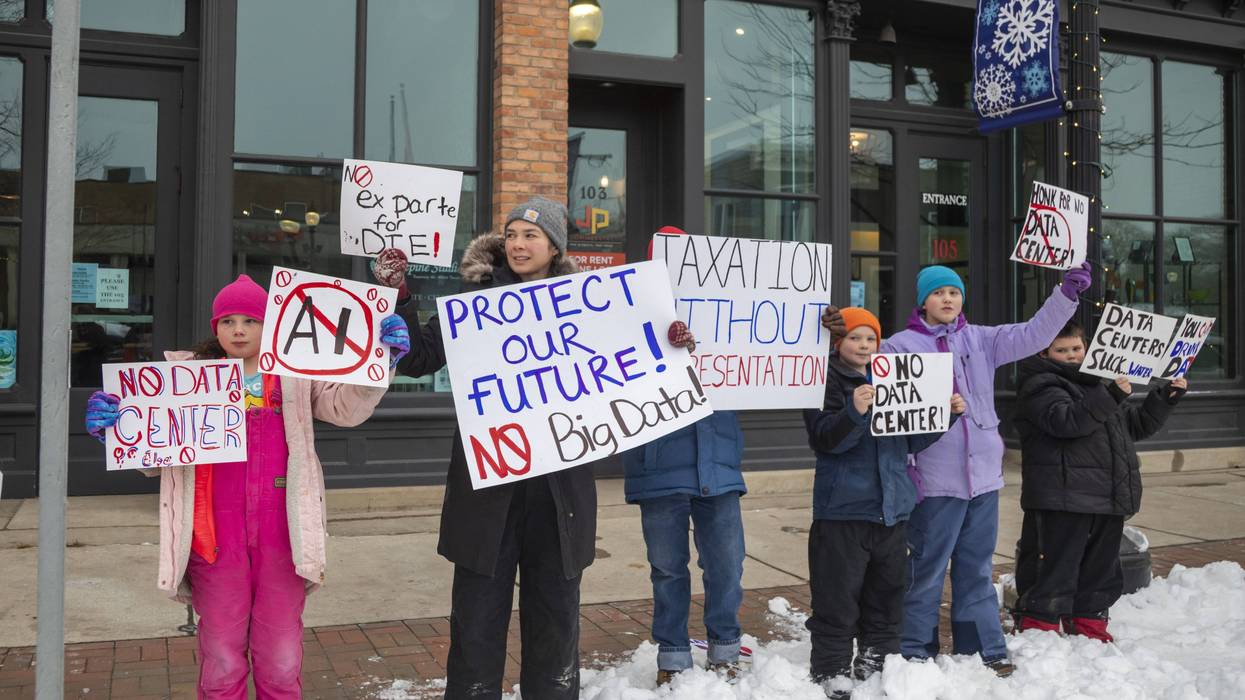
If AI is to fulfill its transformative potential, its benefits must be more equitably distributed, and its environmental costs more transparently accounted for.
Critics are buzzing about Jeff Bezos and Lauren Sánchez’s estimated $5 million Met Gala sponsorship, noting that while framed as philanthropy, it also serves as elite branding and may deliver limited benefit to the broader arts. A similar pattern appears in tech, where highly publicized giving, grants, and initiatives build brand visibility while directing relatively little to wider communities.
As an anthropologist who studies US corporations, I have seen firsthand how technology firms including Amazon, Google, and Microsoft frequently present their companies as a catalyst for economic development and employment opportunity. Large-scale initiatives are framed as serving the public interest, yet evidence reveals a persistent gap between these narratives and their material outcomes. Promised benefits such as job creation, regional development, and infrastructure investment tend to be unevenly distributed or shorter in duration than initially suggested.
Research on data centers underscores these concerns. Although construction phases generate temporary employment, long-term job creation is modest—often fewer than 200 permanent positions per facility. At the same time, AI infrastructure development places significant demands on land, energy, and water resources, and depends on extractive supply chains for minerals such as cobalt and lithium. The result is an extractive industry in which financial gains accrue primarily to tech investors, while the environmental and economic burdens are borne by local communities.
Recent projects across the United States make these dynamics visible. In Indiana, Bezos’s Amazon company cleared 1,200 acres of farmland to build an $11 billion data farm for training artificial intelligence models. In Luzerne County, Pennsylvania, Amazon bought land near a nuclear power plant by the Susquehanna River that used to be zoned for agriculture. Across the country, Gates’ Microsoft has advanced controversial data center projects despite local opposition over environmental strain, including in Michigan and Wisconsin.
Designating data centers as critical infrastructure should not exempt companies from regulatory oversight or fair contributions to the communities in which they operate.
Taken together, these cases point to the broader policy challenge of how to evaluate and govern technology infrastructure projects that are framed as public goods but function within extractive economic models.
Philanthropic initiatives often accompany these developments, shaping public perception of investors’ generosity, but leaving underlying dynamics unchanged. Bezos’ Earth Fund, for example, has directed billions toward climate-related efforts, but much of that funding supports technology that benefits his companies. Similarly, Bill Gates’ climate philanthropy has prioritized large-scale technological interventions, including proposals such as spraying sulfur dioxide into the stratosphere to dim sunlight and lower global temperatures—but scientists warn that such approaches carry significant risks for both public health and ecological systems.
Federal policy is accelerating the problem. President Donald Trump has declared a national emergency related to energy production and encouraged private investments in energy industries. Within this framework, data centers are now designated as critical to national security, given the role of AI in military and defense systems.
However, while federal policy actively courts investment, the communities hosting this infrastructure are often excluded from meaningful participation in its benefits.
At the state level, data center developers aggressively pursue and often secure substantial tax incentives as jurisdictions compete to attract investment. Indiana alone could forego up to $1 billion in tax revenue. Pennsylvania has yet to fully assess the fiscal impact of similar agreements. In Virginia and other states, data center operators are exempt from sales taxes on equipment and electricity, further reducing public returns.
The concentration of wealth and environmental burden extends beyond US borders. KoBold Metals, an AI-driven mineral exploration company backed by both Bill Gates and jeff Bezos, is expanding operations in the Democratic Republic of Congo. Using laser technology, the company seeks deposits of cobalt, copper, nickel, and lithium—materials essential to batteries and AI infrastructure. The Congo currently supplies about 76% of the world’s cobalt, placing it at the center of the global technology economy.
While such projects may generate economic opportunities, they also reproduce familiar patterns. As with data center development in the United States, claims of job creation and regional development warrant careful scrutiny, particularly in contexts marked by historical inequality and resource extraction.
Artificial intelligence and data infrastructure are now central to economic competitiveness and national security, and these priorities are legitimate. However, if AI is to fulfill its transformative potential, its benefits must be more equitably distributed, and its environmental costs more transparently accounted for. Designating data centers as critical infrastructure should not exempt companies from regulatory oversight or fair contributions to the communities in which they operate. Nor can philanthropic initiatives cloud scientists’ knowledge and recommendations.
Policy interventions are needed to rebalance these dynamics. To make the AI boom work for the public rather than just private investors, companies must fully disclose their water and energy consumption, so that communities can understand what they are giving up to big data centers. State and local governments should condition tax incentives on measurable public benefits, including a pre-set number of durable jobs and investments in local infrastructure. And voters must hold elected officials accountable—at the ballot box—for these agreements.
Additionally, mechanisms such as royalties or revenue-generating agreements—long applied in extractive industries like oil and natural gas—could ensure that communities hosting data centers receive a meaningful share of the wealth generated. While the federal government captures significant revenue tied to AI economic activity, state and local governments should, too.
If the AI sector is to gain any public legitimacy, it must take responsibility both for the technologies it develops and for the social environmental consequences of their deployment.