SUBSCRIBE TO OUR FREE NEWSLETTER
Daily news & progressive opinion—funded by the people, not the corporations—delivered straight to your inbox.
5
#000000
#FFFFFF
To donate by check, phone, or other method, see our More Ways to Give page.
Daily news & progressive opinion—funded by the people, not the corporations—delivered straight to your inbox.
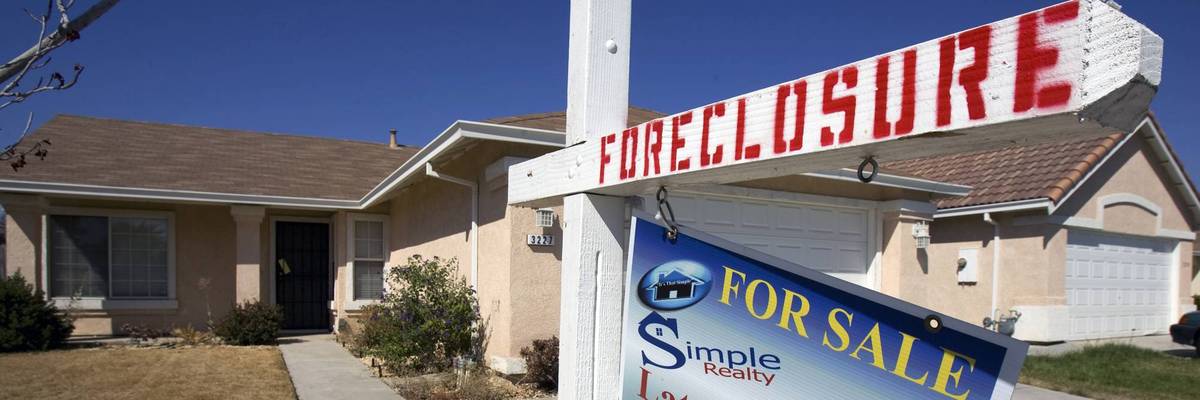
A foreclosure sign sits in front of a home in Stockton, California on June 8, 2009.
"It's a struggle. Especially with everything else being inflated in the country," said one US Army vet, "you know, with groceries, gas... I'm like, what the hell?"
Just as President Donald Trump and Republicans in Congress were warned would happen, close to 100,000 US veterans are currently behind on their mortgage payments or are in the process of foreclosure as a result of the White House's decision to shut down a Department of Veterans Affairs program that helped people with VA-backed home loans when they were behind on their monthly payments.
As NPR reported Thursday, more than 10,000 have already lost their homes, nearly a year after the Trump administration abruptly did away with the VA Servicing Purchase (VASP) program.
The program was rolled out during the Biden administration, after the VA ended a pandemic-era assistance program that had allowed VA home loan borrowers to gradually pay back mortgage payments that they had needed to skip.
Under VASP, the VA purchases home loans that were in default from mortgage services and then modified the loans.
In March 2025, a representative from the Mortgage Bankers Association told the House Veterans Affairs Committee that widespread foreclosures would result if the VASP program—which Republicans in Congress said had been created by former President Joe Biden for "political purposes... to undercut the VA Home Loan program—was not protected.
Despite the warning, the VASP program was halted two months later.
Nearly a year after the program's end, the VA is still developing a replacement to help veterans—many of whom are struggling to afford essentials just like the majority of other Americans as the cost of living crisis intensifies with rising fuel prices due to Trump's war on Iran.
Sources in the mortgage industry told NPR that many of the vets who have lost their homes so far had enough disability benefits or other income to avoid foreclosure, had the VASP program remained in operation.
NPR interviewed Leann Ledford, whose husband, a Marine veteran who served in Afghanistan, has a brain injury, experiences seizures, and suffers post-traumatic stress disorder. The family is one of tens of thousands who learned in October 2022 that the Biden administration had ended the earlier pandemic-era program and that they would have to pay a year's worth of back payments in one lump sum.
The Ledfords were also one of many veteran families who were unable to enroll in VASP before Trump abruptly shut it down.
Ledford told NPR that with her husband's $3,971 monthly disability check, they could have afforded mortgage payments under the VASP program.
Army veteran Jon Henry was also unable to enroll in VASP before it was shut down, and was forced to take a modified loan with payments that are $380 more per month than his original mortgage.
"It's a struggle," Henry told NPR. "Especially with everything else being inflated in the country, you know, with groceries, gas … I'm like, what the hell?"
NPR's reporting led Sen. Tammy Duckworth (D-Ill.), an Iraq War veteran, to denounced Trump as "the most anti-veteran president in history."
When Trump's new VA home loan assistance program is up and running—which isn't expected to happen for several more months, veterans will be able to move their missed payments to the back of their loan term. But in the current draft of the plan, reported NPR, "the VA is telling mortgage companies that if a new, modified loan at a higher interest rate only raises a veteran's monthly payment by up to 15%, they must place vets into that more costly loan."
"So a veteran with a $2,000 monthly mortgage payment could still be pushed into a modified loan that raises their payment by up to $300 a month. And they wouldn't be given the option of moving their missed payments to the back of their loan and keeping their original, lower-cost mortgage," reported the outlet.
Pete Mills of the Mortgage Bankers Association told the VA last month that under Trump's plan, "as drafted, veterans will continue to have worse options than similarly situated non-veterans."
Dear Common Dreams reader, It’s been nearly 30 years since I co-founded Common Dreams with my late wife, Lina Newhouser. We had the radical notion that journalism should serve the public good, not corporate profits. It was clear to us from the outset what it would take to build such a project. No paid advertisements. No corporate sponsors. No millionaire publisher telling us what to think or do. Many people said we wouldn't last a year, but we proved those doubters wrong. Together with a tremendous team of journalists and dedicated staff, we built an independent media outlet free from the constraints of profits and corporate control. Our mission has always been simple: To inform. To inspire. To ignite change for the common good. Building Common Dreams was not easy. Our survival was never guaranteed. When you take on the most powerful forces—Wall Street greed, fossil fuel industry destruction, Big Tech lobbyists, and uber-rich oligarchs who have spent billions upon billions rigging the economy and democracy in their favor—the only bulwark you have is supporters who believe in your work. But here’s the urgent message from me today. It's never been this bad out there. And it's never been this hard to keep us going. At the very moment Common Dreams is most needed, the threats we face are intensifying. We need your support now more than ever. We don't accept corporate advertising and never will. We don't have a paywall because we don't think people should be blocked from critical news based on their ability to pay. Everything we do is funded by the donations of readers like you. When everyone does the little they can afford, we are strong. But if that support retreats or dries up, so do we. Will you donate now to make sure Common Dreams not only survives but thrives? —Craig Brown, Co-founder |
Just as President Donald Trump and Republicans in Congress were warned would happen, close to 100,000 US veterans are currently behind on their mortgage payments or are in the process of foreclosure as a result of the White House's decision to shut down a Department of Veterans Affairs program that helped people with VA-backed home loans when they were behind on their monthly payments.
As NPR reported Thursday, more than 10,000 have already lost their homes, nearly a year after the Trump administration abruptly did away with the VA Servicing Purchase (VASP) program.
The program was rolled out during the Biden administration, after the VA ended a pandemic-era assistance program that had allowed VA home loan borrowers to gradually pay back mortgage payments that they had needed to skip.
Under VASP, the VA purchases home loans that were in default from mortgage services and then modified the loans.
In March 2025, a representative from the Mortgage Bankers Association told the House Veterans Affairs Committee that widespread foreclosures would result if the VASP program—which Republicans in Congress said had been created by former President Joe Biden for "political purposes... to undercut the VA Home Loan program—was not protected.
Despite the warning, the VASP program was halted two months later.
Nearly a year after the program's end, the VA is still developing a replacement to help veterans—many of whom are struggling to afford essentials just like the majority of other Americans as the cost of living crisis intensifies with rising fuel prices due to Trump's war on Iran.
Sources in the mortgage industry told NPR that many of the vets who have lost their homes so far had enough disability benefits or other income to avoid foreclosure, had the VASP program remained in operation.
NPR interviewed Leann Ledford, whose husband, a Marine veteran who served in Afghanistan, has a brain injury, experiences seizures, and suffers post-traumatic stress disorder. The family is one of tens of thousands who learned in October 2022 that the Biden administration had ended the earlier pandemic-era program and that they would have to pay a year's worth of back payments in one lump sum.
The Ledfords were also one of many veteran families who were unable to enroll in VASP before Trump abruptly shut it down.
Ledford told NPR that with her husband's $3,971 monthly disability check, they could have afforded mortgage payments under the VASP program.
Army veteran Jon Henry was also unable to enroll in VASP before it was shut down, and was forced to take a modified loan with payments that are $380 more per month than his original mortgage.
"It's a struggle," Henry told NPR. "Especially with everything else being inflated in the country, you know, with groceries, gas … I'm like, what the hell?"
NPR's reporting led Sen. Tammy Duckworth (D-Ill.), an Iraq War veteran, to denounced Trump as "the most anti-veteran president in history."
When Trump's new VA home loan assistance program is up and running—which isn't expected to happen for several more months, veterans will be able to move their missed payments to the back of their loan term. But in the current draft of the plan, reported NPR, "the VA is telling mortgage companies that if a new, modified loan at a higher interest rate only raises a veteran's monthly payment by up to 15%, they must place vets into that more costly loan."
"So a veteran with a $2,000 monthly mortgage payment could still be pushed into a modified loan that raises their payment by up to $300 a month. And they wouldn't be given the option of moving their missed payments to the back of their loan and keeping their original, lower-cost mortgage," reported the outlet.
Pete Mills of the Mortgage Bankers Association told the VA last month that under Trump's plan, "as drafted, veterans will continue to have worse options than similarly situated non-veterans."
Just as President Donald Trump and Republicans in Congress were warned would happen, close to 100,000 US veterans are currently behind on their mortgage payments or are in the process of foreclosure as a result of the White House's decision to shut down a Department of Veterans Affairs program that helped people with VA-backed home loans when they were behind on their monthly payments.
As NPR reported Thursday, more than 10,000 have already lost their homes, nearly a year after the Trump administration abruptly did away with the VA Servicing Purchase (VASP) program.
The program was rolled out during the Biden administration, after the VA ended a pandemic-era assistance program that had allowed VA home loan borrowers to gradually pay back mortgage payments that they had needed to skip.
Under VASP, the VA purchases home loans that were in default from mortgage services and then modified the loans.
In March 2025, a representative from the Mortgage Bankers Association told the House Veterans Affairs Committee that widespread foreclosures would result if the VASP program—which Republicans in Congress said had been created by former President Joe Biden for "political purposes... to undercut the VA Home Loan program—was not protected.
Despite the warning, the VASP program was halted two months later.
Nearly a year after the program's end, the VA is still developing a replacement to help veterans—many of whom are struggling to afford essentials just like the majority of other Americans as the cost of living crisis intensifies with rising fuel prices due to Trump's war on Iran.
Sources in the mortgage industry told NPR that many of the vets who have lost their homes so far had enough disability benefits or other income to avoid foreclosure, had the VASP program remained in operation.
NPR interviewed Leann Ledford, whose husband, a Marine veteran who served in Afghanistan, has a brain injury, experiences seizures, and suffers post-traumatic stress disorder. The family is one of tens of thousands who learned in October 2022 that the Biden administration had ended the earlier pandemic-era program and that they would have to pay a year's worth of back payments in one lump sum.
The Ledfords were also one of many veteran families who were unable to enroll in VASP before Trump abruptly shut it down.
Ledford told NPR that with her husband's $3,971 monthly disability check, they could have afforded mortgage payments under the VASP program.
Army veteran Jon Henry was also unable to enroll in VASP before it was shut down, and was forced to take a modified loan with payments that are $380 more per month than his original mortgage.
"It's a struggle," Henry told NPR. "Especially with everything else being inflated in the country, you know, with groceries, gas … I'm like, what the hell?"
NPR's reporting led Sen. Tammy Duckworth (D-Ill.), an Iraq War veteran, to denounced Trump as "the most anti-veteran president in history."
When Trump's new VA home loan assistance program is up and running—which isn't expected to happen for several more months, veterans will be able to move their missed payments to the back of their loan term. But in the current draft of the plan, reported NPR, "the VA is telling mortgage companies that if a new, modified loan at a higher interest rate only raises a veteran's monthly payment by up to 15%, they must place vets into that more costly loan."
"So a veteran with a $2,000 monthly mortgage payment could still be pushed into a modified loan that raises their payment by up to $300 a month. And they wouldn't be given the option of moving their missed payments to the back of their loan and keeping their original, lower-cost mortgage," reported the outlet.
Pete Mills of the Mortgage Bankers Association told the VA last month that under Trump's plan, "as drafted, veterans will continue to have worse options than similarly situated non-veterans."