SUBSCRIBE TO OUR FREE NEWSLETTER
Daily news & progressive opinion—funded by the people, not the corporations—delivered straight to your inbox.
5
#000000
#FFFFFF
To donate by check, phone, or other method, see our More Ways to Give page.
Daily news & progressive opinion—funded by the people, not the corporations—delivered straight to your inbox.
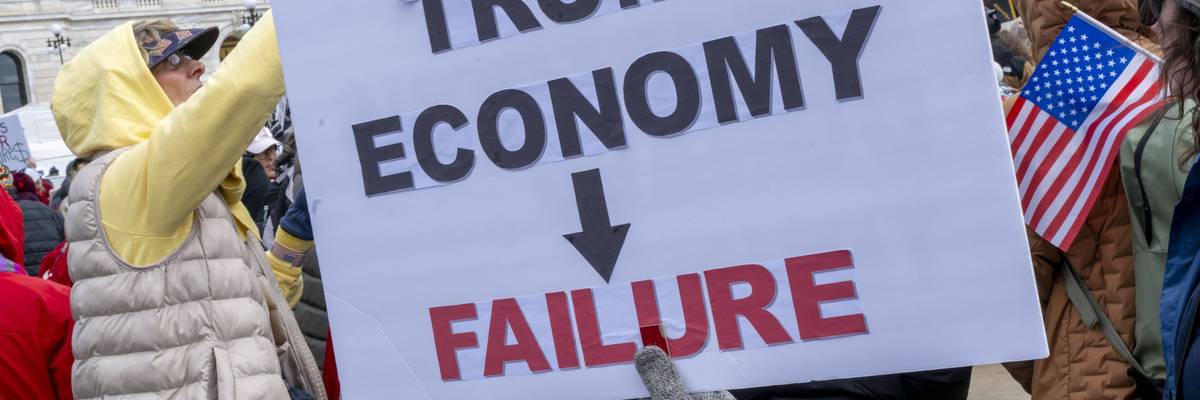
A protester carries a sign calling the economy under President Donald Trump a "failure" during a No Kings rally in Saint Paul, Minnesota on March 28, 2026.
"The latest jobs data show how President Trump's mismanagement of the economy—both domestically and internationally—is harming workers at home," said another expert.
As US Labor Secretary Lori Chavez-DeRemer on Friday declared that "America's economic comeback is on full display" and the country's "workers are winning again" due to what the business press and top newspapers called a "strong" March jobs report, some economists stressed the importance of looking beyond the topline figure and one month of data.
The US Bureau of Labor Statistics announced that employers added 178,000 jobs last month, with gains in construction, healthcare, and transportation and warehousing, and declines in the federal government. The unemployment rate fell slightly to 4.3%, with 7.2 million people officially jobless.
"Folks, today's jobs report is not good," declared Heidi Shierholz, president of the think tank Economic Policy Institute (EPI). She pointed to average job growth over the past two months, the reason for the drop in unemployment ("people leaving the labor force"), slowing wage growth, and the fact that "the effects of our war in Iran aren't even in these numbers yet."
EPI senior economist Elise Gould further explained those points on social media. Although the report "came in stronger than expected... much of the gain was a bounce back to February declines (now a loss of 133,000 jobs)," she said. "As a result, average monthly growth the last two months was only 22,500 jobs."
As far as the unemployment rate ticking down, "it's important to note that this happened for the 'wrong' reasons as both the labor force participation and the share of the population with a job also ticked down," Gould continued. "Job gains were strongest in healthcare as striking workers returned to work."
"Attacks on the federal workforce continue," she highlighted, with the sector down 18,000 jobs in March and 352,000 positions since January 2025, when President Donald returned to power. "The vital services federal employees provide cannot be done without these essential workers. The cost of these losses are only just beginning."
"Manufacturing rose 15,000 jobs in March, but still has a huge deficit since Trump took office. Since January 2025, the manufacturing sector has lost 82,000 jobs," the economist noted. "Wage growth has been slowing for the last few months, particularly driven by slower growth for production and nonsupervisory workers, roughly the lower 82% of the workforce."
Gould added that "we don't have the inflation data yet to show real wage changes in March, but slowing nominal wage growth coupled with rising prices from the Iran war almost surely means real wages will suffer, contributing to worsening affordability."
Trump and Israel launched their war on Iran at the end of February, and the new data is from the middle of March, so "the impact of the war and higher fuel prices will be limited" in this report, as Center for Economic and Policy Research co-founder Dean Baker acknowledged. "April could look considerably worse."
Breyon Williams, chief economist at another think tank, Groundwork Collaborative, said that "beyond today's headline bounce, the labor market continues to deteriorate under Trump's economic mismanagement: Hiring has ground to a halt, paychecks are shrinking, and workers are giving up on finding a job altogether. A single month of modest gains can't reverse the damage that the president has inflicted on working families."
A former senior Labor Department official who's now chief of policy programs at The Century Foundation, Angela Hanks, similarly asserted that "the latest jobs data show how President Trump's mismanagement of the economy—both domestically and internationally—is harming workers at home."
"While the topline rate does not yet reflect the war's impact on the job market, wage growth has stalled, and oil prices are skyrocketing, resulting in higher prices for consumers and threatening to weaken the job market," she noted. Specifically, according to a Thursday report from Democratic members of the congressional Joint Economic Committee, Americans spent an extra $8.4 billion at the gas pump in the first month of Trump's war.
"Families are already under tremendous pressure from rising prices, slowing job growth, and mounting debt as they struggle to make ends meet, and not seeing help on the way," said Hanks. "Families and workers across the country deserve leadership that puts them first and works to make living a fulfilling life affordable for everyone. Instead, they're stuck with leaders in Washington more focused on needless and damaging wars and slashing the safety net to pay for them."
After passing a 2025 budget package that gave the rich more tax breaks by slashing over $1 trillion from the safety net, including food assistance and Medicaid—which is expected to leave millions of Americans without health insurance—congressional Republicans are considering more healthcare cuts to fund Trump's war. The Pentagon has asked for at least $200 billion for Iran, and more broadly, the president wants an unprecedented $1.5 trillion in military spending for the next fiscal year.
Dear Common Dreams reader, It’s been nearly 30 years since I co-founded Common Dreams with my late wife, Lina Newhouser. We had the radical notion that journalism should serve the public good, not corporate profits. It was clear to us from the outset what it would take to build such a project. No paid advertisements. No corporate sponsors. No millionaire publisher telling us what to think or do. Many people said we wouldn't last a year, but we proved those doubters wrong. Together with a tremendous team of journalists and dedicated staff, we built an independent media outlet free from the constraints of profits and corporate control. Our mission has always been simple: To inform. To inspire. To ignite change for the common good. Building Common Dreams was not easy. Our survival was never guaranteed. When you take on the most powerful forces—Wall Street greed, fossil fuel industry destruction, Big Tech lobbyists, and uber-rich oligarchs who have spent billions upon billions rigging the economy and democracy in their favor—the only bulwark you have is supporters who believe in your work. But here’s the urgent message from me today. It's never been this bad out there. And it's never been this hard to keep us going. At the very moment Common Dreams is most needed, the threats we face are intensifying. We need your support now more than ever. We don't accept corporate advertising and never will. We don't have a paywall because we don't think people should be blocked from critical news based on their ability to pay. Everything we do is funded by the donations of readers like you. When everyone does the little they can afford, we are strong. But if that support retreats or dries up, so do we. Will you donate now to make sure Common Dreams not only survives but thrives? —Craig Brown, Co-founder |
As US Labor Secretary Lori Chavez-DeRemer on Friday declared that "America's economic comeback is on full display" and the country's "workers are winning again" due to what the business press and top newspapers called a "strong" March jobs report, some economists stressed the importance of looking beyond the topline figure and one month of data.
The US Bureau of Labor Statistics announced that employers added 178,000 jobs last month, with gains in construction, healthcare, and transportation and warehousing, and declines in the federal government. The unemployment rate fell slightly to 4.3%, with 7.2 million people officially jobless.
"Folks, today's jobs report is not good," declared Heidi Shierholz, president of the think tank Economic Policy Institute (EPI). She pointed to average job growth over the past two months, the reason for the drop in unemployment ("people leaving the labor force"), slowing wage growth, and the fact that "the effects of our war in Iran aren't even in these numbers yet."
EPI senior economist Elise Gould further explained those points on social media. Although the report "came in stronger than expected... much of the gain was a bounce back to February declines (now a loss of 133,000 jobs)," she said. "As a result, average monthly growth the last two months was only 22,500 jobs."
As far as the unemployment rate ticking down, "it's important to note that this happened for the 'wrong' reasons as both the labor force participation and the share of the population with a job also ticked down," Gould continued. "Job gains were strongest in healthcare as striking workers returned to work."
"Attacks on the federal workforce continue," she highlighted, with the sector down 18,000 jobs in March and 352,000 positions since January 2025, when President Donald returned to power. "The vital services federal employees provide cannot be done without these essential workers. The cost of these losses are only just beginning."
"Manufacturing rose 15,000 jobs in March, but still has a huge deficit since Trump took office. Since January 2025, the manufacturing sector has lost 82,000 jobs," the economist noted. "Wage growth has been slowing for the last few months, particularly driven by slower growth for production and nonsupervisory workers, roughly the lower 82% of the workforce."
Gould added that "we don't have the inflation data yet to show real wage changes in March, but slowing nominal wage growth coupled with rising prices from the Iran war almost surely means real wages will suffer, contributing to worsening affordability."
Trump and Israel launched their war on Iran at the end of February, and the new data is from the middle of March, so "the impact of the war and higher fuel prices will be limited" in this report, as Center for Economic and Policy Research co-founder Dean Baker acknowledged. "April could look considerably worse."
Breyon Williams, chief economist at another think tank, Groundwork Collaborative, said that "beyond today's headline bounce, the labor market continues to deteriorate under Trump's economic mismanagement: Hiring has ground to a halt, paychecks are shrinking, and workers are giving up on finding a job altogether. A single month of modest gains can't reverse the damage that the president has inflicted on working families."
A former senior Labor Department official who's now chief of policy programs at The Century Foundation, Angela Hanks, similarly asserted that "the latest jobs data show how President Trump's mismanagement of the economy—both domestically and internationally—is harming workers at home."
"While the topline rate does not yet reflect the war's impact on the job market, wage growth has stalled, and oil prices are skyrocketing, resulting in higher prices for consumers and threatening to weaken the job market," she noted. Specifically, according to a Thursday report from Democratic members of the congressional Joint Economic Committee, Americans spent an extra $8.4 billion at the gas pump in the first month of Trump's war.
"Families are already under tremendous pressure from rising prices, slowing job growth, and mounting debt as they struggle to make ends meet, and not seeing help on the way," said Hanks. "Families and workers across the country deserve leadership that puts them first and works to make living a fulfilling life affordable for everyone. Instead, they're stuck with leaders in Washington more focused on needless and damaging wars and slashing the safety net to pay for them."
After passing a 2025 budget package that gave the rich more tax breaks by slashing over $1 trillion from the safety net, including food assistance and Medicaid—which is expected to leave millions of Americans without health insurance—congressional Republicans are considering more healthcare cuts to fund Trump's war. The Pentagon has asked for at least $200 billion for Iran, and more broadly, the president wants an unprecedented $1.5 trillion in military spending for the next fiscal year.
As US Labor Secretary Lori Chavez-DeRemer on Friday declared that "America's economic comeback is on full display" and the country's "workers are winning again" due to what the business press and top newspapers called a "strong" March jobs report, some economists stressed the importance of looking beyond the topline figure and one month of data.
The US Bureau of Labor Statistics announced that employers added 178,000 jobs last month, with gains in construction, healthcare, and transportation and warehousing, and declines in the federal government. The unemployment rate fell slightly to 4.3%, with 7.2 million people officially jobless.
"Folks, today's jobs report is not good," declared Heidi Shierholz, president of the think tank Economic Policy Institute (EPI). She pointed to average job growth over the past two months, the reason for the drop in unemployment ("people leaving the labor force"), slowing wage growth, and the fact that "the effects of our war in Iran aren't even in these numbers yet."
EPI senior economist Elise Gould further explained those points on social media. Although the report "came in stronger than expected... much of the gain was a bounce back to February declines (now a loss of 133,000 jobs)," she said. "As a result, average monthly growth the last two months was only 22,500 jobs."
As far as the unemployment rate ticking down, "it's important to note that this happened for the 'wrong' reasons as both the labor force participation and the share of the population with a job also ticked down," Gould continued. "Job gains were strongest in healthcare as striking workers returned to work."
"Attacks on the federal workforce continue," she highlighted, with the sector down 18,000 jobs in March and 352,000 positions since January 2025, when President Donald returned to power. "The vital services federal employees provide cannot be done without these essential workers. The cost of these losses are only just beginning."
"Manufacturing rose 15,000 jobs in March, but still has a huge deficit since Trump took office. Since January 2025, the manufacturing sector has lost 82,000 jobs," the economist noted. "Wage growth has been slowing for the last few months, particularly driven by slower growth for production and nonsupervisory workers, roughly the lower 82% of the workforce."
Gould added that "we don't have the inflation data yet to show real wage changes in March, but slowing nominal wage growth coupled with rising prices from the Iran war almost surely means real wages will suffer, contributing to worsening affordability."
Trump and Israel launched their war on Iran at the end of February, and the new data is from the middle of March, so "the impact of the war and higher fuel prices will be limited" in this report, as Center for Economic and Policy Research co-founder Dean Baker acknowledged. "April could look considerably worse."
Breyon Williams, chief economist at another think tank, Groundwork Collaborative, said that "beyond today's headline bounce, the labor market continues to deteriorate under Trump's economic mismanagement: Hiring has ground to a halt, paychecks are shrinking, and workers are giving up on finding a job altogether. A single month of modest gains can't reverse the damage that the president has inflicted on working families."
A former senior Labor Department official who's now chief of policy programs at The Century Foundation, Angela Hanks, similarly asserted that "the latest jobs data show how President Trump's mismanagement of the economy—both domestically and internationally—is harming workers at home."
"While the topline rate does not yet reflect the war's impact on the job market, wage growth has stalled, and oil prices are skyrocketing, resulting in higher prices for consumers and threatening to weaken the job market," she noted. Specifically, according to a Thursday report from Democratic members of the congressional Joint Economic Committee, Americans spent an extra $8.4 billion at the gas pump in the first month of Trump's war.
"Families are already under tremendous pressure from rising prices, slowing job growth, and mounting debt as they struggle to make ends meet, and not seeing help on the way," said Hanks. "Families and workers across the country deserve leadership that puts them first and works to make living a fulfilling life affordable for everyone. Instead, they're stuck with leaders in Washington more focused on needless and damaging wars and slashing the safety net to pay for them."
After passing a 2025 budget package that gave the rich more tax breaks by slashing over $1 trillion from the safety net, including food assistance and Medicaid—which is expected to leave millions of Americans without health insurance—congressional Republicans are considering more healthcare cuts to fund Trump's war. The Pentagon has asked for at least $200 billion for Iran, and more broadly, the president wants an unprecedented $1.5 trillion in military spending for the next fiscal year.