SUBSCRIBE TO OUR FREE NEWSLETTER
Daily news & progressive opinion—funded by the people, not the corporations—delivered straight to your inbox.
5
#000000
#FFFFFF
To donate by check, phone, or other method, see our More Ways to Give page.
Daily news & progressive opinion—funded by the people, not the corporations—delivered straight to your inbox.
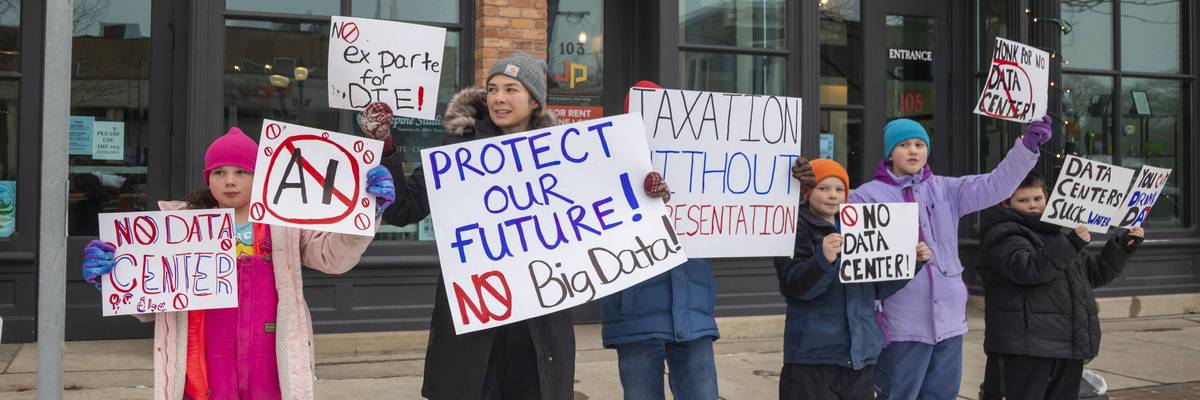
Rural Michigan residents rally against the $7 billion Stargate data center planned on southeast Michigan farm land in Saline, Michigan on December 1, 2025.
If AI is to fulfill its transformative potential, its benefits must be more equitably distributed, and its environmental costs more transparently accounted for.
Critics are buzzing about Jeff Bezos and Lauren Sánchez’s estimated $5 million Met Gala sponsorship, noting that while framed as philanthropy, it also serves as elite branding and may deliver limited benefit to the broader arts. A similar pattern appears in tech, where highly publicized giving, grants, and initiatives build brand visibility while directing relatively little to wider communities.
As an anthropologist who studies US corporations, I have seen firsthand how technology firms including Amazon, Google, and Microsoft frequently present their companies as a catalyst for economic development and employment opportunity. Large-scale initiatives are framed as serving the public interest, yet evidence reveals a persistent gap between these narratives and their material outcomes. Promised benefits such as job creation, regional development, and infrastructure investment tend to be unevenly distributed or shorter in duration than initially suggested.
Research on data centers underscores these concerns. Although construction phases generate temporary employment, long-term job creation is modest—often fewer than 200 permanent positions per facility. At the same time, AI infrastructure development places significant demands on land, energy, and water resources, and depends on extractive supply chains for minerals such as cobalt and lithium. The result is an extractive industry in which financial gains accrue primarily to tech investors, while the environmental and economic burdens are borne by local communities.
Recent projects across the United States make these dynamics visible. In Indiana, Bezos’s Amazon company cleared 1,200 acres of farmland to build an $11 billion data farm for training artificial intelligence models. In Luzerne County, Pennsylvania, Amazon bought land near a nuclear power plant by the Susquehanna River that used to be zoned for agriculture. Across the country, Gates’ Microsoft has advanced controversial data center projects despite local opposition over environmental strain, including in Michigan and Wisconsin.
Designating data centers as critical infrastructure should not exempt companies from regulatory oversight or fair contributions to the communities in which they operate.
Taken together, these cases point to the broader policy challenge of how to evaluate and govern technology infrastructure projects that are framed as public goods but function within extractive economic models.
Philanthropic initiatives often accompany these developments, shaping public perception of investors’ generosity, but leaving underlying dynamics unchanged. Bezos’ Earth Fund, for example, has directed billions toward climate-related efforts, but much of that funding supports technology that benefits his companies. Similarly, Bill Gates’ climate philanthropy has prioritized large-scale technological interventions, including proposals such as spraying sulfur dioxide into the stratosphere to dim sunlight and lower global temperatures—but scientists warn that such approaches carry significant risks for both public health and ecological systems.
Federal policy is accelerating the problem. President Donald Trump has declared a national emergency related to energy production and encouraged private investments in energy industries. Within this framework, data centers are now designated as critical to national security, given the role of AI in military and defense systems.
However, while federal policy actively courts investment, the communities hosting this infrastructure are often excluded from meaningful participation in its benefits.
At the state level, data center developers aggressively pursue and often secure substantial tax incentives as jurisdictions compete to attract investment. Indiana alone could forego up to $1 billion in tax revenue. Pennsylvania has yet to fully assess the fiscal impact of similar agreements. In Virginia and other states, data center operators are exempt from sales taxes on equipment and electricity, further reducing public returns.
The concentration of wealth and environmental burden extends beyond US borders. KoBold Metals, an AI-driven mineral exploration company backed by both Bill Gates and jeff Bezos, is expanding operations in the Democratic Republic of Congo. Using laser technology, the company seeks deposits of cobalt, copper, nickel, and lithium—materials essential to batteries and AI infrastructure. The Congo currently supplies about 76% of the world’s cobalt, placing it at the center of the global technology economy.
While such projects may generate economic opportunities, they also reproduce familiar patterns. As with data center development in the United States, claims of job creation and regional development warrant careful scrutiny, particularly in contexts marked by historical inequality and resource extraction.
Artificial intelligence and data infrastructure are now central to economic competitiveness and national security, and these priorities are legitimate. However, if AI is to fulfill its transformative potential, its benefits must be more equitably distributed, and its environmental costs more transparently accounted for. Designating data centers as critical infrastructure should not exempt companies from regulatory oversight or fair contributions to the communities in which they operate. Nor can philanthropic initiatives cloud scientists’ knowledge and recommendations.
Policy interventions are needed to rebalance these dynamics. To make the AI boom work for the public rather than just private investors, companies must fully disclose their water and energy consumption, so that communities can understand what they are giving up to big data centers. State and local governments should condition tax incentives on measurable public benefits, including a pre-set number of durable jobs and investments in local infrastructure. And voters must hold elected officials accountable—at the ballot box—for these agreements.
Additionally, mechanisms such as royalties or revenue-generating agreements—long applied in extractive industries like oil and natural gas—could ensure that communities hosting data centers receive a meaningful share of the wealth generated. While the federal government captures significant revenue tied to AI economic activity, state and local governments should, too.
If the AI sector is to gain any public legitimacy, it must take responsibility both for the technologies it develops and for the social environmental consequences of their deployment.
Dear Common Dreams reader, It’s been nearly 30 years since I co-founded Common Dreams with my late wife, Lina Newhouser. We had the radical notion that journalism should serve the public good, not corporate profits. It was clear to us from the outset what it would take to build such a project. No paid advertisements. No corporate sponsors. No millionaire publisher telling us what to think or do. Many people said we wouldn't last a year, but we proved those doubters wrong. Together with a tremendous team of journalists and dedicated staff, we built an independent media outlet free from the constraints of profits and corporate control. Our mission has always been simple: To inform. To inspire. To ignite change for the common good. Building Common Dreams was not easy. Our survival was never guaranteed. When you take on the most powerful forces—Wall Street greed, fossil fuel industry destruction, Big Tech lobbyists, and uber-rich oligarchs who have spent billions upon billions rigging the economy and democracy in their favor—the only bulwark you have is supporters who believe in your work. But here’s the urgent message from me today. It's never been this bad out there. And it's never been this hard to keep us going. At the very moment Common Dreams is most needed, the threats we face are intensifying. We need your support now more than ever. We don't accept corporate advertising and never will. We don't have a paywall because we don't think people should be blocked from critical news based on their ability to pay. Everything we do is funded by the donations of readers like you. When everyone does the little they can afford, we are strong. But if that support retreats or dries up, so do we. Will you donate now to make sure Common Dreams not only survives but thrives? —Craig Brown, Co-founder |
Critics are buzzing about Jeff Bezos and Lauren Sánchez’s estimated $5 million Met Gala sponsorship, noting that while framed as philanthropy, it also serves as elite branding and may deliver limited benefit to the broader arts. A similar pattern appears in tech, where highly publicized giving, grants, and initiatives build brand visibility while directing relatively little to wider communities.
As an anthropologist who studies US corporations, I have seen firsthand how technology firms including Amazon, Google, and Microsoft frequently present their companies as a catalyst for economic development and employment opportunity. Large-scale initiatives are framed as serving the public interest, yet evidence reveals a persistent gap between these narratives and their material outcomes. Promised benefits such as job creation, regional development, and infrastructure investment tend to be unevenly distributed or shorter in duration than initially suggested.
Research on data centers underscores these concerns. Although construction phases generate temporary employment, long-term job creation is modest—often fewer than 200 permanent positions per facility. At the same time, AI infrastructure development places significant demands on land, energy, and water resources, and depends on extractive supply chains for minerals such as cobalt and lithium. The result is an extractive industry in which financial gains accrue primarily to tech investors, while the environmental and economic burdens are borne by local communities.
Recent projects across the United States make these dynamics visible. In Indiana, Bezos’s Amazon company cleared 1,200 acres of farmland to build an $11 billion data farm for training artificial intelligence models. In Luzerne County, Pennsylvania, Amazon bought land near a nuclear power plant by the Susquehanna River that used to be zoned for agriculture. Across the country, Gates’ Microsoft has advanced controversial data center projects despite local opposition over environmental strain, including in Michigan and Wisconsin.
Designating data centers as critical infrastructure should not exempt companies from regulatory oversight or fair contributions to the communities in which they operate.
Taken together, these cases point to the broader policy challenge of how to evaluate and govern technology infrastructure projects that are framed as public goods but function within extractive economic models.
Philanthropic initiatives often accompany these developments, shaping public perception of investors’ generosity, but leaving underlying dynamics unchanged. Bezos’ Earth Fund, for example, has directed billions toward climate-related efforts, but much of that funding supports technology that benefits his companies. Similarly, Bill Gates’ climate philanthropy has prioritized large-scale technological interventions, including proposals such as spraying sulfur dioxide into the stratosphere to dim sunlight and lower global temperatures—but scientists warn that such approaches carry significant risks for both public health and ecological systems.
Federal policy is accelerating the problem. President Donald Trump has declared a national emergency related to energy production and encouraged private investments in energy industries. Within this framework, data centers are now designated as critical to national security, given the role of AI in military and defense systems.
However, while federal policy actively courts investment, the communities hosting this infrastructure are often excluded from meaningful participation in its benefits.
At the state level, data center developers aggressively pursue and often secure substantial tax incentives as jurisdictions compete to attract investment. Indiana alone could forego up to $1 billion in tax revenue. Pennsylvania has yet to fully assess the fiscal impact of similar agreements. In Virginia and other states, data center operators are exempt from sales taxes on equipment and electricity, further reducing public returns.
The concentration of wealth and environmental burden extends beyond US borders. KoBold Metals, an AI-driven mineral exploration company backed by both Bill Gates and jeff Bezos, is expanding operations in the Democratic Republic of Congo. Using laser technology, the company seeks deposits of cobalt, copper, nickel, and lithium—materials essential to batteries and AI infrastructure. The Congo currently supplies about 76% of the world’s cobalt, placing it at the center of the global technology economy.
While such projects may generate economic opportunities, they also reproduce familiar patterns. As with data center development in the United States, claims of job creation and regional development warrant careful scrutiny, particularly in contexts marked by historical inequality and resource extraction.
Artificial intelligence and data infrastructure are now central to economic competitiveness and national security, and these priorities are legitimate. However, if AI is to fulfill its transformative potential, its benefits must be more equitably distributed, and its environmental costs more transparently accounted for. Designating data centers as critical infrastructure should not exempt companies from regulatory oversight or fair contributions to the communities in which they operate. Nor can philanthropic initiatives cloud scientists’ knowledge and recommendations.
Policy interventions are needed to rebalance these dynamics. To make the AI boom work for the public rather than just private investors, companies must fully disclose their water and energy consumption, so that communities can understand what they are giving up to big data centers. State and local governments should condition tax incentives on measurable public benefits, including a pre-set number of durable jobs and investments in local infrastructure. And voters must hold elected officials accountable—at the ballot box—for these agreements.
Additionally, mechanisms such as royalties or revenue-generating agreements—long applied in extractive industries like oil and natural gas—could ensure that communities hosting data centers receive a meaningful share of the wealth generated. While the federal government captures significant revenue tied to AI economic activity, state and local governments should, too.
If the AI sector is to gain any public legitimacy, it must take responsibility both for the technologies it develops and for the social environmental consequences of their deployment.
Critics are buzzing about Jeff Bezos and Lauren Sánchez’s estimated $5 million Met Gala sponsorship, noting that while framed as philanthropy, it also serves as elite branding and may deliver limited benefit to the broader arts. A similar pattern appears in tech, where highly publicized giving, grants, and initiatives build brand visibility while directing relatively little to wider communities.
As an anthropologist who studies US corporations, I have seen firsthand how technology firms including Amazon, Google, and Microsoft frequently present their companies as a catalyst for economic development and employment opportunity. Large-scale initiatives are framed as serving the public interest, yet evidence reveals a persistent gap between these narratives and their material outcomes. Promised benefits such as job creation, regional development, and infrastructure investment tend to be unevenly distributed or shorter in duration than initially suggested.
Research on data centers underscores these concerns. Although construction phases generate temporary employment, long-term job creation is modest—often fewer than 200 permanent positions per facility. At the same time, AI infrastructure development places significant demands on land, energy, and water resources, and depends on extractive supply chains for minerals such as cobalt and lithium. The result is an extractive industry in which financial gains accrue primarily to tech investors, while the environmental and economic burdens are borne by local communities.
Recent projects across the United States make these dynamics visible. In Indiana, Bezos’s Amazon company cleared 1,200 acres of farmland to build an $11 billion data farm for training artificial intelligence models. In Luzerne County, Pennsylvania, Amazon bought land near a nuclear power plant by the Susquehanna River that used to be zoned for agriculture. Across the country, Gates’ Microsoft has advanced controversial data center projects despite local opposition over environmental strain, including in Michigan and Wisconsin.
Designating data centers as critical infrastructure should not exempt companies from regulatory oversight or fair contributions to the communities in which they operate.
Taken together, these cases point to the broader policy challenge of how to evaluate and govern technology infrastructure projects that are framed as public goods but function within extractive economic models.
Philanthropic initiatives often accompany these developments, shaping public perception of investors’ generosity, but leaving underlying dynamics unchanged. Bezos’ Earth Fund, for example, has directed billions toward climate-related efforts, but much of that funding supports technology that benefits his companies. Similarly, Bill Gates’ climate philanthropy has prioritized large-scale technological interventions, including proposals such as spraying sulfur dioxide into the stratosphere to dim sunlight and lower global temperatures—but scientists warn that such approaches carry significant risks for both public health and ecological systems.
Federal policy is accelerating the problem. President Donald Trump has declared a national emergency related to energy production and encouraged private investments in energy industries. Within this framework, data centers are now designated as critical to national security, given the role of AI in military and defense systems.
However, while federal policy actively courts investment, the communities hosting this infrastructure are often excluded from meaningful participation in its benefits.
At the state level, data center developers aggressively pursue and often secure substantial tax incentives as jurisdictions compete to attract investment. Indiana alone could forego up to $1 billion in tax revenue. Pennsylvania has yet to fully assess the fiscal impact of similar agreements. In Virginia and other states, data center operators are exempt from sales taxes on equipment and electricity, further reducing public returns.
The concentration of wealth and environmental burden extends beyond US borders. KoBold Metals, an AI-driven mineral exploration company backed by both Bill Gates and jeff Bezos, is expanding operations in the Democratic Republic of Congo. Using laser technology, the company seeks deposits of cobalt, copper, nickel, and lithium—materials essential to batteries and AI infrastructure. The Congo currently supplies about 76% of the world’s cobalt, placing it at the center of the global technology economy.
While such projects may generate economic opportunities, they also reproduce familiar patterns. As with data center development in the United States, claims of job creation and regional development warrant careful scrutiny, particularly in contexts marked by historical inequality and resource extraction.
Artificial intelligence and data infrastructure are now central to economic competitiveness and national security, and these priorities are legitimate. However, if AI is to fulfill its transformative potential, its benefits must be more equitably distributed, and its environmental costs more transparently accounted for. Designating data centers as critical infrastructure should not exempt companies from regulatory oversight or fair contributions to the communities in which they operate. Nor can philanthropic initiatives cloud scientists’ knowledge and recommendations.
Policy interventions are needed to rebalance these dynamics. To make the AI boom work for the public rather than just private investors, companies must fully disclose their water and energy consumption, so that communities can understand what they are giving up to big data centers. State and local governments should condition tax incentives on measurable public benefits, including a pre-set number of durable jobs and investments in local infrastructure. And voters must hold elected officials accountable—at the ballot box—for these agreements.
Additionally, mechanisms such as royalties or revenue-generating agreements—long applied in extractive industries like oil and natural gas—could ensure that communities hosting data centers receive a meaningful share of the wealth generated. While the federal government captures significant revenue tied to AI economic activity, state and local governments should, too.
If the AI sector is to gain any public legitimacy, it must take responsibility both for the technologies it develops and for the social environmental consequences of their deployment.