SUBSCRIBE TO OUR FREE NEWSLETTER
Daily news & progressive opinion—funded by the people, not the corporations—delivered straight to your inbox.
5
#000000
#FFFFFF
To donate by check, phone, or other method, see our More Ways to Give page.
Daily news & progressive opinion—funded by the people, not the corporations—delivered straight to your inbox.
The fossil fuel industry is funding fascism because they know they lose in a democracy. Young people are ready to fight for both, because we see them as inseparable.
In early 2025, Sunrise launched a campaign to make polluters pay for the effects of climate disasters. This campaign had the usual strengths: a focused message, easy to villainize targets, and real opportunities for state-level wins. It allowed us to engage the public directly following climate disasters, when attention to the climate crisis is highest.
But taking the campaign from the drawing board to the streets felt like pulling teeth. It was hard to recruit young people, bring local hubs on board, and build organic momentum. Our leadership team felt unmotivated and lethargic. Ignoring the elephant in the room of escalating fascism was getting to all of us.
In response, our leadership team came together over the summer to reevaluate and reassess the broader landscape. We watched Immigration and Customs Enforcement escalate in Los Angeles, watched as President Donald Trump broke every rule in the book and rapidly consolidated power. He was gutting the Environmental Protection Agency (EPA), dragging us back into the coal era, joking about running in 2028, and threatening to cancel elections. It became very clear that running a Make Polluters Pay campaign was like bringing a knife to a gunfight (figuratively of course).
Here’s what we realized:
From a purely emissions perspective, we were losing. We could get a few polluters to pay for cleanup costs. In some states, like California or New York, state legislation mattered a good amount. But while we were focused on state-level policy, the Trump administration was opening the Arctic National Wildlife Refuge to drilling, reversing vehicle emission standards, withdrawing from international climate agreements again, eliminating the Inflation Reduction Act’s (IRA) tax credits, and staffing the EPA with fossil fuel executives. It was changing the green economy so that there was less incentive to build wind and solar, pausing IRA-funded projects, and actively driving up pollution. We were just being outstripped.
Many of our partner organizations decided to focus on local organizing for three years in order to prepare for what we wanted to win when we won back power. However, this approach depends on stable democratic systems, and the ability to organize freely. Both of which are increasingly unrealistic based on our assessment.
First, Trump may not leave office. He’s openly discussed ignoring term limits. He’s installing loyalists throughout the military and Justice Department. Republican state legislatures are passing laws that would allow them to override election results. Trump has looked at changing ID requirements to require proof of citizenship to vote, and has gerrymandered and mandated Republican states redraw districts. Even if he personally leaves, it’s very likely that he will change the rules of the game to make it basically impossible for a Democratic trifecta to come to power—and because of our levels of polarization, that’s the starting point for climate legislation.
Second, protest is being criminalized. Anti-protest laws passed in 17 states since 2024. Sunrise itself was going to be targeted. Our infrastructure was likely to walk out of the next few years weaker, not stronger.
We need a movement that can force Trump out of office. That won’t be a single-issue movement.
As we started to explore further, it became clear the links between rising fascism and the climate crisis.
Public opinion data currently shows that people support climate action by significant margins: 65% of Americans support regulating carbon dioxide as a pollutant; 72% support transitioning to clean energy. Majorities support Green New Deal-style investments.
In a functional democracy, that should translate to legislation, easily. But our fight for Build Back Better—what later got watered down into the Inflation Reduction Act—taught us that it wasn’t that simple. The broken link—the reality that our government is more bought out by pharmaceutical companies and fossil fuels than it is accountable to everyday people—is exactly how Donald Trump won, promising to be an un-buyable strongman.
And fossil fuel companies recognized that as well. The Biden administration was a clear lesson for fossil fuels: Under a democracy, they will lose their business model. So they’ve made a calculated decision to fund authoritarianism, because under authoritarianism, they win. Fossil fuel industry donations to Trump’s 2024 campaign reached record levels. Trump promised oil executives whatever they wanted in exchange for $1 million in campaign donations. Oil executives are staffing his administration at unprecedented rates. This is fossil-fueled fascism. If we want to stop the climate crisis, we need a democracy that can’t be bought.
The final reason came down to our base and organizing. At the end of the day, Sunrise has always been by and for young people, and the reality that we saw on the ground was that young people were deeply concerned about rising authoritarianism and didn’t know what to do about it. Running a climate-only campaign under these conditions felt like we were ignoring reality. Our members had an intuitive sense that to stop climate change, we needed to stop authoritarianism first.
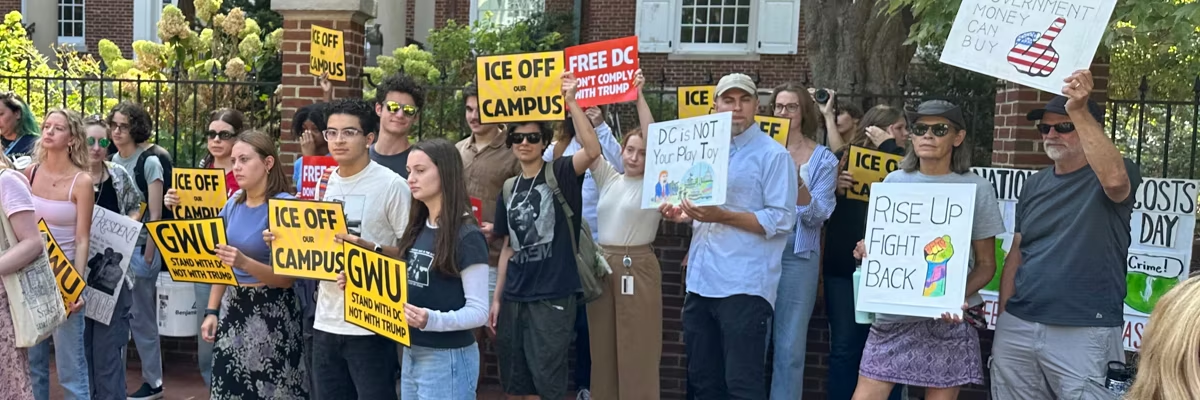
The last six months have only confirmed that instinct. Students showed up in record numbers to fight for sanctuary campuses and to stop Donald Trump’s compacts with universities. Our hotel non-cooperation campaigns went viral, and since we’ve broadened our focus, young people have increasingly come to consider Sunrise their political home.
So we made a decision: Sunrise is pivoting to end authoritarianism and win a democracy capable of addressing the climate crisis.
We’re still a climate movement, but this moment requires the acknowledgment that climate action is impossible under authoritarianism. Winning democracy is a precondition for winning climate policy. The fossil fuel industry is funding fascism because they know they lose in a democracy. Young people are ready to fight for both, because we see them as inseparable.
Our strategy is ambitious, reflecting the scale of the challenge, with three main goals:
It’s ambitious, but it’s the only path that works.
This piece was first published on the Sunrise Movement Substack.
Dear Common Dreams reader, It’s been nearly 30 years since I co-founded Common Dreams with my late wife, Lina Newhouser. We had the radical notion that journalism should serve the public good, not corporate profits. It was clear to us from the outset what it would take to build such a project. No paid advertisements. No corporate sponsors. No millionaire publisher telling us what to think or do. Many people said we wouldn't last a year, but we proved those doubters wrong. Together with a tremendous team of journalists and dedicated staff, we built an independent media outlet free from the constraints of profits and corporate control. Our mission has always been simple: To inform. To inspire. To ignite change for the common good. Building Common Dreams was not easy. Our survival was never guaranteed. When you take on the most powerful forces—Wall Street greed, fossil fuel industry destruction, Big Tech lobbyists, and uber-rich oligarchs who have spent billions upon billions rigging the economy and democracy in their favor—the only bulwark you have is supporters who believe in your work. But here’s the urgent message from me today. It's never been this bad out there. And it's never been this hard to keep us going. At the very moment Common Dreams is most needed, the threats we face are intensifying. We need your support now more than ever. We don't accept corporate advertising and never will. We don't have a paywall because we don't think people should be blocked from critical news based on their ability to pay. Everything we do is funded by the donations of readers like you. When everyone does the little they can afford, we are strong. But if that support retreats or dries up, so do we. Will you donate now to make sure Common Dreams not only survives but thrives? —Craig Brown, Co-founder |
In early 2025, Sunrise launched a campaign to make polluters pay for the effects of climate disasters. This campaign had the usual strengths: a focused message, easy to villainize targets, and real opportunities for state-level wins. It allowed us to engage the public directly following climate disasters, when attention to the climate crisis is highest.
But taking the campaign from the drawing board to the streets felt like pulling teeth. It was hard to recruit young people, bring local hubs on board, and build organic momentum. Our leadership team felt unmotivated and lethargic. Ignoring the elephant in the room of escalating fascism was getting to all of us.
In response, our leadership team came together over the summer to reevaluate and reassess the broader landscape. We watched Immigration and Customs Enforcement escalate in Los Angeles, watched as President Donald Trump broke every rule in the book and rapidly consolidated power. He was gutting the Environmental Protection Agency (EPA), dragging us back into the coal era, joking about running in 2028, and threatening to cancel elections. It became very clear that running a Make Polluters Pay campaign was like bringing a knife to a gunfight (figuratively of course).
Here’s what we realized:
From a purely emissions perspective, we were losing. We could get a few polluters to pay for cleanup costs. In some states, like California or New York, state legislation mattered a good amount. But while we were focused on state-level policy, the Trump administration was opening the Arctic National Wildlife Refuge to drilling, reversing vehicle emission standards, withdrawing from international climate agreements again, eliminating the Inflation Reduction Act’s (IRA) tax credits, and staffing the EPA with fossil fuel executives. It was changing the green economy so that there was less incentive to build wind and solar, pausing IRA-funded projects, and actively driving up pollution. We were just being outstripped.
Many of our partner organizations decided to focus on local organizing for three years in order to prepare for what we wanted to win when we won back power. However, this approach depends on stable democratic systems, and the ability to organize freely. Both of which are increasingly unrealistic based on our assessment.
First, Trump may not leave office. He’s openly discussed ignoring term limits. He’s installing loyalists throughout the military and Justice Department. Republican state legislatures are passing laws that would allow them to override election results. Trump has looked at changing ID requirements to require proof of citizenship to vote, and has gerrymandered and mandated Republican states redraw districts. Even if he personally leaves, it’s very likely that he will change the rules of the game to make it basically impossible for a Democratic trifecta to come to power—and because of our levels of polarization, that’s the starting point for climate legislation.
Second, protest is being criminalized. Anti-protest laws passed in 17 states since 2024. Sunrise itself was going to be targeted. Our infrastructure was likely to walk out of the next few years weaker, not stronger.
We need a movement that can force Trump out of office. That won’t be a single-issue movement.
As we started to explore further, it became clear the links between rising fascism and the climate crisis.
Public opinion data currently shows that people support climate action by significant margins: 65% of Americans support regulating carbon dioxide as a pollutant; 72% support transitioning to clean energy. Majorities support Green New Deal-style investments.
In a functional democracy, that should translate to legislation, easily. But our fight for Build Back Better—what later got watered down into the Inflation Reduction Act—taught us that it wasn’t that simple. The broken link—the reality that our government is more bought out by pharmaceutical companies and fossil fuels than it is accountable to everyday people—is exactly how Donald Trump won, promising to be an un-buyable strongman.
And fossil fuel companies recognized that as well. The Biden administration was a clear lesson for fossil fuels: Under a democracy, they will lose their business model. So they’ve made a calculated decision to fund authoritarianism, because under authoritarianism, they win. Fossil fuel industry donations to Trump’s 2024 campaign reached record levels. Trump promised oil executives whatever they wanted in exchange for $1 million in campaign donations. Oil executives are staffing his administration at unprecedented rates. This is fossil-fueled fascism. If we want to stop the climate crisis, we need a democracy that can’t be bought.
The final reason came down to our base and organizing. At the end of the day, Sunrise has always been by and for young people, and the reality that we saw on the ground was that young people were deeply concerned about rising authoritarianism and didn’t know what to do about it. Running a climate-only campaign under these conditions felt like we were ignoring reality. Our members had an intuitive sense that to stop climate change, we needed to stop authoritarianism first.
The last six months have only confirmed that instinct. Students showed up in record numbers to fight for sanctuary campuses and to stop Donald Trump’s compacts with universities. Our hotel non-cooperation campaigns went viral, and since we’ve broadened our focus, young people have increasingly come to consider Sunrise their political home.
So we made a decision: Sunrise is pivoting to end authoritarianism and win a democracy capable of addressing the climate crisis.
We’re still a climate movement, but this moment requires the acknowledgment that climate action is impossible under authoritarianism. Winning democracy is a precondition for winning climate policy. The fossil fuel industry is funding fascism because they know they lose in a democracy. Young people are ready to fight for both, because we see them as inseparable.
Our strategy is ambitious, reflecting the scale of the challenge, with three main goals:
It’s ambitious, but it’s the only path that works.
This piece was first published on the Sunrise Movement Substack.
In early 2025, Sunrise launched a campaign to make polluters pay for the effects of climate disasters. This campaign had the usual strengths: a focused message, easy to villainize targets, and real opportunities for state-level wins. It allowed us to engage the public directly following climate disasters, when attention to the climate crisis is highest.
But taking the campaign from the drawing board to the streets felt like pulling teeth. It was hard to recruit young people, bring local hubs on board, and build organic momentum. Our leadership team felt unmotivated and lethargic. Ignoring the elephant in the room of escalating fascism was getting to all of us.
In response, our leadership team came together over the summer to reevaluate and reassess the broader landscape. We watched Immigration and Customs Enforcement escalate in Los Angeles, watched as President Donald Trump broke every rule in the book and rapidly consolidated power. He was gutting the Environmental Protection Agency (EPA), dragging us back into the coal era, joking about running in 2028, and threatening to cancel elections. It became very clear that running a Make Polluters Pay campaign was like bringing a knife to a gunfight (figuratively of course).
Here’s what we realized:
From a purely emissions perspective, we were losing. We could get a few polluters to pay for cleanup costs. In some states, like California or New York, state legislation mattered a good amount. But while we were focused on state-level policy, the Trump administration was opening the Arctic National Wildlife Refuge to drilling, reversing vehicle emission standards, withdrawing from international climate agreements again, eliminating the Inflation Reduction Act’s (IRA) tax credits, and staffing the EPA with fossil fuel executives. It was changing the green economy so that there was less incentive to build wind and solar, pausing IRA-funded projects, and actively driving up pollution. We were just being outstripped.
Many of our partner organizations decided to focus on local organizing for three years in order to prepare for what we wanted to win when we won back power. However, this approach depends on stable democratic systems, and the ability to organize freely. Both of which are increasingly unrealistic based on our assessment.
First, Trump may not leave office. He’s openly discussed ignoring term limits. He’s installing loyalists throughout the military and Justice Department. Republican state legislatures are passing laws that would allow them to override election results. Trump has looked at changing ID requirements to require proof of citizenship to vote, and has gerrymandered and mandated Republican states redraw districts. Even if he personally leaves, it’s very likely that he will change the rules of the game to make it basically impossible for a Democratic trifecta to come to power—and because of our levels of polarization, that’s the starting point for climate legislation.
Second, protest is being criminalized. Anti-protest laws passed in 17 states since 2024. Sunrise itself was going to be targeted. Our infrastructure was likely to walk out of the next few years weaker, not stronger.
We need a movement that can force Trump out of office. That won’t be a single-issue movement.
As we started to explore further, it became clear the links between rising fascism and the climate crisis.
Public opinion data currently shows that people support climate action by significant margins: 65% of Americans support regulating carbon dioxide as a pollutant; 72% support transitioning to clean energy. Majorities support Green New Deal-style investments.
In a functional democracy, that should translate to legislation, easily. But our fight for Build Back Better—what later got watered down into the Inflation Reduction Act—taught us that it wasn’t that simple. The broken link—the reality that our government is more bought out by pharmaceutical companies and fossil fuels than it is accountable to everyday people—is exactly how Donald Trump won, promising to be an un-buyable strongman.
And fossil fuel companies recognized that as well. The Biden administration was a clear lesson for fossil fuels: Under a democracy, they will lose their business model. So they’ve made a calculated decision to fund authoritarianism, because under authoritarianism, they win. Fossil fuel industry donations to Trump’s 2024 campaign reached record levels. Trump promised oil executives whatever they wanted in exchange for $1 million in campaign donations. Oil executives are staffing his administration at unprecedented rates. This is fossil-fueled fascism. If we want to stop the climate crisis, we need a democracy that can’t be bought.
The final reason came down to our base and organizing. At the end of the day, Sunrise has always been by and for young people, and the reality that we saw on the ground was that young people were deeply concerned about rising authoritarianism and didn’t know what to do about it. Running a climate-only campaign under these conditions felt like we were ignoring reality. Our members had an intuitive sense that to stop climate change, we needed to stop authoritarianism first.
The last six months have only confirmed that instinct. Students showed up in record numbers to fight for sanctuary campuses and to stop Donald Trump’s compacts with universities. Our hotel non-cooperation campaigns went viral, and since we’ve broadened our focus, young people have increasingly come to consider Sunrise their political home.
So we made a decision: Sunrise is pivoting to end authoritarianism and win a democracy capable of addressing the climate crisis.
We’re still a climate movement, but this moment requires the acknowledgment that climate action is impossible under authoritarianism. Winning democracy is a precondition for winning climate policy. The fossil fuel industry is funding fascism because they know they lose in a democracy. Young people are ready to fight for both, because we see them as inseparable.
Our strategy is ambitious, reflecting the scale of the challenge, with three main goals:
It’s ambitious, but it’s the only path that works.
This piece was first published on the Sunrise Movement Substack.