
SUBSCRIBE TO OUR FREE NEWSLETTER
Daily news & progressive opinion—funded by the people, not the corporations—delivered straight to your inbox.
5
#000000
#FFFFFF
To donate by check, phone, or other method, see our More Ways to Give page.


Daily news & progressive opinion—funded by the people, not the corporations—delivered straight to your inbox.
"We need to hold CEOs accountable for flagrantly violating labor laws, illegally firing pro-union workers, and closing down pro-union shops."
Following a year in which strike activity surged and public approval of unions reached its highest point in nearly six decades, Sen. Bernie Sanders joined Democratic lawmakers and a lone Republican on Tuesday in reintroducing legislation that would strengthen workers' organizing rights and crack down on corporate union-busting.
Named after the late labor leader Richard Trumka, the Richard L. Trumka Protecting the Right to Organize (PRO) Act would, among other changes, give unions and employers the ability to override state-level "right to work" laws, enhance strike protections, ban anti-union "captive audience" meetings, and empower the National Labor Relations Board (NLRB) to impose monetary penalties on companies that violate workers' rights.
"At a time of massive income and wealth inequality, when too many workers are falling further and further behind, we need to make it easier for workers to exercise their constitutional right to form a union and collectively bargain for better wages, benefits, and working conditions," said Sanders, chair of the Senate Health, Education, Labor, and Pensions Committee.
"We need to hold CEOs accountable for flagrantly violating labor laws, illegally firing pro-union workers, and closing down pro-union shops," the Vermont senator continued. "If we are going to reverse the 40-year decline of the middle class, reduce the widening gap between the billionaire class and everyone else, and take on the unprecedented level of corporate greed in America, we have got to rebuild the trade union movement. That is what the PRO Act is all about and I am proud to be introducing this bill in the Senate."
Rep. Bobby Scott (D-Va.), who led the bill's reintroduction in the House, said that "Congress has an urgent responsibility to ensure that workers can join a union and negotiate for higher pay, better benefits, and safer workplaces."
"Passing the PRO Act is the most critical step we can take this Congress to achieve that goal," said Scott, the top Democrat on the House Education and Workforce Committee. "I urge my House and Senate colleagues on both sides of the aisle to join me in advancing the most significant update for workers’ labor organizing rights in more than eight decades."
Even amid high public support for unions and successful organizing drives at Starbucks and other prominent companies across the nation, the percentage of U.S. wage and salary workers who were union members last year was just 10.1%—a historic low that experts attribute to inadequate labor protections and relentless union-busting by corporations.
"While unionization levels increased in 2022, the share of workers in a union decreased despite a substantial amount of union activity and extremely high union popularity, and that drop is part of a decades-long decline in unionization," Heidi Shierholz, Margaret Poydock, and Celine McNicholas of the Economic Policy Institute wrote earlier this year.
"The decline is occurring not because workers don't want unions, but because our current system of labor law is broken," they argued. "Recent worker organizing efforts send a clear message that workers want unions. We must therefore adopt policies that make it easier for workers to form unions. At the federal level, the Protecting the Right to Organize (PRO) Act provides a comprehensive set of reforms that would strengthen private-sector workers’ right to form a union and engage in collective bargaining."
"With CEOs spending $340 million a year on union-busting tactics to intimidate and silence workers seeking to form unions, the deck has never been more stacked against workers speaking out."
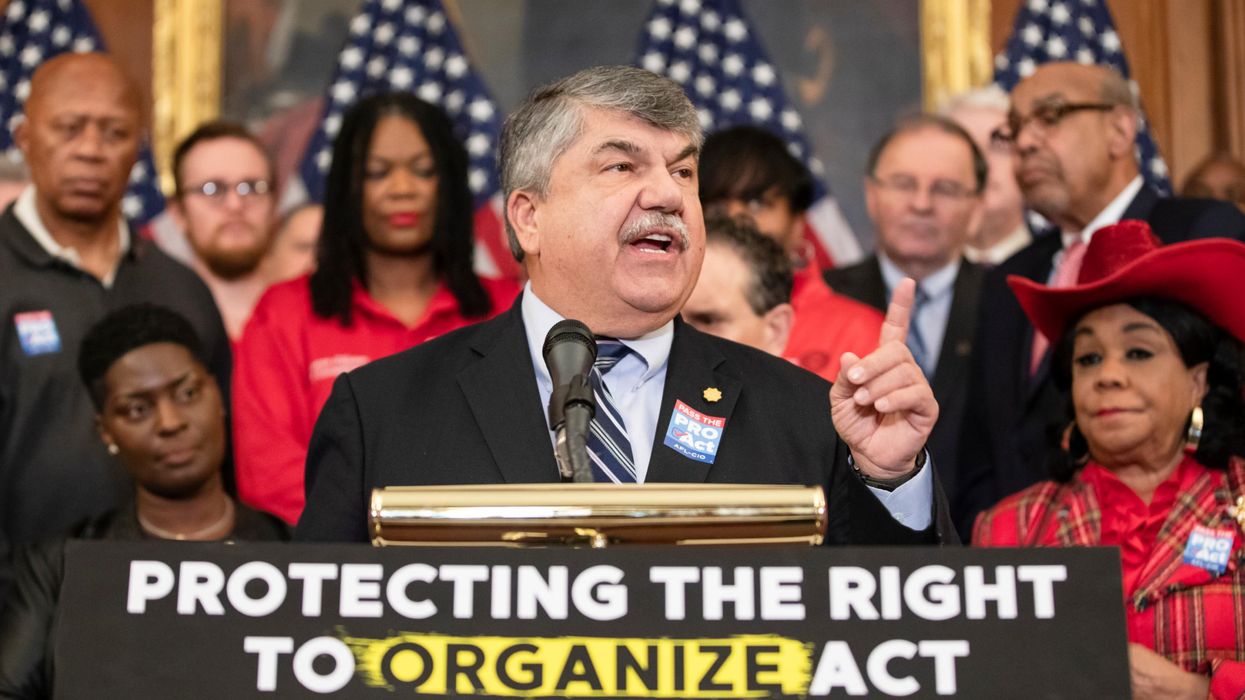
The PRO Act passed the House in both 2020 and 2021 but never reached the floor for a vote in the Senate, where the legislative filibuster requires at least 60 votes to pass most bills. Last year, Sens. Kyrsten Sinema (I-Ariz.), Mark Kelly (D-Ariz.), and Senate Republicansrefused to back the bill, which is furiously opposed by corporate lobbying organizations such as the U.S. Chamber of Commerce.
"The PRO Act is how we level the playing field," AFL-CIO president Liz Shuler said in a statement Tuesday. "It is how we stop the intimidation, the lies. This is how we let workers, not wealthy corporations, decide for themselves if they want the power of a union."
Rep. Brian Fitzpatrick (R-Pa.) was the only Republican to join Sanders and congressional Democrats in reintroducing the PRO Act, which received just five GOP yes votes—including Fitzpatrick's—when it passed in 2021. The bill's legislative hurdles are likely even steeper in the present with Republicans in control of the House.
Mark Zuckerman, president of The Century Foundation (TCF), nevertheless applauded lawmakers for reviving "one of the most ambitious and comprehensive attempts to fix our broken labor laws to date."
"Not only does the legislation ban the most commonly used union-busting techniques, it strengthens workers' fundamental right to strike and ensures that millions of workers currently excluded from labor law protections due to misclassification have an equal right to join a union," said Zuckerman. "Perhaps most importantly, the PRO Act would treat labor rights as civil rights—an idea that TCF has helped push into the mainstream for years."
The Worker Power Coalition, an alliance of national labor, climate, and progressive groups representing 24 million workers, also applauded the bill's reintroduction, calling the PRO Act "the best opportunity in generations to unrig our economy for working people."
"As
Starbucks and Amazon union campaigns have sparked a national wave of worker activism with new union elections up 58 percent in just the first half of 2022, there has never been a more urgent time to ensure workers have an even playing field by fixing our outdated, broken labor laws," the coalition said. "With CEOs spending $340 million a year on union-busting tactics to intimidate and silence workers seeking to form unions, the deck has never been more stacked against workers speaking out."
The first time I met Rich Trumka, the president of the AFL-CIO who suddenly died this past Thursday, was in early 2008. I had only been president of the Writers Guild of America, East, an AFL-CIO union, for a short time, and he was then the labor federation's secretary-treasurer.
"There would be no finer tribute to the life and work of Richard Trumka than to pass the PRO Act."
We and the Writers Guild West were still in the throes of an historic, nerve-wracking but ultimately successful 100-day strike against the Hollywood film and TV conglomerates and I had traveled to Washington, D.C. with our executive director to see Trumka about an issue involving a conflict with another union. He had arranged for a mediation and the problem quickly was handled in a spirit of conciliation and with efficiency and tact. It was impressive.
As was he: a big, mustachioed, funny but tough and smart guy who knew how to define the heart of any issue and get things done. Part of that was his legal and organizing experience, the rest was pure Trumka. "A truculent fighter who didn't give up easily," was how my friend, that knowledgeable labor journalist Steve Greenhouse, described him, and that was so. "A powerful orator who knew how to mobilize workers."
When we first met for that mediation, I'd been told that Trumka's office windows opened out on a panoramic view of the nearby White House but on this weekday afternoon the heavy curtains were closed. I asked him why and he growled, "I'm not gonna open them again until that son-of-a-bitch George Bush is out of there."
Significantly, one of the first to respond to Trumka's death was Bush's successor Barack Obama. He tweeted:
From the coal mines of Pennsylvania to the halls of Congress, Rich Trumka was a fierce advocate for working Americans. He loved this country, and he never missed an opportunity to remind us what we can be. Thinking of his family, friends, and federation on this difficult day.
Trumka, who at one time had been the United Mine Workers' youngest president (he was 33)--and who worked his way through school as a third-generation coal miner himself--performed a remarkable service for Obama during the 2008 presidential campaign, making a heartfelt pitch not only for the election of the Democratic candidate but also doing his part to chip away, for a while at least, some of the deep-set racism that endangered an Obama victory. Rich traveled around the country talking to blue collar union workers, many of whom were reluctant to vote for the first Black American president.
He told them: "We can't tap dance around the fact that there are a lot of white folks out there who just can't get past this idea that there's something wrong with voting for a Black man. Those of us who know better can't afford to look the other way." Obama was the best choice for all working men and women, Trumka said, and there was "only one really, really bad reason to vote against Barack Obama. And that's because he's not white."
In his Washington Post obituary of Trumka, Harrison Smith told the story of Trumka meeting a woman in his Nemacolin, Pennsylvania, hometown who said she couldn't trust Obama because he was Black. Rich said to her:
Look around this town. Nemacolin's a dying town. There's no jobs here. Our kids are moving away because there's no future here. And here's a man, Barack Obama, who's going to fight for people like us, and you want to tell me that you won't vote for him because of the color of his skin?
Are you out of your ever-loving mind, lady?
Two years after we met for that first of many times, I was senior writer at Bill Moyers Journal on PBS and Trumka was a guest. I teased him about the capitalist cravat he wore, a dark red, Brooks Brothers special emblazoned with their Golden Fleece logo. But his necktie was just a minor concession to the inside-the-Beltway crowd. "There are two economies in this country," he told Bill. "There's the real economy that makes things. And there's the financial economy that was supposed to provide them with the capital to make things...
Somewhere along the line, that got turned on its head. And the financial community became the master. And they actually started sucking money out of the real economy... So, it's up to us to correct that imbalance. To make it so that the real economy is actually the dominant economy. And the financial economy is a servant to enable them to do their job.
Rich Trumka was helpful to and supportive of our union on many occasions, showing up when most needed, just as he was there for almost every other union in the AFL-CIO. But he also campaigned on behalf of virtually any and all groups that worked for working men and women whether they were unionized or not.
I will never forget accompanying him one early Friday morning in October 2011 when we visited the activists of Occupy Wall Street. They were just crawling out of their sleeping bags when we arrived and many of them didn't know who he was, but they could sense his interest and support as we quietly walked through the encampment at Zuccotti Park in lower Manhattan's financial district. He spoke with everyone, including some hardhat-wearing workers from New Jersey who had come across the Hudson just to see what was going on and to offer their support.
From 2009, in the dozen years he served as AFL-CIO president, another friend, The Nation's John Nichols wrote, "Trumka worked to forge a more inclusive, and visionary, labor movement."
Said Nichols:
He was the first to say that there was more work to do. And he was willing to do that work--as when he positioned the AFL-CIO in clear opposition to Donald Trump's presidency; as when he championed Black Lives Matter protests, after the murder of George Floyd Jr., in 2020; as he did in the spring of 2021 with his "Immigrant Rights Are Worker Rights" advocacy.
During the 2008 Democratic National Convention in Denver, a year before Trumka became AFL-CIO president, there was a meeting of union presidents at which we were told that the party and Barack Obama's pledge to us was passage of EFCA, the Employee Free Choice Act, legislation which, as Rich described it, "takes the choice of having a union away from the employer, which is where it is right now, and gives it to the employee." It would have been a major shot in the arm to the labor movement.
EFCA never happened during the Obama years, but it lives on in the Protecting the Right to Organize Act--the PRO Act--passed by the House and currently before the U.S. Senate. "To Mr. Trumka's mind," Steve Greenhouse writes, "the PRO Act was an essential tool for adding millions of workers to union rolls. It would make it easier for workers to join unions. It would limit management's ability to propagandize workers and would create hefty fines for when corporations break the law in battling union drives, for instance, by firing outspoken union supporters."
Almost every Democratic senator and Rich Trumka's friend President Joe Biden are behind the bill (although passage may be next to impossible until the filibuster is wiped out). Those curtains in the AFL-CIO offices have been flung back, showing off the view of a White House occupied by the most pro-labor president in a long time.
There would be no finer tribute to the life and work of Richard Trumka than to pass the PRO Act. And here's an added dividend: it would drive Donald Trump, Mitch McConnell, Kevin McCarthy, most of the other GOP legislators--and their deep-pocketed corporate funders--out of their ever-loving minds.
Rich Trumka would love that.
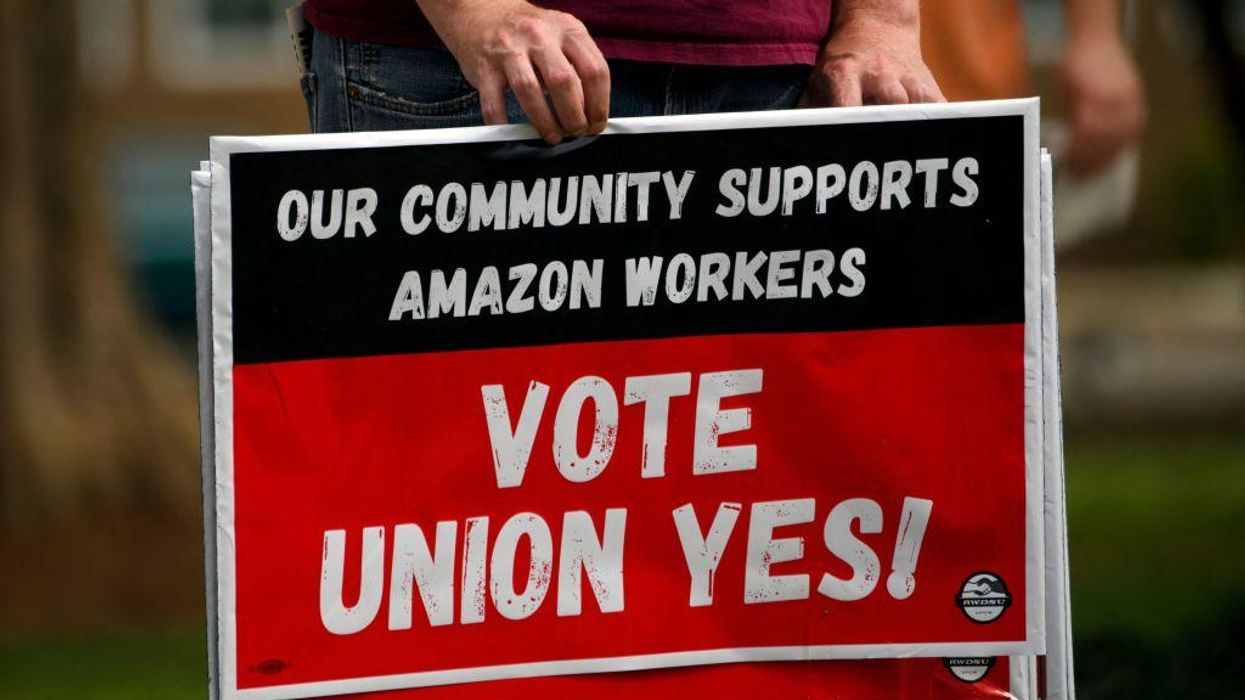
Following one of the most high-profile union votes in history, workers at an Amazon warehouse in Bessemer, Alabama--led by Black organizers--ultimately rejected efforts to form a union by 71 percent, according to the National Labor Relations Board.
But for labor advocates, this fight is far from over.
"The Amazon workers who voted for a union in Bessemer are already winners," Rev. William Barber of the Poor People's Campaign said in a statement. "This is just the first round. Amazon did things to intimidate and suppress the vote. The workers are filing complaints, and they will continue to stand up. They have set a fresh trend in the South, and the echoes of their bold action will reverberate for years."
Nearly all of the union-busting tactics deployed by Amazon would be banned and enforced under the bill.
While the outcome may not have resulted in a union, there is no doubt that the Bessemer union drive is just the beginning of a re-energized national labor movement--a movement driven by the systemic inequality that has allowed Jeff Bezos to become the richest man in the world while his employees are forced to forgo breaks and urinate in bottles in order to meet demands from management.
Inspired by the fight in Bessemer, Amazon workers at other fulfillment centers in Baltimore, New Orleans, Portland, Denver, and southern California have all begun exploring ways to form unions at their own Amazon facilities.
"The American public is now hyper-aware of what Amazon warehouse workers and drivers are forced to go through: Grueling hours with impossible demands," said Erica Smiley, executive director of Jobs With Justice. "But now that these stories are finally being told, thanks to the organizing of the Black workers in Bessemer, Amazon workers nationwide are finally feeling safe and supported enough to start organizing their own warehouse."
Given the state of organized labor in the United States, every unionization drive is an uphill battle. And while support from the public for unions is generally positive -- polling from the AFL-CIO showed that an overwhelming 77 percent support a union for Amazon workers in Bessemer--current federal labor law isn't strong enough to thwart corporate union busting.
Throughout the entire voting period, Amazon used dubious tactics to mislead and intimidate workers. From attempts to delay the vote multiple times, to creating a "Do It Without Dues" campaign (despite Alabama's "right to work" rules, which prohibit mandatory union member dues), and restricting mail-in ballots, it's clear the cards are stacked against the workers.
"Americans want to organize unions," said AFL-CIO President Richard Trumka. "And it should never be this hard to do so."
The Retail Wholesale and Department Store Union (RWDSU), which helped organize the drive in Bessemer, has announced that it is contesting the results of the election, alleging Amazon interfered with the right of Bessemer employees to vote in a free and fair election--a right protected under Section 7 of the National Labor Relations Act.
"Working people deserve better than the way Amazon has conducted itself during this campaign," said RWDSU president Stuart Appelbaum in a statement. "This campaign has proven that the best way for working people to protect themselves and their families is to join together in a union. However, Amazon's behavior during the election cannot be ignored and our union will seek remedy to each and every improper action Amazon took. We won't rest until workers' voices are heard fairly under the law."
Going forward, a clear way to ensure fair, democratic union elections is for the U.S. Senate to pass the Protecting the Right to Organize (PRO) Act. The PRO Act, which passed the U.S. House in March, would add real teeth to existing federal labor laws. Nearly all of the union-busting tactics deployed by Amazon would be banned and enforced under the bill, including:
While it will take weeks for the NLRB to review the potential election violations committed by Amazon, the results are a clear indication that if the law had already been in place, this would have been a much more transparent process. Union drives are not stopping. It is up to Congress to ensure that workers in the future are protected from corporate greed.
In an interview ahead of Labor Day, AFL-CIO chief Richard Trumka said workers across the nation are suffering under President Donald Trump's supposedly "booming" economy and slammed the White House for refusing to raise the minimum wage, pushing for cuts to Medicare and Medicaid, and gutting workplace safety regulations.
"He came to our members and said, 'I'm going to change the rules of the economy,'and they believed him. And, quite frankly, I wish he would have changed the rules of the economy," Trumka told Fox News's Chris Wallace on Sunday.
"Unfortunately, the rules he's changing has hurt them," said Trumka. "He's opposed every increase in the minimum wage. He's changed the regulation to take overtime away from a couple of million people. He's proposed a trillion dollar cuts to Medicare and Medicaid... He's rolled back health and safety standards towards workers."
Trumka went on to note that, despite consistent economic growth and booming corporate profits thanks to the president's massive tax cuts, "real wages are down because of housing costs and healthcare."
The president's response to falling wages, Trumka said, has been "to propose a trillion-dollar cut to Medicare and Medicaid, to oppose increases into the minimum wage."
Trumka's comments came as union leaders are voicing outrage over the president's broad corporate-friendly economic agenda and, specifically, his reckless trade war with China, which has caused falling incomes and record bankruptcies among American farmers.
The AFL-CIO chief said the United States-Mexico-Canada Agreement (USMCA), a trade deal Trump has touted as "very popular" among unions, would represent yet another "windfall for corporations and a disaster for workers."
"They've done more things to hurt workers than they have to help them," Trumka said of the Trump administration.
As author and former New York Times labor reporter Steven Greenhouse noted in The American Prospect last week, Trump has waged an all-out war on American workers from the beginning of his tenure in the White House after running a presidential campaign full of rhetoric aimed at convincing workers "he is their true friend, fighting hard for them."
"With one hand he enchants the crowd, while the other hand, outside the spotlight, steadily pushes down on and squeezes workers day after day," Greenhouse wrote, providing a brief sample of the president's anti-labor actions since taking office:
Trump has effectively scrapped the "fiduciary" rule that required Wall Street firms to act in the best interests of workers and retirees in handling their 401(k)s--a move that could cost many workers tens of thousands of dollars.
Trump erased a rule that extended overtime pay to millions more workers, a move that will deprive many workers of thousands of dollars per year. While Trump boasted that he is the best friend of miners, his Labor Department
pushed to relax rules for safety inspections in coal mines, but was stopped by a federal circuit court. Trump has made it easier to award federal contracts to companies that are repeat violators of wage laws, sexual harassment laws, racial discrimination laws, or laws protecting workers' right to unionize.
"Trump--who held himself out as a champion of workers during the 2016 campaign--seems close to single-handedly pushing the industrial world into recession, which would, of course, do serious harm to workers in the U.S. and around the world," Greenhouse wrote. "With a friend like that, America's workers need no enemies."
AFL-CIO president Richard Trumka told a group of reporters on Wednesday that there is little hope for labor unions to find common ground with the Trump administration, with a White House that's divided into two factions: aides who "turned out to be racist," and "Wall Streeters."
"You had one faction that actually had some of the policies that we would have supported on trade and infrastructure but turned out to be racist, and on the other hand, you had people who weren't racist, but they were Wall Street."
--Richard Trumka, AFL-CIO
"You had one faction that actually had some of the policies that we would have supported on trade and infrastructure but turned out to be racist," Trumka said at a roundtable hosted by the Christian Science Monitor.
"And on the other hand, you had people who weren't racist, but they were Wall Street," he said. "And the Wall Streeters began to dominate the administration and have moved his agenda back to everything he fought against in the election."
Asked which side he thinks the president is on, Trumka responded: "Which day?" before adding: "I don't know. I wish I had the answer to that. I think a lot of people wish they had the answer. He has shown a remarkable ability to do a 180 on a dime."
Trumka's comments are significant, notes Axios' Shane Savitsky, because it is "startling language from the country's most powerful labor leader, who resigned from Trump's manufacturing council after Charlottesville, and a sign that the 'Trump coalition' that included blue collar workers in states like Ohio, Pennsylvania, and Wisconsin, could be breaking down."
Recent polls and studies show that portions of Trump's base that carried him into office, including blue-collar workers, are now moving away from the president. "While Trump's support has been on the decline since he entered office in January," Common Dreams reported, a CNN poll (pdf) conducted earlier this month revealed that "the president's popularity among his previously-solid base is shown to be crumbling."
Even before Trump's controversial charge that "many sides" were to blame for the violent white supremacist demonstrations in Charlottesville, Virginia, calls for impeachment were mounting, along with speculation that he will resign before his term ends.
But his approval ratings hit an all-time low in the wake of his Charlottesville commentary, and he was forced to disband his two business councils after triggering a mass exodus of leaders like Trumka, who said he left the manufacturing council after consulting with union members who saw Trump's remarks as a "spirited defense" of white supremacy.
However, Trumka also said the council "never was a vehicle to provide real policy solutions. In fact, the committee never met." Instead, he said, it became a way for the administration to encourage deregulation, and "they didn't have any solutions for helping manufacturing."
A focus group conducted in Pittsburgh on Tuesday night also displayed the growing discontent with the president in blue-collar America, revealing "bipartisan disappointment in the tenor of Trump's leadership during the first seven months of his presidency," NBC News reports.
When asked to describe Trump in just one word, the participants responded: "outrageous," "dishonest," "disappointing," "narcissistic," "off the scale," "crazy," "unbelievable," and "contemptible." Each participant who voted for Trump expressed concerns with how he's handled the presidency.
But "calling the president names--even if they're accurate--gets you nowhere," Trumka said. "Giving people information about the issues that are of concern to them is a way to bring those people" away from supporting him.
The labor leader told reporters he and many of his union's members are no longer optimistic that they will be able to work with the Trump administration, and that he will instead focus on communicating with disillusioned union members--many of whom voted for the president, he said, because of Trump's campaign trail appeals to working-class people.
"I think a significant amount of the optimism has faded away, because we haven't seen an infrastructure bill, we haven't seen the renewal of manufacturing, we haven't seen the things that we were hopeful about that we could work with him on."
--Trumka
"There's no question that the optimism of a lot of people--our members, of all the sectors, not just the building trades, a lot of the optimism is fading," Trumka said. "I think a significant amount of the optimism has faded away, because we haven't seen an infrastructure bill, we haven't seen the renewal of manufacturing, we haven't seen the things that we were hopeful about that we could work with him on."
"They voted for Trump because he was going to do this, and do that, and do this and do that," but now, when presented with the president's actual agenda, workers are "drawing the conclusion that their investment wasn't a good investment," he said.
Pointing to the healthcare debate as an another example, Trumka noted that the president promised "he was going to bring healthcare for everyone, and we agreed with him, [but] every proposal that the Republicans came forward with, he supported."
In July, Senate Republicans failed at several attempts to repeal the Affordable Care Act (ACA), the law which governs the national healthcare system. Since then, the president has suggested that he will sabotage the ACA, raising concerns among insurance providers, lawmakers, and those who depend on the ACA's state exchanges for health insurance coverage.
When communicating with AFL-CIO members about Trump's policies, "what we have done since day one is tell the truth: Here's what he promised, here's what he did," Trumka said, adding that among members: "You're beginning to see a lot of people come back across the bridge."
This week, AFL-CIO President Richard Trumka ran unopposed for the presidency of the AFL-CIO--but only because his opponent, labor activist Harry Kelber, died before the election.
This week, AFL-CIO President Richard Trumka ran unopposed for the presidency of the AFL-CIO--but only because his opponent, labor activist Harry Kelber, died before the election. While foul play is not suspected (he died from natural causes in late March), the death of 98-year-old union dissident Harry Kelber still came as shock to me.

Harry had gotten so good at living, and at finding beauty and enjoyment in it, that I thought he would never die. Heck, so did he. "The way I figure it, I got enough money to make it till I'm 100," he used to joke.
Harry was a familiar figure at AFL-CIO conventions since 1995, when, at 81, he became the first ever rank-and-file union member to run for executive council of the AFL-CIO, forcing a contested election against incumbent President Lane Kirkland, whom he saw as ineffectual.
After that, he ran for AFL-CIO president four times, ensuring he had a speaking slot at the quadrennial convention--often the only time criticism of the AFL-CIO was heard from the podium during an otherwise tightly choreographed event. Harry considered the AFL-CIO leadership to be a group of "self-serving, self-perpetuating bureaucrats" disinclined toward the kind of tumultuous debates that empowered CIO activists to make the massive organizing gains that they did in the 1930s. "Win or lose, the Trumka group is guaranteed their six-figure salaries and lavish pension deals when they retire," wrote Harry last April. "And they use whatever tactics are necessary to prevent interlopers from challenging their power." (Harry loved to bring up that AFL-CIO President Richard Trumka made $293,750--dramatically more than the salary of a typical union member.)
Harry was constantly searching for ways to impart upon younger generations the lessons of dissent, criticism and reflection that he felt were so crucial to the organizing tactics of the CIO of the '30s. United Electrical Workers (UE) Political Action Director Chris Townsend used to say that Harry had forgotten more about organizing then most people inside of the AFL-CIO ever knew.
As a reporter with three generations of family members involved with the UE and its rank-and-file tradition of democratic control and self-criticism, I found it refreshing to talk to Harry, especially compared to my conversations with the sometimes close-mouthed leaders of the labor movement. When I met him in 2010, he seemed like a connection to people like my then-recently deceased grandparents, whose stories of building the labor movement in the '30s inspired me to become a labor reporter.
Harry continued to write three columns a week well into his 90s, in a lively, open-to-critique style reminiscent of the early labor movement. In some ways, Harry Kelber was the Thomas Paine of a lagging labor movement. I've heard him credited with starting the discussion that eventually lead to the first-ever ousting of an AFL-CIO president, Kirkland, in 1995--and Harry often claimed that his landmark 1990 book, Why Unions Are In Trouble... And What They Can Do About It, sold over 125,000 copies.
For Harry, it was heartbreaking to see modern labor leaders fail in their promises to workers, because he knew firsthand the price workers have paid for the right to join a union. He often recalled seeing a group of old Jewish waiters beaten on a New York street corner in the 1930s just for demanding the right to unionize. And he recalled the joy of successfully leading his own four-month strike as a teenage grocery worker in 1933.
Harry wasn't shy about voicing his criticisms of labor leaders, even when it meant suffering the consequences. During the McCarthy era of the 1950s, he faced underemployment and blacklisting when he fell out of step with the union-backed purge of communism in its own ranks. In 1990, he was fired as Director of the Educational and Cultural Trust Fund of IBEW Local 3 after criticizing IBEW leadership.
What amazed me the most about Harry, though, was how he managed to balance his commitment to labor activism with interests that went far beyond his passion for workers' rights. Labor reporting can be downright traumatic sometimes--covering people losing their jobs for trying to join a union, losing their pensions in slick bankruptcy procedures, and sometimes even losing their lives in all-too-frequent accidental workplace deaths. It's often very depressing because it's just people trying to help themselves, and there is so little you can do as a journalist to help these people. And the contrast between rank-and-file shop floor activists and high-paid, inside-the-Beltway labor leaders can be even more depressing for those of us who write about the movement as a whole.
But Harry never let the ugliness of it all drag him down, because he could constantly escape into the beauty of his many hobbies.
"If I had just sat on that couch and watched TV, I would have been been dead 20 years ago," Harry told me once. "I wake up in the morning and I am excited for whatever I am going to learn that day."
Harry pioneered a new form of poetry, known as a septad, which consisted of 28 syllables arranged in seven lines. He studied foreign languages well into his 90s, despite the fact that he was only capable of traveling to the places where those languages were spoken in his mind.
When it became too difficult for Harry to see the keys on a normal keyboard, instead of giving up writing, Harry simply went out and got a keyboard where the keys were twice as large. I remember during the Egyptian Revolution in 2011, Harry called me up to his apartment in Brooklyn Heights and asked me to show him how to use Twitter at the age of 95 so he could follow what was going on.
"Wow, this is thrilling," Harry exclaimed, watching as the tweets of Egyptian activists in Tahrir Square scrolled down the computer monitor in his Brooklyn Heights flat.
Harry's energy was astounding. He would frequently stay up till 3 a.m. writing, reading, making music, exploring, or listening to philosophy tapes. Harry would always encourage me to call him, no matter what time it was, whenever I got stumped on a piece. I remember once calling Harry in February 2011 at 1 a.m. from Madison, Wis. to ask him what he thought of the massive protests in the streets. I sat on the phone with him for more than an hour, listening to his stories of massive strikes and demonstrations in the 1930s.
He always told me that learning new things and keeping his mind active was what kept him so ecstatic about life. When he told me he'd been taking lessons to learn how to compose music, I assumed that he meant he was writing music on the piano. In the summer of 2011, I visited him with a French friend who finally asked Harry what kind of music he composed.
"Avant-garde music," Harry said. "You know, on the computer?"
My jaw dropped--the guy was 96 and more of a hipster than me.
Harry knew that I had suffered from bouts of depression, and every time we spoke, he would constantly try to encourage me to follow a path that would help me become a very happy 98-year-old labor reporter like him--to develop a hobby, a passion, something that I loved and I could look forward to every day, no matter what.
"Mike, this stuff will kill you if it's all you do," he said. "You gotta have something that you do when you come home that is just beautiful and makes you think with a different part of your brain."
While there may have been other writers who inspired me more as a reporter, nobody has inspired me to pursue the kind of life I wanted to have away from the keyboard like Harry did. I've found my own form of escape clipping magazine artwork to make collages.
Sometimes doing collage work late at night, I find myself thinking about Harry. I think of him sitting at his oversized keyboard struggling to make avant-garde electronic music. I think of sitting around his massive Brooklyn Heights apartment as the 96-year-old labor reporter gave me, a 25-year-old kid, dating advice based on his first failed marriage. I think of the way Harry howled when he laughed, and it makes me smile. I miss my friend.