

SUBSCRIBE TO OUR FREE NEWSLETTER
Daily news & progressive opinion—funded by the people, not the corporations—delivered straight to your inbox.
5
#000000
#FFFFFF
To donate by check, phone, or other method, see our More Ways to Give page.
Daily news & progressive opinion—funded by the people, not the corporations—delivered straight to your inbox.

"No you cannot 'do both.' That would be like sending 50,000 tons of lethal weapons to a brutal, murderous regime and then telling them you 'want a cease-fire,'" said Climate Defiance.
Climate campaigners this week rebuked recent claims by U.S. President Joe Biden—and Vice President Kamala Harris, the 2024 Democratic presidential nominee—that the United States can simultaneously increase fossil fuel production and transition to a clean energy future.
On Saturday, Biden
boasted on social media that "on my watch, we've responsibly increased our oil production to meet our immediate needs—without delaying or deferring our transition to clean energy."
"We're America," the president added. "We can do both."
In a simultaneous swipe at the Biden administration's climate record and support for Israel's annihilation of Gaza, the direct action group Climate Defiance
retorted: "No you cannot 'do both.' That would be like sending 50,000 tons of lethal weapons to a brutal, murderous regime and then telling them you 'want a cease-fire.'"
Other climate groups and experts have also challenged Biden's position in recent days.
Climate scientist Peter Kalmus
said on social media, "This is horrifying."
Fridays for Future USA
contended, "You cannot in fact do both."
"You can't expand fossil fuels on Monday, expand renewables on Tuesday, and call it climate action on Wednesday," the youth-led movement added. "Do better."
Noting that Harris has also claimed that "we can do both," author and professor Genevieve Guenther
asserted: "'We can do both' is apparently the climate and energy messaging on which the Harris campaign has settled. (Harris used the identical phrase in her CNN interview.) I understand it as a message that meets the moment. But it's not true, and I hope they don't believe it."
Despite lofty rhetoric and campaign pledges to center climate action—including by stopping new fossil fuel drilling on public lands—Biden
oversaw the approval of more new permits for drilling on public land during his first two years in office than former President Donald Trump, the 2024 Republican nominee, did in 2017 and 2018.
The Biden administration has also
held fossil fuel lease sales in the Gulf of Mexico and has approved the highly controversial Willow project, Mountain Valley Pipeline, and increased liquefied natural gas production and export before pausing LNG exports earlier this year.
Despite the pause—which campaigners are
urging the Biden administration to make permanent—the president has also overseen what climate defenders have called a "staggering" LNG expansion, including Venture Global's Calcasieu Pass 2 export terminal in Cameron Parish, Louisiana and more than a dozen other projects that, if all completed, would make U.S. exported LNG emissions higher than the European Union's combined greenhouse gas footprint.
Biden also
drew ridicule last year after he said he has "practically" declared a climate emergency—a longtime demand of activists. The president's claim came during a speech touting the clean energy provisions of the Inflation Reduction Act, which allocates hundreds of billions of dollars for climate-mitigating investments but also includes policies that anger green groups.
Climate campaigners widely agree that a Harris administration would be far preferable to one led by the climate science-denying Trump, one of whose mottos is "Drill, Baby, Drill." During his first term, Trump rolled back numerous climate-focused regulations and aggressively expanded U.S. fossil fuel production. Biden has reversed some of Trump's most impactful attacks on climate and environmental protections.
In April, Trump
reportedly told fossil fuel executives that a $1 billion investment in his campaign would be a great deal for them due to all the taxes and regulations they would avoid under his administration.
Meanwhile, Harris is widely expected to continue many of Biden's climate and energy policies, including embracing fracked methane gas, which she once said she wanted to ban.
In another "we can do both" moment, Harris told CNN last week that "what I have seen is that we can grow and we can increase a thriving clean energy economy without banning fracking."
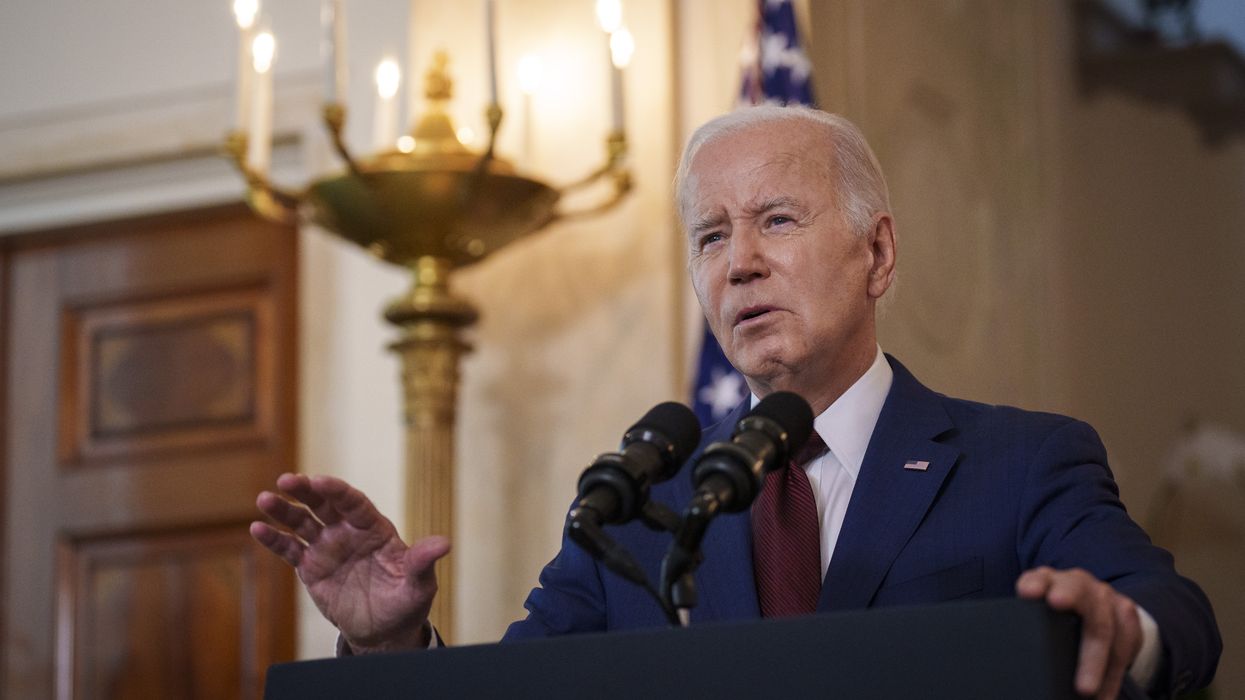
Experts warn that expanding liquefied natural gas infrastructure will put the United States "on a continued path toward escalating climate chaos."
Echoing recent calls from frontline leaders, green groups, and healthcare workers, 170 scientists on Tuesday pressured U.S. President Joe Biden to reject a proposed liquefied natural gas terminal in Louisiana known as CP2 and other pending LNG projects.
"We are scientists who write to you with ever-increasing urgency as our climate continues to deteriorate to implore you to stop the dash to increase exports of liquified natural gas (LNG)," wrote the scientists, including Rose Abramoff, Robert Howarth, Mark Jacobson, Peter Kalmus, Michael Mann, Sandra Steingraber, Farhana Sultana, and Aradhna Tripati.
While stressing their opposition to Venture Global's Calcasieu Pass 2 (CP2) project, they also emphasized that "the magnitude of the proposed buildout of LNG over the next several years is staggering."
"As scientists we are telling you in clear and unambiguous terms that approving CP2 and other LNG projects will undermine your stated goals of meaningfully addressing the climate crisis."
"For years, the science has been overwhelmingly clear that we must stop expanding fossil fuel extraction and infrastructure and rapidly transition to renewable energy. We have simply no runway left and little margin for error," the scientists warned. "In fact, we are rapidly passing tipping points that are further escalating the climate crisis."
"Altogether, the science to date shows that spiraling emissions of the climate super-pollutant methane are a major contributor to the ongoing failure to meet agreed-upon global emissions targets and stabilize the climate," they explained. "The science also shows that LNG facilities are inherently leaky operations and prodigious emitters of methane."
Their letter cites a forthcoming study by Howarth, a Cornell University scientist, that shows LNG is at least 24% worse for the climate than coal.
CP2 alone would produce over 20 times more planet-heating pollution than ConocoPhillips' Willow oil project in Alaska, which the Biden administration is also under fire for greenlighting. The letter highlights that "these climate-wrecking emissions are on top of prodigious amounts of toxic air pollutants, including carcinogenic benzene, released into local environments both from the LNG facilities themselves and the upstream drilling and fracking operations that feed them."
"LNG plants and their associated infrastructure pose serious health harms to surrounding communities and worsen environmental injustice," the scientists pointed out. "These facilities are disproportionately located in communities of color and low-income communities on the Gulf Coast already overburdened with pollution."
"You have often said that your policies will be guided by listening to the science," they wrote to Biden. "As scientists we are telling you in clear and unambiguous terms that approving CP2 and other LNG projects will undermine your stated goals of meaningfully addressing the climate crisis and put us on a continued path toward escalating climate chaos. We implore you to turn back from this course, reject CP2 and other fossil fuel export projects, and put us on a rapid and just trajectory off fossil fuels."
Opposition to CP2 may already be having some effect. Advocates had expected the Federal Energy Regulatory Commission to consider the project this fall but so far, the agency hasn't. Louisiana Bucket Brigade director Anne Rolfes said last week that "every month it is not on the agenda, we consider a victory because it means that it's not getting part of the federal approval that it needs."
While Venture Global lacks the permission required for CP2, the Biden administration has infuriated frontline communities, scientists, and voters concerned about the climate emergency by expanding LNG exports, enabling projects like Willow and the Mountain Valley Pipeline, and continuing fossil fuel lease sales for public lands and waters.
Biden, who was elected in 2020 after running on bold climate promises, is now seeking reelection next year and could again face Republican former President Donald Trump, a major ally to the fossil fuel industry.
The president "must reject new fossil fuel projects, starting with CP2, that poison communities and that will harm young people far into the future," Michele Weindling, political director of the youth-led Sunrise Movement, said Friday. "He can't one day cave to fossil fuel millionaires and the next throw a bone to young people. That's not how science works, and young voters know it."
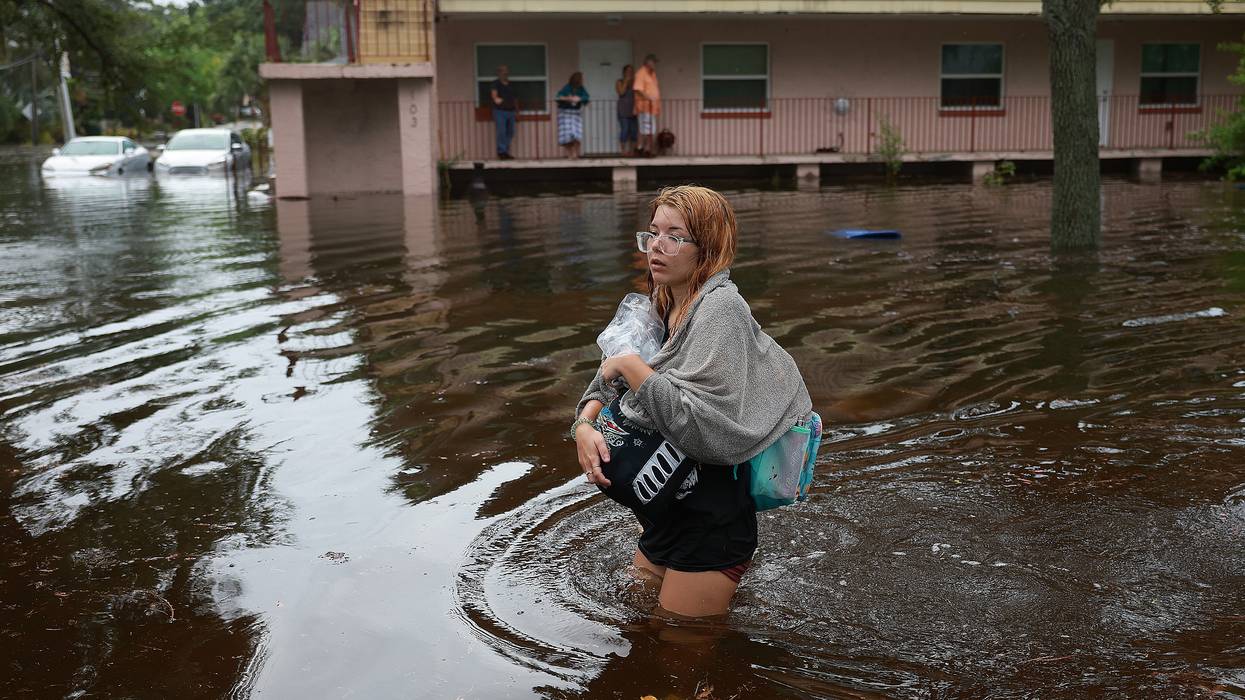
Campaigners also argue that "Big Oil CEOs and politicians like Ron DeSantis must be held accountable for knowingly fueling the climate crisis that heats our oceans and strengthens deadly storms."
As U.S. President Joe Biden plans to visit Florida on Saturday to tour the wreckage from Hurricane Idalia, climate campaigners this week have yet again renewed demands for the Democrat—who is seeking reelection next year—to declare a climate emergency.
"I don't think anybody can deny the impact of the climate crisis anymore," the president said in a Wednesday speech about the hurricane response and wildfire recovery efforts in Maui. "Just look around: historic floods—I mean historic floods; more intense droughts; extreme heat; significant wildfires have caused significant damage like we've never seen before."
Biden suggested during an interview earlier this month that he had "practically" declared a climate emergency—which campaigners forcefully refuted, stressing that actually doing so would unlock various powers to tackle the global crisis.
After the president on Thursday confirmed his upcoming trip to Florida, the youth-led Sunrise Movement wrote on social media that "Biden must declare a climate emergency and do everything he can to prevent future disasters now."
White House Homeland Security Adviser Liz Sherwood-Randall told reporters on Thursday that Biden will "visit the areas most impacted" by the storm and has been receiving regular updates from her and Federal Emergency Management Agency (FEMA) Administrator Deanne Criswell "on the latest developments with Hurricane Idalia, and also of course with the ongoing recovery operations in Hawaii on the island of Maui," according to CNN.
Since the Category 3 hurricane made landfall in Florida early Wednesday before moving on to Georgia and the Carolinas, multiple groups, including Greenpeace USA and the Center for Popular Democracy, have called for a climate emergency declaration.
Scientists have warned that continuing to heat the planet through human activities like fossil fuel use will lead to increasingly devastating hurricanes—particularly because the global ocean has absorbed most of the warming from greenhouse gases in recent decades.
"We can see climate change fueling hurricanes," Andra Garner, a hurricane expert at Rowan University in New Jersey, told NPR on Wednesday, explaining how hotter ocean water is tied to more intense storms. "Think of it like getting a coffee in the morning and getting a couple extra shots of caffeine in there."
Along with calls for a climate emergency declaration, demands are also mounting for the fossil fuel industry—and the politicians who support it, like Florida Gov. Ron DeSantis, a 2024 GOP presidential candidate—to be held accountable for driving the disasters.
"As we Floridians face the devastation of yet another massive hurricane, we know exactly who is responsible for making these countless disasters exponentially worse: the Big Oil CEOs profiting off the climate crisis and their political allies," CLEO Institute executive director Yoca Arditi-Rocha said Thursday. "Big Oil CEOs and politicians like Ron Desantis must be held accountable for knowingly fueling the climate crisis that heats our oceans and strengthens deadly storms—then leading the fight to strip away resources our state could use to respond."
John Paul Mejia, a Miami native and national spokesperson for the Sunrise Movement, shared that "it's hard to see the people and places I love suffering after yet another climate disaster. But the truth is, Florida is standing out as an example of what a world ruled by fossil fuel executives and the politicians they employ looks like."
"By turning down millions of dollars in climate investments while people suffer, Gov. DeSantis has shown he's more willing to shield Big Oil executives from accountability than serve the people of Florida," the campaigner added. "My generation won't forget this and we will do anything in our power to defeat politicians like him."
"It's time to hold Big Oil accountable for the climate disasters they're fueling," declared Jamie Henn of Fossil Free Media, which recently bought billboards in U.S. communities blaming heatwaves on fossil fuel giants. "Big Oil executives are sitting in cushy corner offices making massive profits while people in Florida, Hawaii, and all over the world are losing their homes, businesses, and lives. Finally holding this industry accountable for the damage they're causing has become a major priority for the global climate movement."
As frontline communities and activists seek accountability, including through climate liability lawsuits against oil and gas companies, "the spate of summer disasters has highlighted another potentially looming crisis in the U.S." Inside Climate News reported Tuesday. "The federal Disaster Relief Fund, which allocates billions of dollars to help communities recover after a major disaster, is set to run out of money this fall if Congress can't come to an agreement on how to replenish it."
As the outlet detailed:
On Monday, the Biden administration announced nearly $3 billion in funding for hundreds of communities across the U.S. to reduce their vulnerability to climate-fueled extreme weather events. The money, which will come from the Bipartisan Infrastructure Law that Congress passed in 2021, will go toward building more weather-resilient infrastructure and flood mitigation efforts, among other projects.
But that money—though important—is geared toward preventative measures and is separate from FEMA's disaster relief fund, meaning it won't help communities recover from this summer's devastating weather. If the relief fund isn't replenished soon, the agency could be forced into a difficult position, having to choose which disaster recovery efforts to fund and which to postpone.
Climate scientist and activist Peter Kalmus said on Democracy Now! Thursday that "the public just doesn't understand, in my opinion, what a deep emergency we are in. This is the merest beginning of what we're going to see in coming years. And to me, it's absolutely horrifying."
"I don't think people really fully appreciate how irreversible these impacts are," he continued. "We can't just reverse this. It's not like cleaning up trash in a park. How hot we allow this planet to get is how hot it will stay for a very long time. And I feel like climate scientists, including myself, have been being ignored for decades by world leaders. They just don't seem to get this, either."
"I'm glad to hear President Biden finally using his bully pulpit a little bit to try to wake people up that this is real, but he continues to expand fossil fuels at breakneck pace," Kalmus added, pointing to drilling on public lands, the Willow project in Alaska, and the Mountain Valley Pipeline in Appalachia. "And that's the cause of all of this damage that we're seeing."
"I've got two sons, and it breaks my heart to see the Biden administration continue to expand fossil fuels and take us deeper into this catastrophe, instead of trying to bring us back from this," said the expert, who has called on the president to declare a climate emergency. "He's deeply on the wrong side of history."

The global average ocean surface temperature is expected to rise even further in the coming months as El Niño strengthens.
Climate scientists on Friday said the rapidly rising temperature of the planet's oceans is cause for major concern, particularly as policymakers in the top fossil fuel emissions-producing countries show no sign of ending planet-heating oil and gas extraction.
The European Union's climate agency, Copernicus Climate Change Service, reported this week that the average daily global ocean surface temperature across the planet reached 20.96°C (69.7°F), breaking the record of 20.95°C that was previously set in 2016.
The record set in 2016 was reported during an El Niño event, a naturally occurring phenomenon which causes warm water to rise to the surface off the western coast of South America. The weather pattern was at its strongest when the high ocean temperature was recorded that year.
El Niño is forming this year as well, but has not yet reached its strongest point—suggesting new records for ocean heat will be set in the coming months and potentially wreak havoc in the world's marine ecosystems.
Samantha Burgess, deputy director of Copernicus, told the BBC that March is typically when the oceans are at their hottest.
The warming oceans are part of a feedback loop that's developed as fossil fuel emissions have increasingly trapped heat in the atmosphere.
Rising levels of carbon dioxide in the atmosphere are warming the oceans, leaving them less able to absorb the emissions and contributing to intensifying weather patterns.
"Warmer sea surface temperatures lead to a warmer atmosphere and more evaporation, and both of these lead to more moisture in the atmosphere which can also lead to more intense rainfall events," Burgess told "Today" on BBC Radio 4. "And warmer sea surface temperatures may also lead to more energy being available for hurricanes."
The warming ocean could have cascading effects on the world's ecosystems and economies, reducing fish stocks as marine species migrate to find cooler waters.
"We are seeing changes already in terms of species distributions, prevalence of harmful algae blooms popping up maybe where we would not necessarily expect them, and the species shifting from warmer southern locations up into the colder regions as well which is quite worrying," Helen Findlay, a biological oceanographer at the Plymouth Marine Laboratory in the United Kingdom, told The Evening Standard.
"We are also seeing more species coming up from the south, things like European anchovy or recently examples of Mediterranean octopus coming up into our waters and that is having a knock-on impact for the fish that we catch, and consequences of economics," she added.
Certain parts of the world's oceans provoked particular alarm among scientists in recent days, with water off the coast of Florida hitting 38.44°C—over 101°F—last week.
The National Oceanic and Atmospheric Administration told the BBC that ocean temperatures in that area typically hover between 23°C and 31°C at this time of year.
Since scientists first began measuring ocean temperatures using satellites and research buoys about four decades ago, the global average sea surface temperature has gone up by roughly 0.6°C.
On social media, climate scientists urged news outlets to explicitly connect the rising ocean temperatures to fossil fuel companies and the policymakers who are enabling them to continue fueling the climate emergency—such as British Prime Minister Rishi Sunak, who announced more than 100 new oil and gas licenses in the North Sea this week.
The New York Times this week reported "terrifying Earth breakdown but barely [mentioned] the cause is the fossil fuel industry," said National Aeronautics and Space Administration climate scientist Peter Kalmus.
"The more we burn fossil fuels, the more excess heat will be taken out by the oceans, which means the longer it will take to stabilize them and get them back to where they were," Burgess told the BBC.

"We disrupted the rich and powerful because Joe Biden's approval of deadly new oil and gas projects is killing the planet," said the campaign group Climate Defiance. "We will continue to disrupt until we end fossil fuels."
Members of the corporate media were greeted by hundreds of climate action organizers Saturday night as they arrived at the Washington Hilton Hotel in Washington, D.C. for the annual White House Correspondents Dinner.
Youth-led direct action group Climate Defiance staged a blockade of the event to demand that President Joe Biden fulfill his campaign promise to end fossil fuel extraction on public lands.
The protest came weeks after the Biden administration approved Willow, the massive oil drilling project on federal lands in Alaska, and a month after an oil and gas lease sale of 1.6 million acres of offshore waters in the Gulf of Mexico went forward.
"The president promised us an end to new leasing on federal lands but failed to deliver. Now, he needs to hear from the voting bloc that delivered him the 2022 midterm elections," said Climate Defiance ahead of the protest, referring to research showing that voters between the ages of 18 and 29 were crucial to Biden's victory in 2020.
According to Pew Research, 62% of young voters support a complete phaseout of fossil fuels.
Climate Defiance is backed by the Climate Emergency Fund, a nonprofit run by climate psychologist Margaret Klein Salamon. The group was joined by organizers from the Sunrise Movement, which has helped push more than 100 Democratic lawmakers to co-sponsor Green New Deal legislation.
Documentarian Ford Fischer posted a video of a government vehicle attempting to drive through the protesters before retreating.
U.S. Rep. Ro Khanna (D-Calif.), a Green New Deal co-sponsor, thanked the demonstrators for the action as he walked past them, and climate scientist Peter Kalmus joined the group at one point, telling them, "You guys are on the right side of history... President Biden is on the wrong side of history [for] expanding the fossil fuels during a climate emergency."
Tennessee state Reps. Justin Jones (D-52) and Justin Pearson (D-86), who were recently expelled from the state House for participating in a gun control protest before being reinstated, also joined the campaigners to say that the interconnected fights "for democracy, climate justice, and an end to mass shootings require a coordinated emergency response."
"We're fighting a system that is trying to put the profits of the gun industry, the profits of the fossil fuel industry, the profits of the for-profit healthcare over the lives of our people," he said. "So we must stand together. We must let them know that if you come for one of us, you come for all of us."
"We disrupted the rich and powerful because Joe Biden's approval of deadly new oil and gas projects is killing the planet," said Climate Defiance after the blockade. "We will continue to disrupt until we end fossil fuels."
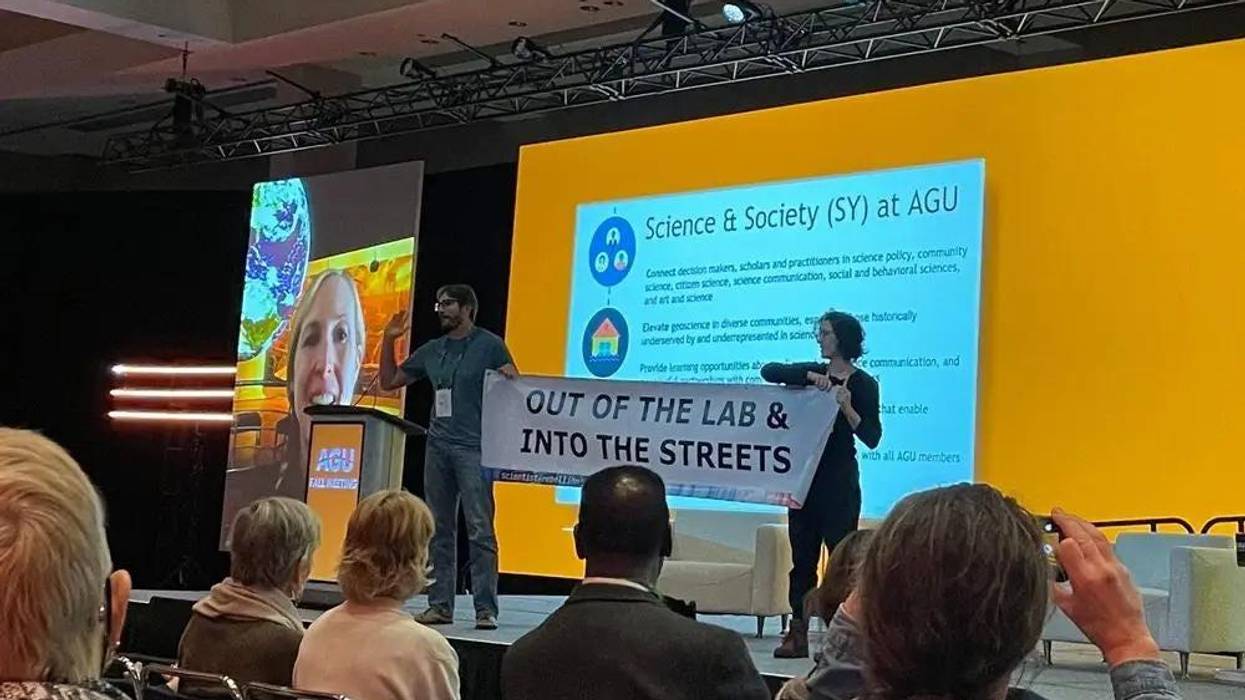
"Climate scientists are citizens and humans too. As citizens, we have our own views of the world and we engage in the public debate in the ways we see fit. As humans, we have the inalienable right to express our opinions in a peaceful manner."
More than 1,500 scientists on Thursday released a letter declaring that they are "appalled by the recent retaliation against colleagues who dared to exercise their civil and human rights" with a peaceful protest at a December conference in Chicago.
Published by news outlets around the world in English, French, and Portuguese, the letter comes after Rose Abramoff and Peter Kalmus unfurled a banner that read "Out of the lab & into the streets" just before an art and science plenary talk at the Fall Meeting of the American Geophysical Union (AGU).
"As scientists, we make detailed observations and carefully design experiments and models to understand the causes, processes, and implications of climate change" the letter states. "We stick to facts and do our best to inform policymakers and fellow citizens, and train students in rigorous scientific methods."
"Importantly, climate scientists are citizens and humans too," the letter adds. "As citizens, we have our own views of the world and we engage in the public debate in the ways we see fit. As humans, we have the inalienable right to express our opinions in a peaceful manner."
Citing scientific conclusions about the causes of the climate emergency and the urgent need to address them, the letter stresses that "more than ever, we need to engage actively as citizens-who-are-scientists in working for the mitigation of greenhouse gas emissions and the swift transition to a low-carbon future."
The AGU—which has over 60,000 members and 23 peer-reviewed journals— describes the annual conference as "the most influential event in the world dedicated to the advancement of Earth and space sciences." The organization launched a probe into the protest.
While Kalmus still works at NASA's Jet Propulsion Laboratory, the Oak Ridge National Laboratory, which is sponsored by the U.S. Department of Energy, fired Abramoff over the demonstration, which she wrote about in a New York Times opinion piece earlier this month.
Abramoff and Kalmus—who have both been arrested for previous climate-related civil disobedience—disrupted the AGU event for less than 30 seconds. Someone swiftly ripped the banner from the scientists' hands and AGU staff escorted them from the stage. Kalmus
tweeted that "the AGU took our badges and kicked us out of the meeting."
HEATED reported Friday that the day before the protest, during a grief circle at the conference that was asked to disperse to clear a hallway, "Abramoff said she gave her phone number to one of the AGU officials. HEATED independently identified this official as the senior vice president of meetings, Lauren Parr."
The report added that "after being expelled from the conference, Abramoff said she received a phone call from Parr (Abramoff did not name Parr in the conversation with HEATED), in which Parr threatened arrest if the two returned; said their research would be removed from the conference; and that AGU would contact their work institutions."
Parr declined to comment while an AGU spokesperson declined to confirm those details and "also attempted to prevent HEATED from naming Parr, claiming she had been receiving significant harassment and death threats," according to the outlet.
The new letter—signed by members of the Earth system science community from dozens of countries, including several authors of Intergovernmental Panel on Climate Change reports—charges that "the response with which they were met was by far disproportionate," calling out both "the AGU's actions against them and the recent retaliation that followed."
The letter continues:
We argue that the cost of silence in the face of such unfair and disproportionate treatment, for the scientific community and the planet, would be too high. The heavy-handed and unjust responses to a short banner unfurling not only threatens the careers of two scientists, it also discourages researchers—and especially early-career scientists—from engaging with their colleagues and society and to speak out about the urgent need for climate action. We are deeply concerned by a decision that tells scientists that they risk their careers if they dare speak out or engage in advocacy that is not formally approved. Employers should not punish scientific researchers for participating in nonviolent climate action. Academia and membership organizations like AGU should be safe spaces for freedom of expression.
We stand by our fellow climate scientists who express frustration with the lack of meaningful climate action within the scientific community and the public, who bring attention to the urgency of the moment in a nonviolent manner. We stand by Rose and Peter.
Scientists and others from across the globe have publicly shared similar sentiments since mid-December.
Erika Spanger-Siegfried, director of strategic climate analytics in the Union of Concerned Scientists' Climate and Energy program, warned last week that "in the absence of a clear endorsement of the objective (not the means) of Abramoff and Kalmus' actions, AGU's response, coupled with Abramoff's firing, may be seen by the scientific community as a strong, disapproving, and chilling signal to scientists to step back from climate activism—just when the world needs them to show up in new, courageous ways."
An open letter addressed directly to the AGU—so far signed by over 2,000 people—says that "we as scientists cannot and must not tolerate this censorship and chilling lack of support from our scientific society and therefore urge AGU to: i) reinstate the scientific contributions of Rose Abramoff and Peter Kalmus to the program; ii) officially rescind any communications AGU may have had regarding this incident with Rose Abramoff and Peter Kalmus' former or home institutions until after the AGU professional misconduct investigation has concluded; and iii) immediately close the professional misconduct investigation."
In response to AGU CEO Randy Fiser's January 11 statement about the demonstration and subsequent investigation, Aaron Thierry tweeted that such protest "is both necessary and justified," and pointed to an August paper he published in the journal Nature Climate Change with four other climate scientists and a political scientist who focuses on civil disobedience and social movements.
According to Thierry, rather than sanctioning and investigating Abramoff and Kalmus, the AGU "should be backing them in their efforts!"
This post has been updated with HEATED's additions clarifying that the news outlet independently identified Lauren Parr and Rose Abramoff did not name the AGU official.