SUBSCRIBE TO OUR FREE NEWSLETTER
Daily news & progressive opinion—funded by the people, not the corporations—delivered straight to your inbox.
5
#000000
#FFFFFF
To donate by check, phone, or other method, see our More Ways to Give page.
Daily news & progressive opinion—funded by the people, not the corporations—delivered straight to your inbox.

After 2023 was the hottest year in human history, experts warn that 2024 "has strong potential to be another record-breaking year."
While global policymakers continue to drag their feet on phasing out planet-heating fossil fuels, scientists around the world "are freaking out" about high ocean temperatures, as they told The New York Times in reporting published Tuesday.
A "super El Niño" has expectedly heated up the Pacific, but Times reporter David Gelles spoke with ocean experts from Miami to Cambridge to Sydney about record heat in the North Atlantic as well as conditions around the poles.
"The sea ice around the Antarctic is just not growing," said Matthew England, a University of New South Wales professor who studies ocean currents. "The temperature's just going off the charts. It's like an omen of the future."
Rob Larter, a marine geophysicist with the British Antarctic Survey who watches polar ice levels, told the paper that "we're used to having a fairly good handle on things. But the impression at the moment is that things have gone further and faster than we expected. That's an uncomfortable place as a scientist to be."
Last week, Jeff Berardelli, WFLA's chief meteorologist and climate specialist, also highlighted the warm North Atlantic and that "all signs are pointing to a busy hurricane season" later this year.
Noting that in the middle of this month, sea surface temperatures in the North Atlantic were around 2°F higher than the 1990-2020 normal and nearly 3°F above the 1980s, Berardelli explained:
That may not sound like a lot, but consider this is averaged over the majority of the basin shown in the red outline in the image above. A deviation like that is unheard of... until now.
To put it into more relatable terms, considering what's been normal for the most recent 30 years, the statistical chance that any February day would be as warm as it is right now is 1-in-280,000. That's not a typo. This is according to University of Miami researcher Brian McNoldy...
And that 1-in-280,000 is compared against a recent climate, which had already been warmed substantially by climate change. If you tried to compare it against a climate considered normal around the year 1900, the math would become nonsensical. Meaning an occurrence like this simply would not be possible.
McNoldy also stressed the shocking nature of current conditions to the Times, telling Gelles that "the North Atlantic has been record-breakingly warm for almost a year now... It's just astonishing. Like, it doesn't seem real."
The new comments from McNoldy and other scientists come on the heels of various institutions and experts worldwide recently confirming that 2023 was the hottest year in human history. Research also showed that it was the warmest year on record for the oceans, which capture about 91% of excess heat from greenhouse gases.
As Common Dreams reported last month, Adam Scaife, a principal fellow at the United Kingdom's Met Office, said that "it is striking that the temperature record for 2023 has broken the previous record set in 2016 by so much because the main effect of the current El Niño will come in 2024."
That's the warm phase of the El Niño Southern Oscillation, a climate phenomenon that also has a cool phase called La Niña expected later this year. Still, Scaife warned that "the Met Office's 2024 temperature forecast shows this year has strong potential to be another record-breaking year."
Throughout the record-shattering 2023, experts also expressed alarm. After an April study showed that the ocean is heating up faster than previously thought, the BBC revealed that some scientists declined to speak about it on the record, reporting that "one spoke of being 'extremely worried and completely stressed.'"
In July, when a buoy roughly 40 miles south of Miami recorded a sea surface temperature of 101.1°F just after a "100% coral mortality" event at a restoration site, Florida State University associate professor Mariana Fuentes told NPR that "if you have several species that are being impacted at the same time by an increase in temperature, there's going to be a general collapse of the whole ecosystem."
The following month, the European Union's Copernicus Climate Change Service announced that the average daily global ocean surface temperature hit 69.7°F, and deputy director Samantha Burgess said, "The fact that we've seen the record now makes me nervous about how much warmer the ocean may get between now and next March."
"The more we burn fossil fuels, the more excess heat will be taken out by the oceans, which means the longer it will take to stabilize them and get them back to where they were," Burgess emphasized at the time.
Last year ended with a United Nations climate summit that scientists called "a tragedy for the planet," because the final deal out of the conference—led by an Emirati oil CEO—did not demand a global phaseout of fossil fuels.
Azerbaijan, which is set to host this year's U.N. conference in November, has similarly selected a former fossil fuel executive to lead the event. The country also plans to increase its gas production by a third during the next decade.

“This will only get worse until there is a global reduction in greenhouse gas emissions," said one expert.
A coral reef forecast released by scientists in the United States this week projects high levels of heat stress for reefs across the Caribbean and off the coasts of several Central and South American countries in the coming months, prompting alarm among experts regarding a potential threat to reefs throughout the planet's oceans.
The Coral Reef Watch project at the National Oceanic and Atmospheric Administration (NOAA) found that reefs throughout the Caribbean and the southern Atlantic and Pacific Oceans have a 90% chance of heat stress over the next four months, necessitating an alert level of 2.
Under Alert Level 2, scientists say severe bleaching as well as coral reef mortality are likely.
Derek Manzello, coordinator of Coral Reef Watch, told The Guardian Friday that by continuing to extract fossil fuels for energy and adding to planet-heating greenhouse gas emissions, humans are conducting "essentially a big field experiment."
"I don't think any of these places have seen heat stress like this before," Manzello told The Guardian.
University of California, Davis atmospheric sciences student Colin McCarthy called the projection for the next four months "shocking."
"Virtually all North American coral reefs could face bleaching in the next four months," he said on social media.
Warmer water causes the algae in a coral reef's tissues to be expelled, leaving the reef with a bleached appearance. The algae is coral's primary food source and its loss makes the reef more susceptible to disease and mortality—harming the marine species that depend on the reef.
Coral reefs provide a habitat for more than a quarter of all marine species.
NOAA's forecast comes days after the Copernicus Climate Change Service, the climate agency of the European Union, released a report on unprecedented high temperatures in the world's oceans.
The average daily global ocean surface temperature reached 20.96°C (69.7°F) last week, breaking 2016's previous record of 20.95°C.
Late last month, researchers found that the ocean 40 miles south of the Miami coast in Florida reached 101.1°F, near a site where scientists detected "100% coral mortality."
"We are marching towards a Caribbean-wide coral bleaching event in the next month if things don't change," Manzello told The Guardian.
The loss of coral reefs would have catastrophic consequences for fishing industries across the world, coastlines that depend on reefs to act as a buffer against powerful storms—which are becoming more common as a result of the climate crisis—and advances in medical science, as experts have used reefs to research new medications and treatments for diseases including cancer and Alzheimer's.
In NOAA's 7-day outlook for the world's coral reefs on Friday, the vast majority of the oceans were at least under a "watch" for bleaching. Large swaths of the South Pacific were under Alert Level 1 or 2.
“This will only get worse until there is a global reduction in greenhouse gas emissions," Manzello told The Guardian. "The big fear is there will be catastrophic mortality."

The global average ocean surface temperature is expected to rise even further in the coming months as El Niño strengthens.
Climate scientists on Friday said the rapidly rising temperature of the planet's oceans is cause for major concern, particularly as policymakers in the top fossil fuel emissions-producing countries show no sign of ending planet-heating oil and gas extraction.
The European Union's climate agency, Copernicus Climate Change Service, reported this week that the average daily global ocean surface temperature across the planet reached 20.96°C (69.7°F), breaking the record of 20.95°C that was previously set in 2016.
The record set in 2016 was reported during an El Niño event, a naturally occurring phenomenon which causes warm water to rise to the surface off the western coast of South America. The weather pattern was at its strongest when the high ocean temperature was recorded that year.
El Niño is forming this year as well, but has not yet reached its strongest point—suggesting new records for ocean heat will be set in the coming months and potentially wreak havoc in the world's marine ecosystems.
Samantha Burgess, deputy director of Copernicus, told the BBC that March is typically when the oceans are at their hottest.
The warming oceans are part of a feedback loop that's developed as fossil fuel emissions have increasingly trapped heat in the atmosphere.
Rising levels of carbon dioxide in the atmosphere are warming the oceans, leaving them less able to absorb the emissions and contributing to intensifying weather patterns.
"Warmer sea surface temperatures lead to a warmer atmosphere and more evaporation, and both of these lead to more moisture in the atmosphere which can also lead to more intense rainfall events," Burgess told "Today" on BBC Radio 4. "And warmer sea surface temperatures may also lead to more energy being available for hurricanes."
The warming ocean could have cascading effects on the world's ecosystems and economies, reducing fish stocks as marine species migrate to find cooler waters.
"We are seeing changes already in terms of species distributions, prevalence of harmful algae blooms popping up maybe where we would not necessarily expect them, and the species shifting from warmer southern locations up into the colder regions as well which is quite worrying," Helen Findlay, a biological oceanographer at the Plymouth Marine Laboratory in the United Kingdom, told The Evening Standard.
"We are also seeing more species coming up from the south, things like European anchovy or recently examples of Mediterranean octopus coming up into our waters and that is having a knock-on impact for the fish that we catch, and consequences of economics," she added.
Certain parts of the world's oceans provoked particular alarm among scientists in recent days, with water off the coast of Florida hitting 38.44°C—over 101°F—last week.
The National Oceanic and Atmospheric Administration told the BBC that ocean temperatures in that area typically hover between 23°C and 31°C at this time of year.
Since scientists first began measuring ocean temperatures using satellites and research buoys about four decades ago, the global average sea surface temperature has gone up by roughly 0.6°C.
On social media, climate scientists urged news outlets to explicitly connect the rising ocean temperatures to fossil fuel companies and the policymakers who are enabling them to continue fueling the climate emergency—such as British Prime Minister Rishi Sunak, who announced more than 100 new oil and gas licenses in the North Sea this week.
The New York Times this week reported "terrifying Earth breakdown but barely [mentioned] the cause is the fossil fuel industry," said National Aeronautics and Space Administration climate scientist Peter Kalmus.
"The more we burn fossil fuels, the more excess heat will be taken out by the oceans, which means the longer it will take to stabilize them and get them back to where they were," Burgess told the BBC.
Some scientists predict that 2023 could be the warmest year on record, as a developing El Niño exacerbates the impacts of the climate crisis.
Following a May of record ocean temperatures and a June of record air temperatures, scientists are warning that 2023 could be the hottest year on record.
For a brief period in June, average global air temperatures even topped 1.5°C above preindustrial levels, the temperature goal enshrined by the Paris climate agreement.
"The world has just experienced its warmest early June on record, following a month of May that was less than 0.1°C cooler than the warmest May on record," the European Union's Copernicus Climate Change Service (C3S) Deputy Director Samantha Burgess said in a statement. "Monitoring our climate is more important than ever to determine how often and for how long global temperatures are exceeding 1.5°C. Every single fraction of a degree matters to avoid even more severe consequences of the climate crisis."
Overall, global mean surface air temperatures for early June were higher than previous C3S data for the month "by a substantial margin," the service said. Between June 7 and 11, those temperatures were above 1.5°C, peaking at 1.69°C June 9, Agence France-Presse reported.
This is not the first time that averages have poked above the 1.5°C target for a limited time. In fact, ironically, the first time was around the negotiating of the Paris agreement in December 2015.
"As it happens, a strong El Niño was close to its peak at the time, and it is now estimated that for a few days the global mean temperature was more than 1.5°C higher than the preindustrial temperature for the month," C3S said. "This was probably the first time this had occurred in the industrial era."
"The global surface temperature anomaly is at or near record levels right now, and 2023 will almost certainly be the warmest year on record."
While there have been more incidents between 2015 and now, they were typically in the Northern Hemisphere winter and early spring. This is the first time averages have risen above 1.5°C in June.
The breach is a "stern warning sign that we are heading into very warm uncharted territory," Melissa Lazenby, a lecturer in climate change at Sussex University in the U.K., told Sky News.
It also comes amidst other concerning climate indicators. On Wednesday, the National Oceanic and Atmospheric Administration (NOAA) in the U.S. announced that average ocean surface temperatures for May reached a record high for the second month in a row. May 2023 overall was the third warmest May on record, and sea ice in Antarctica dwindled to record low levels for the month.
NOAA's findings came a week after it declared that El Niño conditions had arrived, which could exacerbate the impacts of the climate crisis to raise temperatures and fuel more extreme weather events.
"The global surface temperature anomaly is at or near record levels right now, and 2023 will almost certainly be the warmest year on record," University of Pennsylvania climate scientist Michael Mann told The Guardian. "That is likely to be true for just about every El Niño year in the future as well, as long as we continue to warm the planet with fossil fuel burning and carbon pollution."
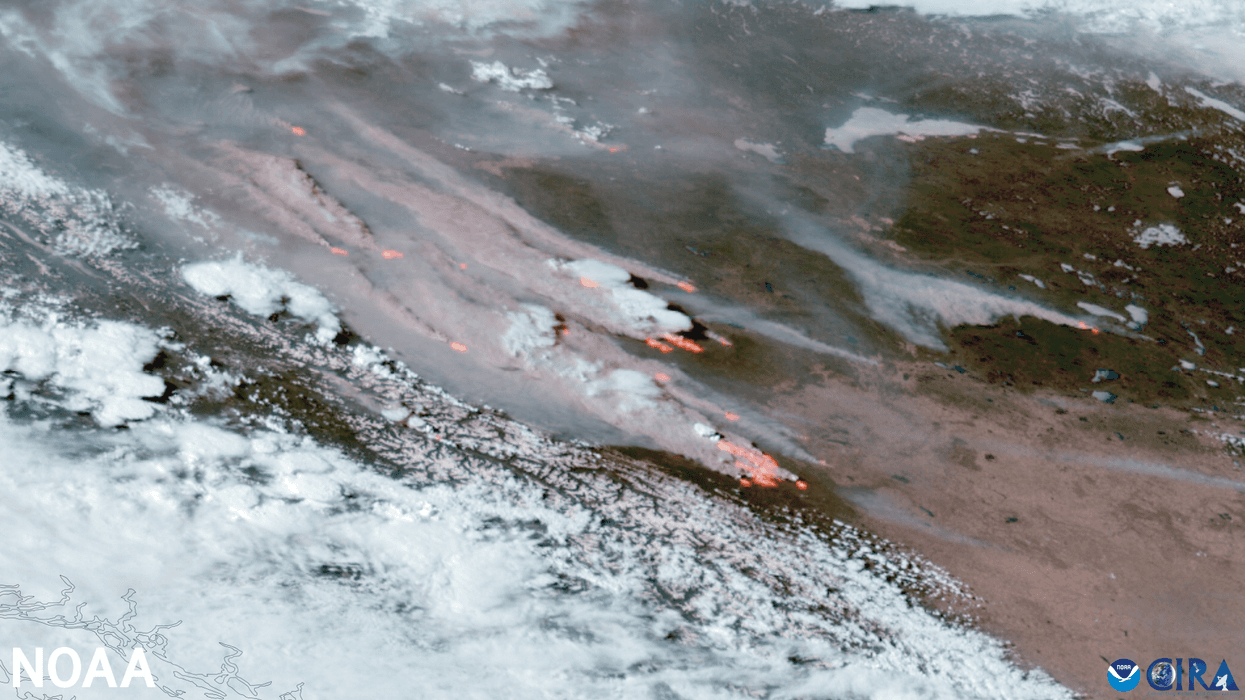
Already this year, warm spring temperatures have had consequences, from unprecedented wildfires in Canada that smothered the Eastern and Midwestern U.S. in smoke to a fish die-off in the Gulf of Mexico.
"With climate change and global warming, it's been an interesting start to the season," NOAA climatologist Rocky Bilotta said during a press call reported by The New York Times.
University of California, Los Angeles climate scientist Daniel Swain told ABC News that the high ocean temperatures were caused by a mixture of the climate crisis, the developing El Niño, the 2022 Hunga Tonga-Hunga Ha'apai volcano eruption, and a reduction in shipping emissions that has removed cooling aerosols from the atmosphere.
If such warming persists, it could have serious consequences because warmer oceans fuel stronger tropical storms and a warmer atmosphere holds more moisture that can worsen flooding events. The World Meteorological Organization (WMO) warned in May that there was a 66% chance that El Niño would work with climate change to push at least one year's average temperature past 1.5°C above preindustrial levels between 2023 and 2027.
C3S noted that the 1.5°C and 2°C temperature targets were based on averages over 20 to 30 years. However, the service added, "as the global mean temperature continues to rise and more frequently exceed the 1.5°C limit, the cumulative effects of the exceedances will become increasingly serious."
Scientists and activists said these breaches, and other recent temperature anomalies and extreme weather events, should serve as a warning to policymakers to act quickly to phase out fossil fuels and reduce greenhouse gas emissions.
"Without stronger emission cuts, the changes we are seeing are just the start of the adverse impacts we can expect to see," Cornell University atmospheric scientist Natalie Mahowald told The Guardian. "This year and the extreme events we have seen so far should serve as a warning."
Activist Bill McKibben meanwhile said the scariest element of recent weather news was that "the world isn't reacting rationally to it."
"The rapid warming over the next couple of years is likely to be our last opportunity to really act coherently as a civilization to reduce the magnitude of this crisis, and so far we are blowing it," he wrote Thursday.
Indeed, U.N. climate talks in Bonn, Germany, which were intended to prepare the way for the COP28 climate conference in the United Arab Emirates in November and December, ended Thursday with an impasse between the E.U. and climate vulnerable countries who want faster emissions cuts and a fossil fuel phaseout, and developing countries that want more climate finance from the Global North, as AFP explained.
"The gap between the Bonn political performance and the harsh climate reality feels already absurd," Li Shuo, a senior global policy adviser at Greenpeace East Asia, told AFP. "Climate impacts stay no longer on paper. People are feeling and suffering from it now."
U.N. Secretary-General António Guterres warned during a press conference Thursday that current national policies put the world on track for 2.8°C of warming by 2100.
"That spells catastrophe," Guterres said. "Yet the collective response remains pitiful."

Remember, people, this is an experiment we haven’t run before, and the test tube we’re using is the whole planet.
Something very troubling is happening on and under the 70 percent of the planet’s surface covered by salt water. We pay far more attention to the air temperature, because we can feel it (and there’s lots to pay attention to, with record temps across Asia, Canada and the Pacific Northwest) but the truly scary numbers from this spring are showing up in the ocean.
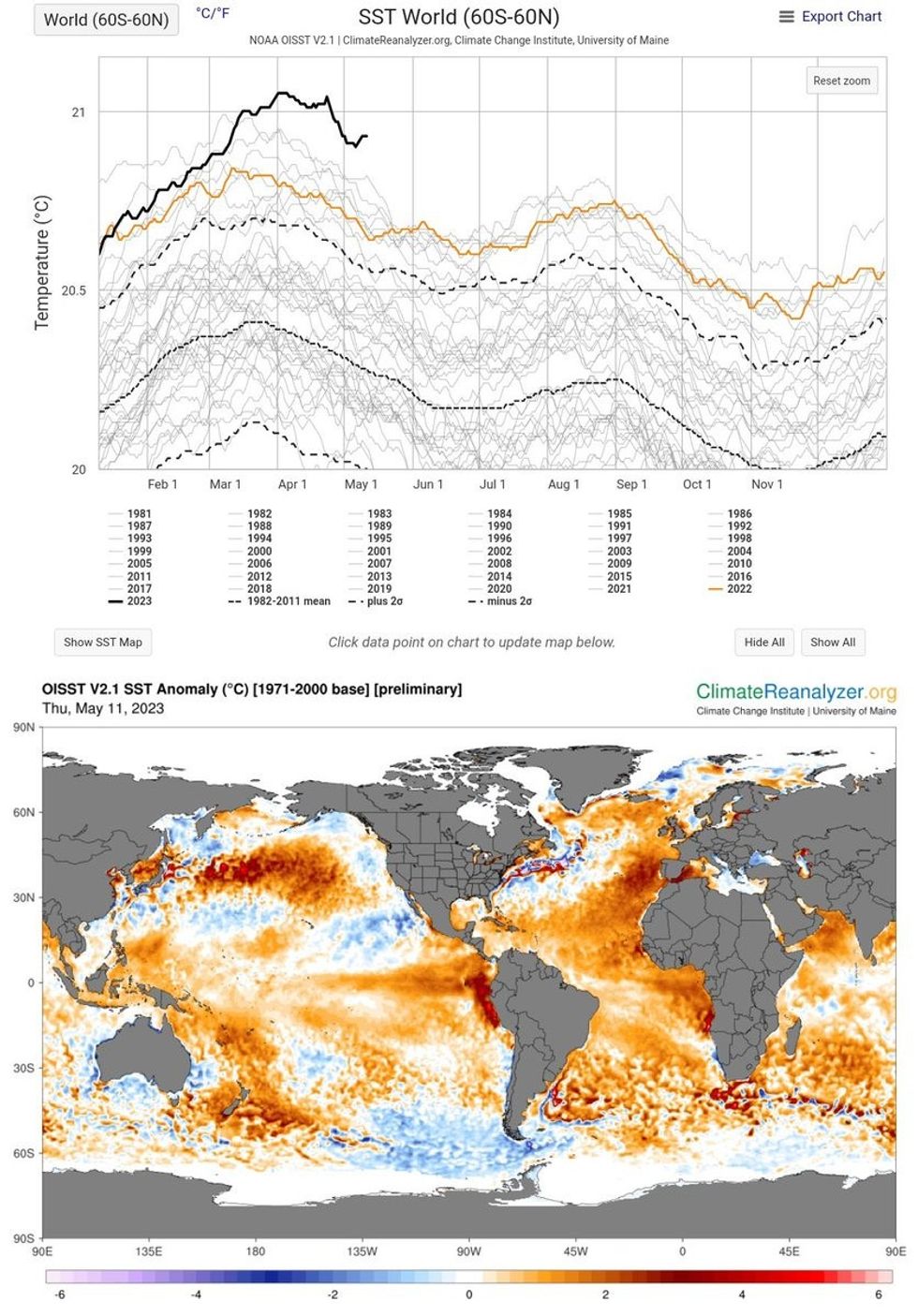 (Graph/Data: via Climate Reanalyzer.org/University of Maine)
If you look at the top chart above, you can see “anomaly” defined. That’s the averaged surface temperature of the earth’s oceans, and beginning in mid-March it was suddenly very much hotter than we’ve measured before. In big datasets for big phenomena, change should be small—that’s how statistics work, and that’s why the rest of the graph looks like a plate of spaghetti. That big wide open gap up there between 2023 and the next hottest year (2016) is the kind of thing that freaks scientists out because they’re not quite sure what it means. Except trouble.
The magnitude of this jump has scientists somewhat perplexed and considerably more frightened—as the BBC pointed out, the numbers are extreme.
In March, sea surface temperatures off the east coast of North America were as much as 13.8C higher than the 1981-2011 average.
"It's not yet well established, why such a rapid change, and such a huge change is happening," said Karina Von Schuckmann, the lead author of the new study and an oceanographer at the research group Mercator Ocean International.
One factor at play is that seagoing vessels have been rapidly phasing out their use of “bunker fuel,” the literal bottom-of-the-barrel tarry sludge that ships have generally burned because it is very very cheap and because they are…out at sea. Research indicated that the pollution from this stuff was blowing back to port and damaging humans, so as Ryan Cooper reports it is being replaced with cleaner fuel. Big enviro win, except that the aerosols in the choking exhaust of those ships (the stuff coming out the smoke stack) helped seed clouds as it trailed out across the main shipping routes; the air is now clearer on those routes, and hence more sunlight gets through to the ocean.
That big wide open gap up there between 2023 and the next hottest year (2016) is the kind of thing that freaks scientists out because they’re not quite sure what it means. Except trouble.
But in a deeper sense, the oceans just seem to be heating very very fast now. A little-noticed recent study headed by Katrina von Schuckmann found that “over the past 15 years, the Earth has accumulated almost as much heat as it did in the previous 45 years,” and that 89 percent of that heat has ended up in the seas. That would be terrifying on its own, but coming right now it’s even scarier. That’s because, after six years dipping in and out of La Nina cooling cycles, the earth seems about to enter a strong El Nino phase, with hot water in the Pacific. El Nino heat on top of already record warm oceans will equal—well, havoc, but of exactly what variety can’t be predicted.
And the ‘can’t be predicted’ part is the real problem. Remember, people, this is an experiment we haven’t run before, and the test tube we’re using is the whole planet. Lots of things will happen: maybe the Beaufort Gyre will release a whole lot of freshwater into the North Atlantic, further disrupting the already weakened Gulf Stream. I bet you hadn’t been worrying about the Beaufort gyre, but a new study last week… Or maybe there will be more of the Midwest drought currently forcing farmers to abandon wheat crops at a record rate. Or ocean oxygen levels will keep falling, putting pressure on lots of species (except jellyfish).
Some things we can say with near certainty: the World Meteorological Organization predicted today that there was a 98 percent chance that sometime during this El Nino run the world will set a new annual temperature record. (I’ve been guessing 2024, but the odds that 2023 might break the all-time record set in 2016 are rising by the day and are currently about one in four). There’s a very good chance, in fact, that at least for a year we will go past the 1.5 Celsius level that Paris set as the mark we should move heaven and earth to avoid. We haven’t moved heaven and earth—we budged Joe Manchin very slightly, though he’s now pushing back—and so we didn’t avoid it. Now what?
Now we have to organize as never before. This havoc, whatever form it takes, will produce pressure on our political and economic systems to do something. The oil industry will be trying to make sure that pressure is converted into yet more public dollars for carbon capture so they can go on burning coal and gas (check out this excellent summary of this particular scam from Food and Water Watch, and this NPR report on what happens when carbon pipelines rupture and suck out all the air).
Now we have to organize as never before.
So the rest of us better be prepared to give one last vigorous push to the clean energy project. As prices for the silicon in solar panels keep falling, the convergence of political pressure and economic opportunity offers the world one last good chance of—not stopping global warming, too late for that. A new National Renewable Energy Lab study underlines the fact that this is our cheapest, fastest option; a new Nature Conservancy study shows it will take even less land than we used to fear. But maybe stopping it short of cutting civilizations off at the knees. That’s what we’re playing for, and this stretch of hot weather is going to be our last best chance.
Last month was the hottest January the planet has experienced since record-keeping began nearly 140 years ago. New data released by NASA on Tuesday confirmed this —and not by much.
According to the data, January's global average surface temperature was 1.13 Celsius (or 2.3o Fahrenheit), above historical averages.
As Andrew Freedman notes at Mashable, making the single-month record even more troubling is that January also capped a three-month period of record-shattering warming, making it much harder to claim that the spike in January represents a fluke.
Climate Central took a close look at the new figures:
This January was the warmest January on record by a large margin while also claiming the title of most anomalously warm month in 135 years of record keeping. The month was 1.13degC -- or just a smidge more than 2degF -- above normal. That tops December's record of being 1.11degC -- or just a smidge below 2degF -- above average.
It marks the fourth month in a row where the globe has been more than 1degC (1.8degF) above normal. Incidentally, those are the only four months where the globe has topped that mark since record keeping began.
As Phil Plait explains at Slate, the latest temperature data comes from "land and ocean measurements analyzed by the NASA Goddard Institute for Space Studies, using NOAA temperature measuring stations worldwide. These are extremely high quality and reliable datasets of global temperature measurements -- despite the fallacious cries of a few."
According to Sally Elliot, writing for The Inquisitr:
The findings emerge amid a series of other studies which have identified similar trends outside of this January -- the past three months, in fact, was the hottest three-month period ever -- and verified links between human activity and climate change. Scientists from NASA and the National Oceanic and Atmospheric Administration (NOAA) have pointed out that, while the hottest January and preceding hottest 12 months ever were aided by the heat-intensifying effects of El Nino, the extremity of global warming has now surpassed the capabilities of natural weather phenomena.
Though expert cautions the data sets are still open to analytical refinement, experts and journalists who cover the global warming trends of recent years say the latest figures portend a frightening year ahead as this year's El Nino combines with already elevated atmospheric and ocean temperatures caused by man-made greenhouse gas emissions.
And as Plait reports:
As it happens, we're in the middle of an El Nino, an event in the Pacific Ocean that tends to warm surface temperatures. This is also one of if not the most intense on record. Some of that record-breaking heat in January is due to El Nino for sure, but not all or even a majority of it. As I pointed out recently, climate scientist Gavin Schmidt showed that El Nino only accounts for a fraction of a degree of this heating. Even accounting for El Nino years, things are getting hotter.
The root cause is not El Nino. It's us. We've been pumping tens of billions of tons of CO2 into the air every year for decades. That gas has trapped the Earth's heat, and the planet is warming up.
Several of the months in 2015 were the hottest on record, leading to 2015 overall being the hottest year ever recorded (again, despite the ridiculously transparent claims of deniers). Will 2016 beat it? We can't say for sure yet, but judging from January, I wouldn't bet against it.
Last month, a joint analysis by NASA and the National Oceanic and Atmospheric Administration (NOAA), confirmed that 2015 was by far the hottest year recorded since the Industrial Revolution took hold.
"Climate change is the challenge of our generation, and NASA's vital work on this important issue affects every person on Earth," said NASA Administrator Charles Bolden in a statement at the time.
Those findings, Bolden continued, "not only underscores how critical NASA's Earth observation program is, it is a key data point that should make policymakers stand up and take notice - now is the time to act on climate."
Hurricane Patricia--the most intense hurricane ever recorded in the Western Hemisphere--was downgraded to a tropical depression with 35-mph sustained winds on Saturday and offered to some observers a reminder of the consequences of a warming planet.
No fatalities from the historic storm, which forced the evacuation of some 50,000 people, have yet been reported, and initial reporting indicates no major devastation. However, damages from potential heavy winds, rains, and landslides are still unfolding as the storm moves inland.
By Saturday morning, Patricia had been downgraded to a Category 2. The National Hurricane Center reports, "On the forecast track, the center of Patricia will move across central and northeastern Mexico today and tonight."
The New York Times reports:
The hurricane spared the densely populated centers of Puerto Vallarta and Manzanillo; it appears to have done the most damage to small villages between the two cities. For many in these impoverished communities, it could take much time to recover from even moderate damage.
The Weather Channel notes that flooding and mudslides remain potentially deadly threats and adds: "El Universal reported that multiple homes were severely damaged and banana and papaya crops were destroyed in Michoacan state. Mud and landslides closed several roads in the region. Some homes in Cuyultan, Colima, were flooded."
Before landfall Friday evening along Mexico's Pacific coast with sustained winds of 165 mph, the then-Category 5 storm was packing winds of 200 mph. "These are the highest reliably-measured surface winds on record for a tropical cyclone, anywhere on the Earth," meteorologist Jeff Masters wrote.
Masters and fellow meteorologist Bob Henson described Patricia as "stunning, historic, mind-boggling, and catastrophic." They added that it's "the fastest-intensifying hurricane ever observed in the Western Hemisphere" and that Patricia's "200 mph sustained winds make it the third strongest tropical cyclone in world history."
"How did Patricia get to be so strong?" meteorologist Eric Holthaus asks at Slate.
The answer, quite simply, involves human-caused climate change. Hurricane Patricia is exactly the kind of terrifying storm we can expect to see more frequently in the decades to come. Although there's no way to know exactly how much climate change is a factor in Patricia's explosive strengthening, it's irresponsible, at this point, not to discuss it.
"Meteorologically," Holthaus adds, "there are at least four reasons why global warming could have contributed to Patricia's ferocity: El Nino, exceptionally warm ocean temperatures, increased atmospheric humidity, and sea level rise."
The Washington Post also notes that "record-setting hurricanes are consistent with predictions by climate researchers about the consequences of a warming world." The Post continues:
The oceans heating up because of climate change will have consequences, said Michael Mann, a climate researcher at Penn State University. "Hurricane Patricia, and her unprecedented 200 mile-per-hour sustained winds, appears to be one of them now, unfortunately."
Such consequences were undeniable to Mexico's climate negotiator at the Bonn, Germany climate talks, which concluded Friday and where delegates sought to hammer out a draft climate treaty ahead of the upcoming COP21 talks in Paris.
Reportedly holding back tears, Roberto Dondisch urged the other delegates to reach a consensus on a deal.
"In about four hours, Hurricane Patricia will hit the Mexican coast," Dondisch said. "I don't think I need to say more about the urgency to get this deal done."
Yet climate change campaigners say the Bonn talks failed to make the needed progress.
"The deplorable inaction at the climate negotiations is a calamity for people across the world," said Dipti Bhatnagar, Friends of the Earth International's climate justice and energy coordinator. "We are facing a planetary emergency with floods, storms, droughts and rising seas causing devastation. The risk of irreversible climate change draws ever closer, and hundreds of thousands of people have already paid with their lives."
The world is burning up.
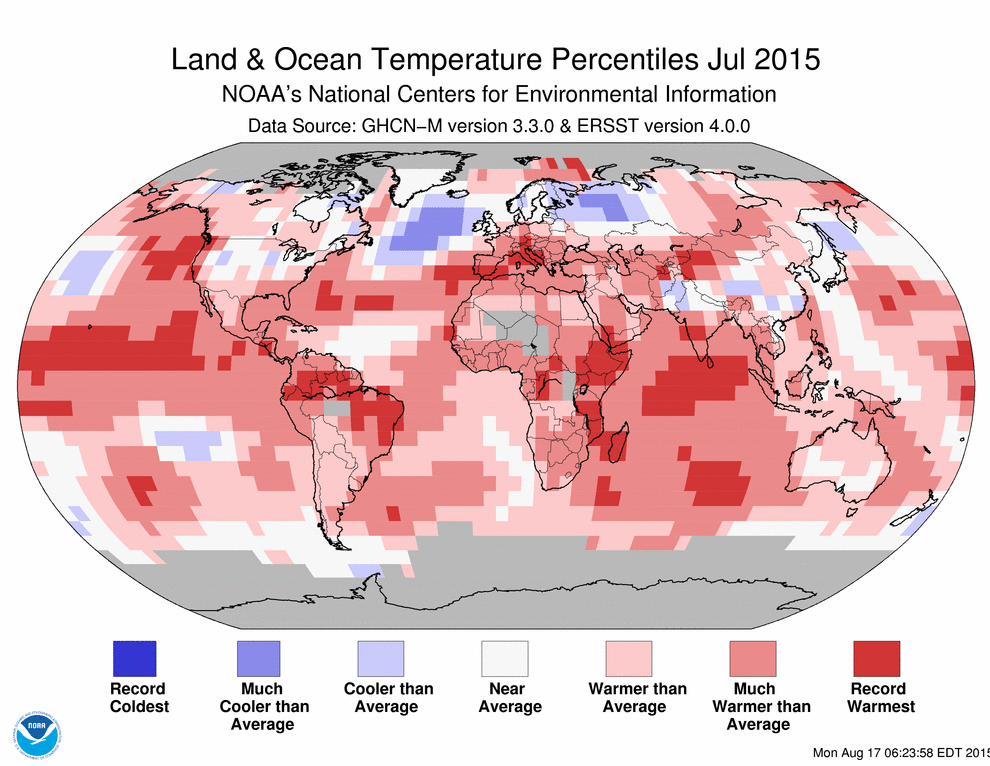
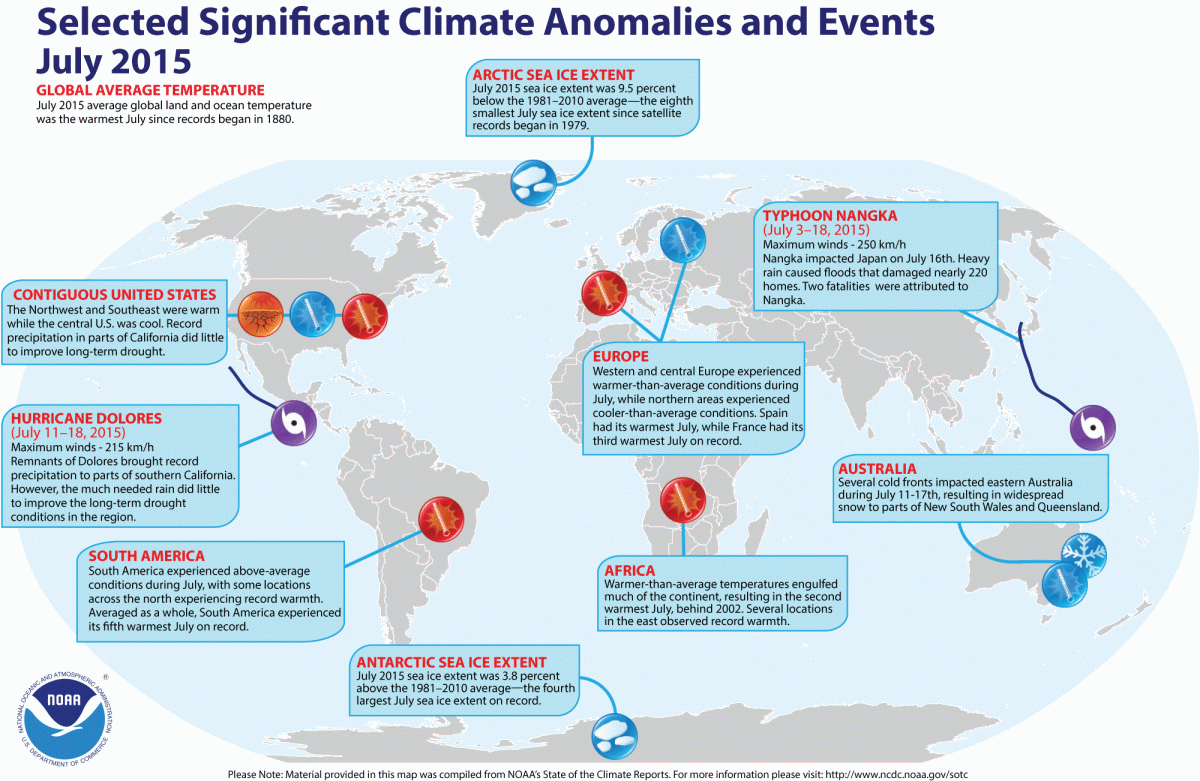
The previously available evidence supports that statement. On Thursday, the National Oceanic and Atmospheric Administration in the U.S. announced that July was the hottest month the planet has experienced since records began and that both land and ocean temperatures are on pace to make 2015 the hottest year ever recorded.
According to NOAA's latest figures, the July average temperature across global land and ocean surfaces was 1.46 degrees Fahrenheit (0.81 degrees Celsius) above the 20th-century average. As July consistently marks the warmest month of the year, NOAA said this most recent one now registers as having the all-time highest monthly temperature since records began in 1880, with an average global thermometer reading of 61.86 degrees Fahrenheit (16.61 degrees Celsius).
NOAA's temperature analysis follows similar findings by NASA and the Japan Meteorological Agency (JMA) published earlier this week, which also said July was a record-breaker regarding heat.
"The world is warming. It is continuing to warm. That is being shown repeatedly in our data," said Jake Crouch, a physical scientist at NOAA's National Centres for Environmental Information.
"Now that we are fairly certain that 2015 will be the warmest year on record," Crouch continued, "It is time to start looking at what the impacts of that are. What does that mean for people on the ground?"
At least for those who experienced perilous heat waves in places like Pakistan, India, Iran, and Egypt in recent weeks and months, they know those direct impacts of record temperatures can be deadly. Meanwhile, climate scientists have spent much of the year--with a unique eye on upcoming UN climate talks in Paris--warning that the collective impacts of increased temperatures on land and in the oceans are resulting in severe consequences for human civilization and the natural world.
More troubling than any one month, experts note, is the consistent and driving trend that has seen temperatures on a steady march upward since the beginning of the century. As Andrea Thompson at Climate Central reports:
After 2014 was declared the warmest year on record, a Climate Central analysis showed that 13 of the 15 warmest years in the books have occurred since 2000 and that the odds of that happening randomly without the boost of global warming was 1 in 27 million.
Even during recent years when a La Nina (the cold water counterpart to El Nino) has been in place, the year turned out warmer than El Nino years of earlier decades.
Global carbon dioxide levels have risen from a preindustrial level of about 280 parts per million to nearly 400 ppm today. In recent years, CO2 levels -- the primary greenhouse gas -- have spent longer and longer above the 400 ppm benchmark. They stayed above this point for about six months this year, twice the three months of last year. It is expected that within a few years, they will be permanently above 400 ppm.
The continued rise of CO2 levels will raise the planet's temperature by another 3degF to 9degF by the end of this century depending on when and if greenhouse gas emissions are curbed, scientists have calculated.
That means that some, future years are likely to continue to set records, even if there will still be year to year variations.
According to Eric Holthaus, who writes about climate change for Slate, the mounting evidence and rising temperatures are painting an increasingly scary picture of the future:
All this warmth on land is being driven by record-setting heat across large sections of the world's oceans. The NOAA report notes that the warmest 10 months of ocean temperatures on record have occurred in the last 16 months. This is mostly due to a near-record strength El Nino, but the current state of the global oceans has little historical precedent. Since it takes several months for the oceanic warmth of an El Nino to fully reach the atmosphere, 2016 will likely be warmer--perhaps much warmer--than 2015. And that poses grave implications for the world's ecosystems as well as humans.
We've recently entered a new point in the Earth's climate history. According to reconstructions using tree rings, corals, and ice cores, global temperatures are currently approaching--if not already past--the maximum temperatures commonly observed over the past 11,000 years (i.e., the time period in which humans developed agriculture), and flirting with levels not seen in more than 100,000 years.
But this is the scary part: The current level of carbon dioxide in the atmosphere is higher than at any point since humans first evolved millions of years ago. Since carbon dioxide emissions lead to warming, the fact that emissions are increasing means there's much more warming yet to come. What's more, carbon dioxide levels are increasing really quickly. The rate of change is faster than at any point in Earth's entire 4.5 billion year history, likely 10 times faster than during Earth's worst mass extinction--the "Great Dying"--in which more than 90 percent of ocean species perished. Our planet has simply never undergone the kind of stress we're currently putting on it. That stunning rate of change is one reason why surprising studies like the recent worse-than-the-worst-case-scenario study on sea level rise don't seem so far fetched.