

SUBSCRIBE TO OUR FREE NEWSLETTER
Daily news & progressive opinion—funded by the people, not the corporations—delivered straight to your inbox.
5
#000000
#FFFFFF
To donate by check, phone, or other method, see our More Ways to Give page.
Daily news & progressive opinion—funded by the people, not the corporations—delivered straight to your inbox.
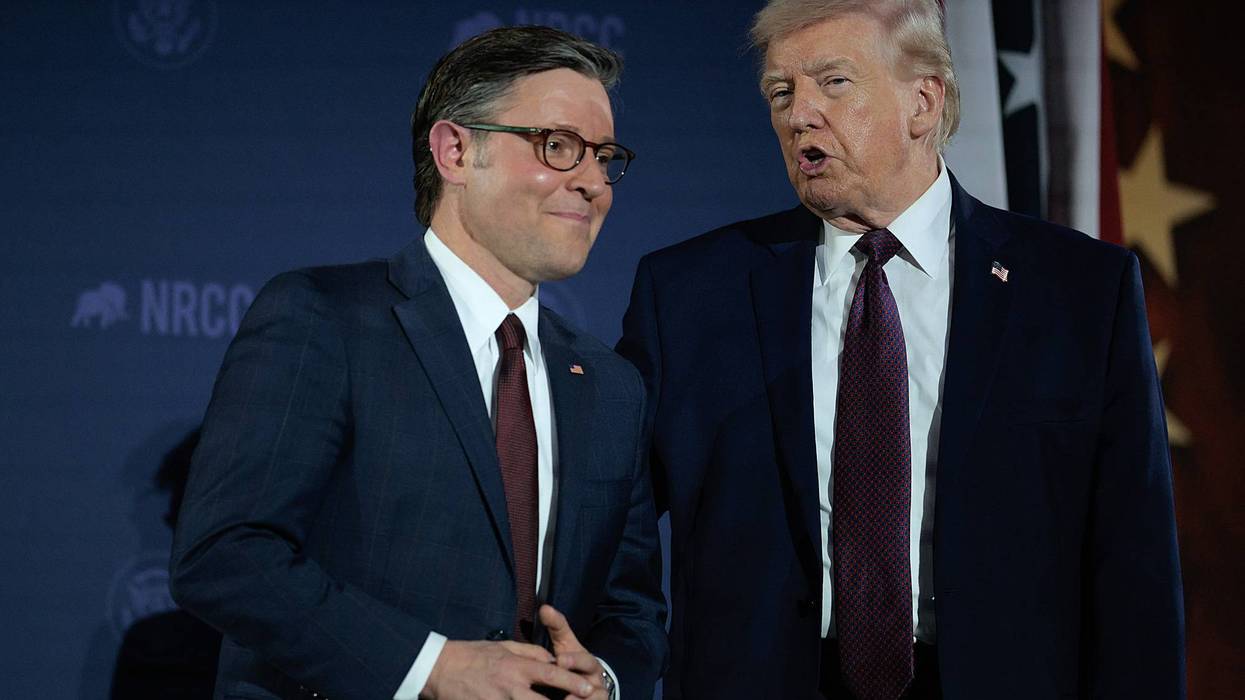
Section 702 of the Foreign Intelligence Surveillance Act is set to expire Thursday, and the president is claiming Saturday's shooting proved "the safety of our nation" depends on the program.
An exchange of gunfire between an armed suspect and law enforcement outside the White House Correspondents' Dinner on Saturday came days ahead of a deadline for extending far-reaching government surveillance powers, and President Donald Trump wasted no time in claiming that the attempted attack on the event proved that the FBI must be permitted to spy on Americans without obtaining warrants.
In an interview with Fox News Sunday, Trump repeated his previous remarks that he is "willing to give up [his] security" in favor of extending Section 702 of the Foreign Intelligence Surveillance Act (FISA), which is set to expire on Thursday—and suggested other Americans should do the same for "the safety of our nation."
Section 702 allows US intelligence agencies to surveil the electronic communications of foreign nationals overseas without a warrant. Since some of the nearly 350,000 foreign nationals whose communications have been collected under the law are in touch with Americans, Section 702 allows for the collection of emails, text messages, and phone calls of US citizens.
Fox anchor Jacqui Heinrich emphasized that "we don't know right now" whether the suspect in Saturday's shooting, Cole Tomas Allen, "was radicalized" by a foreign individual or group, but asked whether the attack drove home "the importance of having these tools to protect our country from these kinds of threats."
The president responded by complaining that former FBI Director James Comey used FISA to obtain warrants to surveil a former Trump aide as part of the agency's investigation into the 2016 Trump presidential campaign's communications with Russia, before saying FISA has been used in the US-Israeli war on Iran and in the US military's invasion of Venezuela earlier this year.
"It's really needed for national security," said Trump. "Iran is decimated, and we got a lot of information by using FISA... I'm willing to give up my security for the military because ultimately that's to me the highest cause is, you know, the safety of our nation."
Pres. Trump, under prodding from Fox News, exploits White House Correspondents' Dinner shooting to push for Congress to approve FISA domestic spying program: "It's really needed for national security…"
He reiterates that he's willing to give up his liberties for safety. pic.twitter.com/tmcepp0Wgn
— Chris Menahan 🇺🇸 (@infolibnews) April 26, 2026
Jordan Liz, an associate professor of philosophy at San José State University, wrote last week in a column at Common Dreams that while Trump, Republican lawmakers, and US intelligence agencies "make sweeping claims about the terror attacks that Section 702 has prevented, there is little publicly available evidence to support this."
"According to the Cato Institute, there is only one well-documented, independently corroborated case of Section 702 preventing a terrorist attack on American soil: the 2009 New York subway bombing plot," wrote Liz. "In that case, Section 702 was used by the [National Security Agency] to track an exchange between an al-Qaeda courier and Najibullah Zazi, who was living in the US. The NSA passed this information to the FBI, which identified Zazi and disrupted the attack before it took place. Importantly, however, the NSA allegedly received the courier’s foreign email address from the government’s British intelligence partners. At best then, this success was a byproduct of productive intelligence sharing between allies. Rather than proving the necessity of Section 702, this incident underscores how Trump’s inane attacks against key US allies undermine our national security."
The suspect in Saturday's shooting is believed to have acted alone, and no evidence has been released that he was in communication with any foreign entities. A document he wrote alluded to his Christian beliefs and to reports of the administration's abuse of immigrants in detention centers, its boat-bombing operations in the Caribbean Sea and eastern Pacific Ocean, and the bombing of an elementary school in Iran.
The president has been pushing in recent weeks for an extension of Section 702. The program was last reauthorized in 2024, and earlier this month two efforts to extend the program—one for 18 months and the other for five years—failed, with opponents objecting to a lack of privacy reforms and to a loophole allowing data brokers to sell private information about Americans to government agencies that have not obtained judicial approval to seize the data.
After those proposals failed, House Speaker Mike Johnson (R-La.) last week unveiled a new bill to extend Section 702 for three years and require the FBI to submit monthly reports on its reviews of Americans' private data to an oversight official, as well as imposing penalties for abuse—provisions that were dismissed by privacy advocates.
The House Rules Committee was set to convene on Monday, a step toward advancing the new bill toward a vote in the House, and according to NPR, Rep. Jamie Raskin (D-Md.) circulated a memo late last week urging his colleagues to reject the Republicans' latest proposal.
The bill, he wrote, "continues the disastrous policy of trusting the FBI to self-police and self-report its abuses of Section 702 and backdoor searches of Americans' data... FBI agents can still collect, search, and review Americans' communications without any review from a judge."
Four Democrats in the House—Reps. Josh Gottheimer (D-NJ), Tom Suozzi (D-NJ), Marie Gluesencamp Perez (D-Wash.), and Jared Golden (D-Maine)—broke with the party and joined the GOP earlier this month in supporting a procedural vote to advance the reauthorization of Section 702, and privacy advocates are ramping up pressure on them to oppose the latest proposal for an extension.
"It all comes down to those four and where they are going to land,” Hajar Hammado, a senior policy adviser at Demand Progress, told The Intercept Monday, “and if they are going to continue to try to hand Trump and [White House homeland security adviser] Stephen Miller warrantless surveillance authorities without any sort of checks or reforms that make sure they’re not violating civil liberties.”
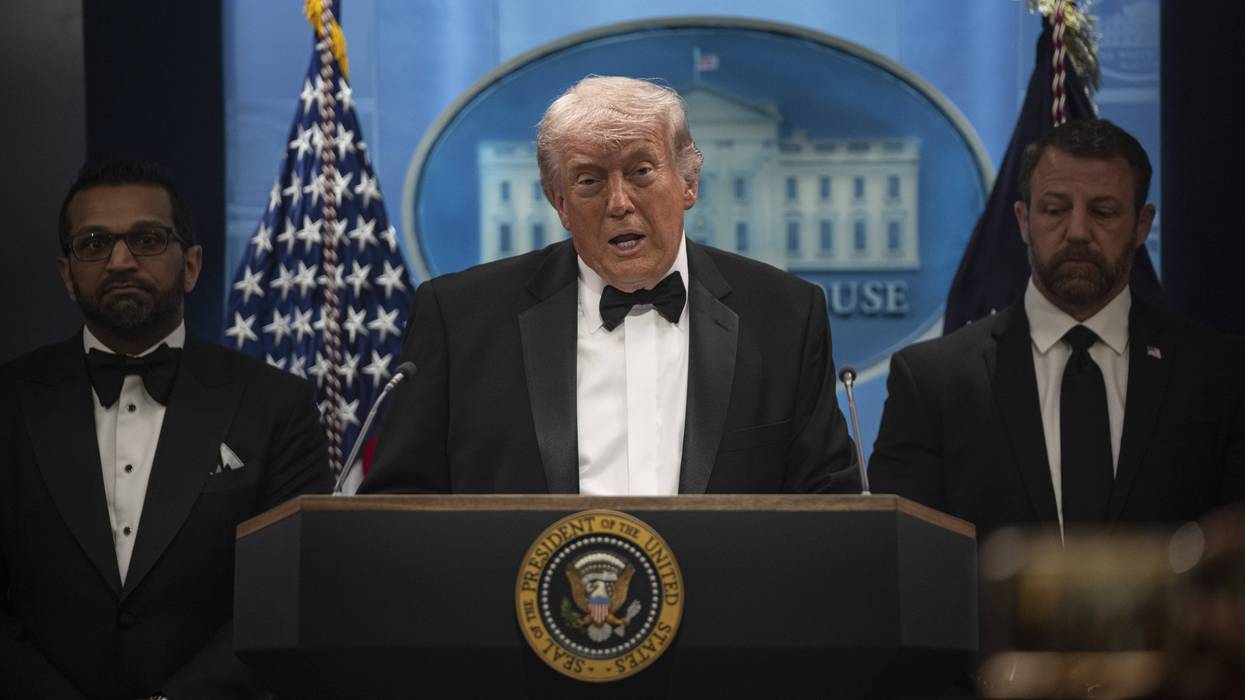
President Donald Trump was evacuated from the White House Correspondents' Dinner after a gunman charged a security checkpoint at the hotel hosting the event.
US President Donald Trump used a lone gunman's storming of the lobby outside the White House Correspondents' Dinner on Saturday night to promote his $400 million White House ballroom project, which is riddled with glaring conflicts of interest.
Speaking at a press conference after being evacuated from the Washington Hilton hotel hosting the White House Correspondents' Dinner, Trump declared that "this is why we have to have all of the attributes of what we're planning at the White House." The president added that "we need the ballroom," saying, "We need levels of security that probably nobody's ever seen before."
President Trump says tonight’s shooting at the WHCD is a clear example of why we need a need a new ballroom for The White House pic.twitter.com/a6dzeH9nyB
— Acyn (@Acyn) April 26, 2026
A man armed with multiple weapons, including a shotgun, charged a security checkpoint outside the White House Correspondents' Dinner on Saturday night, setting off a chaotic scramble to evacuate Trump and members of his administration who were present at the private event.
The chief of the Washington, DC police said at a press conference that the suspect, later identified as 31-year-old Cole Allen of Torrance, California, "exchanged gunfire" with law enforcement and a US Secret Service officer "was struck in his vest." The suspect was not shot and was taken into custody, the police chief said.
CBS News White House reporter Jennifer Jacobs noted on social media that the shooting "happened on the level above the ballroom where the White House Correspondents Association dinner was."
"I don't think people hearing about this—or even those of us in the room—realized how far from the president, VP, and other guests this incident was," Jacobs added. "It was on another floor, up some stairs, and several sets of security away. Because the Washington Hilton's hotel and other public spaces were open for other functions, the entire building wasn't secured by the Secret Service, just the specific areas where the WHCA dinner was held."
Trump, who skipped the annual dinner during his first term as his administration assailed press freedoms, said the event would be rescheduled "within 30 days." Some White House reporters boycotted the event, citing the president's relentless attacks on journalists.
The scene was described as "absolute chaos," with Secret Service officers rushing through the ballroom to evacuate Trump, Vice President JD Vance, and other administration officials and attendees ducking under tables in confusion and panic.
This is the moment we realized what was happening and got down on the stage. Seconds before, all we could see was a throng of law enforcement barreling toward us from the doors at the back of the room.
Secret agents swept VP Vance, who was seated next to me, into the back. I… pic.twitter.com/ZaxFeZu5p0
— Jacqui Heinrich (@JacquiHeinrich) April 26, 2026
The White House ballroom project that Trump touted at his press conference after being evacuated from the correspondents' dinner has received funding from massive corporations with interests before the federal government. Other donations to the project are shrouded in secrecy.
Public Citizen noted in a recent report that "two-thirds of corporate donors—16 out of a total of 24—have entered into government contracts."
"Lockheed is the largest of these government contractors, having received $191 billion in contracts over the last five years. Altogether, the corporate donors benefited from nearly $43 billion in contracts last year and $279 billion over the last five years," the watchdog group observed. "Most of the corporate donors—14 out of 24—are facing federal enforcement actions and/or have had federal enforcement actions suspended by the Trump administration. These include major antitrust actions involving Amazon, Apple, Meta, Microsoft, Nvidia, and T-Mobile; labor rights cases involving Amazon, Apple, Caterpillar, Google, Lockheed, and Meta; and SEC matters involving Coinbase and Ripple."
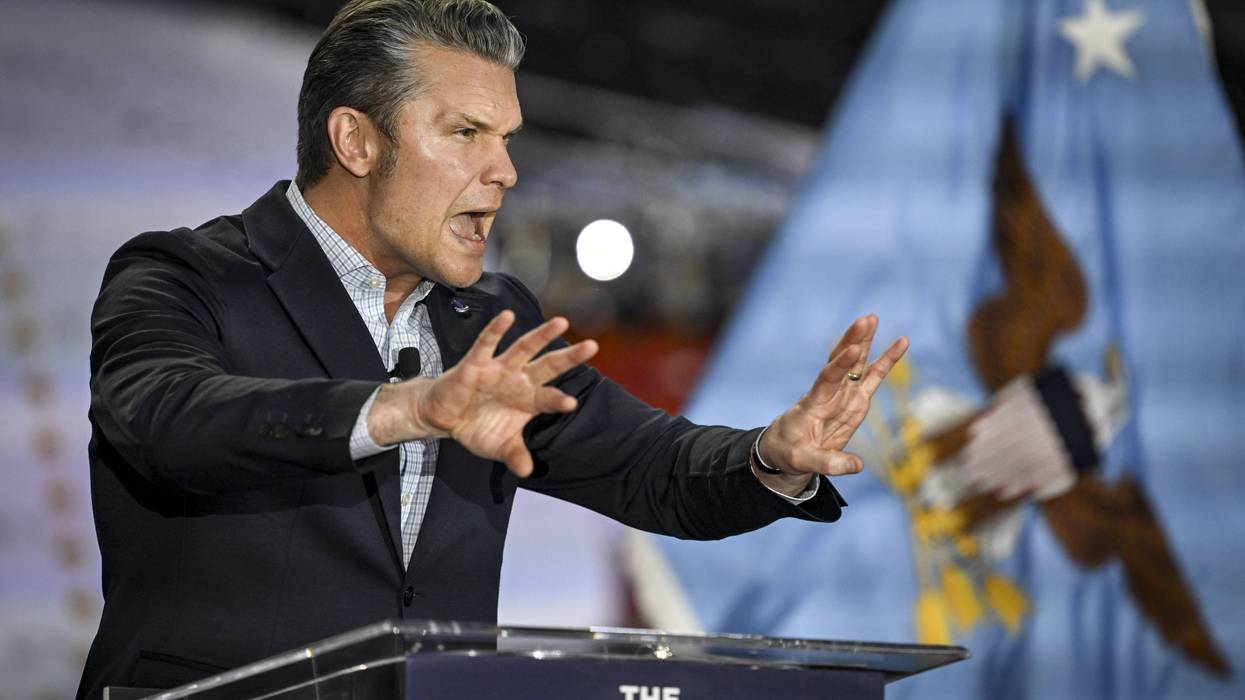
At the White House Correspondents’ Dinner, journalists like those at CBS should be demanding the answers of Pete Hegseth that he has refused to give to Congress.
CBS News is inviting Secretary of War Pete Hegseth to join them at the White House Correspondents’ Dinner this week—to sit at their table, surrounded by journalists he’s banned from Pentagon press conferences.
Many, including journalists who work at CBS, are calling this invitation distasteful, given Hegseth’s attacks on truth, the First Amendment, and journalism. However, given CBS’s hard pivot to the right after being absorbed into the Ellisons’ media sphere—and with warmonger Bari Weiss at the helm—maybe it’s just what makes sense for CBS. This is just one example of mainstream media not only refusing to ask questions of war criminals, but blatantly befriending them.
This move is particularly interesting given Hegseth’s last few months.
He oversaw and commanded the operation that kidnapped the head of state of another country when the US attacked Venezuela earlier this year. He also oversaw targeted strikes that extrajudicially killed Venezuelan fishermen under the auspices of drug smuggling. Just last month, he started the US war against Iran by using AI to target an elementary school in Minab, killing nearly 200 children in an instant. He’s been in lockstep with President Donald Trump in terms of genocidal rhetoric toward seemingly any country he wakes up hating that day. Now, the Hegseth War Department is reportedly planning a war on Cuba—a country 90 miles away from the United States that has done absolutely nothing to us except try to send emergency medical aid after Hurricane Katrina.
Yet the media keeps framing these threats as if he’s bluffing, as if he hasn’t ordered horrific military actions before, as if the blood of 168 little girls won’t still be dripping from his hands as they sit across from him at the White House Correspondents’ Dinner.
The Minab school bombing has seemingly stuck with people in terms of Hegseth’s brutality. Surely, the deliberate targeting of an elementary school is a war crime. Shortly after the bombing, members of Congress submitted a list of 10 questions for Hegseth to answer. It included questions about the use of artificial intelligence in target selection, what steps he took to mitigate civilian harm, and what coordination had been done with Israel. He was also asked what mitigation measures he would take in the future. March 20 was the deadline given to him by Congress, and the day came and went without a word from him.
If the attack in Minab that killed little girls and boys had been an accident, I imagine he could have answered those questions easily. That is one of his many war crimes, possibly one of his most blatant. But a person only needs to commit one war crime to be a war criminal; it just depends on who holds him accountable. If Congress couldn’t get answers to its questions, you would think outlets like CBS would be responsible for having him on their shows and demanding answers, as real journalists would. But instead, they invite him to dinner.
On top of the targeting of a school, Hegseth has also repeatedly—during a ceasefire and delicate negotiations—threatened to bomb Iran’s energy infrastructure. Intentionally attacking power plants or electric grids is a war crime under international law. If carried out as Trump and Hegseth have articulated, wiping out Iran’s power would mean millions of people could die in ways most people in the US can’t even imagine. Power in hospitals would go out, ventilators would shut down, and incubators would stop working. Food would spoil, and transportation—for the sick and injured—would fail. Their blood would be on Hegseth’s hands. Yet the media keeps framing these threats as if he’s bluffing, as if he hasn’t ordered horrific military actions before, as if the blood of 168 little girls won’t still be dripping from his hands as they sit across from him at the White House Correspondents’ Dinner.
At the White House Correspondents’ Dinner, journalists like those at CBS should be demanding answers he refused to give to Congress. With a war secretary who bans the press from his briefings, this might be their only chance to get them.
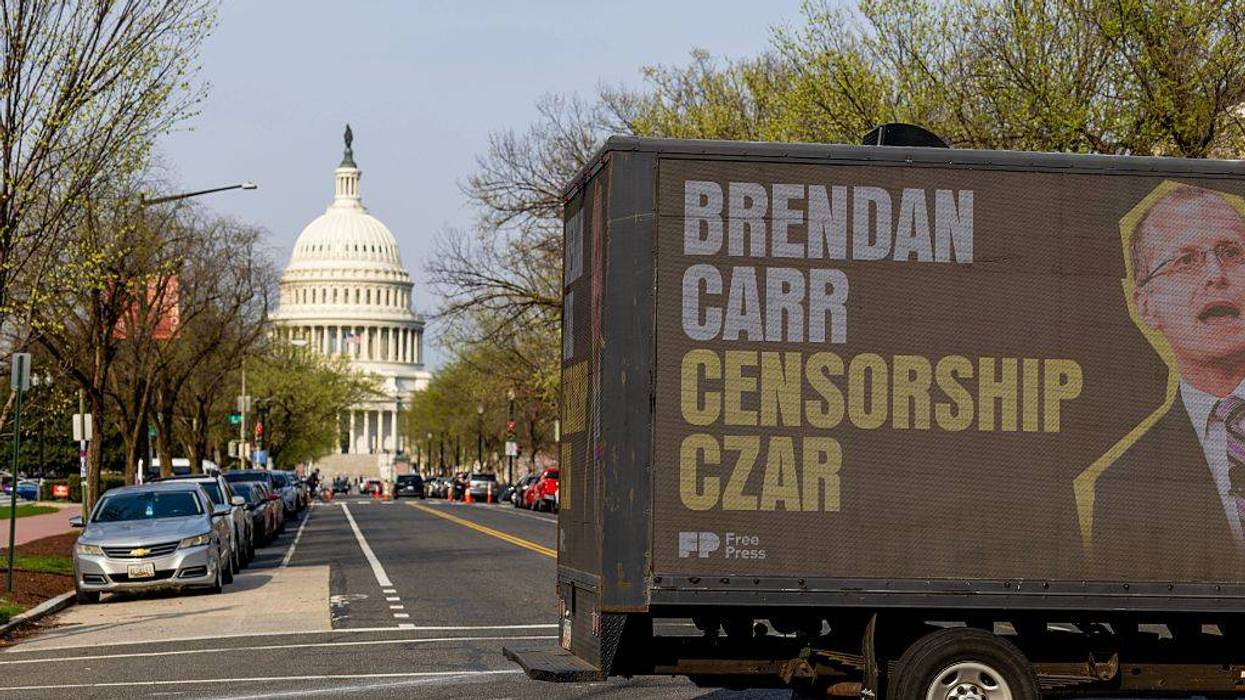
"When you invite fascists to dinner, they devour you," said one critic of the event.
The White House Correspondents' Association is facing pressure to stand up to President Donald Trump over his administration's relentless assault on the free press.
A letter sent to the WHCA on Monday and signed by prestigious US journalists—including Ann Curry, Bill Press, Sam Donaldson, and Dan Rather—urges the association to use its upcoming White House Correspondents' Dinner to "forcefully demonstrate opposition to President Trump's efforts to trample freedom of the press."
The letter outlines several Trump administration actions that it says have undermined the First Amendment of the US Constitution, including "retaliatory access bans, coercive regulatory investigations, frivolous lawsuits against the press, defunding of public broadcasting, dismantling of international broadcasting, physical restrictions on journalists... the arrest of journalists, and the pardoning of those who committed violence against the press."
The letter says that making a strong statement of resistance to Trump will be particularly important because the president is expected to attend and speak at this year's dinner.
"These are not normal times," the letter states, "and this cannot be business as usual with the press standing up to applaud the man who attacks them on a daily basis."
The letter recommends journalists attending the dinner "speak forcefully, in front of the man who seeks to undermine our country's long tradition of an independent, strong, and free press."
On Monday night, Status News reported that Trump-appointed Federal Communications Commission (FCC) Chairman Brendan Carr, who has threatened to revoke broadcasters' licenses unless they give the Trump administration more favorable news coverage.
Mark Jacob, former metro editor at The Chicago Tribune and Sunday editor at The Chicago Sun-Times who last week called for the dinner to be canceled, wrote in a Tuesday social media post that Carr's presence at the dinner seemed like a deliberate insult to the journalists attending.
"The suck-up media will never learn," Jacob commented. "When you invite fascists to dinner, they devour you."
In a piece published by the Washington Monthly on Tuesday, journalist Bill Scher said that Trump's presence at the WHCA dinner was a betrayal of the organization's stated mission to celebrate and defend freedom of the press, and Scher also recommended canceling the event.
"A fundraising event to support 'programs to educate the public and the value of the First Amendment and a free press,'" Scher wrote, "should not have a featured speaker who is the biggest peacetime threat to the First Amendment and a free press in American history."
Scher went on to slam the "naive" rationales offered by WHCA members in showcasing Trump at the event.
"There is nothing to be gained by 'showing the president and other politicos the importance of a free press' when the president is exerting state control over the press," Scher contended. "He has employed litigation and threats from the FCC chair to selectively apply the equal time rule and revoke broadcast licenses over their war coverage, and threats from himself to imprison war correspondents."

"To sit and schmooze with the president while he sends billions of dollars in weapons to Israel to kill their colleagues in Gaza is unethical and immoral."
On Saturday night, U.S. reporters and government officials—including President Joe Biden—will gather at the Washington Hilton Hotel for the annual White House Correspondents' Dinner, a glitzy, humor-filled affair that has faced mounting boycott calls in recent weeks as Palestinian journalists in Gaza are targeted and killed by the Israeli military in appalling numbers.
Earlier this month, dozens of Palestinian journalists urged their American colleagues to spurn the invite-only event "as an act of solidarity with us—your fellow journalists—as well as with the millions of Palestinians currently being starved in Gaza due to the Biden administration's continued political, financial, and military backing of Israel."
One journalist, Mehdi Hasan of Zeteo, has heeded the call.
"I have attended the White House Correspondents' Dinner for the past two years," Hasan, a former MSNBC host, wrote on social media Saturday, hours before the event. "I decided not to attend today's dinner (which, to be clear, is hosted by D.C. journalists not the White House) in solidarity with under-fire Palestinian journalists in Gaza who have called for a boycott."
According to the Committee to Protect Journalists, at least 97 media workers—92 of them Palestinian—have been killed in Gaza, Israel, and Lebanon since October 7. The Palestinian Journalist Syndicate puts the number higher at 125.
"Israel has killed over 10% of our colleagues," said Shuruq As'ad, director of the Palestine Journalism Hub and supporter of calls to boycott the White House Correspondents' Dinner, which is hosted by the White House Correspondents' Association.
The International Federation of Journalists (IFJ), an organization representing more than 600,000 media workers across 146 countries, endorsed the boycott push on Saturday, as did the National Writers Union (NWU).
"More than 100 journalists and media workers have been killed in the past six months of Israel's war on Gaza, backed by the United States government," NWU said in a statement. "As a union of journalists and media workers who strive for truth, we refuse to normalize genocide. Stand with journalists in Gaza and amplify the call for a boycott."
Israel's assault on Gaza, which has been fueled by U.S. weapons and diplomatic support, is the deadliest conflict for journalists in decades. Last year, roughly 75% of the journalists killed globally were killed by Israeli forces.
Al Jazeera's Gaza bureau chief, Wael Dahdouh, has lost five family members to Israeli airstrikes, including his 27-year-old son Hamza, who was also a journalist.
"To dine with him as he allows Palestinians to die of starvation by cutting off funding to critical humanitarian aid is despicable."
Press freedom groups have accused the Biden White House of failing to do enough to stop the Israeli military from targeting members of the media, who continue to risk their lives to show the world the devastation Israel is inflicting in Gaza.
"The Biden administration has been all talk when it comes to journalists killed by the Israel Defense Forces," Seth Stern, director of advocacy at the Freedom of the Press Foundation, said earlier this year. "The Biden administration says it cares deeply about journalists' freedom to cover the war but has failed to demand Israel ensure journalists' safety or hold it accountable when it doesn't."
The New York Times reported that in addition to the jokes, Biden is "expected to issue a more serious warning at a time when journalists around the world are being jailed or detained more frequently for doing their job."
But it remains to be seen whether the president will mention Gaza journalists specifically.
President Biden will address the White House Correspondents Dinner tonight. It’s expected that’ll he’ll mention threats to journalists around the world. Will he mention Israel’s murder of Shireen Abu Aqlah & the scores of Palestinian journalists murdered in Gaza? Probably not. pic.twitter.com/nA6M2t9nK9
— James J. Zogby (@jjz1600) April 27, 2024
Protests are expected outside the dinner's venue, but as NBC News reported, "protests inside the event itself are much less common and perhaps unprecedented, given the tight security."
"People involved in organizing the protests said they knew of no plans to try to infiltrate the exclusive invite-only dinner," the outlet added. (Kelly O'Donnell, NBC's senior White House correspondent, is presiding over this year's dinner.)
Sandra Tamari, executive director of the Adalah Justice Project, which helped organize the letter calling for a boycott of Saturday's dinner, said it's grotesque for reporters who claim to be committed to a free press to pal around with members of an administration that is aiding deadly attacks on journalists in Gaza.
"To sit and schmooze with the president while he sends billions of dollars in weapons to Israel to kill their colleagues in Gaza is unethical and immoral," said Sandra Tamari, executive director of Adalah Justice Project, which helped organize the letter calling for a boycott of Saturday's dinner. "To dine with him as he allows Palestinians to die of starvation by cutting off funding to critical humanitarian aid is despicable."

"We disrupted the rich and powerful because Joe Biden's approval of deadly new oil and gas projects is killing the planet," said the campaign group Climate Defiance. "We will continue to disrupt until we end fossil fuels."
Members of the corporate media were greeted by hundreds of climate action organizers Saturday night as they arrived at the Washington Hilton Hotel in Washington, D.C. for the annual White House Correspondents Dinner.
Youth-led direct action group Climate Defiance staged a blockade of the event to demand that President Joe Biden fulfill his campaign promise to end fossil fuel extraction on public lands.
The protest came weeks after the Biden administration approved Willow, the massive oil drilling project on federal lands in Alaska, and a month after an oil and gas lease sale of 1.6 million acres of offshore waters in the Gulf of Mexico went forward.
"The president promised us an end to new leasing on federal lands but failed to deliver. Now, he needs to hear from the voting bloc that delivered him the 2022 midterm elections," said Climate Defiance ahead of the protest, referring to research showing that voters between the ages of 18 and 29 were crucial to Biden's victory in 2020.
According to Pew Research, 62% of young voters support a complete phaseout of fossil fuels.
Climate Defiance is backed by the Climate Emergency Fund, a nonprofit run by climate psychologist Margaret Klein Salamon. The group was joined by organizers from the Sunrise Movement, which has helped push more than 100 Democratic lawmakers to co-sponsor Green New Deal legislation.
Documentarian Ford Fischer posted a video of a government vehicle attempting to drive through the protesters before retreating.
U.S. Rep. Ro Khanna (D-Calif.), a Green New Deal co-sponsor, thanked the demonstrators for the action as he walked past them, and climate scientist Peter Kalmus joined the group at one point, telling them, "You guys are on the right side of history... President Biden is on the wrong side of history [for] expanding the fossil fuels during a climate emergency."
Tennessee state Reps. Justin Jones (D-52) and Justin Pearson (D-86), who were recently expelled from the state House for participating in a gun control protest before being reinstated, also joined the campaigners to say that the interconnected fights "for democracy, climate justice, and an end to mass shootings require a coordinated emergency response."
"We're fighting a system that is trying to put the profits of the gun industry, the profits of the fossil fuel industry, the profits of the for-profit healthcare over the lives of our people," he said. "So we must stand together. We must let them know that if you come for one of us, you come for all of us."
"We disrupted the rich and powerful because Joe Biden's approval of deadly new oil and gas projects is killing the planet," said Climate Defiance after the blockade. "We will continue to disrupt until we end fossil fuels."

President Joe Biden just made good on his campaign promise to forgive billions in student debt. Republicans, predictably, have gone nuts.
When you search on the phrase "student debt forgiveness" one of the top hits that comes up is a Fox "News" article by a woman who paid off her loans in full.
"There are millions of Americans like me," the author writes, "for whom debt forgiveness is an infuriating slap in the face after years of hard work and sacrifice. Those used to be qualities we encouraged as an American culture, and if Biden gets his way, we'll be sending a very different message to the next generation."
This is, to be charitable, bullsh*t. Forgiving student debt is not a slap at anybody; it's righting a moral wrong inflicted on millions of Americans by Ronald Reagan and his morbidly rich Republican buddies.
When you invest in your young people, you're investing in your nation.
Student debt is evil. It's a crime against our nation, hobbling opportunity and weakening our intellectual infrastructure. Any nation's single biggest asset is a well-educated populace, and student debt diminishes that. It hurts America.
Student debt at the scale we have in America doesn't exist anywhere else in the rest of the developed world.
American students, in fact, are going to college for free right now in Germany, Iceland, France, Norway, Finland, Sweden, Slovenia, and the Czech Republic, because pretty much anybody can go to college for free in those countries--and dozens of others.
Student debt? The rest of the developed world doesn't know what you're talking about.
Student debt largely didn't exist here in America before the Reagan Revolution. It was created here in the 1980s, intentionally, and we can intentionally end it here and join the rest of the world in again celebrating higher education.
Forty years on from the Reagan Revolution, student debt has crippled three generations of young Americans: over 44 million people carry the burden, totaling a $1.8 trillion drag on our economy that benefits nobody except the banks earning interest on the debt and the politicians they pay off.
But that doesn't begin to describe the damage student debt has done to America since Reagan, in his first year as governor of California, ended free tuition at the University of California and cut state aid to that college system by 20 percent across-the-board.
After having destroyed low-income Californians' ability to get an education in the 1970s, he then took his anti-education program national as president in 1981.
When asked why he'd taken a meat-axe to higher education and was pricing college out of the reach of most Americans, he said--much like Ron DeSantis might today--that college students were "too liberal" and America "should not subsidize intellectual curiosity."
Four days before the Kent State Massacre of May 5, 1970, Governor Reagan called students protesting the Vietnam war across America "brats," "freaks," and "cowardly fascists." As The New York Times noted at the time, he then added:
"If it takes a bloodbath, let's get it over with. No more appeasement!"
Before Reagan became president, states paid 65 percent of the costs of colleges, and federal aid covered another 15 or so percent, leaving students to cover the remaining 20 percent with their tuition payments.
That's how it works--at a minimum--in many developed nations; in many northern European countries college is not only free, but the government pays students a stipend to cover books and rent.
Here in America, though, the numbers are pretty much reversed from pre-1980, with students now covering about 80 percent of the costs. Thus the need for student loans here in the USA.
As soon as he became president, Reagan went after federal aid to students with fervor. Devin Fergus documented for The Washington Post how, as a result, student debt first became a widespread thing across the United States during the early '80s:
"No federal program suffered deeper cuts than student aid. Spending on higher education was slashed by some 25 percent between 1980 and 1985. ... Students eligible for grant assistance freshmen year had to take out student loans to cover their second year."
It became a mantra for conservatives, particularly in Reagan's cabinet. Let the kids pay for their own damn "liberal" education.
Reagan's Director of the Office of Management and Budget, David Stockman, told a reporter in 1981:
"I don't accept the notion that the federal government has an obligation to fund generous grants to anybody that wants to go to college. It seems to me that if people want to go to college bad enough then there is opportunity and responsibility on their part to finance their way through the best way they can. ... I would suggest that we could probably cut it a lot more."
After all, cutting taxes for the morbidly rich was Reagan's first and main priority, a position the GOP holds to this day. Cutting education could "reduce the cost of government" and thus justify more tax cuts.
Reagan's first Education Secretary, Terrel Bell, wrote in his memoir:
"Stockman and all the true believers identified all the drag and drain on the economy with the 'tax-eaters': people on welfare, those drawing unemployment insurance, students on loans and grants, the elderly bleeding the public purse with Medicare, the poor exploiting Medicaid."
Reagan's next Education Secretary, William Bennett, was even more blunt about how America should deal with the "problem" of uneducated people who can't afford college, particularly if they were African American:
"I do know that it's true that if you wanted to reduce crime," Bennett said, "you could--if that were your sole purpose, you could abort every black baby in this country, and your crime rate would go down."
These various perspectives became an article of faith across the GOP. Reagan's OMB Director David Stockman told Congress that students were "tax eaters ... [and] a drain and drag on the American economy." Student aid, he said, "isn't a proper obligation of the taxpayer."
This was where, when, and how today's student debt crisis was kicked off in 1981.
Before Reagan, though, America had a different perspective.
Both my father and my wife Louise's father served in the military during World War II and both went to college on the GI Bill. My dad dropped out after two years and went to work in a steel plant because mom got pregnant with me; Louise's dad, who'd grown up dirt poor, went all the way for his law degree and ended up as an Assistant Attorney General for the State of Michigan.
They were two among almost 8 million young men and women who not only got free tuition from the 1944 GI Bill but also received a stipend to pay for room, board, and books. And the result--the return on our government's investment in those 8 million educations--was substantial.
The best book on that time and subject is Edward Humes' Over Here: How the GI Bill Transformed the American Dream, summarized by Mary Paulsell for the Columbia Daily Tribune:
[That] groundbreaking legislation gave our nation 14 Nobel Prize winners, threeSupreme Court justices, three presidents, 12 senators, 24 Pulitzer Prize winners, 238,000 teachers, 91,000 scientists, 67,000 doctors, 450,000 engineers, 240,000 accountants, 17,000 journalists, 22,000 dentists and millions of lawyers, nurses, artists, actors, writers, pilots and entrepreneurs.
When people have an education, they not only raise the competence and vitality of a nation; they also earn more money, which stimulates the economy. Because they earn more, they pay more in taxes, which helps pay back the government for the cost of that education.
Republican policies of starving education and cranking up student debt have made U.S. banks a lot of money, but they've cut America's scientific leadership in the world and stopped three generations of young people from starting businesses, having families, and buying homes.
In 1952 dollars, the GI Bill's educational benefit cost the nation $7 billion. The increased economic output over the next 40 years that could be traced directly to that educational cost was $35.6 billion, and the extra taxes received from those higher-wage-earners was $12.8 billion.
In other words, the U.S. government invested $7 billion and got a $48.4 billion return on that investment, about a $7 return for every $1 invested.
In addition, that educated workforce made it possible for America to lead the world in innovation, R&D, and new business development for three generations. We invented the transistor, the integrated circuit, the internet, new generations of miracle drugs, sent men to the moon, and reshaped science.
Presidents Thomas Jefferson and Abraham Lincoln knew this simple concept that was so hard for Reagan and generations of Republicans since to understand: when you invest in your young people, you're investing in your nation.
Jefferson founded the University of Virginia as a 100% tuition-free school; it was one of his three proudest achievements, ranking higher on the epitaph he wrote for his own tombstone than his having been both president and vice president.
Lincoln was equally proud of the free and low-tuition colleges he started. As the state of North Dakota notes:
Lincoln signed the Morrill Act on July 2, 1862, giving each state a minimum of 90,000 acres of land to sell, to establish colleges of engineering, agriculture, and military science. ... Proceeds from the sale of these lands were to be invested in a perpetual endowment fund which would provide support for colleges of agriculture and mechanical arts in each of the states.
Fully 76 free or very-low-tuition state colleges were started because of Lincoln's effort and since have educated millions of Americans including my mom, who graduated from land-grant Michigan State University in the 1940s, having easily paid her minimal tuition working as a summer lifeguard in Charlevoix.
Every other developed country in the world knows this, too: student debt is a rare or even nonexistent thing in most western democracies. Not only is college free or close to free around much of the world; many countries even offer a stipend for monthly expenses like our GI Bill did back in the day.
Thousands of American students are currently studying in Germany at the moment, for example, for free. Hundreds of thousands of American students are also getting free college educations right now in Iceland, Denmark, Norway, Finland, Sweden, Slovenia, and the Czech Republic, among others.
Republican policies of starving education and cranking up student debt have made U.S. banks a lot of money, but they've cut America's scientific leadership in the world and stopped three generations of young people from starting businesses, having families, and buying homes.
The damage to the working class and poor Americans, both in economic and human terms, is devastating. It's a double challenge for minorities.
And now President Biden has eliminated $10,000 of student debt for low-income people and up to $20,000 for those who qualified for Pell Grants.
The official Republican response came instantly, as USA Today reporter Joey Garrison noted on Twitter:
"The @RNC on Biden's student loan debt cancellation: 'This is Biden's bailout for the wealthy. As hardworking Americans struggle with soaring costs and a recession, Biden is giving a handout to the rich.'"
Which is particularly bizarre. "Wealthy" and "rich" people--by definition--don't need student loan forgiveness because they don't have student loans. How gullible do Republicans think their voters are?
Just like for-profit health insurance, student loans are a malignancy attached to our republic by Republicans
Marjorie Taylor Greene wrote on Twitter that student loan forgiveness was "completely unfair." That's the same Republican congresswoman who just had $183,504 in PPP loans forgiven, and happily banked the money without a complaint.
Republican members of Congress, in fact, seem to be among those in the front of the debt-forgiveness line with their hands out, even as billionaires bankroll their campaigns and backstop their lifestyles.
As the Center for American Progress noted on Twitter in response to a GOP tweet whining that "If you take out a loan, you pay it back":
Member ---- Amount in PPP Loans Forgiven
Matt Gaetz (R-FL) - $476,000
Greg Pence (R-IN) - $79,441
Vern Buchanan (R-FL) - $2,800,000
Kevin Hern (R-OK) $1,070,000
Roger Williams (R-TX) $1,430,000
Brett Guthrie (R-KY) $4,300,000
Ralph Norman (R-SC) $306,250
Ralph Abraham (R-AL) $38,000
Mike Kelly (R-PA) $974,100
Vicki Hartzler (R-MO) $451,200
Markwayne Mullin (R-OK) $988,700
Carol Miller (R-WV) $3,100,000
So, yeah, Republicans are complete hypocrites about forgiving loan debt, in addition to pushing policies that actually hurt our nation (not to mention the generation coming up).
Ten thousand dollars in debt forgiveness is a start, but if we really want America to soar, we need to go away beyond that.
Just like for-profit health insurance, student loans are a malignancy attached to our republic by Republicans trying to increase profits for their donors while extracting more and more cash from working-class families.
Congress should not only zero-out existing student debt across our nation but revive the post-war government support for education--from Jefferson and Lincoln to the GI Bill and college subsidies--that the Reagan, Bush, Bush II, and the Trump administrations have destroyed.
Then, and only then, can the true "making America great again" begin.

Comedian Michelle Wolf offered a succinct, withering reply to President Donald Trump's early Wednesday attack on her by drawing attention back to his continued support for Saudi Arabia in the face of a report linking the kingdom to the murder of journalist Jamal Khashoggi--after his clear attempt to distract from the matter.
After Trump claimed Wolf had "bombed so badly" in her viral remarks at the White House Correspondents Association (WHCA) dinner last year, Wolf suggested that the president would likely have come to her defense if she'd killed a journalist, as Saudi Arabia has admitted it did--with the CIA reporting that Trump ally Crown Prince Mohammad bin Salman (MbS) likely ordered the murder--instead of simply telling the truth about his administration.
Wolf's tweet also included a reference to First Lady Melania Trump's #BeBest campaign, aimed at combating bullying on social media.
The president's tweeted comments on Wolf came hours after he issued a two-page statement declaring that Saudi Arabia's admitted killing of Khashoggi is of no consequence as the U.S. continues supplying the kingdom with billions of dollars in weapons--remarks that were quickly denounced as "delusional" and "imbecilic" by critics.
While political observers expressed shock at the president's callous dismissal of the CIA's conclusion about MbS's involvement, Trump attempted to move on from the issue entirely by attacking Wolf's performance from half a year ago--until she directed attention back to Khashoggi's killing.
Wolf was far from the first comedian to roast a sitting president at the WHCA dinner, but her jokes about Trump's personal financial troubles, his lawyer's payment to adult film star Stormy Daniels during the 2016 campaign, and the corporate media's complicity in the president's lies struck a chord with both the administration and the press--while Trump critics praised her scathing speech.
In an apparent response, the WHCA scrapped the traditional comedic roast this week and invited presidential biographer Ron Chernow to speak at next year's event, in a speech that's expected to touch on reporters' First Amendment rights--a move that led Wolf to denounce the organization as "cowards" while asserting that she "couldn't be prouder" of her performance.

At the White House Correspondents' Dinner on Saturday night, comedian Michelle Wolf roasted President Donald Trump and members of his administration in what's been described as a "scathing" speech.
In a series of tweets, journalist Glenn Greenwald criticized the event but commended Wolf for her comedy routine, declaring that she "was hilarious & struck exactly the right tone from start to finish. She heaped irreverent contempt on D.C. power centers because that's what good comedians do (& they deserve it)."
Wolf cracked jokes about the president's lawyer paying off a porn star to keep quiet about an alleged affair ("It's 2018 and I am a woman, so you cannot shut me up--unless you have Michael Cohen wire me $130,000") and Trump's disputed financial troubles ("Trump is so broke...He looked for foreign oil in Don Jr.'s hair").
She said she wanted to address Democrats too, but "Democrats are harder to make fun of because you guys don't do anything."
Her routine also featured jabs at the corporate news media: "There's a ton of news right now; a lot is going on, and we have all these 24-hour news networks, and we could be covering everything. But, instead, we're covering like three topics. Every hour, it's Trump, Russia, Hillary and a panel of four people who remind you why you don't go home for Thanksgiving."
Watch Wolf's complete remarks:
Wolf's speech--particularly the portion targeting the women of the Trump administration--triggered a slew of sharp headlines on Sunday. In response, Greenwald challenged claims that the dinner should not include attacks of the D.C. elite, tweeting:
Journalists John Nichols and Paul Farhi noted the state of the news media in the Trump era, about which Wolf said: "You guys are obsessed with Trump. ...He's helped you sell your papers and your books and your TV. You helped create this monster and now you're profiting off of him."
Wolf also slammed Kellyanne Conway, counselor to the president, and White House Press Secretary Sarah Huckabee Sanders for being dishonest with the American public.
"Man, she has the perfect last name for what she does: Conway. It's like if my name was Michelle Jokes Frizzy Hair Small Tits," Wolf said, adding: "You guys gotta stop putting Kellyanne on your shows. All she does is lie."
Of Sanders, Wolf said:
And, of course, we have Sarah Huckabee Sanders. We're graced with Sarah's presence tonight. I have to say I'm a little star-struck. I love you as Aunt Lydia in "The Handmaid's Tale." Mike Pence, if you haven't seen it, you would love it.
Every time Sarah steps up to the podium, I get excited because I'm not really sure what we're going to get: you know, a press briefing, a bunch of lies or divided into softball teams. "It's shirts and skins, and this time, don't be such a little bitch, Jim Acosta."
I actually really like Sarah. I think she's very resourceful. Like, she burns facts, and then she uses the ash to create a perfect smoky eye. Like, maybe she's born with it; maybe it's lies. It's probably lies.
And I'm never really sure what to call Sarah Huckabee Sanders. You know, is it Sarah Sanders? Is Sarah Huckabee Sanders? Is it Cousin Huckabee? Is it Auntie Huckabee Sanders? Like, what's Uncle Tom but for white women who disappoint other white women? Oh, I know: Aunt Coulter.
While Wolf's comments that were perceived as attacks on the women's physical appearances garnered intense criticism, some were quick to come to her defense.
Jessica Valenti, who writes about women's rights, tweeted:
The New Yorker's television critic Emily Nussbaum broke down the remarks about Sanders in a series of tweets:
Wolf even took to Twitter on Sunday to confirm that her comments were about Sanders' "despicable behavior."
The Washington Post published a full transcript of Wolf's speech.
Consider for a moment the oxymoronic concept of "fake news," which we have been hearing so much about lately. This isn't your typical disinformation or misinformation -- generated by the government, or foreign adversaries, or corporations -- to advance an agenda by confusing the public. It isn't even the familiar dystopian idea of manipulated fact designed to keep people lobotomized and malleable in some post-human autocracy. Those scenarios assume at least an underlying truth against which nefarious forces can take aim.
Fake news is different. It is an assault on the very principle of truth itself: a way to upend the reference points by which mankind has long operated. You could say, without exaggeration, that fake news is actually an attempt to reverse the Enlightenment. And because a democracy relies on truth -- which is why dystopian writers have always described how future oligarchs need to undermine it -- fake news is an assault on democracy as well.
What is truly horrifying is that fake news is not the manipulation of an unsuspecting public. Quite the opposite. It is willful belief by the public. In effect, the American people are accessories in their own disinformation campaign.
That is our current situation, and it is no sure thing that either truth or democracy survives.
Investigations of fake news have reported that it is a commodity -- primarily a way for its perpetrators, many of whom are young people overseas, to earn money by blasting out ludicrous material for which there is an audience, and in that respect it is no different from many of the so-called "alt-right," white nationalist sites. Commodity or not, fake news has already played a role, perhaps a substantial one, in Donald Trump's election, especially since his campaign was aided by Russian hackers and trolls disseminating falsities -- everything from Hillary Clinton using a body double to Pope Francis endorsing Trump to ongoing charges of voting irregularities to Clinton heading a child-trafficking ring out of a pizzeria.
There is now a Gresham's law in news as in money: Phony news pushes out real news.
We have been heading in this direction for a long time, not because people necessarily love the outlandishly scurrilous or because they are joyfully conspiratorial (though both of those things are probably true), but because it is to the benefit of the right wing, as I have written in earlier posts, to disrupt truth. Conservatives have a near-monopoly on that disruption. A Buzzfeed analysis of fake news found only one viral false election story from a left-wing site.
Stephen Colbert, during his famous White House Correspondents Dinner appearance, quipped that "it is a well-known fact that reality has a liberal bias." It was a joke, but one with a very large grain of truth. The Drudge Report, Breitbart, Fox News, Alex Jones and others in the right-wing media have been peddling their own peculiar version of reality for a while now. It isn't, I think, that any of those outlets or their correspondents necessarily believe the hogwash they deliver. (Well, maybe Alex Jones does.) They have been playing to an audience living in its own paranoid fantasy. But even that may understate their rationale. I doubt Drudge and Roger Ailes and Steve Bannon were in the fake news business to make dough from morons or to rouse right-wing rabble. They were in the fake news business to destroy real news and create a vacuum into which they and their like-minded allies could march. If you think this is a paranoid fantasy, just look at the election results. America is now controlled by white supremacists, and the results are anyone's guess.
Still, right-wing fake news could be quarantined. No one beyond Fox News' aging white male audience took it seriously as a provider of news. What helped break down the thin walls between the right-wing propaganda press and the purportedly real press were social media, which is how Americans -- particularly young Americans -- increasingly receive their news. I won't rehash the recent debate over whether Facebook bears some responsibility for disseminating fake news. Facebook CEO Mark Zuckerberg's defense is that the social media behemoth is not a media site but a connection site, and it doesn't monitor the items to which its users connect. This is a frail defense and a conscienceless one, like Craigslist saying that it had no responsibility for ads offering child pornography.
But here is the thing about those Facebook election stories. That Buzzfeed survey I cited found that as the campaign headed toward its climax, fake news on Facebook outperformed real news in terms of engagement. Or put starkly: Facebook was purveying more blatantly false stories to millions of users -- stories that Buzzfeed also found were largely targeted at Hillary Clinton -- than real news. Readers of those stories clearly wanted to think the worst of Clinton. Facebook gave them more reason to do so. Trump's election, then, is due partly to Zuckerberg's dereliction and to social media's nonchalance when it comes to truth.
In this most surreal of years politically, you have to take a step back to grasp how surreal it has been journalistically too. Of course, truth, even in the mainstream media, has always been insufficiently and carelessly applied. The news media are a business, not a public service, and a large part of that business is providing what the public wants. Still, though I may be naive in saying so, I don't believe that most mainstream journalists have a predisposition to lie. To take the path of least resistance, perhaps. To lie, no. I am sure that in some way most of them feel they are serving the truth, not just their publication, network or website. They understand that truth is the webbing that holds everything together -- our only way of making sense of things. That understanding is what separates them from Fox, Drudge, Breitbart and more straightforwardly fake news sites.
At least that is the way it was before this year and this election. Fake news is intended to slash that webbing. It is not intended to pose an alternative truth, as if there could be such a thing, but to destroy truth altogether, to set us adrift in a world of belief without facts, a world in which there is no defense against lies. That, needless to say, is a very dangerous place.
It is, of course, no accident that the ascendancy of fake news and the ascendancy of Donald Trump coincided. They are made for each other -- two nihilists in a pod. Trump's modus operandi is to make things up, which has placed a special burden on traditional journalism. I hadn't imagined I would ever see a headline like this one in The New York Times, much less a headline about a president-elect: TRUMP CLAIMS, WITH NO EVIDENCE, THAT "MILLIONS OF PEOPLE" VOTED ILLEGALLY.
With no evidence.
In the headline.
Basically, editors are now compelled to fact-check every Trump pronouncement -- before even getting to the body of the story. The alternative is how The Wall Street Journal titled its article on Trump's baseless charge: TRUMP TAKES AIM AT MILLIONS OF VOTES.
Notice how easily the fake slips into the factual. But can one honestly expect every editor and reporter to challenge Trump this way every day? We all realize the media will soon tire of it. The Times already has. (And keep an eye on how NBC News treats Katy Tur, far and away the best reporter on television, and see if they demote her or let her continue fact-checking Trump.) "Post-truth" is what the Oxford English Dictionary anointed as the word of the year. Welcome to post-truth America.
Like many depressed Americans, I have pretty much stopped watching or reading the news since the election. Partly, it is because I can't face the oncoming catastrophe of a Trump presidency and the way it will undo 50 years of social progress. Part of it is because I can't face the fact that the truth is a shambles, and with it, our democracy.
The basic principle of fake news is that when you can believe anything, you wind up believing in nothing. This is a revolution. But you can only place a portion of the blame on the fake news confabulators, on their Russian compatriots, on the "alt-right" white supremacists out to destroy multicultural America, on the traditional conservative press, which happily ballyhooed anything that attacked Democrats, true or not, and on the mainstream press, which, with its on-the-one-hand, on-the-other-hand coverage gave fake news a purchase rather than battle it tooth and nail. You can't even lay the entire blame on the congenital truth-destroyer Trump.
The larger portion of the blame lies with the citizens of the nation that Donald Trump insists only he can make great again. Fake news thrives because there is a lazy, incurious, self-satisfied public that wants it to thrive; because large swaths of that public don't want news in any traditional sense, so much as they want vindication of their preconceptions and prejudices; because in this post-modernist age, every alleged fact is supposed to be a politico-economic construct, and nothing can possibly be true; and because even rationality now is passe. Above all else, fake news is a lazy person's news. It provides passive entertainment, demanding nothing of us. And that is a major reason we now have a fake news president.
Democracy can wither under all sorts of forces. But those forces seldom come from without. They almost always come from within. Perhaps the most powerful force is also the most subtle and seemingly innocuous, one that you would think unlikely to take down a great nation: laziness. We are a lazy people now -- too lazy to hear anything we don't want to hear, too lazy to defend the truth against those who hope to subvert it, and, finally, too lazy to protect our democracy.