

SUBSCRIBE TO OUR FREE NEWSLETTER
Daily news & progressive opinion—funded by the people, not the corporations—delivered straight to your inbox.
5
#000000
#FFFFFF
To donate by check, phone, or other method, see our More Ways to Give page.
Daily news & progressive opinion—funded by the people, not the corporations—delivered straight to your inbox.
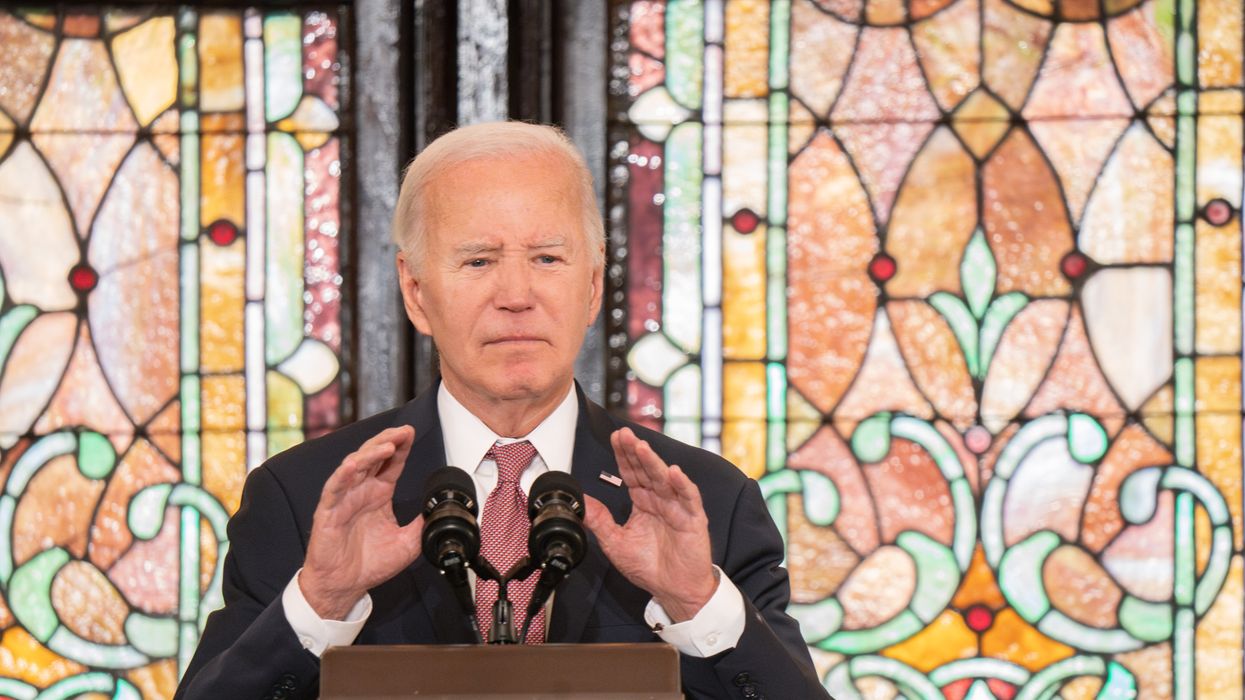
"Biden and every American politician who continues to support arming Israel as it kills more and more Palestinians in Gaza every day do not deserve a moment of peace in their public lives," said one critic.
Demonstrators demanding a cease-fire in the U.S.-backed Israeli war on the Gaza Strip were drowned out by supporters of President Joe Biden chanting "four more years" in Charleston, South Carolina on Monday.
A few audience members disrupted Biden—who is seeking reelection this year—as he addressed a crowd at Mother Emanuel AME Church, where a white supremacist gunman killed nine Black worshippers in 2015.
"If you really care about the lives lost here, then you should honor the lives lost and call for a cease-fire in Palestine," shouted one protester, who was then joined by others in chanting, "Cease-fire now!"
As the cease-fire supporters were escorted out of the church, much louder chants of "four more years" broke out.
Biden has affirmed his "unwavering" support as Israel has waged war on Gaza since the Hamas-led attack of October 7. He asked Congress for a $14.3 billion package on top of the $3.8 billion in military aid that the U.S. gives Israel annually and his administration twice bypassed congressional oversight to approve recent arms sales to the country.
Appearing caught off-guard by Monday's disruption, Biden eventually quieted the crowd with raised hands and repeated "thank you’s.
"Look folks," the president said, "I understand their passion, and I've been quietly working with the Israeli government to get them to reduce and significantly get out of Gaza, using all that I can to do that. But I understand the passion."
In response to footage of the event, IfNotNow, an American Jewish group organizing to end U.S. support for Israel's apartheid system, said: "Biden was shaken. He's starting to understand the reality: His war on Gaza is horrifically unpopular, and people are fed up."
Noting that the disruption in South Carolina came after New York City demonstrators on Monday morning shut down the Holland Tunnel and three major Manhattan bridges, IfNotNow added: "Young people are furious. We will not allow Biden and the U.S. to continue to support the starvation and slaughter of Gaza."
Also welcoming the protest in Charleston, Naftali Ehrenkranz of Justice Democrats said: "Hell yeah. Biden and every American politician who continues to support arming Israel as it kills more and more Palestinians in Gaza every day do not deserve a moment of peace in their public lives. Cease-fire now."
Some Biden backers criticized the protesters for "targeting" the president on "hallowed ground," provoking responses that highlighted recent actions by Israeli forces in Gaza—from killing thousands of kids to bombing places of worship—as well as the history of this church, which was co-founded by Denmark Vesey, who was executed for planning a slave revolt.
"To dilute the history of Black churches as if they aren't the epicenter of civil rights organizing is more than a little harmful. It's downright disingenuous," argued writer and audio producer B.A. Parker. "And if young folk are protesting in a church as a call to action, then maybe they should be heard instead of 'collected.'"
Writer Todd Dillard declared on social media, "I need Democrats to understand that when a protestor shouts '20,000 dead Palestinians; their blood is on your hands' responding with 'FOUR MORE YEARS FOUR MORE YEARS FOUR MORE YEARS' is the grimmest, darkest thing imaginable."
As of Monday, Israeli bombings and raids in Gaza have killed over 23,000 Palestinians and injured nearly 59,000 more. A growing number of legal scholars and world leaders have accused Israel of genocide, including at the International Court of Justice.
"The Democrats rushing to Biden's defense should realize that chanting 'four more years' in response to a protest objecting to the U.S. government's support of a genocide in Gaza is not doing anything to improve the president's standing as his poll numbers continue to drop," said In These Times senior editor Miles Kampf-Lassin.
As The New York Times reported Monday:
Voters broadly disapprove of Mr. Biden's handling of the war, and it has become a major political vulnerability for him.
The protest on Monday, though brief, was a stark reminder that Mr. Biden will not be able to escape the subject as he seeks reelection. Protesters calling for a cease-fire interrupted at least two of his speeches late last year, one in Minnesota and one in Illinois. More than 500 appointees and employees in the federal government signed a letter calling for a cease-fire in November, staff members held a vigil outside the White House in December, and two officials have resigned in protest of his policies on Israel and Gaza.
"I imagine there will be even larger protests like this at Biden's campaign events in swing states like Michigan and Georgia," predicted Democratic strategist Waleed Shahid.
Palestinian American political analyst Yousef Munayyer agreed, saying that this is "probably gonna be the norm for every public event on the campaign trail."
Biden is under mounting pressure from not only the public but also progressives in Congress, with Rep. Ro Khanna (D-Calif.) warning in a Friday interview with Common Dreams that calling for a cease-fire in Gaza "is going to be a dividing issue for the Democratic Party for the future, like the Iraq War was... And I think the window is rapidly closing to be on the right side of history."
Referring to Israeli Prime Minister Benjamin Netanyahu, the Center for International Policy's Matt Duss told MSNBC's Chris Hayes that "Biden has essentially outsourced decision-making for an extremely consequential war... to one of the most dangerous, right-wing authoritarian leaders in the world—and I do use that term advisedly."
"The outrage at President Biden's handling of this war and his continuing unconditional support for this massacre that we've been seeing over the past three months is really off the charts," Duss added, warning that the issue could impact the November presidential election.
We live on. Whether you believe in an afterlife or not, we live on. We live on in the memories of those we leave behind. We live on in words, in gestures, in glances, in anything that changes the heart of another person forever. We live on in loved ones and in strangers, in the people we've touched and the people they touch in turn. Each passes a tiny piece of us down the ancient chain of human life.
Sometimes we live on without even knowing it.
We live on. Whether you believe in an afterlife or not, we live on. We live on in the memories of those we leave behind. We live on in words, in gestures, in glances, in anything that changes the heart of another person forever. We live on in loved ones and in strangers, in the people we've touched and the people they touch in turn. Each passes a tiny piece of us down the ancient chain of human life.
Sometimes, we live on without even knowing it.
So let's start by remembering each of them by name, the nine kind souls who welcomed a stranger into their midst on June 17, 2015 at Emanuel African Methodist Episcopal Church in Charleston, S.C.:
* Cynthia Marie Graham Hurd did Bible study and was a manager for the Charleston County Public Library system.
* Susie Jackson did Bible study and sang in the choir.
* Ethel Lee Lance was the church sexton.
* Depayne Middleton-Doctor was a pastor. He was also an administrator and admissions coordinator at Southern Wesleyan University.
* Clementa C. Pinckney was the church's pastor and a state senator.
* Tywanza Sanders did Bible study.
* Daniel Simmons was a pastor, there at "Mother Emanuel" and at Greater Zion AME Church in Awendaw, S.C.
* Sharonda Coleman-Singleton was a pastor, a speech therapist and a track coach.
* Myra Thompson taught Bible study.
I won't name the young man who killed them. I won't name him because I support the "no notoriety" campaign, and because he was nothing more than the instrument of larger forces. "Like a dog on a chain," says the Bob Dylan song about Medgar Evers' killer, "he ain't got no name."
This week we mourn another gun tragedy, the worst mass shooting in recent American history. It happened at a club called Pulse in Orlando, Fla. There, too, the killer was driven by fanaticism and hatred, this time against LGBT people.
After Newtown, after Charleston, after Orlando, our politicians still haven't summoned the courage to ban assault weapons or to regulate guns the way we regulate cars. So Americans keep killing and dying in numbers that are unheard of in other countries.
You left us too soon, you nine souls of Charleston, so you probably didn't see this coming: Donald Trump is the Republican candidate for president of the United States.
Trump delivered a speech this week that should chill all reasonable people to the bone. He's prepared to punish all of our nation's Muslims for the actions of one deluded killer. New Jersey Governor and Trump supporter Chris Christie upped the ante, threatening to bomb a foreign country for the crime of one sick individual born in Queens, N.Y.
Hate can't conquer hate. Even a fool knows that. But then, some people don't want to know.
The Orlando murderer used his religion the same way the Charleston murderer used his whiteness: as a mask for bloodlust. They're all the same inside, these killers. They may ascribe their deeds to religion, or race, or a totalitarian social ideal. But their real creed is narcissistic hate. They sacrifice strangers on the altar of their own reflections.
If I could talk to the nine sweet souls of Charleston, here's what I'd tell them: We've had some serious talks since you've been gone. We've been talking about the black lives lost, about slow deaths from inequality and sudden deaths from an officer's gun. We've been talking about old folks in need and children gone too soon.
We haven't always agreed. One of our politicians said this to a Black Lives Matter activist: "I don't believe you change hearts. I believe you change laws, you change allocation of resources, you change the way systems operate."
I disagree. I still think the deepest change begins in the heart. But at least we're talking. The young people did that.
If I could talk to the nine sweet souls of Charleston, here's what I'd tell them: We may not have worked it all out yet, but we've learned a little since you left us. We've learned that economic justice and social justice must go hand in hand, or there's no justice at all.
You were studying when you died, so I thought you'd be glad to hear we've learned something.
I was standing by an abandoned church in my hometown—it's a dying manufacturing town—a while back, and for some reason, the old hymn came to me: "Before this time another year, I may be gone."
You didn't know the moment of your passing. None of us do. Each heartbeat could be our last. The rhythm of those beats is our lifeline, our pulse. When it ends, we end. Everything we've done, for good or bad, is what lives on. I hope Trump and Christie understand that. I believe that you did.
A year has passed. If I could talk to you I'd tell you we haven't forgotten you. "Though lovers be lost," wrote Dylan Thomas, "love shall not."
Cynthia Hurd. Susie Jackson. Ethel Lee Lance. Depayne Middle-Doctor. Clementa Pinckney. Tywanza Sanders. Daniel Simmons. Sharonda Singleton. Myra Thompson.
Remember them by name. They live on.
Three more victims of the attack on Charleston, South Carolina's Emanuel A.M.E. Church will be laid to rest on Saturday, as mourners from around the country gather to pay their respects to the nine black men and women shot dead during a Bible study more than a week ago.
The first funeral procession for Cynthia Graham Hurd, 54, will occur in the morning. Hurd was the regional manager at St. Andrews Regional Library, which was named in her honor last week. "Cynthia was a tireless servant of the community who spent her life helping residents, making sure they had every opportunity for an education and personal growth," the library said in a statement after the shooting. "Her loss is incomprehensible and we ask for prayers for her family, her co-workers, her church and this entire community as we come together to face this tragic loss."
Hurd's brother, Malcolm Graham, a former North Carolina state senator, said of his sister last week, "It is unimaginable that she would walk into church and not return. But that's who she was--a woman of faith."
In the afternoon, a joint service will be held for Tywanza Sanders, 26, and his aunt, Susie Jackson, 87. Survivors said that as the gunman opened fire, Sanders tried to talk him out of his attack--then jumped in front of Jackson to shield her from the bullets with his body.
Sanders had recently graduated from Allen University in Columbia, South Carolina.
Jackson will be remembered as a caretaker and a source of strength for her family. The Post and Courier wrote in Jackson's obituary, "At one time, almost every house on Jackson's block was owned by a relative. But her home, a classic Charleston single, was the center of family gatherings. 'You come from out of town, this is where you come,' her nephew Robert Sanders said. 'She opened her arms to us.'"
On Friday, funeral services were held for pastor Rev. Clementa Pinckney, 41. His eulogy was delivered by President Barack Obama, who described the pastor as "a man who believed in things not seen, a man who believed there were better days ahead."
The Post and Courier wrote:
Noting Pinckney's smile and "reassuring baritone," Obama described Pinckney's remarkable career. "He was in the pulpit by 13, pastor by 18, public servant by 23," and how as a state senator for Allendale, Beaufort, Charleston, Colleton, Hampton and Jasper counties, he "represented a sprawling swath of Lowcountry, a place that has long been one of the most neglected in America, a place still racked by poverty and inadequate schools, a place where children can still go hungry and the sick can go without treatment -- a place that needed someone like Clem.
Pinckney, he added, "embodied a politics that was neither mean nor small. He conducted himself quietly and kindly and diligently."
Funeral processions will continue at Emanuel A.M.E. Church on Sunday for DePayne Middleton-Doctor and on Monday for Myra Thompson. The final funeral will be held Tuesday at St. Luke A.M.E. Church, also in Charleston, for Daniel Simmons.
A fire that damaged a predominantly black church in Georgia on Tuesday has been ruled as arson by investigators.
It was one of two instances this week that saw historically black churches set ablaze in the South, with the other in North Carolina on Wednesday, also suspected to be arson. The fires follow last week's terrorist attack on Emanuel A.M.E. Church in Charleston, South Carolina, which saw nine black men and women killed and is being investigated as a hate crime.
As the Telegraph reported on Thursday, Macon-Bibb County Fire Sgt. Ben Gleason does not suspect the fire that damaged Macon's God's Power Church of Christ to be a hate crime. Officials also said that electronics and other equipment had been stolen from the church in two burglaries.
But, as Emma Green writes for the Atlantic, the historical context of arson targeting black churches must not be overlooked. Green says:
These fires join the murder of nine people at Charleston's Emanuel African Methodist Episcopal Church as major acts of violence perpetrated against predominantly black churches in the last fortnight. Churches are burning again in the United States, and the symbolism of that is powerful. Even though many instances of arson have happened at white churches, the crime is often association with racial violence: a highly visible attack on a core institution of the black community, often done at night, and often motivated by hate.
In North Carolina, Charlotte Fire Department senior fire investigator David Williams told the Charlotte Observer on Wednesday that officials are still trying to determine if the arson in Briar Creek Road Baptist Church was a hate crime.
Marty Ahrens, a staffer at the National Fire Protection Association, told the Atlantic that new reporting standards have made it difficult to determine the motivation behind an arson. "To know that something is motivated by hate, you either have to know who did it or they have to leave you a message in some way that makes it very obvious," she said.
Green concludes:
The investigations in North Carolina and Georgia are still ongoing, and they may end up in that broad category of fires of suspicious, but ultimately unknowable, origin that Ahrens described. But no matter why they happened, these fires are a troubling reminder of the vulnerability of our sacred institutions in the days following one of the most violent attacks on a church in recent memory.
At the bond hearing, grieving loved ones forgave Dylann Roof. This was reported as news, but it was so much more than that. It was the light embracing the darkness.
And white America absorbed this forgiveness through the eyes of the 21-year-old terrorist, who watched the proceedings on a video screen from his jail cell. Whatever he heard and felt is unknown, but beyond him, in the world he believed he was saving, something gave. The solidarity of whiteness -- the quiet assumption of white supremacy -- shuddered ever so slightly.
The flag, the flag . . .
The fate of this symbolic relic of the slave era is now the big story in the aftermath of Roof's murder of nine African-Americans. He acted in such clear allegiance to the Confederate flag that politicians everywhere -- even Republican presidential candidates -- are demanding, or at least acquiescing to, its removal from public and official locations, such as in front of the South Carolina State House.
Not only that, "Walmart and Sears, two of the country's largest retailers, will remove all Confederate flag merchandise from their stores," CNN reported.
This is what atonement looks like in a consumer culture.
"The announcements," according to CNN, "are the latest indication that the flag, a symbol of the slave-holding South, has become toxic in the aftermath of a shooting last week at a historic African-American church in Charleston, South Carolina."
A few days later, Amazon and eBay also announced they would remove Confederate flag merchandise from their sites. No longer available, CNN reported, would be such flag-decorated items as folding knives, T-shirts, blankets or (God help us) shower curtains.
Oh Lord. The news so quickly becomes theater of the absurd. Roof's act of terror has forced mainstream America to begin consciously disassociating itself from the lethal margins of white solidarity, to wake up to what it really means. But this waking up, so far, seems limited to the symbolism of Confederate paraphernalia. All our guilt is being dumped here, while the pain that Roof's act of terror has caused ebbs and slowly vanishes from the social mainstream.
In fact, an undead racism still stalks the American consciousness and it will, once again, regroup, Confederate flag or no Confederate flag. What this moment of awareness calls for is true atonement for our history.
"I forgive you." These are the words of Nadine Collier, the daughter of 70-year-old Ethel Lance, one of Roof's victims. "You took something very precious from me. I will never talk to her again. I will never, ever hold her again. But I forgive you. And have mercy on your soul."
Atonement begins with cradling the pain.
"We welcomed you Wednesday night in our Bible study with open arms," said Felicia Sanders, who was not only present in the church during the murders but the mother of Tywanza Sanders, 26, the youngest of those killed. As we cradle the pain, we must cradle this as well: the open souls of the murder victims.
What do we value as a nation? Do we value such openness? The killer -- who was, as he entered the church, simply an unknown young man -- did not go through security clearance as he walked through the open door. He had complete freedom of movement as he entered the historic African-American church, where he was accepted simply for his humanity. Yes, such openness and acceptance are also part of who we are as a nation, but . . . do we value these qualities? Do we have the least faith that they matter now more than ever, now that they've been so violated?
A participant at one of the vigils last week for the murder victims "noted how a church's doors are always open, especially to those in need," a Daily Beast story reported. "She wonders now how churches can square their mission of public service, charity and acceptance with security concerns."
Roof's act of terror has opened a gaping hole in the social fabric. Can we no longer pray together?
But all such questions lead back into the depth of American history and the need for atonement and transformation. A Reuters story, addressing the segregated nature of most American churches (11 a.m. Sunday is "the most segregated hour in the nation," Martin Luther King once said), pointed out: "The story of this division began in America's earliest moments, when slaves and freed African-Americans alike were often expected to pray in the same churches as whites, but in areas cordoned off, often called 'slave galleries.'"
Imagine praying in a setting that defines you as semi-human. Now imagine Dylann Roof walking into Emanuel African Methodist Episcopal Church with a gun in his backpack. Roof was the self-defined semi-human in the church that night, his soul wrapped in a Confederate flag.
The U.S. is enslaved by its past. That's what no one has said yet. One hundred fifty years after the Civil War ended, we're thinking maybe it's time to lower the flag that symbolizes this enslavement.
Dylann Roof, a young white man armed with a virulent, toxic hatred and a 45 caliber pistol, walked into a historic black church and was welcomed with open arms as a stranger into a Bible study. Taking advantage of the well-known hospitality of this sanctuary, he sat for an hour with a group of 10 people, none of whom had any idea that nine of them would be dead within an hour.
The massacre in Charleston is not just an isolated hate crime carried out by a mentally ill racist in South Carolina. It is simultaneously representative and starkly indicative of the rampant racism structurally embedded in America, the responsibility for which, it might be argued, bears no exemption for any American, especially white Americans, north or south, republican or democrat. As Richard Wright wrote in his 1945 non-fiction memoir, Black Boy, America "insists upon seeing the world in terms of good and bad, the holy and the evil, the high and the low, the white and the black; our America is frightened of fact, of history, of processes, of necessity. It hugs the easy way of damning those whom it cannot understand, of excluding those who look different, and it salves its conscience with a self-draped cloak of righteousness."
That cloak of righteousness shields white America from having to face their contemporary prejudices and the historical biases from which they are a result. This cloak of invisibility also inhibits their moral and psychological capacity to acknowledge and understand the magnitude of those historical and contemporary prejudices and their effects on our society. The Charleston shooting was not an anomaly but a manifestation of the violence cultivated in America toward black communities. The shooter, Dylann Roof, is a product of a system that has been breeding hatred and bigotry in America since the first Africans were kidnapped and forcibly transported here in the 15th century as slaves under deplorable, maliciously inhumane conditions.
Prophetic voices in African American literature and the arts have long challenged these deadly views, calling all Americans to "stand in the gap" and risk lifting the cloak of invisibility that surrounds racial violence to see what lies beneath. In an August 9, 2012 interview, Dr. Maya Angelou argued that transatlantic slaving, as an inherently violent institution, connected with colonial conquests, put an imprint of violence on American culture that needs to be addressed on a systematic and systemic level. Today her voice rises from among the dead: "It is imperative that Americans, all Americans, recognize the imprint of the first Africans brought here and the first white women brought here in bondage. I'm trying to say that the word slavery and the term enslavement has lost so much of its weight until people mouth the words without realizing what they're saying, what they're calling up. We have not moved on. We have made some steps toward fair play, but we have not really moved on. It is ignorant, not wise, to think that we can get on without remembering what happened, who did what to whom, to what success, and for what reasons."
Today, this systematic analysis is needed perhaps more than at any other time in our history. As Rev. Clyde Grubbs of Tuckerman Creative Ministries for Justice and Healing noted on Facebook: "The son tells everyone he knew that Black people were taking over the country, and he wore racist decals on his clothing. He told everyone he knew that something must be done to save the white race. He was public in his attitudes, attitudes that were dangerous. He was able to live at home and access the propaganda of racist hate groups (organized terrorists.) His father gifted the gun to his son. The state doesn't require registration of gun, nor notice of selling gun, or gifting gun. Son kills people with gun in an act of racist terrorism. But somehow the killer is a disturbed INDIVIDUAL. So? Are Racism and Psychopathology completely unrelated phenomena? Are Racism and Patriarchy and Privatism and Violence and Destruction of God's Creation really all separate, discrete, separate realities that need to be taken up in isolation from each other?"
Racism kills. In fact, the prevalence of racial epithets in Google searches has been linked to rates of black mortality by Daniel Chae, University of Maryland professor of epidemiology and biostatistics whose research has shown that "African-Americans living in areas where many people are Google-searching for a racial epithet are 8.2 percent more likely than whites to die of any cause." Racism, says Chae, is an environmental hazard. Quoted in the Huffington Post, "I view racism as being a social toxin that over time leads to premature mortality," he said. "Racism kills people," Chae said. "That's not breaking news at all." Meanwhile, in South Carolina the Confederate battle flag flies high as highways throughout the state tout the names of Confederate soldiers that fought to the death to preserve racist institutions while some excuse Dylan Roof's actions as being the result of an alleged mental illness or try to fit it into some other neatly packaged narrative that defers from having to face the real issue at hand; racism.
The very thing many of us fight against -- a deeply masked and far-reaching culture of violence in our society -- has devastated our family. This past Wednesday night, during bible study and prayer service, a gunman filled with a racist heart entered the historic Mother Emanuel AME Church of Charleston, South Carolina, and opened fire on the 12 persons gathered there. Only three people survived the attack.
Our loved one, Rev. Depayne Middleton, was among those killed. Ever since her death was confirmed, our family has been met with unspeakable pain and grief. Our hearts are troubled, but our faith remains steadfast, trusting and believing in God's power to mend our broken hearts.
At this time of grave personal loss, we ask you for two things. First, please keep our family and our church community at Mother Emanuel A.M.E. in your prayers. Next, please move away from the sidelines and unite together -- regardless of your faith or religious practice -- to seek an end to hatred and violence.
What happened to our family is part of a larger attack on Black and Brown bodies. To impact change, we must recognize the connection between racism, hate crimes and racialized policing. While the focus of this specific attack was on African-Americans, we all have a responsibility to seek not only justice for the victims but an end to racial injustice.
We should put our faith to action, making a conscious decision to be more than empty drums that have long lost their melodies. In South Carolina, the Confederate flag -- an unequivocal symbol of hate -- remains on statehouse grounds. We must demand the flag be removed immediately -- we cannot let icons of racism fly free within our society.
We call on all people, public officials, faith leaders, and Americans from all walks of life to help address the festering sores of racism as it spurs an unforgiving culture of violence. This is a big task but may become more manageable if we work together and if all people see the attack in Charleston as an attack on their own families and loved ones.
A memorial fund for the Middleton family is being established. Learn more here.
He sat with them for an hour in prayer. Then he pulled his gun out and started shooting.
And today our national numbness is wrapped in a Confederate flag. The young man who killed nine members of Charleston's Emanuel African Methodist Episcopal Church on Wednesday night was an old-school racist. "I have to do it," Dylann Storm Roof is said to have explained. "You rape our women and you're taking over our country. And you have to go."
Roof's roommate told ABC News the next day that he was "big into segregation and other stuff" and "he wanted to start a civil war." And this is America, where we have the freedom to manifest our lethal fantasies.
But this is bigger than racism and the pathetic monster of white supremacy. Racism is a name for one of the currents of righteous hatred that coils through our collective unconscious, and over the decades and centuries it has motivated terrible crimes against humanity. But the "civil war" that Roof participated in is, I think, much larger and much more meaningless. And not all the participants are loners.
"In a pattern that has become achingly familiar to him and the nation," the New York Times reported, "Mr. Obama on Thursday strode down to the White House briefing room to issue a statement of mourning and grief as he called on the country to unify in the face of tragedy."
Indeed, it's the fourteenth time, according to The Guardian, he has done this since he's been in office. It's the fourteenth time he has said words like: "I am confident that the outpouring of unity and strength and fellowship and love across Charleston today from all races, from all faiths, from all places of worship indicates the degree to which those old vestiges of hatred can be overcome."
America, America, land of the mass murderer.
Mass murders have increased fourteenfold in the United States since the 1960s, sociologist Peter Turchin wrote two and a half years ago, after the Sandy Hook killings. In his essay, called "Canaries in a Coal Mine," Turchin made a disturbing comparison: Mass murderers kill the same way soldiers do, without personal hatred for their victims but to right some large social wrong. He called it the "principle of social substitutability" -- substituting a particular group of people for a general wrong.
"On the battlefield," Turchin wrote, "you are supposed to try to kill a person whom you've never met before. You are not trying to kill this particular person, you are shooting because he is wearing the enemy uniform. . . . Enemy soldiers are socially substitutable."
"That is to say," I noted at the time, "the definition and practice of war and the definition and practice of mass murder have eerie congruencies. Might this not be the source of the social poison? We divide and slice the human race; some people become the enemy, not in a personal but merely an abstract sense -- 'them' -- and we lavish a staggering amount of our wealth and creativity on devising ways to kill them. When we call it war, it's as familiar and wholesome as apple pie. When we call it mass murder, it's not so nice."
Dylann Roof had a toxic "cause" -- to reclaim the Old South, to reclaim the country, from an unwelcome human subgroup -- but the solidarity in which he acted wasn't so much with his fellow racists as with the strategists and planners of war. Any war. Every war.
Perhaps this is why, when I hear Barack Obama laud "the outpouring of unity and strength and fellowship and love" in the wake of the Charleston murders, I feel only despair: despair as deep as a knife wound. War, not love, is structured into the nation's economic and social fabric. We invest trillions of dollars into its perpetuation, across Central Asia and the Middle East and wherever else the strategists and planners see evil, which is to say, opportunity.
Every murderer believes the violence he is wielding is "good violence." Think Timothy McVeigh, whose fertilizer bomb killed 168 people at the Alfred P. Murrah Federal Building in Oklahoma City in 1995. He called his victims "collateral damage," co-opting the official language of the Gulf War in which he served. Mass murderers mimic and find their inspiration in the official wars we wage as a nation. Take away the massive public relations machinery that surrounds these wars and the deaths they cause are just as cruel, just as wrong. The abstract "enemy" dead, in every case, turn out to be human beings, who deserved to live.
And every war and every mass murder spread fear and hatred -- and inspiration -- in their aftermath. We can't go to war without spawning imitators. The next day, USA Today reported, the vigils at two South Carolina churches, in Charleston and Greenville, were disrupted by bomb threats and the churches had to be evacuated. So did Charleston's county building.
"At some point," Obama said, "we as a country will have to reckon with the fact that this type of mass violence does not happen in other advanced countries. It doesn't happen in other places with this kind of frequency -- and it is in our power to do something about it."
Until we begin demilitarizing our relationship with the world, such words uttered by presidents are as empty as the words Dylann Roof uttered in prayer at Emanuel African Methodist Episcopal Church on Wednesday night.
Once again, we are as a nation horrified by another mass shooting, this time an apparent hate crime that took place June 17 at "Mother Emanuel" -- Emanuel African Methodist Episcopal Church, one of the nation's oldest black churches -- in Charleston, South Carolina, and claimed the lives of nine people during an evening of peaceful prayer.
The facts of this tragedy remain under investigation, and there is still a lot that we don't know. But what we do know is that every day, 88 Americans are killed in shootings. Most of these tragedies are preventable through common-sense solutions that keep guns out of the wrong hands, measures that the majority of the American public wants.
Every time there is a mass shooting, our nation grieves and we ask, "Why?" President Obama said, "I've had to make statements like this too many times"; and according to CBS's Mark Knoller, this marks at least the 14th time Obama has made a statement following a mass shooting. The president also said that this is an example of innocent people being killed because someone "who wanted to inflict harm" had "no trouble getting their hands on a gun."
When we talk about solutions, we don't spend enough time talking about the real things we can do to keep guns out of the hands of the people who commit these crimes. Solutions that almost everybody supports, like:
No, there is not a single magic solution that will keep every gun out of the hands of every person intent on doing harm -- but we can do a lot better than we are doing now. As the president said, "At some point we as a country will have to reckon with the fact that this type of mass violence does not happen in other developed countries."
In the late 1790s, Richard Allen and former enslaved people in Philadelphia were tired of praying in the upper regions of St. George's Methodist Episcopal Church and came down to the altar. When they were summarily removed from their prayerful positions, they came together to birth the African Methodist Episcopal Church--the nation's first of its kind. More than 200 years later, the Connectional AME Church spans the globe on five continents.
Over the years, the black church has been the meeting place to organize, strategize and pray for true liberation for black and other marginalized people in America. During this time, the black church universally, and AME churches in particular, have been attacked by domestic terrorists to send a ripple throughout the black community--not only locally but also globally.
I grew up at Bethel African Methodist Episcopal Church in Ann Arbor, Mich. I met lifelong friends in that church and in the youth organization in which I participated. I honed my speaking and leadership skills while participating in youth organizations on local, state and district levels.
My home church rests down the street from a safe house that was used during the Underground Railroad. The state of South Carolina has more AME churches than the district in which I grew up--the 4th Episcopal District--which spans the area from Chicago to Toronto.
The terrorist actions that occurred last night at Emanuel AME Church in Charleston, S.C.--which claimed the lives of nine people, including its pastor, the Rev. Clementa C. Pinckney--are horrifying but also a continuation of attacks upon black churches that have occurred throughout the history of this nation. The story of the modern civil rights movement cannot be told without discussing the attacks on black houses of worship.
Black pastors, ministers and their families were under constant attack as they led their communities and congregants to work and pray for a better life in this nation. Even though federal legislation to unlock barriers to public accommodations, employment and the vote were enacted, the attacks on houses of worship have continued.
As recently as a couple of years ago, a college classmate had his AME church burned in South Carolina. As Conor Friedersdorf of The Atlantic wrote today, the FBI identified 3,563 victims of racially motivated hate crimes in 2013, of whom two-thirds were black.
The history of Charleston's Mother Emanuel AME Church is riddled with acts of violence upon it. Nevertheless, as it has done throughout its 200-year history, and as many black churches before it have done, this church shall rise again.
Even though the suspect in the shooting, Dylann Storm Roof, has been captured, questions remain: How will the people of Mother Emanuel and those who came to learn more about God's word carry on? Who will continue Pinckney's work in the state Senate this fall? And will the battle to eradicate racial terrorism in America begin?
God of our weary years,
God of our silent tears,
Thou who has brought us thus far on the way;
Thou who has by thy might,
Led us into the light,
Keep us forever in the path, we pray.
--from "Lift Ev'ry Voice and Sing" by James Weldon Johnson