
SUBSCRIBE TO OUR FREE NEWSLETTER
Daily news & progressive opinion—funded by the people, not the corporations—delivered straight to your inbox.
5
#000000
#FFFFFF
To donate by check, phone, or other method, see our More Ways to Give page.


Daily news & progressive opinion—funded by the people, not the corporations—delivered straight to your inbox.
Unified and spirited opposition to Trump's destructive rampage is exactly what's needed, but a successful movement will not grow without a vision and proposals to support it.
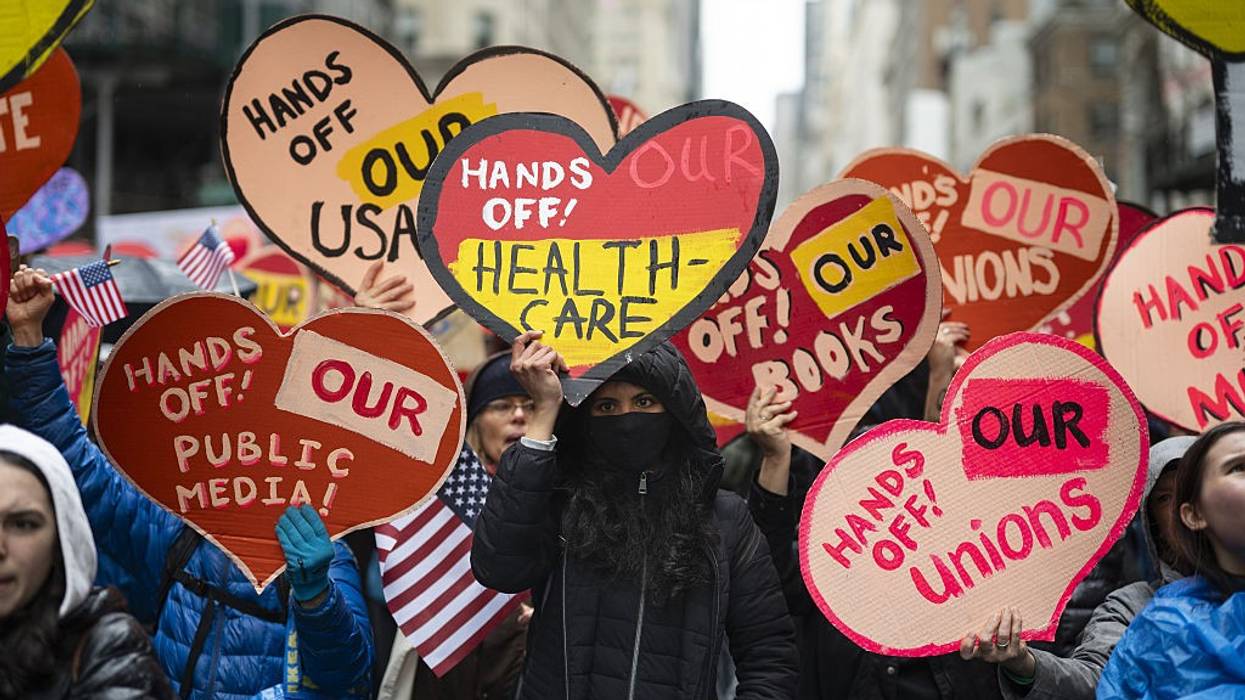
On Saturday, April 5th, fifty-seven years after Martin Luther King, Jr. was assassinated, hundreds of thousands of protestors gathered across the country to challenge Trump’s attack on, well, just about everything!
I went to the rally in New Jersey, where speaker after speaker had us chanting “Hands off our Social Security!” “Hands off our Medicare!” Hands off our Medicaid!” “Hands off our Abortion Rights!” and so on. This was the national theme developed by the Democratic Party.
A few protestors in the back chanted “Hands off Gaza,” which was not on the agenda. But they soon retreated into silence. One woman carrying a large Trump 2024 banner walked near the edge of the crowd of about 2,000 and took on a few angry shouts, but there was no confrontation. Tensions rose enough, however, that the chair of the gathering did feel obliged to remind us that this was a peaceful, non-violent gathering.
As I looked around at the well-healed demonstrators from our liberal town, I couldn’t help but imagine adding a few other items to the list: “Hands off our IRA’s!” “Hands off the Stock Market!” “Hands off Free Trade!” I’m sure that would have been right on the money.
But why was I raining on this parade? After all, these were my neighbors, good caring people who turned up on this rainy Saturday because they truly want to make our society a better place.
My mind went negative because it was crystal clear that the rally was the opposite of Martin Luther King Jr.’s challenge to the established order that enabled Jim Crow and persistent poverty. Dr. King asked us to envision massive changes to the status quo. Today, we were chanting to defend the status quo that Trump is surely taking a wrecking ball to.
The Democrats who put the rallies together across the country missed a moment to present an alternative vision. This was a chance to announce new proposals to tame runaway inequality, the growth of which has undermined the Democratic Party’s coalition, and to provide job insecurity, the lack of which has given MAGA a foothold in the first place.
Instead, we got pure opposition, spirited to be sure. Its only virtue was to provide collective support to those of us who have been stunned by the revanchist thrust of Trumpism. We can’t believe what is happening and we need each other to shore up our spirits. It was a chance, feeble but necessary, to show some form of communal defiance.
But a successful movement will not grow without a vision and proposals to support it. Why didn’t the Democrats do that? Because, except for a few fellow-travelers like Bernie Sanders, their vision is deeply tied the status quo BT (Before Trump).
That set of BT institutions was working well for the top 20 percent of the income distribution, especially those with college and post-graduate degrees, including just about everyone at our town’s demonstration.
It was not working for those whose jobs had been shipped abroad to China, Mexico, or elsewhere, and who watched their communities then crumble.
It also wasn’t working so well for those who lost their jobs to finance Wall Street stock buybacks and outrageous CEO salaries.
And it wasn’t working well at all for those working at poverty wages, especially immigrant workers, risking life and limb with little protection.
In short, the Democratic Party, long the party of the working class, has no compelling vision today because it has left behind a big chunk of the working-class. As analysts debate what went wrong, they should perhaps ask why the Democrats are so reluctant to support a working-class populist agenda.
The answer lies in how it became the party of the established order and therefore was unable to provide a vision that makes sense to working people who have been screwed by the established order. (Please see Wall Street’s War on Workers.)
And that’s a damn shame. Because we want and need to be inspired by a positive vision. But that will only happen when the Democrats take their hands off their imaginations and ours.
We need to return to the days when the vision was FDRs for four freedoms, not four family tax credits to support the “opportunity society.”
The Democrats still have a chance, the field is open, but really? That is not likely to happen until it is challenged by a new independent party that stands for substantive change, created by and for working people.
I’ll be demonstrating for that.
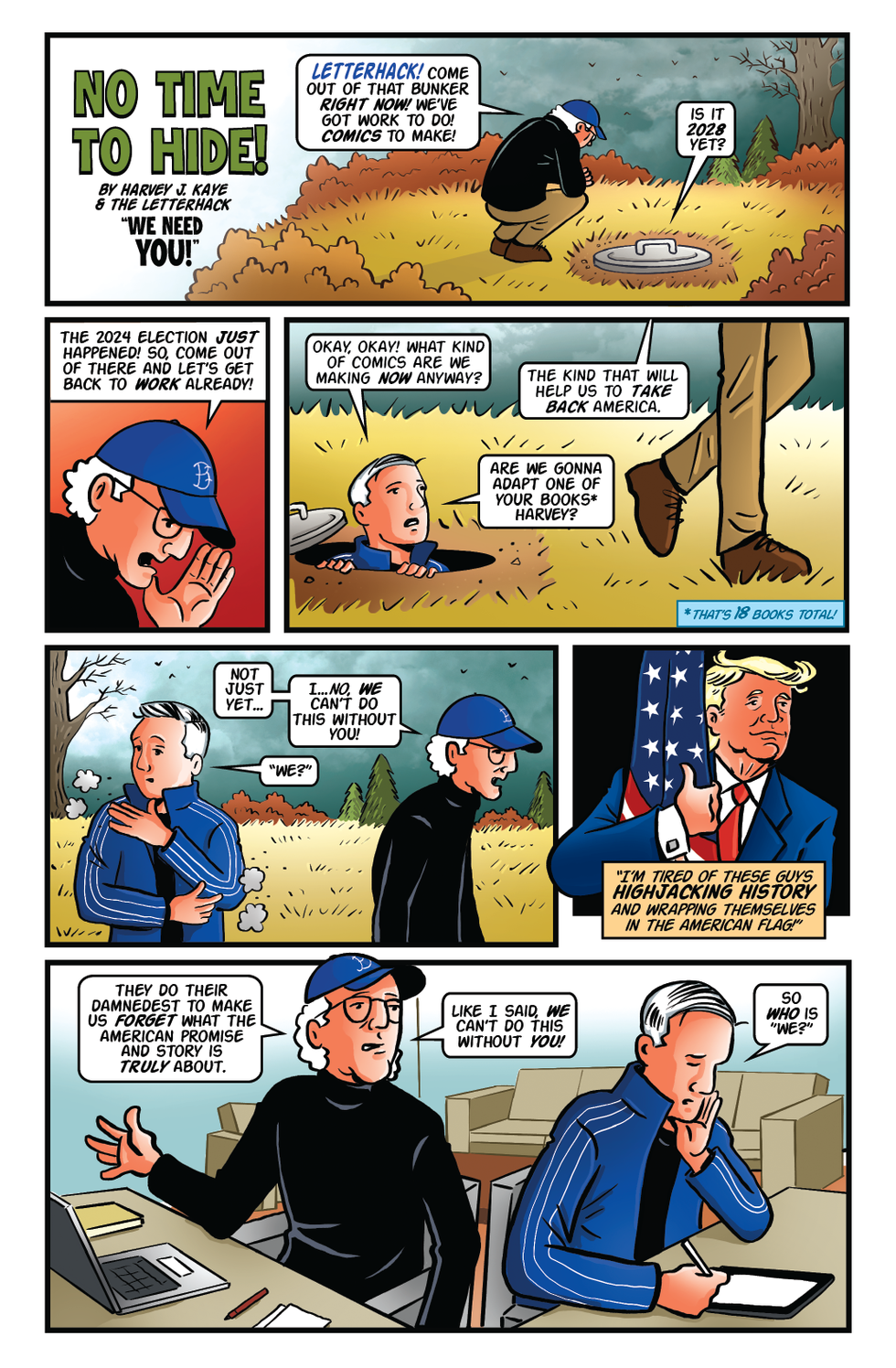
We offer this comic-strip recalling the revolutionary promise proclaimed in the Declaration of Independence. Do not underestimate the power of that promise.
Yes. We lost. And yes, as Thomas Paine pronounced in late 1776 in The Crisis, “These are the times that try men’s souls.” Nonetheless, as we argue here, this is not a time to despair and hide away. For as Paine went on to write in that pamphlet: “The summer soldier and the sunshine patriot will, in this crisis, shrink from the service of their country; but he that stands by it now, deserves the love and thanks of man and woman. Tyranny, like hell, is not easily conquered; yet we have this consolation with us, that the harder the conflict, the more glorious the triumph.” Words that encouraged Americans to sustain the Revolution and, yes, go on to win battles and ultimately, victory.
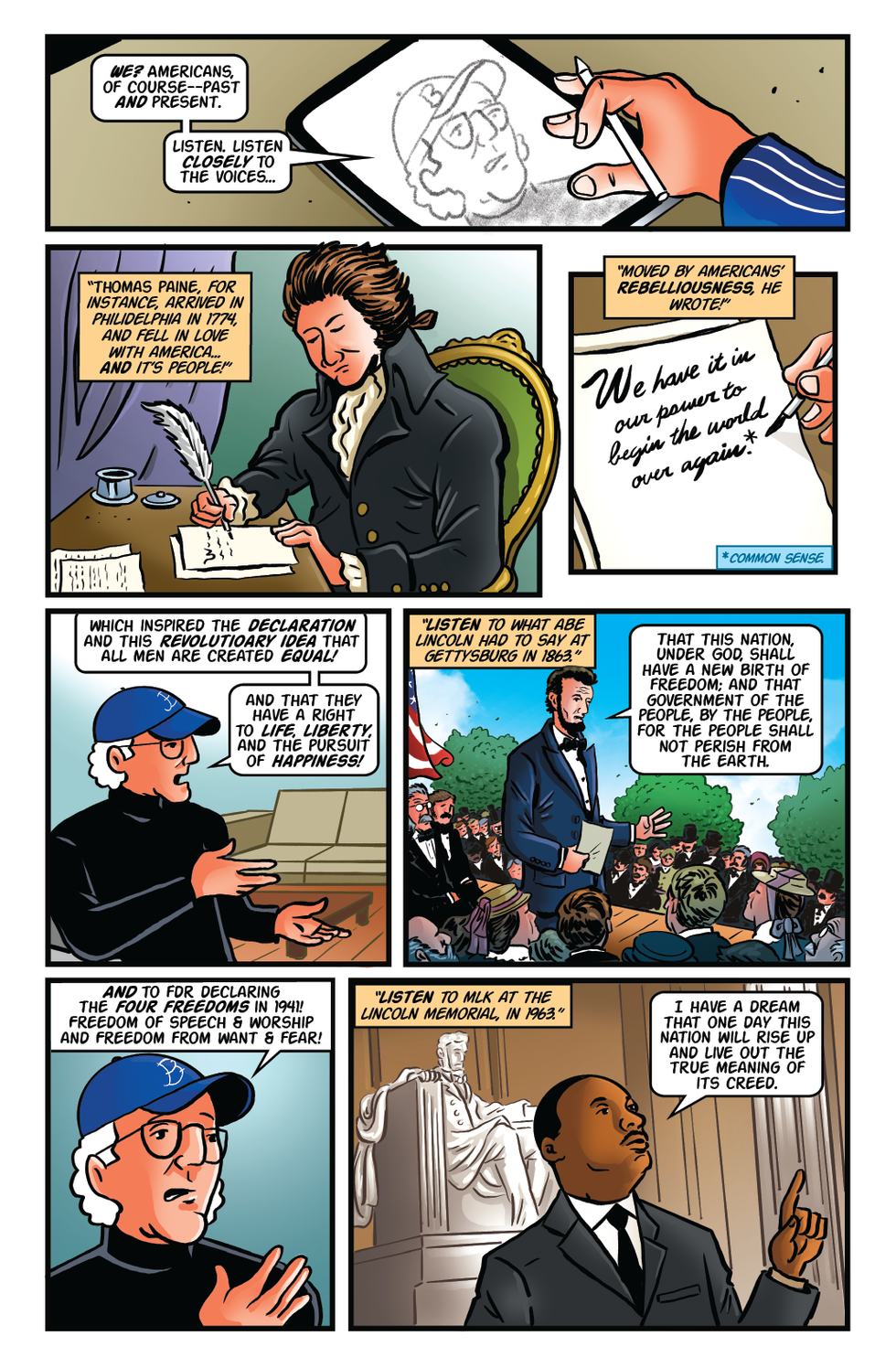
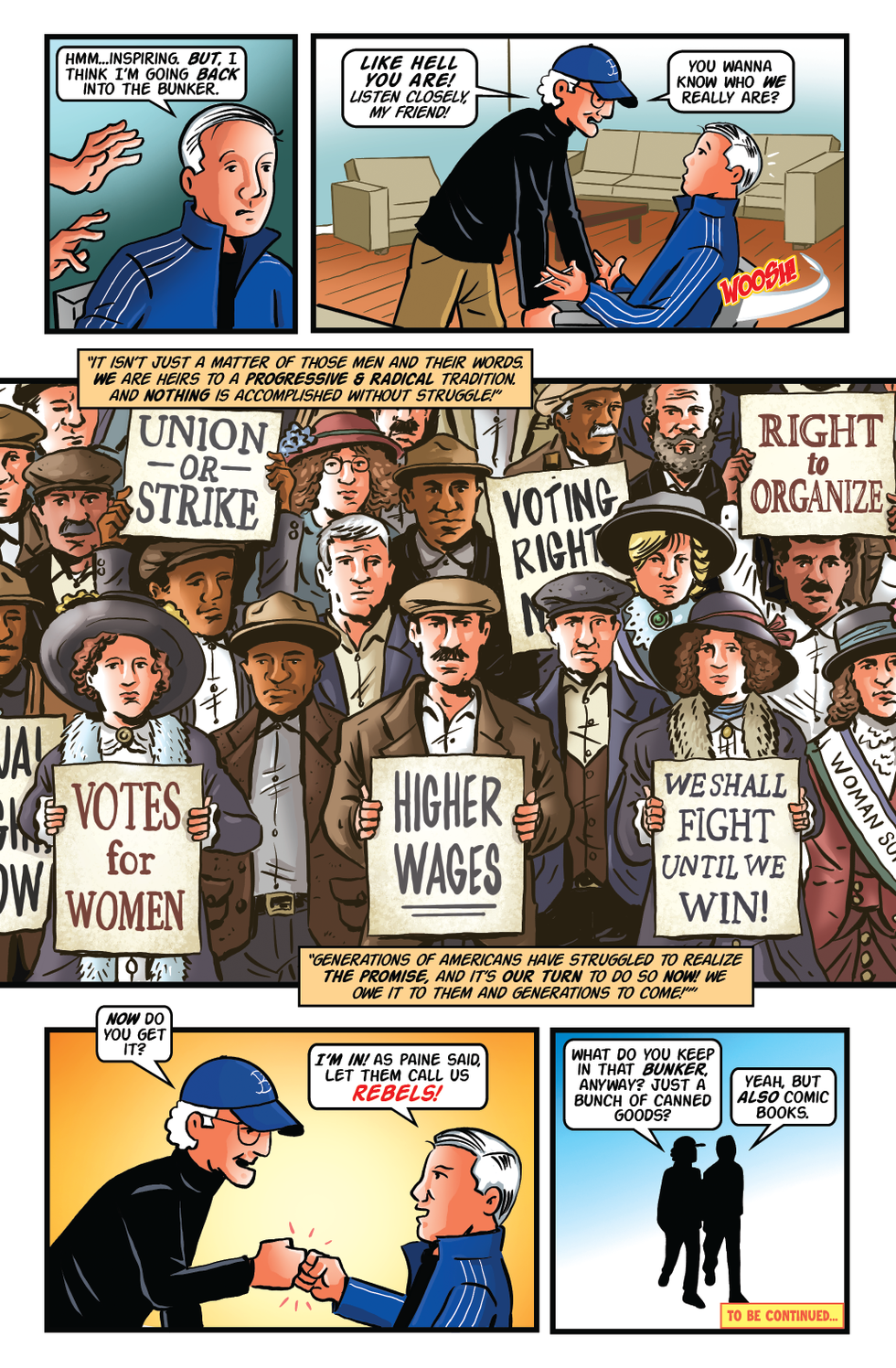
We offer this comic-strip recalling the revolutionary promise proclaimed in the Declaration of Independence—and regularly reaffirmed by our greatest leaders—to remind us all that we, native-born and newly-arrived alike, are the children and grandchildren of generations of progressives and radicals who, in the course of almost 250 years, made that promise their own and fought to realize it.
Do not underestimate the power of that promise. And surely, you feel it too.
Consider the testimony of the great self-emancipated black abolitionist Frederick Douglass in his speech in Rochester, New York, on July 5, 1852, What to the Slave is the Fourth of July? Douglass lambasted the country and his fellow Americans: “There is not a nation on the earth guilty of practices, more shocking and bloody, than are the people of these United States, at this very hour.” And yet, in the end, even he did not surrender to despair: “Allow me to say, in conclusion, notwithstanding the dark picture I have this day presented of the state of the nation, I do not despair of this country. There are forces in operation, which must inevitably work the downfall of slavery... I, therefore, leave off where I began, with hope. While drawing encouragement from the Declaration of Independence, the great principles it contains, and the genius of American Institutions, my spirit is also cheered by the obvious tendencies of the age.”
So, yes, we lost. But the struggle continues. And in that spirit, we want you to know that when Martin Luther King, Jr. would find himself growing despondent about the state of America and the forces opposing the civil rights struggle, he would recall Thomas Paine’s revolutionary words from Common Sense: “We have it in our power to begin the world over again.”
In the weeks and months ahead, we plan to create a continuing series of comics reminding us of who we are and what that demands—and, hopefully, encouraging us all to pursue progressive and radical-democratic action.
This is not a time to seek a solitary life, but to act in solidarity.
When I taught at a small graduate school, we always looked forward to Saul Alinsky's annual visit. Alinsky was the terror of city hall bosses everywhere, and he told us colorful stories from his organizing experience. Our school was the Martin Luther King School of Social Change. The students could earn an M.A. in Social Change, which, when asked, I would explain stood for "Master's in Agitation."
This was the late 1960s, and most of our students were drawn from front-line communities where the struggles were hot. The students were famously direct and critical, and by the time Alinsky turned up, they would have read his "Rules for Radicals" and be eager to take him on.
"Where's your big picture?" they demanded. "How do all those stop-sign victories on a local level add up to larger institutional change?"
He challenged them right back. "What's your method of leadership development? What does empowerment mean if it's just about drama and a flash in the pan? Do the headlines grabbed by you romantics result in solid organizations that improve people's lives in the workplace or the neighborhoods where they live?"
The two great traditions -- mass protest and community/labor organizing -- continue to argue with each other to this day. In "This Is An Uprising" Mark and Paul Engler argue. Their book describes some of the foremost adversaries, including Alinsky himself and activist-sociologist Frances Fox Piven, and sets out their ideas fairly.
The Englers' book, however, could not have been written in the 1960s when Alinsky took on my students. Brothers Mark and Paul Engler shine much more light than we had available then. They draw ideas from the accelerating use of nonviolent struggle on local and national levels and the research that points out what did and didn't work to produce lasting change that affects people's lives.
Spoiler alert: The Englers propose a craft that makes the best of both traditions -- a craft they call "momentum." They don't pull this off by synthesis. They do it by calling everyone to a higher order of strategizing.
Born teachers, they show rather than tell. They show how momentum can work by sharing vivid glimpses from movements and campaigns as various as the DREAMers, Occupy Wall Street, ACT-UP, the Birmingham civil rights campaign, the Harvard 2001 student sit-in for a liveable wage, the LGBT movement, Tahrir Square and the campaign against Egypt's dictatorship, the overthrow of Serbia's dictator Slobodan Milosevic, and others.
Are we there yet? No, the craft is not yet fully embodied, but the Englers help us to see it emerging through the creativity and daring of activists in many places. They also bring to the conversation analysts like political scientists Erica Chenoweth and Maria Stephen, sociologist/organizer Bill Moyer, civil resistance studies founder Gene Sharp, and others. (Full disclosure: I'm there, too. Plus, parts of the book first appeared on Waging Nonviolence.) All of this invites the reader to learn "how to combine explosive short-term uprisings with long-term organizing that can make movements more sustainable."
I've rarely seen movements described so intimately at their strategic turning points, supported with the comparative insights of scholars in the field. Reading the gripping stories alone makes the book worthwhile.
Framing our challenge as a skill-set
The Englers intend to help the reader become skillful in several ways: by "staging creative and provocative acts of civil disobedience," "intelligently escalating once a mobilization is underway," and making sure that "short-term cycles of disruption contribute to furthering longer-term goals."
They take the time to deconstruct the two traditions and show how the differences reveal strengths and weaknesses on both their parts. In the light of this book, Alinsky and my students were both right and wrong. Each side needed a creative leap to find ways of retaining their own strengths and borrowing the strengths of the others through a new theory and practice.
The craft does mean letting go of some assumptions held by both sides, and the Englers are frank about that -- again backing themselves up with the movements' own experiences. As I read, I imagined going through the wealth of campaigns in the Global Nonviolent Action Database to see more examples of people practicing aspects of the craft - or not.
An example of a questioned assumption from the mass protest tradition is: Disruption has the inevitable cost of getting backlash not only from the power holders but also the people caught in the middle. I remember surging with others into a center city street at the height of traffic on a Friday afternoon, for example, and shrugging off the cost to the jammed-up drivers who couldn't pick up their kids from school. The book points out that the political cost of disruption to the 99 percent can be offset by tactical choices in which the activists "put more skin in the game" through personal sacrifice. What I get from this is that creativity matters: It's time to drop the mindless reflex of blocking traffic to show we're indignant.
Another dubious assumption from the mass protest tradition is that sheer numbers win the day. I remember during the anti-Vietnam War movement, there were repeated marches down New York's 5th Avenue. The organizers rejoiced each time the number grew, but the Englers point out -- based on what works in getting change -- drama often trumps numbers. I contrast the "numbers obsession" with Alice Paul's choice to leave the woman suffrage organization's mass marches and start a campaign with smaller numbers and more significant drama -- and then win.
When analyzing what they call "the whirlwind," the Englers clearly describe a movement moment: "The defining attribute of a moment of the whirlwind is that it involves a dramatic public event or series of events that set off a flurry of activity and that this activity quickly spreads beyond the institutional control of any one organization. It inspires a rash of decentralized action, drawing in people previously unconnected to established movement groups."
We can see why mass protests worry some leaders of community organizations and unions - the loss of control. What those leaders miss is the opportunity for organizing that a whirlwind gives. The Englers recall Mine Workers union leader John L. Lewis' use of a whirlwind in the 1930s to organize more unions (membership organizations) and build the Congress of Industrial Organizations into a cohesive national force that gravely worried the 1 percent.
Some Occupy Wall Street leaders saw that kind of opportunity in the Occupy whirlwind, but as we know, the prevailing culture of Occupy prevented building a mass movement. Now I wonder if Occupy's resisters of growth might have been willing to play a bigger game if they had known about the craft of momentum-driven organizing.
In any case, now there's a new marker for us to go by in the Englers' book, and new reason for hope for effective outcomes of our work.
Albert Woodfox turned 69 years old on Friday. He also was released from prison that day after serving 43 years in solitary confinement, more time than anyone in U.S. history. "Quite a birthday gift," Woodfox told us during the "Democracy Now!" news hour in his first televised interview after gaining his freedom. Woodfox is a living testament to the resilience of the human spirit when subjected to the cruel and unusual punishment of solitary. His case also serves as a stark reminder of the injustice that pervades the American criminal justice system.
Woodfox was in his early 20s when he was imprisoned for armed robbery in 1971. He was sent to the notorious Louisiana State Penitentiary, known as Angola, a sprawling prison complex with 5,000 prisoners located in rural Louisiana on the site of a former slave plantation. It gets its name, "Angola," from the country of origin of many slaves.
Conditions in Angola in 1971 were so violent and appalling that Woodfox, along with another prisoner, Herman Wallace, formed one of the first prison chapters of the Black Panther Party. In 1972, Woodfox and Wallace were charged with the murder of prison guard Brent Miller. No physical evidence linked the men to the crime. A bloody fingerprint at the murder scene, which matched neither Wallace's nor Woodfox's, was ignored by authorities. Robert King, another prisoner who joined their Black Panther chapter, was charged with a separate crime in the prison. The three were sent to solitary confinement, where they remained for decades, always maintaining they were innocent of the charges.
Albert Woodfox recalled those early days of organizing inside of Angola when we spoke with him just days after his release: "The saddest thing in the world is to see a human spirit crushed. And that's basically what happened with these young kids coming to Angola. And we decided that if we truly believed in what we were trying to do, it was worth taking whatever measures necessary to try to stop this."
Even back then, the Angola 3, as they became known, were well aware of the potential impacts of solitary confinement. Woodfox recalled during our interview, "When we were first put in CCR [closed cell restriction] in '72, myself, Herman Wallace, and Robert King, we knew that if we had any chance of maintaining our sanity and not allowing the prison system to break us, that we had to keep our focus on society and not become institutionalized." When I asked Woodfox what he read in prison, he told me, "History books, books on Malcolm X, Dr. Martin Luther King, Frantz Fanon, James Baldwin."
A movement grew, globally, to free the Angola 3, with Amnesty International and other organizations calling for their release. Documentaries were made about the case. In one, the widow of Brent Miller joined the call, saying in 2010, "These men, I mean, if they did not do this--and I believe that they didn't--they have been living a nightmare for 36 years."
Two major impediments to their freedom were prison warden Burl Cain and Louisiana Attorney General James "Buddy" Caldwell. Cain was the key decision-maker in keeping the men in solitary. In a 2008 deposition in Woodfox's case, Cain admitted, "I still know that he is still trying to practice Black Pantherism." And while Woodfox's case was overturned on three separate occasions, with a federal judge ordering his release, Attorney General Caldwell insisted on repeatedly retrying the case. Cain resigned in December, facing state ethics violations and a criminal probe for business dealings during his reign as the longest-serving warden in Angola's history. Caldwell lost re-election to fellow Republican Jeff Landry, who allowed Woodfox to leave prison on the condition that he plead "no contest" to manslaughter.
Woodfox squinted into the camera as he spoke on "Democracy Now!." The years of confinement in a six by nine foot cell had damaged his vision. He is proud of his activism. "We've put this solitary-confinement issue before American people, before the people of the world, and it just started building," he said. "It got to the point where it wasn't just about the Angola 3, but it was about solitary confinement."
Robert King was released in 2001, his conviction overturned after serving 29 years in solitary confinement. Herman Wallace was freed in 2013, only after a federal judge threatened to jail Cain if he refused to release him. Wallace died one day later of liver cancer. On Monday, we asked Albert Woodfox about his plans: "I've been locked up so long in a prison within a prison. So, for me, it's just about learning how to live as a free person," he told us. "I'm just trying to learn how to be free."
"And so this is Christmas, and what have you done?" That's the question which John Lennon puts to us in his famous Christmas song. In the chorus, he gets right to the point, to the heart of Christmas: "War is over, if you want it."
For some, that might seem like a leap of faith, but I think John Lennon's theology was better than most. If you want to celebrate Christmas, he says, work for the end of war and the culture of war. Spend your life pursuing a new culture of peace for everyone.
Christmas celebrates the birth of the most active person of nonviolence in the history of the world, as Gandhi once described Jesus. In the Gospel account of Jesus' birth to homeless refugees, angels announce to poor shepherds the coming of peace on earth. He grew up to become a great peacemaker, a nonviolent activist who denounced war and systemic injustice and offered the gift of peace to everyone near and far.
The life of Jesus is a record of pure, radical nonviolence, like Mahatma Gandhi and Martin Luther King, Jr. In the Sermon on the Mount, Jesus taught the methodology and vision of nonviolence--"Offer no violent resistance to one who does evil," "Love your enemies," "Hunger and thirst for justice," "Blessed are the peacemakers." He formed a community of nonviolent resisters and organized a grassroots movement of nonviolence to disarm everyone. He led his campaign of nonviolence from the countryside to Jerusalem where he engaged in dramatic nonviolent civil disobedience and was immediately arrested and killed. But he lived on in the community and the movement, and that creative nonviolence continues today.
To claim the name of Christian is to be a practitioner of Gospel nonviolence. To celebrate the birth of the nonviolent Jesus is to do our part in his ongoing grassroots movement of nonviolence to welcome the gift of peace on earth. "War is over," Jesus announced. "Peace is yours, if you want it. Get involved and join the movement of nonviolence."
To be a Christian is to renounce every trace of violence and carry on Jesus' grassroots movement of Gospel nonviolence. It is to see life through the eyes of peace, and the nonviolent struggle for peace on earth. It means renouncing our own violence and our complicity in the culture of violence. We get rid of our guns, stop supporting the military, serve the poor, welcome the refugee, advocate for justice, and work for disarmament. It means upholding a whole new vision of shared humanity, a whole new world of nonviolence.
What's so interesting is that more than a hundred years ago, Gandhi discovered that every religion is rooted in nonviolence. He realized that nonviolence lay at the heart of Hinduism. With his friend Abdul Gaffer Khan, he learned that nonviolence was central to Islam. His Jewish friends taught him that shalom/nonviolence was key to Judaism. Buddhism, he saw, places nonviolence in the air we breathe. And he began reading the Sermon on the Mount every day and found there what he considered the best blueprint of nonviolence ever written.
We all need to rediscover the nonviolence at the heart of every spiritual tradition. That will help us discern the prejudice and false claims we hear these days. It will also help us pursue a new culture of interfaith nonviolence.
But Christians first and foremost need to rediscover their nonviolence. We have not just ignored the nonviolence of Jesus; we have outright rejected it and mocked it. In its place, we have created cults of violence that have nothing to do with the nonviolent Jesus. In the name of the false gods of war, we justify violence, hatred, corporate greed, racism, guns, warfare and environmental destruction.
Each year, Christmas invites Christians to reject violence and war, to break with the betrayal of past Christian history, and to start over again on the journey of nonviolence in the footsteps of the nonviolent Jesus.
Christmas is a celebration of nonviolence, pure and simple. It invites us to repent of violence and choose once again Jesus' way of nonviolence. It summons us to name warfare as obsolete and get on with the work of practicing nonviolence in our personal lives; joining the global grassroots movement of nonviolence for disarmament and justice; and institutionalizing nonviolent conflict resolution.
Christmas calls us to a high ideal: the abolition of war itself, and along with it, the abolition of poverty, corporate greed, racism, executions, empire, fascism, nuclear weapons, and environmental destruction. This goal is achievable, if we want it.
That's the message of Christmas. Peace is ours, if we want it. John Lennon was right. So were Gandhi and Dr. King. We, too, can side with the voices and visionaries of peace and do our part to hasten the abolition of war and injustice and the coming of a new world of nonviolence.
That's a goal, a vision, a way of life worth celebrating.
At the bond hearing, grieving loved ones forgave Dylann Roof. This was reported as news, but it was so much more than that. It was the light embracing the darkness.
And white America absorbed this forgiveness through the eyes of the 21-year-old terrorist, who watched the proceedings on a video screen from his jail cell. Whatever he heard and felt is unknown, but beyond him, in the world he believed he was saving, something gave. The solidarity of whiteness -- the quiet assumption of white supremacy -- shuddered ever so slightly.
The flag, the flag . . .
The fate of this symbolic relic of the slave era is now the big story in the aftermath of Roof's murder of nine African-Americans. He acted in such clear allegiance to the Confederate flag that politicians everywhere -- even Republican presidential candidates -- are demanding, or at least acquiescing to, its removal from public and official locations, such as in front of the South Carolina State House.
Not only that, "Walmart and Sears, two of the country's largest retailers, will remove all Confederate flag merchandise from their stores," CNN reported.
This is what atonement looks like in a consumer culture.
"The announcements," according to CNN, "are the latest indication that the flag, a symbol of the slave-holding South, has become toxic in the aftermath of a shooting last week at a historic African-American church in Charleston, South Carolina."
A few days later, Amazon and eBay also announced they would remove Confederate flag merchandise from their sites. No longer available, CNN reported, would be such flag-decorated items as folding knives, T-shirts, blankets or (God help us) shower curtains.
Oh Lord. The news so quickly becomes theater of the absurd. Roof's act of terror has forced mainstream America to begin consciously disassociating itself from the lethal margins of white solidarity, to wake up to what it really means. But this waking up, so far, seems limited to the symbolism of Confederate paraphernalia. All our guilt is being dumped here, while the pain that Roof's act of terror has caused ebbs and slowly vanishes from the social mainstream.
In fact, an undead racism still stalks the American consciousness and it will, once again, regroup, Confederate flag or no Confederate flag. What this moment of awareness calls for is true atonement for our history.
"I forgive you." These are the words of Nadine Collier, the daughter of 70-year-old Ethel Lance, one of Roof's victims. "You took something very precious from me. I will never talk to her again. I will never, ever hold her again. But I forgive you. And have mercy on your soul."
Atonement begins with cradling the pain.
"We welcomed you Wednesday night in our Bible study with open arms," said Felicia Sanders, who was not only present in the church during the murders but the mother of Tywanza Sanders, 26, the youngest of those killed. As we cradle the pain, we must cradle this as well: the open souls of the murder victims.
What do we value as a nation? Do we value such openness? The killer -- who was, as he entered the church, simply an unknown young man -- did not go through security clearance as he walked through the open door. He had complete freedom of movement as he entered the historic African-American church, where he was accepted simply for his humanity. Yes, such openness and acceptance are also part of who we are as a nation, but . . . do we value these qualities? Do we have the least faith that they matter now more than ever, now that they've been so violated?
A participant at one of the vigils last week for the murder victims "noted how a church's doors are always open, especially to those in need," a Daily Beast story reported. "She wonders now how churches can square their mission of public service, charity and acceptance with security concerns."
Roof's act of terror has opened a gaping hole in the social fabric. Can we no longer pray together?
But all such questions lead back into the depth of American history and the need for atonement and transformation. A Reuters story, addressing the segregated nature of most American churches (11 a.m. Sunday is "the most segregated hour in the nation," Martin Luther King once said), pointed out: "The story of this division began in America's earliest moments, when slaves and freed African-Americans alike were often expected to pray in the same churches as whites, but in areas cordoned off, often called 'slave galleries.'"
Imagine praying in a setting that defines you as semi-human. Now imagine Dylann Roof walking into Emanuel African Methodist Episcopal Church with a gun in his backpack. Roof was the self-defined semi-human in the church that night, his soul wrapped in a Confederate flag.
The U.S. is enslaved by its past. That's what no one has said yet. One hundred fifty years after the Civil War ended, we're thinking maybe it's time to lower the flag that symbolizes this enslavement.
After a day when hundreds rallied at the North Carolina legislative building against the 'extreme' policies pushed forth by the GOP-led body, 14 protesters were arrested early Wednesday morning after staging an overnight sit-in at the office of the state's House speaker Tom Tillis.
Organized under the banner of the "Moral Monday" campaign, over 170 took part in the demonstration Tuesday to call on lawmakers to "repent for the harm they have caused, to repeal the flood of extreme policies passed last year and to restore confidence in our elected officials," according to a statement by the North Carolina NAACP.
Eight fast food workers, four clergy members, one housing expert and one retired public school employee were arrested at 1:45 am after participating in a 12-hour protest during which the Republican leader left through a back exit to avoid meeting with the demonstrators. In the hallway outside the lawmaker's office, fellow protesters sang the the civil rights ballad, "We Shall Not Be Moved."
"I am participating in the nonviolent civil disobedience today to let my voice be heard," said demonstrator Crystal Price, a 27-year old mother of two and an employee of Wendy's in Greensboro.
"When state lawmakers pass laws eliminating the Earned Income Tax Credit or refuse to expand Medicaid--programs my children and I depend on--while giving tax breaks to the wealthiest few, it makes a statement that these representatives do not care about working mothers like me," she added. Price, who is suffering from cervical cancer, was initially one of the protesters staked out in Tillis's office but had to leave to take care of her children.
"Tonight, we put a face on the real harm these policies are inflicting across our state," said Rev. Dr. William J. Barber, II, movement leader and president of the state's NAACP.
Those arrested were charged with second-degree trespassing, a misdemeanor. By Wednesday morning, twelve of the fourteen were released. The other two continued to be held.
Roughly 950 total activists with the Forward Together Moral Movement were arrested at weekly demonstrations during the 2013 legislative season protesting what they say are the "extreme policies" passed by the GOP-led legislature. These included restrictive voting rules, denial of Medicaid expansion, cuts to unemployment benefits, and the repeal of the Earned Income Tax Credit, among others.
As lawmakers are once again convening at the state assembly, the weekly demonstrations are also set to return with renewed focus to "repeal and reverse" the regressive policies passed in 2013.
The NC NAACP released the below video of the action in and around Tillis's office:
We Shall Not Be Moved | Tillis 15May 27th, 2014 - After North Carolina House Speaker Thom Tillis refuses to meet with North Carolinians, a sit-in turns into a ...
During the demonstration, protesters posted images of the sit-in online:
_____________________
It's become a TV ritual: Every year on April 4, as Americans commemorate Martin Luther King's death, we get perfunctory network news reports about "the slain civil rights leader."
The remarkable thing about these reviews of King's life is that several years -- his last years -- are totally missing, as if flushed down a memory hole.
What TV viewers see is a closed loop of familiar file footage: King battling desegregation in Birmingham (1963); reciting his dream of racial harmony at the rally in Washington (1963); marching for voting rights in Selma, Alabama (1965); and finally, lying dead on the motel balcony in Memphis (1968).
An alert viewer might notice that the chronology jumps from 1965 to 1968. Yet King didn't take a sabbatical near the end of his life. In fact, he was speaking and organizing as diligently as ever.
Almost all of those speeches were filmed or taped. But they're not shown today on TV.
Why?
It's because national news media have never come to terms with what Martin Luther King Jr. stood for during his final years.
In the early 1960s, when King focused his challenge on legalized racial discrimination in the South, most major media were his allies. Network TV and national publications graphically showed the police dogs and bullwhips and cattle prods used against Southern blacks who sought the right to vote or to eat at a public lunch counter.
But after passage of civil rights acts in 1964 and 1965, King began challenging the nation's fundamental priorities. He maintained that civil rights laws were empty without "human rights" -- including economic rights. For people too poor to eat at a restaurant or afford a decent home, King said, anti-discrimination laws were hollow.
Noting that a majority of Americans below the poverty line were white, King developed a class perspective. He decried the huge income gaps between rich and poor, and called for "radical changes in the structure of our society" to redistribute wealth and power.
"True compassion," King declared, "is more than flinging a coin to a beggar; it comes to see that an edifice which produces beggars needs restructuring."
By 1967, King had also become the country's most prominent opponent of the Vietnam War, and a staunch critic of overall U.S. foreign policy, which he deemed militaristic. In his "Beyond Vietnam" speech delivered at New York's Riverside Church on April 4, 1967 -- a year to the day before he was murdered -- King called the United States "the greatest purveyor of violence in the world today."
From Vietnam to South Africa to Latin America, King said, the U.S. was "on the wrong side of a world revolution." King questioned "our alliance with the landed gentry of Latin America," and asked why the U.S. was suppressing revolutions "of the shirtless and barefoot people" in the Third World, instead of supporting them.
In foreign policy, King also offered an economic critique, complaining about "capitalists of the West investing huge sums of money in Asia, Africa and South America, only to take the profits out with no concern for the social betterment of the countries."
You haven't heard the "Beyond Vietnam" speech on network news retrospectives, but national media heard it loud and clear back in 1967 -- and loudly denounced it. Life magazine called it "demagogic slander that sounded like a script for Radio Hanoi." The Washington Post patronized that "King has diminished his usefulness to his cause, his country, his people."
In his last months, King was organizing the most militant project of his life: the Poor People's Campaign. He crisscrossed the country to assemble "a multiracial army of the poor" that would descend on Washington -- engaging in nonviolent civil disobedience at the Capitol, if need be -- until Congress enacted a poor people's bill of rights. Reader's Digest warned of an "insurrection."
King's economic bill of rights called for massive government jobs programs to rebuild America's cities. He saw a crying need to confront a Congress that had demonstrated its "hostility to the poor" -- appropriating "military funds with alacrity and generosity," but providing "poverty funds with miserliness."
How familiar that sounds today, nearly 40 years after King's efforts on behalf of the poor people's mobilization were cut short by an assassin's bullet.
In 2007, in this nation of immense wealth, the White House and most in Congress continue to accept the perpetuation of poverty. They fund foreign wars with "alacrity and generosity," while being miserly in dispensing funds for education and healthcare and environmental cleanup.
And those priorities are largely unquestioned by mainstream media. No surprise that they tell us so little about the last years of Martin Luther King's life.
Correction: An earlier version of this column mistakenly attributed a quote from Life to Time magazine.