

SUBSCRIBE TO OUR FREE NEWSLETTER
Daily news & progressive opinion—funded by the people, not the corporations—delivered straight to your inbox.
5
#000000
#FFFFFF
To donate by check, phone, or other method, see our More Ways to Give page.
Daily news & progressive opinion—funded by the people, not the corporations—delivered straight to your inbox.
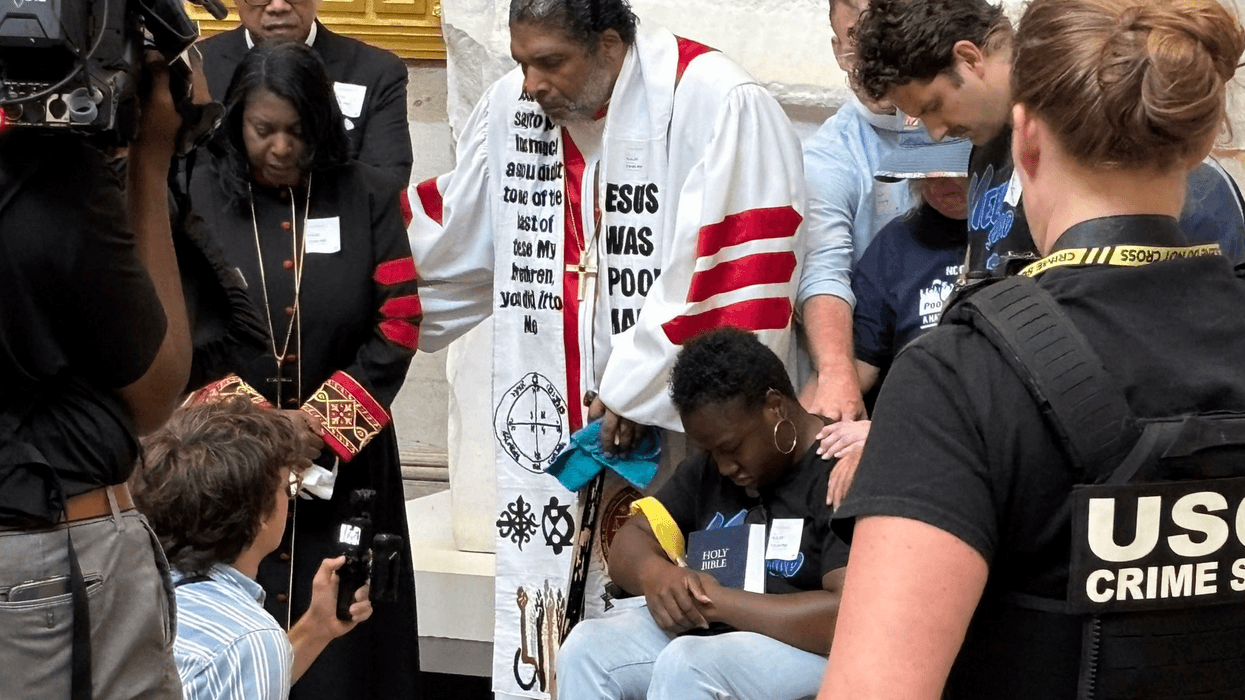
The bill would "rob the poor, starve children, and deny care to the sick in order to line the pockets of the wealthy."
As the so-called "One Big Beautiful Bill Act" made its way to the U.S. Senate Monday, with lawmakers preparing to consider cuts to Medicaid and food assistance and an extension of tax cuts for the rich, one of the nation's top anti-poverty campaigners warned that the proposed budget "is not just bad policy, it is sin."
Rev. William J. Barber II led a "Moral Monday" rally and march through Washington, D.C. to the U.S. Capitol, where he and other advocates spoke out against the proposal that was narrowly passed by the House last month and would "rob the poor, starve children, and deny care to the sick in order to line the pockets of the wealthy."
"We will not stand by while it preys on the most vulnerable," said Barber.
Along with the Institute for Policy Studies and the Economic Policy Institute, Barber's organization, Repairers of the Breach, re-released an earlier report Monday on the proposed budget with additional information about communities that would be impacted if the budget is passed into law.
The budget, said Repairers of the Breach, would result in:
At the rally, Barber spoke about how members of the House voted for a budget that could directly harm hundreds of thousands of their constituents.
"They don't want us to talk about the fact that the largest portion of Medicaid enrollees are families with incomes below $40,000," said Barber. "These are working poor people... In West Virginia for instance, 28% of the entire population is covered by Medicaid. Over 500,000 [people]. And yet every Republican from West Virginia voted to cut. In Ohio, 26% of the people are covered by Medicaid. That's where [Vice President JD] Vance is from... We're talking about children and pregnant women, and adults and people with disabilities."
Repairers of the Breach said it would send delegations into the Senate office buildings to hand senators a petition calling on them to oppose the "immoral cuts" in the proposed budget.
Republicans in the Senate can only afford to lose three votes. Lawmakers including Sen. Ron Johnson (R-Wis.) and Rand Paul (R-Ky.) have suggested major changes will need to be made to the House-passed bill in order for it to be approved—with the senators expressing concern more for the federal deficit than the well-being of millions of Americans who would lose healthcare and food assistance.
"I think there are four of us at this point, and I would be very surprised if the bill at least is not modified in a good direction," Paul told CBS News on Sunday.
Barber told rally-goers on Monday: "We have to stop believing when they say something's over."
"It ain't over until it's over," he said, "and it's not over until all of us have spoken."
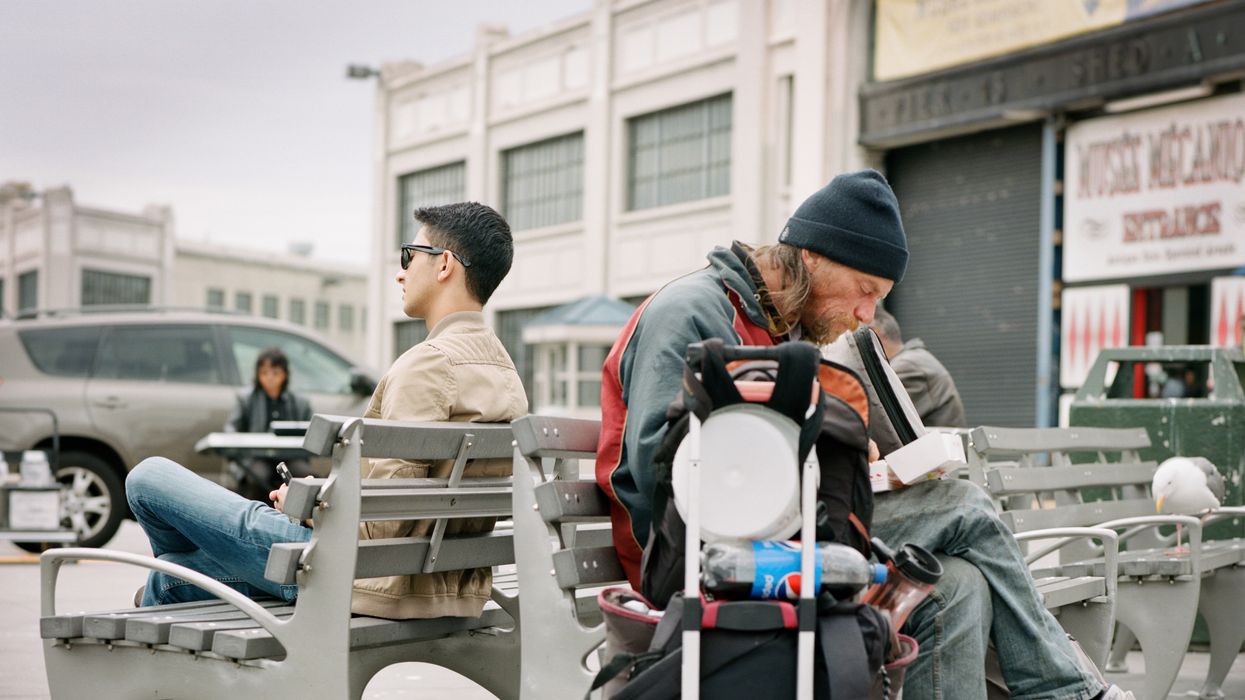
Lives cut short from poverty and low-wealth is a moral indictment of a society that is abandoning millions amid abundance.
In the richest country in human history, poverty has become a death sentence. Yes, despite the fact that the United States throws out more food than is needed to feed every hungry person, that the nation spends more and has more cutting edge developments in health care than any other nation, and despite the GDP growing exponentially over the past years, poverty is the fourth largest killer. Poor people can expect to die 12 or 13 years sooner than rich people in the US, with the death rate gap between rich and poor increasing by 570% since 1980.
In a recent series on declining life expectancy, the Washington Post reports that, “The United States is failing at a fundamental mission—keeping people alive.” This new series shows that the US has a significantly lower life expectancy than other nations with similar economic development. The Post continues, “America is increasingly a country of haves and have-nots, measured not just by bank accounts and property values but also by vital signs and grave markers. Dying prematurely, The Post found, has become the most telling measure of the nation’s growing inequality.”
For too long, poverty has been pushed from the national agenda. For too long, corporate profits have been put before people.
This death measurement indeed is telling. It paints a picture of a country with the resources to raise wages, end homelessness, expand health care, and invest in child care and other needed resources to help struggling families but refuses to do so. It demonstrates a society (with Congress as the speartip) that keeps proposing cuts to health care, food assistance, education, and more even after policy experts have shown that such cuts result in suffering and death.
As theologians and preachers, we know this is not just a health crisis (although Medicaid cuts that could throw as many as 24 million off its rolls is most definitely a healthcare emergency of epic proportions). Lives cut short by poverty and low-wealth is a moral indictment of a society that is abandoning millions amid abundance.
In September, the US Census published the most recent poverty numbers. The US Census report marks a significant increase of the Supplemental Poverty Measure (SPM) from 2021 to 2022, nearly doubling child poverty in the most significant growth in child poverty since the SPM was adopted. These numbers show that 41% of the US population is poor or low-income; 135 million people cannot afford a couple hundred dollar emergency. This reality is an emergency, and anyone who claims to value life, liberty and the pursuit of happiness must treat it as such.
This crisis of poverty and low-wealth requires an emergency response. It requires an emergency meeting between poor and low-income leaders, clergy, economists, public policy experts and the president of the United States at the White House to hear stories and solutions to poverty and policy murder.
It is calling us to a season of direct action, including moral assemblies at state capitols across the country, imploring our elected leaders to support an agenda that tackles poverty and other systemic injustices because there are policy solutions to all of these problems. The Third Reconstruction we are building towards is a revival of our constitutional commitment to establish justice, provide for the general welfare, end decades of austerity, and recognize that policies that center the 140 million poor and low-income people in the country are also good economic policies that can heal and transform the nation.
It means we are committing to convene and converge on Washington D.C. on June 15, 2024 for a Mass Poor People’s and Low-Wage Workers Assembly and Moral March on Washington. And it compels a massive get out the vote effort to enliven and enlarge the electorate of poor and low-wealth voters who hold the power to shift the political calculus of the nation and vote for truth and life and love and justice.
For too long, poverty has been pushed from the national agenda. For too long, corporate profits have been put before people. For too long, we have heard the false narrative that poverty may be unfortunate but inevitable and poor people are to blame for their poverty and if people just worked harder and prayed more, they would not be poor anymore. But as Ms. Yara Allen writes in the anthem of our movement, The Poor People's Campaign, “Somebody’s been hurting our people, people are dying from poverty and policy murder, it’s gone on for too long, and we won’t be silent anymore.”
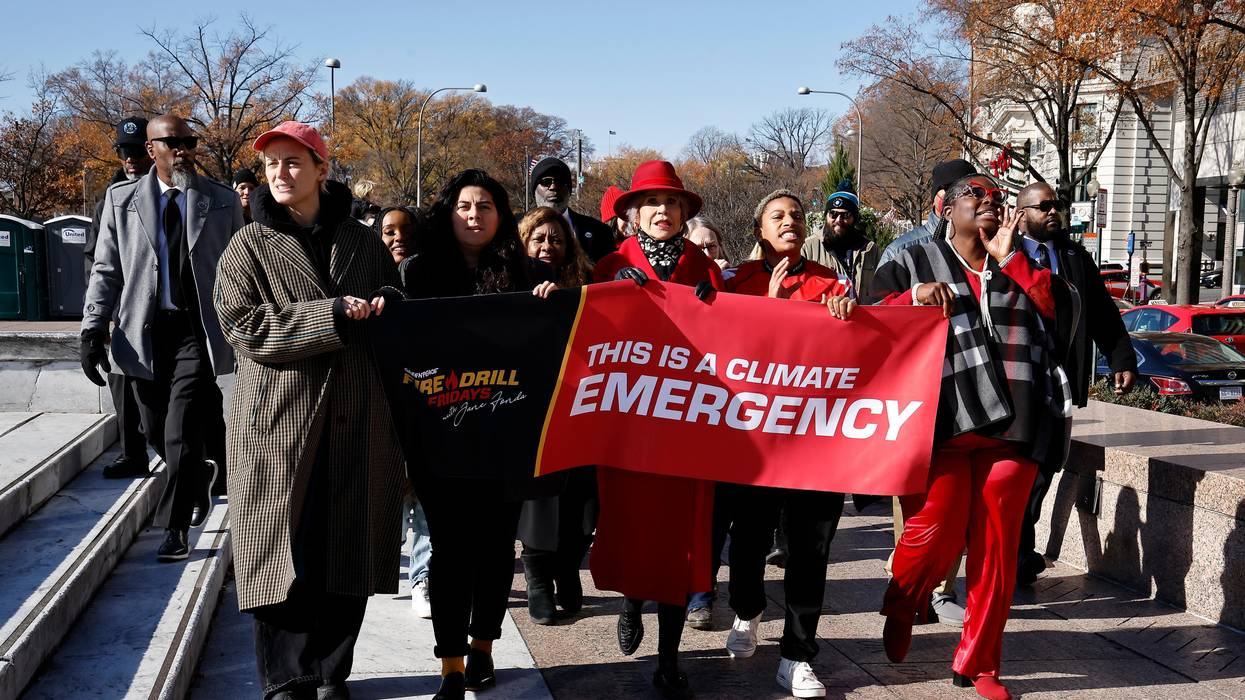
Fire Drill Fridays--the climate action protest launched three years ago by actor and activist Jane Fonda--returned Friday morning to Washington, D.C., where participants rallied and marched against U.S. Sen. Joe Manchin's "dirty deal" while demanding President Joe Biden declare a climate emergency.
"What we do or fail to do in the next eight to 10 years to cut our fossil fuel emissions in half will determine how much of a livable future we will have."
"Organizing does not stop after an election, does it? We must hold the folks we got into office accountable to us, not to oil companies, because the fossil fuel industry does not stop, so we can never stop," Fonda told demonstrators gathered in Freedom Plaza near the White House.
"Time is running out. Scientists are telling us we are in our last decade of action," she added. "What we do or fail to do in the next eight to 10 years to cut our fossil fuel emissions in half will determine how much of a livable future we will have. So this is the time. This is the time for bold action before it's too late. And that's exactly why we are here right now."
Inspired by activists including Fridays for Future founder Greta Thunberg, Moral Mondays co-founder Bishop William J. Barber II, and author Naomi Klein, Fonda started Fire Drill Fridays in 2019 in collaboration with Greenpeace USA. Fonda and other activists were arrested for civil disobedience during the protests, which continued until the beginning of the Covid-19 pandemic the following year, when the demonstrations went online.
The activists took aim at Manchin's so-called dirty deal, proposed permitting modifications favorable to the fossil fuel industry that, while left out of a stopgap funding bill in September, could be revived if the West Virginia Democrat successfully includes it in the next National Defense Authorization Act--which lawmakers are working to pass by the end of the year.
Jerome Foster II--a member of the White House Environmental Justice Advisory Council and, at 20, the youngest-ever presidential adviser--told demonstrators that by being there, they were showing that "the time is now to vote out the politicians like Joe Manchin that are having the dirty deal perpetuated and who think that their pollution and their profits are more important than our lives."
"They chose pollution of their children. They chose profits over our future. And we are tired of having to come here and demand the bare minimum," Foster added.
Sen. Jeff Merkley (D-Ore.) spoke at the demonstration, declaring, "We cannot develop any more fossil fuel infrastructure."
"You know what's in that dirty deal? The Mountain Valley Pipeline for fossil gas," he continued. "And it would mow down every single environmental law in the process... We've got to keep it out of the National Defense Authorization Act... And no dirty deal in any continuing resolution or any other budget bill."
Merkley added that "we need President Biden to declare a climate emergency" and "use all the powers of the federal government to respond to this biggest test of humanity."
Rep. Raul Grijalva (D-Ariz.) told the protesters that "this Manchin dirty deal unfortunately is not unique. There are other dirty deals that threaten the health of people for profit margins."
"We cannot address climate change," he added, "if the balance of power is such that oil and gas interests control the agenda."

Nearly 100 women from 42 states were arrested Monday as they participated in a Washington, D.C. march demanding legislation to safeguard voting rights and deliver relief to poor and marginalized Americans.
"We're planting seeds today. And we are building the movement that will give our children and the next generations the life that they deserve."
--Kenia Alcocer, Poor People's Campaign
Religious News Service reports the arrests occurred during the Women's Moral Monday March on Washington, which was organized by leaders of the Poor People's Campaign: A National Call for Moral Revival, a modern-day continuation of Martin Luther King Jr.'s Poor People's March on Washington led by Rev. Drs. William Barber II and Liz Theoharis.
Monday's event marked the anniversary of the 1848 Seneca Falls Women's Convention, the first women's rights convention in the U.S. Theoharis--who was arrested at the event--told RNS that "173 years later, we are still being denied voting rights."
"If we are trying to make the country a more perfect nation, it will take the leadership of all people--including women," she said.
The march was part of the Poor People's Campaign's Season of Nonviolent Moral Direct Action, which began earlier this month and will continue until August.
The event began outside the U.S. Supreme Court. Demonstrators then marched down First Street to the U.S. Capitol.
According to RNS:
Monday's protesters wore sashes with the group's demands emblazoned on them--demands also outlined in a statement signed by 100 women leaders from across the country. They had four: to end the filibuster; to pass all the provisions of the For the People Act; to fully restore the 1965 Voting Rights Act; and to raise the federal minimum wage to $15 an hour.
These demands are part of the campaign's direct actions leading up to August 6, the 56th anniversary of the Voting Rights Act of 1965. On July 5 Barber... called for a month of "Moral Mondays"--days of nonviolent direct action and protest at state capitols and in D.C.--to save democracy and protest autocracy.
Police began detaining event organizers after they obstructed traffic on First Street. The women were released later in the day.
"Our democracy is in peril," Theoharis said in a statement. "In this time, when our voting rights are under attack, and economic justice is being denied, we must and so we are, calling out the immoral obstructionism of Congress."
Event moderator Kenia Alcocer of the national Poor People's Campaign said: "We're planting seeds today. And we are building the movement that will give our children and the next generations the life that they deserve."
"We don't want to survive," added Alcocer, "we want to thrive."
Marianne Smith, chair of the Poor People's Campaign in Oklahoma, said: "I carry with me today the voices of all the poor and low wealth, women, children, and marginalized citizens of Oklahoma. Rather than seeing an improvement I'm witnessing a decline in the rights and opportunities for the generations behind me. We're demanding equal rights."
Barber said that "in this season when extremists have committed themselves to voter up suppression, we cannot let the forces of greed destroy the very rights you had before you could even comprehend them."
"We cannot, and we will not," added Barber. "We are here today to say that the gutting of the Voting Rights Act in 2013 and the obstruction of [Senate Minority Leader] Mitch McConnell [R-Ky.] that has prevented Congress from restoring it for over eight years, has undermined and eroded our democracy. We don't want some of our justice, we want all of our justice. It's kind of like being pregnant, either you are or you're not."
Next week, the Poor People's Campaign will shift its focus from Washington, D.C. to state capitals, including a "Selma-to-Montgomery style, four-day march" from Georgetown, Texas to Austin.

Outraged by Joe Manchin's obstruction of Democratic efforts to protect and expand voting rights and end the Senate filibuster, the faith-led Poor People's Campaign has announced it will lead a Moral Monday demonstration in the West Virginia senator's home state next week.
"It's time to march on his office," Rev. Dr. William J. Barber II, co-chair of the Poor People's Campaign, said of Manchin, the Senate's most conservative Democrat, in an interview with Religion News Service. "It's time for people of all differences to stand together against him--we call it 'from the hollers in the mountains to the hood.'"
"Thousands upon thousands of people don't agree with [Manchin's] economic position, or his position on voting rights, or his position on the filibuster--and it's time for them to speak up," Barber added.
Pam Garrison, a co-chair of the West Virginia Poor People's Campaign, said she has watched Manchin "talk about compromise, and I wonder, what reality is he in? Is he that delusional, or does he think we're that stupid?"
"We are coming, and I'll tell you what--my fellow Americans are coming with me," said Garrison of next Monday's march. "We are in this together, and we're not taking 'no' for an answer.... We can do better. We deserve better."
Manchin's purported pursuit of bipartisan solutions--efforts opponents argue will bear little fruit with Republican colleagues led by Senate Minority Leader Mitch McConnell (R-Ky.), the self-proclaimed "Grim Reaper"--has rankled progressives. He is the sole Senate Democrat to refuse to co-sponsor the For the People Act, a landmark bill to expand and protect voting rights supported by 79% of likely West Virginia voters. Manchin also stands staunchly opposed to ending the filibuster, a weapon that has historically been used to torpedo civil and voting rights legislation.
Some observers also bristled at what they perceived as the incongruity and tone-deafness of Manchin singing the civil rights anthem "We Shall Overcome" during a Joan Baez tribute at the Kennedy Center Honors Sunday night--the very same day the senator published an op-ed in the Charleston Gazette-Mail explaining why he will vote against the For the People Act.
In response, Rep. Mondaire Jones (D-N.Y.) tweeted that the piece "might as well be titled, 'Why I'll Vote to Preserve Jim Crow.'"
On Tuesday, Manchin held what he called a "productive" meeting with civil rights leaders. While the Black leaders--who included NAACP president and CEO Derrick Johnson, National Urban League President Marc Morial, and the Rev. Al Sharpton--stressed the importance of passing legislation to strengthen voting rights, Manchin left the meeting unmoved in his opposition to the For the People Act.
"I don't think anybody changed positions on that," he told The Hill.
While Johnson hailed the meeting as "robust and insightful" and "focused on finding common ground," Rep. Jamaal Bowman (D-N.Y.) wasn't nearly as cordial, calling Manchin's response to the meeting "disrespectful" and his motivations "questionable."
While Manchin's chimeric quest for Senate unity has left some observers scratching their heads, others say that understanding his unrequited ardor for bipartisanship is as simple as following the money.
Americans for Prosperity, a conservative political advocacy group bankrolled by billionaire Charles Koch, has been pressuring Manchin to hold steadfast in his opposition to crucial Democratic agenda items. The U.S. Chamber of Commerce--the nation's largest lobbying group--has rewarded him and Sen. Kyrsten Sinema (D-Az.), another filibuster preservationist who has broken with her party on more votes than any other senator save Manchin--with thousands of dollars in campaign contributions.
Progressives also worry that Manchin, who has taken hundreds of thousands of dollars in campaign contributions from fossil fuel interests in recent election cycles, could stymie legislative efforts to address the climate emergency.
Barber said he discussed issues including ending the filibuster and raising the federal minimum wage to $15 an hour--which Manchin also opposes--during a meeting with the senator earlier this year.
"We explained... why his defense of the filibuster was historically inaccurate and politically dangerous, and how his position against living wages was hurting over half of the workforce of West Virginia," Barber told Religion News Service. The reverend said he explained that Manchin's opposition to the For the People Act "was hurting not just Black people, but white people, brown people, and particularly poor and low-wealth people."

To mark what would be the 90th birthday of civil rights icon Martin Luther King Jr. this year, Rev. Dr. William Barber II--architect of the Moral Monday movement in North Carolina and co-chair of the national Poor People's Campaign--delivered a sermon on Monday about what is means to preach and why, as Dr. King exemplified, good people of all backgrounds and beliefs "must march, organize and fight" against injustice wherever it is found.
"When words are changed into deeds of liberation--that's preaching. And anything else is just talking." --Rev. Dr. William Barber II"To honor Dr. King, who was always a preacher," Barber stated, "I wrote this sermon for #MLKDay on what it really means to preach."
Commending the powerful preaching of those who stood for social justice and the common good throughout history, Barber's sermon highlights the fact that King stood against "racism, poverty, and war" not because it was popular, but because it was morally unavoidable. "That's why [King] spoke as one who had authority," Barber says.
"And not only did he do it within the comforts of a quarantined sanctuary," he continues, "but he did it in the streets of the nation and even from the jails."
So what is it to preach in these times of struggle?
As the central part of the sermon, and to answer that question, Barber declares:
To preach is to see the people who are crying out and the systems that are crushing them. It is to say, "Somebody's hurting my people and it's gone on far too long and we won't be quiet and inactive anymore." It is to do something about it. It is to join with others who are doing something about it.
When words are changed into deeds of liberation--that's preaching. And anything else is just talking.
When the fruit of the lips become actions dedicated to justice--that's preaching.
When our words call Jews and Muslims and Christians and Sikhs and Buddhists and even people not of faith to come together to work the work of love and work the work of liberation--that's preaching.
When a call goes out that unites people across the lines of race and class and creed and sexuality--now that's preaching.
When the Poor People's Campaign brings Natives and Asians and Black and White and Brown people together, and march together and organize together and go to to jail together for a moral revolution of values--that's preaching.
When preachers go to the border and serve communion to the officers and communion to those who are holding back the immigrants and then tell them while they're eating the communion that they need correction and that they're wrong--that's preaching.
When nuns lobby for healthcare and when preachers say, "I'm not gonna preach another funeral over somebody who died from the lack of healthcare and said 'God called him home.'" Instead I'm going to say, "God may welcome them home, but the government killed them." That's preaching.
When churches and synagogues and mosques open their doors and offer sanctuary to families that are being ripped apart by ICE -- that's preaching!
And when that kind of preaching is happening, it is transformative. It changes the world. It might get you killed, but that same preaching will get you back up again. And if it doesn't get you back up, preaching also gets folks pregnant. So you might be dead, but those behind you will come forth. Preaching always produces.
Watch the full sermon:

We sure hear a lot today about external threats to our democracy, whether it's Russia's election "meddling" or North Korea's nuclear expansion. But a home-bred threat might run deeper still.
More than a third of Americans polled by the finance company LendEdu say they'd forfeit the right to vote in exchange for a 10 percent raise.
Consider this. More than a third of Americans polled by the finance company LendEdu say they'd forfeit the right to vote in exchange for a 10 percent raise. Whoa...I had long assumed that such a sad choice would be tempting only in the poorest societies.
Learning that so many Americans would trade their voice for bucks could help wake us up to one simple truth: Political democracy, i.e. elected government answering to the people, is always vulnerable when citizens feel economically powerless. Put another way, political democracy without citizens' economic empowerment can't endure.
By "economic empowerment" I mean two things.
First, when casting a vote, we feel confident we can choose representatives who will pursue public policies protecting us, and that includes guarding us from exploitative wages as well as shady corporate practices, including those costing millions of us our jobs and savings in the 2008 Wall Street debacle.
Second, "economic empowerment" is what some of us experience first-hand in workplaces protected by a union, for example, or in the thousands of US cooperatives, such as Ace Hardware, or in the 2,500 firms American incorporated as "B corporations" whose charters commit a firm to considering workers' well-being, among other social goods.
Yet on Election Day 2016 many voters--likely feeling neither form of economic empowerment--settled for a "strongman" who promised protection but, as we have now seen, lacked commitment to the rules and norms of democracy required to secure our interests.
If indeed many voted out of a sense of desperation, it's easy to understand.
Workers' wages have barely budged in almost half a century and poverty is so deep that half our newborns depend on public aid to eat. Meanwhile, CEO pay has soared sixteen-fold. So, while there's vast evidence that our money-driven politics along with voter manipulation help to explain the 2016 election, our rigged economy, denying most Americans a voice in their economic well-being, also helped give Trump an edge.
Bottom line: Political democracy is forever in danger absent an understanding of what democracy requires well beyond politics.
Democracy is a culture that lives or dies on whether it's creating three conditions throughout our public lives that have proven to bring forth the best in our species and to keep the worst in check.
Democracy is a culture that lives or dies on whether it's creating three conditions throughout our public lives that have proven to bring forth the best in our species and to keep the worst in check: One, the wide dispersion of power; two, transparency in public affairs; and, three, a culture of mutual accountability in contrast to the blame-the-other culture fomented today.
Yet America is rushing headlong in the opposite direction. Consider democracy's first condition, widely distributed power. It's increasingly absent in both political and economic arenas. One-half of 1 percent of the population contributed about two-thirds of the $6.4 billion cost of the 2016 election. And now, just three Americans control more wealth than the bottom 50 percent of us do.
And, how did we arrive at such obvious affronts to democracy?
Long taught by market-fundamentalists of the Right that seeking the public good is risky because all we can count on is our selfish nature, many believe our only choice is to hand over our fate to a "free market" driven by self-interest. It, we're told, will sort winners and losers--fairly.
It tells that if we don't make it, it's our fault; bringing on a culture of blame and shame: All that's needed to set us up to embrace a president telling us whom to blame.
But wait...in our extreme version of a market, one rule drives all: Do what brings highest return to existing wealth. So, wealth accrues to wealth accrues to wealth. Yet the myth of a free market hangs on. It tells that if we don't make it, it's our fault; bringing on a culture of blame and shame: All that's needed to set us up to embrace a president telling us whom to blame.
So, what's the big lesson?
Democracy's essence is dignity--knowing that we count and have a real voice, in the voting booth, yes, but also in other dimensions of life, including the economic. Thus, the denial of dignity is arguably greatest threat to democracy.
And the good news?
A grassroots democracy movement focused on creating fair political rules is now becoming a "movement of movements," uniting economic, political, racial justice, and environmental dimensions of our lives.
Take Democracy Initiative for example. In just five years, it's already brought together nearly 70 organizations representing roughly 40 million Americans, from the AFL-CIO to NAACP to Sierra Club. Their diverse core passions, and those of so many more, are uniting to fight for democracy, as it touches all parts of our lives.
Or jump to a state...gutsy North Carolina. Building on earlier organizing, the Moral Mondays movement developed what it calls "fusion politics," uniting 200 organizations representing two million citizens around a 14-point agenda--including both voting rights and economic empowerment through, for example, livable wages. Now the approach is taking hold in a dozen other states and has gone national as the Poor People's Campaign.
And in cities, too, this weaving together of our lives is underway. Across the Bay from San Francisco, citizens of Richmond, CA, 80 percent of whom are people of color, had lived for more than century under the heel of Chevron Oil, notorious for denying citizens a real voice by stacking the city council.
Democracy can't be sliced up into parts because human beings cannot be--that is, we cannot trust that we have a real voice at the polls while feeling voiceless in our economic lives.
That is, until the Richmond Progressive Alliance drew together United Steel Workers with immigrant rights and environmental justice activists into a local "movement of movements." By 2004 the Alliance was strong enough to win council seats. Ten years later, its city council slate with a few hundred thousand dollars defeated the three-million-dollar, Chevron-backed candidates.
With unity among diverse citizen interests, the Council has been able to lift Richmond's minimum wage to among the nation's highest and to enact public financing for its seats.
Weaving together democratic political and economic advances, these three stories offer real hope that it's possible to address the desperation showing up at the polls in 2016.
Thus, the lesson at the heart of our current crisis?
Democracy can't be sliced up into parts because human beings cannot be--that is, we cannot trust that we have a real voice at the polls while feeling voiceless in our economic lives. Dignity is dignity. From this commonsense premise, we can unite to address the biggest internal threat to democracy.

This Mother's Day a convergence of unlikely bedfellows launched a Poor People's Campaign -- echoing the Poor People's Campaign Martin Luther King, Jr. initiated half a century ago aiming to "transform the political, economic and moral structures of our society." Is there a strategy that can make that aim more than a vain hope?
Today, millions of people are on the march: The Women's March, the March for Science, the People's Climate March, Black Lives Matter, the Fight for Fifteen, the March for Our Lives, May Day immigrant rights marches, #MeToo, the Red-state Teacher Rebellion, and more. A recent poll found that one American in five has protested in the streets or participated in a political rally since the start of 2016 - about two-thirds of them for progressive causes that some call the "Trump Resistance."
Yet these tens of millions of people face some dilemmas. Surely most of those who participate in these actions support most of each other's causes, yet there is no vehicle to pool their separate power. The forces they are opposing - in shorthand the 1% and their accomplices - can use their immense wealth to buy bases of power ranging from politicians and political parties to constituency organizations like the NRA, from think tanks and university policy centers to the media. They will not bow down before a march, even a march of millions. Trumpism is bigger than Trump and will outlast him.
The default strategy for opponents of Trumpism is to back the Democratic Party. Although it is surely the "lesser of two evils," the Democratic Party is also complicit in the racism, sexism, impoverishment, climate destruction, and violence at home and abroad that the Trump Resistance opposes. It has given little evidence that it will, when in office, effectively combat these evils. It provides little in the way of an alternative vision beyond the status quo ante. It has not proposed a program that can attract those who have supported Trumpism.
These limitations exist primarily because, given the current structure of the American political and economic system, any political party is likely to be dependent on the 1% and to hew to its interests. Simply electing more Democrats, or even more progressive Democrats, provides inadequate leverage to challenge this reality. Advocates of that strategy have a compelling answer, however: Do you really think the world will be a better place if we simply let the Republican Party win elections and rule?
There is a third strategic alternative: A "non-party opposition" which draws diverse constituencies out of their silos to combine their power but uses direct action rather than electoral politics as its means to exercise that power. Such a non-party opposition can play some of the crucial roles of a political party, bringing together different constituencies around common interests, exposing existing policies and institutions, and presenting alternatives.
The testing ground for the new Poor People's Campaign was what came to be known as the Forward Together movement that developed in North Carolina over the past dozen years. It shows how a coalition of movements, acting as a non-party opposition, can challenge reactionary political forces and transform the political arena. Forward Together is best known outside the state for its Moral Mondays and its surprise defeat of North Carolina's anti-trans "bathroom bill," but those are only two of many Forward Together experiences to draw on in constructing a new Poor People's Campaign.
The idea of an "opposition party" is a commonplace in politics. It is a political party that is not in office and aims to replace those that are. But what is a "non-party opposition"?
Political parties, whether parliamentary or revolutionary, almost by definition aim to take state power. When they are not in power, they present a critique of those who are, formulate a program for what the government should do, and appeal to the public to put them in power instead.
A "non-party opposition" is a convergence of social movements that performs some of the classical functions of an opposition party without the goal of taking state power. Movements based on non-violent direct action, like the labor movement in the 1930s and the civil rights and anti-Vietnam war movements of the 1960s, have often been the real "opposition party" in America. For such movements to take the next step and constitute themselves as a united force around a program of basic social changes does not necessarily require that they function in the electoral arena. Indeed, the formation of such a political force organized around a radical program to be implemented by mass direct action was very much the conception on which Martin Luther King was developing the original Poor People's Campaign in 1968.
The Poor People's Campaign planned to use an encampment in Washington, DC, as the bastion for an ongoing interracial movement to challenge the distribution of power in America. An "economic bill of rights" called for full employment, a guaranteed annual income, unemployment insurance, a higher minimum wage, low-income housing, and expanded education, all to be paid for by ending the war in Vietnam. The campaign won support from American Indian, Puerto Rican, Mexican-American and poor white communities; King's engagement in the Memphis sanitation workers strike was part of the coalition-building effort for the campaign. In a 1968 speech to the Poor People's Campaign King called for "opening of a bloodless war to final victory over racism and poverty."
King was responding to a political dead end. Efforts to address the impoverishment of Black America like the War on Poverty were collapsing under the pressure of the Vietnam War. More votes for President Lyndon Johnson (like more votes for Democrats today) might have arguably been necessary to forestall the right and protect existing social programs, but it provided no exit from an unacceptable status quo. A non-electoral opposition offered another pathway to change--a pathway that was tragically cut off by King's assassination.
An "independent opposition"--contrasting with the sham opposition in the parliament--played a critical role in the upheavals in Poland that led to the rise of Solidarity and the downfall of Communist regimes in Eastern Europe. As Adam Michnik put it in Letters from Prison, the purpose of Poland's independent opposition was not to take power but to demonstrate the illegitimacy of the ruling system and help the people empower themselves in all spheres of society. The independent opposition "must be constantly and incessantly visible in public life, must create political facts by organizing mass actions, must formulate alternative programs."
A non-party opposition can include groups that also participate in the electoral process as long as they do not try to subordinate the non-party opposition to their electoral objectives. Even a disruptive non-party opposition can benefit those working in the electoral arena by awakening the 99 percent from fear, isolation, complacency, and despair. King's vision was that the Poor People's Campaign would inspire millions of poor people to vote. Some unions explicitly supported Occupy Wall Street because they believed it would help progressive Democrats in the upcoming elections.
No matter who wins the next election, we can be confident that the 1 percent will still be in power. The job of the nascent non-party opposition is to draw together the 99 percent not around a candidate or a party but around our common interests, the structural changes they require, and the direct actions we can take to begin realizing them. As Adam Michnik put it early in the emergence of Poland's independent opposition, "Nothing instructs the authorities better than pressure from below."
The idea of a non-party opposition can provide an alternative to the Scylla of cooptation and the Charybdis of marginalization. Today, when the government, the political system, and both parties primarily represent the interests of corporations, banks, and the 1 percent, the time for a non-party opposition may have arrived.
What might a non-party opposition that draws together a wide coalition to affect public policy by direct action look like in Trump's America? Maybe a whole lot like North Carolina's Forward Together.
The story of what came to be known as Forward Together is told by its founder and leader, William Barber II, in The Third Reconstruction: How a Moral Movement Is Overcoming the Politics of Division and Fear. Barber, a black minister and the son of a minister, built up an extensive network and wide respect through his decades as head of the North Carolina Civil Rights Commission, the leader of the state NAACP, and the minister of a local congregation known statewide for its outstanding programs for the poor.
In 2007 Barber persuaded the North Carolina NAACP to convene a People's Assembly with what he called the "fourteen justice tribes in North Carolina." The assembly, held on Jones Street outside the statehouse, unanimously adopted a fourteen-point agenda representing the concerns of those fourteen tribes. It outlined eighty-one action steps. The People's Assembly became an annual event. The movement it spawned came to be known as Historic Thousands on Jones Street or HKonJ.
HKonJ chose as one of its first actions support of workers at the Smithfield hog-butchering plant in Tar Heel, NC who had struggled for a decade to win a union. The coalition decided to "change the narrative" by "making the workers' struggle a moral cause for our whole coalition." Conversations about "fair wages" or "civil rights" could not be reduced to the self-interest of separate groups; "We were engaged together in a conversation about what kind of economy builds up the common good." The coalition organized clergy and community leaders to make public statements at grocery stores across the state asking them to stop carrying Smithfield meats. After months of struggle the union was recognized and a contract won; the coalition's relationship to the state's beleaguered unions was solidified as well.
More directly political action followed. A rightwing takeover of the Wake County school board gutted guidelines promoting racial diversity and began to undermine public education. HKonJ held forums to alert the public to what was going on and signed up to speak at school board meetings. "Our job was to shift the public conversation." In response the board banned protestors from its meetings. Barber says, "Like Bull Connor in Birmingham, they set the perfect stage for civil disobedience." Coalition members were repeatedly arrested for trying to enter the meetings. At the same time they mobilized voters for the next election. A year later every member of the board who had tried to resegregate the schools was voted out and the rightwing candidate for state superintendent of schools was defeated.
HKonJ's research indicated that the biggest reason low-income people didn't vote was because they couldn't leave their jobs to do so. In 2007 the coalition pressured the Democratic legislature and governor to pass a voting rights law allowing early voting and same-day registration. Then it mobilized its partner organizations for a wide-reaching voter registration and education campaign. The expansion of voting rights added at least 185,000 new voters. In 2008 all 15 of North Carolina's electoral college votes went to Barrack Obama, who happened to be both a Democrat and African-American.
In the 2012 election a well-organized, well-heeled rightwing backlash took control of the legislature and elected Pat McCrory governor. It passed new restrictions on voting rights, gay rights, abortion rights, environmental protection, unemployment compensation, medical care, education, and other elements of the rightwing agenda. It passed a redistricting plan so gerrymandered that it was eventually blocked by federal courts as "unjustifiably discriminating." A group of college students with duct tape over their mouths filled the legislature's observation area to protest voting rights restrictions and were arrested. Forward Together decided to follow suit. On Monday, April 29, 2013 seventeen protestors were arrested in the legislative gallery. The movement, soon to be rechristened Forward Together, decided to return in a week. Thus began North Carolina's famous Moral Mondays. Over the next three months nearly a thousand protestors were arrested at the state house. Eighty thousand people joined the movement's culminating demonstration. Barber called it a "popular uprising." As the Moral Mondays movement grew, Governor McCrorey's poll numbers fell.
Before the 2016 election Republicans tried to divide the movement, targeting black Christians in particular, through the so-called "bathroom bill" requiring that people use public restrooms matching their "biological gender" - a transparent appeal to anti-trans bigotry. Barber and other ministers spoke at church meetings throughout North Carolina saying "the fundamental principle of equal protection under the law" was a "constitutional and moral principle" that they must uphold. Forward Together said the bill wasn't about bathrooms at all. In fact, it "attempted to codify discrimination, denied all North Carolinians the right to challenge employment discrimination in state court, and overrode the victories of municipal living-wage campaigns." Once they understood what the bill really did, "workers stood with preachers and LGBTQ activists stood with the business community" to oppose it.
At the next election McCrory became the first governor in North Carolina history to lose a bid for reelection.
Forward Together has become a coalition of 145 organizations representing Christians, Muslims, Jews, nonbelievers, blacks, Latinos, and poor whites, labor, civil rights, feminists and environmentalists, doctors and the uninsured, businesspeople and the unemployed, women and men, gay and straight, young and old, documented and undocumented. This unity was based on a belief that "none of us would be free until all of us were free."
A number of principles have shaped Forward Together's actions. One is simply "showing up to support any group in the state that was standing for justice." In 2013 Forward Together supported the fight of Planned Parenthood and NARAL against new abortion restrictions. A few years later a hundred people filled a Durham church to demonstrate solidarity with a Durham-raised asylum seeker fighting deportation. Forward Together seeks "powerful images of solidarity" manifested in "daily acts of justice and community building."
In Forward Together "our most directly affected members" would "speak to the issue closest to their own hearts" but "they would never speak alone." The movement exists
"so preachers can fight for fifteen and workers can say 'black lives matter,' and a white woman can stand with her black sister for voting rights, and a black man can stand for a woman's right to health care, and L.G.B.T.Q. folk can stand for religious liberty, and straight people can stand up for queer people, and a Muslim imam can stand with an undocumented worker."
The movement was often marked by a dual language of faith-based morality and political commitment to constitutional rights and the common good. Barber compares the coming together of diverse constituencies to Ezekiel's vision of a valley of dry bones transformed into a living community; he describes the lineup to commit civil disobedience as an altar call. But his is religion at its least sectarian: "It was often folk outside the church who inspired us the most, standing as examples of what the church should be," he says; the church "didn't have a monopoly on God's dream." And the goals of the movement were often expressed in secular political language: "Justice and community and the general welfare and the domestic tranquility and equal protection under the law" as guaranteed by state and federal constitutions. One journalist described the premise of the movement as a "universalist program" for health care, voting rights, reproductive choice, and higher wages that begins in "building coalitions among people whom politics have driven apart."
Amidst a welter of issues, the defining common ground for Forward Together has been a response to the needs of the poor and vulnerable. As Barber put it, "poor and hurting people were the capstone of our moral arch." They required a response to human suffering that was shared beyond any particular religious or political persuasion. Its supporters knew that "laws which so obviously hurt people are wrong and must be challenged."
Forward Together provides one model, though surely not the only one, of what a non-party opposition might look like in the Trump era. It plays some of roles of a conventional opposition political party, drawing together diverse constituencies around common interests, criticizing existing policies and institutions, and proposing alternatives. But it exercises power by direct action rather than by running candidates.
Barber says,"effective work for justice in the real world" requires "real political power." And yet, "The battle, while deeply political, wasn't fundamentally about campaigns and elections." More than winning seats in the legislature it was about "exposing the conspiracy of the governing elite to maintain absolute power through divide-and-conquer strategies" and reshaping "the stories that tell us who we are." Forward Together began making its demands for voting rights and equal justice when Democrats controlled the legislature and governorship and maintained that its agenda "wasn't Republican or Democrat, liberal or conservative." Unlike a political party or lobbying group, Forward Together has eschewed running or supporting candidates for office. Yet it has transformed North Carolina politics.
Forward Together remains poised for rapid response. It has a network of activists ready to converge on the legislature at a moment's notice. Barber has said that the movement won't stop until its "People's Agenda" becomes the agenda of the North Carolina government.
Within two years of the first Moral Monday in Raleigh, Moral Mondays coalitions had come together in fourteen states. Now the Forward Together movement is going national in the form of the Poor People's Campaign. For the past year co-chairs Barber and Liz Theoharis of the Union Theological Seminary have been holding meetings and rallies around the country. Barber says, "Our focus has been to go to the people first, in the states, on the ground, and build a network of coordinating committees." Activists in dozens of states and Washington, D.C., are joining in 40 days of civil disobedience "to build the power of the poor and the working class to reset the national agenda."
It is not self-evident how to apply the Forward Together model to national politics. It will certainly include dramatic civil disobedience at local, state, and national levels. But Barber says "civil disobedience is just one part of the plan." A second phase will include voter registration, building a broader network, and creating a detailed list of policy demands.
Theoharis makes clear the political but non-party character of the campaign. "We surely want to influence the 2018 midterm elections and the 2020 Presidential election." But they do not plan to endorse candidates or support any political party. Their statement of fundamental principles states that "no elected officials or candidates get the stage or serve on the State Organizing Committee of the Campaign."
The new Poor People's Campaign, like the original one, addresses a wide range of issues related to poverty but going far beyond it to oppose American militarism and foreign wars and emphasizing the threat of climate change. Barber says "Four diseases, all connected, now threaten the nation's social and moral health: racism, poverty, environmental devastation, and the war economy." The Campaign's demands, presented in its "Moral Agenda Based on Fundamental Rights," include 100 percent clean, renewable energy and a public jobs program to transition to a green economy. Like Martin Luther King, Jr. speaking out against the Vietnam war, it is willing to take a public stand on unpopular issues if it is convinced its moral responsibility to do so is clear.
The tens of millions of people who have participated in the Women's March, the March for Our Lives, and the many other protests of the Trump era are marching in place in every community large or small. They have the potential to provide a vast grassroots network if the Poor People's Campaign can reach out and inspire them to act together.
Conversely, all of us who have participated in one or another aspect of what has come to be known as the Trump Resistance should think about how we should be connecting with the new Poor People's Campaign--and with each other. Perhaps we can make that campaign and similar efforts starting points for a non-party opposition that can challenge Trumpism and the power of the 1%--and indeed "transform the political, economic and moral structures of our society."

Aiming to continue the work that Rev. Dr. Martin Luther King, Jr. was doing when he was assassinated 50 years ago, a new Poor People's Campaign officially launched on Monday with advocates for economic justice rallying in Washington, D.C. and more than 30 state capitols nationwide.
The campaign, with an emphasis on voter mobilization and civil disobedience, will include 40 days of demonstrations culminating in a massive protest on June 23 in Washington, D.C. The movement calls for wage laws that are "commensurate for the 21st century economy," a repeal to the tax plan the Republican Party pushed through Congress last year, universal healthcare, and the expansion of public housing as well as guaranteed "fair and decent housing."
Led by the Rev. William Barber, organizer of North Carolina's Moral Mondays protests, the Poor People's Campaign will focus on weekly themes under the larger issue of poverty and economic inequality, including women and children in poverty, voting rights, healthcare, and housing.
"We cannot continue to have a democracy that engages in the kind of policy violence that we see happening every day," Barber told Amy Goodman of Democracy Now! on Monday. "All over this country we continue to see what is not often seen or talked about in our politics, in our political debates, or even in the media...250,000 people are dying every year from poverty and low wealth."
King's Poor People's Campaign aimed to petition the government to pass an Economic Bill of Rights, guaranteeing Americans an annual wage and full employment, allocating $30 billion to combat poverty, and establishment of low-cost housing for the poor.
Today, Barber and the Institute for Policy Studies estimate that 140 million Americans are living in poverty--about 100 million more than the census estimates.
The new Poor People's Campaign demands far-reaching policy changes that aim to alleviate the economic burdens placed on poverty-stricken Americans.
The movement follows a widespread national focus on the labor movement, as teachers across the country have staged walkouts to protest chronically low wages and underfunded schools, and Sen. Bernie Sanders's (I-Vt.) introduction of a bill to strengthen the nation's unions.
On Democracy Now!, Barber stressed that the prevalence of poverty in the U.S.--one of the world's wealthiest countries--and the abandonment of American workers indicates a profound moral failing of the government.
"It is time for a moral confrontation, a non-violent moral confrontation," Barber said. "It is immoral to have 37 million people without healthcare, it is immoral not to pay living wages when we know we can do it...Our first goal is to break through the moral narrative to where we're talking about it. We're not even talking about these issues in the country."
The 40 days of protests will be the launch of a "multi-year campaign," Barber added.
On social media, participants in cities across the country shared images and videos of the Poor People's Campaign's launch.
Washington, D.C.
Massachusetts
Florida
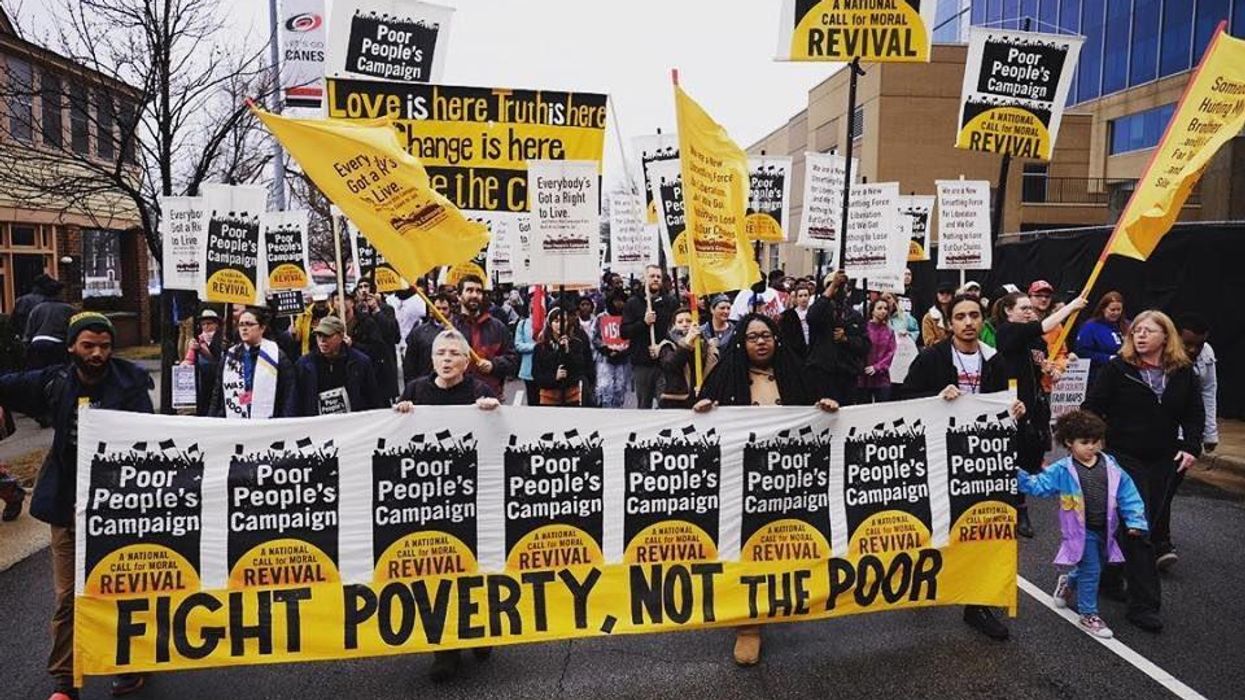
The critical question long-time veterans of the civil rights movement and new activists alike ask is this: Are the times ripe for a newly energized movement to break the stagnation which has shut down most racial progress for the last 50 years?
If so, the follow-up is: What will it take to propel the activists forward who are demanding meaningful racial progress now?
As a white lawyer working for the National Association for the Advancement of Colored People's general counsel, Robert L. Carter, I was there in 1964 when the breakthrough Civil Rights Act of that year became law. It was the result of efforts by thousands of Americans of all stripes taking to the streets and the courts to confront violent mobs, the Klan, racist law enforcement officers, and politicians to enforce their rights.
During those years, black and white activists worked together, went to prison together, and sometimes died together to pressure the federal government and the courts to bring down the racist Jim Crow legal system that demanded total segregation in every aspect of life.
That black-white alliance, with whites also risking life and limb to support a more integrated, freer America, was a thing of beauty I hoped would never come apart. However, it would soon split up -- with far reaching consequences.
What Became Possible
It's worth taking a look at what that alliance accomplished.
What's been called the Second Reconstruction followed on the heels of the return of hundreds of thousands of African American World War II veterans. They had endured segregation during their military service fighting Nazi Germany and Japan only to return to a particularly brutal form of apartheid back home in the South.
The struggle to tear down the all-encompassing reach of Jim Crow laws and the terrorism of the Klan brought together new forces, who accomplished tremendous things together.
At the NAACP, Charles Houston, through his base at Howard Law School, trained brave and committed lawyers, black and white alike, headed by Thurgood Marshall. James Farmer created a new multi-racial organization, the Congress of Racial Equality (CORE). This legal front scored landmark victories: In 1954, the Supreme Court ruled that legally compelled school segregation was unconstitutional in a 9 to 0 decision which undermined the Jim Crow laws.
On the social front, the NAACP's Rosa Parks precipitated the successful 1955-1956 Montgomery bus boycott, leading to the rise of the Southern Christian Leadership Conference (SCLC) under the leadership of Martin Luther King, Jr. The lunch counter sit-ins began in 1960, followed by the student Nonviolent Coordinating Committee (SNCC) organized by Ella Baker.
Young black and white Freedom Riders, following the non-violent precepts of Mahatma Gandhi, exposed for all the nation the viciousness of southern mobs aided and abetted by local law enforcement. Clergymen, rabbis, lawyers, students, and entertainers -- as well as fundraisers in the North -- propelled these groups forward.
The NAACP, SCLC, CORE, and SNCC and men and women of all races and religions joined together for the iconic 1963 march in Washington. The following year, the 1964 Civil Rights Act was passed. Church burnings, killings, and Klan violence continued, but the writing was on the wall: In the South, Jim Crow was dying as a formalized institution.
Still, just like the First Reconstruction that followed the Civil War, this Second Reconstruction focused almost entirely on the South. It barely touched the North, which had its own forms of deeply ingrained violence and racism. Amid the unrest of 1968, it drew to a close before it even had a chance.
Today, all these years later, the possibility once again exists that young blacks and whites -- joined by others whose human and civil rights are under fierce attack, including immigrants, Dreamers, Muslims, and LGBTQ advocates -- will again become a vibrant part of a new coalition to advance civil rights, this time all over the country, North and South, East and West.
To achieve that goal, it's necessary to go back in time to reconstruct what broke that old coalition apart.
A Half-Century of Counter-revolution
Even during my years at the NAACP, a counter-revolution had set in.
The Supreme Court majority turned against civil rights enforcement except in the most egregious cases. In the North, literally no progress was made to desegregate the public schools despite a major campaign led by the NAACP and its legal staff. African Americans remained locked into overcrowded housing in terribly underserved urban ghettos, with extremely limited employment opportunities. They were policed by virtually all-white forces who took their primary duty as protecting the whites who lived separate lives in separate worlds.
By 1965, King realized that the civil rights movement had to head North if it was truly going to free African Americans from segregation. To open a northern campaign, he took the SCLC to Chicago in 1966. Working with the American Friends Service Committee (AFSC) and a local umbrella group, King focused on attempting to open up Chicago's totally white neighborhoods to African Americans. The effort met violent residence. King was hit by a rock during a march and commented that he had never seen such hostility. After what turned out to be a sham agreement negotiated with the city, King and the SCLC retreated, and what had been called the Chicago Freedom Movement was dead.
By 1968 when King was assassinated, the civil rights coalition had fragmented. Frustrated by the resilience of white supremacy, many black activists gravitated toward the Black Power ideologies articulated by leaders like Stokely Carmichael, H. Rap Brown, Malcolm X, and the Black Panther party. At the same time, the attention of many young white activists had shifted from civil rights to stopping the Vietnam War.
King wasn't blind to these fissures. Prior to his death, King and the SCLC had planned a Poor People's Campaign which would include whites as well as blacks and the poor of all national origins. The goal was to reignite the civil rights movement by linking the fights against poverty, racism, and militarism to inspire the millions of Americans of all races living in abject poverty.
After his death, the SCLC, now headed by Ralph Abernathy, decided to continue the campaign, which centered on establishing a tent city on the National Mall to be called Resurrection City. After obtaining a permit, hundreds of people pitched their tents and opened the tent city in May. By June, however, after a month of heavy rain, the authorities drove the occupants out and destroyed the city. Like the early effort to expand the civil rights focus to the North, this effort also ended in failure.
Moreover, across the North, white-dominated establishment groups, funders, and unions that had supported civil rights now balked at calls for Black Power, as well as affirmative action. Even mainstay civil rights organizations like the NAACP, which relied heavily on white financial support, joined the chorus, with its executive director, Roy Wilkins, opposing Black Power as well as black leaders who were coming out against the war in Vietnam.
To many African Americans, the murder of Martin Luther King, Jr. was the last straw. Rebellions -- called riots by the press -- broke out across America. Whole sections of cities, including Washington, D.C., were torched. Troops were called out to quell the outpouring of anger.
As these events unfolded, virtually no major civil rights organizations joined Black Power advocates together with white activists to redirect the prevailing anger into a new, forward-looking civil rights agenda. The NAACP, which had played a leading role in the passage of the Civil Rights Acts of 1964, 1965, and 1968, seemed to have lost its ability to sustain a forward-looking agenda. Moreover, FBI infiltration of SNCC and the Panthers undermined major parts of the black protest movement.
Instead, it was the die-hard segregationists of the South who were on the march, with George Wallace of Alabama leading the charge into the North. There, many whites were fearful of blacks integrating their neighborhoods, workplaces, and schools, all of which made fertile ground for Richard Nixon's "Southern strategy" and "law and order" campaigns, which rallied white fear and resentment behind a reactionary agenda on civil rights.
The mood of mainstream white America at the time was perhaps best expressed by Daniel Patrick Moynihan, an academic and career politician who had received high level appointments under both Republican and Democratic presidents. As an adviser to Nixon in March of 1970, Moynihan wrote a memorandum advocating a policy of "benign neglect" toward blacks.
On the right, Moynihan was viewed as the voice of reason. To the remnants of the civil rights community, he was a traitor. Yet Moynihan's star kept rising. He became the U.S. ambassador to the United Nations, a Harvard University professor, and eventually a U.S. senator. President Bill Clinton later awarded him the country's highest civilian award, the Medal of Freedom.
Throughout Moynihan's post-1971 career, whether he thought of it that way or not, the barely concealed racism of "benign neglect" remained central to American policy makers' retreat. In fact, under President Clinton -- and over Moynihan's own objections -- Congress passed so-called "welfare reform," which only hardened the extreme difficulty under which African Americans (as well as millions of whites) living in poverty existed.
Towards a New Militancy
Now, 50 years after Martin Luther King, Jr. was killed, the same racial injustices still confront the nation.
Many black urban areas look like war zones, thanks to white flight, globalization, de-industrialization, and automation -- as well as both "benign neglect" and more overt racism. Many barely functional public schools are still segregated, often serving as little more than a pipeline to overcrowded prisons. Black unemployment levels are still double those of whites, black wealth remains a small fraction of white wealth, and the housing costs in many cities are so high that African Americans find themselves forced to live in even worse housing further away from available jobs.
Yes, some African Americans have climbed the ladders of corporate, political, artistic, and athletic success to the highest levels. But on the ground, the reality remains bleak.
Perhaps as a result, a new generation of African American thinkers -- including Ta-Nehisi Coates, author of We Were Eight Years in Power, and Michelle Alexander, who wrote The New Jim Crow: Mass Incarceration in the Age of Color Blindness -- have injected into the public consciousness the idea that racism is the extraordinary powerful glue which has resisted all efforts to dismantle it.
Nor are these writers alone in expressing their anger and frustration.
Across the nation, many African Americans are in revolt against repressive police practices, including the killing of unarmed African Americans and a criminal justice system which almost always refuses to press charges against cops, yet imprisons millions of people of color in far greater numbers that they were imprisoned 50 years ago.
Putting the legal system further out of reach by making black political representation less likely, the Supreme Court has stripped the 1965 Voting Rights Act of its key enforcement provision. Donald Trump has appointed a racist attorney general, built a political career on claiming that Barack Obama was born in Kenya, and treated neo-Nazi marchers like "very fine people."
Supporting him, Trump has a solid base of Tea Party members, working class whites who have seen well-paying industrial jobs evaporate, white evangelicals, and millions of racist whites nostalgic for the old days.
After five decades of stagnation, are the times ripe now for a new movement which can win the allegiance of growing numbers of Americans against entrenched interests in order to achieve a more egalitarian nation?
Struggles of this nature are extremely difficult and require sacrifices, just as civil rights advocates made during the Second Reconstruction. In addition, back then, targets were overtly racist laws and customs like Jim Crow. Now, in the eyes of many -- or perhaps most -- white Americans, the issues appear more clouded. Conservative whites have grown increasingly comfortable being overtly hostile to civil rights, while liberal elites fail to grasp the pervasiveness of the institution of racism.
Writing in The Atlantic shortly before Donald Trump won, Julian E. Zelizer noted that Hillary Clinton did not have "an extensive record of dealing with institutional racism." Like Hubert Humphrey back in the 1960s, he wrote, Clinton "has shown a willingness to allow the political fears of the right push her towards a more conservative stance." As for Trump, Zelizer opined, if elected, he would continue "to play to the worst sentiment in the electorate." What an understatement that was.
Yet for precisely these reasons, the time is ripe for the rise of a vital new movement. In recent years, the relentless police killings of unarmed blacks has unleashed the Black Lives Matter movement. That movement, which has been supported by many whites as well blacks, spread to city after city as new shootings occurred.
The use of social media ensured virtually no time lag between the triggering events and the reactions. Despite heavy policy repression, the Black Lives Matter movement flourished into local, non-hierarchical chapters with their own leadership. They had no need for the older civil rights leaders who habitually appeared, bull horn in hand, then jetted out again to the next demonstration.
Nor did the new energy stop there. Women seeking to close the wage gap and stop sexual harassment, environmentalists reacting to global warming, the LGBTQ community demanding marriage equality and workplace protections, workers and unions seeking a $15 minimum wage, and young people working to end gun violence have all taken to the streets with impressive mobilizations.
Even the defeat of Hillary Clinton augurs well for new militancy, as it signals the need for a new generation of leadership. In the political sphere, many more women are seeking election up and down the political ladder, and new and more militant women leaders are emerging on the national stage. Union leaders also understand that by supporting a $15 minimum wage, they are supporting unorganized as well as organized workers.
Sharing the Burden
To move all this energy forward will be a herculean process. People must come to understand their common interests intersect much more than they divide. First and foremost, however, the Second Reconstruction teaches us that blacks and whites must work together as they did during the crucial years of the Second Reconstruction.
African Americans will always be out front in any sustained effort to undo the damage of slavery, Jim Crowism, and relentless segregation. But they cannot and should not bear the burden of confronting America's racism alone. If there is to be a Third Reconstruction, it must receive at least the same kind and level of support that helped move the Second Reconstruction forward. That means whites working with and aiding African American leadership at every level is essential.
Moreover, there are many millions of white Americans who live in desperate poverty. Both blacks and whites living in poverty need the same things: medical care, adequate and healthful food and housing, functioning public schools, access to decent jobs, clean water, clean air, a fairer criminal justice system, and a livable environment. Separately, neither African Americans nor whites will be able to achieve these goals.
A New Poor People's Campaign
Sensing that the time is ripe a Third Reconstruction, the Rev. Drs. William Barber, Jr. and Liz Theoharis have issued a "National Call for Moral Revival," in order to launch a new Poor People's Campaign.
They're melding together their long experiences as organizers and as pastors, each recognizing that the analysis that Martin Luther King, Jr. put forward in the years leading up to 1968 presented a path forward in the current economic, political, and social context.
As the architect of the Moral Mondays Movement in North Carolina, Barber and a coalition of churches, activists, and the North Carolina NAACP created a cross-race, multi-issue moral voice to oppose the repressive policies of lawmakers in that state. By 2014, between 60,000 and 80,000 people gathered in Raleigh for the Moral March, advocating voting rights, labor rights, women's rights, and LGBTQ rights, as well as for health care, education, and the environment.
Explaining his success, Barber told CNN, "We didn't build a white movement or a black movement. We built a moral movement." This momentum built towards a 2016 Moral Revival tour, during which Barber visited 22 states, holding trainings and public events for clergy and grassroots activists. That seeded the ground for Barber in 2017 to join with Theoharis, co-director of the Kairos Center and founder of the Poverty Initiative at Union Theological Seminary, to revive the 1968 Poor People's Campaign.
After a 15-state tour in 2017, the campaign was formally launched on December 4, 2017, 50 years after King announced the 1968 campaign. At a press conference in Washington, D.C., activists from 30 states declared their commitment to participate. On February 5, 2018, local leaders from those 30 states participated in the campaign's first coordinated action, delivering statements to their state capitols announcing their intention to return and organize towards 40 days of nonviolent direct action starting on May 13, 2018 -- Mothers Day -- to raise the moral demands of the campaign.
Mary Kay Henry, the president of the Service Employees International Union (SEIU), also announced her support of the campaign. And the Institute for Policy Studies (IPS), a Washington D.C., think tank with a long history of providing support to progressive groups, is releasing an audit of civil rights progress over the past 50 years for the campaign.
The clock won't run out after 40 days -- this will be only the first chapter in a multi-year campaign, just as the Moral Mondays movement in North Carolina was a multi-year campaign which was built and grew over several years.
As this campaign rises up in states across the North and South, Barber and Theoharis are committed to ensuring the nurturing and development of local leadership, including strong representation of the millions of poor people -- black, brown, and white -- who struggle to be heard. Their aim is to create a multi-racial, multi-gendered, intergenerational campaign which will work to heal the racial and economic divides which presently tear America apart.
To achieve this objective, however, white participation will be a critical ingredient. In the heyday of the Second Reconstruction, white youths joined young black people to put their bodies on the line as Freedom Riders and demonstrators, and white religious leaders, lawyers, and financial supporters stood with their black counterparts. They made clear that the fight against Jim Crow was a national fight.
So too today, the fight for equality must be seen as a national struggle in which the object is to create a more perfect union which will benefit all Americans.