
SUBSCRIBE TO OUR FREE NEWSLETTER
Daily news & progressive opinion—funded by the people, not the corporations—delivered straight to your inbox.
5
#000000
#FFFFFF
To donate by check, phone, or other method, see our More Ways to Give page.


Daily news & progressive opinion—funded by the people, not the corporations—delivered straight to your inbox.
A government's right of eminent domain is typically used to condemn and buy up property that stands in the way of projects purportedly serving direct public needs, such as roads or large-scale public transit. But in Wisconsin, the rationale has been harnessed at the expense of the public good.
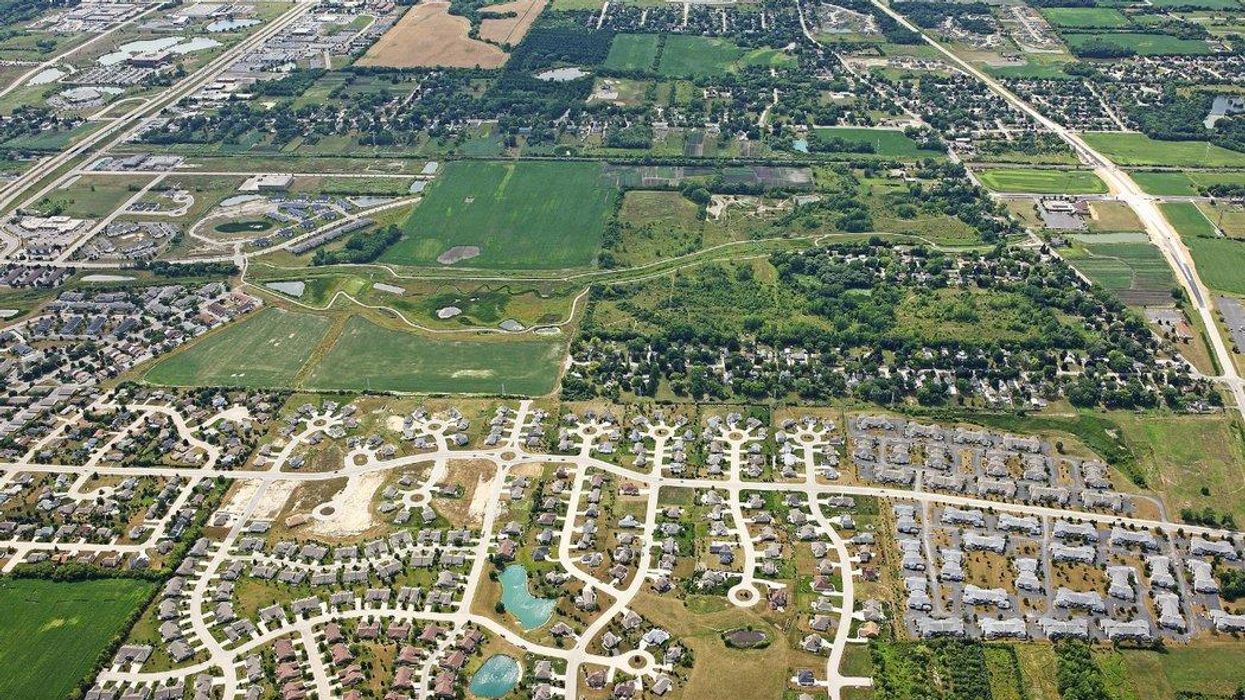
The village of Mt. Pleasant, for example, is using Wisconsin's eminent domain laws to force out homeowners on land coveted by the Taiwanese manufacturer Foxconn for a television and computer-screen plant in southeastern Wisconsin, about twenty miles south of Milwaukee. The nearly four-square-mile project is already slated to receive up to $4.5 billion in state and local subsidies. It will also be exempt from paying taxes due to Wisconsin's existing laws, will benefit from an exemption to smog control regulations (thanks to former EPA chief Scott Pruitt), and the waiving of water quality protections for wetlands and Lake Michigan.
Homeowners in Mt. Pleasant have been forced to sell in heart-wrenching decisions. The home sales worked out particularly badly for Sean McFarlane, a disabled father of four whose story was shared on the podcast "Reply All." When he was forced to leave a home for people with disabilities that his mother had owned, he received a relocation fee of just $22,000. He ended up in temporary lodging with no provision for his wheelchair, and problems with heat and water.
"I told my kids that this would work out," he told the village board in a voice choked in emotion. "The village won't screw you." But McFarlane soon discovered that the village was playing by different rules.
Protections against the misuse of eminent domain are supported both by people on the left, who fear the extension and abuse of corporate power, and those on the right, who champion homeowner rights. In 2006, Wisconsin was one of many states that enacted protective legislation to ensure that eminent domain served the public interest, "prohibiting the use of eminent domain to condemn non-blighted properties to be transferred to another private entity."
Crucial protections against misuse of eminent domain were wiped out when Wisconsin's GOP-dominated legislature inserted an amendment to the 2015-17 state budget.
However, crucial protections were wiped out when Wisconsin's GOP-dominated legislature inserted an amendment to the 2015-17 state budget. The maneuver was expressly designed to give Enbridge Energy, a Canadian oil pipeline company, the power to condemn private property for oil pipeline operations and projects. This authority was previously granted only to private corporations licensed to do business in Wisconsin.
In the Foxconn case, the misuse of eminent domain has been coupled with designating the land surrounding property as a "tax incremental district." This will allow the village of Mount Pleasant and Racine County to dole out $764 million in bonds to aid the project. These will be "repaid" by tax revenue to the city from the project--which it would have had to pay anyway--over next twenty-five years.
The tax incremental district plan, like the distorted use of eminent domain, has spurred citizen outrage. Last summer, Kelly Gallaher, a long-time resident, challenged the village board at a rally last summer--just as a boastful President Trump was conducting a groundbreaking for Foxconn. "Please, do us a favor and spare us the baloney that 'I'm doing this is for the good of the county,'" Gallaher declared. "This is what's good for Foxconn and the $760-million-dollar hole you have dug for us."
The eminent domain doctrine, which some states have modified to protect property owners in recent years, has gained notoriety over the past several decades because of glaring abuses. General Motors and the city of Detroit successfully argued in the early 1980s that eminent domain could be used to justify a new plant that would require the destruction of the tightly-knit and historic Poletown community, inspiring strong resistance. In December 2018, GM announced the plant's permanent closing despite high profits and rising production in Mexico.
The potential abuse of eminent domain was widened by a 2005 U.S. Supreme Court ruling upholding its use for new development in New London, Connecticut, because it would generate new jobs and tax revenue. The chief beneficiary of the decision was the pharmaceutical giant Pfizer. As a result of the ruling, a neighborhood was razed--yet Pfizer closed the plant after just eight years, leaving behind a swath of barren land. Dozens of homes were razed to make room for a hotel, stores, and condominiums--none of which were ever built.
Meanwhile, at Foxconn, there are growing questions over how many production jobs will actually be created and what they will pay relative to those for engineers and other professionals. Also unknown is the planned degree of automation, the plant's product lines, and the actual size of the plant and workforce.
Wisconsin homeowners are also contending with a hazardous "Line 66" oil pipeline sought by Enbridge, which appears intent on using the new, corporate-friendly eminent domain law to expand a line running the length of the state. The pipeline will carry highly volatile oil drawn from Canadian tar sands. An exploding tar sands pipeline in Lac Megantic, Quebec, killed fifty people in a 2013 accident. Seven Wisconsin county boards have passed resolutions against Enbridge and other oil corporations using eminent domain to seize land for building pipelines.
These latest distortions of eminent domain serve as a reminder of the extent to which corporate power can so persuade local and state governments to bend the law to serve private profit over public good.
With Donald Trump attacking the mainstream media, I find myself warming to it as never before -- and thereby losing sight of its many failings.
It gives abundant coverage to celebrities and powerful people, while giving short shrift to issues that threaten the planet, and dropping important stories after a short burst of attention.
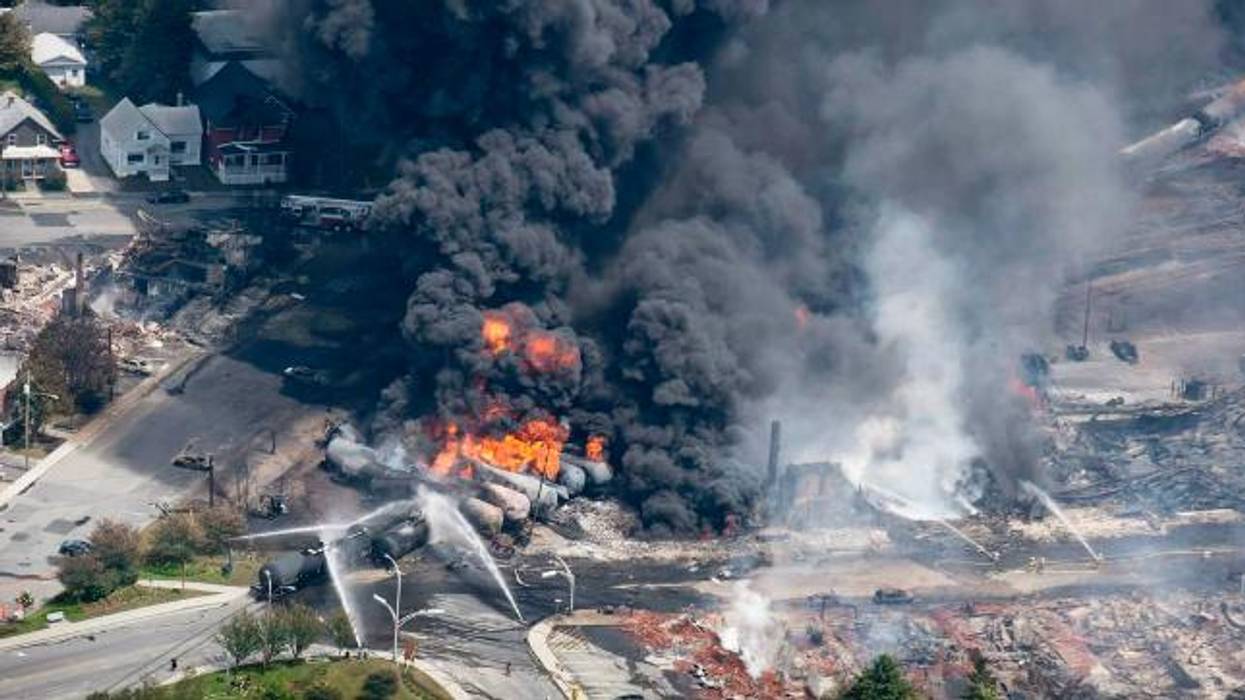
I'm reminded of these serious failings after reading Bruce Campbell's magnificent new book, The Lac-Megantic Rail Disaster, which not only vividly captures the horror of the 2013 derailment inferno that killed 47 Quebecers, but also shows how little Ottawa has done to prevent a similar catastrophe from happening again.
"After the 2013 disaster, oil by rail declined for a while, but is now back with a fury -- and is projected to soon reach a level almost three times higher than 2013."
How is it that a preventable tragedy of this magnitude, which received huge coverage and political attention at the time, has passed into media and political oblivion -- even though the circumstances that led to the crash remain essentially unchanged?
As Campbell meticulously documents, the crash of that runaway train, with 72 cars carrying almost 10,000 tons of highly combustible oil, was rooted in dozens of decisions by Canadian political leaders that reduced Ottawa's role in overseeing rail safety -- all in the name of making things easier and more profitable for the rail industry.
Although deregulation mania reached a peak under Stephen Harper's Conservatives, Justin Trudeau's government remains committed to weakening, removing or blocking regulations that annoy business, despite signs of ongoing safety problems. Recent figures from the Transportation Safety Board, for instance, show a 21 per cent average annual increase in runaway trains in the years since the rail disaster.
And let's not forget that train sped through Toronto before crashing in Lac-Megantic. Similar kilometre-long trains, laden with oil, pass directly through the heart of Toronto daily.
The Lac-Megantic fire soared to 1,650 C; water streaming from fire hoses simply evaporated in the intense heat. There were no injured survivors; everyone engulfed in the flames in the little town died. If a derailment like that happened in Toronto, the toll would be in the thousands.
Another key factor leading to the disaster was the enormous boom in transporting oil by rail, which skyrocketed in Canada from 500 carloads in 2009 to an incredible 160,000 carloads in 2013 -- even as the rail safety budget was reduced, notes Campbell.
After the 2013 disaster, oil by rail declined for a while, but is now back with a fury -- and is projected to soon reach a level almost three times higher than 2013, says Campbell.
And, no, the answer isn't more pipelines. The answer, for God's sake, is proper regulation of our railways -- and every other aspect of our economy that requires government oversight to protect us from corporations whose only interest is bottom-line profits.
Above all, the Lac-Megantic tragedy is a story about increasingly aggressive corporations in the era of hedge funds and bare-knuckle profiteering, and about the supine governments that acquiesce to their demands.
We've allowed ourselves to be lulled into believing we're safe. After all, there are government agencies out there with reassuring names like the "Rail Safety Directorate" and the "Transportation of Dangerous Goods Directorate."
But these agencies have been largely stripped of their regulatory muscle, and now operate under political masters who've drunk the Kool-Aid of a new dogma: that corporations should regulate themselves, and that the proper role for government is to "get out of the way."
" Stephen Harper and his government were never held accountable for their reckless cuts and deregulation. Nor were the greedy rail barons who pushed -- and continue to push -- for relaxed safety laws."
That was the foolish thinking that led to the disaster in Walkerton, Ont. A judicial inquiry blamed cutbacks and lax oversight by Mike Harris' Conservative government for seven deaths and 2,300 illnesses from contaminated water. Shortly afterwards, Harris resigned.
In the more serious Lac-Megantic tragedy, there was no public inquiry. Three railway workers were tried for criminal negligence, and acquitted. Outside the courtroom, someone yelled: "It's not them we want."
Stephen Harper and his government were never held accountable for their reckless cuts and deregulation. Nor were the greedy rail barons who pushed -- and continue to push -- for relaxed safety laws.
Five years later, they're scot-free, while 27 children in Lac-Megantic are without parents due to the catastrophe.
Meanwhile, later today, a massive train loaded with highly flammable oil will be barrelling through Toronto. Let's hope our luck holds.
In a move that outraged environmentalists and increased the chances of deadly and destructive accidents, the Trump administration's Department of Transportation (DOT) has repealed an Obama-era rule that mandated safety upgrades for "dangerous" oil tanker trains to reduce the possibility of derailments, explosions, and spills.
"This commonsense rule was put in place in response to a series of deadly accidents, and this shameless decision to repeal it will mean more workers and communities are put at risk."
--Kelly Martin, Sierra Club"This commonsense rule was put in place in response to a series of deadly accidents, and this shameless decision to repeal it will mean more workers and communities are put at risk," declared Sierra Club Beyond Dirty Fuels campaign director Kelly Martin.
The rule required trains carrying oil and other flammable materials--sometimes called "bomb trains"--to install electronically controlled pneumatic (ECP) brakes that decrease the likelihood of derailment by 2021.
While it was initially criticized by green groups that said it did not go far enough to protect communities, the Monday reversal was regarded as yet another move by the administration to appease polluters at the expense of the public.
"Apparently there's no limit to the lengths the Trump administration will go," Martin said, "to prioritize the desires of polluting industries over the health and safety of the American people."
The repeal was initially proposed in December of 2017, but finalized by the DOT's Pipeline and Hazardous Materials Safety Administration (PHMSA) on Monday. PHMSA claimed that a congressionally-mandated analysis concluded "that the expected costs of requiring ECP brakes would be significantly higher than the expected benefits of the requirement." The change does not prevent railroads from using ECP brakes but the safety upgrade is no longer mandated.
"The electronically controlled brakes would have been a long-awaited safety improvement," Fred Millar, an independent consultant specializing in chemical safety and transport, told BuzzFeed News.
By repealing the safety requirement, Millar added, "the cost will be borne by the people who die or are injured or who have terrible property damage."
"About 20 derailments of trains carrying oil and ethanol that have led to spills, fires, and, in some cases, evacuations have occurred since 2010 in the U.S. and Canada," according to Fortune.
Perhaps of the most high-profile derailment in recent years occurred in Quebec in 2013. A train carrying crude oil derailed and exploded, destroying the small downtown of Lac-Megantic and killing 47 people. Five years after the tragedy, CBC reported in July, rail safety advocates say the Canadian government also has not done enough to prevent future disasters.
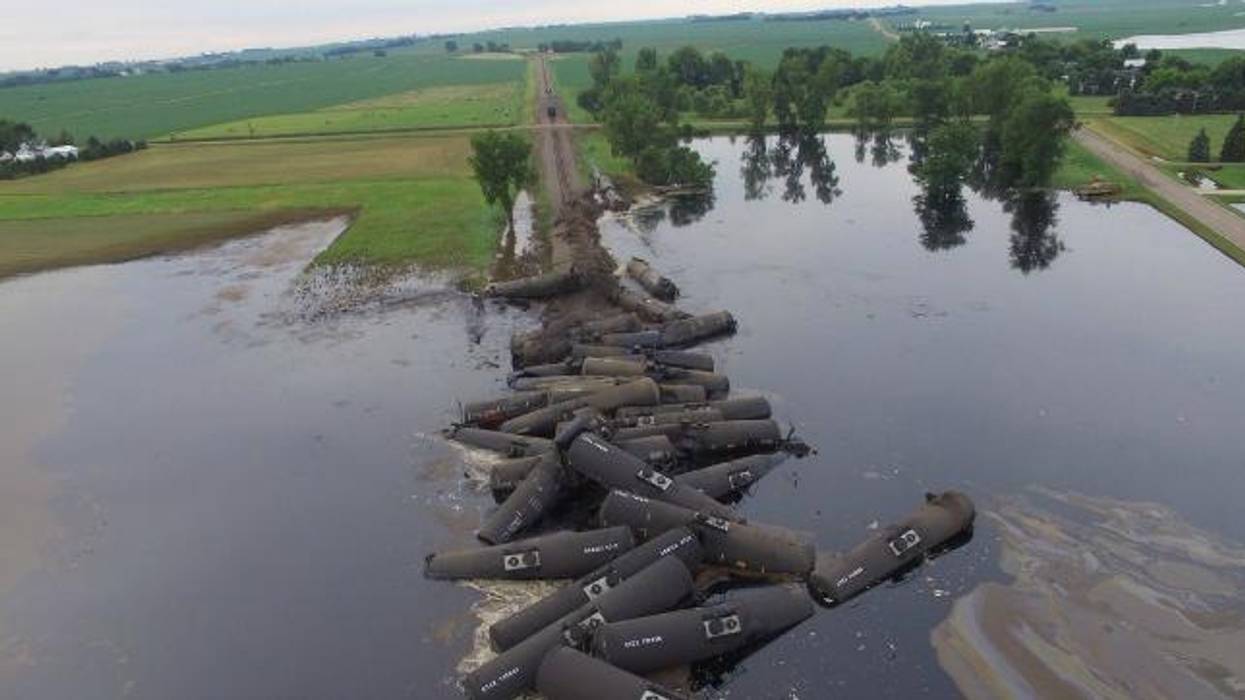
Adding to the mountain of evidence that "oil trains are a disaster for our health, our safety, and our climate"--an argument environmentalists have been making for years--a 31-car freight train derailed in Iowa and started leaking crude oil into floodwaters on Friday morning, forcing evacuations of nearby homes and raising concerns about drinking water contamination.
The Sioux County Sheriff posted a video depicting the aftermath of the derailment near Doon on Facebook:
The derailment occurred around 4:30am local time near the Sioux-Lyon County border, and one or more train cars spilled oil into the floodwaters of the Rock River. Rock Valley Mayor Kevin Van Otterloo told Iowa's Des Moines Register that within a few hours, oil had reached his city, about 5 miles downriver.
Although officials on the scene told the Associated Press they are still unsure what caused the train to leave the tracks, Jacob Faber, who lives near the site of the derailment and spent the Thursday night volunteering with flood recovery efforts, said, "There was water on the train track and the train tried to go over it."
Noting that the massive oil-filled tankers looked as if they had been "thrown around like Legos" across the floodwaters, Faber added that the entire area reeked of exhaust fumes: "You can't describe how strong that oil smell is when you're close to it."
A spokesman for BNSF railroad told the AP the company does not know how much oil has leaked into the floodwaters. He did not say how much oil the tankers were carrying. Ken Hessenius of the Iowa Natural Resources Department said cleanup crews are at the site, working to contain the spill.
"Our first major concerns are public water supplies," he said. Multiple towns downriver from the site draw drinking water from wells near the waterway, and the state has notified local officials of potential contamination.
The environmental advocacy group STAND.earth tweeted in response:
On November 9, like a lot of people around the world, I was stunned and devastated. In the days and weeks afterward, I was hit by new waves from that same feeling, worrying in turn about Muslim registries, the undocumented, the future of life on a rapidly warming planet, and much else.
The specifics have only become more grotesque. It didn't occur to me, for example, that Donald Trump and Justin Trudeau might raise the specter of reviving Keystone XL. Unlike Trump, Trudeau knows climate change isn't a hoax (Chinese or otherwise); he is surely aware, too, that one of his country's most respected energy researchers has concluded that "Canada cannot meet its global climate commitments while at the same time ramping up oil and gas extraction and building new export pipelines" (emphasis mine).
It's like a bad dream; even most Trump voters support action on climate. The KXL battle was hard enough with Obama in office--so with Trump and his band of Koch brother oil-and-gas-lackeys running the federal government, how can people exercise enough power to retain the possibility of a decent future?
"In a democracy, passivity is implicit consent. In any political system, hopelessness is self-fulfilling. When we fight, we win."
Ironically, we should listen to Trudeau, who reminded us last spring that "governments might grant permits, but only communities can grant permission." To understand our power as citizens of the world, we have to remember that in countries where it's still frowned upon to murder environmental activists, fossil fuel companies cannot operate without our consent. What does that consent look like? It looks like the Standing Rock Sioux deciding not to defend their water and their sacred sites. It looks like Seattle shrugging when an Arctic drilling rig is in our port, and figuring well, they're going to do it anyway. It looks like Keystone XL being built in 2011, because ranchers and Native Americans and young people across the country believe the industry when its arrogant executives tell us it's a done deal. It looks like people leaving their money in banks that fund these terrible projects, because they don't see how it matters, or they think the banks are all equally bad.
In a democracy, passivity is implicit consent. In any political system, hopelessness is self-fulfilling. When we fight, we win.
All the oil and gas in the Bakken fields, all the coal in the Powder River basin, all the tar sands bitumen in the Athabasca: it's all got to travel by pipeline, road, and train for many thousands of miles, right through our communities--above our watersheds, next to our schools, and through our farms. As the Lac Megantic explosion and the Deepwater Horizon spill and many others have tragically shown, there are reasons to be deeply disturbed by this even without considering the terrifying urgency of climate change.
When we do consider that terrifying urgency, we understand that what those pipelines, trucks, and trains really carry is the end of history. We cannot simply let them pass. If we refuse to let this happen--if we find the most inspiring, safe, and effective ways possible to stop this transport, we can force our political system to reckon with the climate crisis. People like Exxon CEO and Trump Secretary of State nominee Rex Tillerson, or climate denying US Senator Jim Inhofe, don't need to have a change of heart, and they won't. If we make it impossible for the fossil fuel companies to carry on their deadly business because they have to deal with protests and blockades around every corner, they become financially unviable (as they are already becoming, because of the plummeting cost of renewables, as well as concerns about stranded assets).
And while transport is one of the most obvious weaknesses of the industry, it is by no means the only one. At the moment, the whole system props up our dependence on fossil fuels, so there are many rotten legs we can kick: what would it look like if constituents beset the offices of their elected representatives (local, state, and federal) by having weekly prayer vigils or lock-downs? Exactly how much of their deadly business-as-usual would they be able to get done, under these circumstances?
Or how about the banks? In Seattle, we're having daily actions at Wells Fargo branches as part of the #DefundDAPL campaign, and learning many lessons that we intend to take into a broader campaign through the winter, focusing on all financing for projects catastrophic to the climate. If each of these banks is exposed to relentless coverage of its funding of projects that essentially presume we'll be using fossil fuels at current rates for decades--which scientists tell us means we're marching straight to our doom--how long, exactly, do we think these projects will be attractive investments? It took mere months for some big investors to start pulling out of the Dakota Access Pipeline. And if we remove our money from those banks, and put it into community banks that loan to small businesses in our cities--how long before our communities are healthier and more resilient?
We need to show the world that real change is still possible, and that even when conventional public input like voting and attending hearings is inadequate--and on climate change, it has been profoundly inadequate--we can be effective, creative, demanding, and inspiring. We can refuse to give our consent.
On October 11th, four friends and I initiated the shut down all of the major tar sands pipelines into the US--five pipelines in four states, which together represented 15% of daily US oil supply. Predictably, there were many reactions, from admiration to outrage, but all along the political spectrum, one of the main reactions seemed to be astonishment: you can do that? There were no guards, and just flimsy locks?
You can do that. Just like you can put hundreds of kayaks in front of an Arctic drilling rig, or chain yourself to earth-moving equipment, or sit down with your friends on an oil-train track, or block a truck, or lock yourself inside an office.
We don't all have to do the same thing, nor should we. But we all have to do something. Because otherwise, we're passively consenting to the devastation of most life on earth.
Sometimes people accuse activists of being unrealistic, and wanting to stop all fossil fuel use tomorrow. But this is exactly wrong: only by greatly reducing the use of the dirtiest energy now can we continue using some oil and gas for another decade or two. That's why we focus on tar sands oil and coal, the dirtiest and most carbon-intensive fossil fuels. Our options, essentially, are ambitious and targeted reductions now, or absolutely wrenching changes in a few years. Or, of course, the end of history.
There's a lot of legal risk in lock-downs and valve-turning, of course, so it's harder for many people--young people at the beginning of their careers, people of color, people with small children, undocumented people. But removing our money from banks that fund these projects--and telling them why we're doing it--is something anyone can do. For that matter, you could go in and stage a moving public reading of such a letter--that's not illegal, and even if they make you leave, you'll know you've played a small part in the restoration of the web of life. And you've withdrawn your consent.
There are roles, in other words, for everyone. The point isn't civil disobedience itself; the point is disrupting the inertia of a system that's poised to devastate everything we care about.
If we leave it up to the Rex Tillersons of the world, we know exactly where this will end--in a future of devastation. We must do all that's in our power to avoid that future, and history tells us that this late in the game, the only thing that has a real chance of doing so is active, nonviolent resistance.
We have the power to withdraw our consent. We have the power to do things differently.
We only have to understand that deep in our bones, and then use it.
In the year since five fiery oil train disasters in the US and Canada brought national attention to the threat from trains hauling explosive crude oil, the rail industry has embarked on a high profile public relations exercise to reassure the public that deadly disasters can be averted by emergency responders. In fact, the reality of oil train accidents -- and the unanimous opinion of fire officials and federal rail safety experts -- proves that there is no fighting an oil train derailment and fire. The scene of a crude oil derailment and fire is an uncontrollable fire. All firefighters can do is evacuate the area and wait for the fire to burn itself out.
Images from oil train firefighter training circulated by railroad and oil companies show firefighters standing close to burning tank cars, training hoses on small fires. But as Fairfield, Iowa, Fire Chief Scott Vaughan described in 2014, "If there was a spill or a fire, our big thing would be containment and evacuation," he said. "We train for it, but training and actually doing are two different things." Very simply, there is no controlling an oil train fire.
In 2013 in Lac Megantic, Quebec, 47 people died when an oil train derailed and caught fire in the center of a small Canadian town. More than 1.5 million gallons of crude oil spilled in flowing "rivers of fire", creating pool fires and filling sewers. Blocks away uncontrollable fires erupted from drains and manholes and more than 30 building were destroyed. Despite 1,000 firefighters responding from across Quebec and Maine the fire burned for two days.
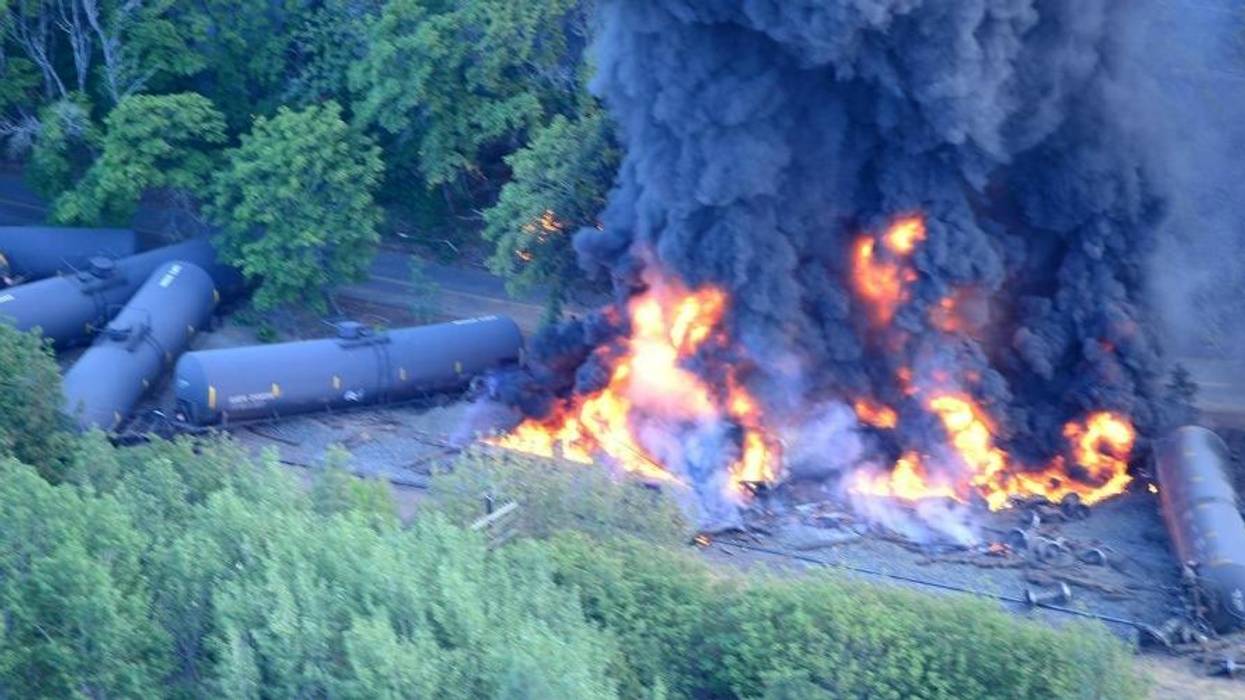
When an oil train derails at any speed over the puncture velocity of roughly 10 miles an hour (for a common CPC-1232 tank car) a dozen or so cars typically come off the tracks, decouple and are thrown from their wheels. If tank cars are punctured, possibly by something on the ground or the couplers on the ends of the cars, the crude (either Bakken or diluted tar sands, both highly volatile) can easily self-ignite or find an ignition source.
Observations published by FEMA from County Emergency Manager Dave Rogness on the oil train explosion that rocked the small town of Casselton, ND, describe the derailment and the size of the spill:
On December 30, 2013 in Casselton, a BNSF westbound train with 112 grain cars went off the tracks. Thirteen of the cars derailed, and one fell on the eastbound tracks. Within two minutes, a BNSF eastbound crude oil train hit that car. That caused two front locomotives, a hopper car, and twenty cars on the eastbound train to derail, and 18 of them ruptured, exploded, and released 450,000 gallons of Bakken crude oil.
First responders to the Casselton accident were forced to pull far back from the scene because of the intense heat:
The command post was originally set up one-quarter mile from the scene, but they had to pull back to a half mile because it was too hot for the responders even inside their rigs.
A similar situation occurred in Galena, Illinois, where the fire from the March 2015 derailment burned for days. First responders, who unloaded emergency equipment nearby to fight the fire, were forced to abandon $10,000 in equipment on the scene when they pulled back to a safe distance.
The DOT Emergency Response Guidebook is quite clear on the initial response to a single tank car disaster: "If tank, rail car or tank truck is involved in a fire, isolate for 800 meters (1/2 mile) in all directions" But this direction is for a single tank car, and oil train disasters almost always involve many more than one car.
Emergency response to oil trains traveling across the US and Canada is left to municipal fire departments. Few fire departments have the manpower, training, or equipment to respond to more than a single burning 10,000-gallon tank truck of crude. An oil train tank car carries triple that, and most oil train disasters involve way more than a single tank car. As North Dakota Emergency Manager Rogness describes:
"There were few options for fighting the fire. Water should not be put on exploding crude oil. Firefighters did not have enough foam in four counties together to put the fire out, plus the foam would freeze in the cold. Dry chemicals were not available. The only choice was to let it burn, which BNSF responders said would take about 12 hours. It took more than 24. Political leaders were skeptical of the strategy.
In fact, federal guidelines for emergency responders for oil train fires state very clearly that the only option is to let the oil burn itself out.
In the event of an incident that may involve the release of thousands of gallons of product and ignition of tank cars of crude oil in a unit train, most emergency response organizations will not have the available resources, capabilities or trained personnel to safely and effectively extinguish a fire or contain a spill of this magnitude.
In 2015 in Mount Carbon, West Virginia, tens of thousands of gallons of burning crude escaped punctured cars, flowing into the nearby river and forming a pool fire under other tank cars. Under the intense heat those additional cars began to rupture and explode. A report on oil train safety by the Interagency Board, which coordinates local, state and federal agencies on emergency response, described the situation on the ground during the 2015 West Virginia oil train accident:
During the derailment sequence, two tank cars were initially punctured releasing more than 50,000 gallons of crude oil. Of the 27 tank cars that derailed, 19 cars became involved in the pileup and post-accident pool fire. The pool fire caused thermal tank shell failures on 13 tank cars that otherwise survived the initial accident.
Emergency responders at the Mount Carbon, WV incident reported the first thermal failure about 25 minutes after the accident. Within the initial 65 minutes of the incident, at least four tank car failures with large fireball eruptions occurred. The 13th and last thermal failure occurred more than 10 hours after the accident.
With oil trains continuing to run across North America, it's a question of when, not if, we will experience the next fatal oil train accident. As Christopher A. Hart of the National Transportation Safety Board explained in January 2016, "We have been lucky thus far that derailments involving flammable liquids in America have not yet occurred in a populated area... But an American version of Lac-Megantic could happen at any time."
Realistic oil train disaster preparations would not involve firefighters spraying tank cars for cameras. The first, most important step would be to recognize -- as emergency responders across the country freely admit -- that no municipal fire department can control an oil train fire.
An upcoming Department of Transportation rulemaking is intended to provide oil train information and preparedness (materials and training) for first responders around the country. Unfortunately, that new rule has been delayed for years and the draft rules are not expected until late 2017. It will be years before the final rules are released, leaving dangerous tank cars, volatile crude, and unprepared communities to bear the risks of oil train traffic.
And thorough reporting by DeSmog Blog on the weak existing regulatory standards and the oil and rail industry's failure to meet them demonstrates, there have been no improvements in the safety of the 100,000 unsafe tank cars in the US fleet. The steps oil shippers have promised to improve the safety of oil trains are as hollow and inadequate as the promise of firefighters dousing burning oil tank cars.
Real emergency preparedness for oil trains would involve preparing for massive amounts of spilled crude oil by developing evacuation protocols for the 25 million Americans who live in the oil train blast zone. It would include modeling the flow of burning crude, likely toxic plumes and wildfires. It would also require much better information sharing and coordination with emergency officials on oil train hazardous cargo, routes, and scheduling, information which railroads have strongly resisted sharing.
According to the National Fire Protection Association 69 percent of the 1.1 million firefighters in North America serve in volunteer fire departments. They are not trained or equipped for effective oil train emergency response - in fact, the scale and danger of an oil train fire puts our emergency responders, like the millions who live along the tracks, at unacceptable risk. The railroads are providing some highly touted emergency training to a tiny sliver of this massive force, but the reality is that these efforts are staged to misinform the public, not prepare emergency responders.
Federal emergency response guidance and fire chiefs have long recognized that there is no effective emergency response to a crude oil derailment fire event. If even one tank car of crude oil is involved in a fire, federal guidelines are clear that firefighters should pull back half a mile and let it burn. And that is another good reason that oil trains are too dangerous for the rails.
Many thanks to Fred Millar for his research and analysis.
As children across the country head back to school this week, a new report from public interest group ForestEthics reveals that 14,800 schools and 5.7 million students are within the "oil train blast zone"--the area that must be evacuated in case of a derailment or fire from an oil train.
Using its Blast Zone map, released last year, and data from the Department of Education, ForestEthics identified the five U.S. cities with the greatest numbers of students at risk from a potential oil train derailment and explosion: Houston, Philadelphia, Chicago, Los Angeles, and El Paso.
"The federal government needs to protect the millions of students sitting in classrooms inside the blast zone," said Matt Krogh, extreme oil campaign director for ForestEthics, which is calling for a moratorium on oil trains in the absence of publicly available information about their routes, their contents, and their safety.
Massive growth of oil train traffic--over 5,000 percent since 2008 in the U.S.--has led to more derailments, oil spills into waterways, and massive explosions. This year alone has seen five explosive derailments in the U.S. and Canada. In 2013, 47 people died when an oil train crashed and exploded in the small Canadian town of Lac-Megantic.
In May, the Department of Transportation unveiled new oil-by-rail safety standards, which included a phase-out of particularly old and dangerous cars, as well as new mandates for thicker steel walls, tougher valves, and in some cases, electronically controlled brakes. Environmental groups were joined by some elected officials in saying the new rules didn't go far enough.
David Turnbull, campaigns director of Oil Change International, described the new regulations as "yet another indication of how dangerous energy policies written by and for Big Oil are for our communities and our climate."
"These weak regulations allow the industry to continue endangering communities with bomb trains that facilitate hazardous expansion of the oil industry," Turnbull said at the time.
A separate analysis released last week by the Center for Biological Diversity (CBD) showed that more than 1 million California students attend school within a mile of confirmed oil train routes, and of those, roughly 521,000 go to school within a half-mile of oil train routes--the area that federal officials say should be initially evacuated in all directions in case of a single tanker on fire.
"Railroad disasters shouldn't be one of the 'three Rs' on the minds of California school kids and their parents," said Valerie Love of CBD. "Oil trains have jumped the tracks and exploded in communities across the country. These dangerous bomb trains don't belong anywhere near California's schools or our children."
The analyses underscore the importance of transparency around oil trains--transparency that has so far been non-existent.
"[W]e don't even know the details on the dangers of these trains--and neither do our first responders or our elected leaders," says ForestEthics in a call to action. "We don't know because oil train companies like BNSF, Union Pacific, CSX, Norfolk Southern, Canadian Pacific and Canadian National are keeping four critical types of information hidden." According to the group, those are:
ForestEthics has dubbed these documents "The Oil Train Secrets" and is calling for their public release.
"The Federal Railroad Administration and the railroads need to release hidden documents that detail the routing choices they make through cities, towns and sensitive areas," said Krogh. "Railroads have created worst case scenario models that determine the billions of dollars of insurance that they carry for when the unthinkable happens. Communities and first responders must have access to these documents, to emergency response plans, and to notification of exactly when and where oil trains are running, in order to gauge the risks for themselves."
A week of direct actions across Canada and the U.S. to stop so-called "bomb trains" began on Monday, the two-year anniversary of the Lac-Megantic rail disaster, when an unmanned train with 72 tankers carrying 30,000 gallons of crude oil careened into a small town in the Canadian province of Quebec, where it derailed, exploded, and killed 47 people.
Decontamination work continues to this day at the crash site, but was suspended at noon for a moment of silence. Later in the day, church bells will ring out 47 times at Lac-Megantic's St. Agnes Church.
"Two years after Lac-Megantic, oil trains keep exploding and carbon pollution keeps rising. Oil trains are a disaster for our health, our safety, and our climate."
--Stop Oil Trains
On every level, recovery in the small community has been challenging.
The Globe and Mail reports: "Two years on, there's still a pile of toxic dirt where the centre of Lac-Megantic used to be." Reconstruction efforts have moved quickly and without a lot of transparency, the newspaper reports--perhaps too swiftly for citizens who feel they've been sidelined from negotiations.
Meanwhile, as the Saskatoon Star-Phoenix noted in an editorial on Monday, "the psychological toll on residents has been profound. A report from the local health department in January revealed that while the community has become closer and more resilient, substance abuse and mental health issues have been major challenges."
According to the Montreal Gazette, while a memorial mass on Sunday was well-attended, some residents left town for the weekend "to avoid the memories."
Sunday morning's ceremony was presided over by Rev. Gilles Baril, who became the town's new priest in February. The Gazette explains:
The priest he replaced, Rev. Steve Lemay, was asked by the church to take six months off. Since the earliest moments of the tragedy, Lemay, only in his mid-30s, had been there to help people mourn, to listen to their stories and try to make sense of them.
An entire community had turned to him for answers as he handled many of the victims' funerals. Drained after a year-and-a-half of doing so, the leave was needed.
"He took a lot on his shoulders and was exhausted," Baril said of Lemay. "He had to step away before it was too late."
On Saturday, about 150 people marched in downtown Lac-Megantic to voice their opposition to the resumption of oil-train service through the town--scheduled for January 2016. The Gazette reports that they dressed all in white, to contrast the color of "dirty oil," and chanted: "Say yes to a bypass railway, say no to another oil spill." Demonstrators lined up elbow-to-elbow on the tracks, and together, symbolically crossed their arms.
Citizens and local elected officials are calling for a new set of tracks that would bypass Lac-Megantic's residential sector. "With every passing day, residents are more determined to see it done," said Mayor Colette Roy-Laroche last week about the bypass railway. "As a municipal council, we consider it a must. Not a week goes by that it's not brought up."
Lac-Megantic residents have good reason to be concerned. As CBC reported on Sunday, "Montreal, Maine and Atlantic--and the company that bought it after it declared bankruptcy--have experienced a number of train derailments since the 2013 Lac-Megantic rail disaster."
Furthermore, CBC added: "Since the Lac-Megantic train crash two years ago, nearly three times as much oil crosses Canada by rail. And it will be a few more years before the DOT-111 train cars involved in that crash will be replaced."
Jonathan Santerre, an activist and founder of the Le Carre Bleu Lac-Megantic citizens' group, told the Gazette: "It's shocking that after everything that happened, people's lives still come second to money."
A $431.5 million settlement, accepted by victims of the disaster last month and involving about 25 companies accused of responsibility in the July 2013 tragedy, is being held up indefinitely because Canadian Pacific Rail has refused to participate in the settlement offer and is challenging its legitimacy.
According to the Canadian Press: "If CP is successful in its challenge, the families and creditors caught up in the disaster might have to go through years of expensive litigation before seeing any money."
Toward the end of June, new charges under Canada's Railway Safety Act and Fisheries Act were laid against six people and two companies in relation to the 2013 disaster. All those charged will appear in court in Lac-Megantic on Nov. 12.
On Monday morning, a vigil commemorating Lac-Megantic took place in Portland, Maine, while activists in Portland, Oregon blocked the tracks at ArcLogistics crude oil distribution terminal.
Both events were part of the Stop Oil Trains Week of Action taking place from July 6-12 in more than 75 cities across North America.
"There is NO safe way to transport extreme tar sands and Bakken crude," states the Stop Oil Trains call to action, backed by groups including ForestEthics, Oil Change International, Center for Biological Diversity, and 350.org.
"Two years after Lac-Megantic, oil trains keep exploding and carbon pollution keeps rising," the groups declare. "Oil trains are a disaster for our health, our safety, and our climate."
In the first three months of 2015 four oil train accidents sent emergency responders scrambling, crude oil spilling into drinking water supplies, and fireballs blasting into the sky. The string of accidents in February and March demonstrate the severe threat from Bakken crude and Alberta tar sands moving on mile-long oil trains. These derailments and explosions set a bar we can use to measure the new oil train standards announced today by the US and Canadian governments.
Would the new rules have prevented any of the 2015 accidents and, ultimately, will they reduce the threat of oil train catastrophes like the 2013 Lac Megantic, Quebec, explosion that killed 47 people? The answer is no, and the reason is speed: the regulations move too slow and the trains continue to move too fast.
The rules announced at a joint press conference today by US and Canadian officials arrive decades late and with the sticky fingerprints of the oil and rail industry all over them. The administration has slowed down and narrowed the scope of the rules so the most dangerous tank cars stay on the rails for at least two and a half years. Other unsafe tank cars have five or seven years before they must meet new higher standards.
Not that the new standards will help much: All four 2015 accidents involved CPC-1232 cars, the newer tank cars that are supposedly safer than the dangerous DOT-111s. But to be clear, neither the upgraded cars or new cars built to the new standard will prevent an explosion if the train is moving at normal speeds.
So we can begin to look for new and upgraded cars (like the ones that exploded in recent months) in the years to come, but those living along the tracks can still expect to see the worst cars continue to roll by their homes for a very long time. The administration effectively allows rail companies to keep antiquated tank cars on the rails in trains with fewer than 35 crude oil tank cars (or 20 in a row.) That means oil trains hauling up to a million gallons of explosive crude oil in the most dangerous tank cars will keep rolling through a downtown near you FOREVER.
The administration trumpets new electronically controlled pneumatic brakes for oil trains. While it's good news that oil and rail companies will use state-of-the-art technology, the administration is giving them until 2021 to install the new better brakes. That's six years too long to require what should be a basic minimum safety requirement.
And while these upgrades to the tank car fleet creep slowly into place, the trains will continue flying down the tracks at reckless speeds. The new rule allows oil trains to travel at more than twice the rated "puncture velocity" of even the new tank cars that they will (in some cases) eventually require. That means that oil trains carrying three million gallons of explosive crude will continue to travel at 50 mph across North America, except in a small number of "high threat" urban areas where they must go 40. The new speed limits offer little comfort because three of the four of the explosive accidents in 2015 occurred at speeds below 35 mph. (The accident in Gogama, ON, occurred at 43 mph, just three mph over the "high-priority" speed limit.) The Galena, Illinois, derailment occurred at only 23 mph, proving that the speed limits in the rule are inadequate to protect anyone.
In the final insult to injury, the administration walked too quickly away from notification standards in an earlier draft of the rule, leaving citizens and emergency responders in the dark about where these trains are running and when.
The Obama Administration took its time developing new rules for hazardous materials on trains that run through the heart of America: they looked at the threat of exploding oil trains, but heavy industry lobbying made them flinch. The administration failed to learn the lessons of Lac Megantic or the four explosive oil train accidents we've seen so far in 2015 alone. They have given public safety the cold shoulder, instead embracing the oil and rail industry lobbyists peddling this dangerous cargo.
We were fortunate that none of the 2015 accidents caused fatalities. ForestEthics and our many partners will continue pushing the administration to do a lot better and hope that our luck holds while we stop these dangerous trains from crisscrossing North America. But it shouldn't be a matter of luck. Secretary Foxx and President Obama have chosen to roll the dice instead of writing strong rules that protect the 25 million of us living in the blast zone.
Despite the clear need to move away from a fossil fuel-based energy system, U.S. taxpayers continue to line the pockets of oil, gas, and coal companies with subsidies and tax giveaways projected to cost more than $135 billion over the next decade.
In a bid to stem what they call "polluter welfare," Independent Sen. Bernie Sanders (Vt.) and Democratic Rep. Keith Ellison (Minn.) marked Earth Day on Wednesday by introducing new legislation (pdf) that would end tax breaks for fossil-fuel industries, recoup taxpayer-owed royalties for fossil-fuel related practices on public lands and waters, and prioritize federally-supported research for clean energy projects. Further, the measures would also prevent companies from escaping liability for spills or deducting clean-up costs from their taxes.
A number of environmental groups were quick to applaud the effort.
In an op-ed on Wednesday, Erich Pica, president of Friends of the Earth, which is among the organizations backing the measure, said that ending such fossil fuel subsidies is one of the "easiest first steps" the U.S. can take to confront the growing climate crisis.
Pica wrote:
Would you believe that the Department of Energy is still co-signing loans for boondoggle projects that pretend coal can be clean? Or that the Department of Transportation is still handing out grant money to oil train operators, essentially subsidizing the unsafe cars that killed 47 people in Lac Megantic, Canada? Or that Congress is still shoveling billions into the pockets of oil, gas and coal interests, ensuring that these companies remain some of the most under-taxed in our entire economy?
He added that forcing polluters to pay their fair share by kicking them off of "corporate welfare" will "raise revenue for much-needed social programs, protect our air and water, and makes the cost of burning carbon a little closer to the true costs of the damage it inflicts."
Over the past 10 years, the five most profitable oil companies--ExxonMobil, Shell, Chevron, BP, and ConocoPhilips--together made more than $1 trillion in profits.
"At a time when scientists tell us we need to reduce carbon pollution to prevent catastrophic climate change, it is absurd to provide massive taxpayer subsidies that pad fossil-fuel companies' already enormous profits," Sanders said in a press statement.
And Ellison added, "They don't need any more tax giveaways."