SUBSCRIBE TO OUR FREE NEWSLETTER
Daily news & progressive opinion—funded by the people, not the corporations—delivered straight to your inbox.
5
#000000
#FFFFFF
To donate by check, phone, or other method, see our More Ways to Give page.
Daily news & progressive opinion—funded by the people, not the corporations—delivered straight to your inbox.
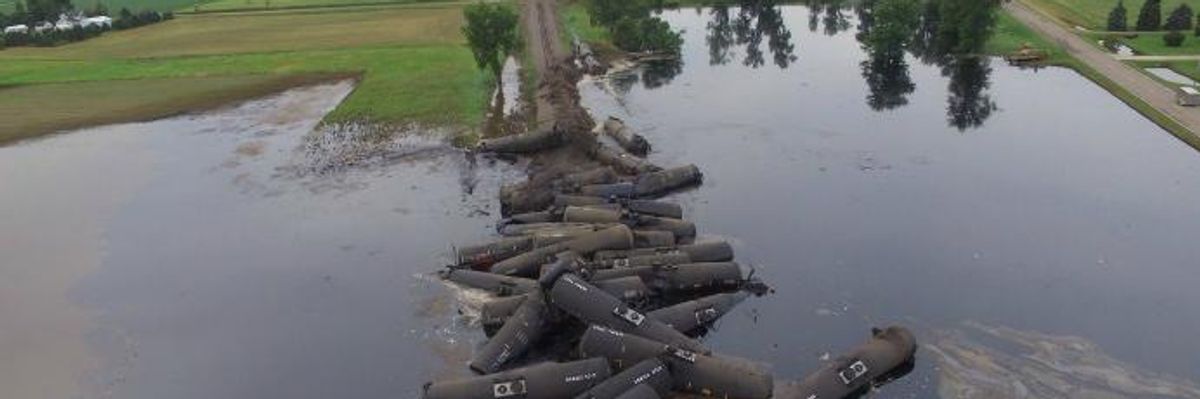
One resident captured aerial footage of a train derailment in Iowa on Friday. (Photo: @jake_fabe/Twitter)
Adding to the mountain of evidence that "oil trains are a disaster for our health, our safety, and our climate"--an argument environmentalists have been making for years--a 31-car freight train derailed in Iowa and started leaking crude oil into floodwaters on Friday morning, forcing evacuations of nearby homes and raising concerns about drinking water contamination.
The Sioux County Sheriff posted a video depicting the aftermath of the derailment near Doon on Facebook:
The derailment occurred around 4:30am local time near the Sioux-Lyon County border, and one or more train cars spilled oil into the floodwaters of the Rock River. Rock Valley Mayor Kevin Van Otterloo told Iowa's Des Moines Register that within a few hours, oil had reached his city, about 5 miles downriver.
Although officials on the scene told the Associated Press they are still unsure what caused the train to leave the tracks, Jacob Faber, who lives near the site of the derailment and spent the Thursday night volunteering with flood recovery efforts, said, "There was water on the train track and the train tried to go over it."
Noting that the massive oil-filled tankers looked as if they had been "thrown around like Legos" across the floodwaters, Faber added that the entire area reeked of exhaust fumes: "You can't describe how strong that oil smell is when you're close to it."
A spokesman for BNSF railroad told the AP the company does not know how much oil has leaked into the floodwaters. He did not say how much oil the tankers were carrying. Ken Hessenius of the Iowa Natural Resources Department said cleanup crews are at the site, working to contain the spill.
"Our first major concerns are public water supplies," he said. Multiple towns downriver from the site draw drinking water from wells near the waterway, and the state has notified local officials of potential contamination.
The environmental advocacy group STAND.earth tweeted in response:
Dear Common Dreams reader, It’s been nearly 30 years since I co-founded Common Dreams with my late wife, Lina Newhouser. We had the radical notion that journalism should serve the public good, not corporate profits. It was clear to us from the outset what it would take to build such a project. No paid advertisements. No corporate sponsors. No millionaire publisher telling us what to think or do. Many people said we wouldn't last a year, but we proved those doubters wrong. Together with a tremendous team of journalists and dedicated staff, we built an independent media outlet free from the constraints of profits and corporate control. Our mission has always been simple: To inform. To inspire. To ignite change for the common good. Building Common Dreams was not easy. Our survival was never guaranteed. When you take on the most powerful forces—Wall Street greed, fossil fuel industry destruction, Big Tech lobbyists, and uber-rich oligarchs who have spent billions upon billions rigging the economy and democracy in their favor—the only bulwark you have is supporters who believe in your work. But here’s the urgent message from me today. It's never been this bad out there. And it's never been this hard to keep us going. At the very moment Common Dreams is most needed, the threats we face are intensifying. We need your support now more than ever. We don't accept corporate advertising and never will. We don't have a paywall because we don't think people should be blocked from critical news based on their ability to pay. Everything we do is funded by the donations of readers like you. When everyone does the little they can afford, we are strong. But if that support retreats or dries up, so do we. Will you donate now to make sure Common Dreams not only survives but thrives? —Craig Brown, Co-founder |
Adding to the mountain of evidence that "oil trains are a disaster for our health, our safety, and our climate"--an argument environmentalists have been making for years--a 31-car freight train derailed in Iowa and started leaking crude oil into floodwaters on Friday morning, forcing evacuations of nearby homes and raising concerns about drinking water contamination.
The Sioux County Sheriff posted a video depicting the aftermath of the derailment near Doon on Facebook:
The derailment occurred around 4:30am local time near the Sioux-Lyon County border, and one or more train cars spilled oil into the floodwaters of the Rock River. Rock Valley Mayor Kevin Van Otterloo told Iowa's Des Moines Register that within a few hours, oil had reached his city, about 5 miles downriver.
Although officials on the scene told the Associated Press they are still unsure what caused the train to leave the tracks, Jacob Faber, who lives near the site of the derailment and spent the Thursday night volunteering with flood recovery efforts, said, "There was water on the train track and the train tried to go over it."
Noting that the massive oil-filled tankers looked as if they had been "thrown around like Legos" across the floodwaters, Faber added that the entire area reeked of exhaust fumes: "You can't describe how strong that oil smell is when you're close to it."
A spokesman for BNSF railroad told the AP the company does not know how much oil has leaked into the floodwaters. He did not say how much oil the tankers were carrying. Ken Hessenius of the Iowa Natural Resources Department said cleanup crews are at the site, working to contain the spill.
"Our first major concerns are public water supplies," he said. Multiple towns downriver from the site draw drinking water from wells near the waterway, and the state has notified local officials of potential contamination.
The environmental advocacy group STAND.earth tweeted in response:
Adding to the mountain of evidence that "oil trains are a disaster for our health, our safety, and our climate"--an argument environmentalists have been making for years--a 31-car freight train derailed in Iowa and started leaking crude oil into floodwaters on Friday morning, forcing evacuations of nearby homes and raising concerns about drinking water contamination.
The Sioux County Sheriff posted a video depicting the aftermath of the derailment near Doon on Facebook:
The derailment occurred around 4:30am local time near the Sioux-Lyon County border, and one or more train cars spilled oil into the floodwaters of the Rock River. Rock Valley Mayor Kevin Van Otterloo told Iowa's Des Moines Register that within a few hours, oil had reached his city, about 5 miles downriver.
Although officials on the scene told the Associated Press they are still unsure what caused the train to leave the tracks, Jacob Faber, who lives near the site of the derailment and spent the Thursday night volunteering with flood recovery efforts, said, "There was water on the train track and the train tried to go over it."
Noting that the massive oil-filled tankers looked as if they had been "thrown around like Legos" across the floodwaters, Faber added that the entire area reeked of exhaust fumes: "You can't describe how strong that oil smell is when you're close to it."
A spokesman for BNSF railroad told the AP the company does not know how much oil has leaked into the floodwaters. He did not say how much oil the tankers were carrying. Ken Hessenius of the Iowa Natural Resources Department said cleanup crews are at the site, working to contain the spill.
"Our first major concerns are public water supplies," he said. Multiple towns downriver from the site draw drinking water from wells near the waterway, and the state has notified local officials of potential contamination.
The environmental advocacy group STAND.earth tweeted in response: