SUBSCRIBE TO OUR FREE NEWSLETTER
Daily news & progressive opinion—funded by the people, not the corporations—delivered straight to your inbox.
5
#000000
#FFFFFF
To donate by check, phone, or other method, see our More Ways to Give page.
Daily news & progressive opinion—funded by the people, not the corporations—delivered straight to your inbox.
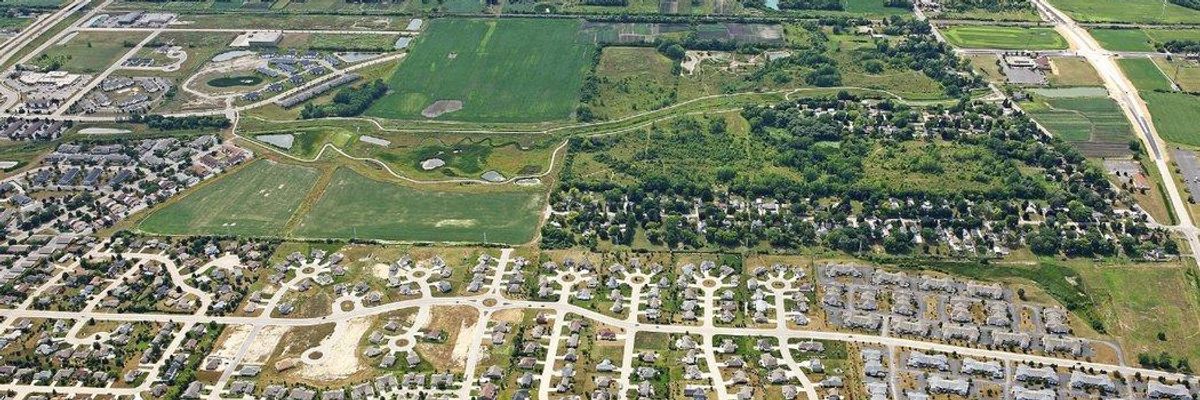
The village of Mt. Pleasant, Wisconsin, is using eminent domain to make way for Taiwanese manufacturer Foxconn. (Photo: Alinghi3/flickr/cc)
A government's right of eminent domain is typically used to condemn and buy up property that stands in the way of projects purportedly serving direct public needs, such as roads or large-scale public transit. But in Wisconsin, the rationale has been harnessed at the expense of the public good.
The village of Mt. Pleasant, for example, is using Wisconsin's eminent domain laws to force out homeowners on land coveted by the Taiwanese manufacturer Foxconn for a television and computer-screen plant in southeastern Wisconsin, about twenty miles south of Milwaukee. The nearly four-square-mile project is already slated to receive up to $4.5 billion in state and local subsidies. It will also be exempt from paying taxes due to Wisconsin's existing laws, will benefit from an exemption to smog control regulations (thanks to former EPA chief Scott Pruitt), and the waiving of water quality protections for wetlands and Lake Michigan.
Homeowners in Mt. Pleasant have been forced to sell in heart-wrenching decisions. The home sales worked out particularly badly for Sean McFarlane, a disabled father of four whose story was shared on the podcast "Reply All." When he was forced to leave a home for people with disabilities that his mother had owned, he received a relocation fee of just $22,000. He ended up in temporary lodging with no provision for his wheelchair, and problems with heat and water.
"I told my kids that this would work out," he told the village board in a voice choked in emotion. "The village won't screw you." But McFarlane soon discovered that the village was playing by different rules.
Protections against the misuse of eminent domain are supported both by people on the left, who fear the extension and abuse of corporate power, and those on the right, who champion homeowner rights. In 2006, Wisconsin was one of many states that enacted protective legislation to ensure that eminent domain served the public interest, "prohibiting the use of eminent domain to condemn non-blighted properties to be transferred to another private entity."
Crucial protections against misuse of eminent domain were wiped out when Wisconsin's GOP-dominated legislature inserted an amendment to the 2015-17 state budget.
However, crucial protections were wiped out when Wisconsin's GOP-dominated legislature inserted an amendment to the 2015-17 state budget. The maneuver was expressly designed to give Enbridge Energy, a Canadian oil pipeline company, the power to condemn private property for oil pipeline operations and projects. This authority was previously granted only to private corporations licensed to do business in Wisconsin.
In the Foxconn case, the misuse of eminent domain has been coupled with designating the land surrounding property as a "tax incremental district." This will allow the village of Mount Pleasant and Racine County to dole out $764 million in bonds to aid the project. These will be "repaid" by tax revenue to the city from the project--which it would have had to pay anyway--over next twenty-five years.
The tax incremental district plan, like the distorted use of eminent domain, has spurred citizen outrage. Last summer, Kelly Gallaher, a long-time resident, challenged the village board at a rally last summer--just as a boastful President Trump was conducting a groundbreaking for Foxconn. "Please, do us a favor and spare us the baloney that 'I'm doing this is for the good of the county,'" Gallaher declared. "This is what's good for Foxconn and the $760-million-dollar hole you have dug for us."
The eminent domain doctrine, which some states have modified to protect property owners in recent years, has gained notoriety over the past several decades because of glaring abuses. General Motors and the city of Detroit successfully argued in the early 1980s that eminent domain could be used to justify a new plant that would require the destruction of the tightly-knit and historic Poletown community, inspiring strong resistance. In December 2018, GM announced the plant's permanent closing despite high profits and rising production in Mexico.
The potential abuse of eminent domain was widened by a 2005 U.S. Supreme Court ruling upholding its use for new development in New London, Connecticut, because it would generate new jobs and tax revenue. The chief beneficiary of the decision was the pharmaceutical giant Pfizer. As a result of the ruling, a neighborhood was razed--yet Pfizer closed the plant after just eight years, leaving behind a swath of barren land. Dozens of homes were razed to make room for a hotel, stores, and condominiums--none of which were ever built.
Meanwhile, at Foxconn, there are growing questions over how many production jobs will actually be created and what they will pay relative to those for engineers and other professionals. Also unknown is the planned degree of automation, the plant's product lines, and the actual size of the plant and workforce.
Wisconsin homeowners are also contending with a hazardous "Line 66" oil pipeline sought by Enbridge, which appears intent on using the new, corporate-friendly eminent domain law to expand a line running the length of the state. The pipeline will carry highly volatile oil drawn from Canadian tar sands. An exploding tar sands pipeline in Lac Megantic, Quebec, killed fifty people in a 2013 accident. Seven Wisconsin county boards have passed resolutions against Enbridge and other oil corporations using eminent domain to seize land for building pipelines.
These latest distortions of eminent domain serve as a reminder of the extent to which corporate power can so persuade local and state governments to bend the law to serve private profit over public good.
Dear Common Dreams reader, It’s been nearly 30 years since I co-founded Common Dreams with my late wife, Lina Newhouser. We had the radical notion that journalism should serve the public good, not corporate profits. It was clear to us from the outset what it would take to build such a project. No paid advertisements. No corporate sponsors. No millionaire publisher telling us what to think or do. Many people said we wouldn't last a year, but we proved those doubters wrong. Together with a tremendous team of journalists and dedicated staff, we built an independent media outlet free from the constraints of profits and corporate control. Our mission has always been simple: To inform. To inspire. To ignite change for the common good. Building Common Dreams was not easy. Our survival was never guaranteed. When you take on the most powerful forces—Wall Street greed, fossil fuel industry destruction, Big Tech lobbyists, and uber-rich oligarchs who have spent billions upon billions rigging the economy and democracy in their favor—the only bulwark you have is supporters who believe in your work. But here’s the urgent message from me today. It's never been this bad out there. And it's never been this hard to keep us going. At the very moment Common Dreams is most needed, the threats we face are intensifying. We need your support now more than ever. We don't accept corporate advertising and never will. We don't have a paywall because we don't think people should be blocked from critical news based on their ability to pay. Everything we do is funded by the donations of readers like you. When everyone does the little they can afford, we are strong. But if that support retreats or dries up, so do we. Will you donate now to make sure Common Dreams not only survives but thrives? —Craig Brown, Co-founder |
A government's right of eminent domain is typically used to condemn and buy up property that stands in the way of projects purportedly serving direct public needs, such as roads or large-scale public transit. But in Wisconsin, the rationale has been harnessed at the expense of the public good.
The village of Mt. Pleasant, for example, is using Wisconsin's eminent domain laws to force out homeowners on land coveted by the Taiwanese manufacturer Foxconn for a television and computer-screen plant in southeastern Wisconsin, about twenty miles south of Milwaukee. The nearly four-square-mile project is already slated to receive up to $4.5 billion in state and local subsidies. It will also be exempt from paying taxes due to Wisconsin's existing laws, will benefit from an exemption to smog control regulations (thanks to former EPA chief Scott Pruitt), and the waiving of water quality protections for wetlands and Lake Michigan.
Homeowners in Mt. Pleasant have been forced to sell in heart-wrenching decisions. The home sales worked out particularly badly for Sean McFarlane, a disabled father of four whose story was shared on the podcast "Reply All." When he was forced to leave a home for people with disabilities that his mother had owned, he received a relocation fee of just $22,000. He ended up in temporary lodging with no provision for his wheelchair, and problems with heat and water.
"I told my kids that this would work out," he told the village board in a voice choked in emotion. "The village won't screw you." But McFarlane soon discovered that the village was playing by different rules.
Protections against the misuse of eminent domain are supported both by people on the left, who fear the extension and abuse of corporate power, and those on the right, who champion homeowner rights. In 2006, Wisconsin was one of many states that enacted protective legislation to ensure that eminent domain served the public interest, "prohibiting the use of eminent domain to condemn non-blighted properties to be transferred to another private entity."
Crucial protections against misuse of eminent domain were wiped out when Wisconsin's GOP-dominated legislature inserted an amendment to the 2015-17 state budget.
However, crucial protections were wiped out when Wisconsin's GOP-dominated legislature inserted an amendment to the 2015-17 state budget. The maneuver was expressly designed to give Enbridge Energy, a Canadian oil pipeline company, the power to condemn private property for oil pipeline operations and projects. This authority was previously granted only to private corporations licensed to do business in Wisconsin.
In the Foxconn case, the misuse of eminent domain has been coupled with designating the land surrounding property as a "tax incremental district." This will allow the village of Mount Pleasant and Racine County to dole out $764 million in bonds to aid the project. These will be "repaid" by tax revenue to the city from the project--which it would have had to pay anyway--over next twenty-five years.
The tax incremental district plan, like the distorted use of eminent domain, has spurred citizen outrage. Last summer, Kelly Gallaher, a long-time resident, challenged the village board at a rally last summer--just as a boastful President Trump was conducting a groundbreaking for Foxconn. "Please, do us a favor and spare us the baloney that 'I'm doing this is for the good of the county,'" Gallaher declared. "This is what's good for Foxconn and the $760-million-dollar hole you have dug for us."
The eminent domain doctrine, which some states have modified to protect property owners in recent years, has gained notoriety over the past several decades because of glaring abuses. General Motors and the city of Detroit successfully argued in the early 1980s that eminent domain could be used to justify a new plant that would require the destruction of the tightly-knit and historic Poletown community, inspiring strong resistance. In December 2018, GM announced the plant's permanent closing despite high profits and rising production in Mexico.
The potential abuse of eminent domain was widened by a 2005 U.S. Supreme Court ruling upholding its use for new development in New London, Connecticut, because it would generate new jobs and tax revenue. The chief beneficiary of the decision was the pharmaceutical giant Pfizer. As a result of the ruling, a neighborhood was razed--yet Pfizer closed the plant after just eight years, leaving behind a swath of barren land. Dozens of homes were razed to make room for a hotel, stores, and condominiums--none of which were ever built.
Meanwhile, at Foxconn, there are growing questions over how many production jobs will actually be created and what they will pay relative to those for engineers and other professionals. Also unknown is the planned degree of automation, the plant's product lines, and the actual size of the plant and workforce.
Wisconsin homeowners are also contending with a hazardous "Line 66" oil pipeline sought by Enbridge, which appears intent on using the new, corporate-friendly eminent domain law to expand a line running the length of the state. The pipeline will carry highly volatile oil drawn from Canadian tar sands. An exploding tar sands pipeline in Lac Megantic, Quebec, killed fifty people in a 2013 accident. Seven Wisconsin county boards have passed resolutions against Enbridge and other oil corporations using eminent domain to seize land for building pipelines.
These latest distortions of eminent domain serve as a reminder of the extent to which corporate power can so persuade local and state governments to bend the law to serve private profit over public good.
A government's right of eminent domain is typically used to condemn and buy up property that stands in the way of projects purportedly serving direct public needs, such as roads or large-scale public transit. But in Wisconsin, the rationale has been harnessed at the expense of the public good.
The village of Mt. Pleasant, for example, is using Wisconsin's eminent domain laws to force out homeowners on land coveted by the Taiwanese manufacturer Foxconn for a television and computer-screen plant in southeastern Wisconsin, about twenty miles south of Milwaukee. The nearly four-square-mile project is already slated to receive up to $4.5 billion in state and local subsidies. It will also be exempt from paying taxes due to Wisconsin's existing laws, will benefit from an exemption to smog control regulations (thanks to former EPA chief Scott Pruitt), and the waiving of water quality protections for wetlands and Lake Michigan.
Homeowners in Mt. Pleasant have been forced to sell in heart-wrenching decisions. The home sales worked out particularly badly for Sean McFarlane, a disabled father of four whose story was shared on the podcast "Reply All." When he was forced to leave a home for people with disabilities that his mother had owned, he received a relocation fee of just $22,000. He ended up in temporary lodging with no provision for his wheelchair, and problems with heat and water.
"I told my kids that this would work out," he told the village board in a voice choked in emotion. "The village won't screw you." But McFarlane soon discovered that the village was playing by different rules.
Protections against the misuse of eminent domain are supported both by people on the left, who fear the extension and abuse of corporate power, and those on the right, who champion homeowner rights. In 2006, Wisconsin was one of many states that enacted protective legislation to ensure that eminent domain served the public interest, "prohibiting the use of eminent domain to condemn non-blighted properties to be transferred to another private entity."
Crucial protections against misuse of eminent domain were wiped out when Wisconsin's GOP-dominated legislature inserted an amendment to the 2015-17 state budget.
However, crucial protections were wiped out when Wisconsin's GOP-dominated legislature inserted an amendment to the 2015-17 state budget. The maneuver was expressly designed to give Enbridge Energy, a Canadian oil pipeline company, the power to condemn private property for oil pipeline operations and projects. This authority was previously granted only to private corporations licensed to do business in Wisconsin.
In the Foxconn case, the misuse of eminent domain has been coupled with designating the land surrounding property as a "tax incremental district." This will allow the village of Mount Pleasant and Racine County to dole out $764 million in bonds to aid the project. These will be "repaid" by tax revenue to the city from the project--which it would have had to pay anyway--over next twenty-five years.
The tax incremental district plan, like the distorted use of eminent domain, has spurred citizen outrage. Last summer, Kelly Gallaher, a long-time resident, challenged the village board at a rally last summer--just as a boastful President Trump was conducting a groundbreaking for Foxconn. "Please, do us a favor and spare us the baloney that 'I'm doing this is for the good of the county,'" Gallaher declared. "This is what's good for Foxconn and the $760-million-dollar hole you have dug for us."
The eminent domain doctrine, which some states have modified to protect property owners in recent years, has gained notoriety over the past several decades because of glaring abuses. General Motors and the city of Detroit successfully argued in the early 1980s that eminent domain could be used to justify a new plant that would require the destruction of the tightly-knit and historic Poletown community, inspiring strong resistance. In December 2018, GM announced the plant's permanent closing despite high profits and rising production in Mexico.
The potential abuse of eminent domain was widened by a 2005 U.S. Supreme Court ruling upholding its use for new development in New London, Connecticut, because it would generate new jobs and tax revenue. The chief beneficiary of the decision was the pharmaceutical giant Pfizer. As a result of the ruling, a neighborhood was razed--yet Pfizer closed the plant after just eight years, leaving behind a swath of barren land. Dozens of homes were razed to make room for a hotel, stores, and condominiums--none of which were ever built.
Meanwhile, at Foxconn, there are growing questions over how many production jobs will actually be created and what they will pay relative to those for engineers and other professionals. Also unknown is the planned degree of automation, the plant's product lines, and the actual size of the plant and workforce.
Wisconsin homeowners are also contending with a hazardous "Line 66" oil pipeline sought by Enbridge, which appears intent on using the new, corporate-friendly eminent domain law to expand a line running the length of the state. The pipeline will carry highly volatile oil drawn from Canadian tar sands. An exploding tar sands pipeline in Lac Megantic, Quebec, killed fifty people in a 2013 accident. Seven Wisconsin county boards have passed resolutions against Enbridge and other oil corporations using eminent domain to seize land for building pipelines.
These latest distortions of eminent domain serve as a reminder of the extent to which corporate power can so persuade local and state governments to bend the law to serve private profit over public good.