

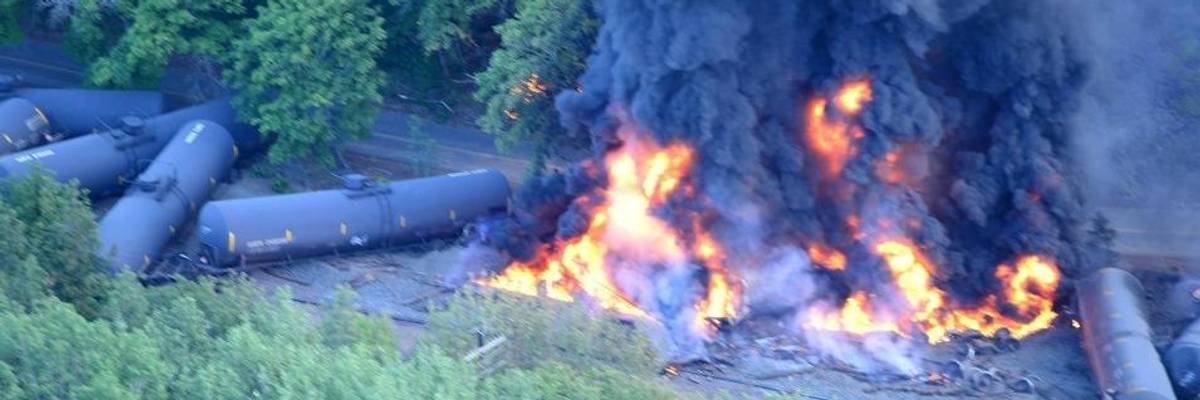
Rail cars burn near the Columbia River Gorge after a 100-car train derailed near the town of Mosier, Ore., June 3, 2016. (Photo: U.S. Coast Guard/Petty Officer 1st Class Levi Read/flickr/cc)
'Shameless': Trump Repeals Rule Meant to Prevent Oil-Carrying 'Bomb Trains' From Derailing and Exploding
"Apparently there's no limit to the lengths the Trump administration will go to prioritize the desires of polluting industries over the health and safety of the American people."
In a move that outraged environmentalists and increased the chances of deadly and destructive accidents, the Trump administration's Department of Transportation (DOT) has repealed an Obama-era rule that mandated safety upgrades for "dangerous" oil tanker trains to reduce the possibility of derailments, explosions, and spills.
"This commonsense rule was put in place in response to a series of deadly accidents, and this shameless decision to repeal it will mean more workers and communities are put at risk."
--Kelly Martin, Sierra Club"This commonsense rule was put in place in response to a series of deadly accidents, and this shameless decision to repeal it will mean more workers and communities are put at risk," declared Sierra Club Beyond Dirty Fuels campaign director Kelly Martin.
The rule required trains carrying oil and other flammable materials--sometimes called "bomb trains"--to install electronically controlled pneumatic (ECP) brakes that decrease the likelihood of derailment by 2021.
While it was initially criticized by green groups that said it did not go far enough to protect communities, the Monday reversal was regarded as yet another move by the administration to appease polluters at the expense of the public.
"Apparently there's no limit to the lengths the Trump administration will go," Martin said, "to prioritize the desires of polluting industries over the health and safety of the American people."
The repeal was initially proposed in December of 2017, but finalized by the DOT's Pipeline and Hazardous Materials Safety Administration (PHMSA) on Monday. PHMSA claimed that a congressionally-mandated analysis concluded "that the expected costs of requiring ECP brakes would be significantly higher than the expected benefits of the requirement." The change does not prevent railroads from using ECP brakes but the safety upgrade is no longer mandated.
"The electronically controlled brakes would have been a long-awaited safety improvement," Fred Millar, an independent consultant specializing in chemical safety and transport, told BuzzFeed News.
By repealing the safety requirement, Millar added, "the cost will be borne by the people who die or are injured or who have terrible property damage."
"About 20 derailments of trains carrying oil and ethanol that have led to spills, fires, and, in some cases, evacuations have occurred since 2010 in the U.S. and Canada," according to Fortune.
Perhaps of the most high-profile derailment in recent years occurred in Quebec in 2013. A train carrying crude oil derailed and exploded, destroying the small downtown of Lac-Megantic and killing 47 people. Five years after the tragedy, CBC reported in July, rail safety advocates say the Canadian government also has not done enough to prevent future disasters.
We are at a crossroads
This country and this world are at a monumental crossroads. In a few short weeks, US voters will have an opportunity to beat back the forces of fascism and confront the billionaires who are rigging the economy, our media system, and our democracy, making it increasingly impossible for ordinary people to get by. We’re not just talking about the election. We’re talking about what must be done once these fascist elements are vanquished from power. We need a bolder set of solutions than what either major party has so far been willing to offer and a working-class movement ready to fight like hell for it. Trump didn't emerge from nowhere. The conditions that fueled MAGA authoritarianism were created by decades of radical neoliberal economic policies and a corrupt political system dominated by corporate interests. They slashed taxes on the super-rich, promising that the benefits would trickle down. They said giveaways to the corporate titans would make life more affordable for the rest of us. It was all bullshit. And when a bitter, betrayed populace searches for someone to blame, right-wing demagogues have little trouble finding scapegoats. People know when they're being lied to, but you won't hear any of this from the corporate media. Only independent journalism—powered and funded by people who believe in building a better world—can deliver truly trustworthy daily news. Our Fall Campaign is underway, and we need your help. To power our newsroom through the rest of the year, we need to raise $125,000 by midnight on October 31. So if you share our vision, please contribute whatever you can to sustain our work. |
In a move that outraged environmentalists and increased the chances of deadly and destructive accidents, the Trump administration's Department of Transportation (DOT) has repealed an Obama-era rule that mandated safety upgrades for "dangerous" oil tanker trains to reduce the possibility of derailments, explosions, and spills.
"This commonsense rule was put in place in response to a series of deadly accidents, and this shameless decision to repeal it will mean more workers and communities are put at risk."
--Kelly Martin, Sierra Club"This commonsense rule was put in place in response to a series of deadly accidents, and this shameless decision to repeal it will mean more workers and communities are put at risk," declared Sierra Club Beyond Dirty Fuels campaign director Kelly Martin.
The rule required trains carrying oil and other flammable materials--sometimes called "bomb trains"--to install electronically controlled pneumatic (ECP) brakes that decrease the likelihood of derailment by 2021.
While it was initially criticized by green groups that said it did not go far enough to protect communities, the Monday reversal was regarded as yet another move by the administration to appease polluters at the expense of the public.
"Apparently there's no limit to the lengths the Trump administration will go," Martin said, "to prioritize the desires of polluting industries over the health and safety of the American people."
The repeal was initially proposed in December of 2017, but finalized by the DOT's Pipeline and Hazardous Materials Safety Administration (PHMSA) on Monday. PHMSA claimed that a congressionally-mandated analysis concluded "that the expected costs of requiring ECP brakes would be significantly higher than the expected benefits of the requirement." The change does not prevent railroads from using ECP brakes but the safety upgrade is no longer mandated.
"The electronically controlled brakes would have been a long-awaited safety improvement," Fred Millar, an independent consultant specializing in chemical safety and transport, told BuzzFeed News.
By repealing the safety requirement, Millar added, "the cost will be borne by the people who die or are injured or who have terrible property damage."
"About 20 derailments of trains carrying oil and ethanol that have led to spills, fires, and, in some cases, evacuations have occurred since 2010 in the U.S. and Canada," according to Fortune.
Perhaps of the most high-profile derailment in recent years occurred in Quebec in 2013. A train carrying crude oil derailed and exploded, destroying the small downtown of Lac-Megantic and killing 47 people. Five years after the tragedy, CBC reported in July, rail safety advocates say the Canadian government also has not done enough to prevent future disasters.
In a move that outraged environmentalists and increased the chances of deadly and destructive accidents, the Trump administration's Department of Transportation (DOT) has repealed an Obama-era rule that mandated safety upgrades for "dangerous" oil tanker trains to reduce the possibility of derailments, explosions, and spills.
"This commonsense rule was put in place in response to a series of deadly accidents, and this shameless decision to repeal it will mean more workers and communities are put at risk."
--Kelly Martin, Sierra Club"This commonsense rule was put in place in response to a series of deadly accidents, and this shameless decision to repeal it will mean more workers and communities are put at risk," declared Sierra Club Beyond Dirty Fuels campaign director Kelly Martin.
The rule required trains carrying oil and other flammable materials--sometimes called "bomb trains"--to install electronically controlled pneumatic (ECP) brakes that decrease the likelihood of derailment by 2021.
While it was initially criticized by green groups that said it did not go far enough to protect communities, the Monday reversal was regarded as yet another move by the administration to appease polluters at the expense of the public.
"Apparently there's no limit to the lengths the Trump administration will go," Martin said, "to prioritize the desires of polluting industries over the health and safety of the American people."
The repeal was initially proposed in December of 2017, but finalized by the DOT's Pipeline and Hazardous Materials Safety Administration (PHMSA) on Monday. PHMSA claimed that a congressionally-mandated analysis concluded "that the expected costs of requiring ECP brakes would be significantly higher than the expected benefits of the requirement." The change does not prevent railroads from using ECP brakes but the safety upgrade is no longer mandated.
"The electronically controlled brakes would have been a long-awaited safety improvement," Fred Millar, an independent consultant specializing in chemical safety and transport, told BuzzFeed News.
By repealing the safety requirement, Millar added, "the cost will be borne by the people who die or are injured or who have terrible property damage."
"About 20 derailments of trains carrying oil and ethanol that have led to spills, fires, and, in some cases, evacuations have occurred since 2010 in the U.S. and Canada," according to Fortune.
Perhaps of the most high-profile derailment in recent years occurred in Quebec in 2013. A train carrying crude oil derailed and exploded, destroying the small downtown of Lac-Megantic and killing 47 people. Five years after the tragedy, CBC reported in July, rail safety advocates say the Canadian government also has not done enough to prevent future disasters.