SUBSCRIBE TO OUR FREE NEWSLETTER
Daily news & progressive opinion—funded by the people, not the corporations—delivered straight to your inbox.
5
#000000
#FFFFFF
To donate by check, phone, or other method, see our More Ways to Give page.


Daily news & progressive opinion—funded by the people, not the corporations—delivered straight to your inbox.
Mutually Assured Destruction may have kept the world free of nuclear war for the last eight decades, but it hasn’t kept the world free of Donald Trump.
If nothing else, Donald Trump pushes the nation’s—the world’s—thought process beyond anything that feels normal and comfortable. Consider the “MADness” of the last eight decades: You know, how “mutually assured destruction” has kept humanity from nuking itself into oblivion because... uh, mass murder could have consequences.
Thus, the planet’s nine nuclear powers have refrained (so far) from unleashing a nuclear assault on an enemy for fear of getting nuked back. Hey, what a solid foundation for building peace! Of course, the nuclear nine have spent billions of dollars over the years expanding and developing the nuclear arsenals they will allegedly never use. But they’ve also made it clear that no other nation on the planet is “authorized” to possess nukes.
This has been the foundation for the pseudo-peace—the avoidance of nuclear omnicide—that has existed throughout my lifetime, and also Donald Trump’s lifetime. (Little known fact: He’s two months older than me). Thus humanity, or at least its global leaders, haven’t had to take on the difficult task of envisioning “peace” beyond militarism. Nor has the media. Military-industrialism maintains its assumed dominance over Planet Earth: We’ll always have war, no matter how many people suffer horrifically from it, no matter how many devote their lives to ending it.
But then along comes Donald Trump, bringing something unique to his position as most powerful person on the planet: his own personal madness. I am not referring to “mutually assured destruction,” but the other kind of mad: He’s losing it mentally. Here’s how members of the International Physicians for the Prevention of Nuclear War put it, in a statement entered into the US Congressional Record a month ago:
It is our professional opinion, based on previous and ongoing assessments, that Donald Trump’s mental state since our 2024 statement has deteriorated even further. In keeping with our professional ethics, and for those of us who are physicians, with the Declaration of Geneva—the successor to the Hippocratic Oath that binds us to the humanitarian principles of medicine since the Nuremberg trials—we are compelled to warn of a President of the United States who is increasingly a danger to the public.
Among his symptoms: rambling digressions and frequent confusion when he speaks; grandiose and delusional beliefs, including assertions of infallibility and unlimited authority (for instance, his release of AI-created pictures and videos, such as a video depicting himself as a combat pilot dropping feces on No Kings protesters); and his reckless threats of violence (such as his social media post to Iran last month: “A whole civilization will die tonight, never to be brought back”).
The physicians conclude:
It is our professional opinion that the behaviors of Donald Trump, tragically, are neither momentary lapses nor political theater. It is our professional opinion that they reflect a rapidly worsening, reality-untethered, increasingly dangerous decline. If we were called upon under the 25th Amendment to judge the President’s present ability to discharge the duties of his office, we would have to conclude that he lacks the capacity to do so.
For the reasons cited above, emphasizing that he presents a clear and present danger to our country and to the world, it is our expert opinion that Donald J. Trump is mentally unfit to be the President of the United States, and that steps to remove him from office must be undertaken with the greatest urgency, with vital responsibilities on the shoulders of those in positions of leadership
Psychotherapist John Gartner put it a bit more directly in a recent interview:
Trump’s going full Hitler... demonizing minorities, putting them in concentration camps, seizing control over elections, destroying free speech, using the government to go after his enemies, purging government of people who aren’t lackeys... He’s doing it at a manic pace, on all fronts, so we can’t even focus our outrage.
But Trump, in his unfitness for office, in his grandiosity and self-worship—though he may be a lost soul—is not wrong about the amount of power he has. This is what stuns me beyond comprehension: that the world we have created is open to him. It’s now his for the taking. Mutually Assured Destruction may have kept the world free of nuclear war for the last eight decades, but it hasn’t kept the world free of Donald Trump.
Has the world evolved to its own endpoint? I don’t know. But we have definitely evolved to a state of complex, unanticipated danger. The Bulletin of the Atomic Scientists—whose Doomsday Clock is now set at 89 seconds to midnight—recently published a piece urging that the US pass a law taking the decision to use nukes away from the president alone, requiring the agreement of at least two people before it can be acted on.
How amazing that such a law doesn’t already exist. Even more amazing is that calls for nuclear disarmament are hardly in the news these days. If humanity wants to continue evolving, we have to envision a world beyond nuclear war... beyond all wars.
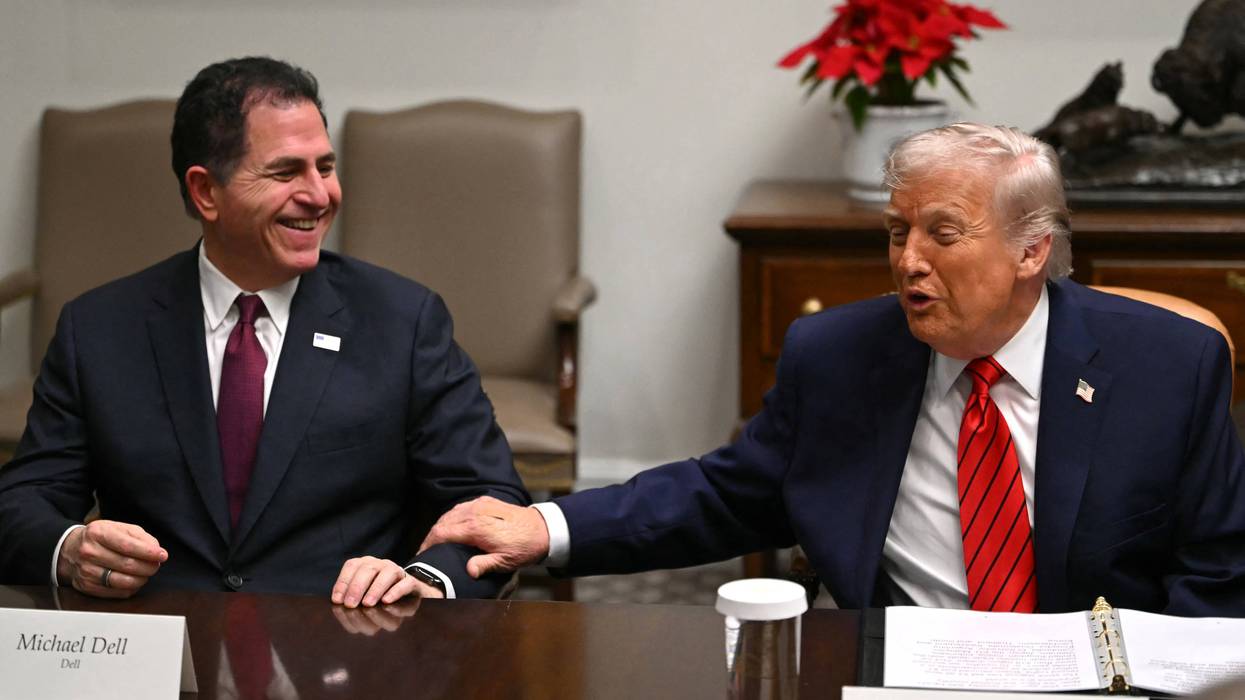
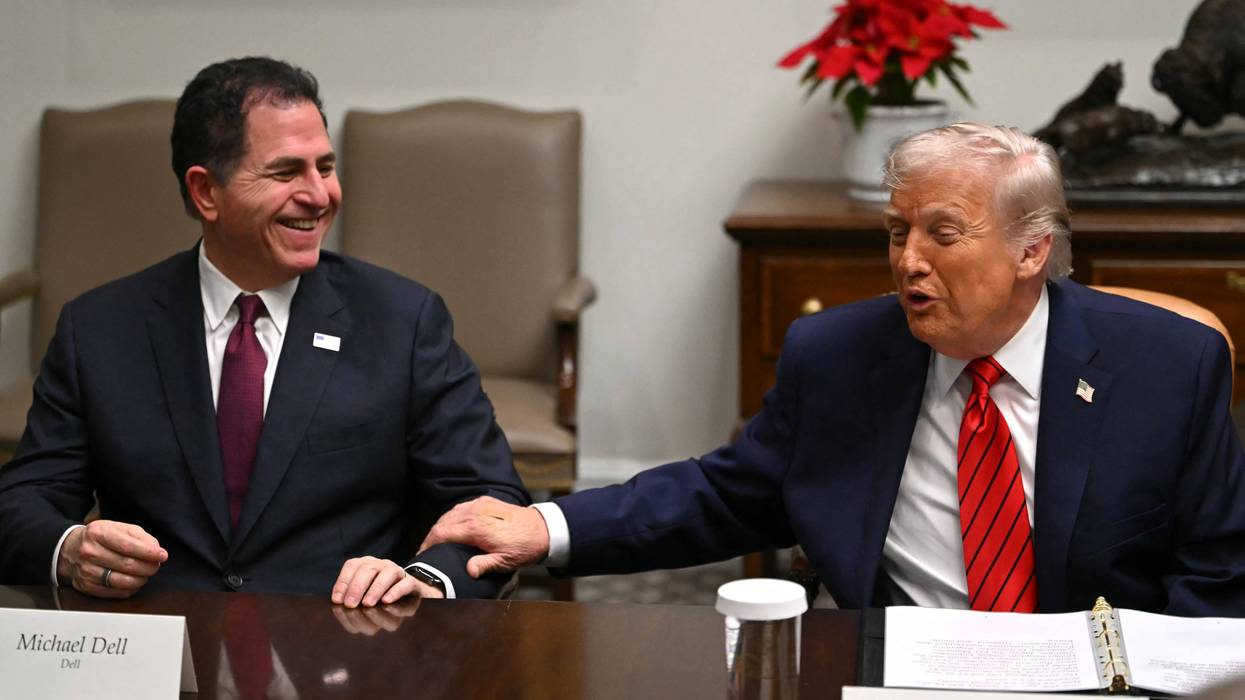
The on-paper value of the president's Dell stock holdings has soared potentially by millions since he told Americans to "go out and buy a Dell" earlier this month.
Just weeks after President Donald Trump urged Americans to "go out and buy a Dell" and months after he bought millions of dollars worth of stock in the company, the computer giant was awarded a $9.7 billion Pentagon contract.
The Department of Defense confirmed the contract with Dell Federal Systems, the government-focused arm of Dell Technologies, on Wednesday.
Euronews reported:
As part of the Core Enterprise Technology Agreement (CETA), a Pentagon-wide Microsoft licensing and software procurement framework, the company will provide and manage Microsoft software licences, cloud subscriptions and on-premises software licensing across the US military, intelligence agencies and the US Coast Guard.
The contract would have raised scrutiny regardless, given the Dell family’s proximity to Trump in his second term. CEO Michael Dell and his wife, Susan, have pledged $6.25 billion to help fund the so-called “Trump accounts” that were part of the president's 2025 mega budget legislation, a policy that critics have described as a tax shelter for the wealthy.
This tied the Dell family fortune to Trump's political agenda. In recent months, he's also hitched it to his own personal wealth.
Follow this:First, Trump quietly buys up to $5 million of Dell stock.Then, he urges his followers to “go out and buy a Dell.”Today, his Pentagon awards a $9.7 billion deal to Dell. www.bloomberg.com/news/article...
[image or embed]
— Bill Grueskin (@bgrueskin.bsky.social) May 27, 2026 at 7:45 PM
During his frenetic burst of stock trading in the first three months of the year, Trump purchased between $1 million and $5 million in Dell stock on February 10, according to financial disclosure forms, when the stock traded at $126 per share.
Months later, at a Mother's Day event on May 8, he publicly shilled for the company's products—a possible violation of White House ethics policy—and lavished praise upon the Dell family:
They've done such a job, such a job on that. They put up a lot of money, too [for Trump accounts]. Put up $6.25 billion. That's somebody and he started making computers on his bed in college and selling them because they were better than other computers.
And he just—I said, "How did you do that?" He said, "Well, I did it and I just never stopped." He just kept going.
So, go out and buy a Dell, they're great.
After the president's remarks, the value of Dell stocks surged by 14.6% to an all-time high of just under $264 before settling at just over $260 by the end of the day.
The announcement of the lucrative new Pentagon deal on Wednesday has caused the stock’s value to soar, reaching nearly $318 per share as of Thursday morning. The value was $305 per share before the announcement.
In total, the share price of Dell stock has climbed by about 155% since Trump bought it back in Feburary. Depending on how much of it he owns, that means he could have unrealized gains of between $1.55 million to $7.74 million. About 47% of those unrealized gains would have come just in the last month since he used the White House to boost Dell stock.
Acting US Navy Chief Information Officer Barry Tanner has insisted that there was no playing favorites when Dell was selected for the contract.
But Trump, who has increased his net worth by an eye-popping $3 billion since retaking office last year, according to the watchdog Citizens for Responsibility and Ethics in Washington (CREW), has regularly faced accusations of lavish self-dealing.
In fact, a ProPublica report out on Thursday found that his White House adviser, Peter Navarro, personally intervened to push the Pentagon to give a $620 million loan to a startup linked to Donald Trump, Jr., out of dozens of companies that were under consideration.
Dell is also far from the first company to receive a Trump administration contract or other beneficial action after Trump purchased their stock. Earlier this month, NOTUS reported that Trump had bought shares in companies, including Palantir, Axon, and AMD, mere weeks before they were granted government contracts or regulatory relief.
Tommy Vietor, a National Security Council staffer under former President Barack Obama and now the host of the liberal Pod Save America podcast, said on social media that the Dell contract was an example of how “every day there’s another example of insider trading and corruption by Trump himself.”
Noting that Trump’s personal profit from the presidency far exceeds that of anyone else who has held the office, Tim Miller, a journalist and commentator at The Bulwark, said that a contract with such an obvious conflict of interest would be a “front-page story and weekslong scandal for anyone other than Trump.”
Can the rest of us organize a powerful, humane alternative to Donald Trump's politics of hatred and division that could transform this country and the world?
Donald Trump’s America is a scary place in significant part thanks to an unholy alliance of MAGA devotees who don’t believe in science and see intellectuals as public enemy number one, and a gaggle of Silicon Valley militarists who think that they’re the smartest people in the room, if not the universe. Add in white Christian nationalists who abuse religious precepts to sow hatred and division and you have the foundations of the political base that elected Donald Trump (twice!). And worse yet, those groupings are likely to be with us long after our current president has gone off to that great cheeseburger stand in the sky.
Still, it’s worth reflecting on whether such an odd coalition of allies can survive without Donald Trump, or even with a president whose policies have become so harmful and irrational that they’re doing severe human and economic damage even to his most loyal supporters (not to mention the rest of us). And it’s also worth considering whether the pillars of the MAGA movement can manage to stick together in the ever-grimmer Trumpian years to come, not to speak of the post-Trumpian ones, or whether the rest of us can organize a powerful, humane alternative to his politics of hatred and division that could transform this country and the world.
As a start, we have the latter-day “Know Nothings,” a term borrowed from a 19th century political movement. It’s not that members of that group literally know nothing. Some of them are quite skilled in their given professions and astute at assessing certain kinds of situations. Some are intelligent but woefully misguided. Trump supporter and former Secretary of Housing and Urban Development Ben Carson, for example, is a brain surgeon.
Members of the anti-science crowd are also often very good at communicating their messages, however wrongheaded or offensive they may be. The problem isn’t that they can’t take in information; it’s that they are distinctly anti-knowledge when it comes to, among other things, separating compelling conspiracy theories from well-documented facts.
Rather than DEI programs that stop at raising tough questions about America’s long history of systematic discrimination, what’s needed are programs that truly change people’s lives by creating better-paying jobs and affordable, quality healthcare for all.
The results of their ingrained antagonism toward basic knowledge are profound, making them a threat to public health and democratic practices. After all, we now live in a country where millions of people are against vaccinating their children to prevent potentially deadly diseases and don’t believe that perhaps the gravest threat to continuing life on this planet—climate change—is caused, or even influenced, by human activity or perhaps is even happening at all.
The dangerous delusions of Trump Secretary of Health Robert F. Kennedy, Jr., now have the stamp of government approval and the power of the US government behind them. There is no way to estimate how many people have already fallen sick or even died unnecessarily due to the implementation of his crackpot theories, but the numbers will undoubtedly be significant. The American Public Health Association captured the grim mood of our moment perfectly in an April 2025 press release entitled “Secretary Kennedy and His Policies Are a Danger to the Public Health.”
On a different spiritual plane, tens of millions of Americans believe in the rapture—the notion that they and their kind will be called up to heaven in the end days, while the rest of us will be left behind, presumably to burn in hell (but not a climate-change version of the same). A 2022 Pew poll found that 39% of Americans believe “we are in the end times.” Already! And such a belief, of course, has an impact on how or even whether one wants to devote time and energy to fixing problems here on Earth.
Such an amalgam of opponents of science and skeptics about basic reality bears a distinct resemblance to the “Know Nothing” movement of the 19th century that thrived on anti-immigrant sentiments and half-baked conspiracy theories.
The anti-intellectual faction on the right has been propagandized for decades to believe that the biggest obstacle to a better life for them and their families isn’t the predatory corporations hollowing out our economy and manipulating our democracy, but a group of liberal intellectuals clustered on both coasts who allegedly want to replace this country’s bedrock beliefs with a set of “politically correct” prescriptions about how they should live their lives, especially when it comes to DEI or diversity, equity, and inclusion. In such a rendering of reality, that “new class” is seen as sapping the country’s strength and undermining the basic values that would make America great (again!).
The use of that “new class” as a political epithet emerged from the neoconservative movement of the 1960s and 1970s, as Andrew Hartman has explained at his blog on American intellectual history:
Out of their political repositioning in the late 1960s and 1970s, neoconservatives developed a critical theory (co-opted from anti-Stalinist thinking) about a so-called "new class" of intellectuals, broadly defined to include all professionals tasked with manipulating language—although more narrowly applied to humanists and social scientists. Members of this "new class," so the theory went, had turned their backs on the society to which they owed their high-ranking status.
However, the current Trumpian war on DEI should be considered an extension of a longstanding conservative effort to distract Americans from the real sources of their problems by promoting a politics of division and hatred. Mainstream accounts of the drive to eradicate concerns about diversity, equity, and inclusion from public life rarely point out that fighting DEI can fairly be characterized as fighting to make racism, misogyny, and anti-gay and anti-trans discrimination ever more acceptable in the sort of open, unapologetic fashion that prevailed before the modern-day civil rights, women’s rights, and gay rights movements gained strength.
The crusade—and it’s nothing less than that—against DEI needs to be called out for what it is, not treated as some sort of skirmish over language. And rather than DEI programs that stop at raising tough questions about America’s long history of systematic discrimination, what’s needed are programs that truly change people’s lives by creating better-paying jobs and affordable, quality healthcare for all, regardless of race, gender, class status, or faith. Getting there will, however, require a flowering of faith of another kind—not religious faith, but faith that we can construct an accountable government that serves the public interest, rather than, as in the present age of Donald Trump, the interests of corporations and inhumane ideologues.
In contrast to the “know nothing” faction of the political right in America is the “know it all” faction—Silicon Valley billionaires like Peter Thiel, Alex Karp, Elon Musk, and Palmer Luckey. They view themselves not just as business executives cashing in on the latest trend, but as superior beings who should be running the planet. They promise better living through technology and, as new age militarists, see robotic weapons as the future of warfare. But the idea that such new technologies will inevitably change our lives for the better or protect us from the worst has, at best, a mixed record. It depends, of course, on just who is using such technologies and for what purpose.
In addition to owning companies that create new systems grounded in artificial intelligence and machine learning, the new age militarists are angling to shape our foreign policy, our federal budget, and the future of our democracy. They literally want to become masters of the universe by figuring out how to live forever and promote the colonization of space. They dream of video games in which, as Palmer Luckey put it, “If you die in the game, you die in real life.”
To say that Thiel, Musk, Palmer Luckey, Alex Karp, and their financiers like Marc Andreessen of the venture capital firm Andreessen Horowitz have a high opinion of themselves—and of the potential of the technology their companies produce—would distinctly be an understatement.
The political reach of the Silicon Valley crowd has grown dramatically in the age of Donald Trump. JD Vance, his vice president, was, of course, groomed and financed by Peter Thiel, the founder of the omnipresent firm Palantir, which provides technology to patrol the border, helps Immigration and Customs Enforcement identify suspects, and has provided software to Israel that its leaders have used to step up the pace of bombing in their genocidal war in Gaza. After a stint at one of Thiel’s venture capital firms, Vance won a Senate election in Ohio with major financial backing from him and his allies.
When Trump chose Vance as his running mate, champagne corks popped in Silicon Valley and the money started flowing to help Trump get elected, including up to a quarter of a billion dollars in dark money from Elon Musk. As a result, Silicon Valley now has its man in the executive branch.
Nor is Vance alone. Former employees of tech firms like SpaceX and Anduril are now embedded in key agencies of the federal government, and Secretary of—yes!—War Pete Hegseth has gone all in on integrating AI into US military planning and practice to the delight of the billionaire tech moguls and their hangers-on.
To say that Thiel, Musk, Palmer Luckey, Alex Karp, and their financiers like Marc Andreessen of the venture capital firm Andreessen Horowitz have a high opinion of themselves—and of the potential of the technology their companies produce—would distinctly be an understatement.
Kathryn Boyle of Andreessen Horowitz, a self-appointed chief ideologist and cheerleader for the Silicon Valley tech takeover of America, gave a speech to the conservative American Enterprise Institute in February 2025 that analyst Gil Duran described as an effort to “equate most government actions with communist dictatorships… while positioning tech bros as the ordained saviors of the traditional family.” Boyle’s bread and butter argument—call it a potentially fatal kind of narcissism—was that only the “founders” (yes, they call themselves that!) are serious enough, skilled enough, and endowed by their creator with enough persistence to solve and reverse America’s imperial decline. The rest of us should just get out of the way and let the new techno-gods do their work.
The Trump coalition is a strange kaleidoscope of confusing views and contradictory cover stories: the know-nothings; the know-it-alls; the false prophets of white Christian nationalism, the billionaires and millionaires, the people who (once upon a time) watched too many episodes of "The Apprentice" and think Trump is a good businessman; those who want yet another tax break; those men among us who want to control what women do with their bodies, and the (mostly) men who feel liberated because Trump openly and repeatedly makes racist, sexist, anti-gay, and anti-trans statements, legitimizing vocal expressions of prejudice in a way not seen in decades.
Yes, his is a motley crew, but so far they have rallied around the president, no matter the promises he breaks or the harmful policies he jams down all of our throats (policies that could ultimately hit many die-hard Trump supporters who aren’t billionaires as hard or harder than they will hit his opponents). Fortunately, there are at least signs that his ability to thrive politically (even as his policies drive America into a ditch) may be fading. His brutal, illogical, illegal, ill-defined war on Iran—complete with genocidal rhetoric about ending an entire civilization—may be the beginning of the end of his grasp of our politics and our psyche.
Unfortunately, he may be as much a symptom of what’s wrong with America as he is a producer of deep damage to the future prospects of democratic governance and human cooperation in this country and on this planet.
Any resistance to such know-nothingism and incipient technofascism must start on a human scale. If we are ever going to build a tolerant, welcoming nation that meets the basic needs of its residents, while leaving ample room for scientific inquiry and creative endeavors of all sorts, we need to get off our machines and start talking to—and crucially, listening to—each other.
This is already happening more widely than you might imagine if you’re a prisoner of your news feed. And it’s happening not just in large gatherings like the No Kings rallies, but in local organizing around schools and housing, voter registration and education efforts, and attempts to help communities survive the double-injury of runaway capitalism and the shredding of the social safety net thanks, at least in part, to Donald Trump’s “Big Beautiful Bill” (which is the ugliest, most inhumane piece of legislation in living memory).
There are no guarantees in life, but in this disastrous Trumpian universe of ours, fighting the power should feel far more fulfilling than bending the knee.
We need to fight on at least three fronts—economically, politically, and culturally. Sen. Bernie Sanders (I-Vt.) has shown just how a truly populist economic program could draw support even among diehard MAGA backers, and such a program is a necessity if we are ever to dig our way out of our current predicament.
But economics is hardly the only problem we have. There’s also the reality of racism to contend with, not to speak of a thriving anti-immigrant sensibility, and misogyny, as well as anti-gay and anti-trans discrimination—all deeply embedded in a nation that was founded as a colonial enterprise fueled by slavery and genocide. Such a history has to be transcended by embracing the values and elevating the leadership of the people most impacted by the legacy of America’s repressive past, while building a new culture based on tolerance, respect, and (yes!) love for our fellow human beings.
To be clear (as President Barack Obama would often say), by “transcend” I don’t mean ignore. We must fully acknowledge and seriously commit our society to repairing the crimes embedded in our development as a nation, not to speak of those being committed right now in Donald Trump’s America against so many of us and our planet as well.
And sadly, it’s all too obvious that coming together to save this planet and retain our basic humanity will not be easy. People are messy and, frankly, can be a pain to deal with (yours truly included). We are, however, all we have, and making the effort will matter.
I believe in the saying, attributed to leaders of the Wobblies (the radical union founded in 1905 and known formally as the Industrial Workers of the World), that we must sow the seeds of any new society in the shell of the old one. The way we treat each other in our homes, workplaces, schools, sites of worship, and other public and private spaces will determine whether we can build a better world or are fated to live in a never-endingly Trumpian one. In that context, it’s important not just to speak truth to power, but to begin trying to create alternative sources of power and good ideas aren’t enough for that. (If they were, we would already be living in a far better world.)
Building alternative power and charting a path to such a world will be a distinctly collective undertaking. A handful of charismatic leaders or courageous organizers can’t do it for us. We all need to be leaders since we are all experts (in the sense of knowing our communities and our bits of the world).
There are no guarantees in life, but in this disastrous Trumpian universe of ours, fighting the power should feel far more fulfilling than bending the knee, and if enough of us join that fight, we at least have a shot at building a society and a world worth sustaining for generations to come.
What are we waiting for?
The president's eldest son had taken a stake in the rare-earth magnet firm three months before the loan was announced.
Three months after Donald Trump Jr.'s venture capital firm took a stake in a small North Carolina rare-earth magnet firm, a Pentagon department tasked with boosting rare-earth manufacturing for national defense purposes expedited a request for a loan worth hundreds of millions of dollars to the company—a transaction that one government ethics expert said at the time gave the appearance of "conflicts of interest."
On Thursday, new details of how the $620 million loan was secured were reported by ProPublica—and only added to concerns that the money was given to Vulcan Elements last year to benefit its new investor, President Donald Trump's eldest son.
According to ProPublica, although Trump Jr., the Pentagon, and Vulcan Elements said Trump Jr. was not involved in the loan deal and the company did not benefit from political favoritism, his close friend—White House trade and manufacturing counselor Peter Navarro—personally made the call to the Pentagon's Office of Strategic Capital last fall, asking them to quickly approve the loan.
The message to staffers in the office at the time was: "The call came from the White House: We have to get this done," one Pentagon employee told ProPublica.
Vetting of companies that the department is considering for funding usually takes months, but the staff "worked late nights and with little sleep to get the loan through in a matter of weeks," the investigative outlet reported.
The $620 million loan dramatically increased Vulcan's valuation, which was estimated to be about $200 million around the time that 1789 Capital, Trump Jr.'s venture capital firm, invested.
Three months after the company took a stake, Vulcan was valued at an estimated $2 billion.
"While your family pays higher prices, companies connected to the Trump family get giant government contracts," said Sen. Elizabeth Warren (D-Mass.) in response to the new reporting. "Congress must investigate: Is this corruption at the highest level? We need answers NOW."
ProPublica also reported that a week before the Vulcan loan was made public, Trump Jr. had Navarro as a guest on his streaming show, "Triggered with Don Jr.," and urged his nearly 2 million subscribers to purchase Navarro's book.
The outlet noted that Trump and his family have been accused of corruption and self-dealing numerous times; a drone parts manufacturer that Trump Jr. owns a stake in is also being considered for a Pentagon loan, and the family has added billions of dollars to their fortunes through World Liberty Financial, a cryptocurrency firm founded by the president's two eldest sons.
"The Vulcan loan represents the first time the awarding of a contract from a federal agency has been directly linked to White House intervention," reported ProPublica.
A Pentagon spokesperson maintained in a statement to the outlet that "no company receives preferential treatment" and that "outside affiliations, investors, or political connections play absolutely no role in the department’s funding decisions.”
But progressive advocate Melanie D'Arrigo said the numerous financial benefits enjoyed by Trump's family during his presidency are not the result of "coincidence."
"It's all corruption," she said.
Democratic lawmakers earlier this year pushed to subpoena Trump Jr., seeking answers about how the company he was tied to secured its funding, but Republicans in the US House blocked the effort.
“If there is nothing to hide,” said Rep. Maxine Dexter (D-Ore.) in March, “then why won’t Donald Trump Jr. explain to this committee why, just months after becoming a partner, his firm’s financial stake grew substantially following the single largest loan ever issued by the Pentagon’s Office of Strategic Capital? This is the oligarchy on full display."