SUBSCRIBE TO OUR FREE NEWSLETTER
Daily news & progressive opinion—funded by the people, not the corporations—delivered straight to your inbox.
5
#000000
#FFFFFF
To donate by check, phone, or other method, see our More Ways to Give page.
Daily news & progressive opinion—funded by the people, not the corporations—delivered straight to your inbox.
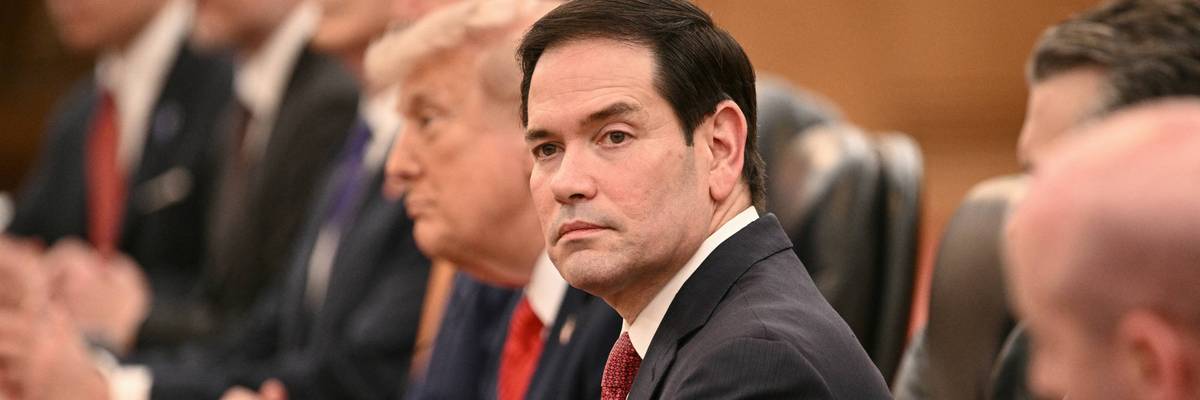
Secretary of State Marco Rubio looks on as US President Donald Trump meets with China's President Xi Jinping at the Great Hall of the People in Beijing on May 14, 2026.
"Trump has turned Venezuela into an effective US colony," said one critic.
Some critics of the Trump administration are reacting with horror to revelations that US Secretary of State Marco Rubio has been serving as the de facto ruler of Venezuela.
According to a Saturday report in The New York Times, Rubio for the last several months has been acting informally as the "viceroy" of Venezuela ever since its recognized president, Nicolás Maduro, was abducted by the American military in January and brought to the US to face charges related to "narco-terrorism."
The Times' sources revealed that Rubio "effectively controls Venezuela’s finances, the distribution of its natural resources, and its government" and "is deeply involved in the country’s day-to-day operations," while maintaining regular contact with acting Venezuelan President Delcy Rodríguez.
Under current arrangements, the US Treasury Department takes in revenue from Venezuela's exports, including its petroleum, and then disperses the money back to the country through its private banks with strict conditions set by Rubio over what it can be spent on.
In explaining the system, the Times likened it to "parents handing out allowances to children," adding that it gives Rubio "immense leverage over... Rodríguez, who depends on the money to pay workers and prop up the national currency."
Elizabeth Saunders, professor of political science at Columbia University, described Rubio's power over Venezuela as "insane," as well as "derelict, unconscionable, and impeachable."
"The secretary of state's time is scarce, valuable, and not outsourcable," Saunders emphasized.
Orlando J. Pérez, professor of Political Science at the University of North Texas at Dallas, said the Times report made a mockery of Rubio's professed claims to want to bring democracy back to Venezuela.
"It appears Rubio has transformed from democracy promotion warrior," Pérez commented, "to transactional realpolitik operative!"
Kenneth Roth, former executive director at Human Rights Watch, wrote that US control over Venezuela appeared similar to the kind of imperial power wielded by European nations in the 19th Century.
"Trump has turned Venezuela into an effective US colony," said Roth, "with Marco Rubio as the viceroy and Washington controlling the country’s oil revenue and dictating major foreign and domestic policies. Democracy has been relegated to the distant future."
Bradley Simpson, historian at the University of Connecticut, also saw the current US arrangement with Venezuela as a return to overt imperialism.
"We are literally back in the Dollar Diplomacy days of the 1910s," Simpson wrote, "when the United States invaded countries and took over their financial systems and ran them as effective colonies. Flagrantly illegal, enormously corrupt. Where is the organization of American states or UN in denouncing this?"
Dear Common Dreams reader, It’s been nearly 30 years since I co-founded Common Dreams with my late wife, Lina Newhouser. We had the radical notion that journalism should serve the public good, not corporate profits. It was clear to us from the outset what it would take to build such a project. No paid advertisements. No corporate sponsors. No millionaire publisher telling us what to think or do. Many people said we wouldn't last a year, but we proved those doubters wrong. Together with a tremendous team of journalists and dedicated staff, we built an independent media outlet free from the constraints of profits and corporate control. Our mission has always been simple: To inform. To inspire. To ignite change for the common good. Building Common Dreams was not easy. Our survival was never guaranteed. When you take on the most powerful forces—Wall Street greed, fossil fuel industry destruction, Big Tech lobbyists, and uber-rich oligarchs who have spent billions upon billions rigging the economy and democracy in their favor—the only bulwark you have is supporters who believe in your work. But here’s the urgent message from me today. It's never been this bad out there. And it's never been this hard to keep us going. At the very moment Common Dreams is most needed, the threats we face are intensifying. We need your support now more than ever. We don't accept corporate advertising and never will. We don't have a paywall because we don't think people should be blocked from critical news based on their ability to pay. Everything we do is funded by the donations of readers like you. When everyone does the little they can afford, we are strong. But if that support retreats or dries up, so do we. Will you donate now to make sure Common Dreams not only survives but thrives? —Craig Brown, Co-founder |
Some critics of the Trump administration are reacting with horror to revelations that US Secretary of State Marco Rubio has been serving as the de facto ruler of Venezuela.
According to a Saturday report in The New York Times, Rubio for the last several months has been acting informally as the "viceroy" of Venezuela ever since its recognized president, Nicolás Maduro, was abducted by the American military in January and brought to the US to face charges related to "narco-terrorism."
The Times' sources revealed that Rubio "effectively controls Venezuela’s finances, the distribution of its natural resources, and its government" and "is deeply involved in the country’s day-to-day operations," while maintaining regular contact with acting Venezuelan President Delcy Rodríguez.
Under current arrangements, the US Treasury Department takes in revenue from Venezuela's exports, including its petroleum, and then disperses the money back to the country through its private banks with strict conditions set by Rubio over what it can be spent on.
In explaining the system, the Times likened it to "parents handing out allowances to children," adding that it gives Rubio "immense leverage over... Rodríguez, who depends on the money to pay workers and prop up the national currency."
Elizabeth Saunders, professor of political science at Columbia University, described Rubio's power over Venezuela as "insane," as well as "derelict, unconscionable, and impeachable."
"The secretary of state's time is scarce, valuable, and not outsourcable," Saunders emphasized.
Orlando J. Pérez, professor of Political Science at the University of North Texas at Dallas, said the Times report made a mockery of Rubio's professed claims to want to bring democracy back to Venezuela.
"It appears Rubio has transformed from democracy promotion warrior," Pérez commented, "to transactional realpolitik operative!"
Kenneth Roth, former executive director at Human Rights Watch, wrote that US control over Venezuela appeared similar to the kind of imperial power wielded by European nations in the 19th Century.
"Trump has turned Venezuela into an effective US colony," said Roth, "with Marco Rubio as the viceroy and Washington controlling the country’s oil revenue and dictating major foreign and domestic policies. Democracy has been relegated to the distant future."
Bradley Simpson, historian at the University of Connecticut, also saw the current US arrangement with Venezuela as a return to overt imperialism.
"We are literally back in the Dollar Diplomacy days of the 1910s," Simpson wrote, "when the United States invaded countries and took over their financial systems and ran them as effective colonies. Flagrantly illegal, enormously corrupt. Where is the organization of American states or UN in denouncing this?"
Some critics of the Trump administration are reacting with horror to revelations that US Secretary of State Marco Rubio has been serving as the de facto ruler of Venezuela.
According to a Saturday report in The New York Times, Rubio for the last several months has been acting informally as the "viceroy" of Venezuela ever since its recognized president, Nicolás Maduro, was abducted by the American military in January and brought to the US to face charges related to "narco-terrorism."
The Times' sources revealed that Rubio "effectively controls Venezuela’s finances, the distribution of its natural resources, and its government" and "is deeply involved in the country’s day-to-day operations," while maintaining regular contact with acting Venezuelan President Delcy Rodríguez.
Under current arrangements, the US Treasury Department takes in revenue from Venezuela's exports, including its petroleum, and then disperses the money back to the country through its private banks with strict conditions set by Rubio over what it can be spent on.
In explaining the system, the Times likened it to "parents handing out allowances to children," adding that it gives Rubio "immense leverage over... Rodríguez, who depends on the money to pay workers and prop up the national currency."
Elizabeth Saunders, professor of political science at Columbia University, described Rubio's power over Venezuela as "insane," as well as "derelict, unconscionable, and impeachable."
"The secretary of state's time is scarce, valuable, and not outsourcable," Saunders emphasized.
Orlando J. Pérez, professor of Political Science at the University of North Texas at Dallas, said the Times report made a mockery of Rubio's professed claims to want to bring democracy back to Venezuela.
"It appears Rubio has transformed from democracy promotion warrior," Pérez commented, "to transactional realpolitik operative!"
Kenneth Roth, former executive director at Human Rights Watch, wrote that US control over Venezuela appeared similar to the kind of imperial power wielded by European nations in the 19th Century.
"Trump has turned Venezuela into an effective US colony," said Roth, "with Marco Rubio as the viceroy and Washington controlling the country’s oil revenue and dictating major foreign and domestic policies. Democracy has been relegated to the distant future."
Bradley Simpson, historian at the University of Connecticut, also saw the current US arrangement with Venezuela as a return to overt imperialism.
"We are literally back in the Dollar Diplomacy days of the 1910s," Simpson wrote, "when the United States invaded countries and took over their financial systems and ran them as effective colonies. Flagrantly illegal, enormously corrupt. Where is the organization of American states or UN in denouncing this?"