SUBSCRIBE TO OUR FREE NEWSLETTER
Daily news & progressive opinion—funded by the people, not the corporations—delivered straight to your inbox.
5
#000000
#FFFFFF
To donate by check, phone, or other method, see our More Ways to Give page.
Daily news & progressive opinion—funded by the people, not the corporations—delivered straight to your inbox.
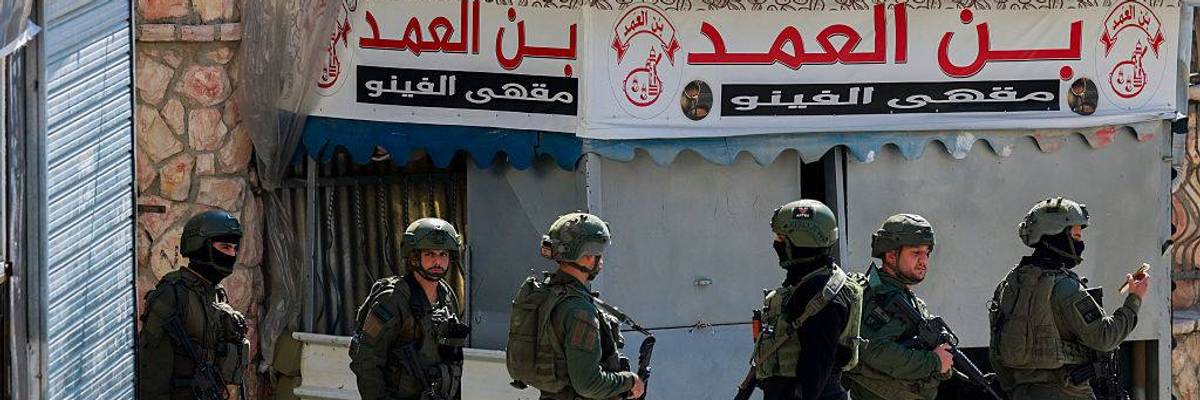
Israeli soldiers patrol a street during a military operation in the Askar refugee camp in eastern Nablus, Israeli-occupied West Bank, on March 2, 2026.
"Messiah complexes, talk of revenge, and the use of force against journalists are just symptoms of what's been happening to the army over the past three years," said one Israeli journalist.
Soldiers in the Israel Defense Forces on Friday were caught on camera assaulting and detaining a crew of CNN journalists while they were reporting from the occupied West Bank.
A video of the incident posted on social media by CNN Jerusalem correspondent Jeremy Diamond shows the CNN crew walking near the Palestinian village of Tayasir, which in recent days has come under assault from Israeli settlers who established an illegal outpost in the area.
The crew are then accosted by armed members of the IDF, who order them to sit down. After the crew complies with their commands, the soldiers come to seize the journalists' cameras and phones that are being used to record the incident.
A soldier then puts CNN photojournalist Cyril Theophilos in a chokehold and forces him to the ground. Writing about the assault later, Theophilos said that the soldier "pushed and strangled me," adding that this kind of violence "is just a symptom of the IDF's actions in the West Bank."
According to Diamond, the CNN crew were subsequently detained for two hours. During that time, Diamond wrote, it became clear that the ideology of the Israeli settlers movement was "motivating many of the soldiers who operate in the occupied West Bank" and that the Israeli military regularly acts "in service of the settler movement."
For instance, one IDF soldier acknowledged during conversations with the CNN crew that the settler outpost near Tayasir was unlawful under both international and Israeli law, but insisted "this will be a legal settlement... slowly, slowly."
The soldier also said he wanted to exact "revenge" on local Palestinians for the death of 18-year-old Israeli settler Yehuda Sherman, who was killed last week by a Palestinian driver. Palestinians who witnessed Sherman's killing have said that the driver was trying to stop Sherman from stealing sheep.
The IDF issued an apology to CNN over the incident, insisting that "the actions and behavior of the soldiers in the incident are incompatible with what is expected of IDF soldiers."
However, this apology was deemed insufficient by Barak Ravid, global affairs correspondent for Axios.
"Apologies are not enough," he wrote on social media. "There is a need for clear accountability. 99.9% of the time there is zero accountability."
The soldiers' actions also drew condemnation from Haaretz reporter Bar Peleg, who argued that problems in the IDF have only grown worse under the far-right government led by Prime Minister Benjamin Netanyahu.
"Messiah complexes, talk of revenge, and the use of force against journalists are just symptoms of what's been happening to the army over the past three years," Peleg said. "The chief of staff and the commanding general can write another thousand letters and wave flags all they want, but the process already seems irreversible."
Palestinian human rights activist Ihab Hassan argued that incidents like the one captured by CNN are all too common for the IDF.
"The Israeli army arrests and assaults journalists, while settlers who commit horrific crimes against Palestinian civilians enjoy total impunity," he wrote. "This is state-backed terrorism."
Dear Common Dreams reader, It’s been nearly 30 years since I co-founded Common Dreams with my late wife, Lina Newhouser. We had the radical notion that journalism should serve the public good, not corporate profits. It was clear to us from the outset what it would take to build such a project. No paid advertisements. No corporate sponsors. No millionaire publisher telling us what to think or do. Many people said we wouldn't last a year, but we proved those doubters wrong. Together with a tremendous team of journalists and dedicated staff, we built an independent media outlet free from the constraints of profits and corporate control. Our mission has always been simple: To inform. To inspire. To ignite change for the common good. Building Common Dreams was not easy. Our survival was never guaranteed. When you take on the most powerful forces—Wall Street greed, fossil fuel industry destruction, Big Tech lobbyists, and uber-rich oligarchs who have spent billions upon billions rigging the economy and democracy in their favor—the only bulwark you have is supporters who believe in your work. But here’s the urgent message from me today. It's never been this bad out there. And it's never been this hard to keep us going. At the very moment Common Dreams is most needed, the threats we face are intensifying. We need your support now more than ever. We don't accept corporate advertising and never will. We don't have a paywall because we don't think people should be blocked from critical news based on their ability to pay. Everything we do is funded by the donations of readers like you. When everyone does the little they can afford, we are strong. But if that support retreats or dries up, so do we. Will you donate now to make sure Common Dreams not only survives but thrives? —Craig Brown, Co-founder |
Soldiers in the Israel Defense Forces on Friday were caught on camera assaulting and detaining a crew of CNN journalists while they were reporting from the occupied West Bank.
A video of the incident posted on social media by CNN Jerusalem correspondent Jeremy Diamond shows the CNN crew walking near the Palestinian village of Tayasir, which in recent days has come under assault from Israeli settlers who established an illegal outpost in the area.
The crew are then accosted by armed members of the IDF, who order them to sit down. After the crew complies with their commands, the soldiers come to seize the journalists' cameras and phones that are being used to record the incident.
A soldier then puts CNN photojournalist Cyril Theophilos in a chokehold and forces him to the ground. Writing about the assault later, Theophilos said that the soldier "pushed and strangled me," adding that this kind of violence "is just a symptom of the IDF's actions in the West Bank."
According to Diamond, the CNN crew were subsequently detained for two hours. During that time, Diamond wrote, it became clear that the ideology of the Israeli settlers movement was "motivating many of the soldiers who operate in the occupied West Bank" and that the Israeli military regularly acts "in service of the settler movement."
For instance, one IDF soldier acknowledged during conversations with the CNN crew that the settler outpost near Tayasir was unlawful under both international and Israeli law, but insisted "this will be a legal settlement... slowly, slowly."
The soldier also said he wanted to exact "revenge" on local Palestinians for the death of 18-year-old Israeli settler Yehuda Sherman, who was killed last week by a Palestinian driver. Palestinians who witnessed Sherman's killing have said that the driver was trying to stop Sherman from stealing sheep.
The IDF issued an apology to CNN over the incident, insisting that "the actions and behavior of the soldiers in the incident are incompatible with what is expected of IDF soldiers."
However, this apology was deemed insufficient by Barak Ravid, global affairs correspondent for Axios.
"Apologies are not enough," he wrote on social media. "There is a need for clear accountability. 99.9% of the time there is zero accountability."
The soldiers' actions also drew condemnation from Haaretz reporter Bar Peleg, who argued that problems in the IDF have only grown worse under the far-right government led by Prime Minister Benjamin Netanyahu.
"Messiah complexes, talk of revenge, and the use of force against journalists are just symptoms of what's been happening to the army over the past three years," Peleg said. "The chief of staff and the commanding general can write another thousand letters and wave flags all they want, but the process already seems irreversible."
Palestinian human rights activist Ihab Hassan argued that incidents like the one captured by CNN are all too common for the IDF.
"The Israeli army arrests and assaults journalists, while settlers who commit horrific crimes against Palestinian civilians enjoy total impunity," he wrote. "This is state-backed terrorism."
Soldiers in the Israel Defense Forces on Friday were caught on camera assaulting and detaining a crew of CNN journalists while they were reporting from the occupied West Bank.
A video of the incident posted on social media by CNN Jerusalem correspondent Jeremy Diamond shows the CNN crew walking near the Palestinian village of Tayasir, which in recent days has come under assault from Israeli settlers who established an illegal outpost in the area.
The crew are then accosted by armed members of the IDF, who order them to sit down. After the crew complies with their commands, the soldiers come to seize the journalists' cameras and phones that are being used to record the incident.
A soldier then puts CNN photojournalist Cyril Theophilos in a chokehold and forces him to the ground. Writing about the assault later, Theophilos said that the soldier "pushed and strangled me," adding that this kind of violence "is just a symptom of the IDF's actions in the West Bank."
According to Diamond, the CNN crew were subsequently detained for two hours. During that time, Diamond wrote, it became clear that the ideology of the Israeli settlers movement was "motivating many of the soldiers who operate in the occupied West Bank" and that the Israeli military regularly acts "in service of the settler movement."
For instance, one IDF soldier acknowledged during conversations with the CNN crew that the settler outpost near Tayasir was unlawful under both international and Israeli law, but insisted "this will be a legal settlement... slowly, slowly."
The soldier also said he wanted to exact "revenge" on local Palestinians for the death of 18-year-old Israeli settler Yehuda Sherman, who was killed last week by a Palestinian driver. Palestinians who witnessed Sherman's killing have said that the driver was trying to stop Sherman from stealing sheep.
The IDF issued an apology to CNN over the incident, insisting that "the actions and behavior of the soldiers in the incident are incompatible with what is expected of IDF soldiers."
However, this apology was deemed insufficient by Barak Ravid, global affairs correspondent for Axios.
"Apologies are not enough," he wrote on social media. "There is a need for clear accountability. 99.9% of the time there is zero accountability."
The soldiers' actions also drew condemnation from Haaretz reporter Bar Peleg, who argued that problems in the IDF have only grown worse under the far-right government led by Prime Minister Benjamin Netanyahu.
"Messiah complexes, talk of revenge, and the use of force against journalists are just symptoms of what's been happening to the army over the past three years," Peleg said. "The chief of staff and the commanding general can write another thousand letters and wave flags all they want, but the process already seems irreversible."
Palestinian human rights activist Ihab Hassan argued that incidents like the one captured by CNN are all too common for the IDF.
"The Israeli army arrests and assaults journalists, while settlers who commit horrific crimes against Palestinian civilians enjoy total impunity," he wrote. "This is state-backed terrorism."