SUBSCRIBE TO OUR FREE NEWSLETTER
Daily news & progressive opinion—funded by the people, not the corporations—delivered straight to your inbox.
5
#000000
#FFFFFF
To donate by check, phone, or other method, see our More Ways to Give page.
Daily news & progressive opinion—funded by the people, not the corporations—delivered straight to your inbox.
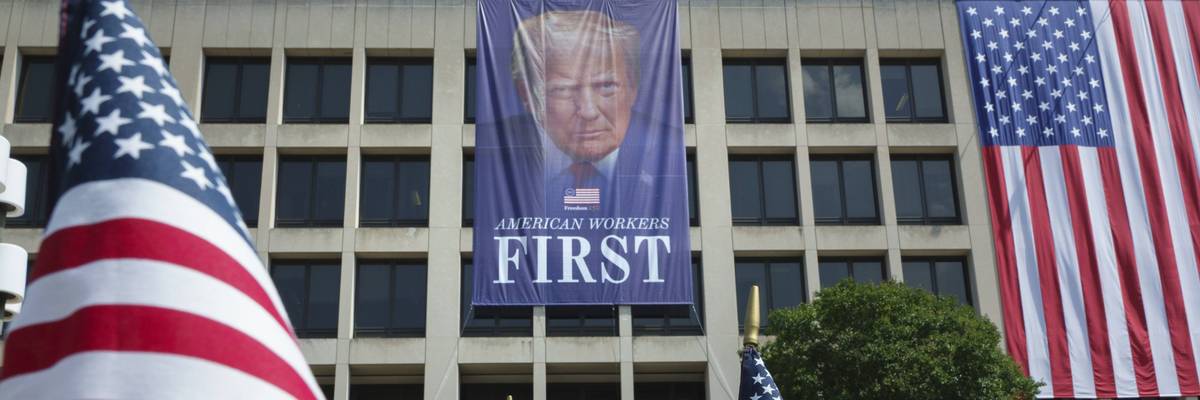
A banner with a portrait of US President Donald Trump is displayed on the front US Department of Labor Frances Perkins Building which is lined with American flags for the 250th anniversary celebration on July 2, 2026 in Washington, DC.
"I've never seen a more dangerous and purposeful attempt to make people sick and hungry," said one Pennsylvania state lawmaker.
Last week marked the first anniversary of President Donald Trump signing H.R. 1, known as the One Big Beautiful Bill Act.
But a new report from the progressive advocacy group Defend America Action, obtained exclusively by Common Dreams, demonstrates that while the bill has indeed been beautiful for the richest households, it has been anything but for working-class Americans.
"Republicans sacrificed the American people's financial future, healthcare, and food security to pay for massive tax breaks for big corporations and the ultrawealthy," the report said. "The richest people on the planet got a handout, and working families got the bill."
According to an analysis by the Institute on Taxation and Economic Policy (ITEP), the richest 1% of Americans will see $117 billion in net tax cuts in 2026, an average windfall of roughly $66,000 each and more than the entire bottom 60% will receive combined.
At the same time, the law contained the largest cuts to federal healthcare funding in US history, slashing over $1 trillion from Medicaid and the Affordable Care Act (ACA) over the next decade.
The report found that as of March 2026, less than a year after the bill passed, enrollment in Medicaid and the Children's Health Insurance Program (CHIP) had already fallen by 3.8 million.
And after Republicans allowed ACA marketplace subsidies to expire, insurance premiums are projected to increase 114% on average, leading one in five enrollees—over 4.2 million people—to drop their coverage entirely.
Additionally, 11 million low-income Americans no longer receive zero-dollar premiums through the marketplace, while deductibles rose an average of 37% for those buying insurance on their own.
In total, more than 8 million people are estimated to have lost insurance coverage due to cuts to these programs, according to Protect Our Care. The nonpartisan Congressional Budget Office has projected that as many as 15 million could lose insurance by 2034 as a result of the law and other policy changes over the next decade.
US Rep. Dina Titus (D) said that the cuts have hit her state of Nevada especially hard, as many people work in the service industry and don't receive employer-sponsored insurance.
"An estimated 100,000 Nevadans are impacted by this, [could be] kicked off Medicaid, including 22,000 just in my one congressional district, and it's children, it's seniors, and it's people with disabilities who are going to be impacted so directly."
"The failure to continue the [ACA] tax credits... has knocked more people off," she said. "Then people who do have it pay higher rates to cover that. So it doesn't just impact the people who are on Obamacare. It impacts everybody."
According to an analysis by Protect Our Care, more than 1,000 hospitals, nursing homes, maternity wards, and other critical care facilities around the country have either shut down, are at risk of closing, or have cut essential services since the law went into place.
"In my more than 25 years as a practicing physician and now a legislator for the last four years, I've never seen a more dangerous and purposeful attempt to make people sick and hungry," said Pennsylvania state Rep. Arvind Venkat (D-30), an emergency physician who represents the suburbs outside Pittsburgh.
"There are a number of hospitals in Pennsylvania that have closed or are under threat to close as a result of the devastation that's being caused by this legislation," he said.
After $187 billion was cut from the Supplemental Nutrition Assistance Program (SNAP), more than 4 million low-income people—10 % of enrollees—no longer receive food assistance, according to the Center on Budget and Policy Priorities.
Millions more are expected to also lose benefits as stringent new work requirements go into effect. This includes 3 million people aged 18-24, according to a report from the Urban Institute, which noted that young adults often have greater difficulty finding stable jobs that allow them to meet the work requirements.
An analysis from ProPublica last month found that across just 12 states that break down data based on age, at least 776,000 children are no longer appearing on SNAP rolls.
"I think when we're talking about SNAP, we should start from the fact that the average benefit per person is [less than] $3 per meal," said Jared Bernstein, who served as the chair of the United States Council of Economic Advisers under former President Joe Biden.
"Nobody's getting rich off of SNAP," he said. "What's happening is people, including a lot of children, are getting fed."
"There's a long line of careful research showing long-term benefits for not just the beneficiaries themselves, but for the broader society," he said, noting that receiving benefits early in life is associated with "better academic performance, long-run health, educational attainment, and economic self-sufficiency."
The report from Defend America Action also said the Trump budget law squashed "an unprecedented American clean energy and manufacturing boom" that began during the Biden years, which created hundreds of thousands of jobs.
The law eliminated clean energy tax credits and led hundreds of projects to be canceled. Citing an analysis by Climate Power, the report said that over 140,000 clean energy jobs have been lost, are at risk, or have been delayed due to H.R. 1, stemming from 382 canceled or delayed projects that represented $69 billion in investment.
This has also contributed to the $92 billion spike in energy bills since Trump took office, the report said. Those canceled projects could have powered more than 17 million homes.
The law also killed the $7,500 electric vehicle (EV) tax credit, which has locked consumers into driving gas-powered cars that cost more to power, especially as Trump's war with Iran has sent gas prices soaring.
Bernstein noted that EV sales "fell off a cliff" after the tax credits were canceled.
"I can't begin to describe how shortsighted this is," he said. "Not just in terms of the environment, but also in terms of the US ever having a chance to capture market share in what I believe already is a do-or-die product development for the auto sector."
He noted that the US abandonment of clean energy, even as its use grows worldwide, has led China to dominate the market.
"This isn't China just eating our lunch," Bernstein said. "This is us serving our lunch to them."
Defend America Action's report notes that at the time of its passage, H.R. 1 was the most unpopular piece of legislation to pass through Congress since at least 1990, with just 31% approving and 55% disapproving, according to an average of four major polls.
Just months before the midterm elections, the bill remains equally unpopular, with only 33% of Americans saying they favor it and 48% opposing it, according to a recent survey by Navigator Research.
Titus told Common Dreams that one year ago, her colleagues in the GOP were very excited to pass H.R. 1.
Now, she said, "They don't really talk about it."
"They always are up for cutting programs," Titus said. "They call it fraud, waste, and abuse, but it's not. It's benefits that people needed."
"I think as you get closer to the election, there will be more concern about it," Titus said. "You know they cleverly made some of these cuts not go into effect until after the election, so they had to have been aware that they weren't very popular."
"I think we need to get the message out as much and as often as we can," she said, "and that's been kind of focused on affordability because all these different programs that we mentioned tie together."
"It's not just one little hit," Titus said. "It's across-the-board hits."
Dear Common Dreams reader, It’s been nearly 30 years since I co-founded Common Dreams with my late wife, Lina Newhouser. We had the radical notion that journalism should serve the public good, not corporate profits. It was clear to us from the outset what it would take to build such a project. No paid advertisements. No corporate sponsors. No millionaire publisher telling us what to think or do. Many people said we wouldn't last a year, but we proved those doubters wrong. Together with a tremendous team of journalists and dedicated staff, we built an independent media outlet free from the constraints of profits and corporate control. Our mission has always been simple: To inform. To inspire. To ignite change for the common good. Building Common Dreams was not easy. Our survival was never guaranteed. When you take on the most powerful forces—Wall Street greed, fossil fuel industry destruction, Big Tech lobbyists, and uber-rich oligarchs who have spent billions upon billions rigging the economy and democracy in their favor—the only bulwark you have is supporters who believe in your work. But here’s the urgent message from me today. It's never been this bad out there. And it's never been this hard to keep us going. At the very moment Common Dreams is most needed, the threats we face are intensifying. We need your support now more than ever. We don't accept corporate advertising and never will. We don't have a paywall because we don't think people should be blocked from critical news based on their ability to pay. Everything we do is funded by the donations of readers like you. When everyone does the little they can afford, we are strong. But if that support retreats or dries up, so do we. Will you donate now to make sure Common Dreams not only survives but thrives? —Craig Brown, Co-founder |
Last week marked the first anniversary of President Donald Trump signing H.R. 1, known as the One Big Beautiful Bill Act.
But a new report from the progressive advocacy group Defend America Action, obtained exclusively by Common Dreams, demonstrates that while the bill has indeed been beautiful for the richest households, it has been anything but for working-class Americans.
"Republicans sacrificed the American people's financial future, healthcare, and food security to pay for massive tax breaks for big corporations and the ultrawealthy," the report said. "The richest people on the planet got a handout, and working families got the bill."
According to an analysis by the Institute on Taxation and Economic Policy (ITEP), the richest 1% of Americans will see $117 billion in net tax cuts in 2026, an average windfall of roughly $66,000 each and more than the entire bottom 60% will receive combined.
At the same time, the law contained the largest cuts to federal healthcare funding in US history, slashing over $1 trillion from Medicaid and the Affordable Care Act (ACA) over the next decade.
The report found that as of March 2026, less than a year after the bill passed, enrollment in Medicaid and the Children's Health Insurance Program (CHIP) had already fallen by 3.8 million.
And after Republicans allowed ACA marketplace subsidies to expire, insurance premiums are projected to increase 114% on average, leading one in five enrollees—over 4.2 million people—to drop their coverage entirely.
Additionally, 11 million low-income Americans no longer receive zero-dollar premiums through the marketplace, while deductibles rose an average of 37% for those buying insurance on their own.
In total, more than 8 million people are estimated to have lost insurance coverage due to cuts to these programs, according to Protect Our Care. The nonpartisan Congressional Budget Office has projected that as many as 15 million could lose insurance by 2034 as a result of the law and other policy changes over the next decade.
US Rep. Dina Titus (D) said that the cuts have hit her state of Nevada especially hard, as many people work in the service industry and don't receive employer-sponsored insurance.
"An estimated 100,000 Nevadans are impacted by this, [could be] kicked off Medicaid, including 22,000 just in my one congressional district, and it's children, it's seniors, and it's people with disabilities who are going to be impacted so directly."
"The failure to continue the [ACA] tax credits... has knocked more people off," she said. "Then people who do have it pay higher rates to cover that. So it doesn't just impact the people who are on Obamacare. It impacts everybody."
According to an analysis by Protect Our Care, more than 1,000 hospitals, nursing homes, maternity wards, and other critical care facilities around the country have either shut down, are at risk of closing, or have cut essential services since the law went into place.
"In my more than 25 years as a practicing physician and now a legislator for the last four years, I've never seen a more dangerous and purposeful attempt to make people sick and hungry," said Pennsylvania state Rep. Arvind Venkat (D-30), an emergency physician who represents the suburbs outside Pittsburgh.
"There are a number of hospitals in Pennsylvania that have closed or are under threat to close as a result of the devastation that's being caused by this legislation," he said.
After $187 billion was cut from the Supplemental Nutrition Assistance Program (SNAP), more than 4 million low-income people—10 % of enrollees—no longer receive food assistance, according to the Center on Budget and Policy Priorities.
Millions more are expected to also lose benefits as stringent new work requirements go into effect. This includes 3 million people aged 18-24, according to a report from the Urban Institute, which noted that young adults often have greater difficulty finding stable jobs that allow them to meet the work requirements.
An analysis from ProPublica last month found that across just 12 states that break down data based on age, at least 776,000 children are no longer appearing on SNAP rolls.
"I think when we're talking about SNAP, we should start from the fact that the average benefit per person is [less than] $3 per meal," said Jared Bernstein, who served as the chair of the United States Council of Economic Advisers under former President Joe Biden.
"Nobody's getting rich off of SNAP," he said. "What's happening is people, including a lot of children, are getting fed."
"There's a long line of careful research showing long-term benefits for not just the beneficiaries themselves, but for the broader society," he said, noting that receiving benefits early in life is associated with "better academic performance, long-run health, educational attainment, and economic self-sufficiency."
The report from Defend America Action also said the Trump budget law squashed "an unprecedented American clean energy and manufacturing boom" that began during the Biden years, which created hundreds of thousands of jobs.
The law eliminated clean energy tax credits and led hundreds of projects to be canceled. Citing an analysis by Climate Power, the report said that over 140,000 clean energy jobs have been lost, are at risk, or have been delayed due to H.R. 1, stemming from 382 canceled or delayed projects that represented $69 billion in investment.
This has also contributed to the $92 billion spike in energy bills since Trump took office, the report said. Those canceled projects could have powered more than 17 million homes.
The law also killed the $7,500 electric vehicle (EV) tax credit, which has locked consumers into driving gas-powered cars that cost more to power, especially as Trump's war with Iran has sent gas prices soaring.
Bernstein noted that EV sales "fell off a cliff" after the tax credits were canceled.
"I can't begin to describe how shortsighted this is," he said. "Not just in terms of the environment, but also in terms of the US ever having a chance to capture market share in what I believe already is a do-or-die product development for the auto sector."
He noted that the US abandonment of clean energy, even as its use grows worldwide, has led China to dominate the market.
"This isn't China just eating our lunch," Bernstein said. "This is us serving our lunch to them."
Defend America Action's report notes that at the time of its passage, H.R. 1 was the most unpopular piece of legislation to pass through Congress since at least 1990, with just 31% approving and 55% disapproving, according to an average of four major polls.
Just months before the midterm elections, the bill remains equally unpopular, with only 33% of Americans saying they favor it and 48% opposing it, according to a recent survey by Navigator Research.
Titus told Common Dreams that one year ago, her colleagues in the GOP were very excited to pass H.R. 1.
Now, she said, "They don't really talk about it."
"They always are up for cutting programs," Titus said. "They call it fraud, waste, and abuse, but it's not. It's benefits that people needed."
"I think as you get closer to the election, there will be more concern about it," Titus said. "You know they cleverly made some of these cuts not go into effect until after the election, so they had to have been aware that they weren't very popular."
"I think we need to get the message out as much and as often as we can," she said, "and that's been kind of focused on affordability because all these different programs that we mentioned tie together."
"It's not just one little hit," Titus said. "It's across-the-board hits."
Last week marked the first anniversary of President Donald Trump signing H.R. 1, known as the One Big Beautiful Bill Act.
But a new report from the progressive advocacy group Defend America Action, obtained exclusively by Common Dreams, demonstrates that while the bill has indeed been beautiful for the richest households, it has been anything but for working-class Americans.
"Republicans sacrificed the American people's financial future, healthcare, and food security to pay for massive tax breaks for big corporations and the ultrawealthy," the report said. "The richest people on the planet got a handout, and working families got the bill."
According to an analysis by the Institute on Taxation and Economic Policy (ITEP), the richest 1% of Americans will see $117 billion in net tax cuts in 2026, an average windfall of roughly $66,000 each and more than the entire bottom 60% will receive combined.
At the same time, the law contained the largest cuts to federal healthcare funding in US history, slashing over $1 trillion from Medicaid and the Affordable Care Act (ACA) over the next decade.
The report found that as of March 2026, less than a year after the bill passed, enrollment in Medicaid and the Children's Health Insurance Program (CHIP) had already fallen by 3.8 million.
And after Republicans allowed ACA marketplace subsidies to expire, insurance premiums are projected to increase 114% on average, leading one in five enrollees—over 4.2 million people—to drop their coverage entirely.
Additionally, 11 million low-income Americans no longer receive zero-dollar premiums through the marketplace, while deductibles rose an average of 37% for those buying insurance on their own.
In total, more than 8 million people are estimated to have lost insurance coverage due to cuts to these programs, according to Protect Our Care. The nonpartisan Congressional Budget Office has projected that as many as 15 million could lose insurance by 2034 as a result of the law and other policy changes over the next decade.
US Rep. Dina Titus (D) said that the cuts have hit her state of Nevada especially hard, as many people work in the service industry and don't receive employer-sponsored insurance.
"An estimated 100,000 Nevadans are impacted by this, [could be] kicked off Medicaid, including 22,000 just in my one congressional district, and it's children, it's seniors, and it's people with disabilities who are going to be impacted so directly."
"The failure to continue the [ACA] tax credits... has knocked more people off," she said. "Then people who do have it pay higher rates to cover that. So it doesn't just impact the people who are on Obamacare. It impacts everybody."
According to an analysis by Protect Our Care, more than 1,000 hospitals, nursing homes, maternity wards, and other critical care facilities around the country have either shut down, are at risk of closing, or have cut essential services since the law went into place.
"In my more than 25 years as a practicing physician and now a legislator for the last four years, I've never seen a more dangerous and purposeful attempt to make people sick and hungry," said Pennsylvania state Rep. Arvind Venkat (D-30), an emergency physician who represents the suburbs outside Pittsburgh.
"There are a number of hospitals in Pennsylvania that have closed or are under threat to close as a result of the devastation that's being caused by this legislation," he said.
After $187 billion was cut from the Supplemental Nutrition Assistance Program (SNAP), more than 4 million low-income people—10 % of enrollees—no longer receive food assistance, according to the Center on Budget and Policy Priorities.
Millions more are expected to also lose benefits as stringent new work requirements go into effect. This includes 3 million people aged 18-24, according to a report from the Urban Institute, which noted that young adults often have greater difficulty finding stable jobs that allow them to meet the work requirements.
An analysis from ProPublica last month found that across just 12 states that break down data based on age, at least 776,000 children are no longer appearing on SNAP rolls.
"I think when we're talking about SNAP, we should start from the fact that the average benefit per person is [less than] $3 per meal," said Jared Bernstein, who served as the chair of the United States Council of Economic Advisers under former President Joe Biden.
"Nobody's getting rich off of SNAP," he said. "What's happening is people, including a lot of children, are getting fed."
"There's a long line of careful research showing long-term benefits for not just the beneficiaries themselves, but for the broader society," he said, noting that receiving benefits early in life is associated with "better academic performance, long-run health, educational attainment, and economic self-sufficiency."
The report from Defend America Action also said the Trump budget law squashed "an unprecedented American clean energy and manufacturing boom" that began during the Biden years, which created hundreds of thousands of jobs.
The law eliminated clean energy tax credits and led hundreds of projects to be canceled. Citing an analysis by Climate Power, the report said that over 140,000 clean energy jobs have been lost, are at risk, or have been delayed due to H.R. 1, stemming from 382 canceled or delayed projects that represented $69 billion in investment.
This has also contributed to the $92 billion spike in energy bills since Trump took office, the report said. Those canceled projects could have powered more than 17 million homes.
The law also killed the $7,500 electric vehicle (EV) tax credit, which has locked consumers into driving gas-powered cars that cost more to power, especially as Trump's war with Iran has sent gas prices soaring.
Bernstein noted that EV sales "fell off a cliff" after the tax credits were canceled.
"I can't begin to describe how shortsighted this is," he said. "Not just in terms of the environment, but also in terms of the US ever having a chance to capture market share in what I believe already is a do-or-die product development for the auto sector."
He noted that the US abandonment of clean energy, even as its use grows worldwide, has led China to dominate the market.
"This isn't China just eating our lunch," Bernstein said. "This is us serving our lunch to them."
Defend America Action's report notes that at the time of its passage, H.R. 1 was the most unpopular piece of legislation to pass through Congress since at least 1990, with just 31% approving and 55% disapproving, according to an average of four major polls.
Just months before the midterm elections, the bill remains equally unpopular, with only 33% of Americans saying they favor it and 48% opposing it, according to a recent survey by Navigator Research.
Titus told Common Dreams that one year ago, her colleagues in the GOP were very excited to pass H.R. 1.
Now, she said, "They don't really talk about it."
"They always are up for cutting programs," Titus said. "They call it fraud, waste, and abuse, but it's not. It's benefits that people needed."
"I think as you get closer to the election, there will be more concern about it," Titus said. "You know they cleverly made some of these cuts not go into effect until after the election, so they had to have been aware that they weren't very popular."
"I think we need to get the message out as much and as often as we can," she said, "and that's been kind of focused on affordability because all these different programs that we mentioned tie together."
"It's not just one little hit," Titus said. "It's across-the-board hits."