

SUBSCRIBE TO OUR FREE NEWSLETTER
Daily news & progressive opinion—funded by the people, not the corporations—delivered straight to your inbox.
5
#000000
#FFFFFF
To donate by check, phone, or other method, see our More Ways to Give page.
Daily news & progressive opinion—funded by the people, not the corporations—delivered straight to your inbox.
"While Trump is weaponizing taxpayer privacy laws for his own benefit, his Treasury Department is flouting those exact same laws to send tens of thousands of individual tax records to his anti-immigrant henchmen at ICE."
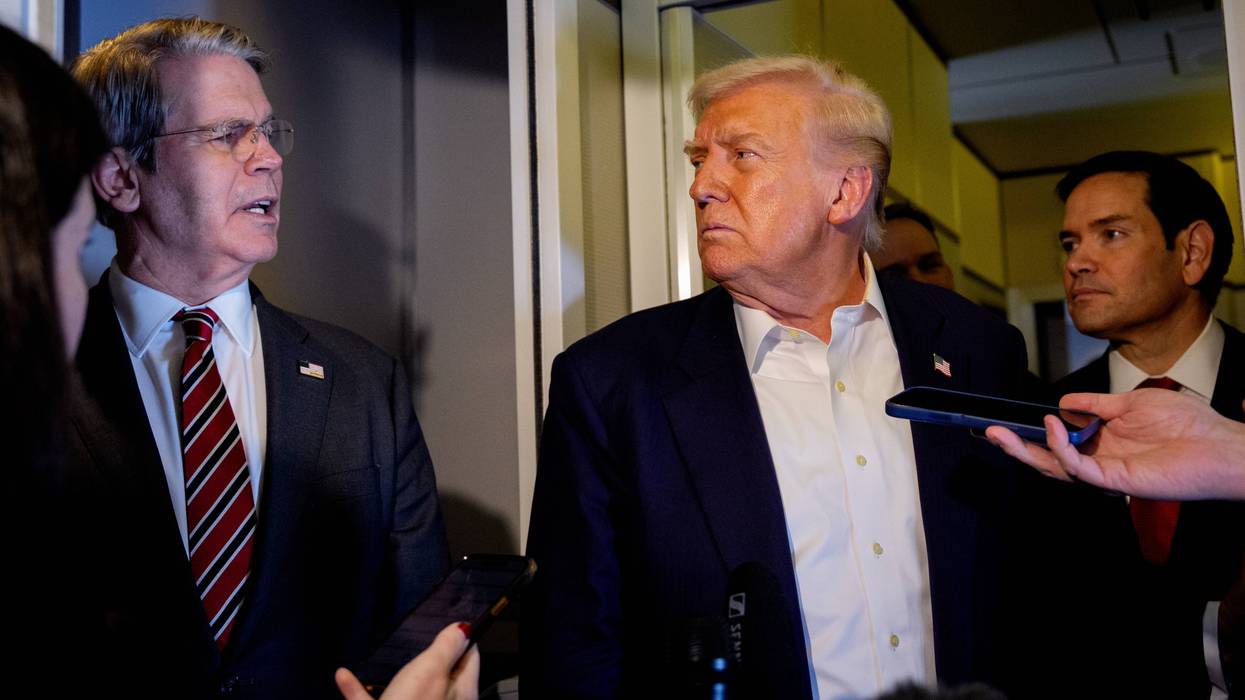
President Donald Trump has sued the US Treasury Department and Internal Revenue Service for $10 billion over the leak of his tax returns during his first term in the White House, when the president broke with decades of tradition by refusing to voluntarily divulge the records.
The lawsuit—joined by Trump's two eldest sons and his family business, the Trump Organization—was revealed Thursday in a filing with the Miami division of the US District Court for the Southern District of Florida. The suit alleges that the IRS and Treasury Department "caused Plaintiffs reputational and financial harm, public embarrassment, unfairly tarnished their business reputations, portrayed them in a false light, and negatively affected President Donald Trump and the other Plaintiffs' public standing."
Charles Littlejohn, a former IRS contractor who was employed by Booz Allen Hamilton, pleaded guilty in late 2023 to one count of unauthorized disclosure of tax return information and was later sentenced to up to five years in prison.
The US Treasury Department, led by Scott Bessent, announced earlier this week that it was canceling all of its contracts with Booz Allen Hamilton, accusing the company of failing to "implement adequate safeguards to protect sensitive data, including the confidential taxpayer information it had access to through its contracts with the Internal Revenue Service."
The leak included the tax records of Trump and other mega-rich Americans, including Amazon founder Jeff Bezos and Tesla CEO Elon Musk. The New York Times, which obtained the records along with ProPublica, reported in 2018 that the returns showed Trump engaged in "outright fraud" and other "dubious" schemes to avoid taxation.
Trump, according to the Times investigation, "paid $750 in federal income taxes in 2016, the year he was elected president, and... he had not paid any income taxes in 10 of the previous 15 years."
US Sen. Ron Wyden (D-Ore.), the top Democrat on the Senate Finance Committee, said in response to the president's lawsuit that “Donald Trump is a cheat and a grifter to his core, and for him to abuse his office in an attempt to steal $10 billion from the American taxpayer is a shameless, disgusting act of corruption."
"While Trump is weaponizing taxpayer privacy laws for his own benefit, his Treasury Department is flouting those exact same laws to send tens of thousands of individual tax records to his anti-immigrant henchmen at ICE," Wyden continued. "It is the height of hypocrisy for Trump to pretend he cares one bit about taxpayer privacy."
Journalist Tim O'Brien, who has covered Trump for decades, called the lawsuit "a flagrant and obvious conflict of interest."
"Trump oversees the IRS. He wants the IRS to pay him a big chunk of change," O'Brien wrote on social media. "He is, and always has been, in it for the money."
The lawsuit isn't the first time Trump has sought a large sum of taxpayer money from a federal agency during his second term in office. Last year, Trump demanded via an administrative claims process that the US Justice Department pay him roughly $230 million in compensation for federal investigations he has faced.
Trump launched his attempt to wring $10 billion in taxpayer money out of the Treasury Department and IRS as he and his allies worked to gut the tax agency, leaving it with inadequate staff and resources to audit wealthy individuals and large corporations. The IRS is currently headed by Frank Bisignano, who was named "chief executive officer" of the agency late last year.
In a letter to Bessent and Bisignano earlier this week, Wyden and a group of fellow Senate Democrats warned that "the administration’s plans for the IRS"—including painful budget cuts—"will shift the burden of audits more heavily onto working Americans while giving rich scofflaws and big businesses a green light to cheat on their taxes."
"The administration has failed to detail any serious plan to avoid that unfair outcome," the senators warned.
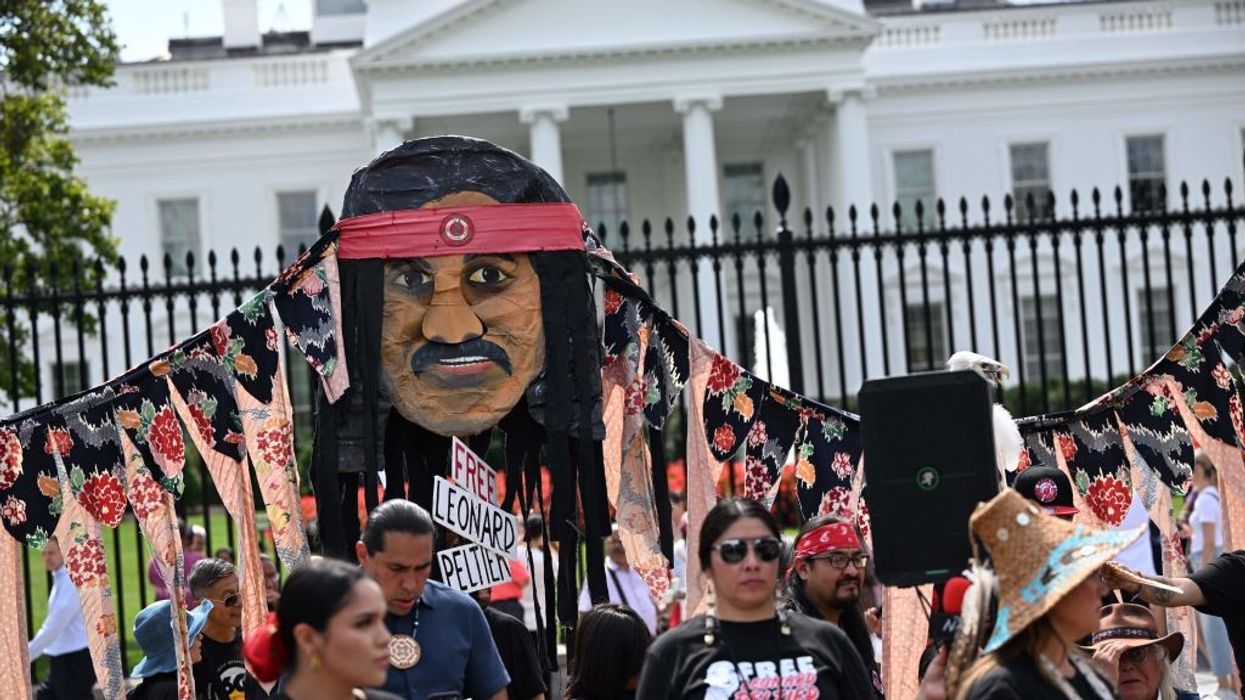
"The victory of freeing Leonard Peltier is a symbol of our collective strength—and our resistance will never stop," vowed one Indigenous organizer.
Just minutes before leaving office, Joe Biden on Monday commuted the life prison sentence of Leonard Peltier, the elderly American Indian Movement activist who supporters say was framed for the murder of two federal agents during a 1975 reservation shootout.
"It's finally over, I'm going home," Peltier, who is 80 years old, said in a statement released by the Indigenous-led activist group NDN Collective. "I want to show the world I'm a good person with a good heart. I want to help the people, just like my grandmother taught me."
While not the full pardon for which he and his defenders have long fought, the outgoing Democratic president's commutation will allow Peltier—who has been imprisoned for nearly a half-century—to "spend his remaining days in home confinement," according to Biden's statement, which was no longer posted on the White House website after Republican President Donald Trump took office Monday afternoon.
🚨BREAKING🚨 Leonard Peltier Granted Executive Clemency After 50 years of unjust incarceration and the tireless efforts of intergenerational grassroots organizing and advocacy, our elder and relative Leonard Peltier has been granted executive clemency.
[image or embed]
— NDN Collective ( @ndncollective.bsky.social) January 20, 2025 at 9:02 AM
"Tribal Nations, Nobel Peace laureates, former law enforcement officials (including the former U.S. attorney whose office oversaw Mr. Peltier's prosecution and appeal), dozens of lawmakers, and human rights organizations strongly support granting Mr. Peltier clemency, citing his advanced age, illnesses, his close ties to and leadership in the Native American community, and the substantial length of time he has already spent in prison," Biden explained.
Biden Interior Secretary Deb Haaland, the first Indigenous cabinet secretary in U.S. history, said in a statement: "I am beyond words about the commutation of Leonard Peltier. His release from prison signifies a measure of justice that has long evaded so many Native Americans for so many decades. I am grateful that Leonard can now go home to his family. I applaud President Biden for this action and understanding what this means to Indian Country."
Congressman Raúl Grijalva (D-Ariz.), who last month led 34 U.S. lawmakers in a letter urging clemency for Peltier, said in a statement that "for too long, Mr. Peltier has been denied both justice and the pursuit of a full, healthy life at the hands of the U.S. government, but today, he is finally able to go home."
"President Biden's decision is not just the right, merciful, and decent one—it is a testament to Mr. Peltier's resilience and the unwavering support of the countless global leaders, Indigenous voices, civil rights and legal experts, and so many others who have advocated so tirelessly for his release," Grijalva added. "While there is still much work to be done to fix the system that allowed this wrong and so many others against Indian Country, especially as we face the coming years, let us today celebrate Mr. Peltier's return home."
NDN Collective founder and CEO Nick Tilsen said Monday that "Leonard Peltier's freedom today is the result of 50 years of intergenerational resistance, organizing, and advocacy."
"Leonard Peltier's liberation is our liberation—we will honor him by bringing him back to his homelands to live out the rest of his days surrounded by loved ones, healing, and reconnecting with his land and culture," Tilsen continued.
"Let Leonard's freedom be a reminder that the entire so-called United States is built on the stolen lands of Indigenous people—and that Indigenous people have successfully resisted every attempt to oppress, silence, and colonize us," Tilsen added. "The victory of freeing Leonard Peltier is a symbol of our collective strength—and our resistance will never stop."
Amnesty International USA executive director Paul O'Brien said that "President Biden was right to commute the life sentence of Indigenous elder and activist Leonard Peltier given the serious human rights concerns about the fairness of his trial."
While Peltier admits to having participated in the June 26, 1975 gunfight at the Oglala Sioux Reservation at Pine Ridge, South Dakota, he denies killing Federal Bureau of Investigation agents Jack Coler and Ronald Williams.
As HuffPost senior political reporter Jennifer Bendery recapped Monday:
There was never evidence that Peltier committed a crime, and the U.S. government never did figure out who shot those agents. But federal officials needed someone to take the fall. The FBI had just lost two agents, and Peltier's co-defendants were all acquitted based on self-defense. So, Peltier became their guy.
His trial was rife with misconduct. The FBI threatened and coerced witnesses into lying. Federal prosecutors hid evidence that exonerated Peltier. A juror acknowledged on the second day of the trial that she had "prejudice against Indians," but she was kept on anyway.
The government's case fell apart after these revelations, so it simply revised its charges against Peltier to "aiding and abetting" whoever did kill the agents—based entirely on the fact that he was one of dozens of people present when the shootout took place. Peltier was convicted and sentenced to two consecutive life terms.
American Indian Movement (AIM) activist Joe Stuntz Killsright was also killed at Pine Ridge when a U.S. Bureau of Indian Affairs agent sniper shot him in the head after Coler and Williams were killed. Stuntz' death has never been investigated.
Some Indigenous activists welcomed Peltier's commutation while also remembering Annie Mae Pictou Aquash, an Mi'kmaq activist who was kidnapped and murdered at Pine Ridge in December 1975 by her fellow AIM members. Some of Aquash's defenders believe her killing to be an assassination ordered by AIM leaders who feared she was an FBI informant.
Before leaving office, Biden issued a flurry of eleventh-hour preemptive pardons meant to protect numerous relatives and government officials whom Trump and his allies have threatened with politically motivated legal action.
However, the outgoing president dashed the hopes of figures including Steven Donziger, Charles Littlejohn, and descendants of Ethel Rosenberg, who were
seeking last-minute pardons or commutations.

There are only a few days left for Biden to heed calls for clemency coming from a diverse array of rights groups.
Outgoing U.S. President Joe Biden announced commutations on Friday for approximately 2,500 people who have been convicted of non-violence drug crimes—a move that was cheered by rights groups and brings his total number of pardons and commutations to the highest of any president.
But Biden has so far stopped short of granting clemency to a number of high profile individuals whose cases—while all very different—have generated significant public interest and sympathy. They include: the former IRS contractor Charles Littlejohn, the environmental lawyer Steven Donziger, Indigenous activist Leonard Peltier, and WikiLeaks founder Julian Assange.
The cases have prompted a flurry of calls from various groups for Biden to take action on the cases before he hands over the White House to President-elect Donald Trump on January 20.
Littlejohn was sentenced in January 2024 to the five years in prison for unauthorized disclosure of tax information to the media. In 2020, The New York Times published a story based on information leaked by Littlejohn revealing that Trump paid only $750 in federal income taxes the year he won the presidency and in 2017. Later, journalists at ProPublica used documents made available by Littlejohn to report on how the wealthiest 25 individuals in America were able to get away with paying very little in income tax between 2014 and 2018.
Given the nature of his case, Kenny Stancil of the Revolving Door Project and Bob Lord of the Institute for Policy Studies, wrote in December that Littlejohn "very well could be on Trump's enemies list" and urged Biden to commute his sentence.
"The longer Littlejohn languishes in jail, the more he is at risk of retribution from Trump," wrote Stancil and Lord, who also highlight that Littlejohn was given the statutory maximum sentence for his crime.
On Thursday, millionaire Abigail Disney penned a defense of Littlejohn, writing that Biden should commute his sentence because he "did the nation a great service by spotlighting the urgent need for tax reform in a country being ripped apart by extreme and rising inequality."
Indigenous leaders and the human rights organization Amnesty International are calling for clemency for another man who is currently behind bars: the Indigenous rights activist Leonard Peltier, who was convicted in 1977 of having murdered two FBI agents and has spent the majority of his life in prison, despite concerns about the fairness of his trial and conviction.
Peltier had his request for parole and compassionate release denied last year, meaning clemency is "likely his only chance for freedom," according to Amnesty International.
"All of us see a little bit of ourselves in Leonard Peltier, and that's why we fight so hard for him," said Nick Tilsen, the founder and CEO of NDN Collective, an Indigenous rights group. "This is about paving a path forward that gives us the opportunity to have justice and begin to heal the relationship between the United States government and Indian people. And so, this decision is massive."
Meanwhile, 50 human rights and environmental groups sent a letter in early January to President Biden, urging him to pardon U.S. human rights lawyer Steven Donziger, who secured a multibillion settlement for Indigenous plaintiffs against Texaco (later acquired by Chevron) in an Ecuadoran court over the company's destructive oil pollution in the Amazon, but was later charged with criminal contempt of court in the U.S. for withholding evidence in a countersuit brought by Chevron. Donziger was disbarred in 2018, and then spent time in both prison and under house arrest.
Rep. Jim McGovern (D-Mass.), who has called for Donziger's pardon, recently told Democracy Now! that "Chevron has spent countless millions and millions of dollars going after Steven Donziger and not helping a single person in Ecuador deal with what they left behind. We have to stand up to corporate excesses in this country."
"If President Biden would pardon him, I think that would be a signal that maybe things are beginning to change," he added.
Also this week, press freedom and civil liberties organizations demanded that Biden pardon WikiLeaks founder and publisher Julian Assange, who last year—as a way to avoid extradition to the U.S. after languishing for years in a British prison—pleaded guilty to a felony charge under the U.S. Espionage Act of conspiring to obtain and disclose classified national military documents. Per the terms of the plea deal, he was allowed to return to his native Australia and is no longer incarcerated.
Freedom of the Press Foundation director of advocacy Seth Stern said in a statement Thursday that Assange's case "normalized the criminalization of work national security journalists do every day—talking to sources, obtaining documents from them, and publishing those documents."
"A pardon won't undo the harm the case has done to the free press or the chilling effect on journalists who now know their work can land them behind bars at the whim of the Department of Justice. But it will help reduce the damage," he said.
Patriotic Millionaires and Revolving Door Project are leading the push for Biden to reduce IRS whistleblower Charles Littlejohn's prison term.
Update:
Patriotic Millionaires senior vice president for tax policy Bob Lord and Revolving Door Project senior researcher Kenny Stancil on Wednesday published commentary in Rolling Stone highlighting the campaign urging Biden to commute Littlejohn's sentence. This, a day after the campaign launched a website where people can add their voices to the chorus of calls for commutation.
Earlier:
With just over a month left in U.S. President Joe Biden's term, a pair of advocacy groups this week launched a campaign urging the outgoing Democrat to commute the sentence of an Internal Revenue Service contractor serving five years in prison for exposing tax dodging by wealthy Americans including Republican President-elect Donald Trump.
The campaign, which is a collaboration between the Revolving Door Project and Patriotic Millionaires, is planning a week of action to push Biden to commute the five-year sentence of Charles Littlejohn—who was also ordered to pay a $5,000 fine after pleading guilty in October 2023 to unauthorized disclosure of tax returns and return information to media outlets—to 10 months, the maximum term of imprisonment he was supposed to receive under the federal guidelines.
On Monday, the campaign letter to Biden from four tax law professors calling on Biden reduce Littlejohn's sentence, which the experts called "particularly harsh in comparison with some recent sentences meted out to blatant tax evaders."
The letter asserts that Littlejohn—who gave The New York Times information on Trump and shared with ProPublica data on Jeff Bezos, Michael Bloomberg, Warren Buffett, Bill Gates, Rupert Murdoch, Elon Musk, Mark Zuckerberg, and others—acted "out of a sincere belief in the public's right to know."
"I've been a tax lawyer for 40 years. For the past decade, I've been pretty outspoken about the various maneuvers that the ultra-rich deploy to avoid tax," Bob Lord, the senior vice president for Tax Policy at Patriotic Millionaires, said in a statement. "But despite my best efforts, I fully recognize that no technical explanation that I could give about any of the myriad tax loopholes that the rich exploit would ever stick in the public conscience the same way that Charles Littlejohn's leaks did about billionaires like Donald Trump, Elon Musk, and Jeff Bezos paying $0 in income tax."
"Littlejohn did break the law, but at the end of the day, he actually did the country a great service by exposing the full degree to which our tax code privileges the wealthy and well-connected," Lord added. "And if lawmakers are inspired by Littlejohn's leaks to finally take meaningful steps to reform our tax system and rein in extreme wealth, he will have undoubtedly done more to save American democracy than harm it."
University of Michigan law professor Reuven Avi-Yonah, the letter's lead signer, has called Littlejohn a "public hero."
According to the professors:
There are many cases that involve massive tax evasion and do not lead to a criminal indictment. Consider for example the case of Alon Farhy, who transferred more than $2 million to a sham foreign entity, which then transferred the funds to a bank account in the name of a Belize-based corporation Mr. Farhy created solely for that purpose. Mr. Farhy's scheme violated a variety of tax-related obligations beyond his duty to correctly report and pay the income tax he owed. The [U.S. Department of Justice] entered into a nonprosecution agreement with Mr. Farhy immunizing him from criminal prosecution in exchange for paying his taxes plus interest and penalties.
"Many other cases involving tax evasion do not result in jail time," the letter notes. "For example, Raj Mukhi ran a business that manufactured and sold professional uniforms in many countries. He was indicted in 2014 for hiding the proceeds in a private bank based in Zürich. He pleaded guilty to one count of filing a false tax return and one count of failing to disclose a foreign bank account and was sentenced to three years of supervised release."
"Even if there is a prison sentence, it is usually much shorter than five years," the professors stressed. "To mention just some cases from this year, an Oklahoma man who instructed a payroll company working with his business to falsely characterize over $2.6 million as reimbursements rather than income was sentenced to 30 months."
"An Indiana woman who electronically filed false income tax returns for clients that reported fictitious businesses and also filed a false tax return for herself that underreported gross receipts from her business was sentenced to 21 months," the letter adds. "A New Jersey man was sentenced to 29 months for evading taxes and not filing income tax returns while earning over $2.5 million in wages. All of these cases involve conduct that is much more culpable and less public-spirited than Mr. Littlejohn's."
"There is a big difference between leaking tax information and tax evasion in the size of the universe of potential violations and the number of violators escaping punishment," the professors said. "The universe of potential violators leaking tax information is infinitesimal compared to the universe of potential tax evaders. And the number of potential violators escaping punishment for leaking tax information is close to zero, whereas the number of evaders escaping punishment is huge."
As his term winds down, Biden has issued approximately 1,500 commutations and 39 pardons, including controversial clemency for his son Hunter Biden and Michael Conahan, a former Pennsylvania judge convicted in a "kids-for-cash" scheme in which he and a colleague funneled thousands of juveniles into private detention centers in exchange for millions of dollars in kickbacks.
With the looming return of Trump—who presided over more federal executions during his first term than numerous presidents did over several preceding decades—advocates are pushing Biden to commute the sentences of 40 federal death row inmates. Advocates are also calling on Biden to pardon figures including Indigenous activist Leonard Peltier and environmental attorney Steven Donziger.
Earlier this month,
Politico Magazine reported that Biden is weighing preemptive pardons for numerous public officials who could be targeted by Trump—who has vowed to exact revenge on his political enemies—during his second term. Kash Patel, Trump's pick to head the Federal Bureau of Investigation, has threatened to prosecute the president-elect's political opponents and journalists.
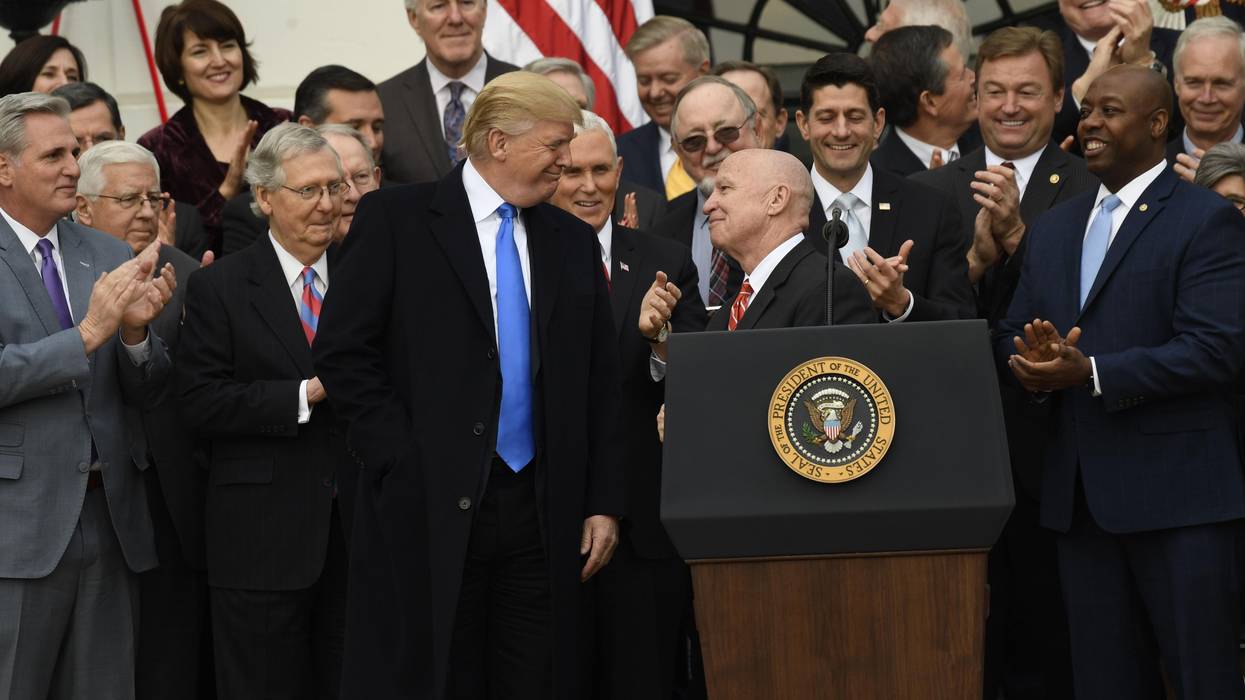
In legislatures, the courts, and our executive offices, we have a system rigged in favor of the ultra-rich, rigged by everything from acts of Congress and judicial rulings to IRS budgets and audit policies.
By all appearances, former U.S. President Donald Trump has cut a sweet deal with a dozen or two of America’s richest billionaires: Finance his campaign and he’ll keep their federal taxes super low—or even lower them—once he’s sitting back in the White House.
How much do billionaires like this deal? This much: In April, hedge fund billionaire John Paulsen held a Palm Beach fundraiser for Trump that brought in $50.5 million. Immediately after Trump’s late May conviction on 34 felony counts in Manhattan, Timothy Mellon, the grandson of the classic plutocrat Andrew Mellon, ponied up $50 million. Miriam Adelson, the billionaire widow of Las Vegas kingpin Sheldon Adelson, appears eager to kick in as much as $100 million.
This past spring, meanwhile, billionaires Elon Musk and David Sacks reportedly held a secret dinner party for Trump, with attendees including the illustrious deep pockets Peter Thiel, Rupert Murdoch, and Michael Milken.
The rich themselves have actually become more brazen about avoiding taxes. Just try to stop us, they seem to be saying.
America’s billionaires clearly see politics as one route to ensuring they pay as little as possible at tax time. But they don’t just make their presence felt at election time. America’s rich have their thumbs firmly on the scale of all three branches of government. In legislatures, the courts, and our executive offices, we have a system rigged in favor of the ultra-rich, rigged by everything from acts of Congress and judicial rulings to IRS budgets and audit policies.
Some of this rigging we can all easily see. The dividends and long-term capital gains of the ultra-rich have for decades faced a maximum tax rate barely half the maximum rate applicable to other forms of income. And the investment income of the rich, unlike the paychecks of working people, faces no Social Security tax.
In 2017, the first year of the Trump presidency, intense lobbying efforts helped rich business owners to a special tax rate for their business income. In 2018 alone, according to ProPublica, that special rate translated into a $67 million gift to Mike Bloomberg, whose personal wealth now reportedly exceeds $100 billion.
But these glaring privileges the rich enjoy at tax time only tell part of the billionaire tax story. Other parts get precious little attention. In 2004, for instance, lawmakers in Congress enacted a penalty for the failure to disclose potentially abusive tax avoidance transactions on tax returns. The penalty on the surface looked substantial: 75% of the tax sought to be avoided. But Congress capped the penalty at $100,000, a move that turned the penalty into a minor nuisance for billionaires seeking to avoid millions of dollars in taxes.
In our current rich people-friendly tax climate, IRS staff who want to do the right thing face tough going. Recently, for example, one former IRS staffer, Michael Welu, went public with his concerns that the IRS itself has both official and unofficial policies that end up treating audited rich taxpayers much more gently than small business owners.
“I was putting butchers, bakers, and candlestick makers in jail,” Welu told the International Consortium of Investigative Journalists, “but the big stuff we really wanted to go after was being ignored.”
Welu found the upper management of the IRS division tasked with auditing the super rich—and the corporations they run—distinctly uninterested in investigating America’s richest and their “most egregious, ridiculous schemes” for avoiding taxes.
IRS officials like Michael Welu do occasionally speak out. But only tax wonks truly have any real sense of how much obscure tax code penalties and IRS audit policies favor the rich. And most of those tax wonks work for the rich.
The rich themselves have actually become more brazen about avoiding taxes. Just try to stop us, they seem to be saying.
Take the recently decided Supreme Court case, Moore v. United States. Working through an array of right-wing organizations, the conservative mover-and-shaker Leonard Leo attempted to use a challenge to an obscure one-time tax as a vehicle to preempt Congress from ever taxing the wealth or unrealized gains of the ultra-rich. Ultimately, the court decided the case without ruling on whether the rich can be taxed on their wealth or unrealized gains. But the opinions that four of the nine justices handed down made it clear that they stand prepared to do the billionaire bidding should a direct challenge to a tax on the wealth or unrealized gains of billionaires come before them.
Billionaires now have at least three Supreme Court justices firmly in their pockets. Reporting by ProPublica has revealed the massive gifts that have been flowing from Harlan Crow and other billionaires to Justice Clarence Thomas as well as the generous gifts that billionaire Paul Singer has been sending Justice Samuel Alito’s way. Justice Neil Gorsuch has had his entire career, including his appointment to the court, funded by the billionaire Philip Anschutz.
Those three justices, along with Justice Amy Coney-Barret, have now made it patently obvious they will not allow billionaires to be taxed on their unrealized gains or their wealth. Does anyone really think the billionaires won’t have the crucial, majority-making fifth vote from Justice Brett Kavanaugh when they need it?
Republican members of Congress are showing even less shame than our Supreme Court justices. Last year, these GOP lawmakers held the country hostage in negotiations to increase the country’s debt limit. Their price for agreeing to raise the debt limit, thereby avoiding a default on the country’s debt? They demanded—and won—a reduction in a scheduled IRS budget increase that would been used to increase enforcement moves against rich taxpayers.
The purported motive for this legislative hostage taking—“concern” over the federal deficit—made for an absurd justification. The proposed increase in the IRS budget would have been recovered, several times over, through increased tax collections. The IRS budget reductions the Republican lawmakers extracted will, in fact, only increase the federal deficit. But those reductions will serve a political purpose. They’ll protect the GOP’s richest patrons from tax enforcement.
The mainstream media, to no one’s surprise, did a miserable job of exposing this Republican dishonesty in the debt limit negotiations. But at one point in our recent past a courageous soul did emerge to expose the rot in our tax system. What happened? The ultra-rich and their henchmen in Congress make sure that this soul faced a punishment far more severe than any punishment ever meted out to those few rich Americans who actually get caught evading their taxes due.
That courageous soul, Charles Littlejohn, worked as an IRS contractor. He leaked tax return information related to Trump and America’s billionaires to The New York Times and ProPublica. ProPublica used that leaked information to write over 50 stories about billionaire tax avoidance, embarrassing and angering many of our richest in the process. Two of them even brought lawsuits, one against the IRS and the other against Littlejohn’s employer.
Ultimately, Littlejohn pled guilty to one count of unauthorized tax return information disclosure, a crime that carries a recommended sentence of four to 10 months. But 25 Republican members of Congress, undoubtedly at the behest of their billionaire patrons, wrote the judge in the case and urged the harshest possible sentence of five years. The judge obliged, stating in her sentencing remarks that Littlejohn posed a graver threat to democracy than the January 6 rioters. As tax law professor Reuven Avi-Yonah has noted, Littlejohn is now serving a sentence far harsher than any imposed on rich Americans convicted of tax evasion.
Littlejohn’s extreme sentence did not reflect the one single count of unauthorized tax return information disclosure he pled guilty to. That sentence reflects his “crime” of exposing the tax avoidance of the billionaire class.
Try this thought experiment: Imagine if Littlejohn had released the return information of 1,000 or so taxpayers with modest incomes to ProPublica. Imagine that ProPublica had then publicly detailed all the tip income that servers and bartenders among these taxpayers had failed to report and all the social meals that small business owners in the sample had claimed as business expenses. If Littlejohn had then pled to one count of unauthorized disclosure, would 25 members of Congress have intervened? Would the judge have imposed a sentence over six times the maximum recommended in federal sentencing guidelines?
Doesn’t it become dangerous to society when the punishment for a crime depends on who the victim happens to be?
We are now living that danger. Our billionaires sit firmly in control. And they will do whatever it takes to make sure they never pay tax at an appropriate level—even if that means locking a human being up for a preposterously long time just to send a message.

"Billionaires control our lives and our government and pay... lower tax rates than the rest of us, but this is the bad guy who should be punished with a five-year prison sentence?"
As the U.S. tax season began Monday, a former Internal Revenue Service contractor who leaked to the media the tax records of wealthy Americans including ex-President Donald Trump was sentenced to five years in prison and ordered to pay a $5,000 fine.
U.S. District Judge Ana C. Reyes, an appointee of President Joe Biden, handed down the maximum sentence to Charles Littlejohn, who pleaded guilty to unauthorized disclosure of tax returns and return information in October. Littlejohn gave The New York Times information on Trump—who is expected to face Biden in the November election—and shared with ProPublica data on Jeff Bezos, Michael Bloomberg, Warren Buffett, Bill Gates, Rupert Murdoch, Elon Musk, Mark Zuckerberg, and more.
While Reyes called the decision to release Trump's filings "an attack on our constitutional democracy" and Littlejohn told the court that he "acted out of a sincere but misguided belief that I was serving the public," others framed the 38-year-old's move as heroic.
"This guy is a hero who showed us how the superrich steal from the American public,"
Slate politics writer Alexander Sammon said Monday. "Naturally, the judge gave him a max sentence, claiming it was 'a moral imperative' to punish him as harshly as possible."
Jeff Hauser of the Revolving Door Project noted that "this whistleblower's cause has been ignored by a LOT of people who have defended much more intrusive leaking. (Tax returns were public in the past, are in some countries now, and should be fully transparent—they're inherently public information, unlike, e.g., John Podesta's emails)."
People's Policy Project founder Matt Bruenig similarly pointed out that "in Finland, these returns are public record available to anyone who wants to see them."
After decades of presidential candidates voluntarily releasing income tax returns, Trump declined to do so—breaking his promise to make them public. The Republican also unsuccessfully fought to block Congress from receiving some of his tax records.
After the sentencing on Monday, Littlejohn's attorney told reporters that his only statement was to thank the court for consideration of the case. Meanwhile, Acting Assistant Attorney General Nicole M. Argentieri of the U.S. Department of Justice's (DOJ) Criminal Division said that his "sentence sends a strong message that those who violate laws intended to protect sensitive tax information will face significant punishment."
When Littlejohn pleaded guilty last year, ProPublica declined to comment other than reiterating that the news outlet "doesn't know the identity of the source who provided this trove of information on the taxes paid by the wealthiest Americans."
Charlie Stadtlander, a spokesperson for the Times, said last year that "we remain concerned when whistleblowers who provide information in the public interest are prosecuted. The Times' reporting on this topic played an important role in helping the public understand the financial ties and tax strategies of a sitting president—information that has long been seen as central to the knowledge that voters should have about the leader of our government and the candidates for that high office."