SUBSCRIBE TO OUR FREE NEWSLETTER
Daily news & progressive opinion—funded by the people, not the corporations—delivered straight to your inbox.
5
#000000
#FFFFFF
To donate by check, phone, or other method, see our More Ways to Give page.
Daily news & progressive opinion—funded by the people, not the corporations—delivered straight to your inbox.
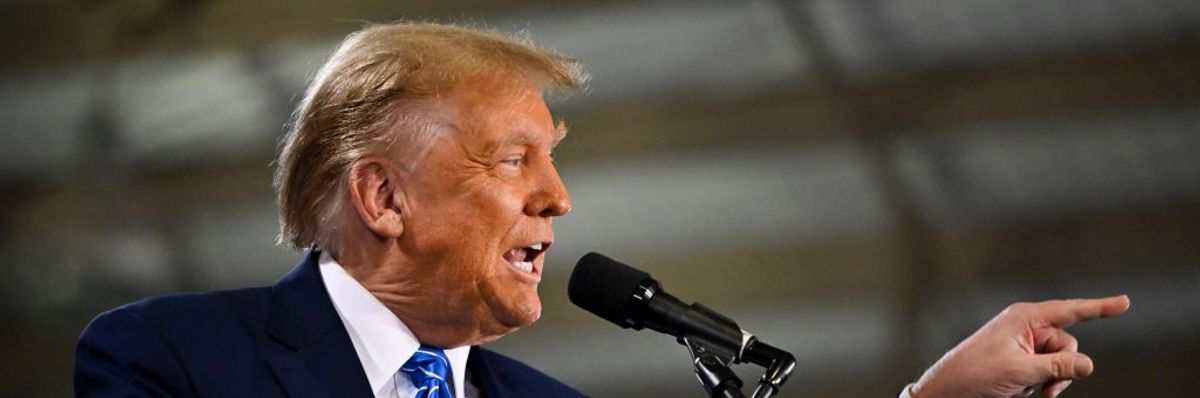
Former U.S. President Donald Trump, the top Republican presidential candidate, speaks during a campaign event on January 27, 2024 in Las Vegas, Nevada.
"Billionaires control our lives and our government and pay... lower tax rates than the rest of us, but this is the bad guy who should be punished with a five-year prison sentence?"
As the U.S. tax season began Monday, a former Internal Revenue Service contractor who leaked to the media the tax records of wealthy Americans including ex-President Donald Trump was sentenced to five years in prison and ordered to pay a $5,000 fine.
U.S. District Judge Ana C. Reyes, an appointee of President Joe Biden, handed down the maximum sentence to Charles Littlejohn, who pleaded guilty to unauthorized disclosure of tax returns and return information in October. Littlejohn gave The New York Times information on Trump—who is expected to face Biden in the November election—and shared with ProPublica data on Jeff Bezos, Michael Bloomberg, Warren Buffett, Bill Gates, Rupert Murdoch, Elon Musk, Mark Zuckerberg, and more.
While Reyes called the decision to release Trump's filings "an attack on our constitutional democracy" and Littlejohn told the court that he "acted out of a sincere but misguided belief that I was serving the public," others framed the 38-year-old's move as heroic.
"This guy is a hero who showed us how the superrich steal from the American public,"
Slate politics writer Alexander Sammon said Monday. "Naturally, the judge gave him a max sentence, claiming it was 'a moral imperative' to punish him as harshly as possible."
Jeff Hauser of the Revolving Door Project noted that "this whistleblower's cause has been ignored by a LOT of people who have defended much more intrusive leaking. (Tax returns were public in the past, are in some countries now, and should be fully transparent—they're inherently public information, unlike, e.g., John Podesta's emails)."
People's Policy Project founder Matt Bruenig similarly pointed out that "in Finland, these returns are public record available to anyone who wants to see them."
After decades of presidential candidates voluntarily releasing income tax returns, Trump declined to do so—breaking his promise to make them public. The Republican also unsuccessfully fought to block Congress from receiving some of his tax records.
After the sentencing on Monday, Littlejohn's attorney told reporters that his only statement was to thank the court for consideration of the case. Meanwhile, Acting Assistant Attorney General Nicole M. Argentieri of the U.S. Department of Justice's (DOJ) Criminal Division said that his "sentence sends a strong message that those who violate laws intended to protect sensitive tax information will face significant punishment."
When Littlejohn pleaded guilty last year, ProPublica declined to comment other than reiterating that the news outlet "doesn't know the identity of the source who provided this trove of information on the taxes paid by the wealthiest Americans."
Charlie Stadtlander, a spokesperson for the Times, said last year that "we remain concerned when whistleblowers who provide information in the public interest are prosecuted. The Times' reporting on this topic played an important role in helping the public understand the financial ties and tax strategies of a sitting president—information that has long been seen as central to the knowledge that voters should have about the leader of our government and the candidates for that high office."
Dear Common Dreams reader, It’s been nearly 30 years since I co-founded Common Dreams with my late wife, Lina Newhouser. We had the radical notion that journalism should serve the public good, not corporate profits. It was clear to us from the outset what it would take to build such a project. No paid advertisements. No corporate sponsors. No millionaire publisher telling us what to think or do. Many people said we wouldn't last a year, but we proved those doubters wrong. Together with a tremendous team of journalists and dedicated staff, we built an independent media outlet free from the constraints of profits and corporate control. Our mission has always been simple: To inform. To inspire. To ignite change for the common good. Building Common Dreams was not easy. Our survival was never guaranteed. When you take on the most powerful forces—Wall Street greed, fossil fuel industry destruction, Big Tech lobbyists, and uber-rich oligarchs who have spent billions upon billions rigging the economy and democracy in their favor—the only bulwark you have is supporters who believe in your work. But here’s the urgent message from me today. It's never been this bad out there. And it's never been this hard to keep us going. At the very moment Common Dreams is most needed, the threats we face are intensifying. We need your support now more than ever. We don't accept corporate advertising and never will. We don't have a paywall because we don't think people should be blocked from critical news based on their ability to pay. Everything we do is funded by the donations of readers like you. When everyone does the little they can afford, we are strong. But if that support retreats or dries up, so do we. Will you donate now to make sure Common Dreams not only survives but thrives? —Craig Brown, Co-founder |
As the U.S. tax season began Monday, a former Internal Revenue Service contractor who leaked to the media the tax records of wealthy Americans including ex-President Donald Trump was sentenced to five years in prison and ordered to pay a $5,000 fine.
U.S. District Judge Ana C. Reyes, an appointee of President Joe Biden, handed down the maximum sentence to Charles Littlejohn, who pleaded guilty to unauthorized disclosure of tax returns and return information in October. Littlejohn gave The New York Times information on Trump—who is expected to face Biden in the November election—and shared with ProPublica data on Jeff Bezos, Michael Bloomberg, Warren Buffett, Bill Gates, Rupert Murdoch, Elon Musk, Mark Zuckerberg, and more.
While Reyes called the decision to release Trump's filings "an attack on our constitutional democracy" and Littlejohn told the court that he "acted out of a sincere but misguided belief that I was serving the public," others framed the 38-year-old's move as heroic.
"This guy is a hero who showed us how the superrich steal from the American public,"
Slate politics writer Alexander Sammon said Monday. "Naturally, the judge gave him a max sentence, claiming it was 'a moral imperative' to punish him as harshly as possible."
Jeff Hauser of the Revolving Door Project noted that "this whistleblower's cause has been ignored by a LOT of people who have defended much more intrusive leaking. (Tax returns were public in the past, are in some countries now, and should be fully transparent—they're inherently public information, unlike, e.g., John Podesta's emails)."
People's Policy Project founder Matt Bruenig similarly pointed out that "in Finland, these returns are public record available to anyone who wants to see them."
After decades of presidential candidates voluntarily releasing income tax returns, Trump declined to do so—breaking his promise to make them public. The Republican also unsuccessfully fought to block Congress from receiving some of his tax records.
After the sentencing on Monday, Littlejohn's attorney told reporters that his only statement was to thank the court for consideration of the case. Meanwhile, Acting Assistant Attorney General Nicole M. Argentieri of the U.S. Department of Justice's (DOJ) Criminal Division said that his "sentence sends a strong message that those who violate laws intended to protect sensitive tax information will face significant punishment."
When Littlejohn pleaded guilty last year, ProPublica declined to comment other than reiterating that the news outlet "doesn't know the identity of the source who provided this trove of information on the taxes paid by the wealthiest Americans."
Charlie Stadtlander, a spokesperson for the Times, said last year that "we remain concerned when whistleblowers who provide information in the public interest are prosecuted. The Times' reporting on this topic played an important role in helping the public understand the financial ties and tax strategies of a sitting president—information that has long been seen as central to the knowledge that voters should have about the leader of our government and the candidates for that high office."
As the U.S. tax season began Monday, a former Internal Revenue Service contractor who leaked to the media the tax records of wealthy Americans including ex-President Donald Trump was sentenced to five years in prison and ordered to pay a $5,000 fine.
U.S. District Judge Ana C. Reyes, an appointee of President Joe Biden, handed down the maximum sentence to Charles Littlejohn, who pleaded guilty to unauthorized disclosure of tax returns and return information in October. Littlejohn gave The New York Times information on Trump—who is expected to face Biden in the November election—and shared with ProPublica data on Jeff Bezos, Michael Bloomberg, Warren Buffett, Bill Gates, Rupert Murdoch, Elon Musk, Mark Zuckerberg, and more.
While Reyes called the decision to release Trump's filings "an attack on our constitutional democracy" and Littlejohn told the court that he "acted out of a sincere but misguided belief that I was serving the public," others framed the 38-year-old's move as heroic.
"This guy is a hero who showed us how the superrich steal from the American public,"
Slate politics writer Alexander Sammon said Monday. "Naturally, the judge gave him a max sentence, claiming it was 'a moral imperative' to punish him as harshly as possible."
Jeff Hauser of the Revolving Door Project noted that "this whistleblower's cause has been ignored by a LOT of people who have defended much more intrusive leaking. (Tax returns were public in the past, are in some countries now, and should be fully transparent—they're inherently public information, unlike, e.g., John Podesta's emails)."
People's Policy Project founder Matt Bruenig similarly pointed out that "in Finland, these returns are public record available to anyone who wants to see them."
After decades of presidential candidates voluntarily releasing income tax returns, Trump declined to do so—breaking his promise to make them public. The Republican also unsuccessfully fought to block Congress from receiving some of his tax records.
After the sentencing on Monday, Littlejohn's attorney told reporters that his only statement was to thank the court for consideration of the case. Meanwhile, Acting Assistant Attorney General Nicole M. Argentieri of the U.S. Department of Justice's (DOJ) Criminal Division said that his "sentence sends a strong message that those who violate laws intended to protect sensitive tax information will face significant punishment."
When Littlejohn pleaded guilty last year, ProPublica declined to comment other than reiterating that the news outlet "doesn't know the identity of the source who provided this trove of information on the taxes paid by the wealthiest Americans."
Charlie Stadtlander, a spokesperson for the Times, said last year that "we remain concerned when whistleblowers who provide information in the public interest are prosecuted. The Times' reporting on this topic played an important role in helping the public understand the financial ties and tax strategies of a sitting president—information that has long been seen as central to the knowledge that voters should have about the leader of our government and the candidates for that high office."