

SUBSCRIBE TO OUR FREE NEWSLETTER
Daily news & progressive opinion—funded by the people, not the corporations—delivered straight to your inbox.
5
#000000
#FFFFFF
To donate by check, phone, or other method, see our More Ways to Give page.
Daily news & progressive opinion—funded by the people, not the corporations—delivered straight to your inbox.
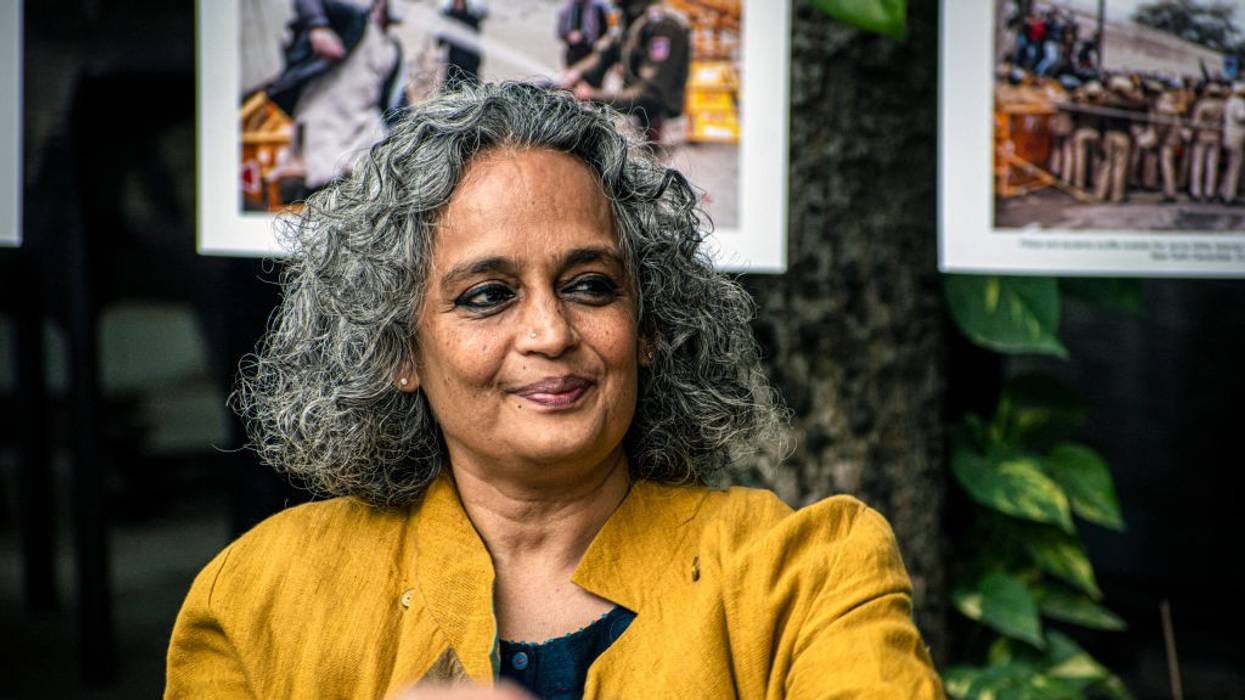
"It is our responsibility to show that as people of India, we refuse to be complicit in that, even if our government wishes to continue with what it does."
Acclaimed Indian author and activist Arundhati Roy this week joined prominent jurists, diplomats, artists, and others in urging their government to stop selling weapons to Israel, which they called "abominable" and "a serious violation of India's obligations under international law and our Constitution."
Speaking Thursday at an event organized by the Press Club of India, Roy—winner of the 1997 Booker Prize for her debut novel The God of Small Things—said that Indians must "at least show that we do not support that murder in Gaza, we do not support our government's support of that."
"What is happening in Gaza, it is not just the murder… of tens of thousands of women and children," she continued. "It is the bombing of hospitals, the destruction of universities… the attempt to erase the very memory people have of that place. It is a genocide like no other because it's taking place on live TV."
"The Indian government is complicit in the genocide that Israel is conducting in Gaza."
"India used to be a country that supported the people of Palestine in their struggle for freedom," Roy noted. "Everywhere, even in the United States… people are standing up against their government's support for [Israel]. But we are not standing up… and that is such a shame."
"We must stand up. We must refuse," she asserted. "We will not support the export of weapons of any kind."
"The Indian government is complicit in the genocide that Israel is conducting in Gaza," Roy added. "It is our responsibility to show that as people of India, we refuse to be complicit in that, even if our government wishes to continue with what it does. We want these weapons exports to stop immediately."
Roy is one of more than two dozen former Indian Supreme Court justices and other judges, foreign service officers, academics, artists, activists, and others who on Wednesday sent a letter to Indian Defense Minister Rajnath Singh urging him to halt the licensing of arms sales to Israel, whose military forces have killed or wounded more than 140,000 Palestinians while obliterating and starving Gaza.
"The International Court of Justice (ICJ) has clearly ruled that Israel is in violation of obligations under the Genocide Convention and further that Israel is in illegal occupation of the occupied Palestinian territory," the letter states. "In light of these rulings, any supply of military material to Israel would amount to a violation of India's obligations under international humanitarian law and the mandate of Article 21 read with Article 51(c) of the Constitution of India."
Among the weapons India has sent to Israel are Hermes 900 unmanned aerial drones, which are co-manufactured with Israeli arms company Elbit Systems. The letter notes that the drones "have been extensively used in the Israeli Defense Forces' military campaign in Gaza."
"Several [United Nations] experts have warned that the transfer of weapons and ammunition to Israel may constitute serious violations of human rights and international humanitarian laws, and risk state complicity in international crimes, possibly including genocide, reiterating their demand to stop transfers immediately," the letter's signer wrote.
"In short, the grant of licenses and approvals for export of military material to Israel, coupled with reports of such exports by Indian companies, constitutes a serious violation of India's obligations under international law and our own Constitution," the letter stresses.
"International law aside, we consider such exports to be morally objectionable, indeed abominable," the signatories added. "We demand, therefore, that India should immediately suspend its collaboration in the delivery of military material to Israel. Further, India must immediately make every effort to ensure that weapons already delivered to Israel are not used to contribute to acts of genocide or violations of international humanitarian law."
The letter came ahead of planned nationwide protests by Indian leftists on Saturday calling for an end to arms sales and "all forms of complicity with Israel's illegal occupation and genocide."
India—which in 1971 invaded Bangladesh (then East Pakistan) in large part to end a U.S.-backed Pakistani genocide mostly targeting Bengalis—voted in favor of the December U.N. Security Council resolution calling for an immediate Gaza cease-fire.
However, the administration of Indian Prime Minister Narendra Modi and many lawmakers from his right-wing Bharatiya Janata Party have expressed steadfast support for Israel and its Gaza onslaught. Critics have noted that both Israel and India are occupying Muslims, the former in Palestine and the latter in Jammu and Kashmir.
In an interview with Middle East Eye published Friday, Roy—who faces prosecution in India over comments she allegedly made nearly 15 years ago regarding Kashmir—said that India could "forever be linked to genocide" if it does not change course.
"India needs to stop the export of weapons to Israel and ensure the return of Indian workers who have been sent to Israel to replace Palestinian workers," she said.
"If it does not do so at once, it is in violation of the orders of the ICJ," she added. "It will forever be complicit in aiding and abetting a genocide that is being telecast live for the world to watch."
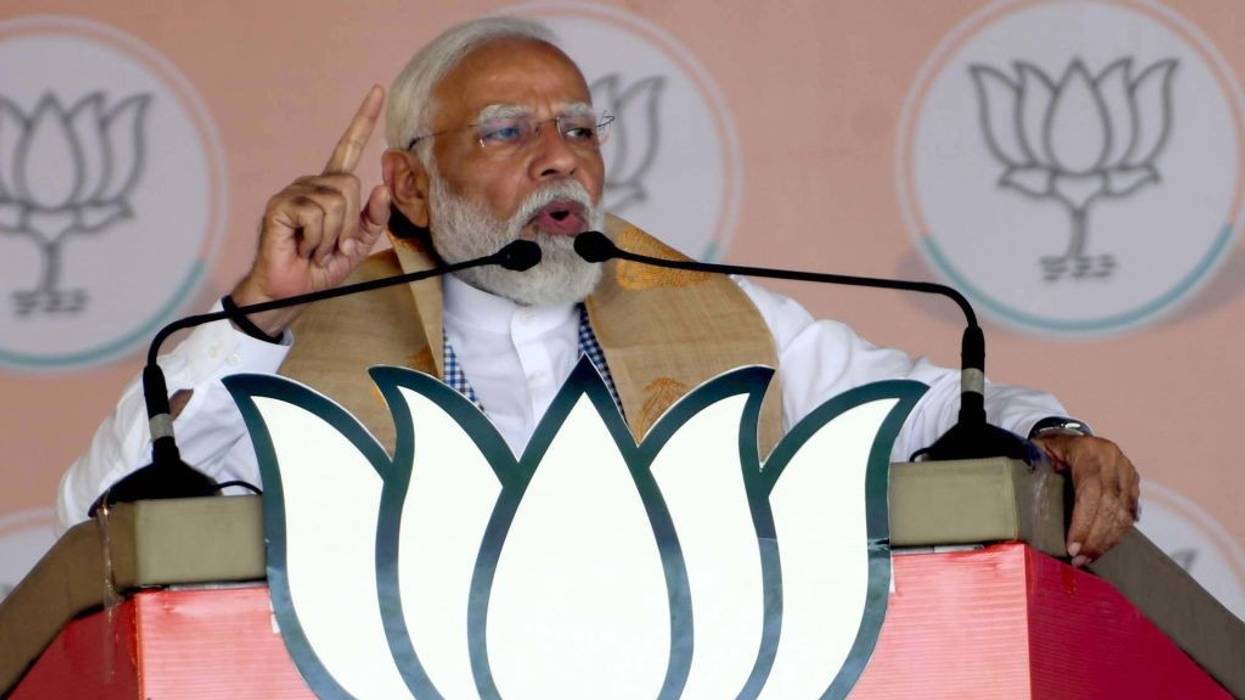
"Modi's rhetoric against Muslims is extremely divisive and dangerous," warned one critic. "It would only fuel more hate and violence against the already battered community."
Critics on Monday condemned far-right Indian Prime Minister Narendra Modi for what one group called a "hateful and dangerous" campaign speech in which he claimed that Muslim "infiltrators" would steal Indians' wealth if the opposition wins parliamentary elections that began last week.
Speaking to supporters at a rally in the western state of Rajasthan on Sunday, Modi said that the manifesto of the opposition Indian National Congress (INC) party details how to calculate "the amount of gold that mothers and sisters have" so that it can be redistributed to Muslims.
"When they were in power, they said Muslims have first right over resources," the prime minister claimed out of context. "They will gather all your wealth and redistribute among those who have more children. They will distribute it among infiltrators. Do you think your hard-earned money should be given to infiltrators? Would you accept this?"
Prime Minister Narendra Modi's rhetoric against Muslims is extremely divisive and dangerous. It would only fuel more hate and violence against the already battered community. pic.twitter.com/KT36FVpS6u
— Raqib Hameed Naik (@raqib_naik) April 21, 2024
Members of Modi's ruling Bharatiya Janata Party (BJP)—which does enjoy the support of a significant number of Indian Muslims—have often portrayed Muslims as outsiders. BJP officials have also pushed a baseless conspiracy narrative roughly analogous to U.S. white supremacists' "great replacement" theory, in this case positing that Muslim migrants and rapidly reproducing Indian Muslims will eventually outnumber Hindus—who make up around 80% of the country's 1.4 billion people.
Modi's remarks came a day after India's seven-step election of 543 members of the Lok Sabha, or lower legislative house, began. Modi is running for a third consecutive term. He's being challenged by INC President Mallikarjun Kharge, leader of the opposition in the Rajya Sabha, the upper legislative house. Results will be announced on June 4.
Kharge responded to Modi's remarks by blasting the "panic-filled" address as "not only a hate speech but also a well-thought-out ploy to divert attention" by the prime minister, the BJP, and Rashtriya Swayamsevak Sangh (RSS)—a fascist-inspired political and paramilitary movement whose brand of Hindu supremacy heavily influenced the rise of the BJP.
"Lying for power, making baseless references to things, and making false accusations on opponents is the specialty of the training of RSS and BJP," Kharge said, adding that Indians "are no longer going to fall prey to this lie."
Indian journalist and
Washington Post opinion columnist Rana Ayyub said on social media that "this is not a dogwhistle, this is a targeted, direct, brazen hate speech against a community."
Thousands of Indians petitioned the country's Election Commission seeking punitive action against Modi.
"The prime minister, while campaigning... made a speech on April 21 in Rajasthan that has disturbed the sentiments of millions of Constitution-respecting citizens of India," one petition states. "The speech is dangerous and a direct attack on the Muslims of India."
Muslim groups around the world also slammed Modi's speech, which the U.S.-based Council on American Islamic Relations (CAIR) called "hateful and dangerous."
"It is unconscionable, but not surprising, that far-right Hindutva leader Narendra Modi would target Indian Muslims with a hateful and dangerous diatribe despite his role as the leader of a nation with such a diverse religious heritage," said CAIR national executive director Nihad Awad.
"We again call on the Biden administration to declare India a 'country of particular croncern' over its discriminatory and violent policies targeting Muslims and other religious minorities," Awad added. "Global Islamophobia is alive and well in India and must be confronted before it escalates to something even worse."
South Asia historian Audrey Truschke, a professor at Rutgers University in New Jersey, accused Modi of "straight-up fascism."
"Modi had a history of encouraging mass violence against Muslims," Truschke added. "So we should all take his words seriously."
Modi was chief minister of the western state of Gujarat in February 2002 when a train full of Hindu pilgrims was set ablaze, killing 58 people. The cause of the disaster remains disputed, but Modi was quick to blame Muslims for the fire. In a three-day paroxysm of intercommunal bloodletting, Hindu mobs murdered at least hundreds—and perhaps thousands—of Muslim men, women, and children. Many women and girls were raped. More than 250 Hindus were also killed during what came to be called the Gujarat riots, during which an estimated 150,000 people were also forcibly displaced.
A team sent by the British government concluded that Modi was "directly responsible for a climate of impunity" that enabled the pogrom. However, a special investigation commissioned by the Indian Supreme Court cleared him of complicity in 2012. Modi's alleged role in the massacre led to a U.S. visa ban during the George W. Bush administration that was lifted during the tenure of former President Barack Obama after Modi became prime minister.
Deadly violence against religious minorities and others has increased during BJP rule. And while the U.S. State Department has perennially criticized the Indian government's human rights record, Modi was courted by both the Trump and Biden administrations. Last year, the White House literally rolled out the red carpet for Modi, who was lavishly feted by President Joe Biden and invited to speak before a rare joint session of Congress. Several progressive lawmakers boycotted the address.
Earlier this year, Progressive International's (PI) executive body used Modi's consecration of a highly controversial Hindu temple on the former site of a 16th-century Muslim mosque destroyed by a Hindu nationalist mob as an opportunity to issue a warning about the accelerating erosion of democracy in India.
"The Modi government has made a decisive move to overthrow India's secular constitution in the name of a new Hindu supremacist nation," PI's statement asserted. "As prime minister, Modi has pushed this Hindu nationalism as India's dominant political force: banning the hijab in schools, introducing 'anti-conversion' laws, abusing municipal forces to demolish Muslim households and shops in cities, and pushing for a 'uniform civil code' in law."
Anti-Muslim speech has also increased dramatically in India, according to a report published earlier this year by the U.S.-based India Hate Lab. The publication detailed 668 incidents in 2023—75% of which occurred in BJP-ruled states.
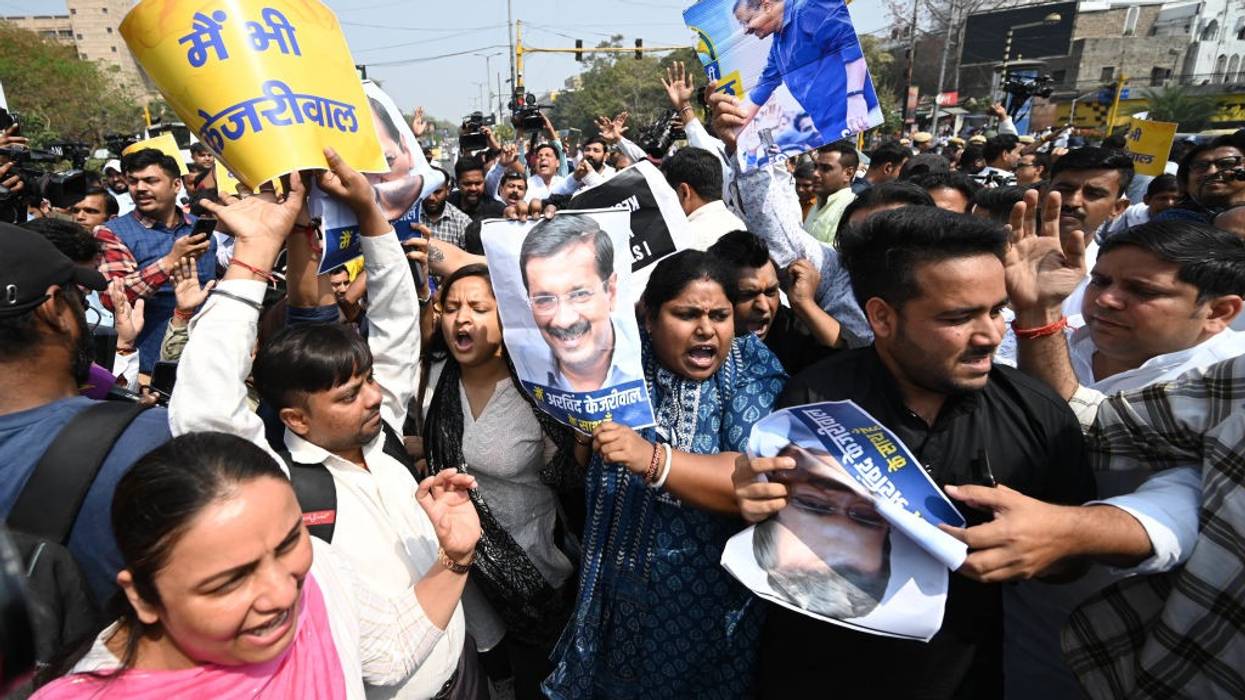
"The growing crackdown clearly shows the authorities' blatant disregard for human rights and rule of law," said one Amnesty International campaigner.
As India's right-wing government cracks down on opposition ahead of next month's general elections, Amnesty International on Friday urged authorities to "stop weaponizing the criminal justice system to intimidate and harass" political candidates, activists, and others.
Protests broke out in the capital New Delhi and other Indian cities after police on Thursday arrested Delhi Chief Minister Arvind Kejriwal, an opposition leader from the Aam Aadmi Party, over corruption allegations AAP members say are politically motivated. Two other AAP leaders were previously arrested in connection with the same case, which involves the alleged favoring of certain alcohol vendors and illegal campaign financing.
Authorities also froze the bank accounts of another leading opposition party, the Indian National Congress, over a tax dispute that dates back to 2018. Party leader Sonia Gandhi accused Indian Prime Minister Narendra Modi's Bharatiya Janata Party (BJP) party of perpetrating "a systematic effort to cripple the party financially."
“They want to know we are corrupt like them, which is not the case.” – AAP chief spokesperson Priyanka Kakkar on the BJP’s crackdown on opposition politicians.
AAP leader Arvind Kejriwal was arrested just today on charges of corruption.
The India Report: https://t.co/rxPr6zKnWx pic.twitter.com/P3eSbxVTVm
— Al Jazeera English (@AJEnglish) March 21, 2024
Gandhi, Kejriwal and others have repeatedly accused of Modi's government of misusing federal agencies and resources to repress opposition figures as elections loom. The BJP denies the allegations.
"The Bharatiya Janata Party-led Indian government's crackdown on peaceful dissent and opposition has now reached a crisis point," Amnesty International India board chair Aakar Patel said in a statement.
"The authorities have repeatedly exploited and weaponized various financial and terrorism laws to systematically crack down on human rights defenders, activists, critics, nonprofit organizations, journalists, students, academics, and political opposition," Patel added. "The arrest of Arvind Kejriwal and the freezing of Indian National Congress' bank accounts a few weeks before India holds its general elections show the authorities' blatant failure to uphold the country's international human rights obligations."
Patel continued:
What we are witnessing is a brutal crackdown on human rights including through the misuse of central investigative and financial agencies, attacks on peaceful protests, arbitrary arrests, use and export of invasive spyware for unlawful surveillance, [and] systematic discrimination against religious minorities to feed into their majoritarian Hindutva politics and targeted suspension of opposition leaders from the Parliament who dare to hold the authorities to account.
"The growing crackdown clearly shows the authorities' blatant disregard for human rights and rule of law," Patel added. "Authorities must respect, protect, promote, and fulfill the human rights of everyone in the country including human rights defenders, activists, and opposition candidates before, during, and after the general elections which are due to begin in April 2024. Authorities must also ensure access to justice and effective remedies for victims of human rights violations."
On Thursday, the U.S. House of Representatives' bipartisan Tom Lantos Human Rights Commission held a hearing on the situation in India.
The commission noted that in recent years, as Modi and the BJP have consolidated power, "concerns about human rights abuses in India have grown" over "a wide range of significant rights issues, including restrictions on religious and press freedoms, violence or threats of violence targeting members of national/racial/ethnic and religious minorities, harassment of and restrictions on civil society and human rights organizations, corruption, and lack of accountability."

The men were among eight people detained after unknown assailants ambushed Indian troops, killing four and wounding several others in the disputed—and critics say occupied—region bordering Pakistan.
Outraged protesters took to the streets of Srinagar, the capital of Indian-administered Jammu and Kashmir, on Saturday following the deaths—and alleged torture—of three Muslim men who were detained by authorities after a deadly ambush on government troops.
According to their relatives, the three men—Mohammad Showkat, age 22; Safeer Hussain, 45; and Shabir Ahmad, 32—were among eight people detained in Topa Pir in Poonch district early on Friday, a day after unknown assailants killed four Indian soldiers and wounded several others in an ambush near the village. The men were members of the Gujjar, traditionally a pastoral mountain people.
Police later called the victims' families and told them to claim the bodies, which relatives said showed signs of severe torture. Grieving loved ones said the men were "tortured to death."
"There were torture marks on his body. What kind of justice is this?"
Videos posted on social media purportedly showed the men being tortured.
"There were torture marks on his body. What kind of justice is this? He died of excessive torture," Husain's brother Noor Ahmad told Al Jazeera. "We want justice, those who killed these innocent people should be punished. My brother has four children."
Mohammad Iqbal, a local businessman and an uncle of one of the victims, told The New York Times that the men "were innocent civilians."
"This is a grave injustice," he added.
Local resident Mohammed Younis told The Associated Press that the detained villagers were beaten and electrocuted by Indian forces.
"My two brothers and a cousin are badly hurt due to torture," he said. "They are being treated in an army hospital."
The men's deaths sparked angry protests in Srinagar, the largest city and summer capital of Jammu and Kashmir.
Authorities cut off internet service in Poonch and nearby Rajouri, a common move during periods of unrest meant to thwart protests and the dissemination of images and information about government abuses.
The Indian Army—which said it is investigating the incident—claimed on social media that it "stands committed to extending full support and cooperation in the conduct of investigations."
However, critics of India's 75-year control of Jammu and Kashmir—which is claimed by both India and Pakistan, who've fought three wars and numerous smaller skirmishes over the divided region—say authorities cannot be trusted to ensure justice and accountability.
Poonch, in southern Kashmir, is located near the Line of Control, the de facto border of India and Pakistan. The village and surrounding areas have generally been spared from human rights abuses including extrajudicial killings and forced disappearances that Indian forces have perpetrated throughout the Kashmir Valley.
Last month, an Indian military court, disregarding a police investigation and army court martial, suspended a life sentence and granted bail to an army captain accused of killing three civilians in Rajouri in 2020. The victims refuted officials' claims that the men were militants, insisting they were laborers searching for work.
In 2019, India deployed hundreds of thousands of additional troops to Kashmir as the government of Prime Minister Narendra Modi fulfilled a campaign promise of his right-wing Hindu nationalist Bharatiya Janata Party (BJP) by revoking Article 370, which granted Kashmir the autonomy to make its own laws in all areas except communications, defense, finance, and foreign policy.
Modi's government also split Kashmir into two regions—Jammu and Kashmir and Ladakh—and placed them under New Delhi's direct rule. Kashmir's constituiton and flag were abolished.
Earlier this month, India's Supreme Court upheld the government's revocation of Kashmir's special status. The court also ordered the Election Commission of India to hold elections for the Jammu and Kashmir Legislative Assembly by next September, and recommended the establishment of a Truth and Reconciliation Commission to investigate human rights crimes committed by all parties.
According to Amnesty International, the Indian government has "drastically intensified" its repression in Jammu and Kashmir since the revocation of Article 370.
"Civil society at large—and journalists, lawyers, [and] human rights defenders in particular—have faced relentless interrogations, arbitrary travel bans, revolving door detentions, and repressive media policies while blocking access to appeals or justice in courts and human rights bodies," Amnesty said in a recent report.
"Additionally, the government recently revealed that Jammu and Kashmir accounted for the highest number of deaths involving the police... in India," Amnesty added. "There is a lack of accountability for use of force in the region by the police due to the continued enforcement of the Armed Forces Special Powers Act, which grants them additional powers and impunity and falls short of international human rights standards."
In an opinion piece published recently in Daily Sabah, Yousaf Junaid, Pakistan's ambassador to Turkey, wrote of Jammu and Kashmir:
It is the region where generations after generations of Kashmiris have only seen darkness of tyranny, oppression, and state terrorism. During this inhuman occupation, over 100,000 Kashmiris have been martyred, thousands of youth abducted and maimed, and women raped by Indian occupation forces. Demolishing properties of Kashmiris, arbitrary detentions, fake cordon and search operations, bans on congregations, social media restrictions, and brute physical torture including the indiscriminate use of pellet guns have become a norm there.
While the Indian government won't say exactly how many troops have been deployed to Jammu and Kashmir, experts believe the number is around 600,000. Critics have compared the situation with Israel's illegal occupation of Palestine. India and Israel—which is also ruled by a far-right ethnonationalist government—have forged close economic and security ties in recent years.

"You have no idea what you will unleash if you pursue this political prosecution aimed at silencing your most eloquent critic," Canadian author Naomi Klein warned Indian Prime Minister Narendra Modi.
Progressive writers and advocates around the world on Tuesday rallied behind acclaimed Indian author and activist Arundhati Roy after a top New Delhi official reportedly approved her prosecution for allegedly advocating for the secession of the disputed and brutally occupied Kashmir region during a "provocative" 2010 speech.
Indian media reported that Delhi Lt. Gov. V.K. Saxena breathed new life into a 2010 criminal complaint accusing Roy—winner of the 1997 Booker Prize for her debut novel The God of Small Things—of sedition for asserting that Kashmir "has never been an integral part of India."
Sources told The Hindu that a first information report (FIR)—a document prepared by law enforcement officials when they receive actionable information regarding alleged serious offenses—was registered in New Delhi's Court of Metropolitan Magistrate under various sections of the Indian Penal Code. Two co-defendants in the case have since died.
Roy, who is 61 years old, has been an outspoken critic of what she calls India's "descent... into full-blown fascism" under the ruling right-wing Bhartiya Janata Party (BJP) of Prime Minister Narendra Modi and its "Hindu supremacism."
Earlier this month, Roy spoke at a Delhi protest following coordinated police raids on the homes of prominent reporters, condemning what she and other human rights activists called government abuse of anti-terrorism laws to oppress critical writers, journalists, and activists.
"The timing of this is not coincidence. The Modi regime is finally set to prosecute Arundhati Roy," wrote Arjun Sethi, an activist, lawyer, and adjunct professor at Georgetown University Law Center in Washington, D.C.
The Modi government has closely aligned itself with Israel and its illegal occupation of Palestine. Sethi warned that far-right Israeli Prime Minister Benjamin Netanyahu's "brutal war" on the Palestinian territory Gaza, "with the approval of global powers, will embolden authoritarians across the world."
Meenakshi Ganguly, deputy Asia director at Human Rights Watch, wrote on social media that it is "interesting what Indian authorities consider 'provocative speech.'"
"They protect government supporters that incite violence and hate, and appear keen to prosecute peaceful critics," she added.
Former Greek Finance Minister and leader of the pan-European leftist political party DiEM25 Yanis Varoufakis posted a message to Modi: "Hands off Arundhati Roy, India's, and perhaps the world's, finest author."
The international advocacy group Reporters Without Borders ranks India 161st out of 180 nations in press freedom, noting in its 2023 country report that "violence against journalists, the politically partisan media, and the concentration of media ownership all demonstrate that press freedom is in crisis in 'the world's largest democracy.'"
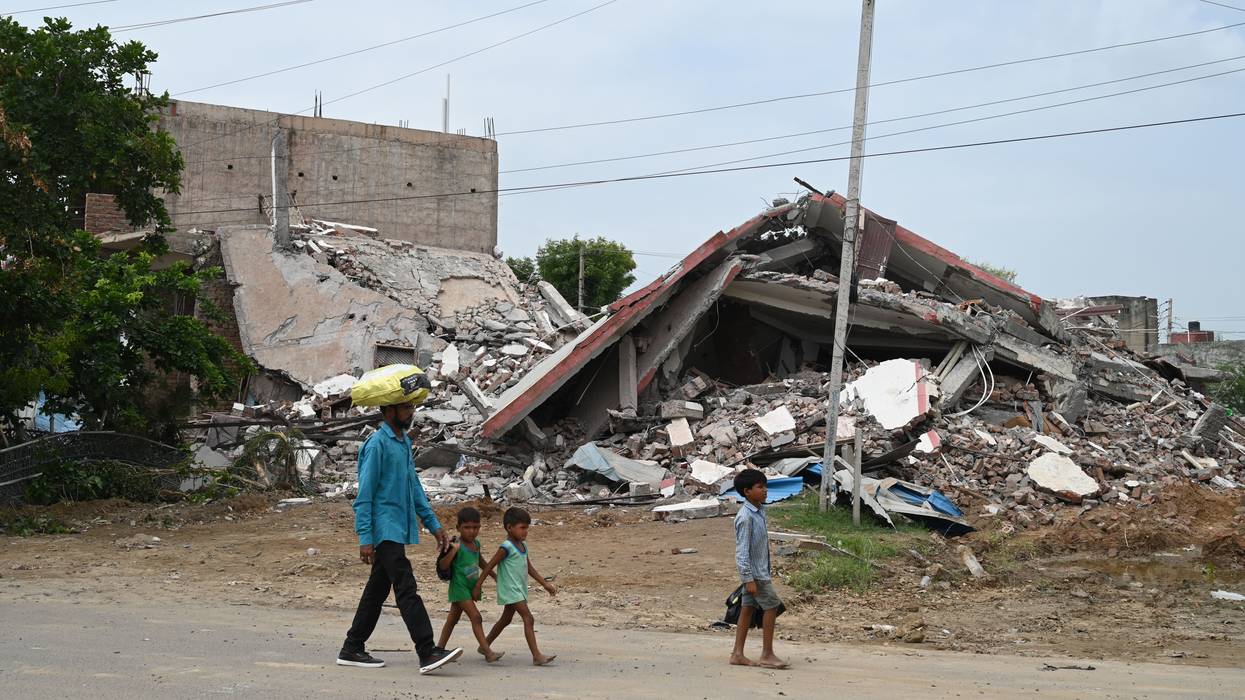
The tribunal's order to stop razing buildings comes amid escalating deadly violence perpetrated primarily by far-right Hindu supremacists against Muslims and other minorities.
An Indian high court on Monday ordered a halt to the destruction of Muslim homes and businesses in a district of Haryana state by the right-wing Bharatiya Janata Party-led government, acts the tribunal suggested are "an exercise in ethnic cleansing."
Justices G.S. Sandhawalia and Harpreet Kaur Jeewan of the Punjab and Haryana High Court in Chandigarh issued a notice to the BJP-led Haryana state government stating that no demolitions could be carried out in the Nuh and Gurugram districts unless proper legal procedures are followed, The Hindu reported.
"Apparently, without any demolition orders, the law and order problem is being used as a ruse to bring down buildings without following the procedure established by law," the justices wrote. "The issue also arises whether the buildings belonging to a particular community are being brought down under the guise of [a] law and order problem and an exercise of ethnic cleansing is being conducted by the state."
According to the Hindustan Times, authorities in Nuh have demolished more than 750 homes, businesses, and roadside shacks belonging to or occupied by Muslims since last week, when violence flared after a Hindu religious procession there was reportedly pelted with stones allegedly thrown by Muslims from structures the government said were illegally built.
Four people including two police officers were killed in subsequent clashes, with more than 60 others injured.
Residents of Nuh—the majority of whom are Muslim—told Al Jazeera that participants in the procession, which was organized by the Hindu nationalist group Vishwa Hindu Parishad and its youth wing, the Bajrang Dal, carried sticks, swords, and guns, and chanted hateful slogans while marching through Muslim neighborhoods.
A video in which notorious Hindu vigilante Mohit Yadav—a Bajrang Dal member who is accused of murdering two Muslim men earlier this year after they allegedly killed a cow—has been cited by Indian media as a catalyst for the bloodshed in Nuh.
Violence quickly spilled over into adjacent areas, including Gurugram—a finance and technology hub bordering the capital New Delhi—where a Hindu mob torched a mosque and killed its deputy imam. Far-right Hindu supremacist groups aligned with the BJP have been pushing to end Friday prayers in Gurugram.
The death and destruction in Nuh and Gurugram come amid rising religious and ethnic violence in the world's most populous nation.
Late last month, an Indian Railways security guard was arrested after he allegedly shot and killed a colleague and three passengers aboard an intercity train near Mumbai. The shooting suspect, Chetan Singh, posted a video on social media in which he is carrying a rifle and standing next to a bloody body.
"If you want to live and vote in Hindustan, I am telling you, it's only Modi and Yogi," Singh said, referring to India, its BJP Prime Minister Narendra Modi, and Yogi Adityanath, the BJP chief minister of Uttar Pradesh, India's most populous state.
"The genie of hate is now out of the bottle and it will take a lot of collective effort to put it back in."
Modi has come under fire for his silence in the face of weeks of interethnic bloodletting between the Metiei and Kuki peoples in the northeastern state of Manipur. The prime minister faces a parliamentary vote of no confidence over the matter, which he will all but certainly defeat given the legislature's BJP majority.
Following the train killings, Jairam Ramesh, a senior leader of the opposition Indian National Congress party, placed the blame for the "hate and violence" on BJP leaders including Modi.
"The genie of hate is now out of the bottle and it will take a lot of collective effort to put it back in," Ramesh wrote in a social media post condemning "the politics of prejudice and polarization of the BJP."
In 2020, more than 50 people—most of them Muslims—were shot, stabbed, slashed, beaten, and burned to death by rampaging Hindu mobs reacting to a peaceful demonstration by Muslims protesting a discriminatory citizenship law passed by the BJP government.
Far-right Hindu extremists allied with Modi—an adherent of Hindutva, or "Hinduness," a political ideology condemned by critics as supremacist—have for years called for a genocide of India's Muslims, who make up about 14% of the country's 1.4 billion people.
Last year, Gregory Stanton, a genocide scholar and founder of the advocacy group Genocide Watch, warned that "genocide could very well happen in India."

"A joint address is among the most prestigious invitations and honors the United States Congress can extend. We should not do so for individuals with deeply troubling human rights records."
As Indian Prime Minister Narendra Modi prepared to deliver a rare address by a foreign leader to a joint meeting of the U.S. Congress, progressive New York Congresswoman Alexandria Ocasio-Cortez on Wednesday joined other Democratic lawmakers in boycotting the right-wing leader's speech due to human rights violations perpetrated by his government.
Modi is set to be feted by President Joe Biden at a state dinner Thursday evening after speaking before Congress. The prime minister, who is the parliamentary leader of the ruling Bharatiya Janata Party (BJP), is a longtime adherent of Hindutva—literally, "Hindu-ness"—a political ideology critics say espouses Hindu supremacy and the transformation of secular India into ethno-nationalist state.
While many U.S. political and business leaders—including billionaire "fan" Elon Musk—welcomed the chance to meet with Modi, Ocasio-Cortez and at least six other House Democrats said they will not attend the prime minister's Capitol speech.
"I will be boycotting Prime Minister Modi's address to Congress tomorrow, and I encourage my colleagues who stand for pluralism, tolerance, and freedom of the press to join me in doing the same," Ocasio-Cortez said in a statement Wednesday evening.
Ocasio-Cortez explained:
In 2005, Narendra Modi was denied a U.S. visa because of his violations of religious freedom, including his complicity in an anti-Muslim riot that left over 1,000 dead. India currently ranks 161 out of 180 in the World Press Freedom Index—in part due to Modi's raids on BBC India's offices and his court challenges against a critical documentary. Additionally, a report from the U.S. Holocaust Museum found that India is at high risk for mass killings—the 8th most at risk of 162 countries studied.
A joint address is among the most prestigious invitations and honors the United States Congress can extend. We should not do so for individuals with deeply troubling human rights records—particularly for individuals whom our own State Department has concluded are engaged in systematic human rights abuses of religious minorities and caste-oppressed communities.
"It's shameful that Modi has been given a platform at our nation's capital—his long history of human rights abuses, anti-democratic actions, targeting Muslims and religious minorities, and censoring journalists is unacceptable," Tlaib tweeted on Tuesday.
Omar, meanwhile, is set to hold a briefing with human rights activists "to discuss Modi's record of repression and violence."
On Tuesday, Congressional Progressive Caucus Chair Pramila Jayapal (D-Wash.) and Sen. Chris Van Hollen (D-Md.) led a letter to Biden signed by scores of Democratic lawmakers urging the president to press Modi on upholding democracy and human rights.
Jayapal, however, plans to attend Modi's speech, as do the four other Indian-American members of Congress, all of them Democrats: Reps. Ami Bera (Calif.), Raja Krishnamoorthi (Ill.), Shri Thanedar (Mich.), and Ro Khanna (Calif.)—a staunch critic of Hindu nationalism who has come under fire for asking House Speaker Kevin McCarthy (R-Calif.) to invite the prime minister to address lawmakers.
Sen. Bernie Sanders (I-Vt.), who signed Jayapal and Van Hollen's letter, tweeted: "Prime Minister Modi's government has cracked down on the press and civil society, jailed political opponents, and pushed an aggressive Hindu nationalism that leaves little space for India's religious minorities. President Biden should raise these facts in his meeting with Modi."
Human rights groups are also speaking out against Modi's human rights record. In an open letter published earlier this month, dozens of organizations in the U.S. and Canada called on Biden to press Modi to "halt the use of anti-terror laws to arbitrarily detain political critics."
"Given the urgency of this crisis, we ask you to engage directly with Indian-American and human rights civil society leaders to explore solutions to address India's human rights crisis," the letter states. "We also ask you to employ the tools at your disposal to ensure that the Indian government cannot attack Indians' human rights with impunity."
The Council on American Islamic Relations (CAIR) said in an action alert that "the evidence of Modi's expanding effort to place a boot firmly on the collective heads of India's religious minorities is extensive."
"CAIR has already noted that under Modi his political allies have banned young Muslim women from wearing hijabs at school, ignored widespread lynchings of Muslims, and censored a BBC documentary about Modi's role in an anti-Muslim pogrom," the group added.
The advocacy group Hindus for Human Rights promoted a Wednesday morning New York rally with the message, "Modi and his fascist regime have been decimating human rights, especially for minorities, in India and have been exporting their Hindutva ideology across the globe."
Hindus for Human Rights, the Indian American Muslim Council, and others also hosted a Thursday protest in Washington, D.C.
"The red carpet welcome for the Butcher of Gujarat Narendra is a slap in the face for India's religious minority communities who continue to face violence and vitriol, and to those who dare to stand up against his hateful politics," Hindus for Human Rights tweeted. "Help us hold him to account."
In 2002, Modi was chief minister of the western state of Gujarat and blamed Muslims for burning a train full of Hindu pilgrims, an act that sparked retaliatory massacres in which at least hundreds and perhaps thousands of Muslims were murdered, tortured, and raped and hundreds of Hindus were also killed.
A U.K. government investigation found that Modi was "directly responsible" for the "climate of impunity" surrounding the massacre, although he was cleared by India's Supreme Court a decade later.
The George W. Bush administration prohibited Modi from entering the United States following the Gujarat slaughter, a proscription left in place until Modi became prime minister in 2014. Then-President Barack Obama—under whom Biden was vice president—subsequently rescinded the visa ban.
As India—now the world's most populous nation—has grown in power, subsequent U.S. administrations have courted the country for its growing economic clout and as part of a strategic policy of encircling China and countering its rise.

"We have taken the view that geopolitics and countering China is more important to us right now than the values-based diplomacy the Biden administration came in saying they would prioritize," said one critic.
Human rights defenders this week condemned President Joe Biden's upcoming state dinner for Indian Prime Minister Narendra Modi—who was once banned from entering the United States for supporting violent Hindu supremacists who massacred Muslims—as part of an ongoing U.S. "whitewash" of the right-wing leader's extremism.
Modi—who represents the ruling Bharatiya Janata Party (BJP)—is set to meet with Biden and speak before Congress this week in a visit the White House says "will strengthen our two countries' shared commitment to a free, open, prosperous, and secure Indo-Pacific."
However, rights groups and activists are condemning Biden's embrace of Modi while underscoring the grave human rights violations committed by the prime minister, his party, and their allies.
"Increasingly in recent years, BJP leaders have used toxic and hateful speech targeting religious minorities, inciting violence or discrimination against them."
"For almost a decade now, human rights activists and others have regularly brought to the White House—Democrats or Republicans—that Modi's regime is authoritarian, it's right-wing, it's anti-Muslim, and it's anti-minority" Suchitra Vijayan, author of Midnight's Borders: A People's History of Modern India, told HuffPost.
"The fact that they continue to whitewash him by giving them a platform is very worrying," she added.
Vijayan noted that "despite who is in the White House, the U.S. has a long history of propping up authoritarian regimes for its own personal ends."
John Prabhudoss, chairman of the Federation of Indian American Christian Organizations, told HuffPost that Indian pastors and their families live in constant terror.
"Their family could be jailed or even the worst, killed. The fear is real," he said. "For the president to bring [Modi] to the White House... is shameful. Mr. Biden, shame on you."
In a June 8 letter to Biden, Human Rights Watch (HRW) called Modi's visit "an important opportunity for the U.S. government to raise concerns—both privately and publicly—about India's worsening human rights situation."
The letter stated:
There are numerous areas of concern. Increasingly in recent years, BJP leaders have used toxic and hateful speech targeting religious minorities, inciting violence or discrimination against them. BJP-led authorities have tightened restrictions on free speech while ramping up censorship and using overbroad and vague laws to investigate and prosecute critics. Modi's government has also demonstrated blatant bias in protecting BJP supporters and affiliates accused [of] a range of crimes, including murder, assault, corruption, and sexual violence. At the international level, Modi's government has often proven unwilling to stand with other governments on key human rights crises, abstaining or refraining from condemning grave human rights violations elsewhere.
HRW and Amnesty International are set to host a private screening of a BBC documentary on Modi and his role in the 2002 Gujarat riots. The film, India: The Modi Question, was banned by the government, which raided the BBC's India offices over what officials called a tax probe but critics condemned as retaliation in line with Modi's attacks on press freedom.
Reporters Without Borders ranks India 161st out of 180 nations in press freedom, behind Afghanistan and just ahead of Russia.
Modi, who was chief minister of the western state of Gujarat at the time of the 2002 slaughter, blamed Muslims for torching a train full of Hindu pilgrims, an attack that killed around 60 people. Hindu mobs then murdered at least hundreds, and perhaps thousands, of Muslim men, women, and children in a retaliatory rampage, with many women raped and mutilated.
More than 250 Hindus were also killed during the violence, which displaced an estimated 150,000 people.
A U.K. government probe found that Modi was "directly responsible" for the "climate of impunity" surrounding the massacre.
While Modi was accused of deliberately allowing the violence, a special investigation commissioned by the Indian Supreme Court cleared him of complicity in 2012. Still, Modi's alleged role in the massacre led to a U.S. visa ban, first instated during the George W. Bush administration in 2005. The ban was lifted by then-President Barack Obama's administration in 2014 after Modi became prime minister.
Violence—sometimes deadly—against religious minorities and others has continued, and increased, under BJP rule.
As the Indian American Muslim Council (IAMC) notes:
The U.S. government and numerous internationally recognized organizations have condemned Modi for his and his political party's attacks on core democratic freedoms, as well as their roles in enabling violence against Indian minorities. The 2023 Report on International Religious Freedom by the Department of State highlights hate speeches by leaders of Modi's Bharatiya Janata Party, which have contributed to anti-Muslim and anti-Christian violence; the BJP's criminalization of religious conversion; BJP-led demolitions of Muslim-owned properties; Hindu supremacist rewriting of school curricula; arbitrary arrests of Muslims; and denial of bail for jailed Muslim activists. For four years running, the United States Commission on International Religious Freedom (USCIRF) has designated India as a Country of Particular Concern for its egregious violations of human rights and religious freedoms, citing similar abuses.
"To fail to note Modi’s violent, anti-minority, authoritarian tendencies, and his corrupt mismanagement of the Indian economy, is not only to ignore the U.S. government's own findings but a strategic blunder with the potential to jeopardize global stability," IAMC said.
"The turmoil Modi and the BJP have sown within Indian society is a profound threat to regional stability and has the potential to substantially undermine any joint initiatives," the group argued.
Derek Grossman, a senior defense analyst with the Rand Corporation, said in an interview published Saturday by the Financial Times, "The question is, are we propping up an increasingly illiberal democracy here?"
"In my view, we are," he asserted. "We have taken the view that geopolitics and countering China is more important to us right now than the values-based diplomacy the Biden administration came in saying they would prioritize."
Some congressional Democrats have also faced criticism for their varying degrees of support for Modi and the BJP.
When then-President Donald Trump embraced the Indian leader at the raucous 2019 "Howdy Modi!" rally in Houston, six Democrats took to the stage to greet Modi: then-House Majority Leader Steny Hoyer (Md.); Rep. Sheila Jackson Lee (Texas); Rep. Carolyn Maloney (N.Y.); Rep. Danny Davis (Ill.); Rep. Tom Suozzi (N.Y.), an erstwhile critic of Indian human rights abuses in Kashmir; and Rep. Raja Krishnamoorthi (Ill.).
Krishnamoorthi has attended the World Hindu Congress, a notorious platform for Hindu nationalists including Mohan Bhagwat, leader of the Rashtriya Swayamsevak Sangh (RSS), a fascist-inspired political and paramilitary movement whose brand of Hindu supremacy heavily influenced the rise of the BJP. Modi is a former RSS regional director.
Others, like Sen. Bernie Sanders (I-Vt.), Congressional Progressive Caucus Chair Pramila Jayapal (D-Wash.), and Rep. Ilhan Omar (D-Minn.), have been unwaveringly critical of Modi's policies and practices.
Then there is the curious case of Rep. Ro Khanna. Invoking the name of his grandfather Amarnath Vidyalankar, a figure in India's independence movement who served multiple terms in parliament, the California Democrat in 2019 declared that "it's the duty of every American politician of Hindu faith to stand for pluralism, reject Hindutva, and speak for equal rights for Hindus, Muslims, Sikhs, Buddhist, and Christians."
Hindutva—literally, "Hindu-ness"—is the modern political ideology espoused by Modi, the BJP, and many of their extremist allies advocating Hindu supremacy and the transformation of secular India into an ethno-nationalist state.
However, last month IAMC expressed its disappointment that Khanna asked House Speaker Kevin McCarthy (R-Calif.) to invite Modi to deliver a joint address before Congress during his state visit to Washington. Khanna's request—which was made with Rep. Michael Waltz (R-Fla.,)—contended that "granting a joint address to Congress is a commensurate honor for the leader of the world's largest democracy and perhaps the most critical partner to countering China in the 21st century."
In response, IAMC cautioned that "the opportunity to speak before Congress will help to legitimize Modi's brand of Hindu nationalist politics and the systematic persecution of religious minorities, particularly Muslims and Christians, under his rule."
"Khanna has previously and admirably criticized Hindu nationalism, Rahul Gandhi's expulsion from parliament, and disingenuous cries of Hinduphobia used to deflect legitimate criticism of the Indian government," the group added. "IAMC urges Rep. Khanna to continue this fight, cancel his request, and instead educate his constituents about the harms the Modi regime has done to India."

"The metamorphosis of BJP's vindictive politics into autocracy is happening at an alarming pace," one Indian state's chief minister said in response to the parliamentary expulsion and criminal sentencing of Rahul Gandhi.
Democracy defenders sounded the alarm Friday after senior Indian opposition leader Rahul Gandhi was ousted from his parliamentary seat a day after being sentenced to two years in prison in a dubious defamation case involving an insult against the surname of Prime Minister Narendra Modi.
India's lower house of Parliament announced Friday that Gandhi—a former president of the Indian National Congress party (called Congress for short) who until Thursday represented the constituency of Wayanad in the southern state of Kerala—was disqualified to serve in office due to his conviction for defaming the Modi name.
The case involved Gandhi allegedly asking during a 2019 campaign rally in Kolar, Karnataka, "How come all the thieves have Modi as the common surname?"
The Times of India reports Surat Chief Judicial Magistrate H. H. Varma convicted Gandhi for defamation under the Indian Penal Code. Varma granted Gandhi bail on a bond of ₹15,000 (approx. $180) and suspended the sentence for 30 days so he may appeal.
While convicting Gandhi, Varma said that the defendant could have limited his insult to the prime minister, but by disparaging all people with the name, the defendant "intentionally" defamed them.
The Modi surname comes from the Modh Ghanchi or Teli Ghanchi community primarily inhabiting western states like Gujarat, Maharashtra, and Rajashtan, and traditionally employed in the oil pressing and trading business. Although officially designated an Other Backward Caste, Gujaratis do not view the widely successful group as such.
Gandhi
tweeted Friday that he is "fighting for the voice of India" and is "ready to pay any cost."
Congress called Gandhi's conviction an "infirm, erroneous, and unsustainable" judgment.
Party spokesperson Abhishek Manu Singhvi said the government's "efforts to create a chilling effect, a throttling effect, strangulating effect on open, fearless speech relating to public interest, will not stop either Rahul Gandhi or the Congress party."
"There are some disturbing aspects of this judgment which of course will be subject to challenge immediately, but firstly, the heart of the law of criminal defamation is that persons who are complainants should be those who must be able to demonstrate how they personally have been defamed, or prejudiced," Singhvi continued.
"Now," he added, "the admitted position is that no one who is the subject matter of the statement which is found to be offending has filed a criminal complaint."
M.K. Stalin, the leftist chief minister of Tamil Nadu state, tweeted that "the metamorphosis of BJP's vindictive politics into autocracy is happening at an alarming pace," a reference to Modi's right-wing Bharatiya Janata Party (BJP). The prime minister is also a member of the Hindu supremacist Rashtriya Swayamsevak Sangh (RSS) paramilitary group.
"The disqualification of Rahul Gandhi is an onslaught on all the progressive-democratic forces of our country," Stalin said in a statement Friday. "All the political parties in India shall realize this and we should oppose unitedly."
In the United States, Democratic California Congressman Ro Khanna—whose parents immigrated from Punjab state— called Gandhi's ouster a "deep betrayal of Gandhian philosophy and India's deepest values."
"This is not what my grandfather sacrificed years in jail for," Khanna added, referring to former Congress parliamentarian and independence movement figure Amarnath Vidyalankar. "Narendra Modi, you have the power to reverse this decision for the sake of Indian democracy."
Arundhati Roy, the renowned Indian writer, said during a Wednesday lecture at the Swedish Academy in Stockholm that "India's democracy is being systematically disassembled. Only the rituals remain."
Mentioning the persecution of religious minorities—especially Muslims—the brutal military occupation of Kashmir, and the imprisonment of journalists, Roy added that "India for all practical purposes has become a corporate, theocratic Hindu state, a highly policed state, a fearsome state [seething] with Hindu supremacist fervor."