

SUBSCRIBE TO OUR FREE NEWSLETTER
Daily news & progressive opinion—funded by the people, not the corporations—delivered straight to your inbox.
5
#000000
#FFFFFF
To donate by check, phone, or other method, see our More Ways to Give page.
Daily news & progressive opinion—funded by the people, not the corporations—delivered straight to your inbox.
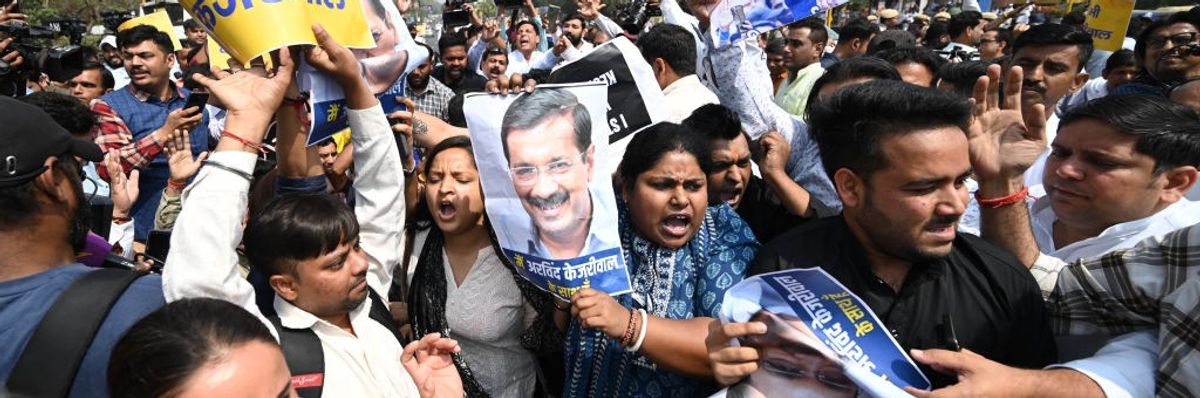
Indians protest the arrest of Delhi Chief Minister Arvind Kejriwal on March 22, 2024 in New Delhi.
"The growing crackdown clearly shows the authorities' blatant disregard for human rights and rule of law," said one Amnesty International campaigner.
As India's right-wing government cracks down on opposition ahead of next month's general elections, Amnesty International on Friday urged authorities to "stop weaponizing the criminal justice system to intimidate and harass" political candidates, activists, and others.
Protests broke out in the capital New Delhi and other Indian cities after police on Thursday arrested Delhi Chief Minister Arvind Kejriwal, an opposition leader from the Aam Aadmi Party, over corruption allegations AAP members say are politically motivated. Two other AAP leaders were previously arrested in connection with the same case, which involves the alleged favoring of certain alcohol vendors and illegal campaign financing.
Authorities also froze the bank accounts of another leading opposition party, the Indian National Congress, over a tax dispute that dates back to 2018. Party leader Sonia Gandhi accused Indian Prime Minister Narendra Modi's Bharatiya Janata Party (BJP) party of perpetrating "a systematic effort to cripple the party financially."
“They want to know we are corrupt like them, which is not the case.” – AAP chief spokesperson Priyanka Kakkar on the BJP’s crackdown on opposition politicians.
AAP leader Arvind Kejriwal was arrested just today on charges of corruption.
The India Report: https://t.co/rxPr6zKnWx pic.twitter.com/P3eSbxVTVm
— Al Jazeera English (@AJEnglish) March 21, 2024
Gandhi, Kejriwal and others have repeatedly accused of Modi's government of misusing federal agencies and resources to repress opposition figures as elections loom. The BJP denies the allegations.
"The Bharatiya Janata Party-led Indian government's crackdown on peaceful dissent and opposition has now reached a crisis point," Amnesty International India board chair Aakar Patel said in a statement.
"The authorities have repeatedly exploited and weaponized various financial and terrorism laws to systematically crack down on human rights defenders, activists, critics, nonprofit organizations, journalists, students, academics, and political opposition," Patel added. "The arrest of Arvind Kejriwal and the freezing of Indian National Congress' bank accounts a few weeks before India holds its general elections show the authorities' blatant failure to uphold the country's international human rights obligations."
Patel continued:
What we are witnessing is a brutal crackdown on human rights including through the misuse of central investigative and financial agencies, attacks on peaceful protests, arbitrary arrests, use and export of invasive spyware for unlawful surveillance, [and] systematic discrimination against religious minorities to feed into their majoritarian Hindutva politics and targeted suspension of opposition leaders from the Parliament who dare to hold the authorities to account.
"The growing crackdown clearly shows the authorities' blatant disregard for human rights and rule of law," Patel added. "Authorities must respect, protect, promote, and fulfill the human rights of everyone in the country including human rights defenders, activists, and opposition candidates before, during, and after the general elections which are due to begin in April 2024. Authorities must also ensure access to justice and effective remedies for victims of human rights violations."
On Thursday, the U.S. House of Representatives' bipartisan Tom Lantos Human Rights Commission held a hearing on the situation in India.
The commission noted that in recent years, as Modi and the BJP have consolidated power, "concerns about human rights abuses in India have grown" over "a wide range of significant rights issues, including restrictions on religious and press freedoms, violence or threats of violence targeting members of national/racial/ethnic and religious minorities, harassment of and restrictions on civil society and human rights organizations, corruption, and lack of accountability."
Dear Common Dreams reader, It’s been nearly 30 years since I co-founded Common Dreams with my late wife, Lina Newhouser. We had the radical notion that journalism should serve the public good, not corporate profits. It was clear to us from the outset what it would take to build such a project. No paid advertisements. No corporate sponsors. No millionaire publisher telling us what to think or do. Many people said we wouldn't last a year, but we proved those doubters wrong. Together with a tremendous team of journalists and dedicated staff, we built an independent media outlet free from the constraints of profits and corporate control. Our mission has always been simple: To inform. To inspire. To ignite change for the common good. Building Common Dreams was not easy. Our survival was never guaranteed. When you take on the most powerful forces—Wall Street greed, fossil fuel industry destruction, Big Tech lobbyists, and uber-rich oligarchs who have spent billions upon billions rigging the economy and democracy in their favor—the only bulwark you have is supporters who believe in your work. But here’s the urgent message from me today. It's never been this bad out there. And it's never been this hard to keep us going. At the very moment Common Dreams is most needed, the threats we face are intensifying. We need your support now more than ever. We don't accept corporate advertising and never will. We don't have a paywall because we don't think people should be blocked from critical news based on their ability to pay. Everything we do is funded by the donations of readers like you. When everyone does the little they can afford, we are strong. But if that support retreats or dries up, so do we. Will you donate now to make sure Common Dreams not only survives but thrives? —Craig Brown, Co-founder |
As India's right-wing government cracks down on opposition ahead of next month's general elections, Amnesty International on Friday urged authorities to "stop weaponizing the criminal justice system to intimidate and harass" political candidates, activists, and others.
Protests broke out in the capital New Delhi and other Indian cities after police on Thursday arrested Delhi Chief Minister Arvind Kejriwal, an opposition leader from the Aam Aadmi Party, over corruption allegations AAP members say are politically motivated. Two other AAP leaders were previously arrested in connection with the same case, which involves the alleged favoring of certain alcohol vendors and illegal campaign financing.
Authorities also froze the bank accounts of another leading opposition party, the Indian National Congress, over a tax dispute that dates back to 2018. Party leader Sonia Gandhi accused Indian Prime Minister Narendra Modi's Bharatiya Janata Party (BJP) party of perpetrating "a systematic effort to cripple the party financially."
“They want to know we are corrupt like them, which is not the case.” – AAP chief spokesperson Priyanka Kakkar on the BJP’s crackdown on opposition politicians.
AAP leader Arvind Kejriwal was arrested just today on charges of corruption.
The India Report: https://t.co/rxPr6zKnWx pic.twitter.com/P3eSbxVTVm
— Al Jazeera English (@AJEnglish) March 21, 2024
Gandhi, Kejriwal and others have repeatedly accused of Modi's government of misusing federal agencies and resources to repress opposition figures as elections loom. The BJP denies the allegations.
"The Bharatiya Janata Party-led Indian government's crackdown on peaceful dissent and opposition has now reached a crisis point," Amnesty International India board chair Aakar Patel said in a statement.
"The authorities have repeatedly exploited and weaponized various financial and terrorism laws to systematically crack down on human rights defenders, activists, critics, nonprofit organizations, journalists, students, academics, and political opposition," Patel added. "The arrest of Arvind Kejriwal and the freezing of Indian National Congress' bank accounts a few weeks before India holds its general elections show the authorities' blatant failure to uphold the country's international human rights obligations."
Patel continued:
What we are witnessing is a brutal crackdown on human rights including through the misuse of central investigative and financial agencies, attacks on peaceful protests, arbitrary arrests, use and export of invasive spyware for unlawful surveillance, [and] systematic discrimination against religious minorities to feed into their majoritarian Hindutva politics and targeted suspension of opposition leaders from the Parliament who dare to hold the authorities to account.
"The growing crackdown clearly shows the authorities' blatant disregard for human rights and rule of law," Patel added. "Authorities must respect, protect, promote, and fulfill the human rights of everyone in the country including human rights defenders, activists, and opposition candidates before, during, and after the general elections which are due to begin in April 2024. Authorities must also ensure access to justice and effective remedies for victims of human rights violations."
On Thursday, the U.S. House of Representatives' bipartisan Tom Lantos Human Rights Commission held a hearing on the situation in India.
The commission noted that in recent years, as Modi and the BJP have consolidated power, "concerns about human rights abuses in India have grown" over "a wide range of significant rights issues, including restrictions on religious and press freedoms, violence or threats of violence targeting members of national/racial/ethnic and religious minorities, harassment of and restrictions on civil society and human rights organizations, corruption, and lack of accountability."
As India's right-wing government cracks down on opposition ahead of next month's general elections, Amnesty International on Friday urged authorities to "stop weaponizing the criminal justice system to intimidate and harass" political candidates, activists, and others.
Protests broke out in the capital New Delhi and other Indian cities after police on Thursday arrested Delhi Chief Minister Arvind Kejriwal, an opposition leader from the Aam Aadmi Party, over corruption allegations AAP members say are politically motivated. Two other AAP leaders were previously arrested in connection with the same case, which involves the alleged favoring of certain alcohol vendors and illegal campaign financing.
Authorities also froze the bank accounts of another leading opposition party, the Indian National Congress, over a tax dispute that dates back to 2018. Party leader Sonia Gandhi accused Indian Prime Minister Narendra Modi's Bharatiya Janata Party (BJP) party of perpetrating "a systematic effort to cripple the party financially."
“They want to know we are corrupt like them, which is not the case.” – AAP chief spokesperson Priyanka Kakkar on the BJP’s crackdown on opposition politicians.
AAP leader Arvind Kejriwal was arrested just today on charges of corruption.
The India Report: https://t.co/rxPr6zKnWx pic.twitter.com/P3eSbxVTVm
— Al Jazeera English (@AJEnglish) March 21, 2024
Gandhi, Kejriwal and others have repeatedly accused of Modi's government of misusing federal agencies and resources to repress opposition figures as elections loom. The BJP denies the allegations.
"The Bharatiya Janata Party-led Indian government's crackdown on peaceful dissent and opposition has now reached a crisis point," Amnesty International India board chair Aakar Patel said in a statement.
"The authorities have repeatedly exploited and weaponized various financial and terrorism laws to systematically crack down on human rights defenders, activists, critics, nonprofit organizations, journalists, students, academics, and political opposition," Patel added. "The arrest of Arvind Kejriwal and the freezing of Indian National Congress' bank accounts a few weeks before India holds its general elections show the authorities' blatant failure to uphold the country's international human rights obligations."
Patel continued:
What we are witnessing is a brutal crackdown on human rights including through the misuse of central investigative and financial agencies, attacks on peaceful protests, arbitrary arrests, use and export of invasive spyware for unlawful surveillance, [and] systematic discrimination against religious minorities to feed into their majoritarian Hindutva politics and targeted suspension of opposition leaders from the Parliament who dare to hold the authorities to account.
"The growing crackdown clearly shows the authorities' blatant disregard for human rights and rule of law," Patel added. "Authorities must respect, protect, promote, and fulfill the human rights of everyone in the country including human rights defenders, activists, and opposition candidates before, during, and after the general elections which are due to begin in April 2024. Authorities must also ensure access to justice and effective remedies for victims of human rights violations."
On Thursday, the U.S. House of Representatives' bipartisan Tom Lantos Human Rights Commission held a hearing on the situation in India.
The commission noted that in recent years, as Modi and the BJP have consolidated power, "concerns about human rights abuses in India have grown" over "a wide range of significant rights issues, including restrictions on religious and press freedoms, violence or threats of violence targeting members of national/racial/ethnic and religious minorities, harassment of and restrictions on civil society and human rights organizations, corruption, and lack of accountability."

