

SUBSCRIBE TO OUR FREE NEWSLETTER
Daily news & progressive opinion—funded by the people, not the corporations—delivered straight to your inbox.
5
#000000
#FFFFFF
To donate by check, phone, or other method, see our More Ways to Give page.
Daily news & progressive opinion—funded by the people, not the corporations—delivered straight to your inbox.
Monsanto accepted Bayer's $66 billion takeover offer--the largest all-cash deal ever--on Wednesday morning.
While anti-trust agencies around the world review the proposed mega-merger, environmental and consumer advocates roundly condemned the creation of what will be the largest pesticide and GMO corporation in the world.
"This new mega corporation would be the world's biggest seed maker and pesticide company, defying important antitrust protections and giving it unacceptable control over critical aspects of our food supply--undermining consumer choice and the freedom and stability of farmers worldwide," said Anne Isakowitsch, head of international corporate watchdog SumOfUs.
"[...] these megadeals are being made to benefit the corporate boardrooms at the expense of family farmers, ranchers, consumers and rural economies."
--Andrew Johnson, National Farmers Union
"The merger of Bayer and Monsanto should make the connection between Big Pharma, Big Biotech, and Big Food all the more apparent to consumers," said Ronnie Cummins, director of the Organic Consumers Association (OCA), in an email to Common Dreams.
"This may be a move to take pressure off the manufacturer of glyphosate, the most profitable pesticide in the world," Cummins added. "But it really doesn't matter who manufactures or sells glyphosate, or any other dangerous chemical. The damage to human health and the environment remains the same, as does our commitment to getting these chemicals out of our food system."
The merger between the two chemical behemoths has been long anticipated, and antitrust experts and environmental groups have been warning against the takeover for months.
A legal opinion by two former Justice Department officials released in August decried the merger as "a five-alarm threat to our food supply and to farmers around the world."
"[T]he antitrust enforcers must not allow this merger to proceed," the officials said.
Thanks to widespread protests and organizing from groups such as the National Farmers Union, next week the Senate Judiciary Committee is set to review the recent spate of consolidation--including deals such as Dow-Dupont and ChemChina-Syngenta--within the biotech industry.
"We are pleased that next week the Senate Judiciary Committee will be reviewing the alarming trend of consolidation in agriculture that has led to less competition, stifled innovation, higher prices and job loss in rural America," said National Farmers Union president Andrew Johnson. "We underscore the importance that all mergers, including this recent Bayer/Monsanto deal, be put under the magnifying glass of the committee and the U.S. Department of Justice."
"Wars were fought, lives lost, nations carved into holy lands [...] while Bayer and Monsanto sold chemicals as bombs and poisons and their brothers provided the loans to buy those bombs."
--Dr. Vandana Shiva
"We will continue to express concern that these megadeals are being made to benefit the corporate boardrooms at the expense of family farmers, ranchers, consumers, and rural economies," Johnson said.
Meanwhile, Sydney Peace Prize-winning environmental activist Dr. Vandana Shiva recently explored Bayer and Monsanto's longstanding relationship and dark history--pointing out that they worked together as chemical weapons manufacturers and war profiteers during several of the 20th century's bloodiest conflicts:
Monsanto and Bayer have a long history. They made explosives and lethally poisonous gases using shared technologies and sold them to both sides in the two world wars. The same war chemicals were bought by the Allied and Axis powers, from the same manufacturers, with money borrowed from the same bank.
MoBay [Monsanto and Bayer] supplied ingredients for Agent Orange in the Vietnam War. Around 20 million gallons of MoBay defoliants and herbicides were sprayed over South Vietnam. Children are still being born with birth defects, adults have chronic illnesses and cancers, due to their exposure to MoBay's chemicals. Monsanto and Bayer's cross-licensed Agent Orange resistance has also been cross-developed for decades. Wars were fought, lives lost, nations carved into holy lands--with artificial boundaries that suit colonization and resource grab--while Bayer and Monsanto sold chemicals as bombs and poisons and their brothers provided the loans to buy those bombs.
"The Farben family chemical cartel [that includes Bayer and Monsanto] was responsible for exterminating people in concentration camps," adds Shiva. "It embodies a century of ecocide and genocide, carried out in the name of scientific experimentation and innovation."
"Today, the poison cartel is wearing [genetic engineering] clothes and citing the mantra of 'innovation' ad nauseam. Hitler's concentration camps were an 'innovation' in killing," Shiva writes, "and almost a century later, the Farben family is carrying out the same extermination--silently, globally, and efficiently."
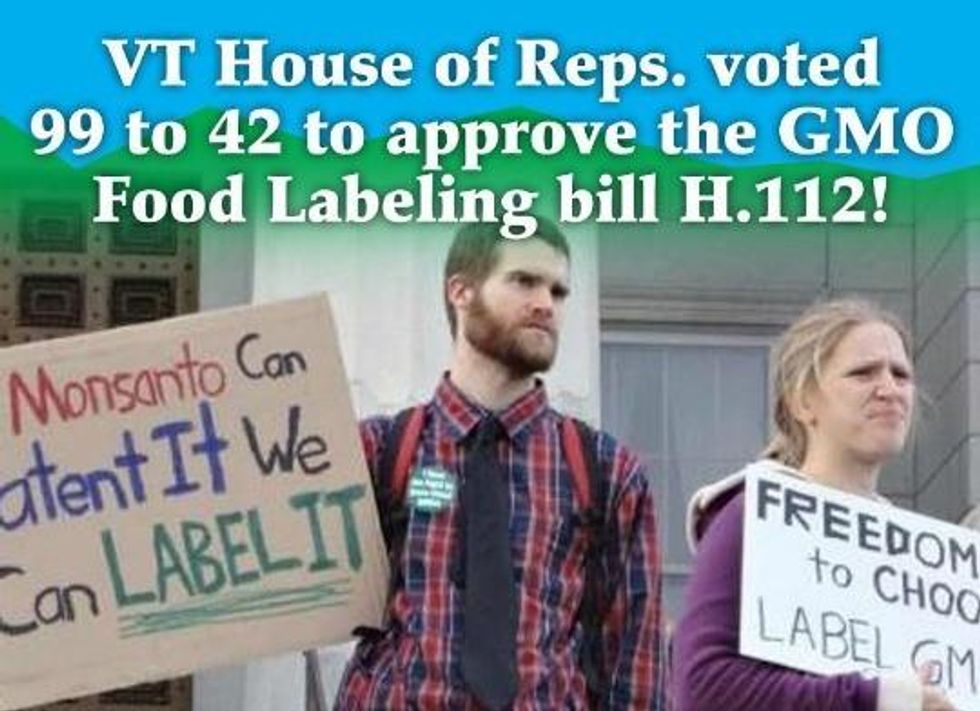
Grassroots groups across the United States are mobilizing against the nation's powerful biotech firms as a new round of labeling laws for foods made with genetically modified organisms (GMOs) make their way through state legislatures.
The front lines in this battle have shifted to two New England states where legislators are preparing to vote on GMO labeling laws while backers prepare for a legal assault by large industry firms like Monsanto.
"The biotech [industry] is seeing growing mass support across the US and they have fewer useful resources to combat truthfulness and popular support," said Jim Gerritsen, president of the Organic Seed Growers and Trade Association (OSGATA), in an interview with Common Dreams. "Their 'big stick' now is litigation."
Biotech firms, including Monsanto and other 'Big Ag' industry groups, were behind the defeat of an earlier labeling initiative, California's Proposition 37, after bankrolling a widespread misinformation campaign.
Gerritsen's statement came on the heels of a small victory in Maine Tuesday night when the Legislature's Agriculture Committee voted 8-5 to approve Bill L.D. 718 which would prohibit retailers from labeling a product "natural" if it contains GMOs.
"Somebody once said that Monsanto isn't a seed company, it's a law firm that makes seeds." - Maine Rep. Lance Harvell
The vote followed the Friday passage of Bill H.112 by the Vermont House of Representatives which requires foods containing GMOs to be labeled, marking the "furthest any such legislation has made it through the legislative process in the United States," according to PR Watch.
The New England states are just two of a coalition of thirty-seven states currently mobilizing for GMO labeling. Of these, twenty now have legislation slated for introduction this year.
A local paper reports that one third of Vermont's legislators were co-sponsors, "signaling the bill's broad public support." Similarly, according to Gerritsen, an astounding 91 percent of Mainers favor the labeling of genetically modified foods.
"Both Vermont and Maine are not going to be bullied by out-of-state biotech firms," added Gerritsen. "It's an outrageous abuse of the democratic process. For out-of-state trade groups to threaten a state acting in the best interest of its people, that is abuse."
According to the Kennebec Journal, Maine Attorney General Janet Mills--who supports the measure--told lawmakers that the legislation is "almost certain" to face a legal challenge from the industry. "These entities are very litigious," Mills told the committee.
Maine Representative Lance Harvell (R-Farmington), who sponsored the bill, added, "You're challenging a biotech industry that's operated on the basis of throwing their weight around," he said. "Somebody once said that Monsanto isn't a seed company, it's a law firm that makes seeds."
Monsanto has already threatened to sue Vermont if the legislation passes.
Gerritsen believes the state is in "excellent position" to combat any legal challenges. What they are promoting is "factual, uncontroversial information which is valid for state interest."
He quotes a recent statistic that 50 percent of American consumers would not purchase foods made with GMOs if they knew about their presence. Not sharing that information, he says, indicates a "level of deceit" on the part of food companies.
As the Maine bill progresses, supporters are "very hopeful" they will receive passage in both the House--where a record 123 legislators (out of 186) are cosponsoring the bill--and Senate.
In Vermont, the Senate vote won't occur until the legislature convenes next January.
Our founding fathers, white-maleness aside, did get a few things right. One of them was the concept of "separation of powers," to ensure a system of checks and balances among the three branches of government: executive, legislative, and judicial. But a dangerous provision snuck into the budget bill passed last week in Congress upends that system. Without any hearings on the matter, the Senate included language that would require the U.S. Department of Agriculture to essentially ignore any court ruling that would otherwise halt the planting of new genetically-engineered crops. Here is how Capital Press explains it:
The rider pertains to transgenic crops that have been deregulated by the USDA but then had that approval overturned by a judge -- a scenario that has occurred with genetically engineered alfalfa and sugar beets.
In such a situation, the agency "shall" immediately issue permits or a partial deregulation order that would temporarily allow farmers to continue growing and selling the crop until USDA is done re-evaluating its environmental effects, according to the rider.
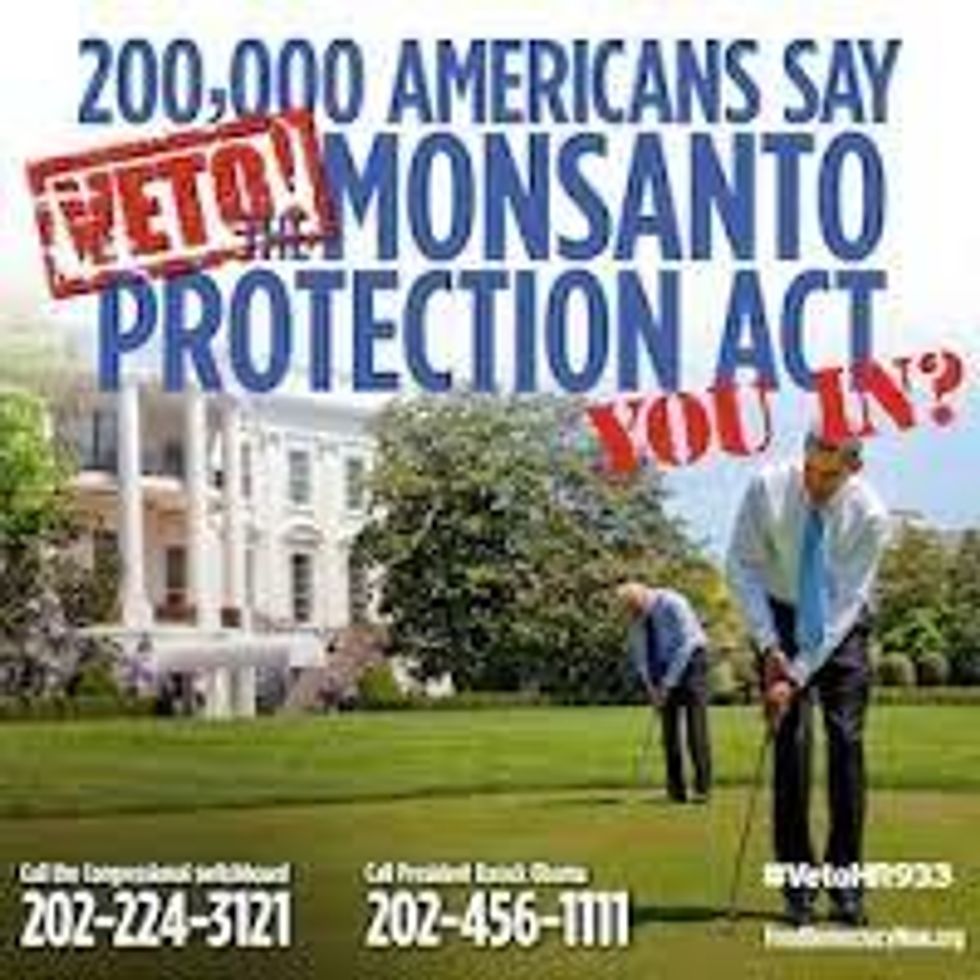
Why is this such a big deal? The court system is often our last hope, with Congress, the White House, and regulatory agencies deep inside industry's pocket. Several legal challenges have resulted in court decisions overturning USDA's approval of new GMO crops, for example, sugar beets.
So the biotech industry, unable to make its case to a judge, figured why not just rewrite the Constitution instead, with the help of a Democratic Senate led by Senator Barbara Mikulski, chair of the Senate Agriculture Committee. Despite Montana Senator Jon Tester's best attempts to stop the so-called biotech rider, the measure was pushed through. (Industry had tried to get a similar measure passed more than once last year.) Tester minced no words, in a recent article in POLITICO about this and other industry power grabs such as weakening small farmer protections:
These provisions are giveaways, pure and simple, and will be a boon worth millions of dollars to a handful of the biggest corporations in this country. They deserve no place in this bill. We simply have got to do better on both policy and process.
If President Obama signs the budget deal with this provision, it could have long-lasting and serious consequences. This list of pending petitions to USDA to approve genetically-engineered crops includes new versions of corn, soybean, canola, and cotton. Once these crops get planted, it will be too late to do much about it. That's why groups such as the Center for Food Safety file lawsuits when USDA turns a blind eye to the potentially harmful environmental consequences of these unique crops.
Here is how Andrew Kimbrell, executive director of the Center for Food Safety, described the situation:
In this hidden backroom deal, Senator Mikulski turned her back on consumer, environmental, and farmer protection in favor of corporate welfare for biotech companies such as Monsanto. This abuse of power is not the kind of leadership the public has come to expect from Senator Mikulski or the Democrat Majority in the Senate.
The biotech industry, with the help of Congress, is attempting an end-run of the judicial system. Since judges can't get be bought off, just go to your friends in Congress instead.
Unfortunately, most of the mainstream media have not picked up on this unprecedented Big Biotech power grab, and in the case of NPR, has even spread misinformation about the rider's effects:
But a closer look at the language of the provision suggests it may not be granting the USDA any powers it doesn't already have.
"It's not clear that this provision radically changes the powers USDA has under the law," Greg Jaffe, director of the Biotechnology Project at the Center for Science in the Public Interest, tells The Salt.
This interpretation was echoed, unsurprisingly, by the biotech industry, in Capital Express:
"It doesn't require the USDA to do anything it wouldn't otherwise have the authority to do," said Karen Batra, communications director for the Biotechnology Industry Organization. "The language is there to protect farmers who have already made planting decisions."
But as Kimbrell of the Center for Food Safety explains, the new language makes what is currently discretionary or optional on USDA's part, mandatory, a huge difference:
The word "shall" forces the USDA to continue allowing biotech crop cultivation even if its commercialization was overturned. They've taken away the discretion of the secretary of agriculture. Its real not-so-hidden purpose is to take away the ability to effectively vacate the approval of a crop that's been approved illegally.
If there is any good news, it's that the continuing resolution the provision hitched a ride on is only valid for six months. But industry seems confident it can make the workaround permanent. Likely what will follow is a protracted court battle over the policy's constitutionality; remember that whole separation of powers thing? Still, any such legal challenge will likely take years to be resolved. Even USDA thinks the provision is unconstititional. Secretary Vilsack's office told POLITICO that he has asked the Office of General Council to review the language, "as it appears to pre-empt judicial review of a deregulatory action which may make the provision unenforceable."
Meanwhile, the grassroots movement continues to grow to demand labeling of foods containing genetically-engineered ingredients. While important, we cannot let labeling distract us from pro-biotech policies at the other end of production. The fewer GMO crops that are allowed to be planted in the first place, the fewer end-products containing GMOs.
But it's not too late. You can still demand that President Obama refuse to sign the budget bill into law unless the biotech rider (aka Monsanto Protection Act) is removed. Food Democracy Now! has already gathered more than 175,000 signatures demanding Obama do the right thing. From that organization's action alert:
By sneaking Section 735 into a federal appropriations bills, Monsanto has successfully planted a dangerous provision in U.S. law that strips judges of their constitutional mandate to protect American's health and the environment while opening up the floodgates for the planting of new, untested genetically engineered crops.
Even if their new GMO crops are ultimately proven to be harmful to human health or the environment, Section 735 allows them to be planted the minute the USDA approves them!
Even more alarming, currently 13 new crops are awaiting approval at the USDA and AquaBounty's GMO salmon is on the verge of being approved by the FDA. This new provision opens the door wide open for these approvals.
If the biotech industry can so easily override our court system, which is our last resort in stopping these dangerous crops from being planted, we will have no place left to turn. And Monsanto will have completed its hostile takeover of the U.S. government.
Take action now by calling and emailing the White House here.
UPDATE: More 'Corporate Welfare': Obama Signs 'Monsanto Protection Act' Into Law
My expose last week, "The Organic Elite Surrenders to Monsanto: What Now?" has ignited a long-overdue debate on how to stop Monsanto's earth killing, market-monopolizing, climate-destabilizing rampage. Should we basically resign ourselves to the fact that the Biotech Bully of St. Louis controls the dynamics of the marketplace and public policy? Should we seek some kind of practical compromise or "coexistence" between organics and Genetically Modified Organisms (GMOs)? Should we focus our efforts on crop pollution compensation and "controlled deregulation" of genetically engineered (GE) crops, rather than campaign for an outright ban, or mandatory labeling and safety-testing? Should we prepare ourselves for a future farm landscape where the U.S.'s 23 million acres of alfalfa, the nation's fourth largest crop, (93% of which are currently not sprayed with toxic herbicides), including organic alfalfa, are sprayed with Roundup and/or genetically polluted with Monsanto's mutant genes?
Or should we stand up and say Hell No to Monsanto and the Obama Administration? Should we stop all the talk about coexistence between organics and GMOs; unite Millions Against Monsanto, mobilize like never before at the grassroots; put enormous pressure on the nation's grocers to truthfully label the thousands of so-called conventional or "natural" foods containing or produced with GMOs; and then slowly but surely drive GMOs from the market?
Of course "coexistence" and "controlled deregulation" are now irrelevant in regard to Monsanto's herbicide-resistant alfalfa. Just after my essay was posted last week, the White House gave marching orders to the USDA to allow Monsanto and its Minions to plant GE Roundup-resistance alfalfa on millions of acres, from sea to shining sea, with no restrictions whatsoever.
"Bill Tomson and Scott Kilman of the Wall Street Journal reported that Vilsack's rejection of a compromise proposal - partial deregulation, which was vehemently opposed by biotech companies and only tepidly accepted by non-GE interests - was the result of an Obama administration review of "burdensome" regulations."
"Sources familiar with the negotiations at USDA, who preferred to remain anonymous, told Food Safety News they believe the White House asked Vilsack to drop proposed regulations so the administration would appear more friendly to big business."
- Helena Bottemiller, Food Safety News
This post-holiday gift to Monsanto from the White House is ominous. After the deliberate contamination of 20 million acres of U.S. alfalfa, we can then expect Monsanto and corporate agribusiness to call for GMOs to be allowed under the National Organic Standards. But of course let us hope we get another temporary reprieve from the same federal judge in California who halted the planting of GE alfalfa previously, since the USDA has still failed to demonstrate in their current Environmental Impact Statement that Monsanto's alfalfa is safe for the environment.
Organic Infighting
Whole Foods and others spent a lot of time this week on their blogs and on the Internet attacking me and the Organic Consumers Association for supposedly mischaracterizing their position on "coexistence" with Monsanto. In an internal company memorandum, marked "For Internal Use Only - Do Not Distribute" January 30, 2011, Whole Foods execs basically told their employees that the OCA is spreading lies to "uniformed consumers" in exchange for money and publicity. Quoting directly from the WFM company memo:
"Why is the OCA spreading misinformation? That's a hard question for us to answer. Perhaps because we don't share their narrow view of what it means to support organics, or perhaps because we do not support them with donations. Either way, it's a shame that an organization that claims to "campaign for health, justice and sustainability" can't simply tell the truth. This just confuses consumers. Despite all their noise, no industry leaders listen to the OCA - but uninformed consumers might. Their fear-mongering tactics, combined with the OCA's lack of transparency about its funding sources, underscore the fact that it is neither credible nor trustworthy. We can only assume their activities are intended for further fund-raising."
After bashing the OCA, Whole Foods then goes on to admit that WFM stores are filled with conventional and "natural" products that are contaminated with GMOs (they neglect to mention to their staff that these conventional and "natural" products make up approximately 2/3 of WFM's total sales). Again quoting directly:
"The reality is that no grocery store in the United States, no matter what size or type of business, can claim they are GE-free. While we have been and will continue to be staunch supporters of non-GE foods, we are not going to mislead our customers with an inaccurate claim (and you should question anyone who does). Here's why: the pervasive planting of GE crops in the U.S. and their subsequent use in our national food supply. 93% of soy, 86% of corn, 93% of cotton, and 93% of canola seed planted in the U.S. in 2010 were genetically engineered. Since these crops are commonly present in a wide variety of foods, a GE-free store is currently not possible in the U.S. (unless the store sells only organic foods.)"
But of course we are not asking WFM to lie to or "mislead" their customers, to claim that all their products are GMO-free, or to sell only organically certified foods. On the contrary, we are simply asking them to abandon the "business as usual" industry practice of remaining silent on the scope and degree of contamination in the billions of dollars of non-organic food they are selling to unwitting consumers every year. What we are asking is that WFM ethically lead the way - in what is now a very unethical marketplace - by admitting publicly (not just in an internal memo) that a major portion of the non-organic foods they are selling (especially processed foods and animal products) are contaminated with GMOs. Then we want them to take the next step and announce that they will start labeling these GMO and/or CAFO foods truthfully, meanwhile pressuring their non-organic food suppliers to either reformulate products with non-GMO ingredients or start making the transition to organic.
Let us hope that WFM eventually does the right thing. It's unlikely WFM will adopt Truth-in-Labeling unless they get a massive amount of pressure from their customers, workers, and natural food competitors. But if we can build a grassroots Movement strong enough to convince WFM and other natural food stores to adopt Truth-in-Labeling practices, there will be enormous pressure in the marketplace for other larger supermarket chains to follow suit. However, if WFM and other grocery stores refuse to voluntarily label GMO and CAFO products, OCA is prepared to mobilize nationwide to press for mandatory labeling ordinances at the city, county, and state level.
Beyond Organic Infighting
The good news this week is that WFM, Organic Valley, Stonyfield, the National Coop Grocers Association and the Organic Trade Association have been making strong statements about fighting against GMOs. In a lengthy telephone conversation two days ago with Organic Valley CEO George Sieman, George told me how angry he was at me and the OCA, but he also said that Organic Valley was going to step up the fight against Monsanto. I said I was glad to hear this. I told him that OCA was going to do the same. I told him that our Millions Against Monsanto Truth-in-Labeling campaign is already attracting thousands of volunteers all across the USA and that we weren't going to give up until grocery stores, natural food stores, and coops start labeling conventional and "natural" products containing GMOs or coming from CAFOs.
We'll certainly see Organic Valley and the rest of the organic industry's pledge to fight GMOs put to the test in the near future, when the USDA unleashes genetically engineered sugar beets for nationwide planting. But given the need for a United Front, OCA would like to stress that Whole Foods Market is not the enemy. Wal-Mart and Monsanto are the enemy. Stonyfield Farm is not the enemy. The Biotechnology Industry Association, Archer Daniels Midland, and Cargill are the enemy. Organic Valley is not the enemy. The Grocery Manufacturers Association, Kraft and Dean Foods are the enemy. OCA wants the organic community to unite our forces, cut the bullshit about "coexistence," and move forward with an aggressive campaign to drive GMOs and CAFOs off the market.
Monsanto's Minions: The White House, Congress, and the Mass Media
The United States is rapidly devolving into what can only be described as a Monsanto Nation. Despite Barack Obama (and Hillary Clinton's) campaign operatives in 2008 publicly stating that Obama supported mandatory labels for GMOs, we haven't heard a word from the White House on this topic since Inauguration Day. Michele Obama broke ground for an organic garden at the White House in early 2009, but after protests from the pesticide and biotech industry, the forbidden "O" (Organic) word was dropped from White House PR. Since day one, the Obama Administration has mouthed biotech propaganda, claiming, with no scientific justification whatsoever, that biotech crops can feed the world and enable farmers to increase production in the new era of climate change and extreme weather.
Like Obama's campaign promises to end the wars in Iraq and Afghanistan; like his promises to bring out-of-control banksters and oil companies under control; like his promises to drastically reduce greenhouse gas pollution and create millions of green jobs; Obama has not come though on his 2008 campaign promise to label GMOs. His unilateral approval of Monsanto's genetically engineered alfalfa, overruling the federal courts, scientists, and the organic community, offers the final proof: don't hold your breath for this man to do anything that might offend Monsanto or Corporate America.
Obama's Administration, like the Bush and Clinton Administrations before him, has become a literal "revolving door" for Monsanto operatives. President Obama stated on the campaign trail in 2007-2008 that agribusiness cannot be trusted with the regulatory powers of government.
But, starting with his choice for USDA Secretary, the pro-biotech former governor of Iowa, Tom Vilsack, President Obama has let Monsanto and the biotech industry know they'll have plenty of friends and supporters within his administration. President Obama has taken his team of food and farming leaders directly from the biotech companies and their lobbying, research, and philanthropic arms:
Michael Taylor, former Monsanto Vice President, is now the FDA Deputy Commissioner for Foods. Roger Beachy, former director of the Monsanto-funded Danforth Plant Science Center, is now the director of the USDA National Institute of Food and Agriculture. Islam Siddiqui, Vice President of the Monsanto and Dupont-funded pesticide-promoting lobbying group, CropLife, is now the Agriculture Negotiator for the US Trade Representative. Rajiv Shah former agricultural-development director for the pro-biotech Gates Foundation (a frequent Monsanto partner), served as Obama's USDA Under-Secretary for Research Education and Economics and Chief Scientist and is now head of USAID. Elena Kagan, who, as President Obama's Solicitor General, took Monsanto's side against organic farmers in the Roundup Ready alfalfa case, is now on the Supreme Court. Ramona Romero, corporate counsel to DuPont, has been nominated by President Obama to serve as General Counsel for the USDA.
Of course, America's indentured Congress is no better than the White House when it comes to promoting sane and sustainable public policy. According to Food and Water Watch, Monsanto and the biotech industry have spent more than half a billion dollars ($547 million) lobbying Congress since 1999. Big Biotech's lobby expenditures have accelerated since Obama's election in 2008. In 2009 alone Monsanto and the biotech lobby spent $71 million. Last year Monsanto's Minions included over a dozen lobbying firms, as well as their own in-house lobbyists.
America's bought-and-sold mass media have likewise joined the ranks of Monsanto's Minions. Do a Google search on a topic like citizens' rights to know whether our food has been genetically engineered or not, or on the hazards of GMOs and their companion pesticide Roundup, and you'll find very little in the mass media. However, do a Google search on the supposed benefits of Monsanto's GMOs, and you'll find more articles in the daily press than you would ever want to read.
Although Congressman Dennis Kucinich (Democrat, Ohio) recently introduced a bill in Congress calling for mandatory labeling and safety testing for GMOs, don't hold your breath for Congress to take a stand for truth-in-labeling and consumers' right to know what's in their food. In a decade of Congressional lobbying, the OCA has never seen more than 24 out of 435 Congressional Representatives co-sponsor one of Kucinich's GMO labeling bills. Especially since the 2010 Supreme Court decision in the outrageous "Citizens United" case gave big corporations like Monsanto the right to spend unlimited amounts of money (and remain anonymous, as they do so) to buy elections, our chances of passing federal GMO labeling laws against the wishes of Monsanto and Food Inc. are all but non-existent. Keep in mind that one of the decisive Supreme Court swing votes in the "Citizen's United' case was cast by the infamous Justice Clarence Thomas, former General Counsel for Monsanto.
To maneuver around Monsanto's Minions in Washington we need to shift our focus and go local. We've got to concentrate our forces where our leverage and power lie, in the marketplace, at the retail level; pressuring retail food stores to voluntarily label their products; while on the legislative front we must organize a broad coalition to pass mandatory GMO (and CAFO) labeling laws, at the city, county, and state levels. And while we're doing this we need to join forces with the growing national movement to get corporate money out of politics and the media and to take away the fictitious "corporate personhood" (i.e. the legal right of corporations to have all the rights of human citizens, without the responsibility, obligations, and liability of real persons) of Monsanto and the corporate elite.
Monsanto's Minions: Frankenfarmers in the Fields
The unfortunate bottom line is that most of the North American farmers who have planted Monsanto's Roundup-resistant or Bt-spliced crops (soybeans, corn, cotton, canola, sugar beets, or alfalfa) are either brain-washed, intimidated (Monsanto has often contaminated non-GMO farmers crops and then threatened to sue them for "intellectual property violations" if they didn't sign a contract to buy GMO seeds and sign a confidentiality contract to never talk to the media), or ethically challenged. These "commodity farmers," who receive billions of dollars a year in taxpayer subsidies to plant their Frankencrops and spray their toxic chemicals and fertilizers, don't seem to give a damn about the human health hazards of chemical, energy, and GMO-intensive agriculture; the cruelty, disease and filth of Factory Farms or CAFOs; or the damage they are causing to the soil, water, and climate. Likewise they have expressed little or no concern over the fact that they are polluting the land and the crops of organic and non-GMO farmers.
Unfortunately, these Frankenfarmers, Monsanto's Minions, have now been allowed to plant GMO crops on 150 million acres, approximately one-third of all USA cropland. With GE alfalfa they'll be planting millions of acres more.
The time has come to move beyond polite debate with America's Frankenfarmers, and their powerful front groups such as the American Farm Bureau, the Biotechnology Industry Organization, and the Grocery Manufacturers Association. "Coexistence" is a joke when you are dealing with indentured Minions whose only ethical guideline is making money. When I asked a French organic farmer a few years ago what he thought about the idea of coexistence with GE crops and farmers, he laughed. "If my neighbor dared to plant Monsanto's GM crops, I'd hop on my tractor and plow them up." Thousands of European farmers and organic activists have indeed uprooted test plots of GMOs over the past decade. Unfortunately if you get caught destroying Frankencrops in the USA, you'll likely be branded a terrorist and sent to prison.
Apart from direct action, it's time to start suing, not just Monsanto and the other biotech bullies, but the Frankenfarmers themselves. Attorneys have pointed out to me that the legal precedent of "Toxic Trespass" is firmly established in American case law. If a farmer carelessly or deliberately sprays pesticides or herbicides on his or her property, and this toxic chemical strays or "trespasses" and causes damage to a neighbor's property, the injured party can sue the "toxic trespasser" and collect significant damages. It's time for America's organic and non-GMO farmers to get off their knees and fight, both in the courts and in the court of public opinion. The Biotech Empire of Monsanto, Dow, Dupont, Bayer, BASF, and Syngenta will collapse if its Frankenfarmers are threatened with billions of dollars in toxic trespass damages.
Monsanto's Minions: Retail Grocery Stores, Factory Farms, Restaurants, and Garden Supply Stores
It's important to understand where GMOs are sold or consumed, and who's selling them. Twenty-five percent of GMOs end up in non-labeled, non-organic processed food, the so-called conventional or "natural" foods sold in grocery stores or restaurants; while the remaining 75% are forced-fed to animals on non-organic farms, feedlots, or CAFOs; or else sold internationally, often without the informed consent of overseas consumers. This means we need to identify and boycott, not only so-called conventional or "natural" foods containing soy, soy lecithin, corn, corn sweetener, canola, cottonseed oil, and sugar beet sweetener, but all non-organic meat, dairy, and eggs that come from factory farms or CAFOs. Once Truth-in-Labeling practices are implemented it will be relatively easy for consumers to identify and avoid products that are labeled "May Contain GMOs" or "CAFO."
Although most of Monsanto's Roundup herbicide sales are directly to farmers, a considerable amount of Roundup is sold in garden supply stores, supplying backyard gardeners, landscapers, and golf courses. Municipal and state governments also spray Roundup in parks and along roadways, while the DEA sprays large amounts of Roundup in rural villages in Colombia and the Andes, part of the insane and murderous War on Drugs.
Monsanto's Minions: Consumers
Millions of health, climate, and environmental-minded consumers are starting to realize that we must vote with our consumer food dollars if we want health, justice, and sustainability. Unfortunately, millions of others are still mindlessly consuming and over consuming processed foods, junk foods, and cheap, contaminated meat and animal products. The only guaranteed way to avoid GMOs completely is to buy organic foods or to grow your own, and stay away from restaurants (unless they are organic) and fast food outlets. Otherwise, if you are contemplating the purchase of a conventional or "natural" food check the ingredients panel carefully. Avoid all non-organic products that contain soy, soy lecithin, corn, corn sweetener, canola, cottonseed oil, and sugar beet sweetener.
Millions Against Monsanto
We must draw hope from the fact that Monsanto is not invincible. After 16 years of non-stop biotech bullying and force-feeding Genetically Engineered or Modified (GE or GM) crops to farm animals and "Frankenfoods" to unwitting consumers, Monsanto has a big problem, or rather several big problems. A growing number of published scientific studies indicate that GE foods pose serious human health threats. Federal judges are finally starting to acknowledge what organic farmers and consumers have said all along: uncontrollable and unpredictable GMO crops such as alfalfa and sugar beets spread their mutant genes onto organic farms and into non-GMO varieties and plant relatives, and should be halted.
Monsanto's Roundup, the agro-toxic companion herbicide for millions of acres of GM soybeans, corn, cotton, alfalfa, canola, and sugar beets, is losing market share. Its overuse has spawned a new generation of superweeds that can only be killed with super-toxic herbicides such as 2,4, D and paraquat. Moreover, patented "Roundup Ready" crops require massive amounts of climate destabilizing nitrate fertilizer. Compounding Monsanto's damage to the environment and climate, rampant Roundup use is literally killing the soil, destroying essential soil microorganisms, degrading the living soil's ability to capture and sequester CO2, and spreading deadly plant diseases.
In just one year, Monsanto has moved from being Forbes' "Company of the Year" to the Worst Stock of the Year. The Biotech Bully of St. Louis has become one of the most hated corporations on Earth.
The biotech bullies and the Farm Bureau have joined hands with the Obama Administration to force controversial Fankencrops like alfalfa onto the market. But as African-American revolutionary Huey Newton pointed out in the late 1960's, "The Power of the People is greater than the Man's technology." Join us as we take on Monsanto and their Minions. Our life and our children's "right to a future" depend upon the outcome of this monumental battle.