Democratic Voters
Democratic voters are intensely anti-Trump and anti-Republican Party and are beating the bushes for voters on Nov. 6. In fact, some candidates have already won, such as two young Democratic Socialist women in Pittsburgh--Summer Lee, a lawyer, and Sara Innamorato, a community activist--who ran for the state Legislature in the Democratic primary, beat the party's establishment candidate and are unopposed in November.
Like Democrats everywhere, those I interviewed are furious about the president and Republicans demonizing immigrants, separating parents from children, trying to destroy Obamacare, passing tax cuts for corporations and the rich, protecting assault weapons, slashing environmental regulations, ripping up the Iran accord and denying climate change. And most were angry that Bernie Sanders was not the party's candidate in 2016.
Moving west from Pittsburgh, there's Chuck Jones, a former United Steelworkers local president in Indianapolis who is running for town trustee in Wayne Township (population 147,000), a position in which he would oversee five fire departments and "poor" relief. Jones became a celebrity when Donald Trump visited the Carrier furnace factory in Indianapolis and claimed he would save more than 1,100 jobs the company was shipping off to Mexico.
"Trump lied his ass off. It was a dog and pony show," Jones told me during our interview. When the president boasted about his deal, Jones published an opinion piece in The Washington Post revealing the real number, which was several hundred jobs lower. Trump immediately tweeted that Jones was "worthless," which, he says, sparked an electric response.
"The union hall was packed. People from all over the world thanked me for standing up to him, and sent me flowers, candy and thousands of letters," he said.
At present, Jones' supporters are crisscrossing the county, campaigning. And he thinks he'll beat incumbent Andy Harris--although it will be close.
Also in the Democrat camp are a retired psychiatric nurse from Cleveland (who wants to remain anonymous) and Baldemar Velasquez, head of the Farm Labor Organizing Committee (FLOC) in Toledo, Ohio.
"Because of my political buttons, T-shirt and bumper stickers, people are in my face. I want to have conversations with them, but I never get anywhere," says the retired nurse. She confronts people who think it wasn't fair to force Southern cities to remove Confederate statues, as well as those who insist that all publications lie--she tries to tell them that the major newspapers double-check the facts. She knows two women, she says, who only read blogs and believe that mass killings around the country are "government set-ups [designed] to take their guns away."
"One woman is a music teacher, which I thought might make her more rational. But I was wrong," she adds.
Velasquez is clear about politicians and the poor (such as the farmworkers in his union). He says they support Ohio congresswoman Marcy Kaptur because she has supported them as far back as the 1990s, when she criticized Bill Clinton's North American Free Trade Agreement. They also support Sen. Sherrod Brown, who is trying to hold onto his seat in a race against Gov. John Kasich.
"Poor and working people support Brown, whom they see as a blue-collar hero, a populist without being right-wing," Velasquez says. He thinks 60 percent of workers in the Toledo area, whether Mexican or white, will vote Democrat.
Velasquez adds that Republicans gerrymandered the district, which forced the two Democratic representatives, Kaptur and Dennis Kucinich, to run against each other in 2012. The new district is so weirdly shaped, he says, that some call it "the snake along the lake."
Lots of auto workers in Toledo vote Republican, he says, as do many in the building trades. "They have a false consciousness and think their jobs are secure. But they're not."
Interestingly, Velasquez notes, "Some people like strong men. Even some Latinos are attracted to Trump, since, as with many other people, they like their leader to be a tough guy and don't care about his policies. I knew a longtime FLOC member who wanted to vote for George Wallace back in 1968. Why? They think these men 'tell it like it is and don't fool people.' There's a Mexican [saying] for this--'A man doesn't let any hair grow on his tongue.' "
The FLOC head says that some workers who voted for Trump would have voted for Sanders if he had been the Democrats' nominee. But when the party undercut him, they got fed up with its business-as-usual behavior and went for Trump in protest.
What did they think of the Kavanaugh hearings? Velasquez says farmworkers and the working poor have different conversations about what's important. "We talk about racism, police misconduct, neglected inner cities and the theft of our wages--when employers don't pay what's owed for the hours we work. The Kavanaugh debate was a luxury we don't have. What matters is where you get your next job and where you'll live."
Farmworkers haven't had a labor law since 1935, which means they're not free to organize, he says. "In all those years, no Democrat has talked about reforming labor laws to protect workers, so we can defend ourselves.
"Thus, the only time many poor people vote is when they think someone champions for them. The last one was JFK in 1960. Jesse Jackson did, but he didn't get elected."
Democrats need to address issues that will attract both Mexicans and the poor, Velasquez says, adding that "although successful Mexican businessmen will vote Republican, most Latinos would vote Democrat."
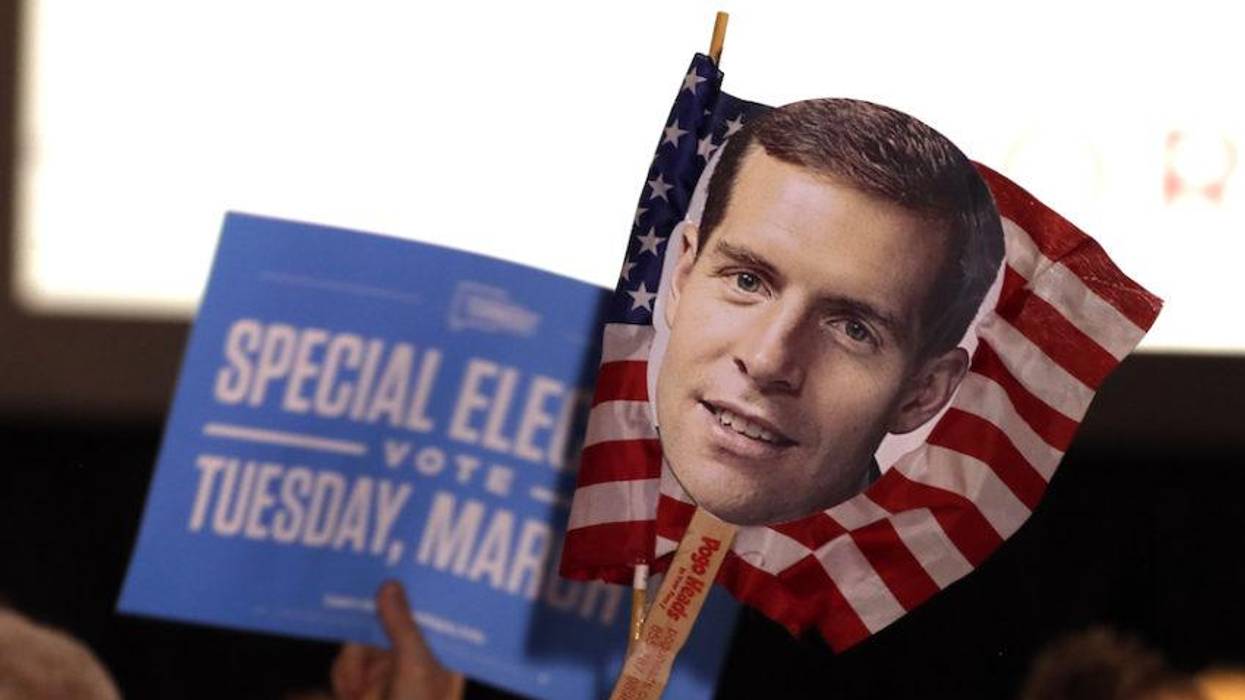
Trump has also spurred many Democrats inside the beltway. In Washington, D.C., for example, men and women who hadn't been activists before, such as professors, government workers and other professionals, worked for over a year and campaigned door-to-door in some northern Virginia races last November in which first-time candidates (mostly women) won. They also traveled to southwestern Pennsylvania in March to campaign for Conor Lamb, the Democrat who won the congressional special election in a Trump stronghold. Now they're campaigning and raising money for northern Virginia Democrats running for Congress in flippable districts.
Many of them, often in their 60s and 70s, joined the Indivisible Network, a group that formed after Trump's election. At a meeting last week, one woman explained why: "I could have just sat around and whined. But I had to do something."
Republican Voters
Those I interviewed--steelworkers, factory workers, truck drivers and small businesspeople--are just as partisan as Democrats. Interestingly, some have a disconnect on some issues: For example, they think universal health care and education-for-all could be good--one retired steelworker had two friends who died because they couldn't afford the care they needed--but they still think these are socialist schemes, and typically reject them.
Doug Jackson, a Mississippi truck driver and trainer of new drivers (he was also once a welder and mechanic), reflects another disconnect--on immigration. "A friend and I were talking about the immigrants headed to the border right now, and he said we ought to keep them out. I used to think that too, but I told him 'to put yourself in the position of being a father where there are death squads. ... You'd do whatever you could to get your family to a safe place.' I also told him that immigrants do the jobs no Americans want. They pick up trash, pluck chickens or pick vegetables. When I finished talking to him, he was thinking about it differently."
Still, Jackson has harsh words for those he thinks are "lazy" and "don't want to work"--labels often linked to the poor who receive benefits. "I've worked since I was 17 and dropped out of school to support my parents," he told me. "If somebody wants something, they have to work for it."
Does he see a connection between Trump's diatribes and Cesar Sayoc, the avid Trump follower who was charged with sending pipe bombs to Democrats and their supporters last week? Jones thinks for a few seconds and says, "Possibly. If someone is that mentally disturbed to begin with, in-your-face rhetoric might set someone off." But, he added, "I'm not certain."
Nearly all the Republicans I interviewed, however, are elated about the economy. Over and over they say they'll vote Republican on Nov. 6 because "the economy is booming, everyone has a job and Trump made it happen." Their older kids are also enrolled in or have graduated from college--the first in their families--although they're often working two jobs to pay off their loans.
Even a young black woman, a part-time Dollar General cashier in a poor Pittsburgh neighborhood, says, "Jobs are what matters."
"Me and some of my friends might even vote for Trump if he runs again," she told me. Although she earns $7.25 an hour (the federal minimum wage) and has no paid vacation, sick leave or company-paid health insurance--and will only get a 50-cent-an-hour raise next year--she still says, "I have a job."
Many factory workers in Indianapolis also take this line. That the number of jobs Trump promised he'd save at the Carrier furnace-producing plant only turned out to be 800, or that the nearby Rexnord Corp. ball-bearings plant shut down in 2017, sending 300 jobs to Monterrey, Mexico, doesn't enter the narrative. Nor does the fact that some Rexnord workers found new jobs, but often at less pay and with far fewer benefits.
They don't like Trump's behavior--not the men at the Flying J truck stop on Interstate 70 in Indiana, not the convenience-store owner in Rankin (a run-down neighborhood outside Pittsburgh, whose steel mill sits shuttered), not the men and women at a bar near an Indianapolis factory, and not the retired realtor who lives in a wealthy Akron, Ohio, suburb. But it doesn't turn them off. "He doesn't say things nicely, but he tells the truth--not like typical politicians talk, who always b.s. us." And they don't read the fact checks or hear them on Fox News. So rudeness--"Yes, he's crude," one woman told me--is mistaken for honesty.
According to Richard Walker, an emeritus professor of economic geography at the University of California, Berkeley, "Since unions have been so compromised and once-tight communities are dispersed, there's no worker education, and no worker or community solidarity." He says these were crucial "because they helped people understand what was going on."
Thus, many workers I interviewed don't blame the companies for closing their plants and dispatching their $25-an-hour jobs to Mexico, where workers earn $3. Instead, they blame the politicians or the union president "who didn't save our jobs."
Others see no point in voting. Not the Cinnabar concession worker at the Flying J, who earns $8.50 an hour and is pleased she'll get a 50-cent raise next year. "I haven't ever voted," she says. Nor does the Pakistani-born, U.S. citizen, refrigerator technician in Virginia who says, "All politicians make promises and are crooks."
Walker says the fact that the economy is booming is normal for the end of a long upswing. He explains that the recovery from the deep 2010 recession, which peaked in 2015, got a push from the Republican 2017 tax cut. While most of the gains went to corporations, it did put some money into the economy and a little more in ordinary people's pockets. In turn, they spent more, which spurred demand and job growth.
This also gave states and cities more taxes, so they have spent more, say, on hiring teachers or fixing roads. "All this had a multiplier effect," Walker says.
The stimulus, however, didn't trigger a massive investment boom in factories or equipment. As recently reported in Financial Times, the tax cut had "little impact on investment." According to the piece, a National Association for Business Economics survey of the third quarter in 2018 found "members reporting rising sales and improved profit margins, but that the Republican tax reform 'has not broadly impacted hiring and investment plans.' "
"The surge reached its peak, isn't sustainable and looks like it's running out of steam," Walker says. He points to the S&P stock market index that's down 10 percent from last year and global stocks that are down 20 percent. "These drops wiped out the gains of the past year. Historically, economies peak before they go down," he notes.
As more evidence of trouble, "Credit card debt in the U.S. has reached a seven-year high," he says. "This means people don't have enough income to cover their needs" and therefore turn to plastic. The economist says the old line is still true--that "people think the economy looks good because it's been down for so long." They think this way although real wages haven't increased since 1979.
Velasquez agrees. "I haven't seen an explosion of new jobs around here. ProMedica, a health care management corporation based in Toledo, consolidated its services in the downtown area, which created construction jobs. Some people believed Trump caused this, but he didn't.
Still, many working- and middle-class Republican voters think life is better than it was a few years ago, which will guide them on Election Day.
On Tuesday, FiveThirtyEight, the online journal that estimates election results, says Democrats have an 85 percent chance of winning the House and a 15 percent chance of winning the Senate, though a loss of one seat is more likely. That would mean a Senate with 52 Republicans and 48 Democrats.
Despite polls heralding blue or red waves, based on my heartland and other interviews, it's a tremendous toss-up.