SUBSCRIBE TO OUR FREE NEWSLETTER
Daily news & progressive opinion—funded by the people, not the corporations—delivered straight to your inbox.
5
#000000
#FFFFFF
To donate by check, phone, or other method, see our More Ways to Give page.


Daily news & progressive opinion—funded by the people, not the corporations—delivered straight to your inbox.
"Joe Biden's next climate legacy-defining act must be to pass the torch to a new nominee," says Sunrise Movement executive director Aru Shiney-Ajay.
The head of a leading U.S. climate action group on Friday joined nearly 20 congressional lawmakers and the growing list of Democratic Party insiders, pundits, and others who are imploring President Joe Biden to step aside and let another Democrat run against former President Donald Trump in November's election.
"For the future of our democracy and our planet, we must defeat Trump this November. If Trump wins, he will demolish President Biden's historic climate achievements, such as the Inflation Reduction Act and American Climate Corps," Sunrise Movement executive director Aru Shiney-Ajay said in a statement. "Another Trump presidency would cause catastrophic and irreversible damage to our climate."
According to Shiney-Ajay:
The Democratic Party must seriously assess whether Joe Biden can successfully convince voters and energize volunteers. After speaking with young people around the country over the last few weeks, I'm concerned that Joe Biden isn't positioned to mobilize young people and win in November.
To be very clear, regardless of who the Democratic candidate is, our plan is the same: to persuade young voters to turn out for the Democratic nominee in order to defeat Trump. With another ticket that energizes young volunteers, we could contact up to twice as many voters this fall.
"To young people: Losing this election could alter the rest of our lives. In order to fight for our generation and our future, we must vote for the Democratic nominee," Shiney-Ajay stressed. "Joe Biden's next climate legacy-defining act must be to pass the torch to a new nominee."
Trump, who has habitually called human-caused climate change a "hoax," filled his administration with officials who were criticized for being inimical to their respective agencies' stated missions. Some of his key appointees—including Rex Tillerson, his first secretary of state, and Ryan Zinke, who headed the Interior Department—were former fossil fuel executives or had track records of supporting the oil, gas, and coal industries.
The debate over Biden's future as the Democratic nominee comes as nearly 20 members of Congress have called on the president to stand down in favor of another candidate, and as poll after poll show him losing to Trump amid a glaring lack of enthusiasm for his candidacy.
"In 2020, Biden was able to energize young people to not only vote, but urge their friends, parents, and neighbors to do the same," said Shiney-Ajay. "We saw that energy at Sunrise, when our volunteers contacted 3.5 million young voters urging them to vote for Biden. Since the debate, already low enthusiasm for Biden has continued to drop."
"The stakes are too high," she added. "We can't afford to ignore the warning signs in front of us."
Relentlessly tearing down one of our most effective leaders undermines the capacity for progressives to win. And win we must.
Last week, something exciting happened: The Biden Administration announced the official launch of the American Climate Corps (in addition to rolling out $7 billion in federal grants for residential solar investments in low-income communities).
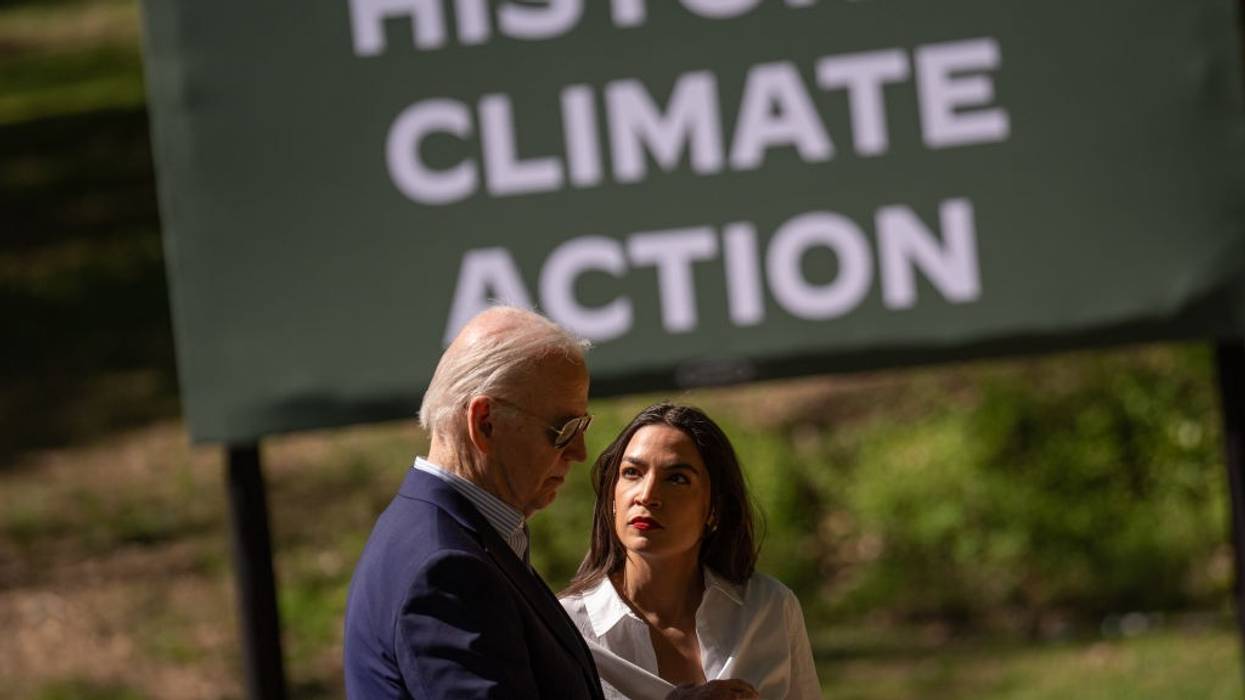
When a Climate Corps program was initially proposed by organizations like the Sunrise Movement and Congressional leaders like Sen. Ed Markey and Rep. Alexandria Ocasio-Cortez, I remember thinking to myself, “Well that’s a lovely idea . . . but yeah right.” Reviving one of the most radical New Deal programs, the Civilian Conservation Corps, to put thousands of young people to work decarbonizing the country? It sounded like a leftwing pipedream. But there was Biden last week, standing next to AOC to describe in concrete, practical terms how you can now apply for a job with the Corps. After five years of electoral organizing, civil disobedience, and legislative advocacy pushing this proposal, it was an announcement worth celebrating—at least for a moment— before diving back into the fight.
But for a segment of the online left, this was not a moment to celebrate. For them, given Biden's terrible Gaza policy, there was only one relevant takeaway from the event: AOC, by standing next to the president showed she was a “a pathetic, spineless coward,” as one representative tweet on X put it. Nevermind that AOC has been one of the most sustained and effective critics of Biden’s uncritical support for Israel's war; nevermind that she provided arguably the highest-profile definition of Israel’s conduct in Gaza as an “unfolding genocide”; nevermind, even, that she took the opportunity at that very Earth Day event to loudly praise campus protesters. For AOC’s haters on the left (and I think “haters” is the right word, versus, say, “critics”—while all politicians deserve accountability, the people I’m referencing here are not those offering constructive critiques of AOC), the rollout of a visionary Green New Deal program that she introduced, that would almost certainly not exist without her organizing and leadership, was just one more opportunity to call AOC a traitor to the progressive cause.
This left-wing AOC derangement syndrome has a lot to say both about the brand of politics that AOC’s haters represent and the role she occupies within our political system.
But first, it bears noting that, according to every piece of private polling I’ve seen, AOC haters comprise an extremely small slice of the American left. They may be very loud on their preferred stomping ground over on X, formerly Twitter, but they do not represent the vast majority of us. What they do represent, to a profoundly precise degree, is a particular strain of leftist politics that has been an obstacle to the goals of our movement for a very long time. Indeed, one’s stance on AOC may just be the most accurate diagnostic test we’ve got of what a supposed leftist is most interested in. Do they want to change the world, or to engage in in-group masturbatory preening? Do they want to win, or do they want to lose?
This left-wing AOC derangement syndrome has a lot to say both about AOC’s haters and the brand of politics they represent, and about AOC and the role she has taken on within our political system.
Much has been written about the proclivity of some on the left to valorize defeat—to, as my friend Sam Adler-Bell put it, “imagine there is some meaningful consolation in losing righteously.” But for those of us who take our progressive values seriously, securing a fairer world and a livable future is not just a social media talking point. It’s a necessity. In the oft-repeated words of Assata Shakur, it is not only “our duty to fight for our freedom. It is our duty to win.”
Taking seriously one’s duty to win requires having a theory of change that is grounded in reality. Of course, different progressive organizers, movements, and elected officials can employ a range of varied yet equally valid visions for how we win. But to be grounded in reality means, at the very least, accepting that we live in a majoritarian democracy in which winning real change requires getting to 50% + 1. (It’s true that the authoritarian right has worked for decades to change this, to instantiate its will through the creation and maintenance of minoritarian structures, from Republican gerrymandering and voter suppression to the Federalist Society’s takeover of our courts. But that only means that, in those arenas, it’s necessary to build even broader majoritarian support to overcome and reverse those antidemocratic developments.)
That fact is not an invitation to fall back on David Shor-style “popularism,” a shallow strategy that takes for granted the immovability of the public and preemptively surrenders our ability to make bigger, more structural changes. Social movements can—and, indeed, must—shift the horizon of what’s possible. But you can’t accomplish that by retreating to your in-group lefty clubhouse, talking only to your small circle of current believers, and waiting for the world to magically change. It requires a disciplined focus on winning over persuadable people, growing our movement, engaging in coalition politics, and making once-radical propositions seem reasonable, even mundane. These are all things that AOC does incredibly well. And they’re the very same proclivities that her haters use to brand her an enemy of the cause.
Yet this approach to politics has been essential in helping the left win a series of progressive victories over the course of Biden’s first term. Indeed, in the last week alone, the administration has ordered power companies to cut pollution from coal plants, banned non-compete agreements for 40 million Americans, raised overtime wages for four million salaried workers, forced airlines to automatically offer refunds for canceled flights and poorly handled baggage, banned illegal junk fees in mortgage lending, and blocked a major corporate merger, among other significant actions.
While it’s understandable to feel that Democratic failures on Israel/Palestine overshadow accomplishments like these, they don't negate the concrete impact of such gains for millions of Americans, and they shouldn't erase the countless organizers who helped achieve these wins.
You’d need a persuasive argument for why our movements—for a livable future, unions for all, reproductive justice, and so much more—aren’t massively better off under Biden than Trump. I haven’t heard any such argument from AOC’s haters.
Of course, the most vitriolic attacks on AOC stem from her support for Biden’s reelection. But what is the alternative strategy? AOC has a clear theory of change for her position: “I think about what conditions do I want to be organizing under in the next four years . . . I would rather, even in places of stark disagreement, I would rather be organizing under the conditions of Biden as an opponent on an issue than Trump . . . I am taking [Trump’s threat to democracy] very seriously, because we will not be able to organize for any movement towards anything [under] the kind of authoritarianism that he threatens.” That’s a strong, empirically-rooted analysis. It’s possible to disagree with her position. But you’d need a persuasive argument for why our movements—for a livable future, unions for all, reproductive justice, and so much more—aren’t massively better off under Biden than Trump. I haven’t heard any such argument from AOC’s haters, or any competing, reality-based theories of change regarding the 2024 election. (To be clear, third parties don’t work in winner-take-all electoral systems, almost by definition. The only way a third party can win in a system like ours is by supplanting another party, which necessarily means it’s no longer a third party, just the other half of a structurally similar duopoly).
And I do not say this as a blind Biden partisan. I was involved in some of the very first conversations kicking off the initial “vote uncommitted” campaign in New Hampshire this year, and in my home state’s presidential primary last month I actively encouraged people to join me in voting uncommitted. These campaigns had a clear, strategic theory of change: to push Biden on Gaza now, prior to the general election, by demonstrating in the most difficult-to-ignore way that recreating his 2020 coalition will be much, much harder if he doesn’t change course. Unsurprisingly, AOC was the highest-profile politician in the country to make an argument in support of this movement—as she so often is.
Of course, I know that nothing written here has a chance of influencing any AOC haters; that group has made up its mind on the subject. This plea is for all the rest of us. Our movement needs to start calling out AOC derangement syndrome for what it is. It’s not just stupid. It’s not just cynical. It is, in actual fact, the perfect distillation of a strain of left politics that represents a betrayal of our cause. As progressives, we have a duty to win. Relentlessly tearing down one of our most effective leaders—someone who’s proven she is able to use both the legislative process and the bully pulpit to move us materially closer to the world we need and deserve—undermines our capacity to win. And that is unforgivable.
"Solar for All is exactly the type of investment the country needs to re-imagine our clean energy future," said one campaigner. "It's great to see President Biden jumpstart this landmark program."
Climate action advocates on Monday celebrated the Biden administration's Earth Day announcement that it is distributing $7 billion in Solar for All grants "to develop long-lasting solar programs that enable low-income and disadvantaged communities to deploy and benefit from distributed residential solar, lowering energy costs for families, creating good-quality jobs in communities that have been left behind, advancing environmental justice, and tackling climate change."
The U.S. Environmental Protection Agencyestimates that the awards—which are going to 60 applicants, including states, territories, tribal governments, municipalities, and nonprofits—will fund solar projects that positively impact over 900,000 households nationwide while reducing 30 million metric tons of carbon dioxide equivalent emissions. The grant competition was made possible by the Inflation Reduction Act, which President Joe Biden signed in August 2022.
"The United States can and must lead the world in transforming our energy systems away from fossil fuels," said Sen. Bernie Sanders (I-Vt.), who joined Biden on Monday to announce the solar grants—$62.45 million in funding will go to his state—and the Vermont Climate Corps.
"The Solar for All program—that I successfully championed—will not only combat the existential threat of climate change by making solar energy available to working class families, it will also substantially lower the electric bills of Americans and create thousands of good-paying jobs," noted Sanders. "This is a win for the environment, a win for consumers, and a win for the economy."
The Mandan, Hidatsa, and Arikara Nation and Indigenized Energy will get over $135 million to work on solar projects in tribal communities across five states.
Cody Two Bears, executive director of Indigenized Energy, said that the award "will serve as a catalyst for tribes and energy justice communities like ours who are leading the way in building our own clean energy systems within our lands."
"This is a once-in-a-generation award that will begin to transform how tribes achieve energy sovereignty," Two Bears added. "The shift from extractive energy to regenerative energy systems will be the legacy we leave for our future generations."
Margie Alt, director of Climate Action Campaign (CAC), a coalition of a dozen national groups, highlighted both the emissions cuts and that in low-income communities across the United States, "families will see savings—approximately $400 per household."
"The president also announced the launch of the ClimateCorps.gov—a new website featuring 2,000 new job listings in climate and conservation," she pointed out. After years of pressure from campaigners, Biden in September announced the American Climate Corps, which was inspired by former President Franklin D. Roosevelt's Civilian Conservation Corps.
"We're thankful to the Biden administration for making these priorities a reality," said Alt. "While Republicans in Congress make every attempt to roll back climate progress, climate champions in Congress and throughout the administration are standing strong in their commitment to America's clean energy future; a future where all Americans have access to clean energy, good-paying jobs in the clean energy industry, and see direct savings from this clean energy boom."
Paula García, senior energy analyst and energy justice lead at the Union of Concerned Scientists (UCS), which is part of the CAC coalition, also applauded the awards, saying that "the Solar for All grant program is a key part of the larger suite of clean energy investments advanced by President Biden and Congress that will help the United States combat climate change."
"Directing investments toward low-income and disadvantaged communities is imperative to ensuring a just transition to clean energy," García stressed. "If we don't prioritize these populations, we risk exacerbating historical injustices and piling additional burdens on those who have been disproportionately affected by environmental harm."
"The announcement of these grants is an important step forward," she continued. "While UCS research has shown clearly that more ambition is needed to meet climate goals, phase out fossil fuels, and advance environmental justice, the Solar for All program will help create much needed momentum toward ensuring the many benefits of a decarbonized economy, including public health protections, reduced consumer energy costs, and increased energy resilience, are reaching everyone."
Jean Su, who directs the Center for Biological Diversity's Energy Justice program, similarly said that "Solar for All is exactly the type of investment the country needs to re-imagine our clean energy future."
"Broad community-based solar is our brightest hope for protecting people and our climate from the scourge of fossil fuels," she added. "These targeted investments mean low-income families get clean energy that is affordable, resilient, and protects our ecosystems. It's great to see President Biden jumpstart this landmark program. I look forward to its expansion, along with steps to curb fossil fuels with a climate emergency declaration."
Her group and the youth-led Sunrise Movement are among the organizations that have long demanded a climate emergency declaration from Biden, who is reportedly reconsidering it in the wake of the hottest year in human history and as he prepares for a November rematch against former Republican President Donald Trump—whose election could mean a surge in planet-heating pollution, according to an analysis published last month.
Emphasizing the difference between the Democratic Party and the GOP, climate reporter David Roberts called the solar grants "amazing stuff that would not happen if Republicans were in charge" and said, "Thanks Biden!"
We're in a global emergency, but Biden's American Climate Corps offers only vague timelines and few concrete plans for deployment. In rare cases where details do exist, they are underwhelming.
The year is 1942. The Japanese have bombed Pearl Harbor. The Nazis have invaded Russia and declared war on America. President Franklin D. Roosevelt addresses the nation to make an important announcement: The White House is launching a drive to recruit 20,000 Americans to fight for our collective survival.
The idea, of course, would have been laughable — a response utterly inadequate to the threat then posed by global fascism. In reality, during his 1942 State of the Union address, FDR announced a list of massively ambitious wartime goals, from industrial production, to collective public determination, to the global deployment of American troops. “We must raise our sights,” he told the nation. “Let no man say it cannot be done.” He did not launch a website to recruit a mere 20,000 soldiers.
Yet this is precisely the type of half-measure actions the Biden administration is taking in tackling the climate crisis.
The latest such move came last week as the White House announced the formation of an American Climate Corps to recruit 20,000 Americans to install solar and wind systems, rebuild wetlands, restore forests, and more. Are these jobs vital to save as much of the world as we can? Absolutely. But just as victory against the Axis Powers rested on the backs of millions of Americans, and an emergency wartime mobilization from coast to coast, victory against the climate crisis will require exponentially more than 20,000 recruits. Pretending otherwise is not only a failure of imagination, it is a tacit surrender to the greatest threat we have yet faced as a people.
President Biden’s American Climate Corps contains echoes of FDR’s Civilian Conservation Corps, which — as part of the New Deal — put over 3 million American men to work on public lands during the Great Depression. Unlike Biden’s plan, however, FDR seemed to mean business from the start: Within days of the executive order that established the corps, the agency had already recruited its first enrollees; two weeks later, it had opened its first camp, in George Washington National Forest. And just three months after its creation — in an astonishing feat of mobilization — the Civilian Conservation Corps employed over 300,000 Americans at 1,400 camps across the country.
By comparison, Biden’s American Climate Corps — also issued by executive order — offers vague timelines and few concrete plans for deployment. In rare cases where details do exist, they are underwhelming; the newly established “Forest Corps,” to take one example, will be tasked with “wildland fire prevention, reforestation, and other natural and cultural resource management projects.” Make no mistake, this is a good proposal that is desperately needed, as evidenced so tragically this summer by the deadly fires in Maui. Yet Biden’s plan calls for hiring just 80 people and “beginning next summer.”
A similar failure in ambition is occurring with industrial manufacturing. One month after the bombing of Pearl Harbor, at his State of the Union address, FDR announced the goal of producing 60,000 planes. Skeptics scoffed at such a lofty plan, yet by 1944 the United States had manufactured over 220,000 planes. Similar feats of industrial ambition occurred across the American economy, from the production of tanks to ships to rubber and more, not because FDR offered low-interest loans and tax incentives to American companies but because he took seriously the existential emergency that we faced as a people. He invoked the War Powers Act, he demanded the “impossible,” and the nation rose to the challenge, not only meeting his expectations but exceeding them.
FDR’s wartime mobilization stands in stark contrast to the incremental, market-based climate solutions favored by the Biden administration. The American economy remains the largest in the world, and the United States should have, years ago, become a global factory for solar panels, wind turbines, electric vehicles, batteries, and more. But between the climate allocations in the Inflation Reduction Act ($370 billion) and the Bipartisan Infrastructure Bill ($250 billion), it has committed less than 2 percent of total funding that experts believe is needed for a meaningful green transition of the US economy within a time frame set for 2029. Furthermore, climate provisions in both bills promote adaptation over mitigation or — worse — simultaneous streamlining fossil fuel development and extraction alongside green energy projects.
So what should Biden do? He must lead like FDR. He must set climate goals that sound less like an effort to fulfill a campaign promise and more like a strategy to successfully address the greatest existential threat we have faced as a planet. And he needs to act now. This past summer, the hottest on human record, was not “the new normal,” as some claim; it was a momentary stop on the route to a far more lethal climate.
The 1930s and ’40s demonstrated what we can achieve as a nation under ambitious leadership. We faced a seemingly invincible, all-powerful enemy and we rallied as a people to win. If we could achieve such monumental feats of logistical planning and rapid, nationwide scaling in a time before satellites and the internet, surely we can do better now. We have to.
"This historic victory," said the youth-led Sunrise Movement, "marks the beginning of a new era in the fight for a Green New Deal."
After years of pressure from environmentalists and progressive lawmakers, the Biden administration on Wednesday announced a new program aimed at training tens of thousands of young people in skills and jobs critical to combating climate breakdown, from land and water conservation to clean energy development.
Inspired by the New Deal's popular Civilian Conservation Corps—a popular decade-long program that employed millions of young men—the Biden administration's American Climate Corps (ACC) will establish a paid training program with the goal of providing "pathways to high-quality, good-paying clean energy and climate resilience jobs in the public and private sectors," according to a White House fact sheet.
The administration estimates that the program, established via executive action, will train more than 20,000 Americans, "putting them to work conserving and restoring our lands and waters, bolstering community resilience, deploying clean energy, implementing energy-efficient technologies, and advancing environmental justice."
Specific pay for the training program has yet to be disclosed.
The new initiative was unveiled days after dozens of U.S. lawmakers and advocacy groups sent letters imploring President Joe Biden to use his executive authority to launch a Civilian Climate Corps to "prepare a whole generation of workers for good-paying, dignified, union jobs, and build the workforce we need for the robust green economy of tomorrow."
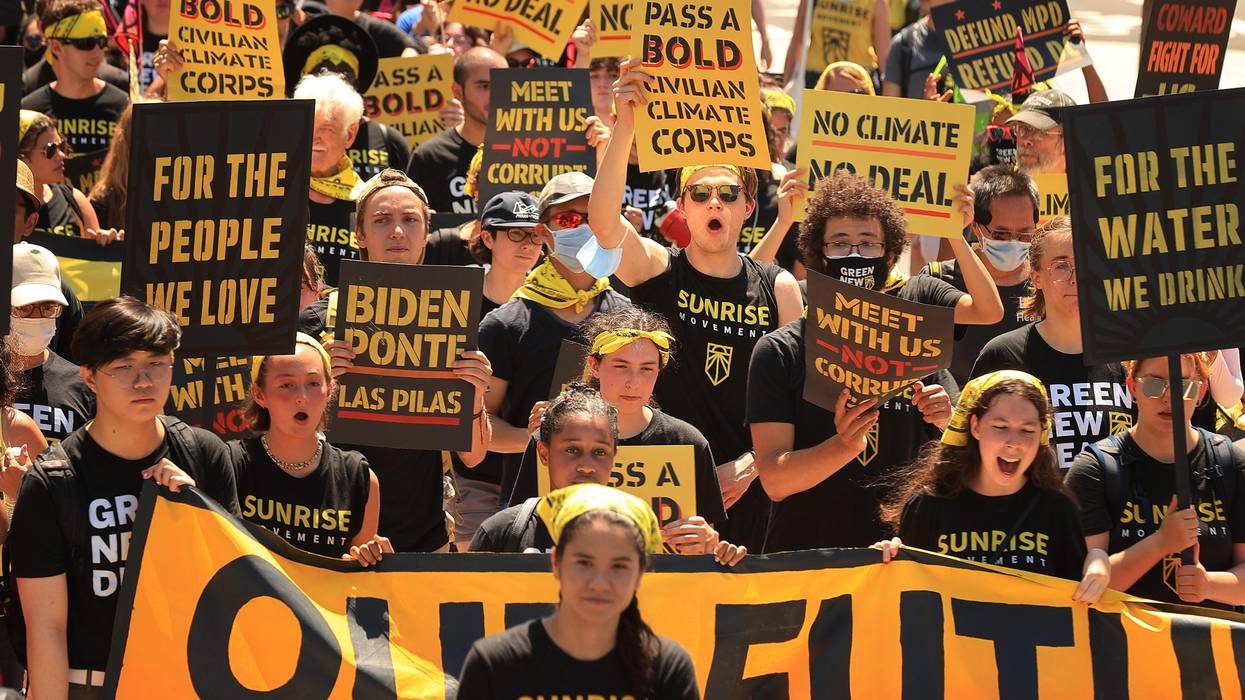
The youth-led Sunrise Movement, which spearheaded the advocacy groups' letter and has been organizing in support of a Civilian Climate Corps for years, celebrated the announcement of the ACC as "a response that begins to meet the moment and show young people how their government can work for them."
"Three years ago, I sat on then-Democratic presidential nominee Joe Biden and Bernie Sanders' Unity Climate Task Force and shared one of Sunrise Movement's top priorities for the future administration—a Civilian Climate Corps, a visionary jobs program to put thousands of young people to work in real career pathways fighting for their future," Varshini Prakash, the Sunrise Movement's executive director, said in a statement Wednesday.
"Now, after years of demonstrating and fighting for a Climate Corps, we turned a generational rallying cry into a real jobs program that will put a new generation to work stopping the climate crisis," Prakash added. "With the ACC and the historic climate investments won by our broader movement, the path towards a Green New Deal is beginning to become visible."
"We're often asked how President Biden can win the support and enthusiasm of young people. He's gotten our attention. Keep going."
Biden previously embraced the idea of a climate corps as he crafted what was known as his "Build Back Better" agenda, which included tens of billions of dollars in funding for such a program.
But due to opposition from oil and gas industry ally Sen. Joe Manchin (D-W.Va.) and other right-wing Democrats—as well as the entire Republican congressional caucus—the administration agreed to dramatically pare back its agenda and approve the Inflation Reduction Act, which included a number of
giveaways to the fossil fuel industry but not a climate corps.
NPR reported that the ACC is "likely to be smaller in scope than early proposals" and is "much smaller" than the Civilian Conservation Corps. The Biden administration did not say how much it plans to spend on the new program, which "will rely on existing funding sources," according to The Washington Post.
Nevertheless, climate advocates welcomed the ACC as a critical first step while urging the Biden administration to do more to phase out fossil fuels.
"We need an all-hands-on-deck approach to address the climate crisis, and the Biden-Harris administration establishing an American Climate Corps—with specific opportunities for youth to work in climate resilience careers—is a historic effort to meet this moment," said Sierra Club executive director Ben Jealous. "The Climate Corps will mobilize young people, workers, and federal resources in a way never seen before."
Keanu Arpels-Josiah, a member of Friday's for Future NYC, argued that "a climate corps is important but the executive actions we desperately need are those that will directly and swiftly phase out fossil fuel expansion and production."
"A climate corps that focuses solely on promoting renewables doesn't do the job," said Arpels-Josiah. "It won't undo the Biden administration's damage in approving climate bombs like Willow. It won't end new fossil fuel projects and phase out existing projects in the timeline we need for our generation to survive."
In a memo released Wednesday, the Sunrise Movement called the establishment of the ACC "a show of the strength of young people in the national political arena" and "a hopeful pivot by the Biden Administration towards a 21st century New Deal society."
"Moves like the creation of the American Climate Corps harken back to Franklin Delano Roosevelt's vision of government—meaning American government has a responsibility to invest directly in its people to provide relief, reform, recovery, and good jobs in collaboration with and support of organized labor," the group wrote. "This historic victory for Sunrise and the rest of the climate movement marks the beginning of a new era in the fight for a Green New Deal."
A number of federal agencies will be involved in supporting and implementing the new program, including the Department of Labor, the Department of the Interior, the Department of Energy, and AmeriCorps.
The Biden administration also announced Wednesday that "five new states—Arizona, Utah, Minnesota, North Carolina, and Maryland—are moving forward with state-based climate corps that are funded through public-private partnerships, including AmeriCorps, which will work with the American Climate Corps as implementing collaborators to ensure young people across the country are serving their communities."
Other states, including California, Maine, and Michigan, have already established climate corps programs.
"This past summer we saw record climate disasters, record labor strikes demanding good, meaningful work, and major climate protests led by young people," Prakash said Wednesday. "We're often asked how President Biden can win the support and enthusiasm of young people. He's gotten our attention. Keep going."