SUBSCRIBE TO OUR FREE NEWSLETTER
Daily news & progressive opinion—funded by the people, not the corporations—delivered straight to your inbox.
5
#000000
#FFFFFF
To donate by check, phone, or other method, see our More Ways to Give page.

Daily news & progressive opinion—funded by the people, not the corporations—delivered straight to your inbox.
The nearly $4.7 billion in International Finance Corporation trade finance commitments that may have supported fossil fuel-related projects in 2023 is a telltale example.
Since assuming office, World Bank President Ajay Banga has pursued a clear agenda: mobilize vast amounts of private capital in service of the bank’s goal to end poverty on a livable planet. There are many valid criticisms of this approach, but none speaks louder than a deeper look into the World Bank’s own private sector arm, the International Finance Corporation, or IFC, and its dealings.
Urgewald’s research on IFC trade finance in Financial Year (FY) 2022 and FY2023 shows just how slippery the private sector slope can be. Indeed, the IFC trade finance program’s alarming developments exemplify the World Bank’s overall trajectory: throwing good money after bad, neglecting environmental and social standards, and prioritizing private profit over public well-being.
From FY2017 to 2023, the IFC trade finance portfolio saw a hefty 86% increase. In FY2023, trade finance amounted to 58% of the IFC’s total portfolio. (Trade finance refers to a range of financial instruments and services designed to facilitate international trade. It provides liquidity and risk mitigation for exporters and importers, enabling transactions that might otherwise not be viable. Instruments such as letters of credit, guarantees, and working capital loans ensure that buyers and sellers can engage in global trade with reduced financial risks.)
The private sector’s profit orientation is incompatible with the World Bank Group’s public service mandate.
While the sums for trade finance are growing exponentially, the checks and norms for their disbursal are stagnating. The environmental and social standards that apply to trade finance have not been updated for at least a decade, and financial flows are shrouded in mystery.
The stated goal of ending poverty on a livable planet presupposes transparency, accountability and sustainability. And yet the meteoric rise of IFC trade finance transactions in recent years comes with opacity, outright unwillingness to disclose basic information about individual transactions, and the long shadow of fossil fuel favoritism.
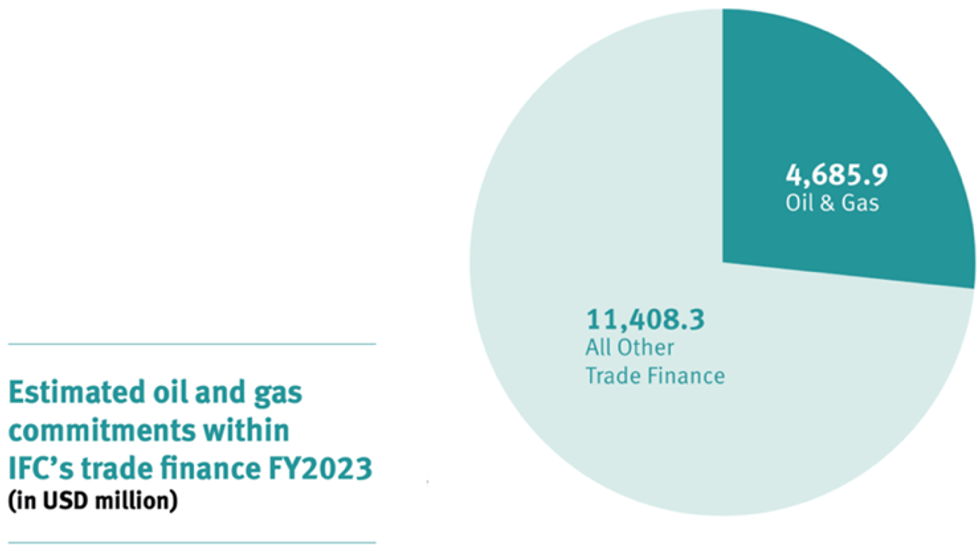
So, what’s the number? In FY2023, $4.7 billion, or nearly one-third of total IFC trade finance commitments, may have supported fossil fuel-related projects. This figure represents a 28% increase compared to FY2022.
The Global Trade Finance Program (GTFP) alone accounted for $3.7 billion of possible oil and gas-related financing, 41.7% of its total commitments. Transparency issues persist as the IFC fails to disclose detailed information about specific trade transactions and beneficiaries.
The World Bank Group’s own Independent Evaluation Group (IEG) indicates that in the past, significant shares of IFC trade finance investments went into fossil fuel financing, particularly in Africa (50%) and the Middle East (28%).
The dangerous trend of enabling fossil fuel transactions in fragile countries expands when we look at the IFC Private Sector Window (PSW). It was established in 2017 to encourage private sector investments in high-risk, low-income countries, particularly in IDA-designated regions. The PSW provides risk-sharing mechanisms and facilitates trade finance and other investments that might otherwise be deemed too risky. Between FY2020 and FY2024, $1.03 billion, or about a quarter of PSW approvals, were allocated to trade finance projects. These funds enabled $5.1 billion in trade finance, underscoring the PSW’s leveraged impact.
This fivefold impact, however, remains controversial. Despite its commitment to sustainable development, the PSW lacks exclusion criteria for fossil fuels. Thus, it allows for investments in oil and gas. Transparency remains a significant issue, and information about specific projects and the traded commodities is sparse. PSW-supported trade finance’s environmental and developmental impacts are questionable at best.
Many of these problems precede President Banga’s tenure. However, it is vital to highlight and address them now because his laser focus on mobilizing private capital is likely to exacerbate the issues highlighted above. The private sector’s profit orientation is incompatible with the World Bank Group’s public service mandate. The IFC’s growing trade finance portfolio highlights the organization’s critical role in shaping global trade. The significant share of fossil fuel commitments in that portfolio undermines the World Bank Group’s mission of fostering sustainable development.
To align with international climate objectives, the IFC must adopt urgent reforms to enhance transparency; exclude harmful investments; and prioritize clean, fair, decentralized renewable energy—especially in poor and high-risk regions of the world that need them most. To better align the PSW with its mission, the allocation of Private Sector Window funds should prioritize renewable energy and sustainable development projects. Additionally, stringent exclusion criteria and improved reporting standards should ensure greater accountability and alignment with climate and social goals.
These changes are clearly at odds with President Banga’s agenda, and yet only through them can the World Bank Group stay true to its noble goals.
Exploiting a "trade finance" loophole, the bank dumped an estimated $3.7 billion into oil and gas projects in 2022.
An analysis released Tuesday by the German nonprofit Urgewald estimated that the World Bank spent nearly $4 billion on fossil fuel financing last year, when it was under the leadership of a climate denier nominated by former U.S. President Donald Trump.
The World Bank pledged in 2017 to end financing for upstream oil and gas—with narrow exceptions—after 2019. But Urgewald observed in its new report that the World Bank's pledge applied only to direct finance, allowing the powerful institution to funnel cash to oil and gas projects through "trade finance" dished out by its private-sector arm, the International Finance Corporation (IFC).
"Despite trade finance's vast and still-growing share of the IFC’s budget, over 70% of it is given out in secrecy," Urgewald noted. "The types of goods and businesses it is funding are not even reported to the World Bank's shareholders, i.e., our governments. The public has a right to know where all this money is going."
Citing the IFC's "severe lack of transparency," Urgewald stressed that it was only able to "formulate an estimate" for oil and gas transactions. The group calculated that the World Bank spent roughly $3.7 billion on oil and gas trade finance in 2022.
"This would more than triple the current annual level of fossil fuel finance attributed to the World Bank and cast serious doubts on Bank claims of alignment with the Paris Climate Agreement," Urgewald's Heike Meinhardt said in a statement.
"The easiest way for a big oil company or coal operation to escape attention surrounding public assistance is to cloak it in trade finance."
The World Bank has long been accused of reneging on its climate commitments. A report released last year by Big Shift Global estimated that the World Bank has spent nearly $15 billion supporting fossil fuels since the adoption of the Paris Climate Agreement in 2015.
Late last year, former World Bank President David Malpass sparked global outrage by saying he's not sure whether he accepts the scientific consensus that climate change is caused by the burning of fossil fuels, further validating climate activists' longstanding calls for systemic reforms at the bank.
"I don't know," Malpass said in response to a reporter's question about his views on climate change. "I'm not a scientist."
The comments prompted widespread calls for Malpass to step down, which he did in June. Current World Bank President Ajay Banga, who U.S. President Joe Biden nominated to replace Malpass, is a former private equity executive who has worked for Nestlé, PepsiCo, and Citibank.
Urgewald warned in its report Tuesday that the World Bank will remain a major source of funding for the fossil fuel industry until it enacts reforms that prevent the IFC from bolstering oil and gas under the guise of "trade finance."
"The easiest way for a big oil company or coal operation to escape attention surrounding public assistance is to cloak it in trade finance," the group said. "It is a huge loophole that must be closed and evaluated through public disclosure."
Urgewald added that "there is no doubt" the World Bank and IFC "are going to deny" its findings and "claim the figures are inaccurate."
That's exactly what an IFC spokesperson did on Tuesday, telling The Guardian that "Urgewald's report contains serious factual inaccuracies and grossly overstates IFC's support for fossil fuels."
"IFC regularly reports accurate and timely project information through various channels," the spokesperson added.
Urgewald disputed that narrative in its report, asserting that the "continued secrecy surrounding trade finance makes it impossible to determine how much fossil fuel business the IFC is ultimately facilitating and whether the World Bank is actually aligned with the goals of the Paris Climate Agreement."
"An exorbitant amount of IFC money, i.e., more than half its budget, is streaming through banks without any oversight by the [World Bank Board of Directors], without any opportunity for public scrutiny, without any accountability," the group said.
"You can't address poverty in a world of climate chaos," one advocacy group told Ajay Banga. "End fossil fuel finance now!"
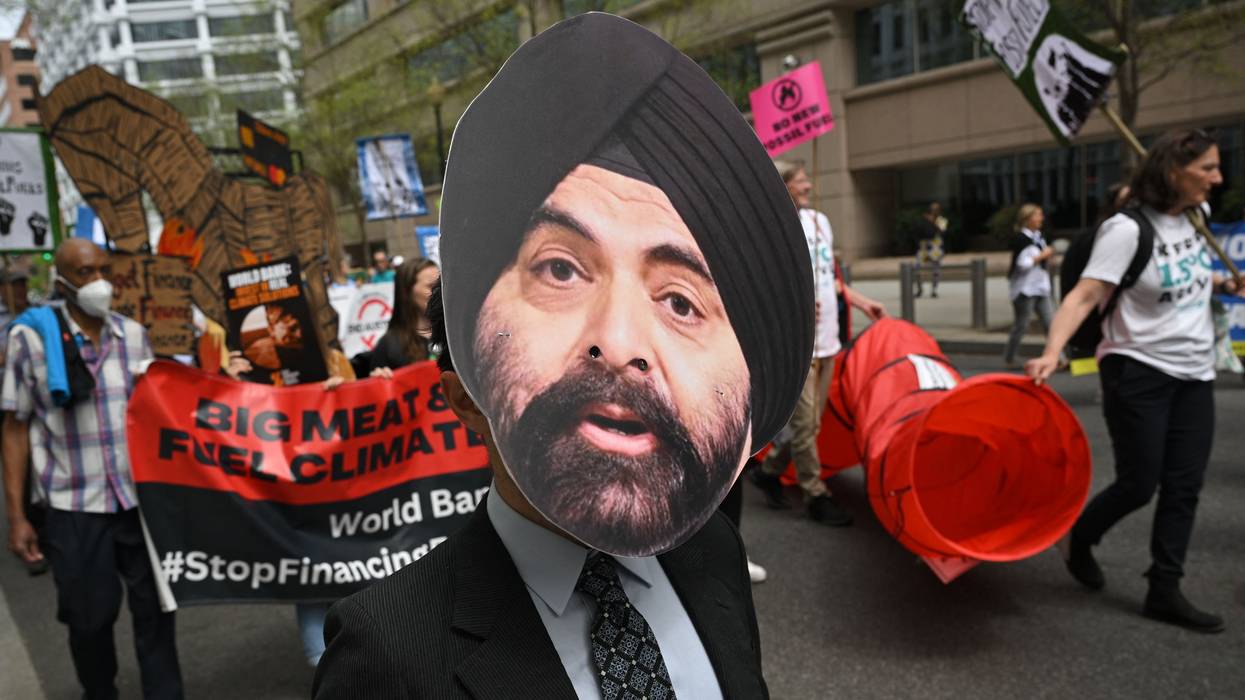
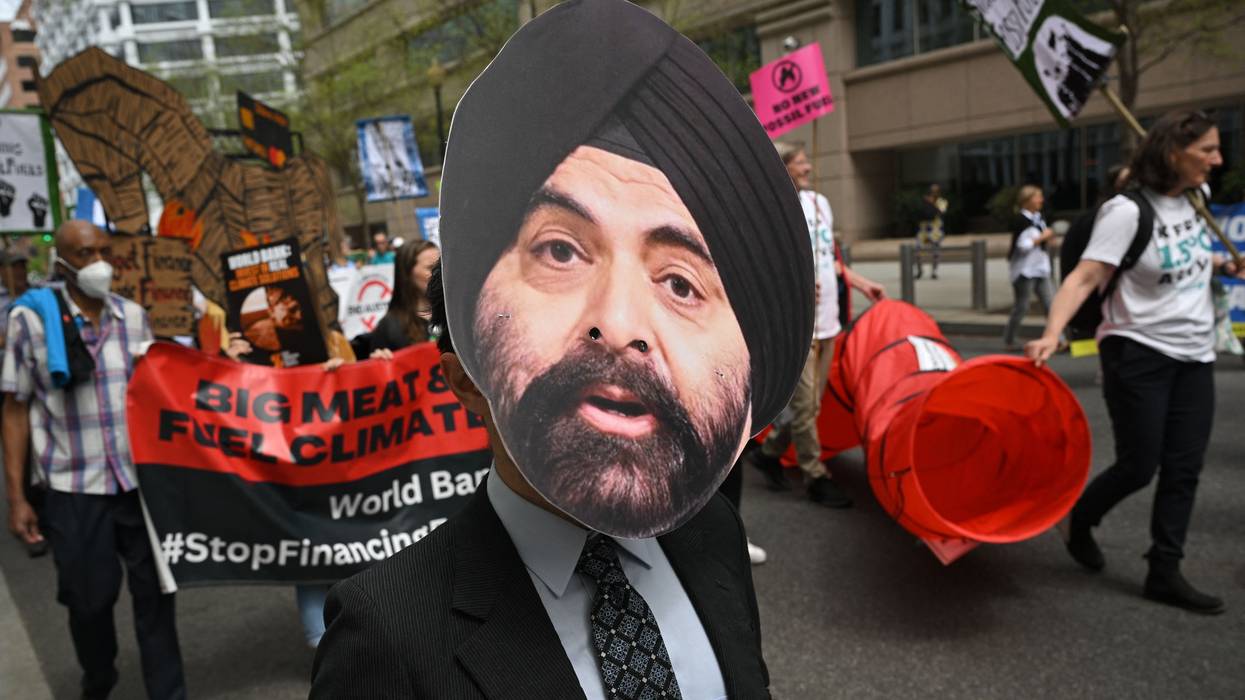
Climate advocates on Friday held a demonstration outside the World Bank Group's headquarters in Washington, D.C., where they welcomed the bank's new president, Ajay Banga, and implored him to immediately begin pursuing a global just transition.
Campaigners from the Glasgow Actions Team, Global Citizen, Friends of the Earth, and Big Shift Global handed their "First 100 Days" demands to World Bank staffers as they entered the building, making the case on Banga's first day at the helm that he should prioritize four key goals over the next few months: end fossil fuel finance, ramp up clean energy funding, cancel debt for poor nations facing myriad crises, and align the bank's policies with the Paris agreement's goal of limiting global warming to 1.5°C.
"It's not often we feel hope in the climate movement, but today, with a new World Bank president having publicly committed to taking climate change seriously, we're feeling hopeful," Glasgow Actions Team director Andrew Nazdin said in a statement. "But President Banga doesn't have a moment to lose; the time is now to announce plans to move away from fossil fuels and help the globe transition to clean energy in a just and equitable manner."

Climate advocates cheered in February when former World Bank President David Malpass, nominated to lead the bank by then-U.S. President Donald Trump in 2019, said that he would step down this spring, nearly a year ahead of schedule.
The early resignation announcement followed a sustained pressure campaign against Malpass, who was condemned as a "climate denier" after refusing to acknowledge that burning fossil fuels causes the planet-heating pollution underlying increasingly frequent and intense extreme weather disasters.
U.S. President Joe Biden's ensuing decision to tap Banga for the role angered progressives, who argued that the erstwhile private equity executive and former Mastercard CEO is likely to advance the powerful international financial institution's historically pro-corporate and pro-fossil fuel agenda. When the World Bank's board of governors ratified Banga's presidency in early May—appointing the Biden nominee to a five-year term with a June 2 start date—the bank's new leader suggested that a "climate change shift" was coming.
On the eve of Banga's first day in office, Big Shift Global acknowledged that his stated belief in climate science is an improvement over the status quo. But whether he leads the World Bank in "the right direction on climate" remains an open question, the international campaign noted, reiterating its demands for "a phaseout of fossil fuel finance and support for a just, clean energy transition."
Luisa Abbott Galvao, senior international policy campaigner at Friends of the Earth U.S., pointed out that "Ajay Banga has spent his career chasing profits for shareholders rather than working in the public interest."
"But he could still commit to a different legacy from his climate change-denying predecessor, David Malpass," said Galvao. "We call on Banga to pledge an end to World Bank financing for fossil fuels on his first day in office. When science says new fossil fuel developments are incompatible with the 1.5°C pathway, a failure to act is effectively climate denial."
For its part, the Glasgow Actions Team tweeted, "While Ajay Banga is inside addressing his staff, we're outside showing him how easy it is to truly shift the World Bank to act on climate change!"
"You can't address poverty in a world of climate chaos," the group added. "End fossil fuel finance now!"
Big Shift Global showed in a recent report that the World Bank has directly financed at least $14.8 billion in fossil fuel production since the signing of the Paris agreement in 2015—reneging on its 2017 pledge to stop supporting oil and gas projects within two years.
The Intergovernmental Panel on Climate Change and the International Energy Agency have made clear that fossil fuel expansion will cause the climate emergency's consequences to grow even deadlier, especially for humanity's poorest members who have done the least to cause the crisis.
Global Citizen noted Friday that impoverished countries on the frontlines of mounting socio-ecological catastrophes "can't tackle climate change when they're drowning in debt" and urged Banga to implement a debt jubilee in addition to subsidizing a green overhaul of the global economy.
The group also took out a full-page ad in The Wall Street Journal, calling on Banga to begin transforming the World Bank into an instrument for genuinely sustainable development on his first day.
"As the new president, what will your legacy be?" the ad asks. "In the face of the triple climate, poverty, and hunger crises, the world's biggest development bank stands at a critical juncture."
"Under your guidance, the World Bank could serve as an invaluable partner for low-income countries and those vulnerable to climate change," it continues. "The solutions are on the table."
"Make your first steps bold," says the ad. "Working alongside other multilateral development banks, help mobilize $1 trillion more in financing to help the world's poorest and most vulnerable countries quicken their transition to clean energy, withstand disasters, and power our planet."
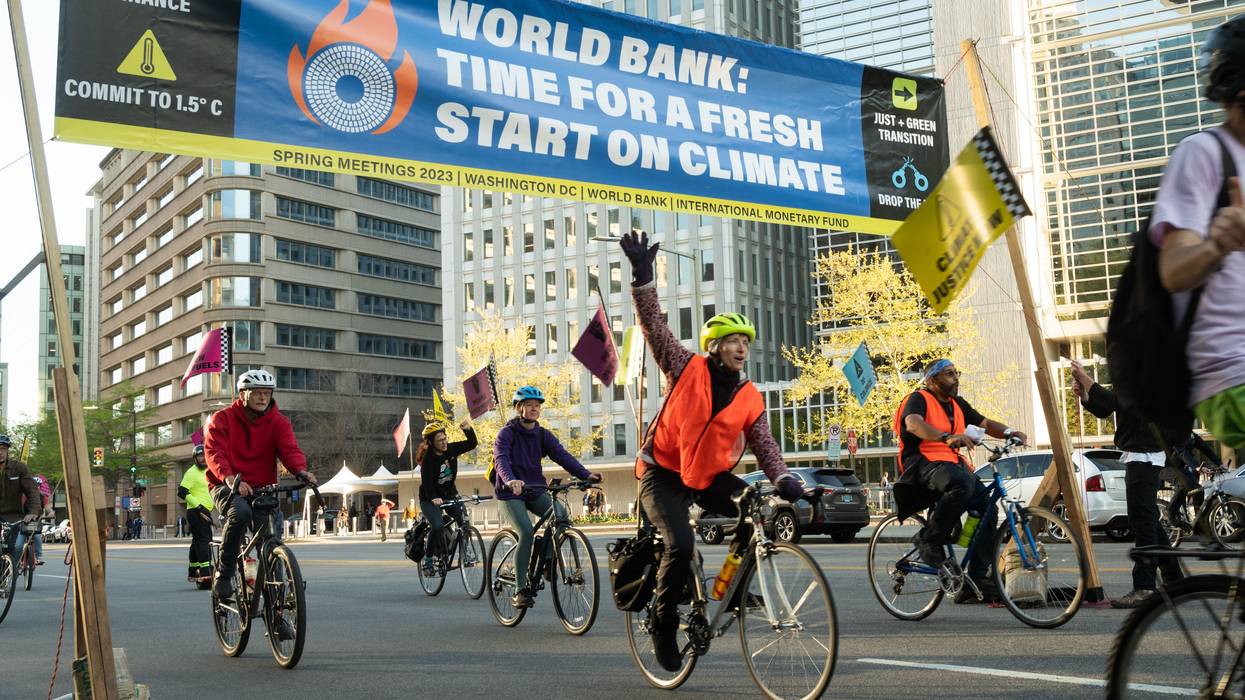
"After years of David Malpass in the president's office, we cannot afford another second of climate denial leading the bank," said one campaigner.
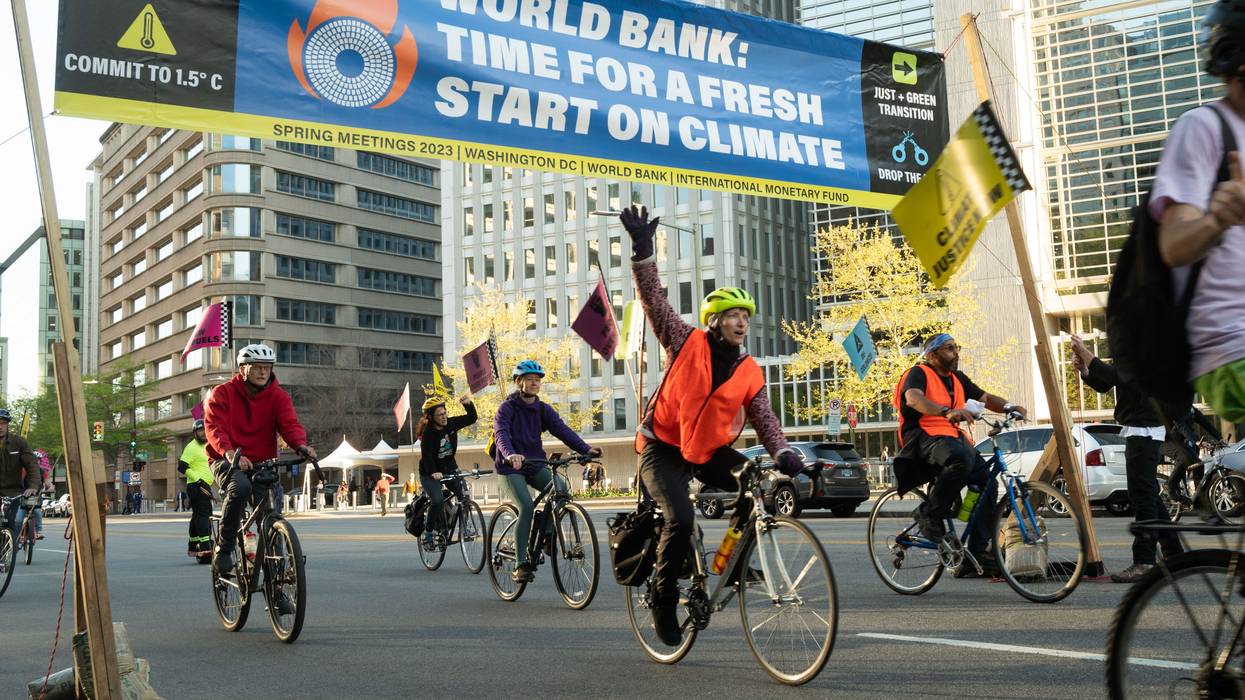
Roughly 100 activists marked the opening day of the World Bank Group spring meetings by riding bicycles through the streets of Washington, D.C. on Monday night, calling on incoming bank president Ajay Banga to halt fossil fuel financing and ramp up clean energy and climate justice investments.
While demanding a turnaround on green funding in developing countries, the "Wrong Way on Climate" bike protest blocked rush-hour traffic outside World Bank headquarters as finance ministers traveled to dinner parties and backroom meetings.
"Bikes are very literally people-powered," Hope Neyer, a public health student and organizer with Shutdown D.C., said in a statement. "They're the ultimate zero-emission vehicles. We chose to gather on bikes tonight to remind the World Bank of the potential we have as individuals and communities to show up for what we believe in—the need to protect our planet, the international right to make healthy choices for our families, and a future that is just and livable for us all."
The action took place on the first day of the bank's 2023 spring meetings, which are being run this week by outgoing World Bank President David Malpass. Climate advocates cheered in February when Malpass, tapped to lead the bank by then-U.S. President Donald Trump in 2019, said that he plans to step down by the end of June, nearly a year ahead of schedule. The early resignation announcement followed a sustained pressure campaign against Malpass, who was condemned as a "climate denier" after refusing to acknowledge that burning fossil fuels causes the planet-heating pollution underlying increasingly frequent and intense extreme weather disasters around the globe.
Activists—whose bike ride started under a banner that reads, "World Bank: Time for a Fresh Start on Climate"—are now looking to Malpass' replacement, Banga, to reverse course and scale up decarbonization efforts. Progressives in February denounced U.S. President Joe Biden for nominating the private equity executive and former Mastercard CEO to the role, arguing that he's likely to advance the powerful international financial institution's historically pro-corporate and pro-fossil fuel agenda. Campaigners are wasting no time in pressuring Banga to make the World Bank an instrument for genuinely sustainable development.
"Nominee Banga has the opportunity of a lifetime, if he can rise to the climate challenge."
"After years of David Malpass in the president's office, we cannot afford another second of climate denial leading the bank," Andrew Nazdin, director of the Glasgow Actions Team, said Monday. "Nominee Banga has the opportunity of a lifetime, if he can rise to the climate challenge—ending financing oil or gas, ramping up investment in renewables, and becoming the transformative leader the world is begging for."
In an attempt to defend his record amid criticism last September, Malpass said the World Bank allocated $31.7 billion to climate finance in 2021, with half of it aimed at bolstering adaptation efforts. Not only is that a tiny fraction of the trillions of dollars in green investment the Intergovernmental Panel on Climate Change (IPCC) says is needed each year to maintain a habitable planet, but according to reporting by the Financial Times, Malpass was directly involved in weakening multilateral development banks' (MDBs) joint announcement on climate lending at COP26.
After the World Bank described itself last year as "the largest multilateral funder of climate investments in developing countries," Bronwen Tucker of Oil Change International pointed out that "the World Bank Group still funds more fossil fuels than any other MDB, and they continue to lock Global South countries into expensive and volatile fossil fuel contracts through their heavy-handed policy lending programs."
The Big Shift Global coalition showed in a recent report that the World Bank has directly financed at least $14.8 billion in fossil fuel production since the signing of the Paris agreement in 2015—negating its 2017 pledge to stop supporting oil and gas projects within two years.
The IPCC and the International Energy Agency have made clear that fossil fuel expansion is incompatible with limiting global warming to 1.5°C above preindustrial levels, beyond which the climate emergency's consequences will grow even deadlier, especially for humanity's poorest members who have done the least to cause the crisis.
"As the World Bank and IMF meet behind closed doors to advance the agenda of concentrated corporate and political power, a coalition of D.C.-area activists in solidarity with movements worldwide, especially in the Global South, manifested a very different vision outside," Basav Sen, member of the For People For Planet coalition, said Monday. "We encircled the meetings on bicycle and on foot, to assert the power of organized people."
Concerned citizens from around the globe are demonstrating throughout the week to demand that the World Bank stop financing fossil fuels. They also plan to call for an overhaul of both Bretton Woods institutions—the World Bank and the International Monetary Fund—to "prioritize justice, helping developing countries to green to follow a 1.5°C roadmap with poverty alleviation at its heart," according to the Glasgow Actions Team. "They will also call to end the 'gentlemen's agreement' that has thus far allowed only the U.S. to nominate the World Bank president."
On Tuesday morning, activists held a "First 100 Days" protest outside World Bank headquarters. They unveiled a first 100 days checklist that outlines what they want incoming bank president Banga to achieve at the start of his five-year term.
Campaigners also plan to gather outside the World Bank on Wednesday for a "Stop Fossil Gas" demonstration, where they will draw attention to the bank's continued funding of a worldwide expansion of gas pipelines.
Activists plan to cap off the week of action with a large march and rally on Friday that features a "Trojan Horse" of debt impacts on low-income nations the World Bank works with.
"This moment demands a World Bank leader who will prioritize the urgency of the climate crisis, not another Big Business executive with no experience in development, environmental work, or the public sector."
U.S. President Joe Biden on Thursday nominated a private equity executive and former Mastercard CEO to lead the World Bank, drawing furious backlash from climate and anti-corruption campaigners who said the pick would ensure the key global financial institution remains a tool of corporate interests and funder of climate chaos.
Ajay Banga's employment history, touted as exemplary by the White House, was the primary source of concern for advocates who were hoping Biden would replace outgoing World Bank head David Malpass—a Trump appointee who recently came under fire for climate denial—with a public servant dedicated to combating the climate crisis, global poverty, and skyrocketing income and wealth inequality.
Before becoming vice chairman of General Atlantic—which one watchdog described as a "rapacious international private equity firm"—Banga worked at Nestlé, PepsiCo, and Citibank. Banga also served on Dow Chemical's board of directors and as chair of the International Chamber of Commerce, a powerful corporate lobbying organization.
"Nothing in Banga's resume inspires confidence that he will turn the World Bank away from a path of neocolonialism and predation by Global North corporations upon Global South countries," said Revolving Door Project executive director Jeff Hauser, alluding to the body's history of pushing austerity, advocating for the privatization of critical resources such as water, and financing oil and gas projects.
"Sadly, a vision that those who govern best are those that have profited the most from deregulation, economic predation, and the shrinking of the public sphere seems to be winning out in the Biden administration now. Indeed, this vision, we have argued, is what guides Biden's new Chief of Staff, Jeffrey Zients," Hauser continued. "Biden and [Treasury Secretary Janet] Yellen should be ashamed of this choice. Our message in the past was to figure out how to expeditiously fire David Malpass. Our message now is to retract this nomination and simply do better."
Collin Rees, the U.S. program co-manager at Oil Change International, said in a statement Thursday that Biden's selection of Banga is "deeply disappointing."
"This moment demands a World Bank leader who will prioritize the urgency of the climate crisis, not another Big Business executive with no experience in development, environmental work, or the public sector," Rees added. "Banga's long career at predatory banks and corporations does not inspire confidence that he would transform the World Bank into an institution that can work for people and the planet. On the contrary, it's sadly ironic that his past work as a Nestlé executive aligns with the World Bank's damaging history of water privatization."
"He represents U.S. corporations rather than the needs of 8 billion people around the world."
Since the World Bank's inception in 1944, the U.S.—the institution's largest shareholder—has chosen its leader, a "gentleman's agreement" that critics say is deeply undemocratic and partly responsible for the bank's historic fealty to corporate power.
Banga must be confirmed by the World Bank's board, a step that is widely seen as a forgone conclusion given the outsized power the U.S. wields.
Earlier this month, a coalition of civil society organizations urged Yellen and World Bank directors to push for an end to the body's "financing for fossil fuels, industrial animal agriculture, and activities that harm biodiversity."
The coalition also demanded that the World Bank reject "misguided approaches to private finance" and "regressive" policy approaches such as cuts to public services.
But advocates fear their calls for transformative changes at the World Bank will be stymied by the elevation of Banga, who "has no background in public service, mitigating climate change, promoting sustainable agriculture, reducing poverty, or supporting a just energy transition," as Friends of the Earth's Kate DeAngelis put it.
"We don't need another World Bank president who will further corporate interests like fossil fuels and industrial agriculture. The bank should be striving for just, equitable development as part of its vision and purpose to confront global challenges," DeAngelis said. "He represents U.S. corporations rather than the needs of 8 billion people around the world."