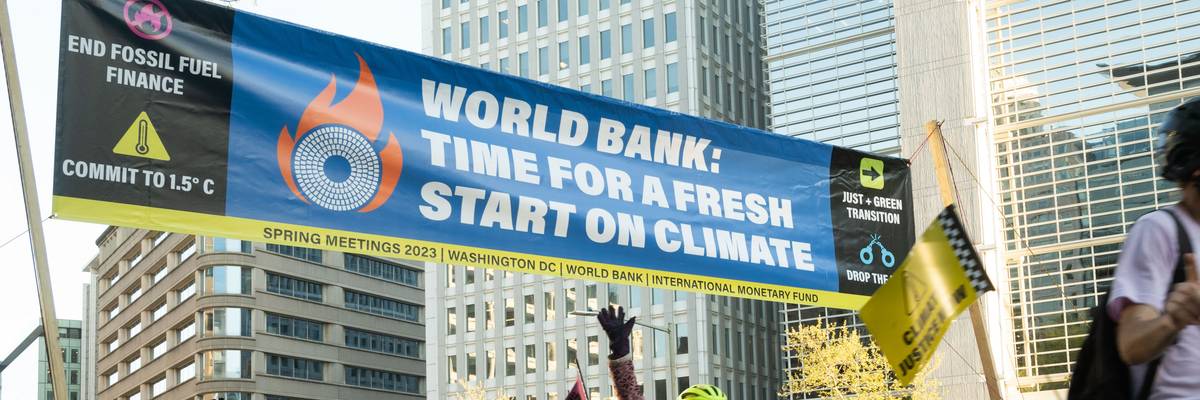
Cyclists take over rush hour traffic outside World Bank headquarters and urge the bank's president to end funding for fossil fuels on April 10, 2023 in Washington, D.C.
World Bank Pumping Billions More Into Fossil Fuels Than Publicly Known: Study
Exploiting a "trade finance" loophole, the bank dumped an estimated $3.7 billion into oil and gas projects in 2022.
An analysis released Tuesday by the German nonprofit Urgewald estimated that the World Bank spent nearly $4 billion on fossil fuel financing last year, when it was under the leadership of a climate denier nominated by former U.S. President Donald Trump.
The World Bank pledged in 2017 to end financing for upstream oil and gas—with narrow exceptions—after 2019. But Urgewald observed in its new report that the World Bank's pledge applied only to direct finance, allowing the powerful institution to funnel cash to oil and gas projects through "trade finance" dished out by its private-sector arm, the International Finance Corporation (IFC).
"Despite trade finance's vast and still-growing share of the IFC’s budget, over 70% of it is given out in secrecy," Urgewald noted. "The types of goods and businesses it is funding are not even reported to the World Bank's shareholders, i.e., our governments. The public has a right to know where all this money is going."
Citing the IFC's "severe lack of transparency," Urgewald stressed that it was only able to "formulate an estimate" for oil and gas transactions. The group calculated that the World Bank spent roughly $3.7 billion on oil and gas trade finance in 2022.
"This would more than triple the current annual level of fossil fuel finance attributed to the World Bank and cast serious doubts on Bank claims of alignment with the Paris Climate Agreement," Urgewald's Heike Meinhardt said in a statement.
"The easiest way for a big oil company or coal operation to escape attention surrounding public assistance is to cloak it in trade finance."
The World Bank has long been accused of reneging on its climate commitments. A report released last year by Big Shift Global estimated that the World Bank has spent nearly $15 billion supporting fossil fuels since the adoption of the Paris Climate Agreement in 2015.
Late last year, former World Bank President David Malpass sparked global outrage by saying he's not sure whether he accepts the scientific consensus that climate change is caused by the burning of fossil fuels, further validating climate activists' longstanding calls for systemic reforms at the bank.
"I don't know," Malpass said in response to a reporter's question about his views on climate change. "I'm not a scientist."
The comments prompted widespread calls for Malpass to step down, which he did in June. Current World Bank President Ajay Banga, who U.S. President Joe Biden nominated to replace Malpass, is a former private equity executive who has worked for Nestlé, PepsiCo, and Citibank.
Urgewald warned in its report Tuesday that the World Bank will remain a major source of funding for the fossil fuel industry until it enacts reforms that prevent the IFC from bolstering oil and gas under the guise of "trade finance."
"The easiest way for a big oil company or coal operation to escape attention surrounding public assistance is to cloak it in trade finance," the group said. "It is a huge loophole that must be closed and evaluated through public disclosure."
Urgewald added that "there is no doubt" the World Bank and IFC "are going to deny" its findings and "claim the figures are inaccurate."
That's exactly what an IFC spokesperson did on Tuesday, telling The Guardian that "Urgewald's report contains serious factual inaccuracies and grossly overstates IFC's support for fossil fuels."
"IFC regularly reports accurate and timely project information through various channels," the spokesperson added.
Urgewald disputed that narrative in its report, asserting that the "continued secrecy surrounding trade finance makes it impossible to determine how much fossil fuel business the IFC is ultimately facilitating and whether the World Bank is actually aligned with the goals of the Paris Climate Agreement."
"An exorbitant amount of IFC money, i.e., more than half its budget, is streaming through banks without any oversight by the [World Bank Board of Directors], without any opportunity for public scrutiny, without any accountability," the group said.
We are at a crossroads
This country and this world are at a monumental crossroads. In a few short weeks, US voters will have an opportunity to beat back the forces of fascism and confront the billionaires who are rigging the economy, our media system, and our democracy, making it increasingly impossible for ordinary people to get by. We’re not just talking about the election. We’re talking about what must be done once these fascist elements are vanquished from power. We need a bolder set of solutions than what either major party has so far been willing to offer and a working-class movement ready to fight like hell for it. Trump didn't emerge from nowhere. The conditions that fueled MAGA authoritarianism were created by decades of radical neoliberal economic policies and a corrupt political system dominated by corporate interests. They slashed taxes on the super-rich, promising that the benefits would trickle down. They said giveaways to the corporate titans would make life more affordable for the rest of us. It was all bullshit. And when a bitter, betrayed populace searches for someone to blame, right-wing demagogues have little trouble finding scapegoats. People know when they're being lied to, but you won't hear any of this from the corporate media. Only independent journalism—powered and funded by people who believe in building a better world—can deliver truly trustworthy daily news. Our Fall Campaign is underway, and we need your help. To power our newsroom through the rest of the year, we need to raise $125,000 by midnight on October 31. So if you share our vision, please contribute whatever you can to sustain our work. |
An analysis released Tuesday by the German nonprofit Urgewald estimated that the World Bank spent nearly $4 billion on fossil fuel financing last year, when it was under the leadership of a climate denier nominated by former U.S. President Donald Trump.
The World Bank pledged in 2017 to end financing for upstream oil and gas—with narrow exceptions—after 2019. But Urgewald observed in its new report that the World Bank's pledge applied only to direct finance, allowing the powerful institution to funnel cash to oil and gas projects through "trade finance" dished out by its private-sector arm, the International Finance Corporation (IFC).
"Despite trade finance's vast and still-growing share of the IFC’s budget, over 70% of it is given out in secrecy," Urgewald noted. "The types of goods and businesses it is funding are not even reported to the World Bank's shareholders, i.e., our governments. The public has a right to know where all this money is going."
Citing the IFC's "severe lack of transparency," Urgewald stressed that it was only able to "formulate an estimate" for oil and gas transactions. The group calculated that the World Bank spent roughly $3.7 billion on oil and gas trade finance in 2022.
"This would more than triple the current annual level of fossil fuel finance attributed to the World Bank and cast serious doubts on Bank claims of alignment with the Paris Climate Agreement," Urgewald's Heike Meinhardt said in a statement.
"The easiest way for a big oil company or coal operation to escape attention surrounding public assistance is to cloak it in trade finance."
The World Bank has long been accused of reneging on its climate commitments. A report released last year by Big Shift Global estimated that the World Bank has spent nearly $15 billion supporting fossil fuels since the adoption of the Paris Climate Agreement in 2015.
Late last year, former World Bank President David Malpass sparked global outrage by saying he's not sure whether he accepts the scientific consensus that climate change is caused by the burning of fossil fuels, further validating climate activists' longstanding calls for systemic reforms at the bank.
"I don't know," Malpass said in response to a reporter's question about his views on climate change. "I'm not a scientist."
The comments prompted widespread calls for Malpass to step down, which he did in June. Current World Bank President Ajay Banga, who U.S. President Joe Biden nominated to replace Malpass, is a former private equity executive who has worked for Nestlé, PepsiCo, and Citibank.
Urgewald warned in its report Tuesday that the World Bank will remain a major source of funding for the fossil fuel industry until it enacts reforms that prevent the IFC from bolstering oil and gas under the guise of "trade finance."
"The easiest way for a big oil company or coal operation to escape attention surrounding public assistance is to cloak it in trade finance," the group said. "It is a huge loophole that must be closed and evaluated through public disclosure."
Urgewald added that "there is no doubt" the World Bank and IFC "are going to deny" its findings and "claim the figures are inaccurate."
That's exactly what an IFC spokesperson did on Tuesday, telling The Guardian that "Urgewald's report contains serious factual inaccuracies and grossly overstates IFC's support for fossil fuels."
"IFC regularly reports accurate and timely project information through various channels," the spokesperson added.
Urgewald disputed that narrative in its report, asserting that the "continued secrecy surrounding trade finance makes it impossible to determine how much fossil fuel business the IFC is ultimately facilitating and whether the World Bank is actually aligned with the goals of the Paris Climate Agreement."
"An exorbitant amount of IFC money, i.e., more than half its budget, is streaming through banks without any oversight by the [World Bank Board of Directors], without any opportunity for public scrutiny, without any accountability," the group said.
An analysis released Tuesday by the German nonprofit Urgewald estimated that the World Bank spent nearly $4 billion on fossil fuel financing last year, when it was under the leadership of a climate denier nominated by former U.S. President Donald Trump.
The World Bank pledged in 2017 to end financing for upstream oil and gas—with narrow exceptions—after 2019. But Urgewald observed in its new report that the World Bank's pledge applied only to direct finance, allowing the powerful institution to funnel cash to oil and gas projects through "trade finance" dished out by its private-sector arm, the International Finance Corporation (IFC).
"Despite trade finance's vast and still-growing share of the IFC’s budget, over 70% of it is given out in secrecy," Urgewald noted. "The types of goods and businesses it is funding are not even reported to the World Bank's shareholders, i.e., our governments. The public has a right to know where all this money is going."
Citing the IFC's "severe lack of transparency," Urgewald stressed that it was only able to "formulate an estimate" for oil and gas transactions. The group calculated that the World Bank spent roughly $3.7 billion on oil and gas trade finance in 2022.
"This would more than triple the current annual level of fossil fuel finance attributed to the World Bank and cast serious doubts on Bank claims of alignment with the Paris Climate Agreement," Urgewald's Heike Meinhardt said in a statement.
"The easiest way for a big oil company or coal operation to escape attention surrounding public assistance is to cloak it in trade finance."
The World Bank has long been accused of reneging on its climate commitments. A report released last year by Big Shift Global estimated that the World Bank has spent nearly $15 billion supporting fossil fuels since the adoption of the Paris Climate Agreement in 2015.
Late last year, former World Bank President David Malpass sparked global outrage by saying he's not sure whether he accepts the scientific consensus that climate change is caused by the burning of fossil fuels, further validating climate activists' longstanding calls for systemic reforms at the bank.
"I don't know," Malpass said in response to a reporter's question about his views on climate change. "I'm not a scientist."
The comments prompted widespread calls for Malpass to step down, which he did in June. Current World Bank President Ajay Banga, who U.S. President Joe Biden nominated to replace Malpass, is a former private equity executive who has worked for Nestlé, PepsiCo, and Citibank.
Urgewald warned in its report Tuesday that the World Bank will remain a major source of funding for the fossil fuel industry until it enacts reforms that prevent the IFC from bolstering oil and gas under the guise of "trade finance."
"The easiest way for a big oil company or coal operation to escape attention surrounding public assistance is to cloak it in trade finance," the group said. "It is a huge loophole that must be closed and evaluated through public disclosure."
Urgewald added that "there is no doubt" the World Bank and IFC "are going to deny" its findings and "claim the figures are inaccurate."
That's exactly what an IFC spokesperson did on Tuesday, telling The Guardian that "Urgewald's report contains serious factual inaccuracies and grossly overstates IFC's support for fossil fuels."
"IFC regularly reports accurate and timely project information through various channels," the spokesperson added.
Urgewald disputed that narrative in its report, asserting that the "continued secrecy surrounding trade finance makes it impossible to determine how much fossil fuel business the IFC is ultimately facilitating and whether the World Bank is actually aligned with the goals of the Paris Climate Agreement."
"An exorbitant amount of IFC money, i.e., more than half its budget, is streaming through banks without any oversight by the [World Bank Board of Directors], without any opportunity for public scrutiny, without any accountability," the group said.