

SUBSCRIBE TO OUR FREE NEWSLETTER
Daily news & progressive opinion—funded by the people, not the corporations—delivered straight to your inbox.
5
#000000
#FFFFFF
To donate by check, phone, or other method, see our More Ways to Give page.
Daily news & progressive opinion—funded by the people, not the corporations—delivered straight to your inbox.
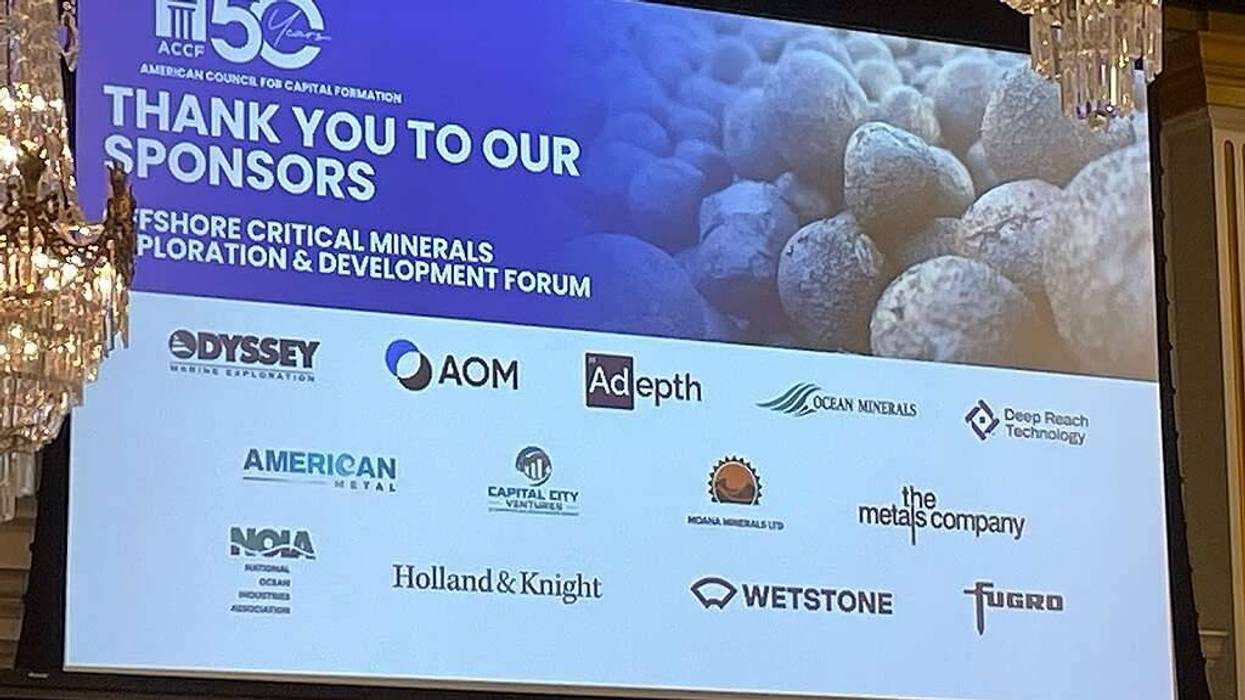
The goal of an invitation-only event seemed to be to foster a shared belief among government officials and mining industry executives that deep-sea mining has a future. I’m not sure it worked.
In the chaotic aftermath of Snowmaggedon 2026, I snuck into the Offshore Critical Minerals Exploration and Development Forum at the famed Willard Hotel, known for hosting exclusive insider events and serving as a primary gathering spot for Washington DC’s “movers and shakers.” This event fit that mold—but with the growing secrecy of the deep-sea mining crowd added for extra flavor.
Hosted by the American Council for Capital Formation (ACCF), the goal of this invitation-only event seemed to be to foster a shared belief among government officials and mining industry executives that deep-sea mining has a future. I’m not sure it worked.
ACCF’s Michael Zehr set the tone early, making sure everyone understood that “we’re not here to discuss the ISA [International Seabed Authority] and UNCLOS [United Nations Convention on the Law of the Sea].”
OK, look, I get it. I’m sure they had to promise that the agenda would steer clear of prickly issues of international law to get the Trump officials to show up. But it’s a bit delusional to assume that the US will just carry on with President Donald Trump’s plan to bypass the International Seabed Authority after Trump is gone, so avoiding this issue completely undermined the whole purpose of the gathering.
Not only does deep-sea mining not yet exist, as Ocean Minerals CEO Hans Smit pointed out, it is an industry that should not exist. Humanity does not have a very good track record when it comes to launching new extractive industries, as even the predictable consequences are often dwarfed by the impacts we didn’t fully see coming. But this was not the group of people who were going to pause for that kind of self-reflection.
Instead, the mining CEOs did their best to convince everyone that deep-sea mining is easy and definitely going to happen while simultaneously making excuses for why it might take a long time. The investors tried to politely raise some of their huge glaring concerns in a way that wouldn’t alarm the government officials. And the Trump administration officials waved away questions about whether future leaders are going to just pull the plug on Trump’s reckless approach. Throughout the day, speakers probably spent more time worrying about environmentalists than the environment, which I suppose was no surprise coming from this bunch.
The speakers responsible for raising the capital to make DSM possible acknowledged that investors are not exactly jumping on this rusty bandwagon. Mining is right up there with tobacco, alcohol, pornography, and gambling for many investors, who categorically exclude financing industries that fail the vice clause screen. Even those who might be willing to overlook the environmental impacts or reputational risks have held back, apparently for two main reasons.
As someone who has worked closely with staff at NOAA, State, and other federal agencies for over 20 years, it was galling to see how completely captured these agencies have become by corporate interests.
First, deep-sea mining is fantastically expensive to get going, and so far no one is close to being ready to operate at commercial scale. No one wants to throw hundreds of millions of dollars into a venture that may well be headed for bankruptcy (again). Which is connected to the second big problem, which came up throughout the day: durability. This administration will be out of office well before commercial mining will be operational, and probably even before it can be permitted. Even Tim Petty, the assistant secretary of commerce, refused to speculate on whether the Trump administration could move fast enough to actually grant permits, looking visibly uncomfortable and just saying, “We’ll see.”
Sometimes, when they avoid the question, it is all the answer you need. Petty also ducked a question about the approach the administration will take to consultation with Pacific stakeholders, responding with a completely unrelated tangent. Then, when he was asked about a comment Rep. Ed Case (D-Hawaii) had just made at a congressional hearing, that the National Oceanic and Atmospheric Administration (NOAA) is in bed with The Metals Company, Petty preferred to recount that in his meeting with staffers, “None of the questions about the environment came up”—as if that was some sort of validation.
As someone who has worked closely with staff at NOAA, State, and other federal agencies for over 20 years, it was galling to see how completely captured these agencies have become by corporate interests. Don’t get me wrong, corporations have always had far too much influence over public policy, but hearing NOAA’s Deputy Assistant Secretary Erik Noble say repeatedly that “NOAA is open for business” does not exactly provide much assurance that the agency responsible for stewardship of our oceans is up to the task right now. The general message from NOAA and Bureau of Ocean Energy Management (BOEM) officials to mining execs was clear: We are on your side. Regulations and laws are flexible, money will flow, incentives are coming. Tell us what you need and we will make it happen. To drive the point home even harder, Megan Carr used the gathering as an opportunity to announce that BOEM was launching a new process to start paving the way for deep-sea mining on Alaska’s outer continental shelf.
It was painful to sit through a day of delusional boosterism, especially from agencies that are responsible for protecting our oceans and America’s standing in the world. By the second half of the day, though, it was clear that there were hardly any “investors” in the room, and that the audience was mostly just made up of a rotating group of speakers talking to each other. Two-thirds of the seats were empty, and so, ultimately, was the promise of any real discussion when fundamental issues were off the table, speakers were unwilling to answer questions (from moderators only—no questions were ever taken from the audience), and people with other perspectives were not invited.
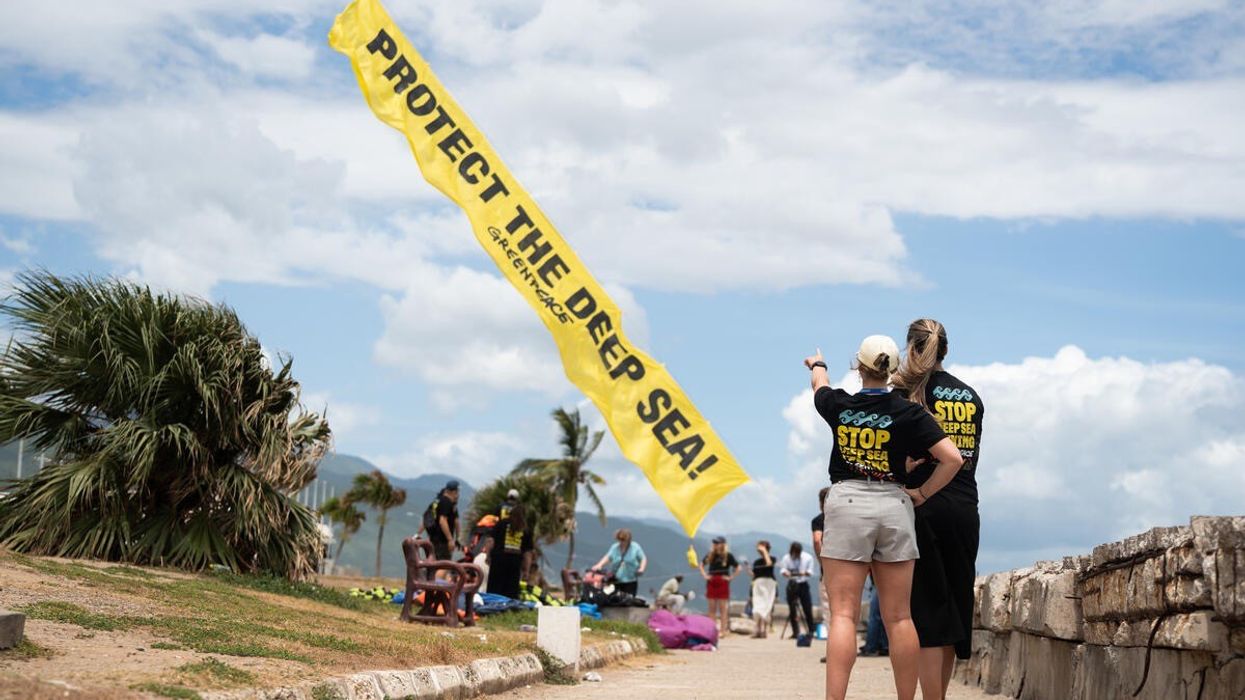
"There is still a chance to stop this industry before it begins, but only if governments stand up for science, equity, and precaution now," one campaigner said.
Despite growing momentum, world governments failed to agree to a moratorium on deep-sea mining as the 30th session of the International Seabed Authority wrapped up on Friday.
The authority's July meeting was the first since U.S. President Donald Trump signed an executive order to expedite permits for deep-sea mining under U.S. authority and The Metals Company (TMC) promptly applied for U.S. permits. Governments rebuked the U.S. and TMC for their unilateral approach and did not agree on a mining code that would allow the controversial practice to move forward under international law. However, campaigners said more decisive action is needed to protect the ocean and its biodiversity.
"Governments have yet to rise to the moment," Greenpeace International campaigner Louisa Casson said in a statement. "They remain disconnected from global concerns and the pressing need for courageous leadership to protect the deep ocean."
Casson continued: "We call on the international community to rise up and defend multilateralism against rogue actors like The Metals Company. Governments must respond by establishing a moratorium and reaffirming that authority over the international seabed lies collectively with all states—for the benefit of humanity as a whole."
The International Seabed Authority (ISA) gains its authority to regulate deep-sea mining under the United Nations Law of the Sea, to which the U.S. is not party. TMC, however, could suffer consequences for bypassing the international process, as other countries and companies may decide not to do business with it.
At the most recent session, the ISA's council decided not to revoke exploratory permits it had previously granted to TMC and its subsidiaries. However, it approved an investigation on Monday into whether mining contractors such as TMC subsidiaries Nauru Ocean Resources Inc. and Tonga Offshore Mining Limited were abiding by their obligations under international law.
"TMC has been testing the limits of what it can get away with, a bit like a child seeing how far it can go with bad behavior," Matthew Gianni, cofounder of the Deep Sea Conservation Coalition (DSCC), told The New York Times.
"The member countries of the ISA have basically sent a shot across the bow, a warning to TMC that going rogue may well result in the loss of its ISA exploration claims," Gianna explained, adding that the investigation also served as a warning to other companies who might consider following TMC's example.
"The Trump administration's pursuit of deep-sea mining isn't about global stewardship—it's about sidestepping it."
Casson agreed: "The international community's message to The Metals Company is clear: Violating international law, ignoring scientific consensus, and disregarding human rights will have consequences. This is also a warning to any companies or governments choosing to align themselves with [TMC CEO] Gerard Barron's business model—they must be prepared to bear the reputational fallout of trying to destroy the ocean."
At the same time, a U.S. representative spoke on Thursday, doubling down on Trump's dismissal of the international process and earning instant push back from Brazil, France, and China
"As a non-party to the Law of the Sea Convention, the United States is not bound by the convention rules dealing with seabed mining through the International Seabed Authority," the U.S. statement said in part.
The statement came days after Greenpeace released a report titled Deep Deception: How the Deep-Sea Mining Industry is Manipulating Geopolitics to Profit from Ocean Destruction, which details how TMC and other deep-sea mining companies are exploiting national security concerns to lobby U.S. lawmakers to fast track deep-sea mining.
"The U.S. statement confirms what Deep Deception has already exposed: The Trump administration's pursuit of deep-sea mining isn't about global stewardship—it's about sidestepping it," Arlo Hemphill, Greenpeace USA's project lead for the Stop Deep-Sea Mining campaign, said in a statement. "By rejecting the ISA's authority while claiming environmental responsibility, the U.S. is trying to have it both ways—and in doing so is advancing a 'smash and grab' agenda that puts ocean health and international cooperation at serious risk."
Ultimately, ocean advocates agree that the only way to protect the deep sea is for governments to agree to a precautionary pause on a practice they argue would do irreparable harm to ecosystems science barely understands.
The consensus for such a pause is building, with Croatia becoming the 38th nation to support one during the latest ISA meeting.
"The ISA is paralyzed by a small group clinging to outdated extraction agendas while blocking even the most basic reforms," Simon Holmström, the deep-sea mining policy officer for Seas at Risk, said in a statement. "The firm rejection of the U.S. and The Metals Company's power grab, alongside 38 countries now calling for a moratorium or precautionary pause, shows growing resistance to sacrificing the planet's least understood ecosystem for corporate short-term profit."
"To even consider a new form of ecocide on our already ailing planet is both reckless and irrational."
Several nations spoke strongly in favor a moratorium, including Palau, Panama, and France.
"Exploiting the seabed is not a necessity—it is a choice," said His Excellency Surangel S. Whipps Jr., president of the Republic of Palau, on Tuesday. "And it is reckless. It is gambling with the future of Pacific Island children, who will inherit the dire consequences of decisions made far from their shores."
A Pacific leader from Solomon Island also defended the interests of the Pacific Ocean community: "As Pacific people, we continue to carry the trauma of what extractive industries have already done to our homes. Mining companies that came with promises, stripped our lands and waters, and left behind ecological, cultural, and spiritual scars. We cannot let that cycle repeat itself, in the ocean that connects us. That sustains us. And that defines us."
Olivier Poivre d'Arvor of France called for a pause of 10-15 years: "Our message is clear: no deep-sea mining without science, without collective legitimacy, without equity [...] France is calling for a moratorium or a precautionary pause. What for? Because we refuse to mortgage the future for a few nodules extracted in a hurry, in favor of a few."
However, campaigners argued that many governments continued to fall short of the commitments they had made at the U.N. Ocean Conference (UNOC) in Nice in early June.
"Thirty-eight states have now joined the call for a moratorium or precautionary pause, with Croatia joining the coalition during this Assembly," said DSCC campaign director Sofia Tsenikli. "But too many other states, which were bold in their ocean promises at UNOC, are not putting this into action at the ISA. Governments must meet their promises by doing what it takes to implement a moratorium before it's too late."
Farah Obaidullah, founder and director of The Ocean and Us, argued that the ocean already faces too many other threats to add the additional burden of deep-sea mining.
"The health of the high seas including the seabed is critical to our own. Yet our shared heritage faces an onslaught of threats from climate and nature collapse, escalating tensions, and failed leadership," Obaidullah said. "To even consider a new form of ecocide on our already ailing planet is both reckless and irrational. We know that deep-sea mining will devastate life in the deep ocean, wipe out species before they have been discovered, and impact ocean functions, including carbon sequestration. When it comes to the ocean we have no time to lose. We cannot colonize and conquer our shared heritage which belongs to us all. There is only one responsible way forward, and that is to secure a moratorium on deep-sea mining."
DSCC's Gianni also argued strongly for a pause: "Being on the fence or remaining silent is not a politically defensible position. We are risking severe ecological damage, and future generations will ask what we did to stop it. There is still a chance to stop this industry before it begins, but only if governments stand up for science, equity, and precaution now, and take action to prevent companies within their jurisdiction from cooperating with rogue mining operations."
Greenpeace's Hemphill concluded: "Governments must secure a moratorium that leaves no room for a desperate industry to force through a mining code. The science is not ready. The legal framework is not in place. The world must not be bullied into an irreversible mistake for the benefit of a few."
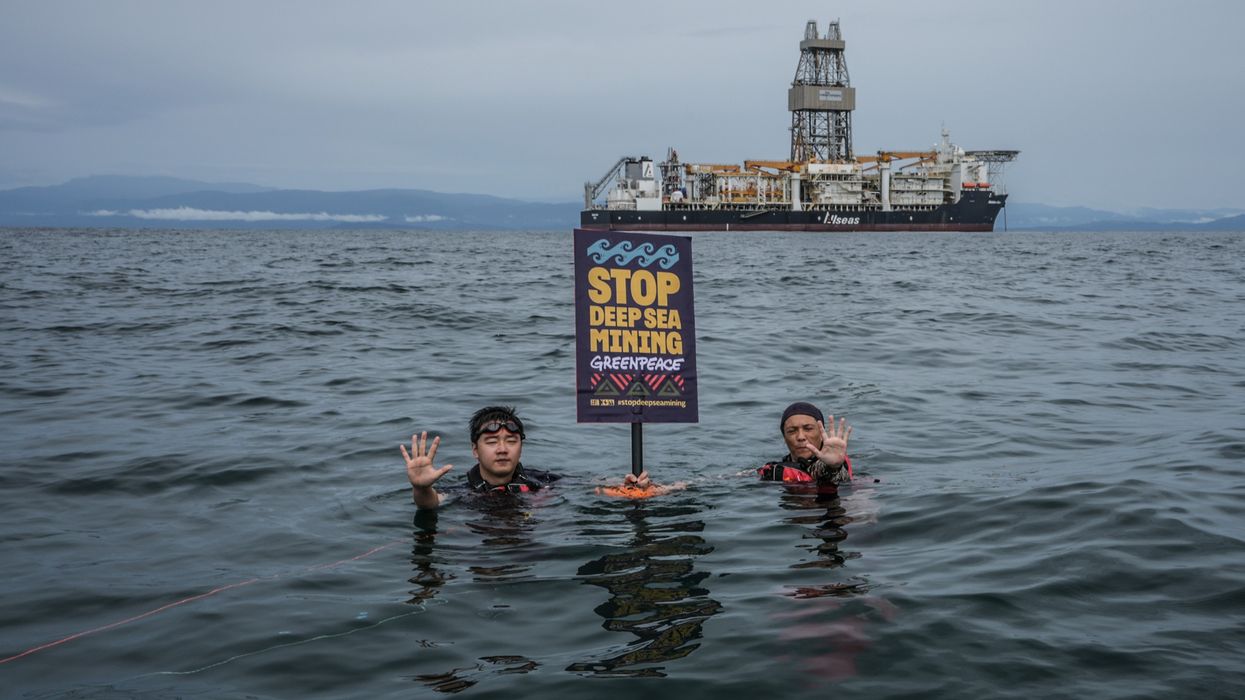
"Mining the deep ocean in defiance of international consensus," said one retired defense official, "would erode U.S. credibility, fracture alliances, and set a dangerous precedent for unilateral resource exploitation."
As officials meet in Jamaica for a summit on the international seabed this week, a new report by the climate action group Greenpeace details how the deep-sea mining industry—failing to make a convincing case that its exploitation of the deep sea is necessary for a green energy transition—is trying a new strategy: lobbying Congress with the intent of classifying mining on the ocean floor as a national security priority.
In the Monday report, titled Deep Deception: How the Deep Sea Mining Industry is Manipulating Geopolitics to Profit from Ocean Destruction, Greenpeace describes how firms like the Metals Company (TMC), a Canada-based mining company, have spent years trying to convince policymakers around the world that mining in the deep ocean for minerals like copper, nickel, manganese, and cobalt is essential to manufacture electric vehicle batteries for a green transition.
But much of the key data underpinning that argument was produced by mining companies themselves or published by academic journals with financial interests in the industry, and support for the sector from electric carmakers has waned in recent years as the industry has failed to prove it can mine the ocean floor "in a way that ensures the effective protection of the marine environment," as one statement calling for a moratorium read.
Confronted with growing opposition to the notion that deep-sea mining—in which companies use equipment to comb the habitat of tens of thousands of species and potentially spread mining waste for miles—can serve as a key climate solution, Greenpeace said, "these fickle deep-sea entrepreneurs are jumping ship."
Now "they are eager to embrace politically opportunistic 'national security' storylines," reads the report.
"For TMC, the green transition was always a false narrative," said Arlo Hemphill, project lead for the Stop Deep-Sea Mining campaign at Greenpeace USA. "The numbers just didn't add up to justify opening the world's last unspoiled wilderness to mass-scale extractive exploitation. Now, the industry is repackaging itself as essential to national security and defense, exploiting real geopolitical tensions for personal profit. It's a dangerous and unnecessary strategy that could destroy the international seabed to enrich a few."
The report was released as the International Seabed Authority (ISA) convened in Kingston, Jamaica for its 30th Assembly, with governments under heavy pressure from the deep-sea mining industry to fast-track a Mining Code under which they could move forward with ramping up operations—even as 37 states and nearly 1,000 international scientists now support a moratorium on deep-sea mining.
As the ISA began its meeting on Monday, Pew Environment explained the risks carried by deep-sea mining—from noise and light pollution to the endangerment of species scientists haven't yet discovered.
"The deep sea is one of Earth's most pristine and fragile ecosystems," said Grace Evans, senior associate of ocean governance at Pew Charitable Trusts. "Once we damage it, we can't go back."
TMC began "targeting defense and industrial policy stakeholders" in 2022 as it was still pushing its green energy transition narrative.
The company spent nearly half a million dollars over two years to hire lobbying firms to influence votes on the National Defense Authorization Act (NDAA) in 2023 and 2024—and succeeded in pushing the Department of Defense (DOD) to deliver a report "assessing the processing of seabed resources of polymetallic nodules domestically."
TMC's lobbying push also convinced 31 Republican members of Congress to write to then-Defense Secretary Lloyd Austin in 2023, asking him "to develop a plan to address the national security ramifications of [China's] interest and investment in seabed mining."
In March, TMC announced it would seek permits from the U.S. to mine the international deep sea under American authorization—a move that "brazenly" bypassed international treaties and consensus, said Greenpeace.
Greenpeace's report comes four months after that application and three months after President Donald Trump signed an executive order signaling the government's intent to "rapidly" develop and invest in U.S. capabilities to explore and collect seabed mineral resources through "streamlined permitting," with the White House asserting the U.S. "has a core national security and economic interest in maintaining leadership in deep-sea science and technology and seabed mineral resources."
"We will not stand by while a neocolonial deep-sea land grab takes place that will harm our communities, disrupt our cultural connection to the ocean, and endanger our livelihoods."
Under the order, the Trump administration signaled its "readiness to unilaterally authorize deep sea mining in both U.S. and international waters," reads the Greenpeace report—potentially violating the United Nations Convention on the Law of the Sea, which the U.S. has not signed.
Days after the order was signed, TMC applied to the U.S. government for deep-sea mining exploration licenses and commercial mining permits. The Greenpeace report details how the Trump administration and companies including TMC are working together to once again promote a false narrative about the necessity of deep-sea mining—one that is actually meant to provide "a lifeline for an industry in crisis."
Global defense industries "likely represent only a tiny fraction of overall global consumption" of the metals found in polymetallic nodules in the deep sea, according to the report—meaning that as with the electric auto industry, the defense sector's true demand for deep-sea mining is much smaller than the industry and the Trump administration would have the public believe.
"The U.S. defense demand stands for a tiny percentage of our domestic consumption of critical metals. And to be honest, U.S. defense is not a big user of anything," Jack Lifton, executive director of the Critical Minerals Institute, told Greenpeace. "Given what the defense industry and the DOD and the different contractors are doing in terms of securing metals from elsewhere, friendshoring, reshoring, recycling, there is no need to mine the seabed for cobalt or nickel or rare earths."
While metals that can be accessed through deep-sea mining do have military uses, "the scale of this military use is relatively modest compared to global civilian demand—dwarfed by the commercial manufacturing sector," reads the report.
For example, the U.S. currently imports manganese ore from Gabon, South Africa, and Mexico, and "a substantial deep sea mining development could nearly double the global supply of manganese in its first year, resulting in an immediate oversupply" and a reduction in the value of the metal and the global mining operation. The U.S. also already has a stockpile of 322,000 tons of manganese in Arizona.
In a foreword to the Greenpeace report, retired U.S. Army Major General Randy Manner wrote that "the bedrock of national security" lies in "global stability, the rule of law, and ecological resilience"—not in accumulating new minerals and weaponry.
"Mining the deep ocean in defiance of international consensus would degrade all three. It would erode U.S. credibility, fracture alliances, and set a dangerous precedent for unilateral resource exploitation," said Manner.
In the Pacific region—where deep-sea mining companies aim to operate—several states and leaders have called for a ban. moratorium, or precautionary pause on the practice, with Pacific Island Heritage Coalition Chair Solomon P. Kaho'ohalahala warning that "the Pacific is not a sacrifice zone."
"We will not stand by while a neocolonial deep-sea land grab takes place that will harm our communities, disrupt our cultural connection to the ocean, and endanger our livelihoods," said Kaho'ohalahala. "This July, ISA member states must make it clear where they stand—for their foundational principles of equity, multilateralism, and environmental protection or unbounded corporate greed."
At the ISA meeting in Kingston, Greenpeace International campaigner Louisa Casson said governments around the world "have sent a clear signal that the deep-sea mining industry will not get international approval any time soon"—even amid industry pressure and the Trump administration's push.
TMC's application to the U.S. "shatters" the firm's credibility "and serves as a stark warning to others considering this reckless path."
"Governments have also reaffirmed that there should be no deep sea mining in the global oceans while major political and scientific questions remain unresolved," said Casson. "Deep sea mining is a dangerous gamble we cannot afford, and the only responsible way forward is a global moratorium."
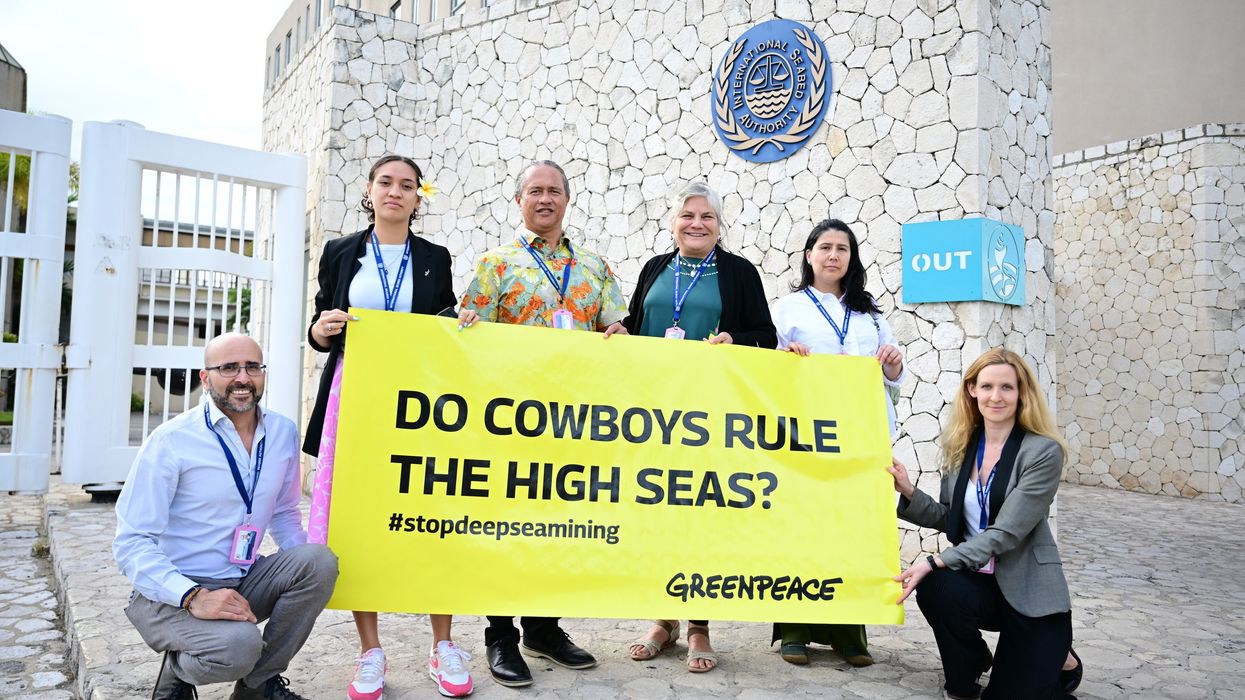
We must defend international law. We must defend the oceans. And we must reject a broken economic model that gambles our planet's future for corporate gain.
On April 24, U.S. President Donald Trump signed an executive order to fast-track deep-sea mining in U.S. and international waters that sidelines international law and puts fragile ocean ecosystems, Indigenous rights, and millions of lives that depend on a healthy ocean at risk.
While this is being sold to the American public as a bold move to secure America's mineral supply chain, address climate change, or boost the clean energy transition, science and the tech and auto industries have already debunked that ruse. In the current climate, it will surprise very few that this is instead another giveaway to well-heeled corporate interests that will gamble away the health of our oceans and future for the short-term profit of a few corporations.
Once destroyed, deep-sea ecosystems are likely gone forever, taking with them species and processes vital to planetary health.
The Broligarchy is not just burning fossil fuels and sending rockets into space or dismantling American institutions. They are also gearing up to mine the depths of our last great wilderness in the deep sea. And as we've seen, they won't let details like the well-founded concerns about the cost to people, the climate, or our shared future get in their way.
For decades, the international community has worked through the United Nation's International Seabed Authority (ISA) to regulate whether and how deep-sea mining might proceed, recognizing the deep sea as the "common heritage of humankind," not a resource to be plundered by any one country or corporation.
Trump's executive order tramples that principle of shared stewardship, reviving a Cold War-era U.S. law that bypasses the U.N. framework and green-lights corporate plunder of the seafloor. This reckless move undermines global legal norms, threatens to unravel international cooperation, and could trigger an unregulated race for the ocean's resources at a time when stronger protections are most needed. As ISA Secretary General Leticia Carvalho warns, dismantling multilateral ocean governance threatens the very foundations of global cooperation, setting a dangerous precedent for the future of all shared global commons.
The economic case for deep-sea mining is collapsing. There is no current shortage of minerals like cobalt or nickel, and advances in battery chemistry, recycling, circular economy models, and alternative materials are rapidly reducing projected future demands for deep-sea minerals. Even if mining started today, it would likely take more than a decade for the industry to bring deep-sea minerals to market at scale.
Early ventures like Nautilus Minerals and Loke Marine Minerals have already failed, exposing the financial risks. On Tuesday, The Metals Company (TMC) upped the ante on its risky bet to fast-track deep-sea mining when it submitted its application under the U.S. Seabed Mining Code to begin commercial mining in areas licensed by the International Seabed Authority. For the president, with his track record on casinos, backing a company like TMC is a gamble whose cost will be borne by coastal communities, Indigenous rights, and investors alike.
Americans already face $150 billion annually in costs from climate change. And our children and grandchildren born in 2024 may have to bear the weight of $500,000 over their lifetime. We can't afford to absorb the cost of another failed venture while the billionaire class does not even pay their fair share of taxes and does little to fix the problems their corporations have created.
Perhaps most shamefully, Trump's executive order green-lights a new wave of colonialism, opening the deep sea of Pacific waters to corporate plunder without the consent of Pacific Peoples—communities whose lives, cultures, and economies are deeply intertwined with the ocean.
Trump's executive order shows exactly why the world needs a strong, binding global moratorium on deep-sea mining.
The Pacific has already spoken: American Samoa, Hawai'i, and several Pacific Island nations have called for moratoriums to protect their fisheries and heritage. Indigenous leaders have made it clear—the deep sea is not a sacrifice zone. Yet TMC, which leveraged its partnership with Nauru to fast-track negotiations at the ISA, is now looking to shift its strategy and cut deals under U.S. law, sidelining Pacific voices.
By moving to open adjacent U.S. federal waters for mining, without meaningful consultation, the United States perpetuates a familiar and painful pattern of resource extraction without consent. We cannot allow history to repeat itself in the deep sea.
Despite industry assurances, we still know remarkably little about the deep ocean. In mining target zones such as the Clarion-Clipperton Zone, over 90% of species have yet to be formally described by science, and essential life-sustaining ecosystem functions like carbon sequestration and nutrient cycling are barely understood.
There is no credible scientific evidence demonstrating that deep-sea mining can be conducted without causing irreversible harm, nor any proven way to prevent, mitigate, or repair it. Once destroyed, deep-sea ecosystems are likely gone forever, taking with them species and processes vital to planetary health.
This week's congressional hearing on deep-sea mining underscores the urgent need for democratic oversight of an industry advancing without sufficient scientific, legal, or public scrutiny. Congress must act to protect the public interest, not hand over our oceans to private companies chasing speculative profits.
With a dearth of independent science, no enforceable global safeguards, and no justification, deep-sea mining isn't just risky--it's reckless.
Trump's executive order shows exactly why the world needs a strong, binding global moratorium on deep-sea mining.
We must defend international law. We must defend the oceans. And we must reject a broken economic model that gambles our planet's future for corporate gain.
The deep sea belongs to all of us, and we have a duty to protect it, not destroy it. The future of the oceans—and the future stability of global commons governance—demands nothing less.
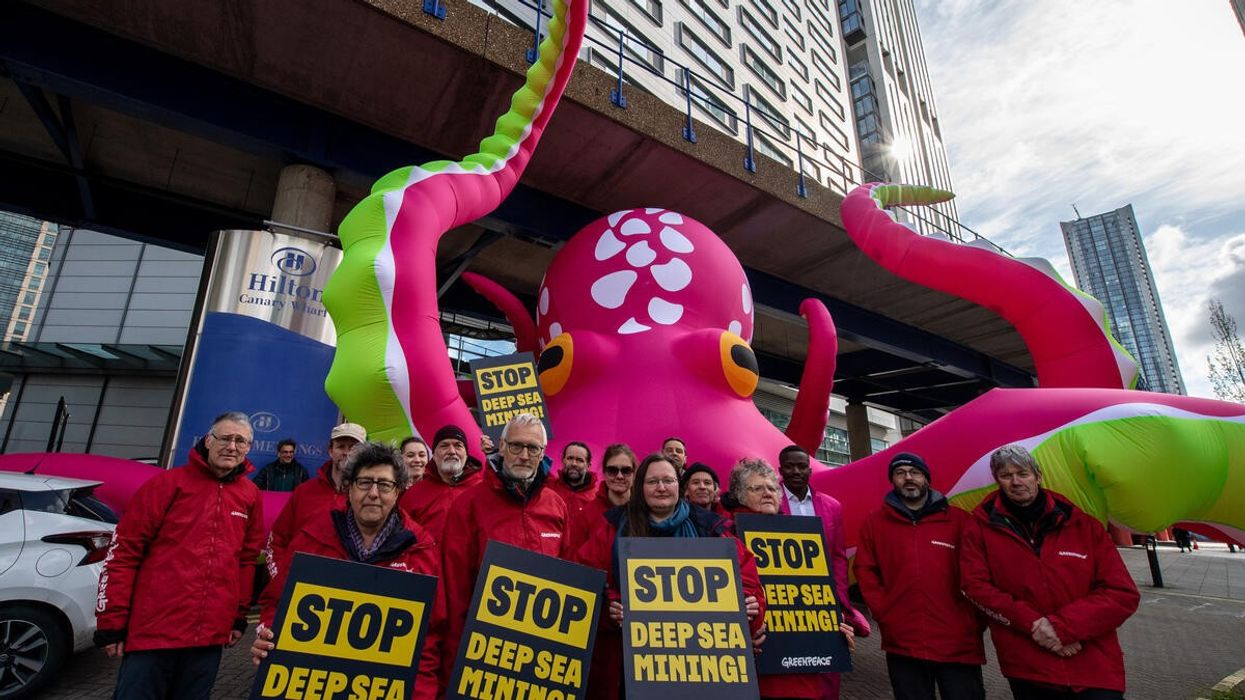
"The harm caused by deep-sea mining isn't restricted to the ocean floor: It will impact the entire water column, top to bottom, and everyone and everything relying on it," one campaigner warned.
Amid global calls for a ban on deep-sea mining to protect marine ecosystems, U.S. President Donald Trump on Thursday signed an executive order to advance the risky practice and "restore American dominance in offshore critical minerals and resources."
"The broad order avoids a direct confrontation with the United Nations-backed International Seabed Authority and seeks essentially to jump-start the mining of U.S. waters as part of a push to offset China's sweeping control of the critical minerals industry," noted Reuters, which had previewed the measure aimed at attaining nickel, cobalt, copper, manganese, titanium, and rare earth elements.
"The International Seabed Authority—created by the United Nations Convention on the Law of the Sea, which the U.S. has not ratified—has for years been considering standards for deep-sea mining in international waters, although it has yet to formalize them due to unresolved differences over acceptable levels of dust, noise, and other factors from the practice," the agency reported.
Trump's order directs Cabinet members including Secretary of Commerce Howard Lutnick—whose department oversees the National Oceanic and Atmospheric Administration (NOAA)—to expedite the permit process and work on various related reports.
"Authorizing deep-sea mining outside international law is like lighting a match in a room full of dynamite—it threatens ecosystems, global cooperation, and U.S. credibility all at once."
Deep-sea mining is opposed by over 30 countries as well as academics and advocacy groups worldwide. Among them is Greenpeace USA, whose campaigner Arlo Hemphill said Thursday that "authorizing deep-sea mining outside international law is like lighting a match in a room full of dynamite—it threatens ecosystems, global cooperation, and U.S. credibility all at once."
"We condemn this administration's attempt to launch this destructive industry on the high seas in the Pacific by bypassing the United Nations process," Hemphill declared. "This is an insult to multilateralism and a slap in the face to all the countries and millions of people around the world who oppose this dangerous industry."
"But this executive order is not the start of deep-sea mining. Everywhere governments have tried to start deep-sea mining, they have failed. This will be no different," he added. "We call on the international community to stand against this unacceptable undermining of international cooperation by agreeing to a global moratorium on deep-sea mining. The United States government has no right to unilaterally allow an industry to destroy the common heritage of humankind, and rip up the deep sea for the profit of a few corporations."
No exaggeration, deep sea mining could cause the massive collapse of the entire deep sea ecosystem and food chain. This is an existential risk to every person on this planet. www.nytimes.com/2025/04/24/c...
[image or embed]
— Alejandra Caraballo (@esqueer.net) April 24, 2025 at 5:54 PM
Ocean Conservancy vice president for external affairs Jeff Watters also blasted the move, saying that "this executive order flies in the face of NOAA's mission. NOAA is charged with protecting, not imperiling, the ocean and its economic benefits, including fishing and tourism; and scientists agree that deep-sea mining is a deeply dangerous endeavor for our ocean and all of us who depend on it."
"Areas of the U.S. seafloor where test mining took place over 50 years ago still haven't fully recovered," Watters pointed out. "The harm caused by deep-sea mining isn't restricted to the ocean floor: It will impact the entire water column, top to bottom, and everyone and everything relying on it. Evidence tells us that areas targeted for deep-sea mining often overlap with important fisheries, raising serious concerns about the impacts on the country's $321 billion fishing industry."
He highlighted that "NOAA is already being threatened by this administration's unprecedented cuts. NOAA is the eyes and ears for our water and air. NOAA provides Americans with accessible and accurate weather forecasts; it tracks hurricanes and tsunamis; it responds to oil spills; it keeps seafood on the table; and so much more. Forcing the agency to carry out deep-sea mining permitting while these essential services are slashed will only harm our ocean and our country."
"It's not just our country this executive order would harm: This action has far-reaching implications beyond the U.S.," Watters added, warning that by unilaterally allowing deep-sea mining, "the administration is opening a door for other countries to do the same—and all of us, and the ocean we all depend on, will be worse off for it."
As The New York Times reported:
The executive order could pave the way for the Metals Company, a prominent seabed mining company, to receive an expedited permit from NOAA to actively mine for the first time. The publicly traded company, based in Vancouver, British Columbia, disclosed in March that it would ask the Trump administration through a U.S. subsidiary for approval to mine in international waters. The company has already spent more than $500 million doing exploratory work.
"We have a boat that's production-ready," said Gerard Barron, the company's chief executive, in an interview on Thursday. "We have a means of processing the materials in an allied friendly partner nation. We're just missing the permit to allow us to begin."
In response to the late March disclosure—which came during International Seabed Authority negotiations—Louisa Casson, senior campaigner for Greenpeace International, said that "this is another of the Metals Company's pathetic ploys and an insult to multilateralism. It shows that a moratorium on deep-sea mining is more urgently needed than ever. It also proves that the company's CEO Gerard Barron's plans never focused on solutions for the climate catastrophe."
"The Metals Company is desperate and now is encouraging a breach of customary international law by announcing their intent to mine the international seabed through the United States' Deep-Sea Hard Mineral Resources Act," the camapigner asserted. "This comes after the Metals Company has spent years exerting immense pressure on the International Seabed Authority to try and force governments to allow mining in the international seabed—the common heritage of humankind."
Casson stressed that "states, civil society, scientists, companies, and Indigenous communities continue to resist these efforts. Having tried and failed to pressure the international community to meet their demands, this reckless announcement is a slap in the face to international cooperation."
Less than a week later, the Norwegian deep-sea mining company Loke Marine Minerals declared bankruptcy—which Haldis Tjeldflaat Helle, a campaigner for Greenpeace Nordic, noted came "on the same day that we shut down a deep-sea mining conference in Bergen."
The Norwegian government in December halted plans to move forward with deep-sea mining in the Arctic Ocean, which Steve Trent, CEO and founder of the Environmental Justice Foundation, had called "a testament to the power of principled, courageous political action, and... a moment to celebrate for environmental advocates, ocean ecosystems, and future generations alike."
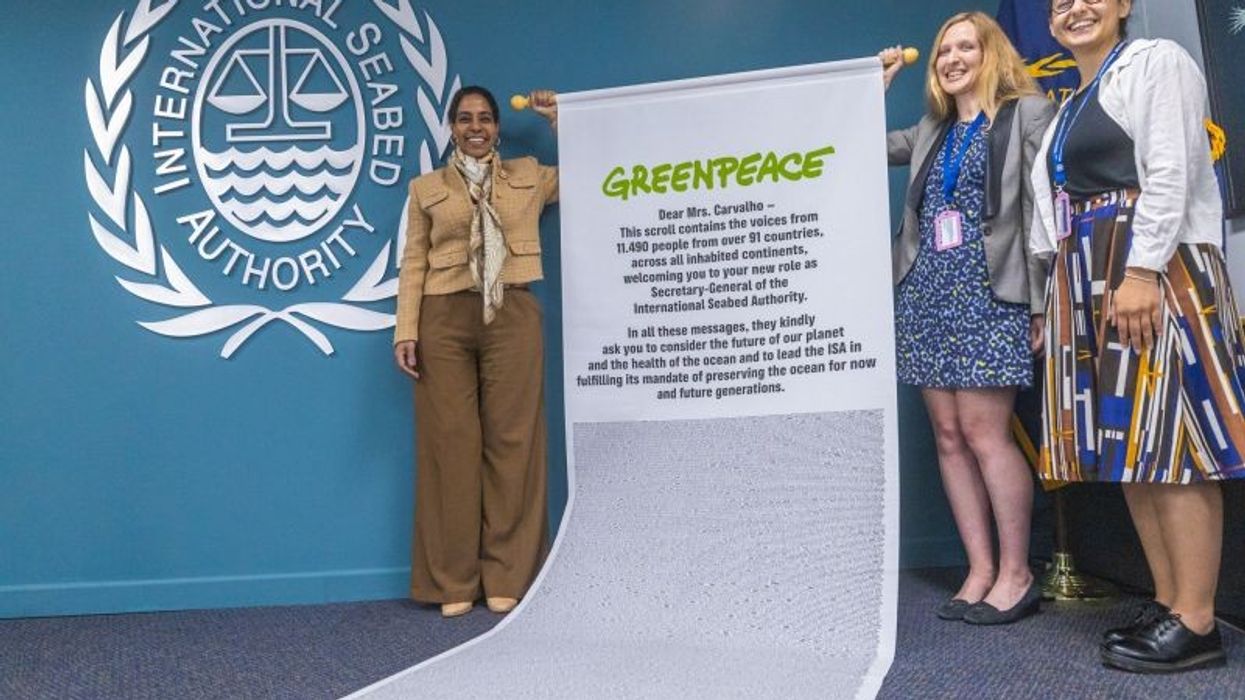
The multilateral body, recently decried for its seemingly pro-industry stance, should reorient itself back toward its most weighty purpose: protecting the seabed for the benefit of humankind as a whole.
The deep sea, Earth’s last untouched ecological frontier, is an ancient, living system that regulates our climate, stores carbon, and hosts breathtaking biodiversity. It is the common heritage of all of us. It is not a resource bank for speculative profits. And it is not for sale.
Yet, the deep-sea mining industry, led by The Metals Company (TMC), is determined to change that. The company has threatened to submit the world’s first commercial mining application in June 2025—with or without regulations in place. And now, in a desperate new move, it says it will bypass the International Seabed Authority (ISA) altogether and seek mining permits under the United States’ 1980 Deep Seabed Hard Mineral Resources Act (DSHRMA).
TMC’s reckless and dangerous attempt at a deep-sea neocolonial land grab came on the penultimate day of the ISA’s 30th Council session, ahead of a discussion of its mining application and a Fourth Quarter 2024 Earnings Update call. As it became clear that it would be forced to leave the meeting empty-handed, when nations rejected its wish to secure a process to have its commercial application approved, the company doubled down. Its tactics echo those of the oil and gas industry—manufacturing urgency and demanding fast-tracked approval.
The truth is this: deep-sea mining is a “cause in search of a purpose.” Greed, driven by speculative profit rather than public need, is driving the push for the launch of this destructive industry.
Member states and the ISA’s newly appointed Secretary-General Leticia Carvalho swiftly condemned it as a blatant attempt to sidestep international law and undermine the multilateral governance of the global commons. This pressure from TMC and other industry players forces a defining question for the ISA: Will it uphold its mandate to protect the seabed for the benefit of all humankind, or will it cave to corporate pressure?
Contrary to industry complaints, the careful ISA deliberations that have taken place over the years are safeguards to ensure that crucial unresolved questions around environmental risk, equity, science, and underwater cultural heritage are addressed. Notably, in this session, the African Group spotlighted long-ignored issues of how benefits will be shared and the socioeconomic impacts of seabed mining on terrestrial mining countries. These questions cut to the core of justice and global balance, and they demand answers before any approval can be considered.
Outside the meeting rooms, public opposition is mounting. Greenpeace International and Pacific allies brought the voices of over 11,000 people from 91 countries directly to the ISA urging deep-sea conservation. Thirty-two countries now support a moratorium, ban, or precautionary pause on deep-sea mining. The United Nations Environment Program has echoed these calls, emphasizing the need for robust, independent science before any decisions are made. And legal scholars have dismissed recent threats of lawsuits from contractors as baseless.
The industry is increasingly being recognized for what it is—a false solution. Deep-sea mining proponents claim that mining the seabed would reduce pressure on land-based ecosystems. However, research suggests deep-sea mining is more likely to add to global extraction than replace it. Meanwhile, emerging battery technologies, recycling breakthroughs, and circular economy models are rapidly reducing any purported demand for virgin metals from the seafloor.
With its original green-washing narrative unraveling, TMC and others are now stoking geopolitical tensions, positioning themselves as a strategic necessity for national security. However, the cracks are showing. For instance, TMC recently surrendered a third of its mining contract area in the Clarion-Clipperton Zone (CCZ), after ending a services agreement with its Kiribati-sponsored partner, Marawa. The industry faces failed mining tests, equipment and vessel delays, no finalized regulations, and growing investor skepticism over the industry’s environmental and financial viability.
The truth is this: deep-sea mining is a “cause in search of a purpose.” Greed, driven by speculative profit rather than public need, is driving the push for the launch of this destructive industry.
And the risks are profound. A recent study published in Nature found reduced biodiversity and ecosystem degradation more than 40 years after a small-scale mining test. Recovery of these nodules, which take millions of years to form, in human timescales is impossible.
But there is still hope. The recent appointment of Leticia Carvalho, a scientist who is calling for transparency, inclusivity, sustainability, environmental protection, and science-driven governance, as the secretary-general of the ISA presents a real opportunity. The multilateral body, recently decried for its seemingly pro-industry stance, should seize it and reorient itself back toward its most weighty purpose: protecting the seabed for the benefit of humankind as a whole.
The ISA’s dual mandate under the United Nations Convention on the Law of the Sea (UNCLOS)—to both manage the mineral resources of the seabed and ensure the effective protection of the marine environment—has always been fraught with tension. But in this era of climate chaos, biodiversity loss, and ocean degradation, it is precaution and protection that must prevail. The health of the ocean, the rights of future generations, and the principle of the common heritage of humankind demand it.
As the world heads toward the U.N. ocean conference in Nice, France this June—just a few weeks before the July ISA Assembly—leaders will have a crucial chance to show where they stand. They must reject TMC’s and the rest of the deep-sea mining industry’s attempts to force the ocean floor to be opened for exploitation with no assurance of marine protection. They must not allow themselves to be bullied into the adoption of a weak Mining Code built on industry-favored timelines. They must honor their roles as stewards—not sellers—of the international seabed.
The deep sea is not for sale—and the ISA still has a chance to prove it.
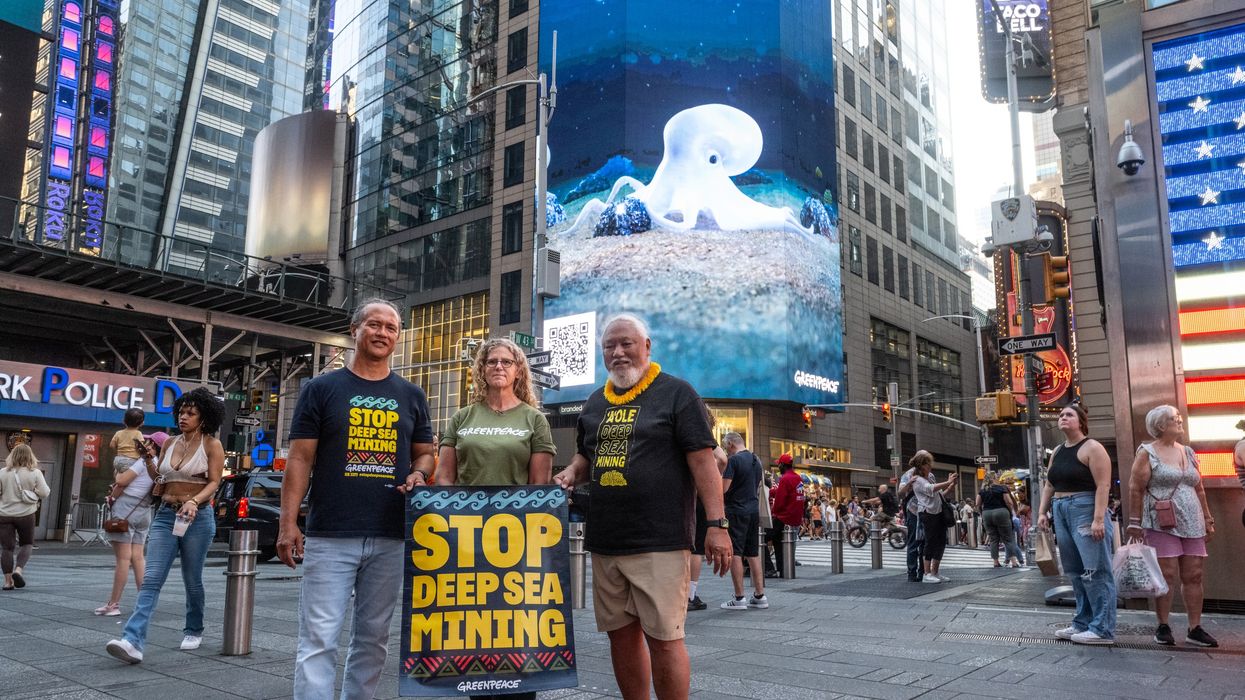
The ocean is far more than a collection of resources to be exploited; it's a living, breathing entity that sustains life on Earth, and it's our duty to protect it.
In the bustling heart of New York City, where the pulse of global capitalism beats strongest, Greenpeace USA illuminated a towering LED Billboard with a crucial message for the Biden administration and investors: "Stop Deep-Sea Mining."
As an ocean campaigner with Greenpeace, every pixel of that display resonates with me as a beacon of hope in the ongoing battle to safeguard our oceans.
My connection to the ocean runs deep. From my childhood in Coastal California, where the ocean is a central part of our culture and economy, to the privilege I've enjoyed as a campaigner to explore its depths and sail its vast expanses, marveling at its mysteries and the incredible creatures that call it home, to the unparalleled joy of teaching my grandchildren to snorkel. The ocean is far more than a collection of resources to be exploited; it's a living, breathing entity that sustains life on Earth, and it's our duty to protect it.
With our oceans, climate, and planet facing crises, we cannot afford to take unnecessary risks with another ill-conceived and needlessly destructive industry.
And now our oceans, which have already been pushed to the brink, face a new and urgent peril: Deep-Sea Mining. Driven by the insatiable thirst for profit, this industry is poised to unravel the delicate tapestry of life in the most pristine ecosystem on our planet: the deep seas. This is one of the last places in the world that is largely untouched by human activity, a place where scientists are just now discovering thousands of new species, and it's crucial to all life on our planet. In its wake, deep-sea mining could collectively impact an oceanic area greater than the size of the continental U.S. and worsen the already critical state of the world's oceans.
Over 2.8 million people worldwide have signed the Greenpeace petition calling for a moratorium on deep-sea mining because this is about more than just preserving habitats and safeguarding species—it's about protecting a part of ourselves.
We are not alone. The industry faces resistance from international investors and major banks, who have refused to fund deep-sea mining. Businesses such as Google, BMW, Volvo, and Renault have all called for a pause. Governments around the world, the United Nations human rights commissioner, fishing interests, battery manufacturers, Indigenous groups, and thousands of climate and youth activists have also raised objections. As a result, deep-sea mining didn't get the "green light" that was expected at an international meeting last year.
But the threat remains.
Today, as I stand in Times Square surrounded by flashy billboards, our call to protect the ocean stands alongside the seven-story Nasdaq Billboard where The Metals Company (TMC), a leading proponent of deep-sea mining, previously broadcast its entry as a Nasdaq-traded company, and I am reminded of the gravity of what's at stake. The ocean provides over 70% of the oxygen we breathe. It is an essential carbon sink that has helped us to regulate the climate even in the face of our increasing production of greenhouse gasses—buffering us from the worse impacts of climate change.
But it's what we don't know that should give us pause about launching an industry with irreversible impacts in a critical life-sustaining environment. Mining in the Clarion-Clipperton Zone could have unknown impacts on the ocean's carbon cycle. Extracting nodules, disrupting marine habitats, and generating sediment plumes from mining activities may disrupt carbon sequestration and hinder oxygen-producing processes.
This should worry investors buying into the industry's hyperbole of expected returns as, judging from the surge in climate change and biodiversity cases, they could face both litigation and business model risks. Countries, communities, and other stakeholders impacted by seabed mining—like fishing communities—can pursue their perceived losses in international, regional, and national courts.
Until recently, The Metals Company CEO Gerard Barron actively sought investment and political support, promoting seafloor polymetallic nodules as a pivotal resource for electric vehicles, dubbing them a "battery in a rock." However, with the evolution of battery technology diminishing the purported necessity for seafloor minerals coupled with a notable decline in metal prices, and after failing to persuade people that deep-sea minerals are needed to fight climate change, these reckless opportunists have turned their sights on the Pentagon. They are now exploiting geopolitical tensions as they cite China as an alternative market if the U.S. won't help them open the gates to the new extractive industry.
Recently, former military and government officials who should know better lent their names to a letter that supports the right thing for the wrong reasons. The letter, echoing The Metals Company's fear-mongering rhetoric, calls for the U.S. to ratify the United Nations Convention on the Law of the Sea (UNCLOS) to spur the country's interest in deep-sea mining amid competition with China for critical minerals. There are numerous good reasons for the U.S. to ratify UNCLOS, and being able to vote for a moratorium on deep-sea mining should be at the top of that list.
Instead, The Metals Company is aiming to get deep-sea mining started, ignoring all the reasons not to, possibly because their Nasdaq stock price just hasn't been able to get back up since their bellowing beginning. They announced they will submit an application to begin commercial deep-sea mining following the meeting of the International Seabed Authority this month - even though the organization is very unlikely to adopt a regulatory framework to permit mining this year.
Rather than cowering to an aggressive company seeking to profit off devastating an ocean ecosystem we barely understand, the U.S. government should focus on its responsibility to extend protections for our oceans. Investing billions of dollars in an untested and destructive industry like deep-sea mining is not the answer. It's 2024, a time when prospectors are beginning to look out to other planets for new resources. We have already done so much damage to this blue planet we call Earth, the only place known to harbor life. Isn't it time to finally prioritize preserving the rich life-giving oceans that sustain us? Instead of deep-sea mining, a better choice would be supporting innovative technology and scaling the recycling and reuse of batteries and minerals that are already making this industry obsolete.
It doesn't make sense to destroy little-understood ecosystems just to add a small percentage of world metals production. Investors should be cautious against falling for the poorly veiled greenwashing narrative. With our oceans, climate, and planet facing crises, we cannot afford to take unnecessary risks with another ill-conceived and needlessly destructive industry.
We call on U.S. President Joe Biden to support a moratorium on deep-sea mining and join the other 27 countries that have opposed this industry. This will ensure that corporations like TMC do not destroy another global resource that belongs to us all.
The choices we make today will echo through the generations. Will we choose to exploit the depths of our oceans for profit and weapons of war, or will we unite to protect and preserve the precious blue heart of our planet? The power to decide lies in our collective hands.
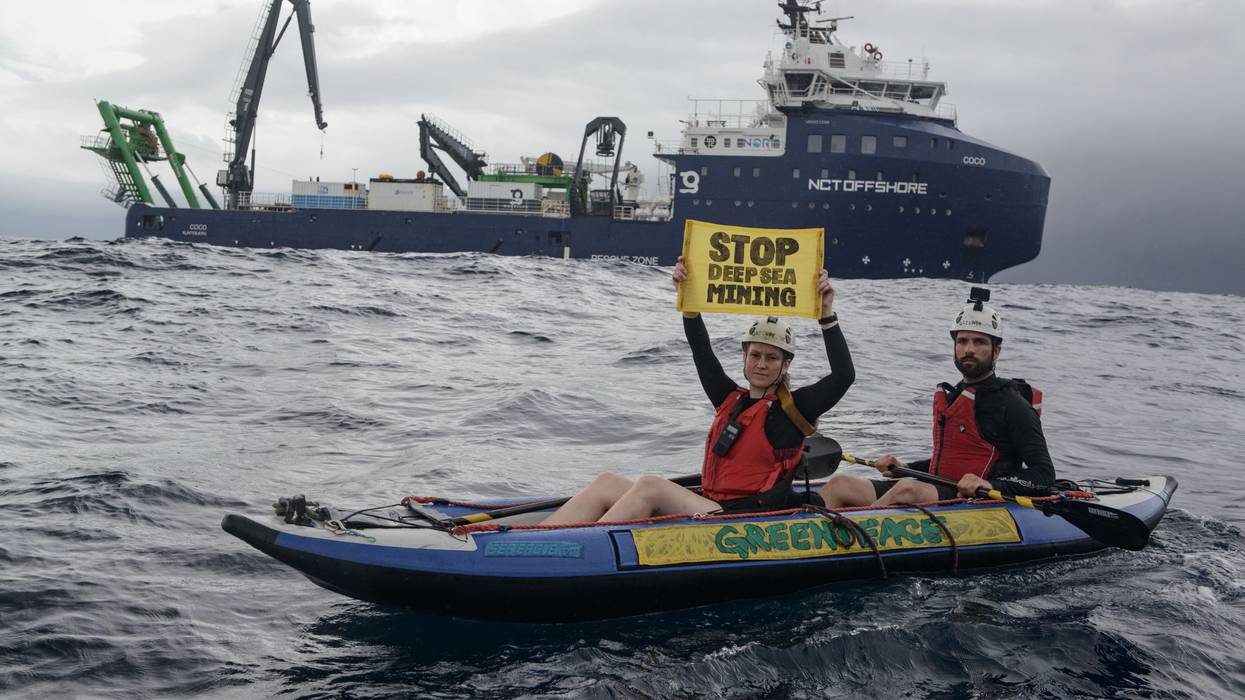
"How can Greenpeace's activists paddling on kayaks be a threat to the environment, but the plundering of the oceans be a solution to the climate catastrophe?"
As the International Seabed Authority kicked off its annual summit in Jamaica on Monday to discuss rules for extracting minerals from the ocean floor, Greenpeace—which could be expelled from the United Nations body over a demonstration targeting a mining company—is urging the ISA to "stop deep-sea mining, not protests."
Representatives of 167 nations are gathering in Kingston to draft the regulatory framework for deep-sea mining, which ISA member states agreed to work out by July 2025. Although there are no current commercial deep seabed mining operations, the ISA has issued exploration licenses to state-owned companies and agencies in China, France, Germany, India, Japan, Russia, and South Korea, and to private corporations including U.K. Seabed Resources, a subsidiary of U.S. military-industrial complex giant Lockheed Martin.
The Metals Company, a Canadian startup looking to make a big splash in deep-sea mining, has been targeted by Greenpeace "kayaktivists," who last November boarded a ship belonging to subsidiary Nauru Ocean Resources Inc. in the Pacific Ocean and occupied the vessel's stern crane to draw attention to the potential harm that mineral extraction would cause to one of the world's last untouched ecosystems.
That peaceful protest could cost Greenpeace its ISA observer status, as members will consider whether to punish the environmental group during this week's conference. ISA Secretary-General Michael Lodge claimed that Greenpeace's kayak protest posed a "serious threat" to company personnel and "the marine environment."
However, last November a Dutch court rejected The Metals Company's request for an injunction against the protesters, finding it "understandable" that Greenpeace took direct action in the face of "possibly very serious consequences" of the company's mining plans.
Greenpeace plans to hold a side event at the ISA conference on Monday focusing on the right to protest.
"If Michael Lodge had put as much effort into properly scrutinizing deep-sea mining companies and ensuring transparent negotiations as he has chasing dissent, a pristine ecosystem would have a fair chance to remain undisturbed," said Greenpeace International Deep-Sea Mining campaign lead Louisa Casson. "How can Greenpeace's activists paddling on kayaks be a threat to the environment, but the plundering of the oceans be a solution to the climate catastrophe?"
This year's ISA conference comes as two dozen nations are calling for a moratorium on deep-sea mining and campaigners are urging the United States to ratify the U.N. Convention on the Law of the Sea, under which the ISA was established.
"Over the past year, it's been outstanding to see the growing call for a moratorium from countries in the Pacific, Europe, and Latin America," said Casson. "Responsible nations at the ISA are listening to the mounting science that shows deep-sea mining would cause irreversible damage to the oceans... The momentum is on the side of a moratorium."
There is also pushback. Last week, more than 350 former military and political leaders in the United States including former Secretary of State Hillary Clinton published a letter urging the U.S. Senate to sign and ratify the Law of the Sea in a bid to boost deep-sea mining amid rising international competition for minerals.
"Almost everyone agrees that the United States should ratify the Law of the Sea—it's a no-brainer and has been since the treaty was adopted over 40 years ago. This might be the only thing that Greenpeace and Big Oil agree with each other on," said Arlo Hemphill, who heads the Oceans Are Life campaign at Greenpeace USA.
"Now, deep-sea mining corporation The Metals Company has jumped on the bandwagon, hoping it will increase their chances of making it big after several costly failed ventures," Hemphill added. "With two dozen countries already on the record opposing the launch of deep-sea mining any time soon, there is little possibility it will be permitted."
However, earlier this year Norway became the first country to green-light deep-sea mining, a decision one environmental campaigner warned will have "severe impacts on ocean wildlife."
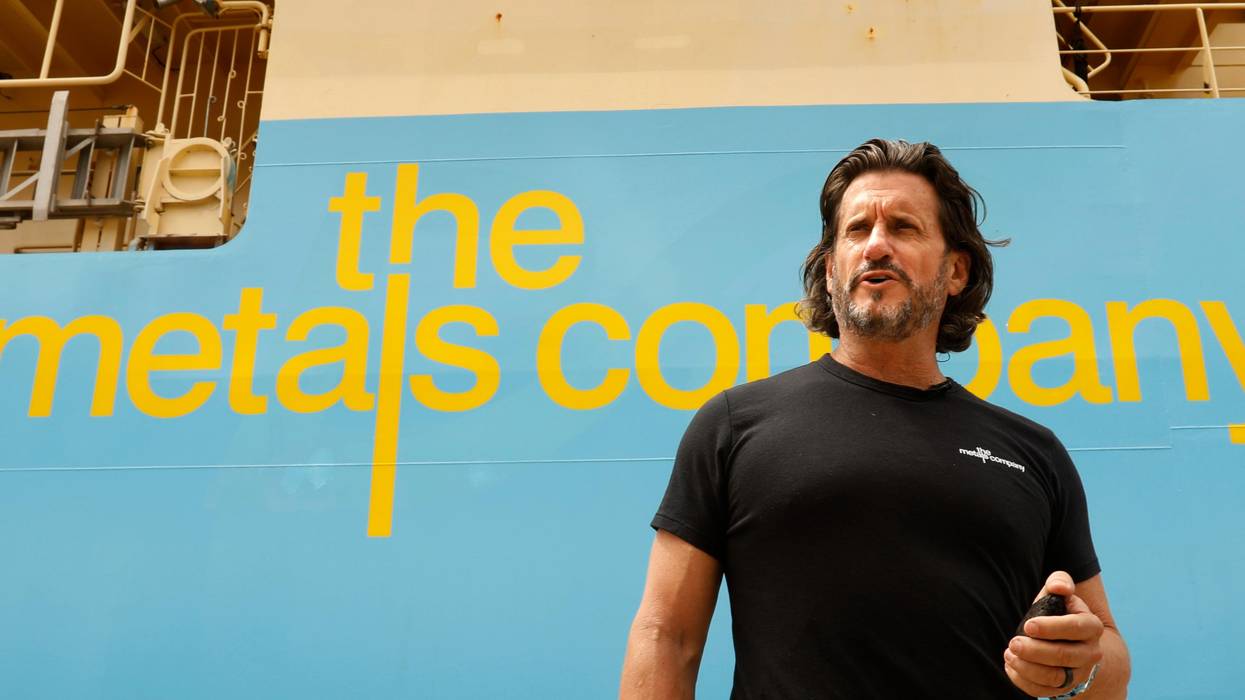
"This is a cowboy company running out of cash and trying to ride roughshod over international decisions," said one Greenpeace campaigner.
Greenpeace on Wednesday again took aim at a Canadian startup after the deep-sea mining company announced its expected application costs, development timeline, and production capacity following an international agency's recent meeting that ended without finalized regulations.
"The Metals Company's (TMC) announcement flies in the face of international opposition to deep-sea mining, and it's a big kick in the teeth for governments that spent three long weeks debating the future of the oceans and concluded this industry should not get a green light," said Greenpeace campaigner Louisa Casson in a statement.
"It's clear that trying to mine the oceans is becoming politically toxic—even more so with zero rules in place. This is bullish talk to try and force governments into rushed decisions, but it will come back to bite them," she continued. "TMC are showing their true colors: This is a cowboy company running out of cash and trying to ride roughshod over international decisions."
Casson added that "instead of acting on scientific findings, which conclusively prove this industry will put the oceans in danger, they're announcing fanciful plans to ramp up production in a desperate attempt to reassure their worried investors and save their plummeting share price."
TMC and the Pacific nation of Nauru worked together in 2021 to pressure the International Seabed Authority (ISA)—which already permits companies to explore the deep sea for research—to finalize global rules for commercial mining by July 2023.
As Common Dreams reported last month, when the ISA Council convened in Jamaica, Greenpeace was among the environmental groups and governments that advocated for a ban on "reckless" deep-sea mining. The meeting wrapped up with negotiators deciding that additional talks on regulations were needed through at least the first half of 2024.
As Greenpeace explained last week, the ISA Council's July decisions "effectively mean that a majority of countries—including Brazil, Costa Rica, Chile, Vanuatu, Germany, and Switzerland—did not yield to pressure from the industry—supported by nations such as Norway, Nauru, and Mexico—to fast-track rules for deep-sea mining."
"Industry frontrunner the Metals Company saw its share price plummet as markets reacted to the news," the group noted. "However, the ISA still failed to close a legal loophole for companies to start mining next year."
As The New York Times reported last month:
The area of most intense focus is the Clarion-Clipperton Zone, a remote stretch between Mexico and Hawaii where seabed rocks have the highest concentration of metals. The rocks sit 2.5 miles down, so deep that remotely operated machines are needed to lift them to collection ships.
This is the region where the Metals Company wants to begin its mining operations, convinced it can generate $30 billion in post-tax net cash flow over the 25-year life of the initial project. If it is successful, this small company that has never produced a profit would become one of the largest global suppliers of key metals needed for electric vehicle batteries.
TMC announced Tuesday that "subsidiary Nauru Ocean Resources Inc. (NORI) intends to submit an application to the ISA for an exploitation contract for NORI Area D following the July 2024 meeting of the ISA. Assuming a one-year review process, NORI expects to be in production in the fourth quarter of 2025."
TMC chairman and CEO Gerard Barron said that "NORI will monitor closely the progress that the council makes over the next three meetings" and both the parent company and its subsidiary "are prepared to work within the ISA's new roadmap."
"We are pleased to see the ISA's reiteration of their obligation to consider a plan of work when we are ready to lodge it in consultation with our sponsoring state," he added. "Meanwhile, our teams continue work on the scientific evidence to support NORI's application and we will include a campaign to revisit the site of last year's pilot collection trials in the Clarion-Clipperton Zone to further bolster our environmental knowledge. We will continue to share this data openly, with the entire world."
Some scientists have disputed industry claims about the necessity of deep-sea mining—given that metals used in battery-making can be extracted elsewhere—and warned that such activity could cause "irreparable damage" to fragile ecosystems.

At the start of the current meeting to decide the fate of deep sea mining, new guidelines appeared on the ISA’s website containing hard restrictions to peaceful protest, documentation, and media scrutiny.
If you’re trying to kick-start an environmentally destructive industry in 2023, with the climate movement stronger and more mainstream than ever, you better hope no one notices.
That was the strategy of the deep sea mining industry.
“We want to assist in getting this very delicate legislation [allowing deep sea mining] in place, and keeping that out of the very public eye will be of benefit to us all I feel,” the CEO of a deep sea mining company wrote to the head of the industry’s regulator in 2017, according to the LA Times. And then people started noticing.
Recently, the threat of deep sea mining became concrete as a result of the Canadian-registered The Metals Company using a legal loophole to try and jam through the start of this industry. Now governments gathered at the International Seabed Authority (ISA) in Kingston have to decide whether to allow it to go ahead. It’s not looking good: New warnings by scientists about what we stand to lose, petitions from Indigenous Peoples, and concerns from the fishing industry have all contributed to over 20 governments now trying to put the brakes on this reckless industry
The problem for deep sea miners is that the genie is out of the bottle. Limiting the ability of journalists to do their job will only make them keener to dig for more inconsistencies and scandals.
Opposition to deep sea mining needed to be controlled and silenced. In the March ISA meeting, two LA Times journalists who previously exposed the ISA Secretary-General Michael Lodge’s proximity to companies were banned from chambers. Some days later Greenpeace-funded billboards calling on governments to take action to stop being the “Irresponsible Seabed Authority” were taken down.
At the start of the current meeting, new guidelines appeared on the ISA’s website: seven pages containing hard restrictions to peaceful protest, documentation, and media scrutiny. Journalists are seemingly now allowed at just one of the three weeks of the meeting while mining companies sit on government delegations. Also, media actions must not engage in “derisory activity or criticism directed at the Authority, its Member States, the Secretariat, the competent authorities of the host government.”
The new rules also now mention protesting outside the conference center while this is not within the competence of the ISA—and forbid it inside the conference center. Ironically, on the first day of the meeting Lodge took the floor to invite everyone to look at the poster exhibition outside the venue. Spoiler: It’s not children’s drawings of deep sea creatures, much less a platform for Pacific activists, it’s “the first Contractors' Poster Exhibition,” a showcase of propaganda for deep sea mining companies. Climate conferences don’t get away with giving advertising space to the fossil fuel industry, so why is this acceptable for deep sea mining?
Scientists warn that if this industry gets a greenlight, it will cause irreversible and unavoidable harm to the oceans. Good job for the companies that it’s pitch-black 4,000 meters deep, and the area they’re targeting are mostly way out on the high seas, hundreds of kilometers from shore. Even with a fleet of ships like the Rainbow Warrior, it’s hard for Greenpeace to keep an eye on what’s happening down there, much less any kind of international watchdog.
In campaigning to protect the oceans from this industry ever starting, we’ve had to rely on tip-offs from concerned whistleblowers, people with privileged information or access to the industry who can bear its encroachment into the oceans no more.
It’s how we broke the story back in 2021 that a Belgian company had got their deep sea mining machine stuck on the seafloor during trials in the middle of the Pacific—for several days. It took inquiries from journalists for the company to confirm this incident publicly, days after the problem started.
Several governments, who make up the ISA, noted that it should not come down to whistleblowers and civil society to expose the problems. So is it any surprise that at this crunch point the ability to scrutinize and protest these negotiations is facing a major clampdown?
For years, campaigners have warned of corporate capture at the ISA, allowing obscure ownership structures of companies to go unquestioned. Michael Lodge made increasingly pro-mining comments, calling the idea of a moratorium “anti-science.”
A safe, respectful, and courteous working environment requires accountability. Governments are making a momentous decision here that requires the active participation of people across the world, bringing diverse perspectives and, where necessary, criticism and warnings. The U.N. human rights commissioner said as much last week.
The problem for deep sea miners is that the genie is out of the bottle. Limiting the ability of journalists to do their job will only make them keener to dig for more inconsistencies and scandals. Revelations that images of test-mining have been kept locked in a corporate archive for 40 years will only beg the question, what else is there to hide?
When the answer is species extinctions, harm to whales, and deepening exploitation of Pacific peoples, you are basically hiding that you are on the way to becoming the fossil fuel industry of the 21st century. And good luck getting any social license or political approval to operate while global temperatures keep breaking records.