SUBSCRIBE TO OUR FREE NEWSLETTER
Daily news & progressive opinion—funded by the people, not the corporations—delivered straight to your inbox.
5
#000000
#FFFFFF
To donate by check, phone, or other method, see our More Ways to Give page.
Daily news & progressive opinion—funded by the people, not the corporations—delivered straight to your inbox.
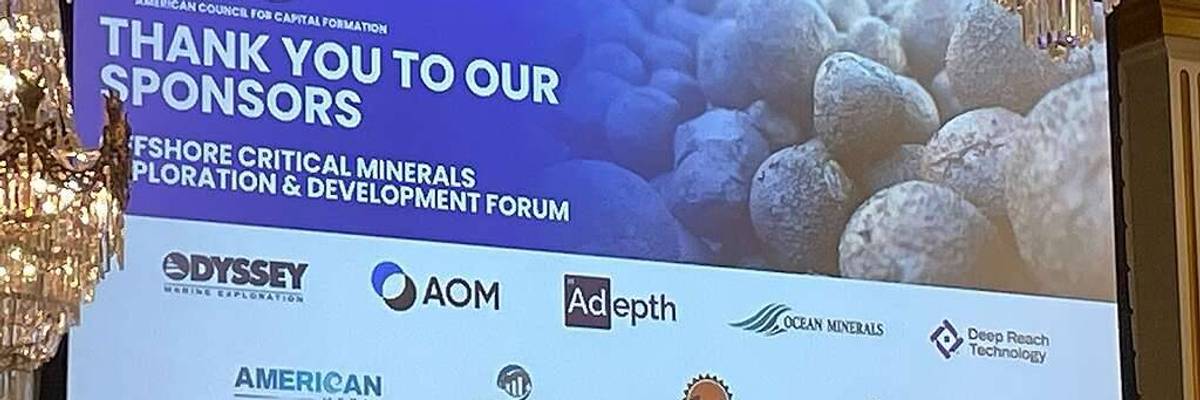
A billboard advertises the Offshore Critical Minerals Exploration and Development Forum.
The goal of an invitation-only event seemed to be to foster a shared belief among government officials and mining industry executives that deep-sea mining has a future. I’m not sure it worked.
In the chaotic aftermath of Snowmaggedon 2026, I snuck into the Offshore Critical Minerals Exploration and Development Forum at the famed Willard Hotel, known for hosting exclusive insider events and serving as a primary gathering spot for Washington DC’s “movers and shakers.” This event fit that mold—but with the growing secrecy of the deep-sea mining crowd added for extra flavor.
Hosted by the American Council for Capital Formation (ACCF), the goal of this invitation-only event seemed to be to foster a shared belief among government officials and mining industry executives that deep-sea mining has a future. I’m not sure it worked.
ACCF’s Michael Zehr set the tone early, making sure everyone understood that “we’re not here to discuss the ISA [International Seabed Authority] and UNCLOS [United Nations Convention on the Law of the Sea].”
OK, look, I get it. I’m sure they had to promise that the agenda would steer clear of prickly issues of international law to get the Trump officials to show up. But it’s a bit delusional to assume that the US will just carry on with President Donald Trump’s plan to bypass the International Seabed Authority after Trump is gone, so avoiding this issue completely undermined the whole purpose of the gathering.
Not only does deep-sea mining not yet exist, as Ocean Minerals CEO Hans Smit pointed out, it is an industry that should not exist. Humanity does not have a very good track record when it comes to launching new extractive industries, as even the predictable consequences are often dwarfed by the impacts we didn’t fully see coming. But this was not the group of people who were going to pause for that kind of self-reflection.
Instead, the mining CEOs did their best to convince everyone that deep-sea mining is easy and definitely going to happen while simultaneously making excuses for why it might take a long time. The investors tried to politely raise some of their huge glaring concerns in a way that wouldn’t alarm the government officials. And the Trump administration officials waved away questions about whether future leaders are going to just pull the plug on Trump’s reckless approach. Throughout the day, speakers probably spent more time worrying about environmentalists than the environment, which I suppose was no surprise coming from this bunch.
The speakers responsible for raising the capital to make DSM possible acknowledged that investors are not exactly jumping on this rusty bandwagon. Mining is right up there with tobacco, alcohol, pornography, and gambling for many investors, who categorically exclude financing industries that fail the vice clause screen. Even those who might be willing to overlook the environmental impacts or reputational risks have held back, apparently for two main reasons.
As someone who has worked closely with staff at NOAA, State, and other federal agencies for over 20 years, it was galling to see how completely captured these agencies have become by corporate interests.
First, deep-sea mining is fantastically expensive to get going, and so far no one is close to being ready to operate at commercial scale. No one wants to throw hundreds of millions of dollars into a venture that may well be headed for bankruptcy (again). Which is connected to the second big problem, which came up throughout the day: durability. This administration will be out of office well before commercial mining will be operational, and probably even before it can be permitted. Even Tim Petty, the assistant secretary of commerce, refused to speculate on whether the Trump administration could move fast enough to actually grant permits, looking visibly uncomfortable and just saying, “We’ll see.”
Sometimes, when they avoid the question, it is all the answer you need. Petty also ducked a question about the approach the administration will take to consultation with Pacific stakeholders, responding with a completely unrelated tangent. Then, when he was asked about a comment Rep. Ed Case (D-Hawaii) had just made at a congressional hearing, that the National Oceanic and Atmospheric Administration (NOAA) is in bed with The Metals Company, Petty preferred to recount that in his meeting with staffers, “None of the questions about the environment came up”—as if that was some sort of validation.
As someone who has worked closely with staff at NOAA, State, and other federal agencies for over 20 years, it was galling to see how completely captured these agencies have become by corporate interests. Don’t get me wrong, corporations have always had far too much influence over public policy, but hearing NOAA’s Deputy Assistant Secretary Erik Noble say repeatedly that “NOAA is open for business” does not exactly provide much assurance that the agency responsible for stewardship of our oceans is up to the task right now. The general message from NOAA and Bureau of Ocean Energy Management (BOEM) officials to mining execs was clear: We are on your side. Regulations and laws are flexible, money will flow, incentives are coming. Tell us what you need and we will make it happen. To drive the point home even harder, Megan Carr used the gathering as an opportunity to announce that BOEM was launching a new process to start paving the way for deep-sea mining on Alaska’s outer continental shelf.
It was painful to sit through a day of delusional boosterism, especially from agencies that are responsible for protecting our oceans and America’s standing in the world. By the second half of the day, though, it was clear that there were hardly any “investors” in the room, and that the audience was mostly just made up of a rotating group of speakers talking to each other. Two-thirds of the seats were empty, and so, ultimately, was the promise of any real discussion when fundamental issues were off the table, speakers were unwilling to answer questions (from moderators only—no questions were ever taken from the audience), and people with other perspectives were not invited.
Dear Common Dreams reader, It’s been nearly 30 years since I co-founded Common Dreams with my late wife, Lina Newhouser. We had the radical notion that journalism should serve the public good, not corporate profits. It was clear to us from the outset what it would take to build such a project. No paid advertisements. No corporate sponsors. No millionaire publisher telling us what to think or do. Many people said we wouldn't last a year, but we proved those doubters wrong. Together with a tremendous team of journalists and dedicated staff, we built an independent media outlet free from the constraints of profits and corporate control. Our mission has always been simple: To inform. To inspire. To ignite change for the common good. Building Common Dreams was not easy. Our survival was never guaranteed. When you take on the most powerful forces—Wall Street greed, fossil fuel industry destruction, Big Tech lobbyists, and uber-rich oligarchs who have spent billions upon billions rigging the economy and democracy in their favor—the only bulwark you have is supporters who believe in your work. But here’s the urgent message from me today. It's never been this bad out there. And it's never been this hard to keep us going. At the very moment Common Dreams is most needed, the threats we face are intensifying. We need your support now more than ever. We don't accept corporate advertising and never will. We don't have a paywall because we don't think people should be blocked from critical news based on their ability to pay. Everything we do is funded by the donations of readers like you. When everyone does the little they can afford, we are strong. But if that support retreats or dries up, so do we. Will you donate now to make sure Common Dreams not only survives but thrives? —Craig Brown, Co-founder |
In the chaotic aftermath of Snowmaggedon 2026, I snuck into the Offshore Critical Minerals Exploration and Development Forum at the famed Willard Hotel, known for hosting exclusive insider events and serving as a primary gathering spot for Washington DC’s “movers and shakers.” This event fit that mold—but with the growing secrecy of the deep-sea mining crowd added for extra flavor.
Hosted by the American Council for Capital Formation (ACCF), the goal of this invitation-only event seemed to be to foster a shared belief among government officials and mining industry executives that deep-sea mining has a future. I’m not sure it worked.
ACCF’s Michael Zehr set the tone early, making sure everyone understood that “we’re not here to discuss the ISA [International Seabed Authority] and UNCLOS [United Nations Convention on the Law of the Sea].”
OK, look, I get it. I’m sure they had to promise that the agenda would steer clear of prickly issues of international law to get the Trump officials to show up. But it’s a bit delusional to assume that the US will just carry on with President Donald Trump’s plan to bypass the International Seabed Authority after Trump is gone, so avoiding this issue completely undermined the whole purpose of the gathering.
Not only does deep-sea mining not yet exist, as Ocean Minerals CEO Hans Smit pointed out, it is an industry that should not exist. Humanity does not have a very good track record when it comes to launching new extractive industries, as even the predictable consequences are often dwarfed by the impacts we didn’t fully see coming. But this was not the group of people who were going to pause for that kind of self-reflection.
Instead, the mining CEOs did their best to convince everyone that deep-sea mining is easy and definitely going to happen while simultaneously making excuses for why it might take a long time. The investors tried to politely raise some of their huge glaring concerns in a way that wouldn’t alarm the government officials. And the Trump administration officials waved away questions about whether future leaders are going to just pull the plug on Trump’s reckless approach. Throughout the day, speakers probably spent more time worrying about environmentalists than the environment, which I suppose was no surprise coming from this bunch.
The speakers responsible for raising the capital to make DSM possible acknowledged that investors are not exactly jumping on this rusty bandwagon. Mining is right up there with tobacco, alcohol, pornography, and gambling for many investors, who categorically exclude financing industries that fail the vice clause screen. Even those who might be willing to overlook the environmental impacts or reputational risks have held back, apparently for two main reasons.
As someone who has worked closely with staff at NOAA, State, and other federal agencies for over 20 years, it was galling to see how completely captured these agencies have become by corporate interests.
First, deep-sea mining is fantastically expensive to get going, and so far no one is close to being ready to operate at commercial scale. No one wants to throw hundreds of millions of dollars into a venture that may well be headed for bankruptcy (again). Which is connected to the second big problem, which came up throughout the day: durability. This administration will be out of office well before commercial mining will be operational, and probably even before it can be permitted. Even Tim Petty, the assistant secretary of commerce, refused to speculate on whether the Trump administration could move fast enough to actually grant permits, looking visibly uncomfortable and just saying, “We’ll see.”
Sometimes, when they avoid the question, it is all the answer you need. Petty also ducked a question about the approach the administration will take to consultation with Pacific stakeholders, responding with a completely unrelated tangent. Then, when he was asked about a comment Rep. Ed Case (D-Hawaii) had just made at a congressional hearing, that the National Oceanic and Atmospheric Administration (NOAA) is in bed with The Metals Company, Petty preferred to recount that in his meeting with staffers, “None of the questions about the environment came up”—as if that was some sort of validation.
As someone who has worked closely with staff at NOAA, State, and other federal agencies for over 20 years, it was galling to see how completely captured these agencies have become by corporate interests. Don’t get me wrong, corporations have always had far too much influence over public policy, but hearing NOAA’s Deputy Assistant Secretary Erik Noble say repeatedly that “NOAA is open for business” does not exactly provide much assurance that the agency responsible for stewardship of our oceans is up to the task right now. The general message from NOAA and Bureau of Ocean Energy Management (BOEM) officials to mining execs was clear: We are on your side. Regulations and laws are flexible, money will flow, incentives are coming. Tell us what you need and we will make it happen. To drive the point home even harder, Megan Carr used the gathering as an opportunity to announce that BOEM was launching a new process to start paving the way for deep-sea mining on Alaska’s outer continental shelf.
It was painful to sit through a day of delusional boosterism, especially from agencies that are responsible for protecting our oceans and America’s standing in the world. By the second half of the day, though, it was clear that there were hardly any “investors” in the room, and that the audience was mostly just made up of a rotating group of speakers talking to each other. Two-thirds of the seats were empty, and so, ultimately, was the promise of any real discussion when fundamental issues were off the table, speakers were unwilling to answer questions (from moderators only—no questions were ever taken from the audience), and people with other perspectives were not invited.
In the chaotic aftermath of Snowmaggedon 2026, I snuck into the Offshore Critical Minerals Exploration and Development Forum at the famed Willard Hotel, known for hosting exclusive insider events and serving as a primary gathering spot for Washington DC’s “movers and shakers.” This event fit that mold—but with the growing secrecy of the deep-sea mining crowd added for extra flavor.
Hosted by the American Council for Capital Formation (ACCF), the goal of this invitation-only event seemed to be to foster a shared belief among government officials and mining industry executives that deep-sea mining has a future. I’m not sure it worked.
ACCF’s Michael Zehr set the tone early, making sure everyone understood that “we’re not here to discuss the ISA [International Seabed Authority] and UNCLOS [United Nations Convention on the Law of the Sea].”
OK, look, I get it. I’m sure they had to promise that the agenda would steer clear of prickly issues of international law to get the Trump officials to show up. But it’s a bit delusional to assume that the US will just carry on with President Donald Trump’s plan to bypass the International Seabed Authority after Trump is gone, so avoiding this issue completely undermined the whole purpose of the gathering.
Not only does deep-sea mining not yet exist, as Ocean Minerals CEO Hans Smit pointed out, it is an industry that should not exist. Humanity does not have a very good track record when it comes to launching new extractive industries, as even the predictable consequences are often dwarfed by the impacts we didn’t fully see coming. But this was not the group of people who were going to pause for that kind of self-reflection.
Instead, the mining CEOs did their best to convince everyone that deep-sea mining is easy and definitely going to happen while simultaneously making excuses for why it might take a long time. The investors tried to politely raise some of their huge glaring concerns in a way that wouldn’t alarm the government officials. And the Trump administration officials waved away questions about whether future leaders are going to just pull the plug on Trump’s reckless approach. Throughout the day, speakers probably spent more time worrying about environmentalists than the environment, which I suppose was no surprise coming from this bunch.
The speakers responsible for raising the capital to make DSM possible acknowledged that investors are not exactly jumping on this rusty bandwagon. Mining is right up there with tobacco, alcohol, pornography, and gambling for many investors, who categorically exclude financing industries that fail the vice clause screen. Even those who might be willing to overlook the environmental impacts or reputational risks have held back, apparently for two main reasons.
As someone who has worked closely with staff at NOAA, State, and other federal agencies for over 20 years, it was galling to see how completely captured these agencies have become by corporate interests.
First, deep-sea mining is fantastically expensive to get going, and so far no one is close to being ready to operate at commercial scale. No one wants to throw hundreds of millions of dollars into a venture that may well be headed for bankruptcy (again). Which is connected to the second big problem, which came up throughout the day: durability. This administration will be out of office well before commercial mining will be operational, and probably even before it can be permitted. Even Tim Petty, the assistant secretary of commerce, refused to speculate on whether the Trump administration could move fast enough to actually grant permits, looking visibly uncomfortable and just saying, “We’ll see.”
Sometimes, when they avoid the question, it is all the answer you need. Petty also ducked a question about the approach the administration will take to consultation with Pacific stakeholders, responding with a completely unrelated tangent. Then, when he was asked about a comment Rep. Ed Case (D-Hawaii) had just made at a congressional hearing, that the National Oceanic and Atmospheric Administration (NOAA) is in bed with The Metals Company, Petty preferred to recount that in his meeting with staffers, “None of the questions about the environment came up”—as if that was some sort of validation.
As someone who has worked closely with staff at NOAA, State, and other federal agencies for over 20 years, it was galling to see how completely captured these agencies have become by corporate interests. Don’t get me wrong, corporations have always had far too much influence over public policy, but hearing NOAA’s Deputy Assistant Secretary Erik Noble say repeatedly that “NOAA is open for business” does not exactly provide much assurance that the agency responsible for stewardship of our oceans is up to the task right now. The general message from NOAA and Bureau of Ocean Energy Management (BOEM) officials to mining execs was clear: We are on your side. Regulations and laws are flexible, money will flow, incentives are coming. Tell us what you need and we will make it happen. To drive the point home even harder, Megan Carr used the gathering as an opportunity to announce that BOEM was launching a new process to start paving the way for deep-sea mining on Alaska’s outer continental shelf.
It was painful to sit through a day of delusional boosterism, especially from agencies that are responsible for protecting our oceans and America’s standing in the world. By the second half of the day, though, it was clear that there were hardly any “investors” in the room, and that the audience was mostly just made up of a rotating group of speakers talking to each other. Two-thirds of the seats were empty, and so, ultimately, was the promise of any real discussion when fundamental issues were off the table, speakers were unwilling to answer questions (from moderators only—no questions were ever taken from the audience), and people with other perspectives were not invited.