

SUBSCRIBE TO OUR FREE NEWSLETTER
Daily news & progressive opinion—funded by the people, not the corporations—delivered straight to your inbox.
5
#000000
#FFFFFF
To donate by check, phone, or other method, see our More Ways to Give page.
Daily news & progressive opinion—funded by the people, not the corporations—delivered straight to your inbox.
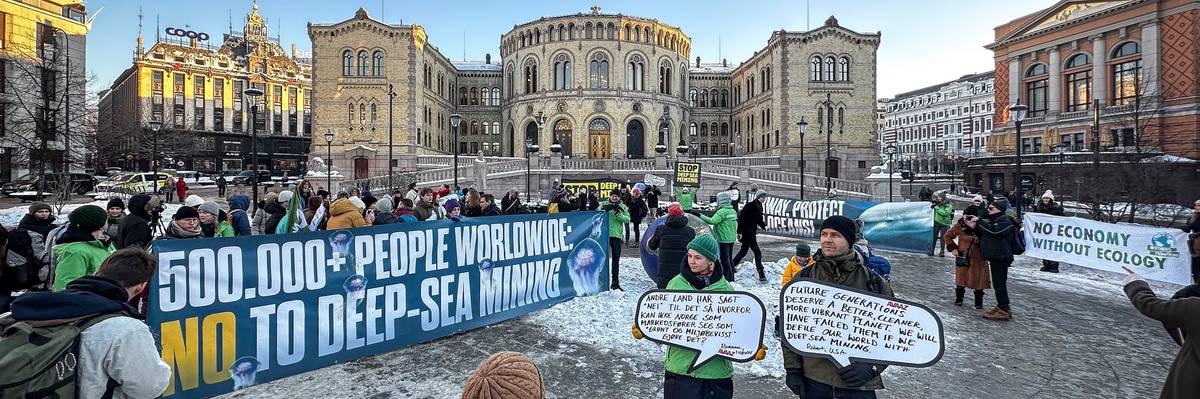
Activists gathered outside the Norwegian parliament in Oslo during a vote to approve deep-sea mining on January 9, 2024.
"This decision is an irrevocable black mark on Norway's reputation as a responsible ocean state," said one critic, warning of environmental impacts.
The Norwegian government came under fire from environmentalists and scientists worldwide on Tuesday after moving to become the first country to enable destructive commercial deep-sea mining.
Stortinget, Norway's parliament, overwhelmingly voted in favor of allowing exploration of the seabed under the country's Arctic waters for minerals—an outcome widely expected after center-left parties that control the government struck a deal with right-wing parties last month.
"This decision is an irrevocable black mark on Norway's reputation as a responsible ocean state," declared Steve Trent, CEO and founder of the U.K.-based Environmental Justice Foundation (EJF), in a statement Tuesday. "Deep-sea mining is a pursuit of minerals we don't need, with environmental damage that we can't afford."
"We can upgrade our economies and get to zero carbon without wrecking the deep ocean in the process."
"We know so little about the deep ocean, but we know enough to be sure that mining it will wipe out unique wildlife, disturb the world's largest carbon store, and do nothing to speed the transition to clean economies," he stressed. "Recent scientific studies in Norwegian waters demonstrate that there will be severe impacts on ocean wildlife if this mining goes ahead."
Trent continued:
Instead of being the answer to boosting renewable energy, deep-sea mining would be just another form of harmful resource extraction, with steep and needless costs we cannot and should not pay. As the Norwegian government decides to push forward with deep-sea mining, EJF's latest report reveals that we can upgrade our economies and get to zero carbon without wrecking the deep ocean in the process. New battery technologies are taking off, and there is a ready supply of minerals available now if we improve existing recycling rates. The argument for destroying the deep sea for cobalt and nickel does not withstand scrutiny and Norwegian lawmakers must recognize this.
Chloé Mikolajczak of Europe's Fossil Free Politics campaign said on social media that "exploration, while different from exploitation, already comes with significant environmental damage. Today, Norway failed the world and failed to protect our future. But the fight can not stop and we're mobilizing a community of thousands to #StopDeepSeaMining."
Amanda Louise Helle, who was among the Greenpeace Norway activists protesting outside Stortinget on Tuesday, was similarly determined to continue the battle against deep-sea mining.
"Today our parliament is getting ready to vote in favor of a criminal fate for one of the last safe havens for Arctic marine life," Helle said ahead of the vote. "Promising to protect the oceans one day and proposing deep-sea mining the next, is next-level hypocrisy. Not only does it risk vulnerable ecosystems in the Arctic, but also Norway's international reputation."
"If our politicians are ready to give the Arctic away to greedy companies, then we are more than ready to chase them wherever they plan to deploy their destructive machines," the campaigner pledged.
Norway's plan applies to 108,000 square miles of its national waters—"an area bigger than the size of the U.K.," as the BBC reported Tuesday. "The Norwegian government will not immediately allow companies to start drilling. They will have to submit proposals, including environmental assessments, for a licence which will then be approved on a case-by-case basis by parliament."
Hundreds of scientists, countries including the U.K., and the European Union have called for a moratorium on deep-sea mining due to environmental concerns. The United Nations-affiliated International Seabed Authority is set to meet later this year to try to finalize global rules about the controversial practice.
Dear Common Dreams reader, It’s been nearly 30 years since I co-founded Common Dreams with my late wife, Lina Newhouser. We had the radical notion that journalism should serve the public good, not corporate profits. It was clear to us from the outset what it would take to build such a project. No paid advertisements. No corporate sponsors. No millionaire publisher telling us what to think or do. Many people said we wouldn't last a year, but we proved those doubters wrong. Together with a tremendous team of journalists and dedicated staff, we built an independent media outlet free from the constraints of profits and corporate control. Our mission has always been simple: To inform. To inspire. To ignite change for the common good. Building Common Dreams was not easy. Our survival was never guaranteed. When you take on the most powerful forces—Wall Street greed, fossil fuel industry destruction, Big Tech lobbyists, and uber-rich oligarchs who have spent billions upon billions rigging the economy and democracy in their favor—the only bulwark you have is supporters who believe in your work. But here’s the urgent message from me today. It's never been this bad out there. And it's never been this hard to keep us going. At the very moment Common Dreams is most needed, the threats we face are intensifying. We need your support now more than ever. We don't accept corporate advertising and never will. We don't have a paywall because we don't think people should be blocked from critical news based on their ability to pay. Everything we do is funded by the donations of readers like you. When everyone does the little they can afford, we are strong. But if that support retreats or dries up, so do we. Will you donate now to make sure Common Dreams not only survives but thrives? —Craig Brown, Co-founder |
The Norwegian government came under fire from environmentalists and scientists worldwide on Tuesday after moving to become the first country to enable destructive commercial deep-sea mining.
Stortinget, Norway's parliament, overwhelmingly voted in favor of allowing exploration of the seabed under the country's Arctic waters for minerals—an outcome widely expected after center-left parties that control the government struck a deal with right-wing parties last month.
"This decision is an irrevocable black mark on Norway's reputation as a responsible ocean state," declared Steve Trent, CEO and founder of the U.K.-based Environmental Justice Foundation (EJF), in a statement Tuesday. "Deep-sea mining is a pursuit of minerals we don't need, with environmental damage that we can't afford."
"We can upgrade our economies and get to zero carbon without wrecking the deep ocean in the process."
"We know so little about the deep ocean, but we know enough to be sure that mining it will wipe out unique wildlife, disturb the world's largest carbon store, and do nothing to speed the transition to clean economies," he stressed. "Recent scientific studies in Norwegian waters demonstrate that there will be severe impacts on ocean wildlife if this mining goes ahead."
Trent continued:
Instead of being the answer to boosting renewable energy, deep-sea mining would be just another form of harmful resource extraction, with steep and needless costs we cannot and should not pay. As the Norwegian government decides to push forward with deep-sea mining, EJF's latest report reveals that we can upgrade our economies and get to zero carbon without wrecking the deep ocean in the process. New battery technologies are taking off, and there is a ready supply of minerals available now if we improve existing recycling rates. The argument for destroying the deep sea for cobalt and nickel does not withstand scrutiny and Norwegian lawmakers must recognize this.
Chloé Mikolajczak of Europe's Fossil Free Politics campaign said on social media that "exploration, while different from exploitation, already comes with significant environmental damage. Today, Norway failed the world and failed to protect our future. But the fight can not stop and we're mobilizing a community of thousands to #StopDeepSeaMining."
Amanda Louise Helle, who was among the Greenpeace Norway activists protesting outside Stortinget on Tuesday, was similarly determined to continue the battle against deep-sea mining.
"Today our parliament is getting ready to vote in favor of a criminal fate for one of the last safe havens for Arctic marine life," Helle said ahead of the vote. "Promising to protect the oceans one day and proposing deep-sea mining the next, is next-level hypocrisy. Not only does it risk vulnerable ecosystems in the Arctic, but also Norway's international reputation."
"If our politicians are ready to give the Arctic away to greedy companies, then we are more than ready to chase them wherever they plan to deploy their destructive machines," the campaigner pledged.
Norway's plan applies to 108,000 square miles of its national waters—"an area bigger than the size of the U.K.," as the BBC reported Tuesday. "The Norwegian government will not immediately allow companies to start drilling. They will have to submit proposals, including environmental assessments, for a licence which will then be approved on a case-by-case basis by parliament."
Hundreds of scientists, countries including the U.K., and the European Union have called for a moratorium on deep-sea mining due to environmental concerns. The United Nations-affiliated International Seabed Authority is set to meet later this year to try to finalize global rules about the controversial practice.
The Norwegian government came under fire from environmentalists and scientists worldwide on Tuesday after moving to become the first country to enable destructive commercial deep-sea mining.
Stortinget, Norway's parliament, overwhelmingly voted in favor of allowing exploration of the seabed under the country's Arctic waters for minerals—an outcome widely expected after center-left parties that control the government struck a deal with right-wing parties last month.
"This decision is an irrevocable black mark on Norway's reputation as a responsible ocean state," declared Steve Trent, CEO and founder of the U.K.-based Environmental Justice Foundation (EJF), in a statement Tuesday. "Deep-sea mining is a pursuit of minerals we don't need, with environmental damage that we can't afford."
"We can upgrade our economies and get to zero carbon without wrecking the deep ocean in the process."
"We know so little about the deep ocean, but we know enough to be sure that mining it will wipe out unique wildlife, disturb the world's largest carbon store, and do nothing to speed the transition to clean economies," he stressed. "Recent scientific studies in Norwegian waters demonstrate that there will be severe impacts on ocean wildlife if this mining goes ahead."
Trent continued:
Instead of being the answer to boosting renewable energy, deep-sea mining would be just another form of harmful resource extraction, with steep and needless costs we cannot and should not pay. As the Norwegian government decides to push forward with deep-sea mining, EJF's latest report reveals that we can upgrade our economies and get to zero carbon without wrecking the deep ocean in the process. New battery technologies are taking off, and there is a ready supply of minerals available now if we improve existing recycling rates. The argument for destroying the deep sea for cobalt and nickel does not withstand scrutiny and Norwegian lawmakers must recognize this.
Chloé Mikolajczak of Europe's Fossil Free Politics campaign said on social media that "exploration, while different from exploitation, already comes with significant environmental damage. Today, Norway failed the world and failed to protect our future. But the fight can not stop and we're mobilizing a community of thousands to #StopDeepSeaMining."
Amanda Louise Helle, who was among the Greenpeace Norway activists protesting outside Stortinget on Tuesday, was similarly determined to continue the battle against deep-sea mining.
"Today our parliament is getting ready to vote in favor of a criminal fate for one of the last safe havens for Arctic marine life," Helle said ahead of the vote. "Promising to protect the oceans one day and proposing deep-sea mining the next, is next-level hypocrisy. Not only does it risk vulnerable ecosystems in the Arctic, but also Norway's international reputation."
"If our politicians are ready to give the Arctic away to greedy companies, then we are more than ready to chase them wherever they plan to deploy their destructive machines," the campaigner pledged.
Norway's plan applies to 108,000 square miles of its national waters—"an area bigger than the size of the U.K.," as the BBC reported Tuesday. "The Norwegian government will not immediately allow companies to start drilling. They will have to submit proposals, including environmental assessments, for a licence which will then be approved on a case-by-case basis by parliament."
Hundreds of scientists, countries including the U.K., and the European Union have called for a moratorium on deep-sea mining due to environmental concerns. The United Nations-affiliated International Seabed Authority is set to meet later this year to try to finalize global rules about the controversial practice.

