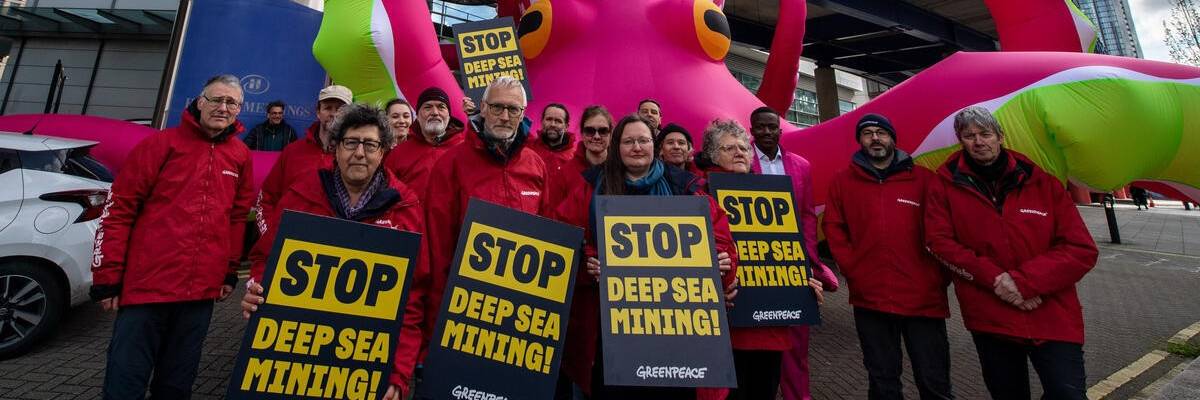
Greenpeace activists crash a deep-sea mining summit with a giant octopus on April 17, 2024 in London, England.
Trump Signs Executive Order to Advance 'Deeply Dangerous' Deep-Sea Mining
"The harm caused by deep-sea mining isn't restricted to the ocean floor: It will impact the entire water column, top to bottom, and everyone and everything relying on it," one campaigner warned.
Amid global calls for a ban on deep-sea mining to protect marine ecosystems, U.S. President Donald Trump on Thursday signed an executive order to advance the risky practice and "restore American dominance in offshore critical minerals and resources."
"The broad order avoids a direct confrontation with the United Nations-backed International Seabed Authority and seeks essentially to jump-start the mining of U.S. waters as part of a push to offset China's sweeping control of the critical minerals industry," noted Reuters, which had previewed the measure aimed at attaining nickel, cobalt, copper, manganese, titanium, and rare earth elements.
"The International Seabed Authority—created by the United Nations Convention on the Law of the Sea, which the U.S. has not ratified—has for years been considering standards for deep-sea mining in international waters, although it has yet to formalize them due to unresolved differences over acceptable levels of dust, noise, and other factors from the practice," the agency reported.
Trump's order directs Cabinet members including Secretary of Commerce Howard Lutnick—whose department oversees the National Oceanic and Atmospheric Administration (NOAA)—to expedite the permit process and work on various related reports.
"Authorizing deep-sea mining outside international law is like lighting a match in a room full of dynamite—it threatens ecosystems, global cooperation, and U.S. credibility all at once."
Deep-sea mining is opposed by over 30 countries as well as academics and advocacy groups worldwide. Among them is Greenpeace USA, whose campaigner Arlo Hemphill said Thursday that "authorizing deep-sea mining outside international law is like lighting a match in a room full of dynamite—it threatens ecosystems, global cooperation, and U.S. credibility all at once."
"We condemn this administration's attempt to launch this destructive industry on the high seas in the Pacific by bypassing the United Nations process," Hemphill declared. "This is an insult to multilateralism and a slap in the face to all the countries and millions of people around the world who oppose this dangerous industry."
"But this executive order is not the start of deep-sea mining. Everywhere governments have tried to start deep-sea mining, they have failed. This will be no different," he added. "We call on the international community to stand against this unacceptable undermining of international cooperation by agreeing to a global moratorium on deep-sea mining. The United States government has no right to unilaterally allow an industry to destroy the common heritage of humankind, and rip up the deep sea for the profit of a few corporations."
No exaggeration, deep sea mining could cause the massive collapse of the entire deep sea ecosystem and food chain. This is an existential risk to every person on this planet. www.nytimes.com/2025/04/24/c...
[image or embed]
— Alejandra Caraballo (@esqueer.net) April 24, 2025 at 5:54 PM
Ocean Conservancy vice president for external affairs Jeff Watters also blasted the move, saying that "this executive order flies in the face of NOAA's mission. NOAA is charged with protecting, not imperiling, the ocean and its economic benefits, including fishing and tourism; and scientists agree that deep-sea mining is a deeply dangerous endeavor for our ocean and all of us who depend on it."
"Areas of the U.S. seafloor where test mining took place over 50 years ago still haven't fully recovered," Watters pointed out. "The harm caused by deep-sea mining isn't restricted to the ocean floor: It will impact the entire water column, top to bottom, and everyone and everything relying on it. Evidence tells us that areas targeted for deep-sea mining often overlap with important fisheries, raising serious concerns about the impacts on the country's $321 billion fishing industry."
He highlighted that "NOAA is already being threatened by this administration's unprecedented cuts. NOAA is the eyes and ears for our water and air. NOAA provides Americans with accessible and accurate weather forecasts; it tracks hurricanes and tsunamis; it responds to oil spills; it keeps seafood on the table; and so much more. Forcing the agency to carry out deep-sea mining permitting while these essential services are slashed will only harm our ocean and our country."
"It's not just our country this executive order would harm: This action has far-reaching implications beyond the U.S.," Watters added, warning that by unilaterally allowing deep-sea mining, "the administration is opening a door for other countries to do the same—and all of us, and the ocean we all depend on, will be worse off for it."
As The New York Times reported:
The executive order could pave the way for the Metals Company, a prominent seabed mining company, to receive an expedited permit from NOAA to actively mine for the first time. The publicly traded company, based in Vancouver, British Columbia, disclosed in March that it would ask the Trump administration through a U.S. subsidiary for approval to mine in international waters. The company has already spent more than $500 million doing exploratory work.
"We have a boat that's production-ready," said Gerard Barron, the company's chief executive, in an interview on Thursday. "We have a means of processing the materials in an allied friendly partner nation. We're just missing the permit to allow us to begin."
In response to the late March disclosure—which came during International Seabed Authority negotiations—Louisa Casson, senior campaigner for Greenpeace International, said that "this is another of the Metals Company's pathetic ploys and an insult to multilateralism. It shows that a moratorium on deep-sea mining is more urgently needed than ever. It also proves that the company's CEO Gerard Barron's plans never focused on solutions for the climate catastrophe."
"The Metals Company is desperate and now is encouraging a breach of customary international law by announcing their intent to mine the international seabed through the United States' Deep-Sea Hard Mineral Resources Act," the camapigner asserted. "This comes after the Metals Company has spent years exerting immense pressure on the International Seabed Authority to try and force governments to allow mining in the international seabed—the common heritage of humankind."
Casson stressed that "states, civil society, scientists, companies, and Indigenous communities continue to resist these efforts. Having tried and failed to pressure the international community to meet their demands, this reckless announcement is a slap in the face to international cooperation."
Less than a week later, the Norwegian deep-sea mining company Loke Marine Minerals declared bankruptcy—which Haldis Tjeldflaat Helle, a campaigner for Greenpeace Nordic, noted came "on the same day that we shut down a deep-sea mining conference in Bergen."
The Norwegian government in December halted plans to move forward with deep-sea mining in the Arctic Ocean, which Steve Trent, CEO and founder of the Environmental Justice Foundation, had called "a testament to the power of principled, courageous political action, and... a moment to celebrate for environmental advocates, ocean ecosystems, and future generations alike."
We are at a crossroads
This country and this world are at a monumental crossroads. In a few short weeks, US voters will have an opportunity to beat back the forces of fascism and confront the billionaires who are rigging the economy, our media system, and our democracy, making it increasingly impossible for ordinary people to get by. We’re not just talking about the election. We’re talking about what must be done once these fascist elements are vanquished from power. We need a bolder set of solutions than what either major party has so far been willing to offer and a working-class movement ready to fight like hell for it. Trump didn't emerge from nowhere. The conditions that fueled MAGA authoritarianism were created by decades of radical neoliberal economic policies and a corrupt political system dominated by corporate interests. They slashed taxes on the super-rich, promising that the benefits would trickle down. They said giveaways to the corporate titans would make life more affordable for the rest of us. It was all bullshit. And when a bitter, betrayed populace searches for someone to blame, right-wing demagogues have little trouble finding scapegoats. People know when they're being lied to, but you won't hear any of this from the corporate media. Only independent journalism—powered and funded by people who believe in building a better world—can deliver truly trustworthy daily news. Our Fall Campaign is underway, and we need your help. To power our newsroom through the rest of the year, we need to raise $125,000 by midnight on October 31. So if you share our vision, please contribute whatever you can to sustain our work. |
Amid global calls for a ban on deep-sea mining to protect marine ecosystems, U.S. President Donald Trump on Thursday signed an executive order to advance the risky practice and "restore American dominance in offshore critical minerals and resources."
"The broad order avoids a direct confrontation with the United Nations-backed International Seabed Authority and seeks essentially to jump-start the mining of U.S. waters as part of a push to offset China's sweeping control of the critical minerals industry," noted Reuters, which had previewed the measure aimed at attaining nickel, cobalt, copper, manganese, titanium, and rare earth elements.
"The International Seabed Authority—created by the United Nations Convention on the Law of the Sea, which the U.S. has not ratified—has for years been considering standards for deep-sea mining in international waters, although it has yet to formalize them due to unresolved differences over acceptable levels of dust, noise, and other factors from the practice," the agency reported.
Trump's order directs Cabinet members including Secretary of Commerce Howard Lutnick—whose department oversees the National Oceanic and Atmospheric Administration (NOAA)—to expedite the permit process and work on various related reports.
"Authorizing deep-sea mining outside international law is like lighting a match in a room full of dynamite—it threatens ecosystems, global cooperation, and U.S. credibility all at once."
Deep-sea mining is opposed by over 30 countries as well as academics and advocacy groups worldwide. Among them is Greenpeace USA, whose campaigner Arlo Hemphill said Thursday that "authorizing deep-sea mining outside international law is like lighting a match in a room full of dynamite—it threatens ecosystems, global cooperation, and U.S. credibility all at once."
"We condemn this administration's attempt to launch this destructive industry on the high seas in the Pacific by bypassing the United Nations process," Hemphill declared. "This is an insult to multilateralism and a slap in the face to all the countries and millions of people around the world who oppose this dangerous industry."
"But this executive order is not the start of deep-sea mining. Everywhere governments have tried to start deep-sea mining, they have failed. This will be no different," he added. "We call on the international community to stand against this unacceptable undermining of international cooperation by agreeing to a global moratorium on deep-sea mining. The United States government has no right to unilaterally allow an industry to destroy the common heritage of humankind, and rip up the deep sea for the profit of a few corporations."
No exaggeration, deep sea mining could cause the massive collapse of the entire deep sea ecosystem and food chain. This is an existential risk to every person on this planet. www.nytimes.com/2025/04/24/c...
[image or embed]
— Alejandra Caraballo (@esqueer.net) April 24, 2025 at 5:54 PM
Ocean Conservancy vice president for external affairs Jeff Watters also blasted the move, saying that "this executive order flies in the face of NOAA's mission. NOAA is charged with protecting, not imperiling, the ocean and its economic benefits, including fishing and tourism; and scientists agree that deep-sea mining is a deeply dangerous endeavor for our ocean and all of us who depend on it."
"Areas of the U.S. seafloor where test mining took place over 50 years ago still haven't fully recovered," Watters pointed out. "The harm caused by deep-sea mining isn't restricted to the ocean floor: It will impact the entire water column, top to bottom, and everyone and everything relying on it. Evidence tells us that areas targeted for deep-sea mining often overlap with important fisheries, raising serious concerns about the impacts on the country's $321 billion fishing industry."
He highlighted that "NOAA is already being threatened by this administration's unprecedented cuts. NOAA is the eyes and ears for our water and air. NOAA provides Americans with accessible and accurate weather forecasts; it tracks hurricanes and tsunamis; it responds to oil spills; it keeps seafood on the table; and so much more. Forcing the agency to carry out deep-sea mining permitting while these essential services are slashed will only harm our ocean and our country."
"It's not just our country this executive order would harm: This action has far-reaching implications beyond the U.S.," Watters added, warning that by unilaterally allowing deep-sea mining, "the administration is opening a door for other countries to do the same—and all of us, and the ocean we all depend on, will be worse off for it."
As The New York Times reported:
The executive order could pave the way for the Metals Company, a prominent seabed mining company, to receive an expedited permit from NOAA to actively mine for the first time. The publicly traded company, based in Vancouver, British Columbia, disclosed in March that it would ask the Trump administration through a U.S. subsidiary for approval to mine in international waters. The company has already spent more than $500 million doing exploratory work.
"We have a boat that's production-ready," said Gerard Barron, the company's chief executive, in an interview on Thursday. "We have a means of processing the materials in an allied friendly partner nation. We're just missing the permit to allow us to begin."
In response to the late March disclosure—which came during International Seabed Authority negotiations—Louisa Casson, senior campaigner for Greenpeace International, said that "this is another of the Metals Company's pathetic ploys and an insult to multilateralism. It shows that a moratorium on deep-sea mining is more urgently needed than ever. It also proves that the company's CEO Gerard Barron's plans never focused on solutions for the climate catastrophe."
"The Metals Company is desperate and now is encouraging a breach of customary international law by announcing their intent to mine the international seabed through the United States' Deep-Sea Hard Mineral Resources Act," the camapigner asserted. "This comes after the Metals Company has spent years exerting immense pressure on the International Seabed Authority to try and force governments to allow mining in the international seabed—the common heritage of humankind."
Casson stressed that "states, civil society, scientists, companies, and Indigenous communities continue to resist these efforts. Having tried and failed to pressure the international community to meet their demands, this reckless announcement is a slap in the face to international cooperation."
Less than a week later, the Norwegian deep-sea mining company Loke Marine Minerals declared bankruptcy—which Haldis Tjeldflaat Helle, a campaigner for Greenpeace Nordic, noted came "on the same day that we shut down a deep-sea mining conference in Bergen."
The Norwegian government in December halted plans to move forward with deep-sea mining in the Arctic Ocean, which Steve Trent, CEO and founder of the Environmental Justice Foundation, had called "a testament to the power of principled, courageous political action, and... a moment to celebrate for environmental advocates, ocean ecosystems, and future generations alike."
- The Deep Sea Is Not for Sale—the ISA Must Reject Corporate Pressure ›
- Greenpeace Says Ban Deep-Sea Mining, Not Our Right to Protest Against It ›
- 'Monumental Victory for the Ocean': Norway Halts Plans for Deep-Sea Mining ›
- Greenpeace Slams Impossible Metals’ Deep-Sea Mining Lease Bid as Desperate Move Amid Industry Collapse ›
- Campaigners Demand Global Ban on Deep-Sea Mining ›
- Opinion | Trump's Rogue Deep-Sea Mining Order Endangers Our Ocean and Our Future | Common Dreams ›
- 'Deep Deception': Report Details How Deep-Sea Mining Industry Exploits National Security Fears | Common Dreams ›
- Governments Fail to 'Rise to the Moment' as Seabed Meeting Ends Without Mining Pause | Common Dreams ›
- In 'Historic Victory' for Oceans, Norway Pauses Controversial Deep-Sea Mining Plans | Common Dreams ›
- Opinion | How to Save the World: Give Up War, Cars, and Leaf-Blowers... and Unveil the Stars | Common Dreams ›
- Opinion | Inside the Shadowy Forum Trying (and Likely Failing) to Make Deep-Sea Mining Happen | Common Dreams ›
- Opinion | Hey Trump, Our Ocean Isn't for Sale | Common Dreams ›
- Opinion | The Business of War: Trump’s Critical Minerals Grift | Common Dreams ›
- Opinion | Alaska's Vital Waters Are Already Under Stress; They Don't Need Deep-Sea Mining | Common Dreams ›
Amid global calls for a ban on deep-sea mining to protect marine ecosystems, U.S. President Donald Trump on Thursday signed an executive order to advance the risky practice and "restore American dominance in offshore critical minerals and resources."
"The broad order avoids a direct confrontation with the United Nations-backed International Seabed Authority and seeks essentially to jump-start the mining of U.S. waters as part of a push to offset China's sweeping control of the critical minerals industry," noted Reuters, which had previewed the measure aimed at attaining nickel, cobalt, copper, manganese, titanium, and rare earth elements.
"The International Seabed Authority—created by the United Nations Convention on the Law of the Sea, which the U.S. has not ratified—has for years been considering standards for deep-sea mining in international waters, although it has yet to formalize them due to unresolved differences over acceptable levels of dust, noise, and other factors from the practice," the agency reported.
Trump's order directs Cabinet members including Secretary of Commerce Howard Lutnick—whose department oversees the National Oceanic and Atmospheric Administration (NOAA)—to expedite the permit process and work on various related reports.
"Authorizing deep-sea mining outside international law is like lighting a match in a room full of dynamite—it threatens ecosystems, global cooperation, and U.S. credibility all at once."
Deep-sea mining is opposed by over 30 countries as well as academics and advocacy groups worldwide. Among them is Greenpeace USA, whose campaigner Arlo Hemphill said Thursday that "authorizing deep-sea mining outside international law is like lighting a match in a room full of dynamite—it threatens ecosystems, global cooperation, and U.S. credibility all at once."
"We condemn this administration's attempt to launch this destructive industry on the high seas in the Pacific by bypassing the United Nations process," Hemphill declared. "This is an insult to multilateralism and a slap in the face to all the countries and millions of people around the world who oppose this dangerous industry."
"But this executive order is not the start of deep-sea mining. Everywhere governments have tried to start deep-sea mining, they have failed. This will be no different," he added. "We call on the international community to stand against this unacceptable undermining of international cooperation by agreeing to a global moratorium on deep-sea mining. The United States government has no right to unilaterally allow an industry to destroy the common heritage of humankind, and rip up the deep sea for the profit of a few corporations."
No exaggeration, deep sea mining could cause the massive collapse of the entire deep sea ecosystem and food chain. This is an existential risk to every person on this planet. www.nytimes.com/2025/04/24/c...
[image or embed]
— Alejandra Caraballo (@esqueer.net) April 24, 2025 at 5:54 PM
Ocean Conservancy vice president for external affairs Jeff Watters also blasted the move, saying that "this executive order flies in the face of NOAA's mission. NOAA is charged with protecting, not imperiling, the ocean and its economic benefits, including fishing and tourism; and scientists agree that deep-sea mining is a deeply dangerous endeavor for our ocean and all of us who depend on it."
"Areas of the U.S. seafloor where test mining took place over 50 years ago still haven't fully recovered," Watters pointed out. "The harm caused by deep-sea mining isn't restricted to the ocean floor: It will impact the entire water column, top to bottom, and everyone and everything relying on it. Evidence tells us that areas targeted for deep-sea mining often overlap with important fisheries, raising serious concerns about the impacts on the country's $321 billion fishing industry."
He highlighted that "NOAA is already being threatened by this administration's unprecedented cuts. NOAA is the eyes and ears for our water and air. NOAA provides Americans with accessible and accurate weather forecasts; it tracks hurricanes and tsunamis; it responds to oil spills; it keeps seafood on the table; and so much more. Forcing the agency to carry out deep-sea mining permitting while these essential services are slashed will only harm our ocean and our country."
"It's not just our country this executive order would harm: This action has far-reaching implications beyond the U.S.," Watters added, warning that by unilaterally allowing deep-sea mining, "the administration is opening a door for other countries to do the same—and all of us, and the ocean we all depend on, will be worse off for it."
As The New York Times reported:
The executive order could pave the way for the Metals Company, a prominent seabed mining company, to receive an expedited permit from NOAA to actively mine for the first time. The publicly traded company, based in Vancouver, British Columbia, disclosed in March that it would ask the Trump administration through a U.S. subsidiary for approval to mine in international waters. The company has already spent more than $500 million doing exploratory work.
"We have a boat that's production-ready," said Gerard Barron, the company's chief executive, in an interview on Thursday. "We have a means of processing the materials in an allied friendly partner nation. We're just missing the permit to allow us to begin."
In response to the late March disclosure—which came during International Seabed Authority negotiations—Louisa Casson, senior campaigner for Greenpeace International, said that "this is another of the Metals Company's pathetic ploys and an insult to multilateralism. It shows that a moratorium on deep-sea mining is more urgently needed than ever. It also proves that the company's CEO Gerard Barron's plans never focused on solutions for the climate catastrophe."
"The Metals Company is desperate and now is encouraging a breach of customary international law by announcing their intent to mine the international seabed through the United States' Deep-Sea Hard Mineral Resources Act," the camapigner asserted. "This comes after the Metals Company has spent years exerting immense pressure on the International Seabed Authority to try and force governments to allow mining in the international seabed—the common heritage of humankind."
Casson stressed that "states, civil society, scientists, companies, and Indigenous communities continue to resist these efforts. Having tried and failed to pressure the international community to meet their demands, this reckless announcement is a slap in the face to international cooperation."
Less than a week later, the Norwegian deep-sea mining company Loke Marine Minerals declared bankruptcy—which Haldis Tjeldflaat Helle, a campaigner for Greenpeace Nordic, noted came "on the same day that we shut down a deep-sea mining conference in Bergen."
The Norwegian government in December halted plans to move forward with deep-sea mining in the Arctic Ocean, which Steve Trent, CEO and founder of the Environmental Justice Foundation, had called "a testament to the power of principled, courageous political action, and... a moment to celebrate for environmental advocates, ocean ecosystems, and future generations alike."
- The Deep Sea Is Not for Sale—the ISA Must Reject Corporate Pressure ›
- Greenpeace Says Ban Deep-Sea Mining, Not Our Right to Protest Against It ›
- 'Monumental Victory for the Ocean': Norway Halts Plans for Deep-Sea Mining ›
- Greenpeace Slams Impossible Metals’ Deep-Sea Mining Lease Bid as Desperate Move Amid Industry Collapse ›
- Campaigners Demand Global Ban on Deep-Sea Mining ›
- Opinion | Trump's Rogue Deep-Sea Mining Order Endangers Our Ocean and Our Future | Common Dreams ›
- 'Deep Deception': Report Details How Deep-Sea Mining Industry Exploits National Security Fears | Common Dreams ›
- Governments Fail to 'Rise to the Moment' as Seabed Meeting Ends Without Mining Pause | Common Dreams ›
- In 'Historic Victory' for Oceans, Norway Pauses Controversial Deep-Sea Mining Plans | Common Dreams ›
- Opinion | How to Save the World: Give Up War, Cars, and Leaf-Blowers... and Unveil the Stars | Common Dreams ›
- Opinion | Inside the Shadowy Forum Trying (and Likely Failing) to Make Deep-Sea Mining Happen | Common Dreams ›
- Opinion | Hey Trump, Our Ocean Isn't for Sale | Common Dreams ›
- Opinion | The Business of War: Trump’s Critical Minerals Grift | Common Dreams ›
- Opinion | Alaska's Vital Waters Are Already Under Stress; They Don't Need Deep-Sea Mining | Common Dreams ›