SUBSCRIBE TO OUR FREE NEWSLETTER
Daily news & progressive opinion—funded by the people, not the corporations—delivered straight to your inbox.
5
#000000
#FFFFFF
To donate by check, phone, or other method, see our More Ways to Give page.
Daily news & progressive opinion—funded by the people, not the corporations—delivered straight to your inbox.
"Let us understand that reality and not play along with this charade," the Senate HELP committee ranking member said before a vote on the labor secretary nominee.
U.S. Sen. Bernie Sanders on Thursday urged colleagues to reject Lori Chavez-DeRemer, President Donald Trump's nominee for labor secretary, and hold hearings to examine Department of Government Efficiency chief Elon Musk's outsized role in the Republican president's administration.
Chavez-DeRemer, a former GOP U.S. congresswoman from Oregon was
approved by a 14-9 Senate vote by members of the Senate Health, Education, Labor and Pensions (HELP) Committee.
"Let us understand that reality and not play along with this charade," said Sanders (I-Vt.), the ranking HELP member.
Sanders used the occasion of the panel's vote, however, to make the broader point about key members of Trump's cabinet and the absurdity of the amount of power that has been bestowed on Musk.
"Today, we are not voting on who the next secretary of labor is," Sanders said. "The next secretary of labor, the next secretary of education, the next secretary of housing, the next secretary of the treasury is Elon Musk. Let us understand that reality and not play along with this charade."
Sanders continued:
We have a situation where people all over this country understand that joining a trade union is a way to get better wages and working conditions. Millions of workers all over this country say, "I want to join a union." And yet we have large corporations acting illegally to deny workers the right to join unions, which is why one of my major priorities and the priority of many members on this side of the aisle is to pass the :[Richard L. Trumka] Protecting the Right to Organize PRO Act.
Last year, Sanders led the reintroduction of the PRO Act, legislation which would give unionswhich would, give unions and employers the ability to override state-level so-called "right to work" laws, enhance strike protections, ban anti-union "captive audience" meetings, and empower the National Labor Relations Board to impose monetary penalties on companies that violate workers' rights.
"Today, tens of millions of American workers are earning starvation wages, $12, $13 an hour," Sanders noted. "Nobody in any part of this country can survive on $12, $13 dollars an hour. And yet the minimum wage—the federal minimum wage of $7.25—has not been raised in a very, very long time."
"So what we need is a secretary of labor who is going to stand up and say we are going to take on powerful special interests," the senator continued. "We are going to stand with the working class of this country. Unfortunately... Chavez-DeRemer is not that person."
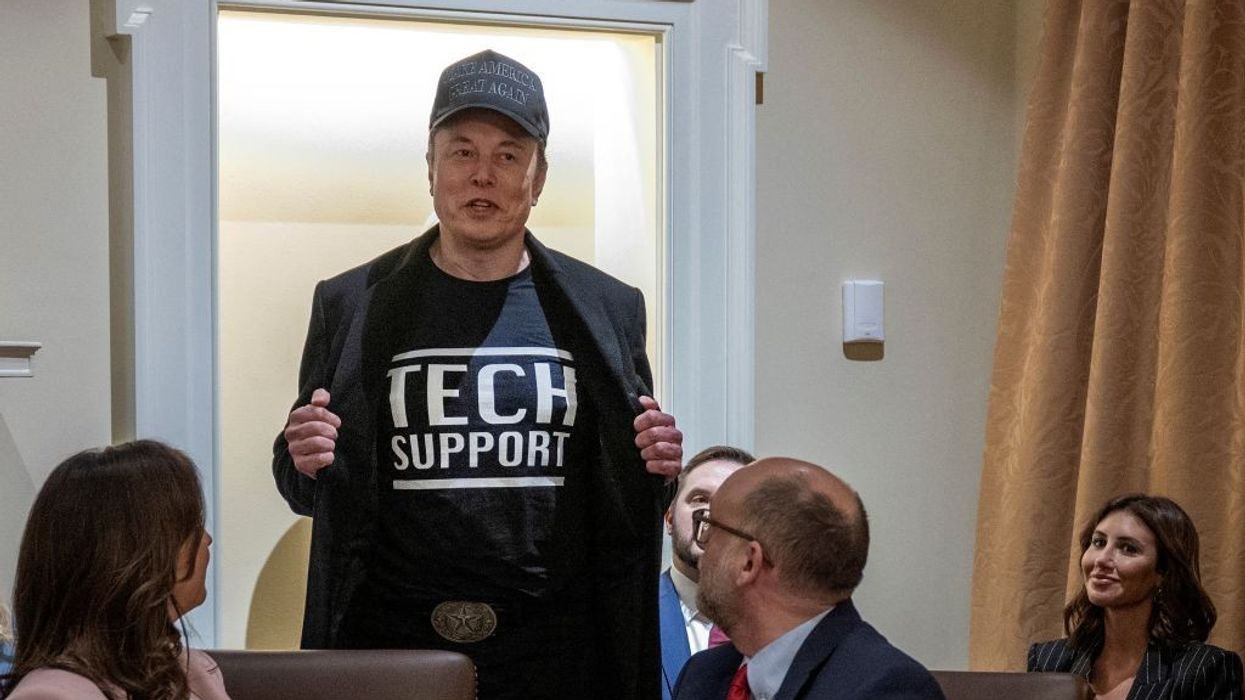
"Just yesterday, the president held a meeting with his cabinet," Sanders noted. "And who was the star of the meeting? Was it the secretary of the defense? Was it secretary of state? No, it was an unelected official who happens to be the wealthiest person on Earth. It was Elon Musk."
"If any cabinet official has courage to stand up to Mr. Musk and disobey his edicts, they are gone," the senator added. "So... my request to you is a simple one. Let's be honest. The American people understand it, and it’s time that we understood it as well."
"If you want to discuss policies in the Department of Labor," Sanders said, "let's bring in the real secretary. Mr. Chairman, I respectfully request that this committee bring Elon Musk before this committee so that we can really hear what's going on with the government."
Unions are more popular than ever and there are 60 million workers ready to join the labor movement. It's well past time to organize them. It should be our very top priority.
Unions are a critical working-class institution. They are one of the most effective organizations in the struggle against poverty, inequality, and economic insecurity.
They’re also deeply popular with the American public — a poll conducted by Gallup last year saw labor unions receive an approval rating of 70 percent.
But despite that broad public support, union membership has fallen steadily over the past four decades. Union density collapsed from 20.1 percent in 1983 to 9.9 percent in 2024, a record low. That’s a total loss of more than 3.4 million union members, from 17.72 million to 14.25 million union members out of a workforce of 88.29 million and 144.52 million, respectively.
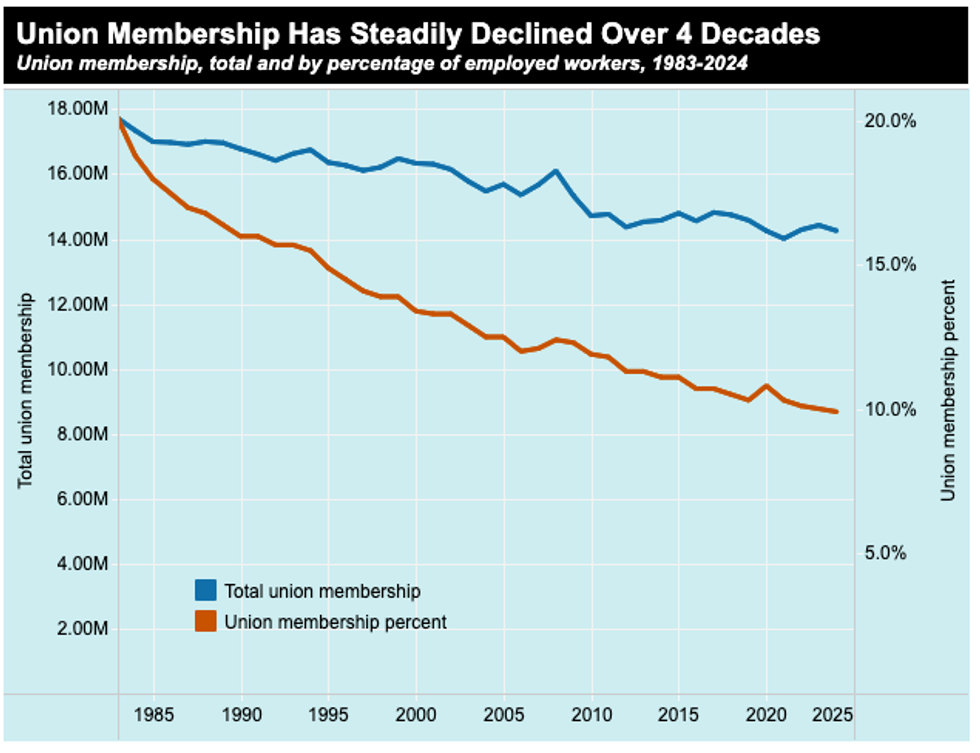
The majority of the American public correctly sees this downward trend as harmful to both the country and the working-class. The slide also highlights the need for labor to dedicate more of its resources to organizing non-unionized workplaces rather than lobbying and political campaigns.
Our political system’s dependence on money is a serious structural barrier towards moving the country in a pro-labor direction. We see this in the massive deployment of economic resources at the federal level by lobbyists. And the disparity is jarring when you compare the federal spending by business lobbyists to labor.
From the beginning of 2020 to this past year, labor lobbyists spent more than $258 million, but this is dwarfed by the $17.1 billion doled out by the business sector. This is a ratio of 66 to 1 in favor of business. Corporate influence operations account for 86.7 percent of all federal lobbying spending, and they have zero interest in seeing the expansion of workers’ rights and power.
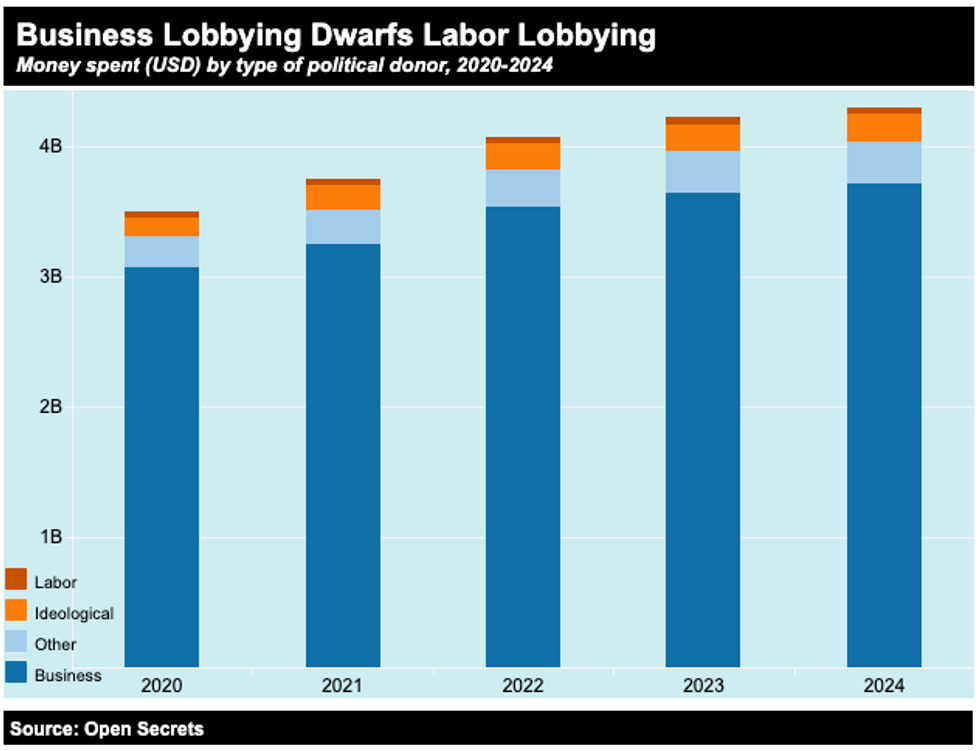
In other words, political spending is a losing game for organized labor. They cannot match the economic power of oligarchs and the corporations they control, leaving it with little political leverage and influence over our elected public officials.
Despite these structural disadvantages, the labor movement has scored some political victories. Unions endorsed Joe Biden for president in 2020 and donated $27 million directly to his electoral campaign. This paid some dividends. The Biden administration bolstered the National Labor Relations Board (NLRB) in a pro-labor direction, increasing the agency’s funding and appointing dedicated workers’ rights advocates.
However, as noted by journalist Hamilton Nolan, the opportunity to expand worker power was squandered — a record low of union density was reached after four years of a favorable administration.
Now the organized labor movement is forced to operate in a hostile, anti-worker environment for the next four years, and the brazen attacks have already begun.
In his first two weeks as president, Donald Trump fired General Counsel Jennifer Abruzzo and Board member Gwynne Wilcox. The latter dismissal generated a legal challenge, but until the courts settle the matter or a new Board member is appointed, the NLRB will remain a hamstrung federal agency.
The lack of quorum strips the Board’s ability to issue a number of important labor-related decisions that come across its desk and it leaves organizing workers vulnerable to both retaliatory attacks and illegal anti-union activities by corporations.
Research conducted by the Economic Policy Institute demonstrates that there are more than 60 million workers who want and are ready to join a union. Union resources need to be allocated towards organizing those workers, not politics. It would more than quadruple union density and increase the pool of resources available to the labor movement.
Organizing those 60 million workers strengthens our collective power, expands our dues base, develops more leaders, and increases our political influence. We can use our moral and material resources to combat the oncoming increases in the cost of living — thanks to Trump’s tariff regime — and the most unfavorable environment for labor organizing in recent memory.
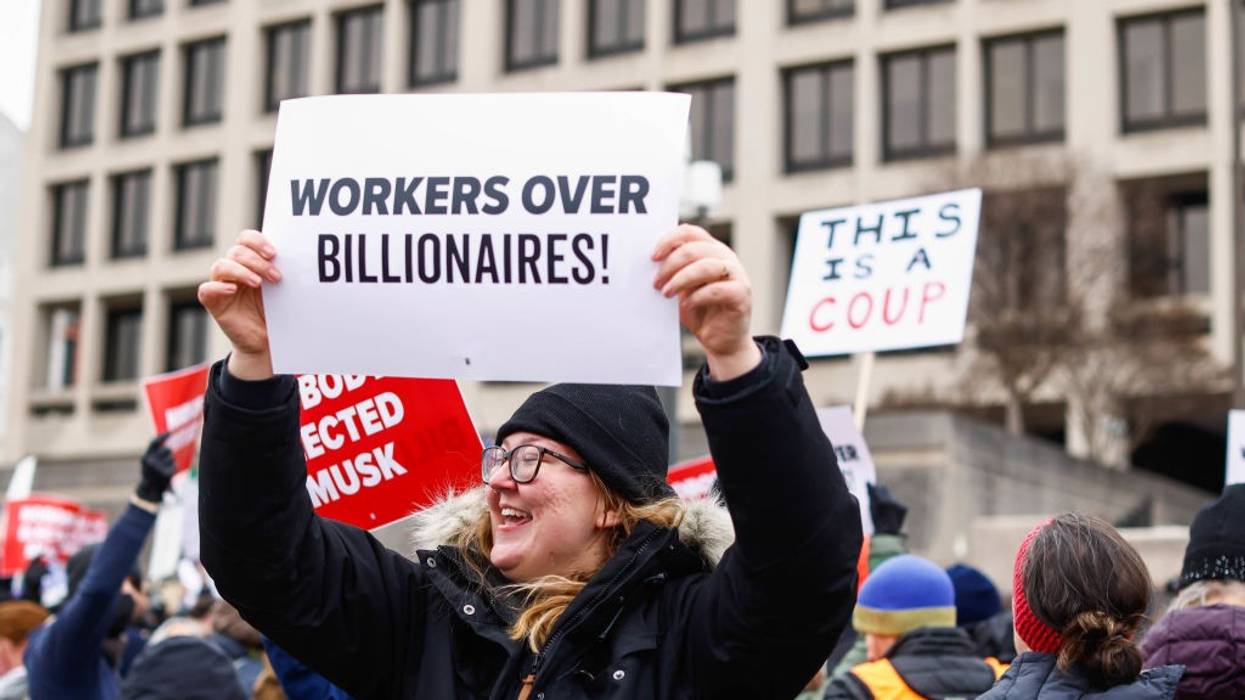
"Rather than standing up for average Americans," said the Independent U.S. senator, the president is "protecting the interests of some of the wealthiest people in the world."
President Donald Trump, by his actions, has revealed his clear dishonesty when he claims to be governing on behalf of American workers and their families.
That's the message at the heart of a statement released Friday by Sen. Bernie Sanders (I-Vt.), who cited recent attacks on the National Labor Relations Board (NLRB) by the Trump administration and his allies that directly contradict any such claims.
"When Trump campaigned for president, he claimed he was on the side of the working class," said Sanders. "But that’s not what he’s delivering. Rather than standing up for average Americans, he's protecting the interests of some of the wealthiest people in the world."
When Trump, he continued, "fires the most pro-union General Counsel in the history of the NLRB and illegally removes a member of this independent board, he is not a champion of the working class. He is a champion of unfettered corporate greed and union busters."
"When Trump campaigned for president, he claimed he was on the side of the working class. But that’s not what he’s delivering."
—Sen. Bernie Sanders
On Jan. 27, NLRB Commissioner Gwynne Wilcox, appointed to the board in 2021 for a term intended to last through to 2028, was terminated in a move that labor experts said was both unprecedented and unlawful.
Wilcox, who has since filed a lawsuit over her ouster, said in an interview with CBS News on Thursday that she was shocked—as were many others—by Trump's move, which she called a "blatant violation" of statutes that protect members of the board from political interference or reprisal.
"The law is that board members cannot be removed from their position unless they've engaged in neglect or duty or malfeasance, Wilcox explained. "And based upon the letter I received, there was no claim of that. There [wasn't] any cause or any reason that I was actually terminated."
Labor unions and advocates have said the attack on Wilcox represents a full and frontal assault on the ability of workers to organize or for union members to have their disputes or grievances addressed.
"The removal of Chair Wilcox threatens NLRB's independence and endangers working people's rights," said Eric Dean, General President of the Iron Workers Union (IW), in a Friday statement. "We stand in solidarity with Chair Wilcox and call for her immediate reinstatement to safeguard workers' rights."
The IW, which represents over 135,000 ironworkers in North America, said the "inappropriate" removal of Wilcox "has rendered the 5-member board inoperable, shutting down its decision-making ability and jeopardizing the protection of workers."
Sanders, in his remarks, echoed that central concern:
As a result of Trump’s unprecedented move, the NLRB no longer has a quorum and has effectively been shut down. What does this mean? It means that it will be far, far harder for workers to exercise their constitutional right to form a union and improve their standard of living. It means that during a union election, corporate bosses can illegally fire workers who vote to join a union. It means that corporate CEOs have free rein to illegally intimidate and coerce pro-union workers without recourse. It means that corporations can aggressively decide not to bargain in good faith with union workers or sign a first contract.
And because the NLRB is now dysfunctional, workers have no recourse.
Trump’s decision has already had disastrous consequences. Last week, workers at a Whole Foods grocery store in Philadelphia voted 130-100 to join the United Food and Commercial Workers union. But Whole Foods, owned by Jeff Bezos, has made it crystal clear that they will ignore this union victory and will not bargain with their union workers in good faith. Without a functioning NLRB, Whole Foods cannot be held accountable for its illegal behavior.
Sanders singled out Bezos as well as Elon Musk, who has been tapped by Trump to oversee the Department of Government Efficiency (DOGE), which is not an actual department with congressionally-granted authority but has targeted numerous federal agencies over the last two weeks, including the Department of Labor.
"For months, Elon Musk and Jeff Bezos, the two wealthiest men alive," said Sanders, "have been working overtime to abolish the NLRB. Why is that? These notorious anti-union billionaires want the absolute power to exploit their workers and violate labor law. The lower the wages they pay, the more money they make. Since Election Day, Elon Musk and Jeff Bezos have become $184 billion richer and are now worth $669 billion. But, apparently, that’s not enough."
Since Trump's reelection in November, a campaign victory bankrolled by numerous right-wing billionaires like Musk, Sanders has railed against the threat posed by what he has termed an American oligarchy.
Union leaders like AFL-CIO president Liz Shuler have also issued warnings about the erosion of worker protections under Trump.
“The government can work for billionaires or it can work for working people—but not both,” Shuler said on Wednesday ahead of a rally outside the Department of Labor, where DOGE personnel were said to meeting with DOL staffers.
“The government can work for billionaires or it can work for working people—but not both." —Liz Shuler, AFL-CIO
In a recent appearance on MSNBC's "All In With Chris Hayes," Sanders said that while Republicans are in control of both chambers of Congress, those majorities are historically slim and that means lawmakers remain "susceptible to citizen outrage."
Sanders said he wanted the American people, and specifically working families, to understand that they are right to be anxious about the current situation, but that they must mobilize and agitate to make their opposition heard.
"If you see these guys doing something—like wanting to give huge tax breaks to billionaires while they cut Medicare; or they want to go 'Drill, baby, drill' while we happen to be facing an existential threat of climate change; if they want to deport 20 million people in this country—stand up, fight back, we can beat them," said Sanders.
"Let's not act in a hopeless way," he continued, remarking on what can be done in the immediate term. "Longer term, obviously, we have to do what the Democratic Party has not done—and become the party of the working class, develop a strong grassroots movement, with labor unions, with young people, with people of color—and organize and fight back."
"The progressive agenda, and I say this over and over again, is the people's agenda," said Sanders. "It is wildly popular."
The acting general counsel of the National Labor Relations Board acknowledged that "the past few days and nights have been extremely scary and distressing" as federal agencies come under attack.
The top attorney at the National Labor Relations Board wrote in a memo to staff on Friday that she can't "promise everything is going to be OK" as the Trump administration attempts to ravage agencies across the government, running roughshod over career federal employees and the law in the process.
"I know that the past few days and nights have been extremely scary and distressing for some of us," Acting NLRB General Counsel Jessica Rutter wrote in a message obtained and posted to social media by independent journalist Ken Klippenstein.
"I know that at this moment, no matter what I say there is uncertainty," Rutter continued. "I cannot promise you that everything is going to be OK. I can promise you that I will be standing with the employees of his agency to effectuate our mission."
The memo from Rutter, who took over the post earlier this week after Trump fired former NLRB General Counsel Jennifer Abruzzo, marks the latest expression of deep unease and alarm from a federal workforce facing unprecedented attacks by President Donald Trump, billionaire Elon Musk, and the lackeys they have installed in key positions of authority throughout the government.
Slate's Mark Joseph Stern reported earlier this week that the NLRB's staff is "profoundly demoralized," particularly following Trump's termination of NLRB Chair Gwynne Wilcox—a move that was widely seen as illegal. Wilcox has vowed to pursue "all legal avenues to challenge" her removal.
"We expected Abruzzo's removal," a career attorney at the NLRB told Slate, "but Wilcox's unconstitutional ouster is a punch to the gut, not only because she was a fierce defender of the [National Labor Relations Act's] principles, but because a quorumless board leaves many of us floundering in our jobs."
Stern stressed that in addition to severely hindering the NLRB in the near-term, Trump's removal of Wilcox sets the stage for challenges to Supreme Court precedent that could "unleash a spate of firings across other independent agencies."
"Trump could bring every regulatory body under his thumb, terminating anyone who questioned his priorities," Stern warned. "And he would not stop there. The president has already claimed authority to fire high-ranking members of the civil service, who have merit protections, and has begun illegally removing them. He is seeking to reclassify at least 50,000 more career employees so he can easily oust them. And he is, of course, already purging other agencies with weaker protections than the NLRB—including the Equal Employment Opportunity Commission."
"Today's decision better protects workers' freedom to make their own choices in exercising their rights," said the chair of the National Labor Relations Board.
In a decision that advocates say will likely be reversed during the second administration of Republican U.S. President-elect Donald Trump, the National Labor Relations Board on Wednesday ruled that employers cannot force workers to attend anti-union speeches.
The NLRB's 3-1 decision in Amazon.com Services, LLC means that workers will no longer have to take part in so-called "captive audience meetings," which employers often use as a union-busting tool and a form of coercion. The agency explained that such meetings violate Section 7 of the National Labor Relations Act "because they have a reasonable tendency to interfere with and coerce employees."
"However, the board made clear that an employer may lawfully hold meetings with workers to express its views on unionization so long as workers are provided reasonable advance notice of: the subject of any such meeting, that attendance is voluntary with no adverse consequences for failure to attend, and that no attendance records of the meeting will be kept," the NLRB added.
NLRB Chairperson Lauren McFerran, a Democrat, said in a statement that "ensuring that workers can make a truly free choice about whether they want union representation is one of the fundamental goals of the National Labor Relations Act."
"Captive audience meetings—which give employers near-unfettered freedom to force their message about unionization on workers under threat of discipline or discharge—undermine this important goal," McFerran added. "Today's decision better protects workers' freedom to make their own choices in exercising their rights under the act, while ensuring that employers can convey their views about unionization in a noncoercive manner."
In April 2022, the NLRB's general counsel office issued a memo asserting that captive audience meetings are illegal. At least 11 states have banned such meetings. Other states are in various stages of considering or enacting bans or restrictions on them.
Workers' rights advocates hailed Wednesday's decision, although labor journalist Hamilton Nolan quipped on social media that employees should "enjoy this brief shining period before the Trump NLRB reverses this decision."
However, More Perfect Union producer Jordan Zakarin argued that Democrats can protect this "monumental win for labor" for "the next few years" if "they finally confirm" President Joe Biden's nomination of Joshua Ditelberg—a Republican lawyer who has represented companies including Amazon, Airbnb, and UnitedHealth—to fill the fifth NLRB seat.
According to the Economic Policy Institute (EPI)—a Washington, D.C.-based, pro-union think tank—U.S. employers spend an estimated $433 million per year on union-busting consultants.
"This reality makes it harder for workers to fight for their collective bargaining rights because they do not know the extent of their companies' investments in union-busting, a figure that could empower them at the negotiating table when employers claim they can't afford to increase pay and benefits," EPI said last year.
Being Trump’s buddy is not going to save you from the end of the NLRB and a return to pre-New Deal hostility to all forms of union power.
Why should anyone give a damn about a labor union’s presidential endorsement? A few reasons. Philosophically, since a good union is a democratic organization, an endorsement allows a politician to claim the legitimate support of a large group of hardworking Americans, that most treasured of groups. Politically, a good union’s endorsement also comes with money for the candidate and a team of union members to make calls and knock on doors, a valuable asset for any campaign. And practically, an endorsement allows a union to shore up support for its own priorities by cozying up to a future elected leader. A union backs a politician, the politician fights for the union’s needs, and the mutually beneficial cycle carries on.
The Teamsters’ non-endorsement of any candidate for U.S. president this week is notable in that it fails on every last one of those metrics.
In fairness, it’s not like every big union in America is some paragon of political virtue. Many or most big unions have a distinctly undemocratic endorsement process, dictated by a small group of leaders in a room rather than by an honest vote of the membership. (This can cause internal uproars, as we saw in 2020 when a number of union locals that supported Sen. Bernie Sanders (I-Vt.) railed publicly against their parent unions’ endorsements of U.S. President Joe Biden.) Credit the Teamsters for, at least, releasing some “member polling” data showing that Biden was the candidate supported by most Teamsters this summer, but that Trump had taken a lead after Vice President Kamala Harris entered the race. This fig leaf of democratic legitimacy is undermined by the fact that there was no methodology released—one number came from “Town Hall Straw Polls,” and another from an “Electronic Member Poll” that some members griped they hadn’t heard about. The American Prospect reported that the eight rank-and-file Teamster members who attended Kamala Harris’ sit down meeting with the union subsequently said they supported her—though the General Board proceeded to vote 14-3 for no endorsement.
A true union leader, who understands the stakes of this election, must stand up and tell his members: “Hey, if Trump is elected, unions, the working class, women, and your immigrant brothers and sisters are going to be fucked in the following ways.”
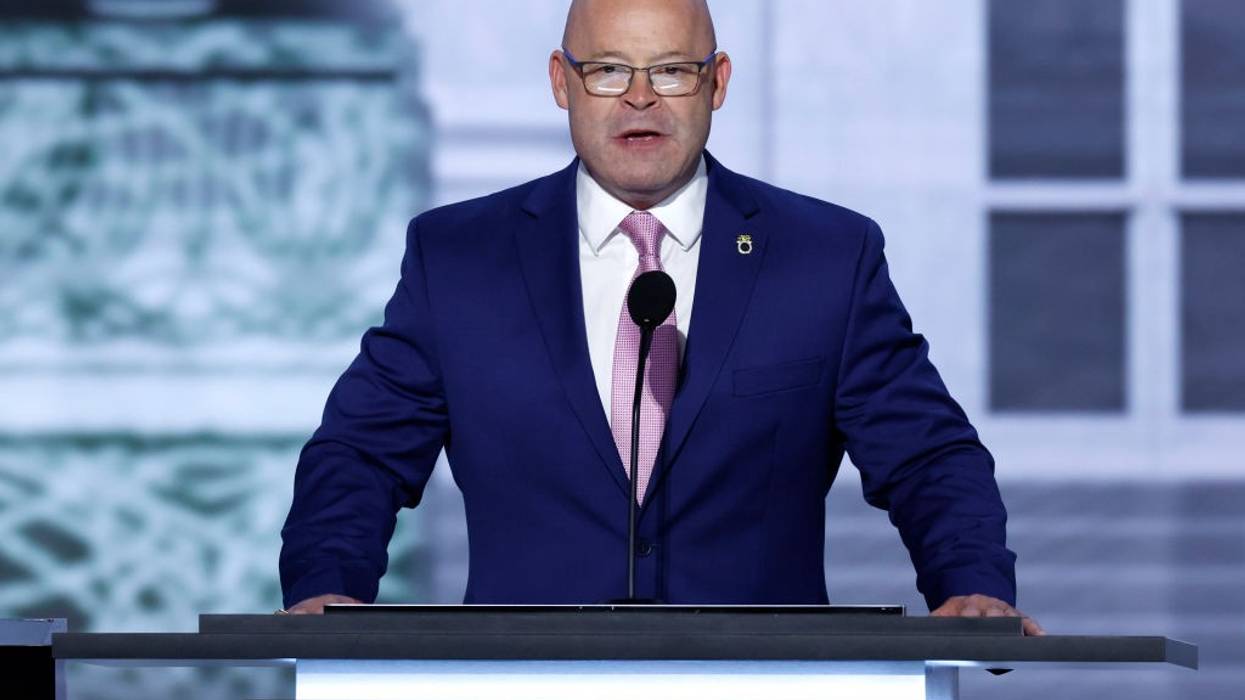
In reality, there is every indication that Teamsters president Sean O’Brien just… kinda likes former President Donald Trump. He posed for pictures with Trump in the lobby of Teamsters headquarters, unnecessarily. He had a private meeting with Trump at Mar-a-Lago. He had the union donate $45,000 to the Republican National Committee, alongside a donation to the Democrats. And, to cap it off, he gave a prime time speech at the Republican National Convention, mixing pro-worker slogans with ingratiating compliments to a smiling Trump. In doing so, O’Brien made himself into a useful patsy for the false and dangerous attempt by the Republicans to brand themselves as some kind of “working class” party.
O’Brien’s long flirtation with Trump has been marked by notable levels of insincerity. The Teamsters leader will say: I’m open to both sides! We’re having a fair and transparent process! This seems believable, as long as you are a child who has never encountered the American political system in action before. Want to have all candidates come to your union’s HQ to take questions? Great! You do not need to also pose for a publicity photo that they can use in their specious fascist propaganda. Want to maintain open lines of communication with both parties? Sure. That is vastly different from giving a prime time speech at a party’s convention, which is a television event that expressly exists to help get one candidate elected. Acting as if it is possible to speak at the RNC while maintaining independence is a bit like sitting in a car with the windows rolled up as your friends smoke a pound of weed, and claiming that you yourself are drug free. Have you noticed where you are, man?
Want to work with both sides of the aisle on your union’s political priorities? That’s fine. That’s great. Judge politicians not on their party label, but on what they actually do for workers. So here is a summary of the two sides in the upcoming election: One side gave you $36 billion to save your pensions. The other side was against that. One side put the most pro-union general counsel ever at the head of the NLRB. The other side will fire her, and then appoint a bunch of right-wing judges who will rule the NLRB unconstitutional. One side will try to pass the PRO Act to improve America’s labor laws. The other side will oppose the PRO Act and support every last legal and regulatory measure to drain your union of its power and make it harder to organize new workers.
Hmm. Hmm. Choices, choices.
The most plausible theory of the Teamsters’ weird endorsement fiasco is this: The union’s membership has a lot of Trump supporters, plus O’Brien himself is a bit of the macho-esque type of guy who might think Trump is sort of cool, plus—before Biden dropped out of the race—it looked like Trump was going to win. This combination of factors may have been enticing enough to convince O’Brien that he could pave the way for a plausible case to endorse Trump, which would then allow him to accrue power as the lone major union leader that Trump liked when he went back to the White House. O’Brien could then use his uniquely positive relationship with Trump to shield the Teamsters from the bad things the Republicans would do, and make himself labor’s biggest political player at the same time.
Let us count the flaws in this plan. First, Biden dropping out has reset the entire race, making the Democrats the betting favorite once again. But by the time that happened, O’Brien had already pissed off the Democrats so much with his RNC speech and general refusal to endorse that they froze him out of the DNC, instead putting a group of Teamsters members on stage to drive home the point that the Democrats saved their pensions. As soon as the Teamsters International announced they would not endorse anyone this week, Teamsters locals, councils, and caucuses across the nation began quickly announcing their own endorsements of the Harris-Walz ticket. Those endorsements piled up so fast that the Harris campaign was able to blast out their own press release saying that they add up to a total of 1 million Teamsters—the vast majority of the union’s total membership. (The Trump campaign issued its own press release bragging about the non-endorsement, thereby completing the full spectrum of political uselessness.)
Now, Sean O’Brien has pissed off the Democratic Party. He has pissed off the Harris campaign. He has pissed off the rest of the labor movement, and his union allies. He has pissed off the most politically astute segment of his own membership. He looks weak, since his own locals staged a backlash against him. O’Brien’s actions have led to an internal opposition campaign to his reelection. If the Democrats win, he will have to try to rebuild all of these bridges that have been burned. And—the cherry on top—if the Republicans win, organized labor will be fucked anyhow! Being Trump’s buddy is not going to save you from the end of the NLRB and a return to pre-New Deal hostility to all forms of union power.
Smoothly done, sir. Canny maneuvering.
I do not want to end on such a snide note. Let’s imagine that O’Brien did this all in good faith—that he truly felt that his members did not support one side or the other. It would be a positive step for union democracy if every major union had a set internal processes to solicit all members to vote on presidential endorsements every four years, and followed their will. But such a democratic process does not erase the need for leadership. A true union leader, who understands the stakes of this election, must stand up and tell his members: “Hey, if Trump is elected, unions, the working class, women, and your immigrant brothers and sisters are going to be fucked in the following ways.” The Teamsters’ process obviously did not play out like that. Perhaps we can all do better four years from now. Assuming the whole democracy thing still exists.
The right-wing agenda "offers a playbook for how an administration could jeopardize the NLRB's ability to protect organizing workers."
With longtime labor lawyer Jennifer Abruzzo at the helm of the National Labor Relations Board, serving as general counsel, the Biden administration has worked to reverse the decadeslong trend in the U.S. of weakened labor laws—achieving a high rate of workers voting to join unions, requiring thousands of workers to be reinstated at their jobs after being illegally fired for organizing, and increasing the number of workers who are eligible to unionize.
But as the Center for American Progress (CAP) warned in an analysis published on Thursday, all that progress and more could be erased if former President Donald Trump, the presumptive Republican nominee in the November election, were to win a second term in the White House—enabling him to put the right-wing plot Project 2025 into action.
As Common Dreams has reported, Project 2025 is spearheaded by the conservative think tank Heritage Foundation and includes agenda items for continuing to roll back reproductive rights, imposing mass deportations of undocumented immigrants, and rolling back climate actions taken by President Joe Biden and other administrations.
The CAP analysis released Thursday details how the project would also push the White House and the NLRB to dismantle protections achieved for workers in recent years.
The general counsel would be among the federal employees whose jobs would be eliminated "on Day One" of a potential Trump presidency, threatening the NLRB's "ability to protect workers trying to organize for good, middle-class jobs," wrote CAP policy analyst Aurelia Glass.
Project 2025 also advises the NLRB to reinstate a 2019 standard which allowed many workers to be classified as independent contractors, leaving them without the legal ability to organize in the workplace.
"Project 2025 offers a playbook for how an administration could jeopardize the NLRB's ability to protect organizing workers."
The right-wing playbook would further hamstring workers' efforts to unionize by reinstating Trump-era rules that gave anti-union companies more freedom to fight organizing campaigns and allowed them to more easily avoid liability for labor violations by relying on staffing agencies and contractors to supply their workforce.
Glass noted that the Project 2025 agenda would weaken an agency that has been "a key part of the Biden administration's strategy for empowering workers."
"Crucial appointees are holding lawbreaking corporations accountable and helping reverse a decadeslong trend that allowed bad actors to bust workers' unions before they could form. Project 2025... threatens rolling back unions' success over the past four years," said Glass.
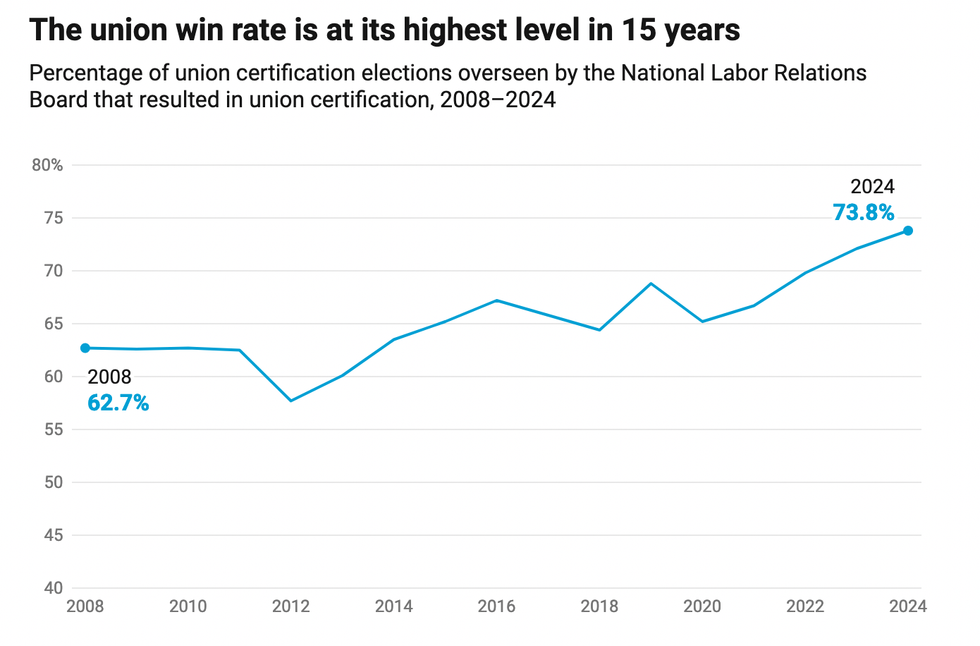
Analyzing NLRB elections data, CAP found that workers in 2024 have a better chance of winning union representation than at any point in the past 15 years, with the agency recording a 73.8% win rate—the first time in 15 years that a 70% victory rate has been surpassed.
Under the Trump administration, the win rate dipped as low as 64.4%, and with corporations employing consultants and lawyers specializing in "union avoidance," since 2008 the percentage of workers who won union representation in elections has been as low as 57.7%.
Under the Biden administration, the NLRB has proposed bans on captive audience meetings, which require employees to attend to listen to anti-union propaganda, and surveillance for union organizers.
"Compared with this pro-worker agenda, Project 2025 instructs the next administration to eliminate procedures such as card checks, which make it easier to form a union, and would turn the administrative state against unions by accelerating the process to decertify them when workers have won a contract," wrote Glass.
CAP noted that by firing the NLRB's general counsel, a potential Trump administration carrying out Project 2025 would effectively punish Abruzzo and the agency for securing "more reinstatement offers for workers illegally fired for protected organizing activity in the general counsel's first year on the job than during the entire previous administration."
The Biden administration has achieved 8,285 offers of reinstatement for illegally fired workers—a 54% increase over the Trump administration.
Despite the successes of the past three years, wrote Glass, there is "always a risk that future administrations reverse course—and Project 2025 offers a playbook for how an administration could jeopardize the NLRB's ability to protect organizing workers."
The rule was supposed to go into effect on Monday.
A Trump-appointed federal judge in Texas has blocked a National Labor Relations Board rule that—had it been allowed to take effect on Monday—would have made it easier for workers to unionize at large companies.
The rule was passed four years ago, and it related to when two companies could be regarded as "joint employers" in labor negotiations. It was specifically aimed at dealing with situations like if a McDonald's franchise is a joint employer with its corporate brand.
"The new rule would have expanded that definition to say companies may be considered joint employers if they have the ability to control—directly or indirectly—at least one condition of employment. Conditions include wages and benefits, hours and scheduling, the assignment of duties, work rules, and hiring," CBS reports.
A federal judge in Texas has blocked the new NLRB "joint employer" rule.
Right now a company like McDonald's isn't technically the employer of most of its workers since they're directly employed by franchisees.
The new rule would've remedied that.https://t.co/SkneE8imqY
— More Perfect Union (@MorePerfectUS) March 11, 2024
Essentially, the franchise and the corporation would be considered a joint employer under the new rule. This would allow workers to negotiate with the corporation.
"The District Court's decision to vacate the board's rule is a disappointing setback, but is not the last word on our efforts to return our joint-employer standard to the common law principles that have been endorsed by other courts," NLRB Chair Lauren McFerran said in a statement. "The agency is reviewing the decision and actively considering next steps in this case."
The U.S. Chamber of Commerce and others sued the NLRB in order to prevent the rule from going into effect. The Texas judge ruled in their favor, and he said the rule exceeded "the bounds of the common law."
More Perfect Union called the move "a precedent that could change college sports."
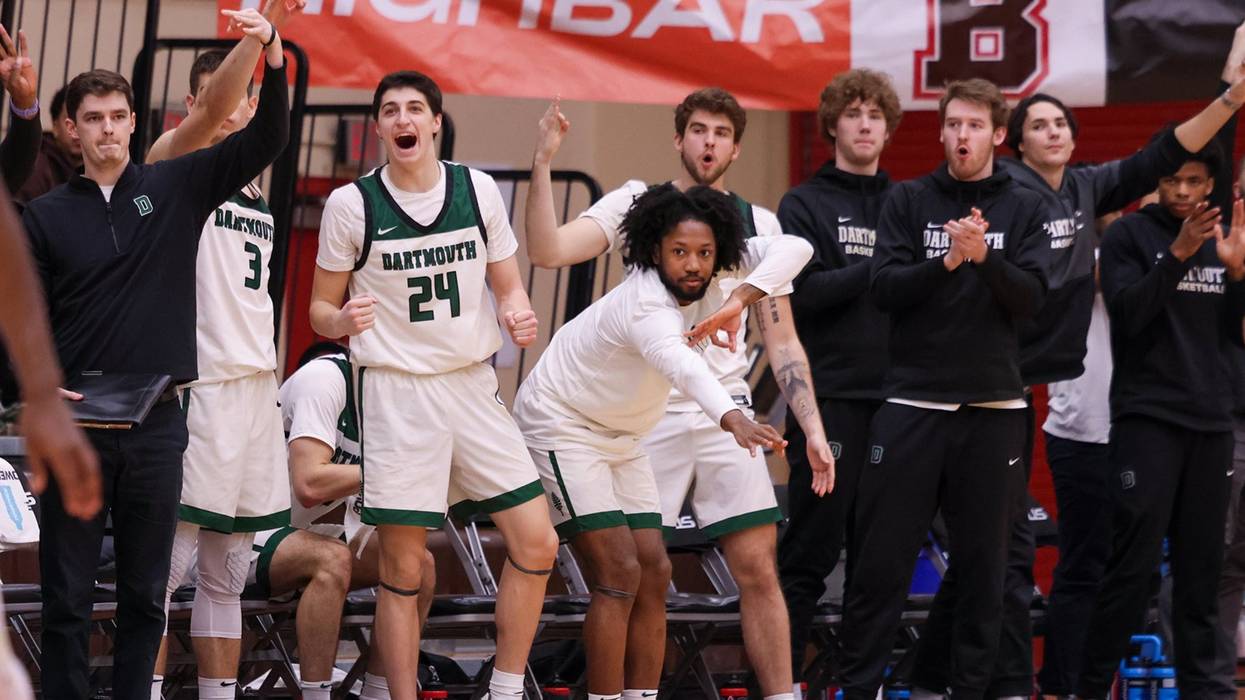
The Dartmouth College men's basketball team voted Tuesday to unionize, becoming the first-ever U.S. collegiate athletes to do so—but the private New Hampshire university is mounting a challenge to the move that could end up in federal court.
Dartmouth players voted 13-2 to join the Service Employees International Union (SEIU) Local 560 in an election supervised by the U.S. National Labor Relations Board (NLRB) and the university's human resources department.
"Today is a big day for our team," said Dartmouth players Cade Haskins and Romeo Myrthil, two leaders of the organizing effort. "We stuck together all season and won this election. It is self-evident that we, as students, can also be both campus workers and union members. Dartmouth seems to be stuck in the past. It's time for the age of amateurism to end."
Haskins told the Associated Press that "I think this is just the start" and that the Dartmouth vote "is going to have a domino effect on other cases across the country, and that could lead to other changes."
SEIU Local 560 president Chris Peck said he is "looking forward to standing in solidarity" with Dartmouth players "as they begin to negotiate their historic first contract."
Last month, the NLRB's regional office ruled that the Dartmouth players are employees of the school with collective bargaining rights. Team members had previously petitioned the NLRB to organize with the SEIU.
Dartmouth officials appealed to the full NLRB.
"For Ivy League students who are varsity athletes, academics are of primary importance, and athletic pursuit is part of the educational experience," the school said in a statement. "Classifying these students as employees simply because they play basketball is as unprecedented as it is inaccurate. We, therefore, do not believe unionization is appropriate."
Colleges and universities have been urging U.S. lawmakers to pass legislation prohibiting student-athletes from being classified as employees, asserting that being forced to provide pay and benefits and allowing them to form or join unions threatens their multibillion-dollar monopoly.
The National Collegiate Athletic Association weighed in on the Dartmouth vote:
The association believes change in college sports is long overdue and is pursuing significant reforms. However, there are some issues the NCAA cannot address alone, and the association looks forward to working with Congress to make needed changes in the best interest of all student-athletes.
Labor advocates and progressive politicians cheered the vote, with the AFL-CIO calling it a "huge moment."
AFL-CIO president Liz Shuler said that "NCAA athletes make billions in profits for their universities and they deserve a seat at the table. This is the start of a new chapter in collegiate athletics."
U.S. Sen. Bernie Sanders (I-Vt.) wrote on social media: "Congratulations to the members of the Dartmouth men's basketball team on voting overwhelmingly to become the first college sports team in America to form a union. It's time for Dartmouth to respect their constitutional right to organize and bargain for a fair contract now."
The modern-day robber barons want the Supreme Court to return America to a time before workers had the right to form unions.
I never believed Jeff Bezos, the second-richest person in America (worth an estimated $114 billion), and Elon Musk, the richest (at $180 billion), would brazenly use their wealth and power to try to eliminate labor unions and thereby suppress the wages of American workers even further.
In my naivete, I assumed they wouldn’t reveal themselves as no better (and in many ways worse) than the robber barons of the first Gilded Age, whose riches were unrivaled and who fought with all their might against labor unions.
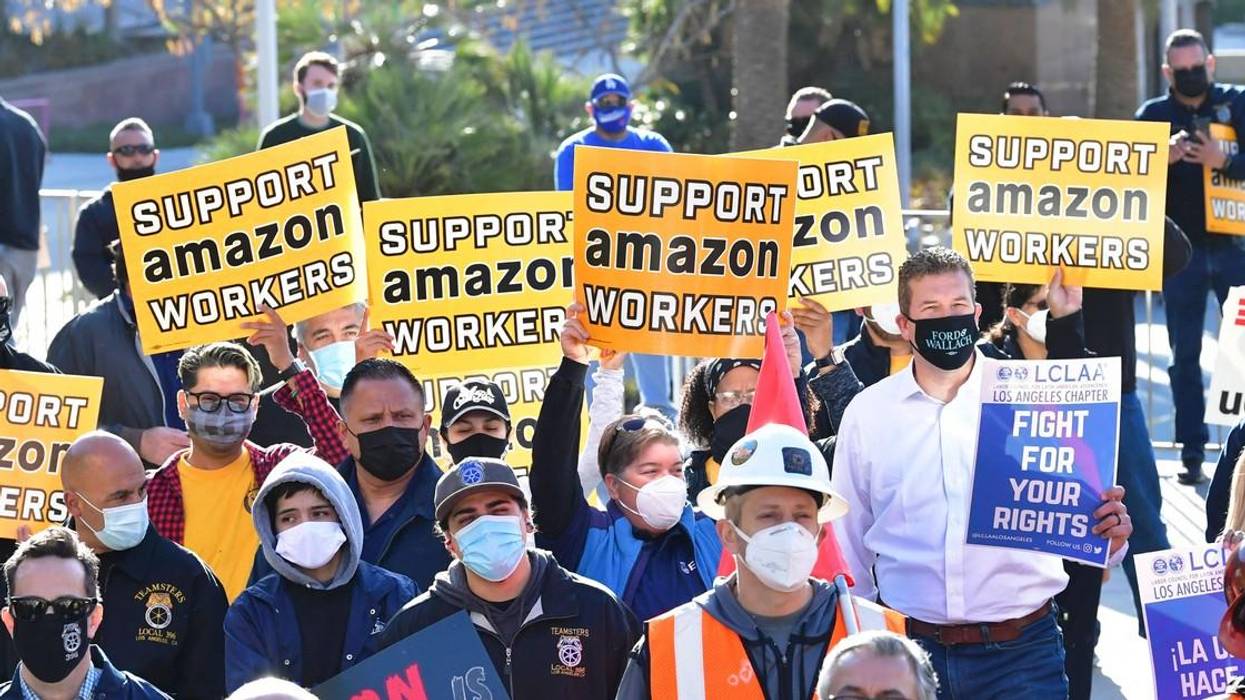
It’s not that Bezos’ Amazon has exactly hidden its objective. The company has fought off every attempt to organize its workers—holding anti-union meetings, targeting union supporters, challenging union elections, and firing workers who tried to organize.
But in a legal filing last Thursday, Amazon went even further. It argued that the National Labor Relations Board (NLRB), which supervises and enforces labor law, is unconstitutional because it mixes judicial and executive functions.
Evidently, it’s not enough for Bezos and Musk to amass more wealth than any two people on the planet.
Jeff Bezos’s view (I’m assuming Amazon’s filing reflects his view) is the same as that of retrograde Elon Musk, whose SpaceX made an almost identical argument in a lawsuit last month.
The NLRB is the agency that enforces the National Labor Relations Act—the 1935 Act that legitimized labor unions.
Bezos and Musk’s argument was rejected by the Supreme Court 86 years ago in NLRB v. Jones & Laughlin Steel Corp.
In that case, the NLRB found that the giant steel corporation Jones & Laughlin had violated the National Labor Relations Act by firing workers for trying to organize a union. The board ordered the corporation to reinstate them, pay them back wages, and refrain from any further actions to discourage workers from exercising their rights under the act.
In an opinion by Chief Justice Charles Evans Hughes, the Supreme Court upheld the NLRB’s order, holding that Congress acted within its constitutional authority to pass the National Labor Relations Act of 1935, including the National Labor Relations Board to enforce it.
But modern-day robber barons Jeff Bezos and Elon Musk want the Supreme Court to reverse its 1937 ruling and return America to a time before workers had the right to form unions.
Both of these tycoons hate unions. Both have illegally fired workers for trying to organize them. Bezos’s Amazon—having had one of its warehouses vote to unionize—is actively patrolling its workplaces against any signs of unionizing activity. Musk’s Tesla is the target of organizing efforts by the UAW and a number of European unions.
Evidently, it’s not enough for Bezos and Musk to amass more wealth than any two people on the planet. Not enough for them to monopolize their respective industries (Amazon is now being sued by the Federal Trade Commission, Musk’s SpaceX and his X platform are also monopolies). Not enough for them to fight their workers who want better pay and safer working conditions. Not enough for them to wage a war on the freedom of workers to join labor unions.
No, they want even more wealth and covet even more of the power—and don’t want to share any of it with their workers, or any other American workers.
Evidently, they believe that today’s Supreme Court—packed with right-wing justices who have few scruples about reversing long-held judicial precedents or even taking money from wealthy people with a financial interest in how they rule—will find their argument compelling.
I hope they’re wrong.