SUBSCRIBE TO OUR FREE NEWSLETTER
Daily news & progressive opinion—funded by the people, not the corporations—delivered straight to your inbox.
5
#000000
#FFFFFF
To donate by check, phone, or other method, see our More Ways to Give page.
Daily news & progressive opinion—funded by the people, not the corporations—delivered straight to your inbox.
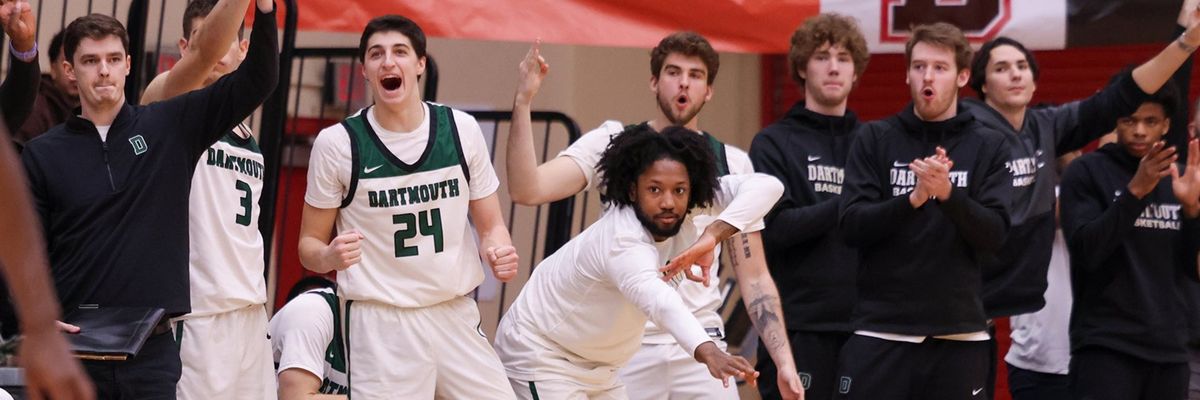
Members of Dartmouth's men's basketball team cheer on their teammates from the sidelines.
More Perfect Union called the move "a precedent that could change college sports."
The Dartmouth College men's basketball team voted Tuesday to unionize, becoming the first-ever U.S. collegiate athletes to do so—but the private New Hampshire university is mounting a challenge to the move that could end up in federal court.
Dartmouth players voted 13-2 to join the Service Employees International Union (SEIU) Local 560 in an election supervised by the U.S. National Labor Relations Board (NLRB) and the university's human resources department.
"Today is a big day for our team," said Dartmouth players Cade Haskins and Romeo Myrthil, two leaders of the organizing effort. "We stuck together all season and won this election. It is self-evident that we, as students, can also be both campus workers and union members. Dartmouth seems to be stuck in the past. It's time for the age of amateurism to end."
Haskins told the Associated Press that "I think this is just the start" and that the Dartmouth vote "is going to have a domino effect on other cases across the country, and that could lead to other changes."
SEIU Local 560 president Chris Peck said he is "looking forward to standing in solidarity" with Dartmouth players "as they begin to negotiate their historic first contract."
Last month, the NLRB's regional office ruled that the Dartmouth players are employees of the school with collective bargaining rights. Team members had previously petitioned the NLRB to organize with the SEIU.
Dartmouth officials appealed to the full NLRB.
"For Ivy League students who are varsity athletes, academics are of primary importance, and athletic pursuit is part of the educational experience," the school said in a statement. "Classifying these students as employees simply because they play basketball is as unprecedented as it is inaccurate. We, therefore, do not believe unionization is appropriate."
Colleges and universities have been urging U.S. lawmakers to pass legislation prohibiting student-athletes from being classified as employees, asserting that being forced to provide pay and benefits and allowing them to form or join unions threatens their multibillion-dollar monopoly.
The National Collegiate Athletic Association weighed in on the Dartmouth vote:
The association believes change in college sports is long overdue and is pursuing significant reforms. However, there are some issues the NCAA cannot address alone, and the association looks forward to working with Congress to make needed changes in the best interest of all student-athletes.
Labor advocates and progressive politicians cheered the vote, with the AFL-CIO calling it a "huge moment."
AFL-CIO president Liz Shuler said that "NCAA athletes make billions in profits for their universities and they deserve a seat at the table. This is the start of a new chapter in collegiate athletics."
U.S. Sen. Bernie Sanders (I-Vt.) wrote on social media: "Congratulations to the members of the Dartmouth men's basketball team on voting overwhelmingly to become the first college sports team in America to form a union. It's time for Dartmouth to respect their constitutional right to organize and bargain for a fair contract now."
Dear Common Dreams reader, It’s been nearly 30 years since I co-founded Common Dreams with my late wife, Lina Newhouser. We had the radical notion that journalism should serve the public good, not corporate profits. It was clear to us from the outset what it would take to build such a project. No paid advertisements. No corporate sponsors. No millionaire publisher telling us what to think or do. Many people said we wouldn't last a year, but we proved those doubters wrong. Together with a tremendous team of journalists and dedicated staff, we built an independent media outlet free from the constraints of profits and corporate control. Our mission has always been simple: To inform. To inspire. To ignite change for the common good. Building Common Dreams was not easy. Our survival was never guaranteed. When you take on the most powerful forces—Wall Street greed, fossil fuel industry destruction, Big Tech lobbyists, and uber-rich oligarchs who have spent billions upon billions rigging the economy and democracy in their favor—the only bulwark you have is supporters who believe in your work. But here’s the urgent message from me today. It's never been this bad out there. And it's never been this hard to keep us going. At the very moment Common Dreams is most needed, the threats we face are intensifying. We need your support now more than ever. We don't accept corporate advertising and never will. We don't have a paywall because we don't think people should be blocked from critical news based on their ability to pay. Everything we do is funded by the donations of readers like you. When everyone does the little they can afford, we are strong. But if that support retreats or dries up, so do we. Will you donate now to make sure Common Dreams not only survives but thrives? —Craig Brown, Co-founder |
The Dartmouth College men's basketball team voted Tuesday to unionize, becoming the first-ever U.S. collegiate athletes to do so—but the private New Hampshire university is mounting a challenge to the move that could end up in federal court.
Dartmouth players voted 13-2 to join the Service Employees International Union (SEIU) Local 560 in an election supervised by the U.S. National Labor Relations Board (NLRB) and the university's human resources department.
"Today is a big day for our team," said Dartmouth players Cade Haskins and Romeo Myrthil, two leaders of the organizing effort. "We stuck together all season and won this election. It is self-evident that we, as students, can also be both campus workers and union members. Dartmouth seems to be stuck in the past. It's time for the age of amateurism to end."
Haskins told the Associated Press that "I think this is just the start" and that the Dartmouth vote "is going to have a domino effect on other cases across the country, and that could lead to other changes."
SEIU Local 560 president Chris Peck said he is "looking forward to standing in solidarity" with Dartmouth players "as they begin to negotiate their historic first contract."
Last month, the NLRB's regional office ruled that the Dartmouth players are employees of the school with collective bargaining rights. Team members had previously petitioned the NLRB to organize with the SEIU.
Dartmouth officials appealed to the full NLRB.
"For Ivy League students who are varsity athletes, academics are of primary importance, and athletic pursuit is part of the educational experience," the school said in a statement. "Classifying these students as employees simply because they play basketball is as unprecedented as it is inaccurate. We, therefore, do not believe unionization is appropriate."
Colleges and universities have been urging U.S. lawmakers to pass legislation prohibiting student-athletes from being classified as employees, asserting that being forced to provide pay and benefits and allowing them to form or join unions threatens their multibillion-dollar monopoly.
The National Collegiate Athletic Association weighed in on the Dartmouth vote:
The association believes change in college sports is long overdue and is pursuing significant reforms. However, there are some issues the NCAA cannot address alone, and the association looks forward to working with Congress to make needed changes in the best interest of all student-athletes.
Labor advocates and progressive politicians cheered the vote, with the AFL-CIO calling it a "huge moment."
AFL-CIO president Liz Shuler said that "NCAA athletes make billions in profits for their universities and they deserve a seat at the table. This is the start of a new chapter in collegiate athletics."
U.S. Sen. Bernie Sanders (I-Vt.) wrote on social media: "Congratulations to the members of the Dartmouth men's basketball team on voting overwhelmingly to become the first college sports team in America to form a union. It's time for Dartmouth to respect their constitutional right to organize and bargain for a fair contract now."
The Dartmouth College men's basketball team voted Tuesday to unionize, becoming the first-ever U.S. collegiate athletes to do so—but the private New Hampshire university is mounting a challenge to the move that could end up in federal court.
Dartmouth players voted 13-2 to join the Service Employees International Union (SEIU) Local 560 in an election supervised by the U.S. National Labor Relations Board (NLRB) and the university's human resources department.
"Today is a big day for our team," said Dartmouth players Cade Haskins and Romeo Myrthil, two leaders of the organizing effort. "We stuck together all season and won this election. It is self-evident that we, as students, can also be both campus workers and union members. Dartmouth seems to be stuck in the past. It's time for the age of amateurism to end."
Haskins told the Associated Press that "I think this is just the start" and that the Dartmouth vote "is going to have a domino effect on other cases across the country, and that could lead to other changes."
SEIU Local 560 president Chris Peck said he is "looking forward to standing in solidarity" with Dartmouth players "as they begin to negotiate their historic first contract."
Last month, the NLRB's regional office ruled that the Dartmouth players are employees of the school with collective bargaining rights. Team members had previously petitioned the NLRB to organize with the SEIU.
Dartmouth officials appealed to the full NLRB.
"For Ivy League students who are varsity athletes, academics are of primary importance, and athletic pursuit is part of the educational experience," the school said in a statement. "Classifying these students as employees simply because they play basketball is as unprecedented as it is inaccurate. We, therefore, do not believe unionization is appropriate."
Colleges and universities have been urging U.S. lawmakers to pass legislation prohibiting student-athletes from being classified as employees, asserting that being forced to provide pay and benefits and allowing them to form or join unions threatens their multibillion-dollar monopoly.
The National Collegiate Athletic Association weighed in on the Dartmouth vote:
The association believes change in college sports is long overdue and is pursuing significant reforms. However, there are some issues the NCAA cannot address alone, and the association looks forward to working with Congress to make needed changes in the best interest of all student-athletes.
Labor advocates and progressive politicians cheered the vote, with the AFL-CIO calling it a "huge moment."
AFL-CIO president Liz Shuler said that "NCAA athletes make billions in profits for their universities and they deserve a seat at the table. This is the start of a new chapter in collegiate athletics."
U.S. Sen. Bernie Sanders (I-Vt.) wrote on social media: "Congratulations to the members of the Dartmouth men's basketball team on voting overwhelmingly to become the first college sports team in America to form a union. It's time for Dartmouth to respect their constitutional right to organize and bargain for a fair contract now."