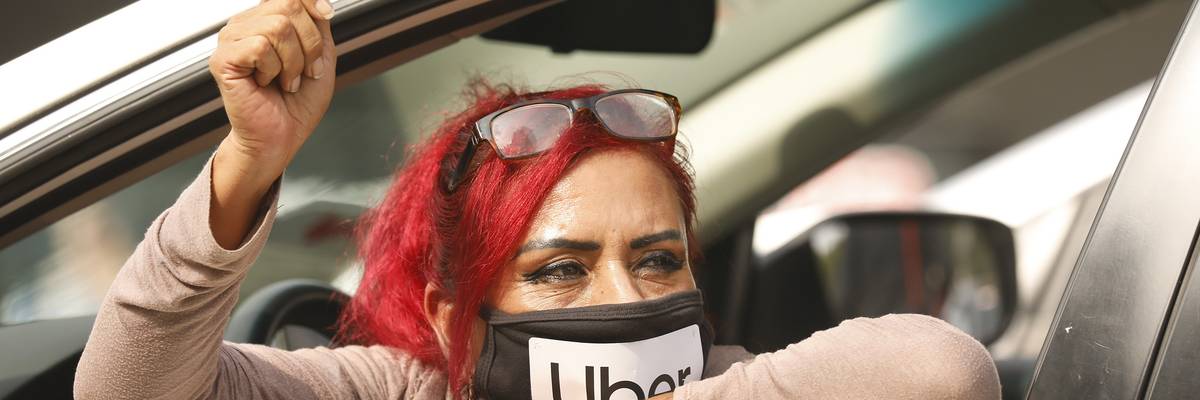
Rideshare driver Teresa Mercado raises her fist in support as app-based gig workers hold a driving demonstration in front of Los Angeles City Hall urging California voters to vote no on Proposition 22 on October 8, 2020.
Biden DOL Finalizes Independent Contractor Rule to 'Help Protect Workers'
Praising the policy, one economist said that employer misclassification "robs workers of labor rights and threatens their economic security."
Democrats in Congress and unions were among those applauding on Tuesday as the U.S. Department of Labor announced its final rule to provide guidance on when employers can treat workers as independent contractors under the Fair Labor Standards Act.
"Misclassifying employees as independent contractors is a serious issue that deprives workers of basic rights and protections," acting Labor Secretary Julie Su said in a statement. "This rule will help protect workers, especially those facing the greatest risk of exploitation, by making sure they are classified properly and that they receive the wages they've earned."
Welcoming the rule—set to take effect in March—the Teamsters said on social media that "it's long past time for American employers to recognize and respect their employees, to stop exploiting loopholes to pay workers less and deprive them of benefits, and to honor every worker's right to organize and collectively bargain a union contract."
Economic Policy Institute (EPI) president Heidi Shierholz highlighted that the rule rescinds a Trump-era
policy and, like Su, stressed how "employer misclassification of workers as independent contractors robs workers of labor rights and threatens their economic security."
"Many workers are harmed by employer misclassification—particularly those in the lowest-wage and most difficult jobs, such as nail salon workers, truck drivers, and construction workers," Shierholz said. "A previous EPI analysis found that in 11 commonly misclassified occupations, workers misclassified as independent contractors lose out on thousands of dollars in earnings and benefits per year, compared with workers doing the same job with employee status."
"Since this rule was proposed, opponents of this rule have waged an all-out misinformation war, claiming that independent entrepreneurs and business owners will now be forced into employee status against their will," the economist noted. "The reality is that if the Trump administration's rule was allowed to stand, workers with far less power to actually set the terms and conditions of their employment—not bonafide contractors—would have continued to lose out on basic worker protections, earnings, and benefits to which they should be entitled."
The Washington Post reported Tuesday that "the rule is expected to face an onslaught of legal challenges from companies. It has faced extensive criticism from businesses and industry groups, including those representing Uber, Lyft, DoorDash, and other ride-share and delivery platforms. But labor officials say they have carefully considered possible litigation and are confident that the rule would withstand a court challenge."
Some Republicans in Congress are already taking aim at the policy, with U.S. Senate Committee on Health, Education, Labor and Pensions (HELP) Ranking Member Bill Cassidy (R-La.) threatening to challenge it under the Congressional Review Act.
Meanwhile, Senate HELP Committee Chair Bernie Sanders (I-Vt.), a longtime labor rights advocate, praised the administration's new move to "stop unscrupulous employers from deliberately misclassifying their workers and cheating them out of hard-earned wages," adding that "when 60% of Americans live paycheck-to-paycheck, workers need labor laws that protect them, not allow them to be ripped off."
Congressional Progressive Caucus (CPC) Chair Pramila Jayapal (D-Wash.) also offered praise, saying that "I am thrilled to see the Biden administration continuing to put its pro-worker commitment into action with this new final rule."
"With gig work playing a larger role in our economy, it's more important than ever that workers are protected under federal law and have access to all the rights to which they're entitled," she said. "This new policy will
ensure that the workers who have fallen through the cracks—from rideshare and delivery drivers to janitors and home care workers—will finally be able to access Social Security benefits and unemployment insurance and be guaranteed overtime and minimum wage pay."
"The rule is also an essential check on large, wealthy corporations who have skirted their obligations to these workers even as their labor makes the companies" profits possible," she continued, adding that the CPC looks forward to working with President Joe Biden and Su to ensure it "is implemented fairly and equitably across the country and industries."
The department's announcement came a day after Biden renominated Su as labor secretary—a decision also celebrated by progressives, including Jayapal and Sanders, who called on the Senate to stop stalling.
"Julie Su has spent her career as a dedicated public servant, fighting tirelessly for working people, especially the lowest-wage workers, domestic workers, immigrant workers, and workers of color," Jayapal pointed out. "She deeply understands how the Department of Labor should work and the needs of our modern economy."
"There is so much work still to do to raise wages, lower costs, and fight for the working people of this country, and we need Labor Secretary Su to achieve it," the CPC leader added. "We urge the Senate to move swiftly and finally confirm this extremely qualified nominee."
Sanders said that "I strongly support Julie Su's renomination to serve as Secretary of Labor. Her strong pro-worker track record as acting Secretary shows beyond a shadow of a doubt that she is the right person for the job. Her tireless and consistent work for working families across the country should continue as secretary of labor and I urge my colleagues to support her nomination."
We are at a crossroads
This country and this world are at a monumental crossroads. In a few short weeks, US voters will have an opportunity to beat back the forces of fascism and confront the billionaires who are rigging the economy, our media system, and our democracy, making it increasingly impossible for ordinary people to get by. We’re not just talking about the election. We’re talking about what must be done once these fascist elements are vanquished from power. We need a bolder set of solutions than what either major party has so far been willing to offer and a working-class movement ready to fight like hell for it. Trump didn't emerge from nowhere. The conditions that fueled MAGA authoritarianism were created by decades of radical neoliberal economic policies and a corrupt political system dominated by corporate interests. They slashed taxes on the super-rich, promising that the benefits would trickle down. They said giveaways to the corporate titans would make life more affordable for the rest of us. It was all bullshit. And when a bitter, betrayed populace searches for someone to blame, right-wing demagogues have little trouble finding scapegoats. People know when they're being lied to, but you won't hear any of this from the corporate media. Only independent journalism—powered and funded by people who believe in building a better world—can deliver truly trustworthy daily news. Our Fall Campaign is underway, and we need your help. To power our newsroom through the rest of the year, we need to raise $125,000 by midnight on October 31. So if you share our vision, please contribute whatever you can to sustain our work. |
Democrats in Congress and unions were among those applauding on Tuesday as the U.S. Department of Labor announced its final rule to provide guidance on when employers can treat workers as independent contractors under the Fair Labor Standards Act.
"Misclassifying employees as independent contractors is a serious issue that deprives workers of basic rights and protections," acting Labor Secretary Julie Su said in a statement. "This rule will help protect workers, especially those facing the greatest risk of exploitation, by making sure they are classified properly and that they receive the wages they've earned."
Welcoming the rule—set to take effect in March—the Teamsters said on social media that "it's long past time for American employers to recognize and respect their employees, to stop exploiting loopholes to pay workers less and deprive them of benefits, and to honor every worker's right to organize and collectively bargain a union contract."
Economic Policy Institute (EPI) president Heidi Shierholz highlighted that the rule rescinds a Trump-era
policy and, like Su, stressed how "employer misclassification of workers as independent contractors robs workers of labor rights and threatens their economic security."
"Many workers are harmed by employer misclassification—particularly those in the lowest-wage and most difficult jobs, such as nail salon workers, truck drivers, and construction workers," Shierholz said. "A previous EPI analysis found that in 11 commonly misclassified occupations, workers misclassified as independent contractors lose out on thousands of dollars in earnings and benefits per year, compared with workers doing the same job with employee status."
"Since this rule was proposed, opponents of this rule have waged an all-out misinformation war, claiming that independent entrepreneurs and business owners will now be forced into employee status against their will," the economist noted. "The reality is that if the Trump administration's rule was allowed to stand, workers with far less power to actually set the terms and conditions of their employment—not bonafide contractors—would have continued to lose out on basic worker protections, earnings, and benefits to which they should be entitled."
The Washington Post reported Tuesday that "the rule is expected to face an onslaught of legal challenges from companies. It has faced extensive criticism from businesses and industry groups, including those representing Uber, Lyft, DoorDash, and other ride-share and delivery platforms. But labor officials say they have carefully considered possible litigation and are confident that the rule would withstand a court challenge."
Some Republicans in Congress are already taking aim at the policy, with U.S. Senate Committee on Health, Education, Labor and Pensions (HELP) Ranking Member Bill Cassidy (R-La.) threatening to challenge it under the Congressional Review Act.
Meanwhile, Senate HELP Committee Chair Bernie Sanders (I-Vt.), a longtime labor rights advocate, praised the administration's new move to "stop unscrupulous employers from deliberately misclassifying their workers and cheating them out of hard-earned wages," adding that "when 60% of Americans live paycheck-to-paycheck, workers need labor laws that protect them, not allow them to be ripped off."
Congressional Progressive Caucus (CPC) Chair Pramila Jayapal (D-Wash.) also offered praise, saying that "I am thrilled to see the Biden administration continuing to put its pro-worker commitment into action with this new final rule."
"With gig work playing a larger role in our economy, it's more important than ever that workers are protected under federal law and have access to all the rights to which they're entitled," she said. "This new policy will
ensure that the workers who have fallen through the cracks—from rideshare and delivery drivers to janitors and home care workers—will finally be able to access Social Security benefits and unemployment insurance and be guaranteed overtime and minimum wage pay."
"The rule is also an essential check on large, wealthy corporations who have skirted their obligations to these workers even as their labor makes the companies" profits possible," she continued, adding that the CPC looks forward to working with President Joe Biden and Su to ensure it "is implemented fairly and equitably across the country and industries."
The department's announcement came a day after Biden renominated Su as labor secretary—a decision also celebrated by progressives, including Jayapal and Sanders, who called on the Senate to stop stalling.
"Julie Su has spent her career as a dedicated public servant, fighting tirelessly for working people, especially the lowest-wage workers, domestic workers, immigrant workers, and workers of color," Jayapal pointed out. "She deeply understands how the Department of Labor should work and the needs of our modern economy."
"There is so much work still to do to raise wages, lower costs, and fight for the working people of this country, and we need Labor Secretary Su to achieve it," the CPC leader added. "We urge the Senate to move swiftly and finally confirm this extremely qualified nominee."
Sanders said that "I strongly support Julie Su's renomination to serve as Secretary of Labor. Her strong pro-worker track record as acting Secretary shows beyond a shadow of a doubt that she is the right person for the job. Her tireless and consistent work for working families across the country should continue as secretary of labor and I urge my colleagues to support her nomination."
- Progressive Coalition Speaks Out as Big Business Moves to Crush Julie Su ›
- The Biden Administration Can Reverse Much of Trump's Bad Labor Policy Without Congress ›
- Opinion | Seattle’s City Council Must Stay the Course on Protections for App Workers | Common Dreams ›
- Opinion | Wall Street Greed, Not Worker Pay, Is Making Your Uber Ride More Expensive | Common Dreams ›
- Biden Labor Department Finalizes Pro-Worker Rules on Overtime, Retirement Savings | Common Dreams ›
- Opinion | 5 Ways Trump's Labor Secretary Pick Can Prove She's Really Pro-Worker | Common Dreams ›
Democrats in Congress and unions were among those applauding on Tuesday as the U.S. Department of Labor announced its final rule to provide guidance on when employers can treat workers as independent contractors under the Fair Labor Standards Act.
"Misclassifying employees as independent contractors is a serious issue that deprives workers of basic rights and protections," acting Labor Secretary Julie Su said in a statement. "This rule will help protect workers, especially those facing the greatest risk of exploitation, by making sure they are classified properly and that they receive the wages they've earned."
Welcoming the rule—set to take effect in March—the Teamsters said on social media that "it's long past time for American employers to recognize and respect their employees, to stop exploiting loopholes to pay workers less and deprive them of benefits, and to honor every worker's right to organize and collectively bargain a union contract."
Economic Policy Institute (EPI) president Heidi Shierholz highlighted that the rule rescinds a Trump-era
policy and, like Su, stressed how "employer misclassification of workers as independent contractors robs workers of labor rights and threatens their economic security."
"Many workers are harmed by employer misclassification—particularly those in the lowest-wage and most difficult jobs, such as nail salon workers, truck drivers, and construction workers," Shierholz said. "A previous EPI analysis found that in 11 commonly misclassified occupations, workers misclassified as independent contractors lose out on thousands of dollars in earnings and benefits per year, compared with workers doing the same job with employee status."
"Since this rule was proposed, opponents of this rule have waged an all-out misinformation war, claiming that independent entrepreneurs and business owners will now be forced into employee status against their will," the economist noted. "The reality is that if the Trump administration's rule was allowed to stand, workers with far less power to actually set the terms and conditions of their employment—not bonafide contractors—would have continued to lose out on basic worker protections, earnings, and benefits to which they should be entitled."
The Washington Post reported Tuesday that "the rule is expected to face an onslaught of legal challenges from companies. It has faced extensive criticism from businesses and industry groups, including those representing Uber, Lyft, DoorDash, and other ride-share and delivery platforms. But labor officials say they have carefully considered possible litigation and are confident that the rule would withstand a court challenge."
Some Republicans in Congress are already taking aim at the policy, with U.S. Senate Committee on Health, Education, Labor and Pensions (HELP) Ranking Member Bill Cassidy (R-La.) threatening to challenge it under the Congressional Review Act.
Meanwhile, Senate HELP Committee Chair Bernie Sanders (I-Vt.), a longtime labor rights advocate, praised the administration's new move to "stop unscrupulous employers from deliberately misclassifying their workers and cheating them out of hard-earned wages," adding that "when 60% of Americans live paycheck-to-paycheck, workers need labor laws that protect them, not allow them to be ripped off."
Congressional Progressive Caucus (CPC) Chair Pramila Jayapal (D-Wash.) also offered praise, saying that "I am thrilled to see the Biden administration continuing to put its pro-worker commitment into action with this new final rule."
"With gig work playing a larger role in our economy, it's more important than ever that workers are protected under federal law and have access to all the rights to which they're entitled," she said. "This new policy will
ensure that the workers who have fallen through the cracks—from rideshare and delivery drivers to janitors and home care workers—will finally be able to access Social Security benefits and unemployment insurance and be guaranteed overtime and minimum wage pay."
"The rule is also an essential check on large, wealthy corporations who have skirted their obligations to these workers even as their labor makes the companies" profits possible," she continued, adding that the CPC looks forward to working with President Joe Biden and Su to ensure it "is implemented fairly and equitably across the country and industries."
The department's announcement came a day after Biden renominated Su as labor secretary—a decision also celebrated by progressives, including Jayapal and Sanders, who called on the Senate to stop stalling.
"Julie Su has spent her career as a dedicated public servant, fighting tirelessly for working people, especially the lowest-wage workers, domestic workers, immigrant workers, and workers of color," Jayapal pointed out. "She deeply understands how the Department of Labor should work and the needs of our modern economy."
"There is so much work still to do to raise wages, lower costs, and fight for the working people of this country, and we need Labor Secretary Su to achieve it," the CPC leader added. "We urge the Senate to move swiftly and finally confirm this extremely qualified nominee."
Sanders said that "I strongly support Julie Su's renomination to serve as Secretary of Labor. Her strong pro-worker track record as acting Secretary shows beyond a shadow of a doubt that she is the right person for the job. Her tireless and consistent work for working families across the country should continue as secretary of labor and I urge my colleagues to support her nomination."
- Progressive Coalition Speaks Out as Big Business Moves to Crush Julie Su ›
- The Biden Administration Can Reverse Much of Trump's Bad Labor Policy Without Congress ›
- Opinion | Seattle’s City Council Must Stay the Course on Protections for App Workers | Common Dreams ›
- Opinion | Wall Street Greed, Not Worker Pay, Is Making Your Uber Ride More Expensive | Common Dreams ›
- Biden Labor Department Finalizes Pro-Worker Rules on Overtime, Retirement Savings | Common Dreams ›
- Opinion | 5 Ways Trump's Labor Secretary Pick Can Prove She's Really Pro-Worker | Common Dreams ›