SUBSCRIBE TO OUR FREE NEWSLETTER
Daily news & progressive opinion—funded by the people, not the corporations—delivered straight to your inbox.
5
#000000
#FFFFFF
To donate by check, phone, or other method, see our More Ways to Give page.


Daily news & progressive opinion—funded by the people, not the corporations—delivered straight to your inbox.
"Looks like Israel is now escalating in Lebanon in a major way in the hopes of kicking off a major war in the north that has thus far been kept to more limited exchanges," warned one analyst.
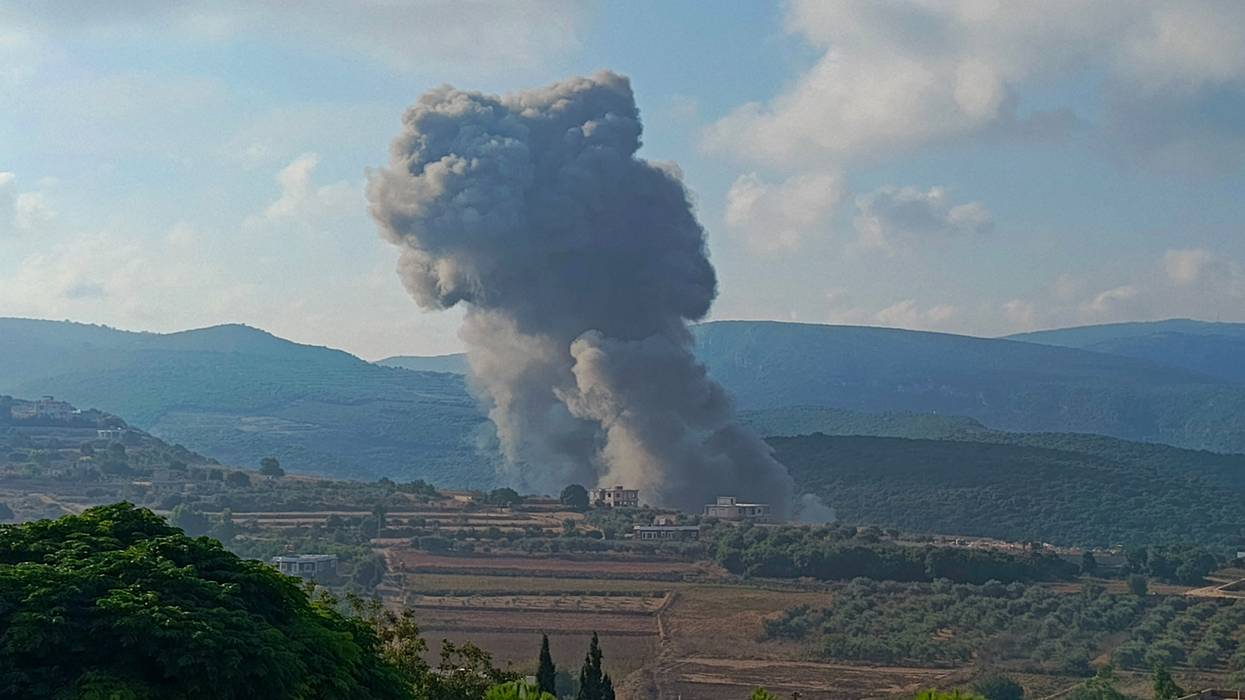
Israel's military deployed around 100 fighter jets to launch a massive bombing campaign in southern Lebanon on Sunday, endangering tens of thousands of civilians and heightening the chances of an all-out regional war.
The Israel Defense Forces (IDF) characterized the wave of airstrikes as an effort to preemptively "remove the threat" posed by a purportedly imminent Hezbollah attack, but observers argued the Israeli bombing marked a serious escalation that could further undermine hopes of a cease-fire deal in Gaza.
"Looks like Israel is now escalating in Lebanon in a major way in the hopes of kicking off a major war in the north that has thus far been kept to more limited exchanges," wrote political analyst Yousef Munayyer. "Just as negotiations for a cease-fire were reportedly advancing."
Hezbollah said Sunday that it had fired hundreds of drones and rockets at Israeli military sites in retaliation for the assassination of one of the group's senior commanders last month. Hezbollah said the "first phase" of its response was complete and rejected the IDF's claim that it preempted the group's retaliatory action.
The Associated Press reported that "by mid-morning, it appeared that the exchange had ended, with both sides saying they had only aimed at military targets."
"At least three people were killed in the strikes on Lebanon," AP noted, "while there were no reports of casualties in Israel."
Israel Katz, the Israeli foreign minister, wrote on social media following the attack on Lebanon that he "sent a direct message to dozens of foreign ministers worldwide, urging them to support Israel against the Iranian axis of evil and its proxies, led by Hezbollah."
Sunday's dangerous back-and-forth, described by one newspaper as the two sides' biggest exchange of fire since the 2006 war, further intensified concerns that the region is moving toward the precipice of an all-out conflict as Israel's U.S.-backed assault on the Gaza Strip continues with no end in sight.
A White House spokesperson said Sunday that U.S. President Joe Biden is "closely monitoring events in Israel and Lebanon."
"At his direction, senior U.S. officials have been communicating continuously with their Israeli counterparts," the spokesperson said. "We will keep supporting Israel's right to defend itself, and we will keep working for regional stability."
One senior U.S. official said Israel did not give the White House advance notice of the Lebanon attack.
Monica Marks, professor of Middle East politics at New York University Abu Dhabi, wrote that the White House's claim to be promoting regional stability "lands like a bad joke" given ongoing U.S. support for Israel's "escalatory acts."
"Lives on the ground are at stake. So are [Democratic presidential nominee Kamala] Harris' chances and Biden's legacy," Marks added. "D.C. is playing Middle East roulette."
Israel's bombardment of Lebanon came after another horrific day in the Gaza Strip, where the IDF killed dozens of Palestinians in southern Gaza. "Among the dead," according to the AP, "were 11 members of a family, including two children, after an airstrike hit their home in Khan Younis."
The atrocities preceded a fresh round of high-level cease-fire talks, negotiations that Israeli Prime Minister Benjamin Netanyahu has repeatedly thwarted with hardline demands.
The Washington Post reported Saturday that "Israel and Hamas were sending senior-level delegations to Cairo this weekend as U.S., Qatari, and Egyptian mediators prepared for a high-stakes summit they hope will break the deadlock in negotiations for a cease-fire in the Gaza Strip."
"Hamas officials arrived in the Egyptian capital Saturday, while Israeli media reported that a team led by the head of Mossad, David Barnea, would travel there Sunday," the Post added. "The summit, also on Sunday, will include CIA Director William J. Burns, Egyptian intelligence chief Abbas Kamel, and Qatari Prime Minister Mohammed bin Abdulrahman Al Thani."
"But the U.S. can snap to its senses, end the Gaza war, and climb down from pointless escalations across the Middle East," said one observer.
Since October, the United States has bombed Iraq and Syria dozens of times, launched five rounds of airstrikes in Yemen, supplied the Israeli government with more than 10,000 tons of military equipment for its devastating assault on the Gaza Strip, and opposed international efforts to secure a cease-fire in the Palestinian enclave.
Yet Biden administration officials continue to insist that the U.S. is not at war in the Middle East, and is not seeking a broader military conflict in the region.
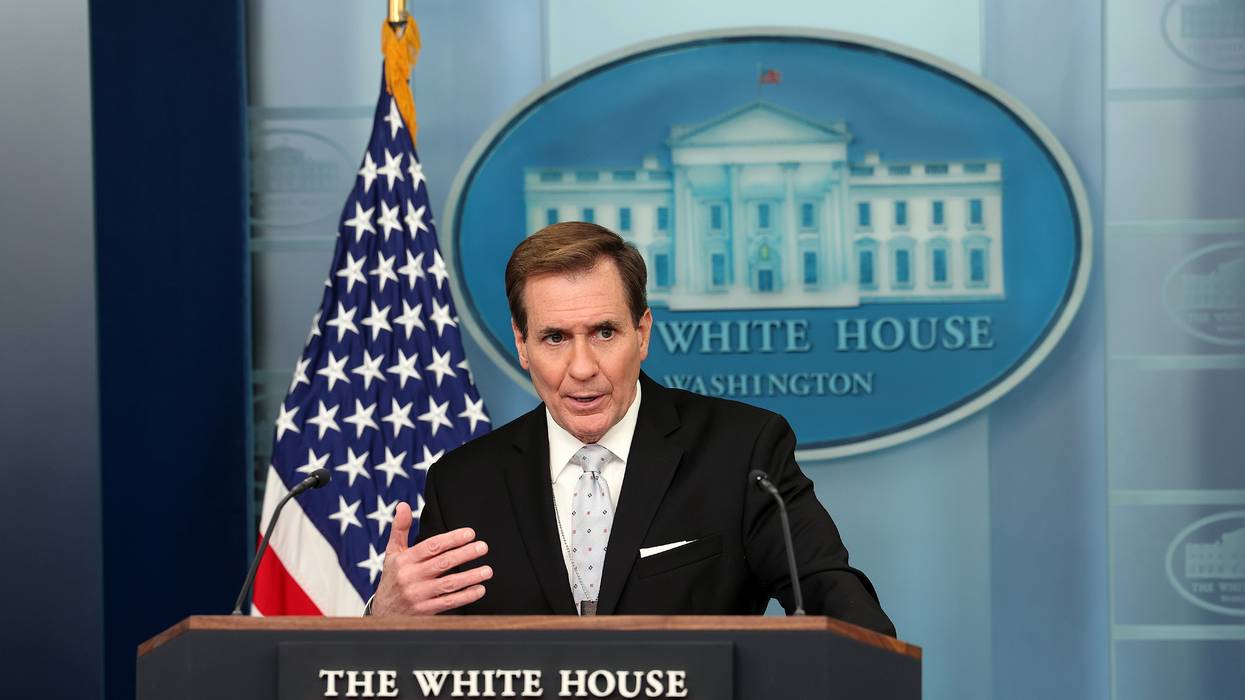
On Monday, amid reports that the U.S. is weighing how to respond to a deadly drone attack on American servicemembers just inside Jordan's border with Syria—an attack the White House blamed on Iran-backed militia groups—National Security Council spokesman John Kirby said in an appearance on NBC's "Today Show" that "we don't want a wider war with Iran."
"We don't want a wider war in the region," said Kirby, "but we gotta do what we have to do."
The disconnect between the White House's stated intention to avoid a broader conflagration in the Middle East and its escalatory actions has become increasingly stark in recent weeks, with potentially dire consequences for the region.
Phyllis Bennis, director of the New Internationalism Project at the Institute for Policy Studies, told Common Dreams that—contrary to Kirby's suggestion—the U.S. is not obligated to continue the tit-for-tat strikes that are fueling the intensifying cycle of violence and risking an all-out war.
"They don't 'gotta do' what they're doing," Bennis wrote in an email. "What they've 'gotta do'—if there's any reality to the claim that they don't want to expand the war in the region or risk war with Iran—is exactly the opposite of what they're now doing."
"That means stop the military provocations," she added. "Withdraw the aircraft carrier groups and destroyers from the area. Stop bombing Iraq and Syria, and withdraw the 2,500 U.S. troops from Iraq (isn't that war officially over?) and the 900 or so U.S. troops from Syria (who are we fighting there, anyway?). Stop bombing Yemen, killing civilians as well as Houthi fighters. And first things first—call for an immediate cease-fire in Gaza."
"The only genuine path to significantly reducing the current spasm of violence in the Middle East is securing an immediate cease-fire in Gaza, pouring cold water on the fire at the heart of this regional inferno."
The attack on American troops in Jordan—reportedly carried out by a drone that was initially mistaken for a U.S. aircraft—immediately set off the drumbeats of war, with Democratic and Republican members of Congress demanding that the Biden administration respond forcefully with strikes inside Iran.
Biden signaled in a statement Sunday that the U.S. will retaliate "at a time and in a manner of our choosing." Kirby declined to say Monday whether the president is weighing strikes within Iran—which has denied involvement in the Jordan attack—but vowed that the U.S. "absolutely will" retaliate.
Analysts and anti-war campaigners warned that a military response would be a potentially catastrophic mistake, further inflaming a conflict that already involves at least 10 countries.
Thanassis Cambanis, director of The Century Foundation's Center for International Research and Policy, argued late Sunday that with the U.S. already "fighting on multiple fronts," it is "too late to avoid regional war."
Unless the U.S. "deescalates immediately" across the region and pressures Israel to stop its war on the Gaza Strip, President Joe Biden "will have ended one war in Afghanistan only to start a bigger one that stretches from Iran to the Suez Canal," Cambanis wrote.
"It's too late for 26,000 dead Gazans," he added. "It's too late to avoid colossal self-harm to America's reputation. But the U.S. can snap to its senses, end the Gaza war, and climb down from pointless escalations across the Middle East."
Stephen Miles, president of Win Without War, also made the case for urgent deescalation efforts, saying in a statement that the attack on U.S. servicemembers in Jordan was "a painful reminder that President Biden's current policy in the Middle East is simply not working."
"The same voices who advocated for never-ending wars in Iraq and Afghanistan, arguing victory was forever just around the corner, now want the American public to believe that the path to peace lies with yet another war in the Middle East—this time with Iran. They were wrong then, and they are wrong now," said Miles. "The only genuine path to significantly reducing the current spasm of violence in the Middle East is securing an immediate cease-fire in Gaza, pouring cold water on the fire at the heart of this regional inferno."
This story has been updated to include additional comment from Phyllis Bennis.
"After years of working to block and undermine diplomatic alternatives, these people may be closer than ever to realizing their dream of war with Iran."
Warhawks in the United States wasted no time agitating for direct military conflict with Iran after a drone attack on a military base just inside Jordan's border with Syria on Sunday killed three American troops and injured dozens more.
Both Republican and Democratic members of Congress called on U.S. President Joe Biden to quickly respond with strikes inside Iran, which denied any connection to Sunday's attack.
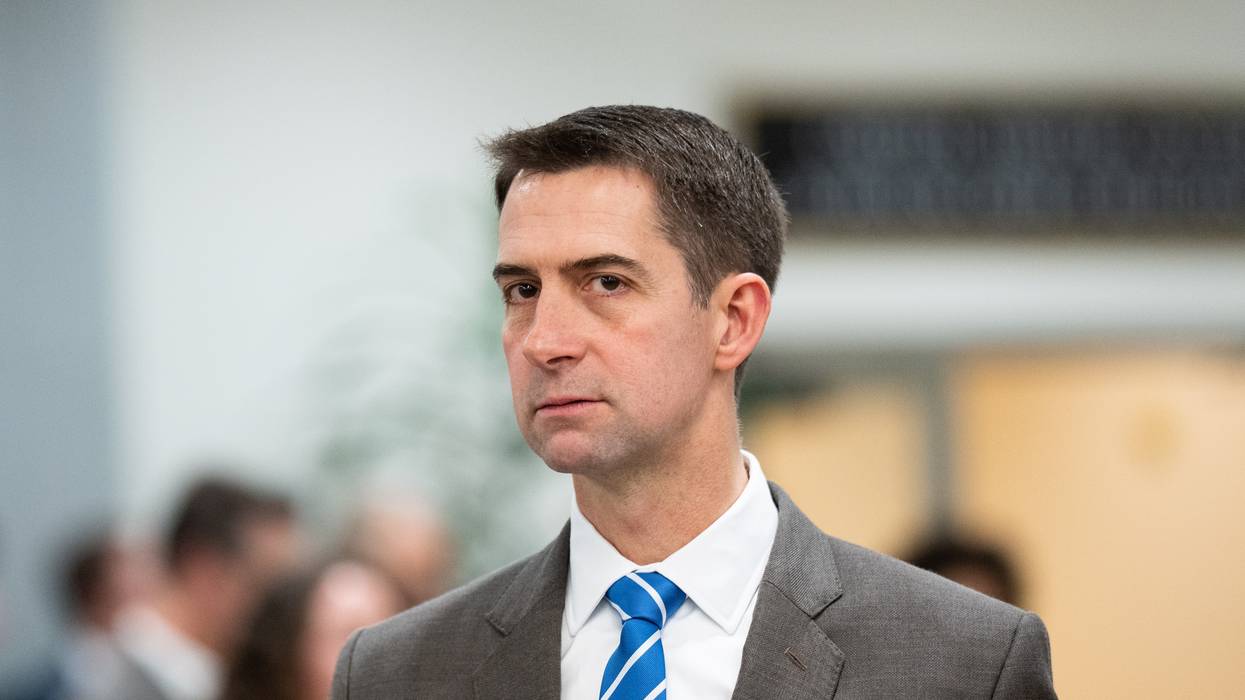
"The only answer to these attacks must be devastating military retaliation against Iran's terrorist forces, both in Iran and across the Middle East," said Sen. Tom Cotton (R-Ark.), a longtime supporter of war with Iran. "Anything less will confirm Joe Biden as a coward unworthy of being commander-in-chief."
Rep. Jared Moskowitz (D-Fla.) called Iran "an existential threat to the U.S. and our allies in the region" and said Tehran "must be held accountable for the murder of three U.S. soldiers."
That sentiment was echoed by a number of lawmakers, including Rep. Josh Gottheimer (D-N.J.) and Sens. John Cornyn (R-Texas) and Lindsey Graham (R-S.C.).
United Against Nuclear Iran, a group chaired by former Sen. Joseph Lieberman, also demanded "a decisive U.S. military response against targets inside Iran."
"The U.S. should attack and destroy Islamic Revolutionary Guard Corps (IRGC) military and intelligence targets in Iran, as well as missile and drone bases where the Iranian regime’s proxies are trained," the group said.
"Those who have consistently counseled only violence to address the crisis unleashed on October 7 should be ashamed of the disastrous outcomes they have so far reaped."
Biden claimed in a statement Sunday that "radical Iran-backed militant groups operating in Syria and Iraq" were responsible for Sunday's drone attack, but acknowledged that the U.S. is "still gathering the facts."
"Have no doubt—we will hold all those responsible to account at a time and in a manner [of] our choosing," the president said.
U.S. forces stationed in the Middle East have faced increasingly frequent attacks since Israel launched its large-scale war on the Gaza Strip following the deadly Hamas-led assault on southern Israel on October 7. Sunday marked the first time since October that American troops have been killed in a Middle East attack.
The Biden administration has blamed the attacks on Iran-aligned militias and responded with airstrikes in Iraq and Syria, intensifying concerns that the U.S. is fueling a regionwide conflict. The administration has also launched a series of unauthorized strikes in Yemen in response to Houthi attacks on commercial shipping in the Red Sea.
Despite the above, the Pentagon continues to insist that the U.S. is "not at war in the Middle East."
Contrary to the growing calls for a military response to attacks on U.S. troops, analysts and progressive lawmakers have argued that the only way to halt the escalating violence in the region is to secure a cease-fire in the Gaza Strip, where Israeli forces armed by the U.S. have killed more than 26,000 people in less than four months. The Biden administration has repeatedly stonewalled international efforts to secure a cease-fire.
"I am heartbroken by the loss of the servicemembers killed in Jordan," Rep. Barbara Lee (D-Calif.), a U.S. Senate candidate, wrote in a social media post on Sunday. "Like I feared, the violence is spiraling out of control. President Biden must demand a cease-fire in Gaza now."
Jamal Abdi, president of the National Iranian American Council, warned in a statement Sunday that "the U.S. and Iran are now closer to the brink of being pulled into a full-blown regional war by the vortex of violence that was unleashed by Hamas' attack on Israel on October 7th and Israel's assault on Gaza."
"Those who have consistently counseled only violence to address the crisis unleashed on October 7 should be ashamed of the disastrous outcomes they have so far reaped," said Abdi. "We are disgusted by calls for more escalation from opportunists like Senators Lindsey Graham, Tom Cotton, and John Cornyn who are urging yet again for the U.S. to directly attack Iran. After years of working to block and undermine diplomatic alternatives, these people may be closer than ever to realizing their dream of war with Iran."
"President Biden must show leadership and recognize that there is no military solution to this crisis that has only been expanded and prolonged by military escalation and a dearth of diplomacy," he continued. "The president must calibrate his response so as not to condemn the U.S. and region to an intractable war and instead work to end this conflict. The most impactful thing Biden can do to prevent further deaths across the region and prevent a full-blown war is to secure an immediate cease-fire between Israel and Palestine."
Trita Parsi, executive vice president of the Quincy Institute for Responsible Statecraft, similarly argued that "to truly protect our troops and avoid both war and more needless American deaths, Biden should begin withdrawing troops from Iraq and Syria and press Israel for a cease-fire, since its slaughter in Gaza is fueling four fronts that put the U.S. at risk."
"There will be understandable calls for revenge and counterstrikes," Parsi said. "Biden will almost certainly go down that path. Know that this is how America gets dragged into endless war. Retaliations, which in the moment may feel justified by the unacceptable attacks of these militias, put us on a path toward a war that doesn't serve our interests and that we cannot afford—one whose victory we cannot define and whose exit we cannot envision."
The United States has been involved in the Middle East for almost one hundred years because of the vast oil reserves there, and the US has been militarily involved since 1967, when the US began supplying Israel with weapons with which to defend itself. However, the US has only been involved in the "quagmire" of Middle East wars since 2001.
The failed US policy in the Middle East began with the US's bombing, sanctioning and then invasion of Iraq, which was based on false information about Iraq's development of nuclear weapons. The forged information was most probably given by a neo-conservative with ties to Italian and Israeli intelligence, Michael Ladeen, to Italian intelligence, who gave it to US intelligence, causing the US to invade without justification another sovereign country. George H. Bush merely bombed Iraq and imposed sanctions that killed a million people, half of them children. Osama Bin Laden's 9/11 attack on the World Trade Center that killed 2,996 people was retaliation for those killings and for the US's supplying Israel with F 15's, F 16's and other weapons that were used to attack Palestinian refugee camps. Thus, the Israeli-motivated attack on Iraq and the US's funding of Israeli aggression against Palestinians resulted in great harm to US citizens in the US.
George W. Bush's invasion of Iraq resulted in the US's subsequent holding of elections there that put a Shia government in power and dismantled the former Sunni Baath Party and caused the persecution of the overthrown Baath Party military men, who were not allowed to obtain other jobs. The new Shia government of Iraq immediately allied itself with Shia Iran, the former enemy of Iraq. Iran thus gained regional power and challenged the hegemony of Saudi Arabia and Egypt, the strongest Sunni Arab countries. Moreover, the infrastructure of Iraq has never recovered from the US bombing: electricity still is not universally available, nor are jobs, housing, education, and health care, as they were under the former Sunni government of Saddam Hussein. Farmers in southern Iraq also lost their farms and livelihood because of drought and the many Turkish and Syrian dams on the Tigris and Euphrates Rivers cutting the water supply to Basra and the surrounding areas. Moreover, the human rights abuses by the Iraqi government are seldom mentioned by the western media, though those by the opposition Islamic State are highlighted. Yet, according to Hameedt Sooden of the Christian Peacemaker Team formerly in Iraqi Kurdistan, the Iraqi security forces, including under the current Prime Minister al-Abadi, engage in similar practices. The Iraqi forces have practiced summary executions of civilians, including women and children, torture, hostage-taking, beheading, lynching, burning captives to death, and desecrating corpses. And they have celebrated the atrocities in photographs and videos posted online. The Iraqi forces also have engaged in looting and wanton destruction of property, as well as shelling and bombing residential areas and hospitals. Moreover, Iraqi and Kurdish authorities sometimes have prevented families fleeing the fighting from reaching safer parts of the country. Iraqi forces also have established "death zones" around Baghdad.
Furthermore, these abuses by Iraqi forces are often preceded by coalition airstrikes. Not only are the airstrikes effectively providing cover for what appears to be ethnic cleansing in areas re-captured from ISIS, but they are also directly causing civilian deaths that may amount to war crimes. According to the Red Cross, the airstrikes are compounding the humanitarian consequences of the conflict. The war against Iraq caused the deaths of 4,474 US military men and women and 2,300 military contractors, a total of 6,774. The war against Iraq from 2003 until 2008 was also harmful to US taxpayers: it cost the US $757.8 billion and brought no benefits to the US economy--except to the US war profiteers made the weapons and who allegedly rebuilt Iraq but in reality squandered billions.
George W. Bush continued the onslaught against Sunnis. He attacked Afghanistan to retaliate for Osama Bin Laden's 9/11 attack on the US World Trade Center and Pentagon. When George W. Bush demanded that Afghanistan turn Osama Bin Laden over to the US, Mullah Omar, the head of the Taliban government, refused since Bin Laden was a benefactor of Afghanistan. But Mullah Omar did offer to turn Bin Laden over to a third neutral country for a trial by an Islamic court, an offer that conforms to international law, which states that "everyone shall be entitled to a fair and public hearing by a competent, independent and impartial tribunal established by law." (UN Covenant on Civil and Political Rights, Art. 14.1) In spite of that offer, George W. Bush declared falsely that the Taliban were "harboring terrorists" and attacked Afghanistan, beginning the longest war the US has fought. When the Taliban were the government, they stopped the rape of women, the rape of boys by pedophiles, and the growing of opium poppies. Currently, under the US supported government, Afghanistan is the leading grower of opium poppies in the world, the rape of women is rampant, and the US Marines are instructed to ignore the pedophile warlords' rape of boys and are court-marshaled or forced out of the Marines if they disobey and try to help the boy-victims. Not surprisingly, the Taliban, of the majority Pashtun tribe, still enjoy strong support in Afghanistan and US troops are occasionally killed by "friendly" Afghan soldiers. Isn't it time to give Afghanistan back to the Taliban and let them clean up the mess the US has created? 1457 US military men and women have died in the war, and the US taxpayers have spent $2.5 trillion attacking the Taliban since 2001. With this great expenditure of money and life, the US has created unconscionable chaos in Afghanistan and no benefit to the US.
In Pakistan, also, the US has attacked the Taliban and has given the Pakistani government $20.7 billion since 2001 to convince it to attack the Taliban, even though Pakistan was the Taliban's earliest supporter. The US now conducts drone strikes in Waziristan to kill Taliban, and also kills many civilians, thus assuring the Taliban of ever-new supporters. Isn't it time to leave the Taliban in Pakistan alone and use the money to improve conditions in the US?
In Egypt, the situation is also non-viable. Although the US did support the people's revolution to overthrow Mubarak, their dictator of thirty some years; and told the military, which the US financed, not to intervene to support Mubarak. Moreover, the US accepted Mohammed Morsi, the first elected president of Egypt, and a Muslim Brotherhood member. However, when Gen. Al Sisi joined the people on the left to overthrow Morsi, the US did not object to the military coup, although US law prohibits funding a military coup, nor has it influenced Sisi to stop persecuting, arresting and killing the Muslim Brotherhood people in Egypt. In fact, the US taxpayers give Egypt $1.5 billion a year, and have given significant amounts since 1979 after Egypt's peace treaty with Israel. Radical Islamists who oppose the military coup are taking power in the northern Sinai and elsewhere, and they have allied themselves with the Islamic State.
In Libya, the US supported the rebels seeking to overthrow Muammar Gaddafi because he did not fund their area adequately. The US however did not work with the groups to form a stable government, and now Libya is designated as almost a failed state because of the continued fighting there among various groups. The US spent $896 million to create the failed state.
In Syria, in which the large majority of Sunnis have been governed by the Assad family from a minority Shia group, the Alawites, the Sunnis revolted against Assad when he massacred 4500 Sunni farmers who demonstrated against the government's taking water from their farms to give to industry. Sunni soldiers in the army began defecting and shooting back at the army as it attacked the Sunni demonstrators. Thus began Syria's civil war, which has claimed 250,000 lives and displaced 12 million people from their homes. The civil war pits the Sunnis against the small minorities of Shias, Kurds, and Christians. Although the US formally supported the Sunni rebels, spending about $500 million training them, Russia, Iran and Hezbollah in Lebanon have supported Assad and kept him in power. The subsequent flood of Syrian refugees is destabilizing the EU countries.
Moreover, in Syria itself the Islamic State (ISIS or Daash) has seized many areas in the largely Sunni Muslim country. The Islamic State is made up of the persecuted secular and socialist Iraqi Baath Party military men who joined with fundamentalist Islamic Salafists to form the Islamic State that has seized many Sunni cities and villages from the Shia governments in Iraq and Syria. The US has spent $4.59 billion attacking the Islamic State, which is seeking to gain self-determination for the persecuted Sunni Muslims in Iraq and Syria. Although a few US and NATO backed Sunnis have fought with the Islamic State in Syria and Iraq, only the Islamic State has made major gains against the Shia governments. Originally the Islamic State fought only against Assad and his supporters in Syria--the Alawites, the Kurds, including the Yazidis, and the Orthodox Christians. However, when other nations attacked the Islamic State, sometimes supporting the Yazidi Kurds, for example, then the Islamic State attacked citizens of those countries in retaliation for its people being killed: it attacked citizens of the US, France, and Russia, and it attacked the Kurds in Turkey. Turkey, however, remains fairly neutral about the Sunni Islamic State, and allegedly a number of Sunni Arab countries or their citizens support the it. Sunni fighters from around the world have traveled to Syria and Iraq to fight with the Islamic State to help the Sunnis gain self- determination and freedom from harsh Shia rule. US and NATO, however, are fighting the Islamic State because it retaliated when they first attacked it without good reason. Thus the US and NATO may join Russia, Iran and Hezbollah in fighting the Sunni Islamic State, which represents Sunni self-determination.
Thus in the Middle East, the US is fighting the Sunni Islamic State and illogically is trying to get other Sunni Arab countries to take the lead in fighting it. One might say that aggressive US policy in the Middle East has caused chaos in the region. Is that what the US desired to accomplish? No, but it certainly accords with Israeli policy of breaking up strong Arab countries and encouraging Muslim to fight Muslim, and US policy in the Middle East is largely but not entirely determined by Israel. However, the US is supporting its oil-supplying ally Saudi Arabia against the Shia rebels in Yemen. The rebels want the former president instead of the current Saudi-allied Sunni president. Saudi Arabia, however, has been committing war crimes against the Shia population, and the US is therefore implicated since it is militarily supporting Saudi Arabia.
The major cause of the current chaos in the Middle East, which is also affecting the EU because of the great number of Syrian refugees seeking asylum in Europe, is Israel's continuing harsh and illegal occupation of Palestine, for Israel and the US supporters of Israel are pleased that Muslims fight Muslims in the Middle East and that the US fights Muslims there, for when there is chaos, the Muslim nations do not think of attacking Israel nor of demanding an end of the illegal Israeli occupation of Palestine. It is very ironic that Israel is now governed by extremists similar in political views to those of Igdal Amir, the settler who assassinated Rabin. It is as though Amir's act guided Israel into its current path--the path of racism and violent oppression of a subject Palestinian population. And the US government continues to fund the occupation, for money is fungible and money given to a nation or organization for one purpose frees money that can be used for other purposes. Thus the US aid to Israel funds at $3.2-4.2 billion a year the illegal occupation that the US officially opposes and that contributes to the chaos in the Middle East. In fact, since 2001, the US has given Israel $49.5 billion.
Isn't it time for the US to cease to fund a brutal and illegal occupation and instead follow US law and cut aid to Israel because of Israel's extra-judicial killing of Palestinians? Isn't it time for justice to prevail and bring peace to the Middle East as well as relief to US taxpayers, who have spent $3,450,896,000,000 (over $3 trillion) on the Middle East since 2001 and who now have more national debt than has existed previously in world history? Don't those taxpayers need to invest billions not in war but to repair the crumbling US infrastructure, to improve the declining US educational system, and to provide health care, parental leave, food and housing for the poor, and cost of living increases in Social Security for the seniors, as well as to restore the disappearing middle class. Why should the US taxpayers suffer in order for the neo-cons to fight endless wars in the Middle East? Isn't it time for the US to convince Israel to make peace with Palestine and thus lead the way to peace throughout the Middle East?