SUBSCRIBE TO OUR FREE NEWSLETTER
Daily news & progressive opinion—funded by the people, not the corporations—delivered straight to your inbox.
5
#000000
#FFFFFF
To donate by check, phone, or other method, see our More Ways to Give page.
Daily news & progressive opinion—funded by the people, not the corporations—delivered straight to your inbox.
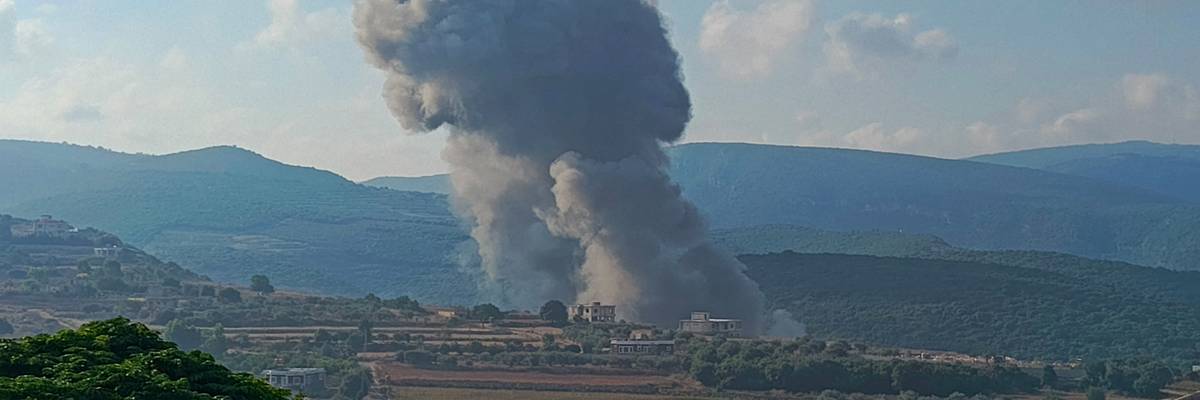
Smoke billows from the site of an Israeli airstrike on Zibqin in southern Lebanon on August 25, 2024.
"Looks like Israel is now escalating in Lebanon in a major way in the hopes of kicking off a major war in the north that has thus far been kept to more limited exchanges," warned one analyst.
Israel's military deployed around 100 fighter jets to launch a massive bombing campaign in southern Lebanon on Sunday, endangering tens of thousands of civilians and heightening the chances of an all-out regional war.
The Israel Defense Forces (IDF) characterized the wave of airstrikes as an effort to preemptively "remove the threat" posed by a purportedly imminent Hezbollah attack, but observers argued the Israeli bombing marked a serious escalation that could further undermine hopes of a cease-fire deal in Gaza.
"Looks like Israel is now escalating in Lebanon in a major way in the hopes of kicking off a major war in the north that has thus far been kept to more limited exchanges," wrote political analyst Yousef Munayyer. "Just as negotiations for a cease-fire were reportedly advancing."
Hezbollah said Sunday that it had fired hundreds of drones and rockets at Israeli military sites in retaliation for the assassination of one of the group's senior commanders last month. Hezbollah said the "first phase" of its response was complete and rejected the IDF's claim that it preempted the group's retaliatory action.
The Associated Press reported that "by mid-morning, it appeared that the exchange had ended, with both sides saying they had only aimed at military targets."
"At least three people were killed in the strikes on Lebanon," AP noted, "while there were no reports of casualties in Israel."
Israel Katz, the Israeli foreign minister, wrote on social media following the attack on Lebanon that he "sent a direct message to dozens of foreign ministers worldwide, urging them to support Israel against the Iranian axis of evil and its proxies, led by Hezbollah."
Sunday's dangerous back-and-forth, described by one newspaper as the two sides' biggest exchange of fire since the 2006 war, further intensified concerns that the region is moving toward the precipice of an all-out conflict as Israel's U.S.-backed assault on the Gaza Strip continues with no end in sight.
A White House spokesperson said Sunday that U.S. President Joe Biden is "closely monitoring events in Israel and Lebanon."
"At his direction, senior U.S. officials have been communicating continuously with their Israeli counterparts," the spokesperson said. "We will keep supporting Israel's right to defend itself, and we will keep working for regional stability."
One senior U.S. official said Israel did not give the White House advance notice of the Lebanon attack.
Monica Marks, professor of Middle East politics at New York University Abu Dhabi, wrote that the White House's claim to be promoting regional stability "lands like a bad joke" given ongoing U.S. support for Israel's "escalatory acts."
"Lives on the ground are at stake. So are [Democratic presidential nominee Kamala] Harris' chances and Biden's legacy," Marks added. "D.C. is playing Middle East roulette."
Israel's bombardment of Lebanon came after another horrific day in the Gaza Strip, where the IDF killed dozens of Palestinians in southern Gaza. "Among the dead," according to the AP, "were 11 members of a family, including two children, after an airstrike hit their home in Khan Younis."
The atrocities preceded a fresh round of high-level cease-fire talks, negotiations that Israeli Prime Minister Benjamin Netanyahu has repeatedly thwarted with hardline demands.
The Washington Post reported Saturday that "Israel and Hamas were sending senior-level delegations to Cairo this weekend as U.S., Qatari, and Egyptian mediators prepared for a high-stakes summit they hope will break the deadlock in negotiations for a cease-fire in the Gaza Strip."
"Hamas officials arrived in the Egyptian capital Saturday, while Israeli media reported that a team led by the head of Mossad, David Barnea, would travel there Sunday," the Post added. "The summit, also on Sunday, will include CIA Director William J. Burns, Egyptian intelligence chief Abbas Kamel, and Qatari Prime Minister Mohammed bin Abdulrahman Al Thani."
Dear Common Dreams reader, It’s been nearly 30 years since I co-founded Common Dreams with my late wife, Lina Newhouser. We had the radical notion that journalism should serve the public good, not corporate profits. It was clear to us from the outset what it would take to build such a project. No paid advertisements. No corporate sponsors. No millionaire publisher telling us what to think or do. Many people said we wouldn't last a year, but we proved those doubters wrong. Together with a tremendous team of journalists and dedicated staff, we built an independent media outlet free from the constraints of profits and corporate control. Our mission has always been simple: To inform. To inspire. To ignite change for the common good. Building Common Dreams was not easy. Our survival was never guaranteed. When you take on the most powerful forces—Wall Street greed, fossil fuel industry destruction, Big Tech lobbyists, and uber-rich oligarchs who have spent billions upon billions rigging the economy and democracy in their favor—the only bulwark you have is supporters who believe in your work. But here’s the urgent message from me today. It's never been this bad out there. And it's never been this hard to keep us going. At the very moment Common Dreams is most needed, the threats we face are intensifying. We need your support now more than ever. We don't accept corporate advertising and never will. We don't have a paywall because we don't think people should be blocked from critical news based on their ability to pay. Everything we do is funded by the donations of readers like you. When everyone does the little they can afford, we are strong. But if that support retreats or dries up, so do we. Will you donate now to make sure Common Dreams not only survives but thrives? —Craig Brown, Co-founder |
Israel's military deployed around 100 fighter jets to launch a massive bombing campaign in southern Lebanon on Sunday, endangering tens of thousands of civilians and heightening the chances of an all-out regional war.
The Israel Defense Forces (IDF) characterized the wave of airstrikes as an effort to preemptively "remove the threat" posed by a purportedly imminent Hezbollah attack, but observers argued the Israeli bombing marked a serious escalation that could further undermine hopes of a cease-fire deal in Gaza.
"Looks like Israel is now escalating in Lebanon in a major way in the hopes of kicking off a major war in the north that has thus far been kept to more limited exchanges," wrote political analyst Yousef Munayyer. "Just as negotiations for a cease-fire were reportedly advancing."
Hezbollah said Sunday that it had fired hundreds of drones and rockets at Israeli military sites in retaliation for the assassination of one of the group's senior commanders last month. Hezbollah said the "first phase" of its response was complete and rejected the IDF's claim that it preempted the group's retaliatory action.
The Associated Press reported that "by mid-morning, it appeared that the exchange had ended, with both sides saying they had only aimed at military targets."
"At least three people were killed in the strikes on Lebanon," AP noted, "while there were no reports of casualties in Israel."
Israel Katz, the Israeli foreign minister, wrote on social media following the attack on Lebanon that he "sent a direct message to dozens of foreign ministers worldwide, urging them to support Israel against the Iranian axis of evil and its proxies, led by Hezbollah."
Sunday's dangerous back-and-forth, described by one newspaper as the two sides' biggest exchange of fire since the 2006 war, further intensified concerns that the region is moving toward the precipice of an all-out conflict as Israel's U.S.-backed assault on the Gaza Strip continues with no end in sight.
A White House spokesperson said Sunday that U.S. President Joe Biden is "closely monitoring events in Israel and Lebanon."
"At his direction, senior U.S. officials have been communicating continuously with their Israeli counterparts," the spokesperson said. "We will keep supporting Israel's right to defend itself, and we will keep working for regional stability."
One senior U.S. official said Israel did not give the White House advance notice of the Lebanon attack.
Monica Marks, professor of Middle East politics at New York University Abu Dhabi, wrote that the White House's claim to be promoting regional stability "lands like a bad joke" given ongoing U.S. support for Israel's "escalatory acts."
"Lives on the ground are at stake. So are [Democratic presidential nominee Kamala] Harris' chances and Biden's legacy," Marks added. "D.C. is playing Middle East roulette."
Israel's bombardment of Lebanon came after another horrific day in the Gaza Strip, where the IDF killed dozens of Palestinians in southern Gaza. "Among the dead," according to the AP, "were 11 members of a family, including two children, after an airstrike hit their home in Khan Younis."
The atrocities preceded a fresh round of high-level cease-fire talks, negotiations that Israeli Prime Minister Benjamin Netanyahu has repeatedly thwarted with hardline demands.
The Washington Post reported Saturday that "Israel and Hamas were sending senior-level delegations to Cairo this weekend as U.S., Qatari, and Egyptian mediators prepared for a high-stakes summit they hope will break the deadlock in negotiations for a cease-fire in the Gaza Strip."
"Hamas officials arrived in the Egyptian capital Saturday, while Israeli media reported that a team led by the head of Mossad, David Barnea, would travel there Sunday," the Post added. "The summit, also on Sunday, will include CIA Director William J. Burns, Egyptian intelligence chief Abbas Kamel, and Qatari Prime Minister Mohammed bin Abdulrahman Al Thani."
Israel's military deployed around 100 fighter jets to launch a massive bombing campaign in southern Lebanon on Sunday, endangering tens of thousands of civilians and heightening the chances of an all-out regional war.
The Israel Defense Forces (IDF) characterized the wave of airstrikes as an effort to preemptively "remove the threat" posed by a purportedly imminent Hezbollah attack, but observers argued the Israeli bombing marked a serious escalation that could further undermine hopes of a cease-fire deal in Gaza.
"Looks like Israel is now escalating in Lebanon in a major way in the hopes of kicking off a major war in the north that has thus far been kept to more limited exchanges," wrote political analyst Yousef Munayyer. "Just as negotiations for a cease-fire were reportedly advancing."
Hezbollah said Sunday that it had fired hundreds of drones and rockets at Israeli military sites in retaliation for the assassination of one of the group's senior commanders last month. Hezbollah said the "first phase" of its response was complete and rejected the IDF's claim that it preempted the group's retaliatory action.
The Associated Press reported that "by mid-morning, it appeared that the exchange had ended, with both sides saying they had only aimed at military targets."
"At least three people were killed in the strikes on Lebanon," AP noted, "while there were no reports of casualties in Israel."
Israel Katz, the Israeli foreign minister, wrote on social media following the attack on Lebanon that he "sent a direct message to dozens of foreign ministers worldwide, urging them to support Israel against the Iranian axis of evil and its proxies, led by Hezbollah."
Sunday's dangerous back-and-forth, described by one newspaper as the two sides' biggest exchange of fire since the 2006 war, further intensified concerns that the region is moving toward the precipice of an all-out conflict as Israel's U.S.-backed assault on the Gaza Strip continues with no end in sight.
A White House spokesperson said Sunday that U.S. President Joe Biden is "closely monitoring events in Israel and Lebanon."
"At his direction, senior U.S. officials have been communicating continuously with their Israeli counterparts," the spokesperson said. "We will keep supporting Israel's right to defend itself, and we will keep working for regional stability."
One senior U.S. official said Israel did not give the White House advance notice of the Lebanon attack.
Monica Marks, professor of Middle East politics at New York University Abu Dhabi, wrote that the White House's claim to be promoting regional stability "lands like a bad joke" given ongoing U.S. support for Israel's "escalatory acts."
"Lives on the ground are at stake. So are [Democratic presidential nominee Kamala] Harris' chances and Biden's legacy," Marks added. "D.C. is playing Middle East roulette."
Israel's bombardment of Lebanon came after another horrific day in the Gaza Strip, where the IDF killed dozens of Palestinians in southern Gaza. "Among the dead," according to the AP, "were 11 members of a family, including two children, after an airstrike hit their home in Khan Younis."
The atrocities preceded a fresh round of high-level cease-fire talks, negotiations that Israeli Prime Minister Benjamin Netanyahu has repeatedly thwarted with hardline demands.
The Washington Post reported Saturday that "Israel and Hamas were sending senior-level delegations to Cairo this weekend as U.S., Qatari, and Egyptian mediators prepared for a high-stakes summit they hope will break the deadlock in negotiations for a cease-fire in the Gaza Strip."
"Hamas officials arrived in the Egyptian capital Saturday, while Israeli media reported that a team led by the head of Mossad, David Barnea, would travel there Sunday," the Post added. "The summit, also on Sunday, will include CIA Director William J. Burns, Egyptian intelligence chief Abbas Kamel, and Qatari Prime Minister Mohammed bin Abdulrahman Al Thani."