
SUBSCRIBE TO OUR FREE NEWSLETTER
Daily news & progressive opinion—funded by the people, not the corporations—delivered straight to your inbox.
5
#000000
#FFFFFF
To donate by check, phone, or other method, see our More Ways to Give page.


Daily news & progressive opinion—funded by the people, not the corporations—delivered straight to your inbox.
"We demand international protection for hospitals, patients, and medical staff," said the Gaza Ministry of Health.
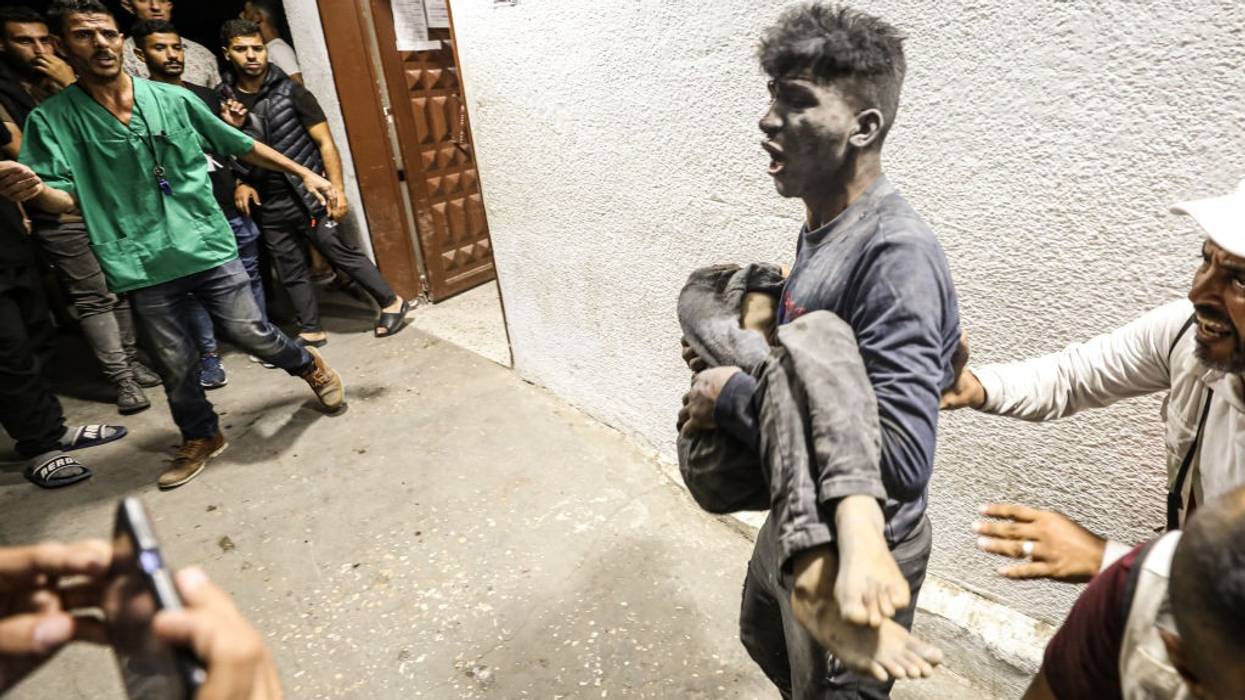
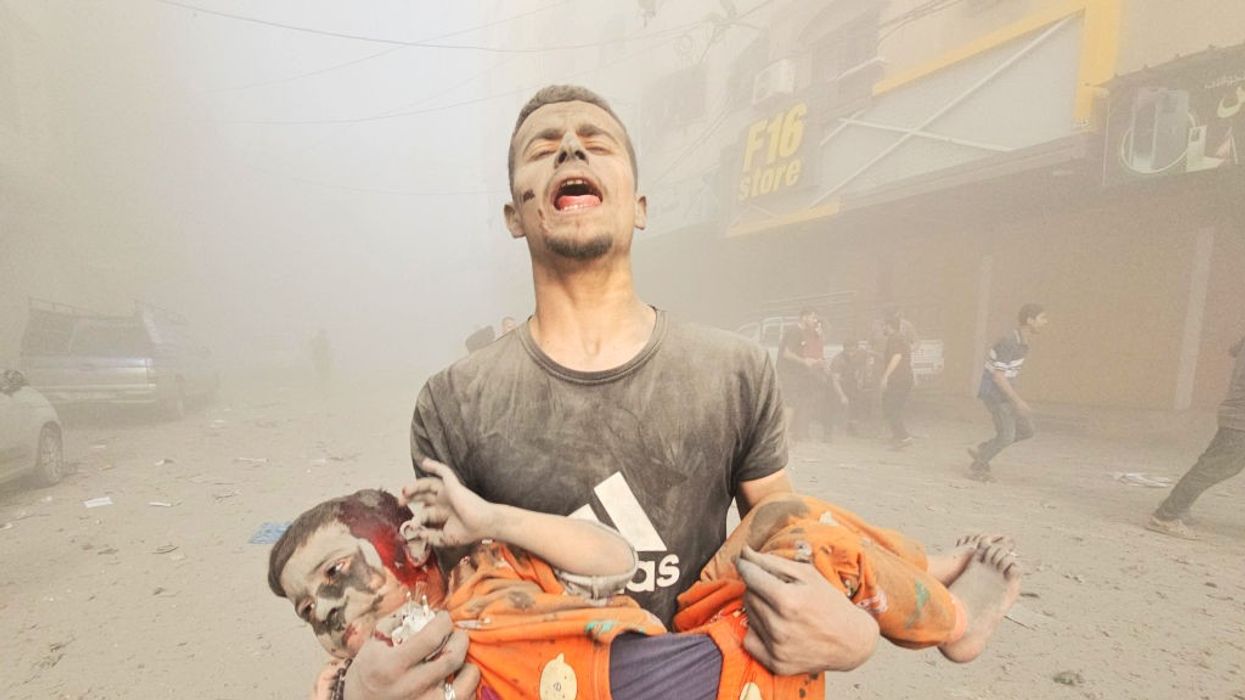
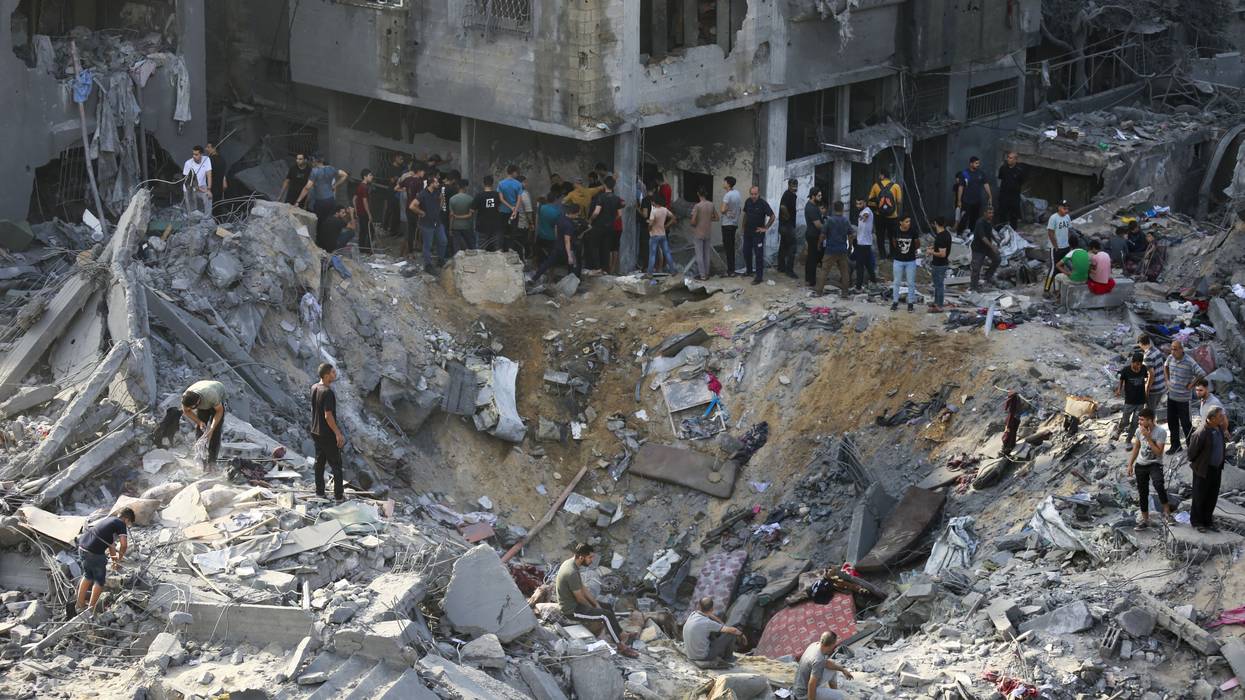
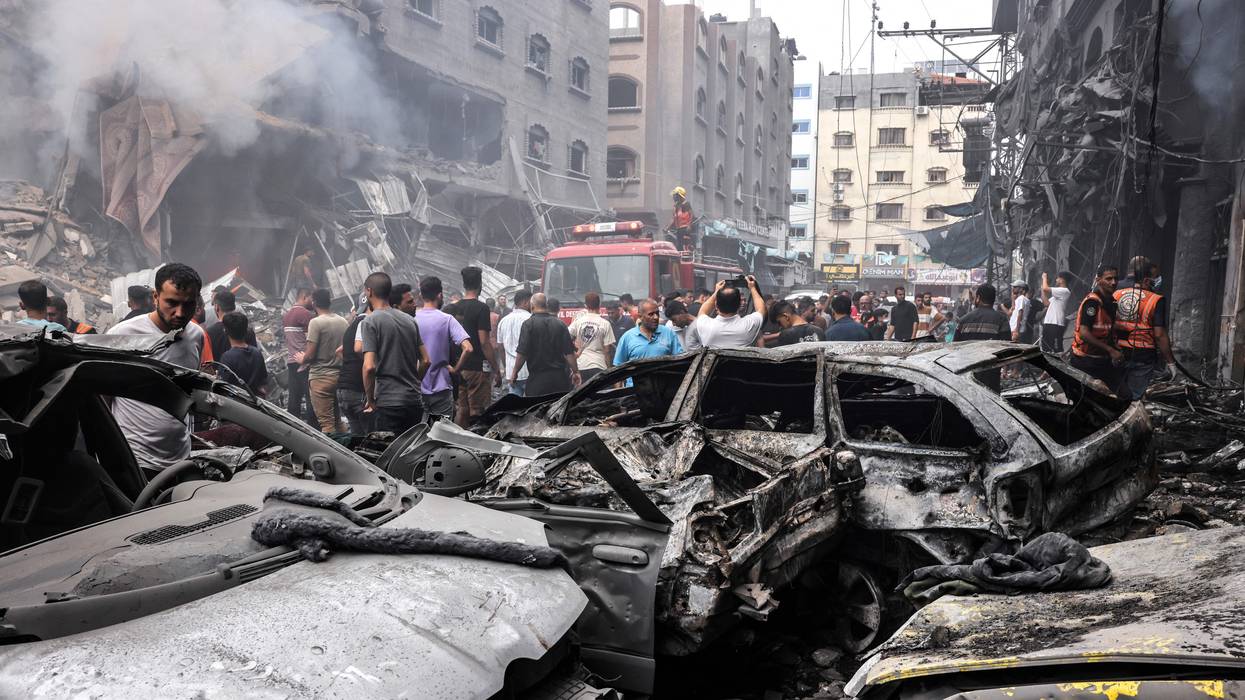
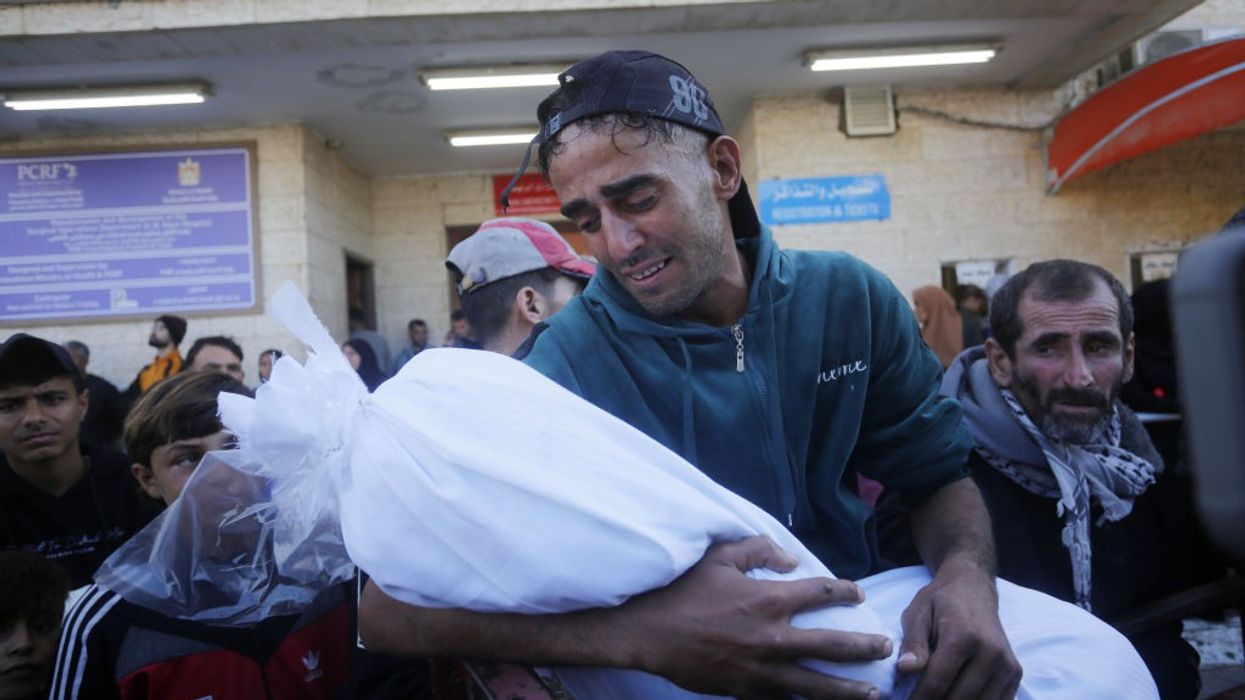
The death toll from Israel's 14-month assault on the Gaza Strip hit at least 44,758 on Monday, with 50 people killed in the past 24 hours alone, as Israeli forces bombed refugee camps, a flour distribution line, and a hospital, according to reporters and officials in the Palestinian enclave.
The Gaza Ministry of Health said a bombing at the Indonesian Hospital north of Gaza City wounded six patients—who are now among more than 106,000 Palestinians injured since Israel began its retaliation for last year's Hamas-led attack.
"We demand international protection for hospitals, patients, and medical staff," the ministry said in a statement reported by The Associated Press—which noted that Israel Defense Forces (IDF) claimed Sunday evening it was unaware of any attack on the hospital "in the last three to four hours."
A nurse shared footage from the hospital with Drop Site News, which circulated the material on social media:
According to Al Jazeera, "Overnight, an Israeli attack in the southern city of Rafah also killed 10 people while they had lined up to buy flour."
Israel, which faces a genocide case at the International Court of Justice, has been accused of starving Gaza's 2.3 million residents by refusing to allow enough humanitarian aid into the besieged enclave.
Reporting from central Deir al-Balah, Al Jazeera's Hani Mahmoud said that at least three people were killed in a Monday morning attack on the Jabalia refugee camp in the north that Israeli bombing and the ongoing blockade have "turned into a graveyard."
The victims "were trying to leave their home in search of food in the vicinity of their neighborhood when they were targeted by a drone," the journalist said. "They were killed right away. Their bodies are still in the street and nobody has the ability to get to the bombed site and remove the bodies from the street."
The IDF announced that three soldiers were killed and 12 others were wounded Monday in fighting in Jabalia.
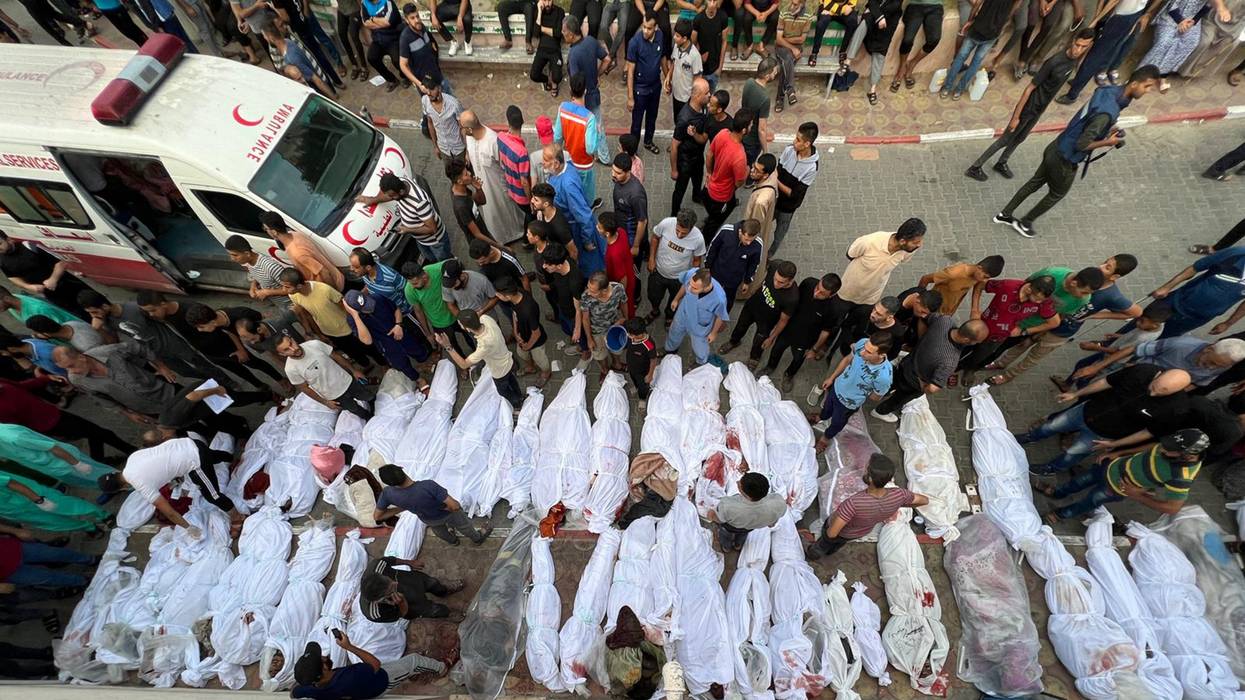
Mahmoud, the journalist, also said Monday that bodies were piling up outside al-Aqsa Martyrs Hospital after an Israeli bombing at the Bureij refugee camp.
"The agony keeps on unfolding here at al-Aqsa Hospital, where survivors and relatives showed up early this morning to collect the bodies from the morgue of the hospital," he said. "At some point, the morgue of the hospital was packed with the bodies and there was not enough room for more bodies."
Citing the Palestinian news agency Wafa, Middle East Eye reported that "two children lost their lives, and others were injured on Monday, during Israeli shelling of al-Maghazi camp in the central Gaza Strip."
The updates followed a Hamas delegation led by Khalil al-Hayya leaving Cairo Sunday evening after meeting with Egypt's general intelligence chief, Maj. Gen. Hassan Rashad, to discuss a potential cease-fire in Gaza.
Israeli media reported Sunday that unnamed political sources claimed Hamas and Israel are close to reaching a "small" deal that would involve a two-month cease-fire; the release of prisoners who are elderly, women, wounded, and sick; and the IDF's withdrawal from parts of Gaza.
Neither Hamas nor mediators Egypt and Qatar have commented on the reporting—which came over a week into an Israeli cease-fire with the Lebanese group Hezbollah that Israel has repeatedly violated since it took effect late last month.
In neighboring Syria, the government of President Bashar al-Assad collapsed over the weekend as he fled and rebels took control of the capital. Israel seized more of the country's Golan Heights, which it has illegally occupied for decades, and the United States—which arms the IDF—launched airstrikes on over 75 Islamic State targets in Syria.
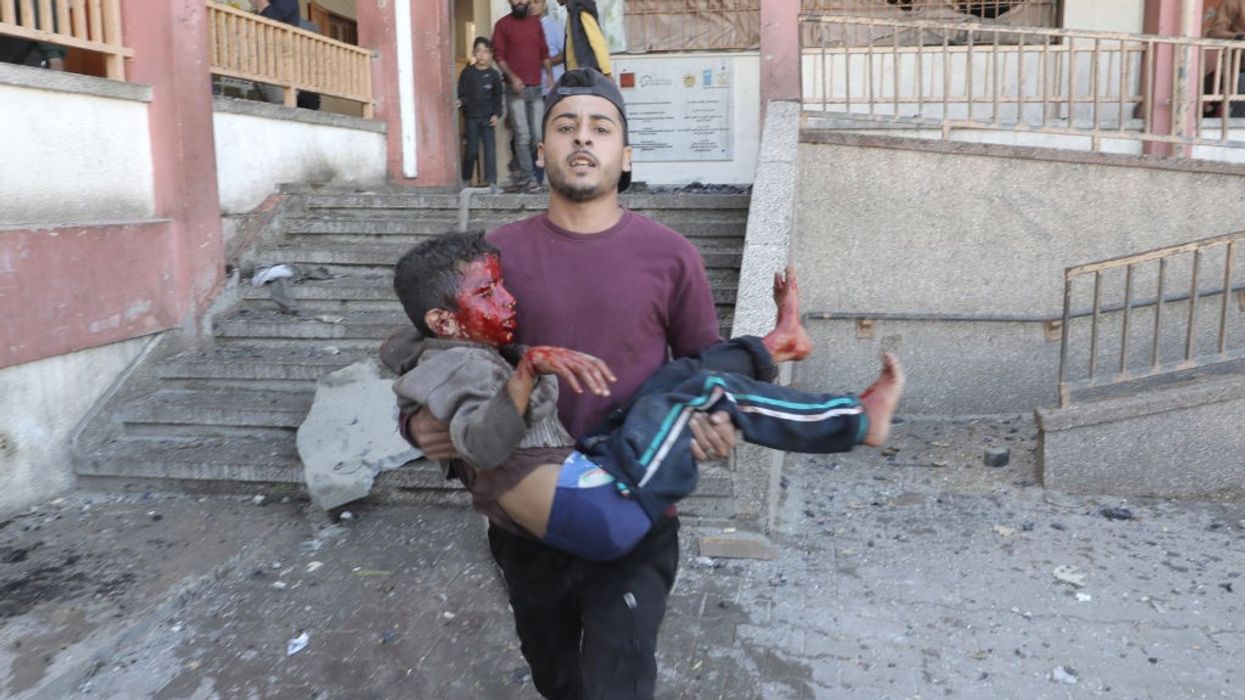
"Our ambulances can't transfer wounded people," said one overwhelmed hospital director. "Those who can arrive by themselves to the hospital receive care, but those who don't just die in the streets."
A devastating wave of Israeli airstrikes across the Gaza Strip on Wednesday and Thursday have killed or wounded hundreds of Palestinians, including many children, according to local and international media reports.
Citing Gaza Civil Defense officials, Palestine's Quds News Network reported Thursday that at least 150 Palestinian civilians were killed or wounded by Israel Defense Forces (IDF) bombardment of around a dozen apartment towers on Al-Houja Street in the Jabalia refugee camp in northern Gaza.
Local and international media outlets earlier reported at least 17 Palestinians were killed and dozens more wounded by an IDF strike on the al-Shuhada school in the Nuseirat refugee camp in central Gaza.
Medical staff at the al-Awda Hospital in Nuseirat—where many people killed and wounded in the strike were taken—told Al Jazeera that 13 children under age 18 and three women were among the dead.
The IDF said the strike targeted a Hamas command-and-control center. However, survivors and eyewitnesses said that all of the dead were women and children.
Gaza Notifications published the names of 16 people killed in the attack, including at least five children—the youngest of whom was a baby, just 11 months old.
The outlet said a total of 203 Palestinian civilians have been killed so far on Thursday, and that "all medical and rescue operations have been completely halted by the military administration."
"The Israeli army has warned that ambulances and rescue teams will be directly targeted if they attempt to continue their operations, effectively blocking any humanitarian efforts," the site added.
Gaza's Government Media Office reported 34 Palestinians including 11 children were burned alive in an IDF strike on a youth club-turned shelter in the al-Maghazi refugee camp in central Gaza.
Israeli forces have also reportedly attacked hospitals and healthcare workers throughout Gaza. The Palestine Chronicle reported that IDF troops opened fire on Kamal Adwan Hospital in Beit Lahia, "with sick children inside."
Hussam Abu Safia, the hospital's director, told Al Jazeera that IDF tanks surrounded the facility and "directly targeted" it, severely damaging the intensive care unit. On Wednesday, Abu Safia said there were more than 150 wounded people in the hospital, including 14 children in the ICU or neonatal ward.
"There is a very large number of wounded people, and we lose at least one person every hour because of the lack of medical supplies and medical staff," he said. "Our ambulances can't transfer wounded people. Those who can arrive by themselves to the hospital receive care, but those who don't just die in the streets."
The Palestinian Ministry of Health also said several of its employees were wounded by Israeli artillery strikes on Thursday.
Earlier this month, the United Nations Independent International Commission of Inquiry on the Occupied Palestinian Territory released a report detailing how "Israel has perpetrated a concerted policy to destroy Gaza's healthcare system as part of a broader assault on Gaza, committing war crimes and the crime against humanity of extermination with relentless and deliberate attacks on medical personnel and facilities."
Israel's ongoing offensive in northern and central Gaza has killed or wounded more than 2,000 Palestinians this month alone, according to Gaza officials. Since last October, Israel's war on Gaza—which is the subject of a South Africa-led genocide case at the International Court of Justice—has left more than 153,000 Palestinians dead, maimed, or missing; millions more forcibly displaced, starved, or sickened; and most of the coastal enclave in ruins.
Thursday's strikes came as U.S. Secretary of State Antony Blinken traveled to the Middle East, where he is set to take part in cease-fire negotiations with officials from Israel, Egypt, and Qatar in the Qatari capital Doha.
"Going back to the negotiations on ceasefire and the hostages, one of the things we're doing is looking at whether there are different options that we can pursue to get us to a conclusion, to get us to a result," Blinken said Thursday.
The United States is Israel's primary international backer, providing billions of dollars in military aid and diplomatic cover including multiple vetoes of United Nations Security Council cease-fire resolutions.
As the situation inside Gaza is increasingly described as "indescribable," medical NGOs blocked from providing care to Palestinians trapped inside besieged territory demand world leaders to stop turning 'blind eye' to Israeli war crimes and violations of humanitarian law.
As more Israeli bombing of the Jabalia refugee camp in northern Gaza killed dozens of people Saturday, health workers from both inside and out of the besieged territory are again pleading with world leaders to bring an end to the indiscriminate attacks and imposed humanitarian crisis that witnesses on the ground increasingly say there are no words to describe.
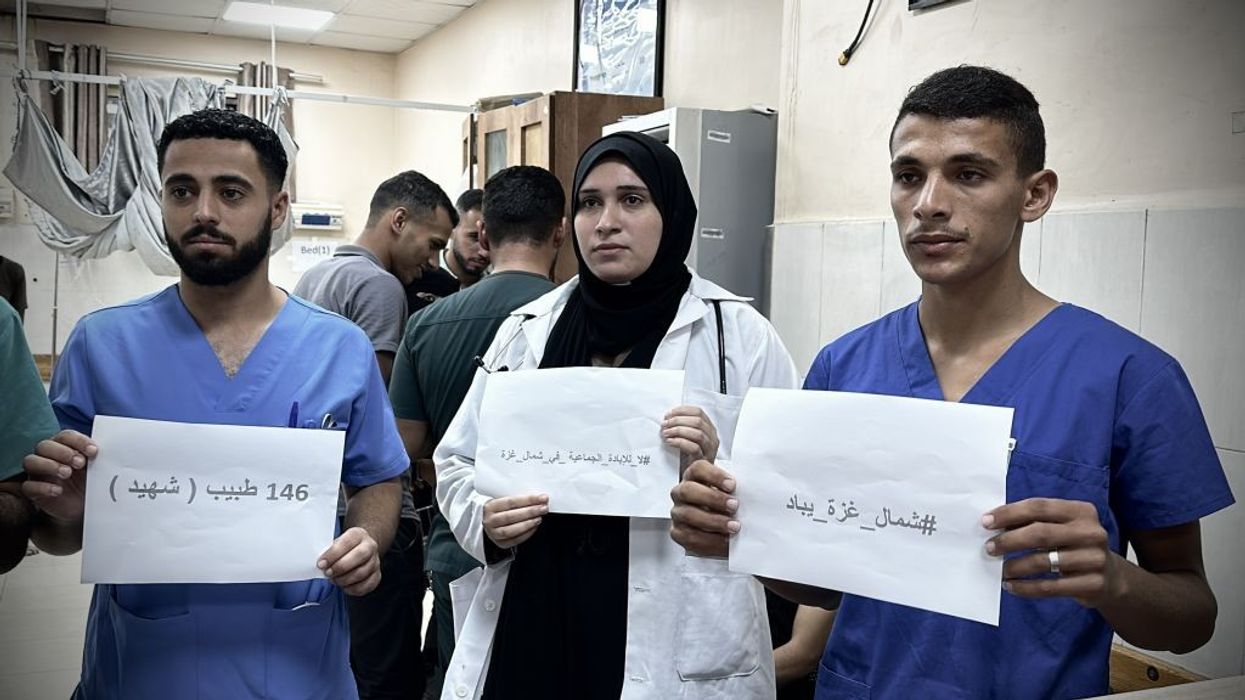
At al Nasser Hospital in Khan Yunis and elsewhere in Gaza, doctors and other medical staff on Saturday staged protests and held press conferences to call attention to the ongoing attacks in northern areas, including the latest targeting of Jabalia in which reporting indicated anywhere from 33 to over 50 people—including civilian men, women, and children—were killed.
"The world is watching, and history will judge us by how we respond to this grave injustice. I call upon each and everyone one of you to join this fight for the preservation of our shared humanity." —Dr. Khaled Saleh, FAJR Scientific
Al-Jazeera reports that hospitals, which have repeatedly been bombed by Israel over the last year, were not immune from this latest round:
Three partially functioning hospitals treating severely wounded patients and sheltering thousands of displaced Palestinian civilians in northern Gaza are now out of service after coming under intense Israeli fire, a Gaza health official told Al Jazeera, as the siege on Jabalia enters its third week, with at least 33 more people killed in the northern area.
Israeli forces bombed al-Awda Hospital in Jabalia early on Saturday, and have also shelled Kamal Adwan and the Indonesian hospitals in Beit Lahiya over the past few hours, Al Jazeera correspondents have reported.
Saturday's attacks come days after Israel barred at least six medical service NGOs from continuing their life-saving work in Gaza. According to the Washington Post:
Two of those medical NGOs, Glia and the Palestinian American Medical Association (PAMA), confirmed to The Washington Post that they were notified by the WHO this week about the bans. Both groups have worked in Gaza for years preceding the war.
"WHO is concerned about the impact of these denials on Gaza's strained healthcare system," the organization said Thursday in a statement. It added that international emergency medical teams (EMTs) deployed to Gaza are essential to keeping the system operational, as only 17 of the enclave's 36 hospitals remain functional and "healthcare needs far exceed the system's capacity."
Dr. Khaled Saleh, chair of FAJR Scientific, which provides surgical expertise and trauma specialists to war-torn regions and was another of the groups notified by the WHO that it had been barred from entering Gaza, said in a statement that the move by the Israeli government filled him with "deep sadness and concern for the current state of our global family, questioning our shared humanity and ethics."
Blocked from providing aid to people in dire need, Saleh called on people worldwide to push for an end to Israel's blocking of vital medical aid and those seeking to provide it.
"This is a devastating blow to humanity, representing a level of destruction that we have not witnessed since World War II, yet our world leaders turn a blind eye," he said.
"As a member of the global community," Saleh continued, "I implore all of you who value compassion, ethics, and the sanctity of human life to stand with us and raise your voices against this unconscionable decision. Together, we must advocate for the voiceless and demand restoration of the fundamental right to access to medical care."
Israel's ban on the medical NGOs comes after a string of healthcare professionals who spent time in the Gaza strip have gone public with what they witnessed on the ground, telling tales of unspeakable horror and trying to shake the world out of its complacency on what experts say is a genocide in motion being carried out by Israeli forces.
Earlier this week, the UN humanitarian office, OCHA, said that Israel's continued blocking of food and medical supplies to Jabalia and other ares in the northern was "having life-threatening impacts" for the people there.
OCHA spokesperson Farhan Haq said the OCHA was calling on Israeli authorities "to allowed safe, sustained and unimpeded access to Jabalia and all areas of the north where people are in desperate need of assistance."
In a post on Friday, Oxfam International mourned the killing of Dr. Ahmad Al-Najar and midwife Laila Jneid, both of whom worked with Juzoor, "killed by Israeli airstrikes on Jabalia," the group said. "They were providing lifesaving health care in Gaza. Attacking aid workers is a war crime." Oxfam repeated its demand for a "cease-fire now" and said healthcare workers should never be a target.
In a dispatch on Friday, Dr. Taghreed Al-Imawi, Juzoor staff and an OBGYN doctor at Kamal Adwan Hospital in northern Gaza, described the untenable situation on the ground.
"The situation is beyond horrific and is very difficult and indescribable," said Al-Imawi. "Dead people, severed body parts and injured people everywhere. We are receiving emergency calls from all the areas of the north. Ambulances are not able to reach the injured. We have seen more than 23 pregnant women among the injured coming to the hospital since last week, wounded either by shrapnel or gunfire, suffering from fractures. Some were in a critical condition. Kamal Adwan Hospital and other semi-operational hospitals have received displacement orders but there is no way to evacuate in any case."
"The pediatrics section is closed as it is full of injured people," Al-Imawi added, "the surgery section is full of injured people, even the reception, the hospital has been shelled several times and targeted by snipers, people are terrified to come to the hospital now."
Having recently returned from a field mission in Gaza, pediatric nurse Becky Platt, working through Save the Children—who posted her testimony Saturday—described a situation on the ground that was "like nothing I've seen before."
Platt said the horrific situation is "both in terms of healthcare need and just in terms of the whole humanitarian context—seeing homes and landscapes completely devastated and seeing just the absolute level of human suffering and need as absolutely mind blowing."
❗️ “Gaza was like nothing I’ve ever seen before”
With Gaza’s health system decimated, children being treated lack adequate pain relief. Healthcare workers have limited access to morphine and are having to treat blast injuries with paracetamol.
Paediatric nurse Becky Platt spoke… pic.twitter.com/zsb4OIvcvI
— Save the Children UK (@savechildrenuk) October 19, 2024
"No child should have to be in pain," she said. "And it just feels like your hands are tied when you can't do what you know that you could do easily at home or in another context. I think that when it really hits. It's just—it's just not fair. It's not okay that we've got children with devastating injuries who don't have access to pain relief."
For his part, Dr. Saleh of FAJR Scientific, said it was up to everyone in the world to make their voices heard.
"The world is watching," he said, "and history will judge us by how we respond to this grave injustice. I call upon each and everyone one of you to join this fight for the preservation of our shared humanity."
"People are starving," said a Médecins Sans Frontières driver trapped in northern Gaza. "I am afraid to stay, and I am also afraid to leave."
The death toll from Israel's latest ground and aerial assault on northern Gaza continued to mount on Saturday as the U.S.-armed military targeted the Jabalia refugee camp and other parts of the region, trapping hundreds of thousands of people, firing on those who try to flee, and blocking deliveries of lifesaving humanitarian aid.
Israeli strikes on Jabalia homes and schools housing displaced people killed more than 20 Palestinians and wounded dozens more late Friday. Hours later, the Israeli military issued fresh evacuation orders for northern Gaza, instructing residents to move to a so-called humanitarian zone that Israel has repeatedly attacked.
Many have opted to remain in their homes as Israeli quadcopters and snipers target those attempting to escape the besieged and famine-stricken region. As Al Jazeera's Hind Khoudary explained Saturday, "Palestinians say they prefer dying in their homes because they believe that there is no place safe across the Gaza Strip, so even if they evacuate they might get killed on the way."
"There has been intensive shooting from quadcopters and [Palestinians] are also being blocked from evacuating."
Al Jazeera's Hind Khoudary reports on the Israeli attacks and intense siege of the Jabalia refugee camp in north Gaza. pic.twitter.com/uPydI90Fud
— Al Jazeera English (@AJEnglish) October 12, 2024
Sarah Vuylsteke, project coordinator for Médecins Sans Frontières (MSF), said Friday that "nobody is allowed to get in or out, anyone who tries is getting shot."
MSF said five of its staffers were trapped in Jabalia and "fearing for their lives." An MSF driver said that they were "staying at the Al-Yemen Al-Saeed Hospital, but [Israeli forces] bombed it," killing roughly 20 people.
"I don't know what to do, at any moment we could die," said the MSF driver, identified as Haydar. "People are starving. I am afraid to stay, and I am also afraid to leave."
Video footage posted to social media shows the disturbing aftermath of an Israeli strike on a residential block in Jabalia:
A huge massacre in Jabalia Refugee Camp |
At least 22 Palestinians killed in an Israeli airstrike that wiped out a residential block.
Assaf, Dardona, Jneed and Azzam homes. All erased. In Assaf’s home over 15 killed alone.
The youngest victim is 7 month old pic.twitter.com/xsxMz8tzr2
— Younis Tirawi | يونس (@ytirawi) October 11, 2024
One resident of northern Gaza told +972 Magazine that "quadcopter drones are hovering low over the streets, firing at anything that moves."
"Snipers are positioned on rooftops, targeting anyone who steps outside," said 27-year-old Mohammed Shehab. "At the same time, soldiers and tanks have pushed into the camp, demolishing homes and bulldozing roads and fields."
The true death toll from Israel's latest assault on northern Gaza is impossible to discern, given the difficulty of navigating the area amid relentless airstrikes and gunfire as well as fuel shortages caused by Israel's siege.
"We are unable to count the number of massacres happening in Jabalia, and ambulances are unable to reach the calls due to the fuel shortage in northern Gaza," wrote journalist Hossam Shabat, who is on the ground in northern Gaza.
One Palestinian trapped in northern Gaza said there are "dead bodies everywhere, and the wounded lie in the streets with no one able to help them."
The Euro-Mediterranean Human Rights Monitor warned that as the international community looks on—and as U.S. military aid continues to flow—Israel is "accelerating the pace of its genocide against the Palestinians" by "carrying out mass and planned killings, as well as widespread forced displacements," in northern Gaza.
"The Euro-Med Monitor field team received testimonies from citizens, who were able to reach Gaza City, about witnessing dead bodies lying in the streets," the group said. "The Israeli army is systematically working to empty northern Gaza of its residents and force them to move to the south, recently issuing several evacuation orders and dropping leaflets demanding their evacuation."
"The forcible deportation of a population is defined as a crime against humanity under the statute of the International Criminal Court, and the United Nations and the international community must intervene immediately to save tens of thousands of Palestinian residents in northern Gaza who face ethnic cleansing by Israel," said Euro-Med. "Furthermore, the U.N. and international community have a legal and moral obligation to put an end to the horrific crime of genocide being committed by the Israeli occupation for the second year in a row now."
"The bomb that killed her family was most likely American. As an American, your tax money paid for it."
Footage of a young girl rescued from beneath the rubble of a building in central Gaza overnight is among the latest graphic images to emerge from the Palestinian enclave as Israel intensifies its military assault and anger grows over U.S. complicity in the carnage that has left over 35,000 people—mostly innocent men, women, and children—dead and hundreds of thousands of others missing, severely wounded, or displaced.
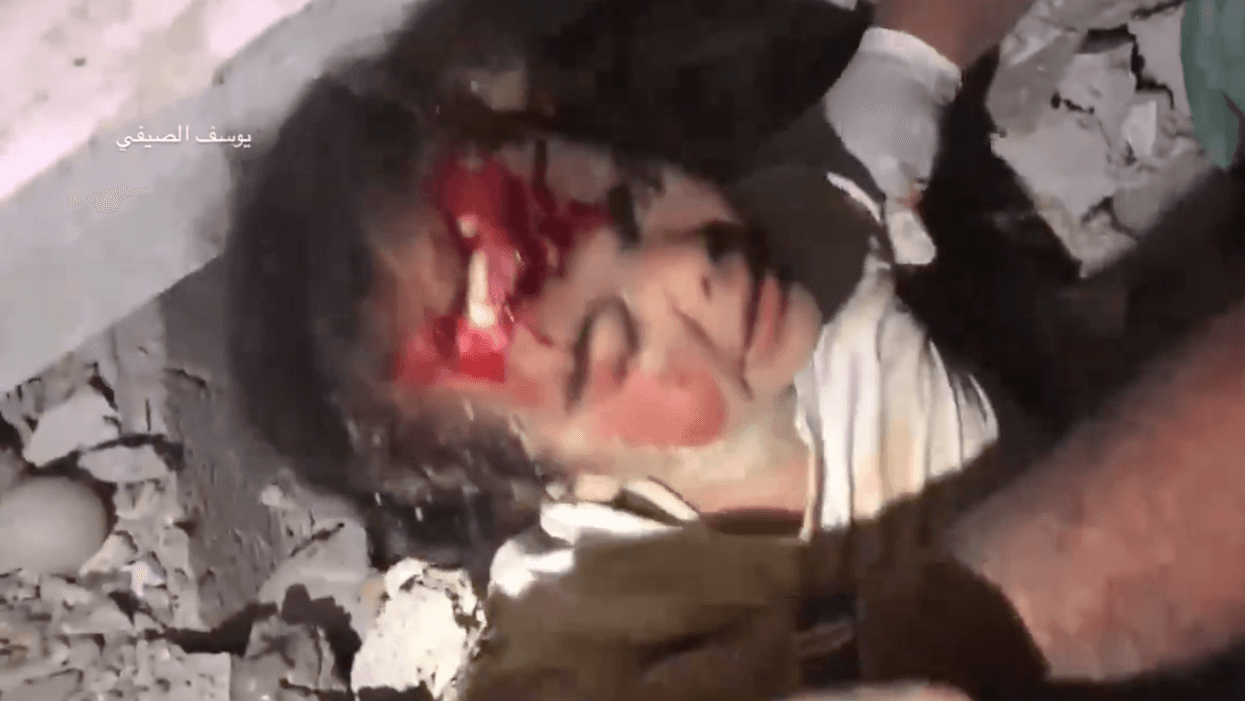
Civil Defense teams in Gaza, who spoke to the young child by the name "Tulin," dug her out by hand after following her cries for help. "Where's my mom?" the girl can be heard saying in Arabic.
While footage of the rescue was widely available available on both X and YouTube, all of the versions were restricted and not available for reposting or embedding.
Oh GOD🙏💔www.youtube.com
"Having survived the weight of a building being bombed to pieces on her fragile body, Tulin is crying for her mother," said Rawan Arraf, a lawyer and the executive director of the Australian Centre for International Justice. Arraf was among those who reported that Tulin's mother did not survive the bombing.
"Tulin's mama was murdered by the genocidal Israeli regime," Arraf said. "More than 19,000 children have been orphaned; 6,000 mothers have been murdered."
"The bomb that killed her family was most likely American. As an American, your tax money paid for it," said Trita Parsi, executive vice president for Responsible Statecraft, a U.S.-based foreign policy think tank.
The attack that claimed Turin's mother comes as Israeli forces bombed targets in norther, central, and southern Gaza over the last 24 hours. Airstrikes were reported in Rafah in the far south, where approximately 1.4 million people remain trapped, as well as in the north were the Jabalia refugee camp came under heavy barrage on Sunday and fighting on the ground between Israeli Defense Forces and Hamas fighters was also reported.
Hundreds of thousands have tried to flee Rafah in recent days, according to the United Nations, who warned that providing humanitarian aid would be nearly impossible if the Israelis pressed ahead with a major invasion of the city.
Gaza's Health Ministry on Monday said its entire health system could collapse "within hours" if fuel was not secured for the hospitals that remain active.
Junaid Sultan, a vascular surgeon who spent time volunteering in Rafah, told Al-Jazeera that hospitals without power would be a "death sentence" for patients in Gaza.
Hospitals in Gaza, he said, "are running out pretty much today and if fuel is not provided, then they will basically run out of electricity, water," leaving them incapable of operation. "[If] that fuel does not come in, that will be a death sentence to not only 100, but thousands of patients," he warned.
In a desperate message on Sunday, Philippe Lazzarini, Commissioner-General of UNRWA, which administers humanitarian relief in Gaza on behalf of the U.N., said the people of Gaza are "enduring unprecedented suffering" in the current moment.
"Everything has been said already," Lazzarini lamented. "No words are left that can do justice to the people of Gaza. They are people like you and I. They used to have drams, they were part of a vibrant and diverse community... Now it's only broken lives and broken futures."
What is happening now in Gaza is genocide. I mourn for my friends, neighbors, and family with the deepest sadness, but it is not only sadness that I feel.
The repeating Israeli airstrikes on the Jabalia refugee camp in Gaza are beyond my own comprehension. For at least 10 of the last 40 days, missiles have rained down on the most densely populated refugee camp in all of Gaza.
And it is not just the days; it is also the nights. The bombing is done in the dark, when the power is off and the only light is from the fires that burn. It is done when the internet is cut, when the journalists are shot dead, to hide their crimes, the burning of children.
I have a long history and strong connection to the people in this camp. My friends, former coworkers, patients, and people I have known for decades through my work as a doctor at Gaza’s Al-Awda hospital are living in this camp. There are the children who grew up coming to the library I founded in Jabalia, who are now young men and women, who have their own children, their own families. There are my beautiful neighbors and friends and patients, who are not my relatives but are my family. They are generation after generation of refugee families living in one of the most crowded places on earth.
After the latest massacre, I cannot reach any of them.
I am so very sad. But it is not only sadness that I feel. It is also rage.
I see these same families in the video sent to me of my neighbors pulling children from the rubble. I see them in my memories as we lived and struggled under dual occupations, and Israeli bombings and apartheid. I hear what it sounds like in the aftermath when women and children, the overwhelming majority of those living in, injured, and killed in Jabalia, scream and mourn in anguish and wake up to do it again. I can taste the chemicals, the poisons that linger in the air for hours and days after these indiscriminate explosions. I can smell the acrid odor of white phosphorus, used by Israel in Gaza and caked on the walls of burning buildings and bodies. I can feel the collective hunger: for food and for justice and for all of it to stop.
But now I am in Cairo and it is so difficult and distressing to hear more terrible news each day, news of my loved ones killed by this criminal occupation, by these crimes of war bragged about by Israeli officials who say that there will be no buildings left in Gaza, that we will be a “city of tents.”
I had always been home in Gaza during previous Israeli bombings that so often use U.S. planes and U.S. missiles, gifted and given as “aid.” Such “help” is the opposite of the aid I am buying now. The food, medicine, and more, even toys for children who have lost so, so much. The Middle East Children’s Alliance is raising money so we can buy these supplies to deliver to children and families in Gaza as soon as we can.
I am so very sad. But it is not only sadness that I feel. It is also rage.
How do I feed a child that will not eat because of fear? How do you give a toy to a child who will not play, who searches the skies for what they know will come?
I am enraged at Israel’s constant, ruthless bombardment, killing thousands of people from newborn babies to grandfathers. What is happening now in Gaza is genocide. Those who are not killed by Israeli bombs are dying slowly from the lack of medicine, food, and water.
How do I feed a child that will not eat because of fear? How do you give a toy to a child who will not play, who searches the skies for what they know will come?
I mourn more of my beloveds, both family and friends, every day and I ask myself who is next. Last week it was one of my dear friends killed in Jabalia. We were friends for over 35 years, since we worked together during the first intifada in 1987.
Before that, it was my own family. My own brother speaks in the video about our own family members that were killed a few weeks ago.
This is our story and it is the tragedy of every family in Gaza. More than one out of every two hundred Palestinians in Gaza has been killed in the last 40 days.
I have always signed my letters to supporters and friends from around the world with these words, “From Gaza with Love.” But today I’m writing with a rage that no mother should know, a rage of desperation and disbelief about what is being allowed to happen. I still feel love for everyone in Palestine, and people who have stood in support and solidarity of our shared struggle. But please, take action. And then do more.
We must stop this genocide.
Airwars noted that this is "the most named victims we have ever monitored in a single event."
Israel's war on Gaza has killed more than 11,000 Palestinians, including over 100 civilian victims of a single Israeli bombing in the densely populated Jabalia refugee camp on October 31 who were publicly identified on Thursday by the U.K.-based watchdog Airwars.
The group identified 116 names of civilians killed in the strike—including 10 cases with the death of multiple family members, three of which reportedly involved entire families being wiped out. The estimated civilian death toll is 126-136, including 69 children.
Airwars noted on social media that this is "the most named victims we have ever monitored in a single event," and "almost every named victim we found died along with at least one other family member."
As Guardian reporting cited by Airwars detailed:
A spokesperson for the Israeli military said the attack had been authorized to assassinate a senior Hamas commander and destroy his base. IDF spokesperson Daniel Hagari named the target as Ibrahim Biari, commander of Central Jabaliya Battalion, who he said had been leading fighting in northern Gaza from a network of tunnels under the camp.
Hagari declined to comment on how many munitions, or which types, were used to target the camp, or identify which craters were caused by tunnel collapses. He said Israel would provide some of these details at a later date.
But a visual analysis by The Guardian has identified at least five craters in the densely populated refugee camp, which weapons experts said were left by the use of multiple JDAMs—joint direct attack munitions—in the airstrike.
"Hamas spokesperson Hazem Qassem denied any senior commander there and called the claim an Israeli pretext for killing civilians," according to Reuters.
Ahmad al-Kahlout, a spokesperson for the Hamas-controlled Gaza Interior Ministry in Gaza, told reporters at the time that "these buildings house hundreds of citizens. The occupation's air force destroyed this district with six U.S.-made bombs. It is the latest massacre caused by Israeli aggression on the Gaza Strip."
Hagari claimed the IDF killed "scores" of militants alongside Biari.
"With ambiguity around the exact number of militants killed, Airwars has applied a 12-24 combatant casualty range to account for comments such as 'dozens' of targets killed," the watchdog said.
Those in the camp remain at risk. Middle East Eye reported Wednesday that "renewed heavy Israeli shelling has targeted residential homes in the Jabalia refugee camp. Footage showed blocks falling to the ground and survivors digging in the rubble with their hands to retrieve dead bodies."
The IDF strikes on Jabalia have been globally condemned as war crimes—as have various other Israeli actions since October 7, when the nation launched what experts are calling a "genocidal" war in response to a Hamas-led attack.
Throughout Israel's bombing campaign and ground operations in Gaza—which along with killing and wounding thousands of civilians have destroyed civilian infrastructure and displaced around three-quarters of the population—global calls for a cease-fire have mounted.
There have also been growing demands for International Criminal Court action. Rutgers Law School professor and Just Security executive editor Adil Haque tagged the ICC prosecutor, Karim A. A. Khan, in a social media post about the Airwars analysis.
Khan last month asked civil society groups "to send us any and all evidence that underpins their reports or their communiques or their notices that they issue" on Gaza, explaining that "reports by themselves are, of course, not evidence and I cannot and will not act pursuant to my oath of office without reliable evidence that we can validate that can stand up in a court of law."
"The U.S. government cannot keep funding these atrocities," said U.S. Rep. Cori Bush. "There must be a cease-fire now."
The Israeli military bombed Gaza's largest refugee camp for the second consecutive day on Wednesday as humanitarian groups and lawmakers called the series of attacks a blatant war crime and slammed the U.S. government for enabling such atrocities.
Wednesday's attack reportedly killed and wounded "a number of" people at the densely populated Jabalia refugee camp, where hundreds were killed or injured roughly 24 hours earlier in bombings by the Israeli military.
The Israeli Defense Forces (IDF) asserted that Tuesday's strikes were aimed at a "tunnel complex" where a senior Hamas commander, Ibrahim Biari, was purportedly hiding. The IDF said the airstrikes killed Biari but denied intentionally bombing the camp's buildings, more than a dozen of which were leveled in the attack.
"I was waiting in line to buy bread when suddenly and without any prior warning seven to eight missiles fell," said one eyewitness. "There were seven to eight huge holes in the ground, full of killed people, body parts all over the place. It felt like the end of the world."
A Doctors Without Borders nurse in Gazasaid that after Tuesday's strikes, "young children arrived at the hospital with deep wounds and severe burns."
"They came without their families," the nurse added. "Many were screaming and asking for their parents. I stayed with them until we could find a place, as the hospital was full with patients."
Asked about the civilians who were killed in the Tuesday strikes, an IDF spokesperson told CNN that "this is the tragedy of war" and that the Israeli military instructed people in the area to "move south."
Hamas
denied the claim that one of its commanders was in the area targeted by the Israeli military.
Jeremy Konyndyk, the president of Refugees International, argued Tuesday that Israel's assault on Gaza's largest refugee camp "is a clear-cut war crime."
"It shows wanton disregard for the legal obligation to minimize civilian harm in targeting military objectives. It is the latest of many such attacks by the IDF," Konyndyk wrote. "This in turn underscores that Netanyahu is making a mockery of Biden's repeated pleas to follow the laws of war—without any acknowledgment of that reality by the U.S. This leaves a cease-fire as the only viable path to civilian protection."
U.S. Rep. Cori Bush (D-Mo.), who is leading a congressional resolution calling for a cease-fire in Gaza, also denounced the refugee camp bombing as a war crime and said that "this unspeakable violence must end."
"The U.S. government cannot keep funding these atrocities," Bush added. "There must be a cease-fire now."
U.S. Rep. Ilhan Omar (D-Minn.) similarly criticized the Biden administration and Congress for backing Israel as it carries out massive crimes against humanity.
"Make no mistake: these human rights abuses are being carried out with U.S. weapons, U.S. funding, and with 'no red lines,'" Omar wrote on social media. "And now we are set to vote on an additional $14 billion with no restrictions or conditions. The United States Congress should not fund violations of U.S. and international law."
Israeli forces have killed at least 8,800 people in Gaza since October 7, when Hamas launched a deadly attack on Israel.
The nation's relentless bombing campaign and siege have fueled a massive humanitarian crisis in the Gaza Strip, displacing more than a million people, imperiling the enclave's healthcare system, and decimating much of the territory's civilian infrastructure—including communication and internet services.
The United Nations and human rights organizations have accused Israeli forces of committing grave war crimes in Gaza, including
collective punishment, forcible transfer, and genocide.
The wave of airstrikes that hit Jabalia on Wednesday marked at least the sixth time Israel has bombed the camp since October 7, according to Al Jazeera.
"This is just the latest atrocity to befall the people of Gaza where the fighting has entered an even more terrifying phase, with increasingly dreadful humanitarian consequences," United Nations emergency relief coordinator Martin Griffiths said of the Jabalia attack on Wednesday. "Meanwhile, the world seems unable, or unwilling, to act. This cannot go on."
Lawyers for Palestinian Human Rights, a United Kingdom-based legal charity, said in a statement Wednesday that the Jabalia strikes "should overwhelmingly signal to the U.K. Government and Labour Party that they must now call for an immediate cease-fire."
"We urge the U.K. Government and Labour Party to urgently revise their position in light of the Jabalia mass killing, and clearly place the future preservation of civilian life as its highest objective," the group added.
"What we are watching today is one of the darkest hours of our time," said one scholar. "We are watching genocide live."
Israeli bombardment of Gaza's largest refugee camp killed and wounded hundreds of people—many of them women and children—on Tuesday, Palestinian officials said.
Ahmad al-Kahlout, a spokesperson for Gaza's Interior Ministry, told reporters that the attack "completely destroyed" the Jabalia refugee camp in the northern Gaza Strip. Jabalia, along with the nearby al-Shati refugee camp, is located in an Israeli-designated evacuation zone.
"These buildings house hundreds of citizens. The occupation's air force destroyed this district with six U.S.-made bombs," said al-Kahlout. "It is the latest massacre caused by Israeli aggression on the Gaza Strip."
The director of the nearby Indonesian Hospital said at least 50 people were killed in the strike.
A separate Israeli strike on a home in the al-Shati camp on Tuesday killed at least 10 people, Palestinian media reported.
"There aren't enough beds. The dead and wounded are on the floor," al-Khalout continued. "If we don't have fuel, operations will completely stop. The intensive care units, the kidney care patients, will all lose their lives."
"In this case," he added, "the world is signing the death warrant of those people."
Jabalia—with more than 116,000 registered residents packed in just 1.4 square kilometers—is the largest of Gaza's eight refugee camps and one of the most densely populated areas on Earth.
The camp, which was established in the wake of the ethnic cleansing of over 750,000 Arabs from Palestine during the founding of the modern state of Israel in 1948, was the birthplace of the 1987-93 intifada, or uprising, against Israeli occupation and oppression.
Israeli forces bombed a United Nations school in Jabalia during the 2014 war on Gaza, killing 15 people—mostly women and children—sheltering there.
United Nations High Commissioner for Refugees Filippo Grandi said Tuesday that "the past three weeks have provided devastating proof that disregarding the basic rules of law, international humanitarian law, is increasingly becoming the norm—and not the exception—with innocent civilians killed in unprecedented numbers in the Hamas attacks on Israeli civilians, and in the killing of Palestinian civilians and massive destruction of infrastructure caused by the ongoing Israeli military operation."
"As we speak... over 2 million Gazans, half of them children, are going through... hell on Earth," Grandi continued.
"A humanitarian cease-fire, coupled with substantive delivery of humanitarian aid inside Gaza can at least stop this spiral of death," he added.
Earlier on Tuesday, Gaza health officials said 8,525 people have been killed by Israeli forces in Gaza since October 7, when Hamas-led militants infiltrated southern Israel and killed more than 1,400 civilians and soldiers while taking over 200 hostages.
"The victims include 3,542 children and 2,187 women, while 21,543 other people were injured," Gaza Health Ministry spokesman Ashraf al-Qudra told reporters in Gaza City.
Nearly half of all homes in Gaza have also been destroyed or damaged, while more than 1.4 million residents have fled for their lives amid a nascent Israeli ground invasion and genocidal threats and statements from Israel's leaders.
Israeli public broadcaster Kan said Monday that 1,538 Israeli civilians and troops have been killed by Palestinian militants since October 7.
Aicha Elbasri, a researcher at the Arab Center for Research & Policy Studies, told Al Jazeera after the Jabalia bombing that "what we are watching today is one of the darkest hours of our time."
"We are watching genocide live," she added.
"Everything ground up has been bombed," said a Palestinian human rights lawyer in Gaza.
Israeli airstrikes rained down across the densely populated Gaza Strip on Monday, reportedly killing dozens at the enclave's largest refugee camp, damaging the children's wing of a major hospital, and hitting the occupied territory's main university and residential buildings.
"Everything ground up has been bombed," Raji Sourani, a lawyer with the Palestinian Center for Human Rights in Gaza, told Democracy Now! as bombs could be heard falling in the background.
"There is no safe haven in this place," said Sourani.
Bombs reportedly struck the Islamic University of Gaza earlier today as we spoke to @RajiSourani from his home less than a mile away.
"Everything ground up has been bombed...there is no safe haven in this place." pic.twitter.com/LEhj20ALgZ
— Democracy Now! (@democracynow) October 9, 2023
Tens of thousands of Gazans have already been displaced by the Israeli bombing campaign, which has killed hundreds of people thus far—including dozens of children and entire families, according to the besieged territory's health ministry.
Far-right Israeli Prime Minister Benjamin Netanyahu posted to social media a minute-long video of airstrikes leveling buildings in Gaza.
התחלנו. ישראל תנצח 🇮🇱 pic.twitter.com/tCwDLXkyaY
— Benjamin Netanyahu - בנימין נתניהו (@netanyahu) October 9, 2023
Those attempting to flee the assault, which follows a deadly Hamas attack on Israel over the weekend, often have nowhere safe to hide. The Associated Press reported that 57-year-old Nasser Abu Quta believed he and his extended family would be protected at his four-story residential building after the Israeli military fired a warning shot on Sunday signaling that a nearby home would be targeted.
"But the house of Abu Quta's neighbor was never hit," AP noted. "In an instant, an explosion ripped through his own home, wiping out 19 members of his family, including his wife and cousins, he said. The airstrike also killed five of his neighbors who were standing outside in the jam-packed refugee camp, a jumble of buildings and alleyways."
On Monday, a Red Crescent paramedic told The New York Times that an Israeli airstrike on Gaza's Jabalia refugee camp killed at least 60 people. According to the Times, the bombing began "as vendors and customers packed the marketplace, stocking up on food and produce amid widespread fears that Israeli airstrikes will intensify."
Doctors Without Borders said its team treated more than 50 people in Al Awda hospital following the bombing.
"Our Palestinian colleagues are working day and night to cope with the influx of wounded," Matthias Kannes, the organization's head of mission in Gaza, said in a statement.
The Jabalia refugee camp in northern Gaza was pounded with intense Israeli air strikes on October 9, leaving dozens of civilians dead and others wounded pic.twitter.com/n1W9zJDZFr
— TRT World (@trtworld) October 9, 2023
In addition to ordering a total blockade of Gaza—a move that legal experts called a war crime—Israeli Defense Minister Yoav Gallant demanded an intensification of the destructive bombing campaign on Monday as human rights organizations issued pleas for an immediate cease-fire.
"This escalation in violence comes on top of an existing dire humanitarian situation for the 2.2 million people who live in Gaza, a strip of land just 365 km2 in size," the Norwegian Refugee Council (NRC) in a statement. "Power cuts and fuel shortages warn of a looming disaster for people, damaging access to healthcare, electricity, and clean water. As of now, electricity is limited to only four hours a day, and fuel supplies will run out within a few days."
"The fighting must stop immediately," the group added. "The events are going to have long-term humanitarian consequences on Israeli and Palestinian civilians involved."
Jan Egeland, NRC's secretary-general,
told AP in response to Israel's blockade on Gaza that "there is no doubt that collective punishment is in violation of international law."
"If and when it would lead to wounded children dying in hospitals because of a lack of energy, electricity, and supplies," Egeland added, "it could amount to war crimes."
Among the buildings impacted by Israeli bombing on Monday was the children's ward of the Shifa Medical Complex Hospital. Citing Gaza's health ministry, Middle East Eye reported that the facility "has been damaged in Israel's bombing of the besieged enclave."
"The shelling has caused parts of the ceiling to collapse and fall, almost hitting a premature baby," the outlet added.
🔴 UPDATE #Palestine #Israel
Residents in the besieged Gaza Strip have been calling for help on social media.
One resident of the strip said that said that there is a “genocide” taking place pic.twitter.com/3EvTPyxgaB
— Middle East Eye (@MiddleEastEye) October 9, 2023
Far from pushing for an end to the violence, the U.S. is preparing to send weaponry and warships to support Israel as it carries out its large-scale assault on the Gaza Strip and readies a ground invasion.
The Israeli
newspaper Haaretz observed Monday that U.S. Secretary of State Antony Blinken "deleted a tweet where he called for a cease-fire—the second such instance in the past several days when U.S. officials have deleted tweets encouraging Israeli restraint."
"The new tweet replaced the cease-fire language with 'Israel has the right to defend itself, rescue any hostages, and protect its citizens,'" the outlet reported.
The prospects of months of deadly fighting and a potentially broadening Middle East war sent the share prices of major weapons makers surging, with Lockheed Martin's stock rising more than 8% on Monday.
"Israel is bombing Gaza now harder than ever," Yousef Munayyer, a Palestinian-American political analyst, wrote on social media. "People in Gaza, who have survived many wars, are saying this is more barbaric than anything they have seen before. No one knows where to go and the bombs are being dropped everywhere."
This story has been updated to include a statement from Doctors Without Borders.