Keynes was not, of course, complaining about the end of the world war, nor about the need for a treaty to end it, but about the terms of the treaty - and in particular the suffering and the economic turmoil forced on the defeated enemy, the Germans, through imposed austerity. Austerity is a subject of much contemporary interest in Europe - I would like to add the word "unfortunately" somewhere in the sentence. Actually, the book that Keynes wrote attacking the treaty, The Economic Consequences of the Peace, was very substantially about the economic consequences of "imposed austerity". Germany had lost the battle already, and the treaty was about what the defeated enemy would be required to do, including what it should have to pay to the victors. The terms of this Carthaginian peace, as Keynes saw it (recollecting the Roman treatment of the defeated Carthage following the Punic wars), included the imposition of an unrealistically huge burden of reparation on Germany - a task that Germany could not carry out without ruining its economy. As the terms also had the effect of fostering animosity between the victors and the vanquished and, in addition, would economically do no good to the rest of Europe, Keynes had nothing but contempt for the decision of the victorious four (Britain, France, Italy and the United States) to demand something from Germany that was hurtful for the vanquished and unhelpful for all.
The high-minded moral rhetoric in favour of the harsh imposition of austerity on Germany that Keynes complained about came particularly from Lord Cunliffe and Lord Sumner, representing Britain on the Reparation Commission, whom Keynes liked to call "the Heavenly Twins". In his parting letter to Lloyd George, Keynes added, "I leave the Twins to gloat over the devastation of Europe." Grand rhetoric on the necessity of imposing austerity, to remove economic and moral impropriety in Greece and elsewhere, may come more frequently these days from Berlin itself, with the changed role of Germany in today's world. But the unfavourable consequences that Keynes feared would follow from severe - and in his judgement unreasoned - imposition of austerity remain relevant today (with an altered geography of the morally upright discipliner and the errant to be disciplined).
Aside from Keynes's fear of economic ruin of a country, in this case Germany, through the merciless scheduling of demanded payments, he also analysed the bad consequences on other countries in Europe of the economic collapse of one of their partners. The thesis of economic interdependence, which Keynes would pursue more fully later (including in his most famous book, The General Theory of Employment, Interest and Money, to be published in 1936), makes an early appearance in this book, in the context of his critique of the Versailles Treaty.
"An inefficient, unemployed, disorganised Europe faces us," says Keynes, "torn by internal strife and international hate, fighting, starving, pillaging, and lying." If some of these problems are visible in Europe today (as I believe to some extent they are), we have to ask: why is this so? After all, 2015 is not really anything like 1919, and yet why do the same words, taken quite out of context, look as if there is a fitting context for at least a part of them right now?
If austerity is as counterproductive as Keynes thought, how come it seems to deliver electoral victories, at least in Britain? Indeed, what truth is there in the explanatory statement in the Financial Times, aired shortly after the Conservative victory in the general election, and coming from a leading historian, Niall Ferguson (who, I should explain, is a close friend - our friendship seems to thrive on our persistent disagreement): "Labour should blame Keynes for their election defeat."
If the point of view that Ferguson airs is basically right (and that reading is shared by several other commentators as well), the imposed austerity we are going through is not a useless nightmare (as Keynes's analysis would make us believe), but more like a strenuous workout for a healthier future, as the champions of austerity have always claimed. And it is, in this view, a future that is beginning to unfold already in our time, at least in Britain, appreciated by grateful voters. Is that the real story now? And more generally, could "the Heavenly Twins" have been right all along?
***
There are many odd features of the experience of the world since the crisis of 2008, beginning in the United States. One of them is that what began as a clear failure of the market economy (particularly fed by misbehaving financial institutions) soon looked like a problem of the overstretched role of the state. The crisis, when it came, was seen - rightly, I believe - as a failure of the operation of the private financial institutions, and led to a huge demand for reinstating some of the state regulations, particularly of the financial markets, that had been gradually eliminated in the US economy through piecemeal eradication (beginning in the Reagan presidency but continuing through Democratic administrations). However, after the massive decline in 2008 of financial markets and of business confidence had been halted and to some extent reversed through the intervention of the state, especially through stimulating the economy, often paid for by heavy public borrowing, the state had large debts to deal with. The demand for a smaller government which had begun earlier, led by those who were sceptical of extensive public services and state provision, now became a loud chorus, with political leaders competing with each other in frightening people with the idea that the economy could not but collapse under the burden of public debt.
Similarly, at the international level, the global free fall following the 2008 crisis was largely halted by the move, under the visionary leadership of Gordon Brown, for a meeting of the governments of the newly formed G20 in April 2009 in London, each promising to do its best not to feed the downward spiral by domestic complicity. This turned a page in the history of the crisis successfully, but soon the story changed, with the governments being asked to get out of the way before they ruined healthy business activities.
Turning to the management of debts, suddenly the idea of austerity as a way out for the depressed and heavily indebted economies became the dominant priority of the financial leaders of Europe. Those with an interest in history could easily see in this a reminder of the days of the Great Depression of the 1930s when cutting public expenditure seemed like a solution, rather than a problem. This is, of course, where Keynes made his definitive contribution in his classic book, the General Theory, in 1936. Keynes ushered in the basic understanding that demand is important as a determinant of economic activity, and that expanding rather than cutting public expenditure may do a much better job of expanding employment and activity in an economy with unused capacity and idle labour. Austerity could do little, since a reduction of public expenditure adds to the inadequacy of private incomes and market demands, thereby tending to put even more people out of work. There is, of course, more to Keynes's full theory than that, but the common-sense summary just presented is gist enough.
However, the financial leaders of Europe had a different reading - from Keynes and from a great many mainstream economists - of what was needed, and they were not going to budge from their understanding. As it is quite common these days to blame economists for failing to see the real world, I take this opportunity to note that very few professionally trained economists were persuaded by the direction in which those in charge of European finances decided to take Europe. The European debacle demonstrated, in effect, that you do not need economists to generate a holy mess: the financial sector can generate its own gory calamity with the greatest of elegance and ease. Further, if the policy of austerity deepened Europe's economic problems, it did not help in the aimed objective of reducing the ratio of debt to GDP to any significant extent - in fact, sometimes quite the contrary. If things have started changing, over the past few years, even if quite slowly, it is mainly because Europe has now started to pursue a hybrid policy of somewhat weakened fiscal austerity with monetary expansion. If that is a half-hearted gesture towards Keynes, the results are half-hearted, too.
There is, in fact, plenty of evidence in the history of the world that indicates that the most effective way of cutting deficits is to resist recession and to combine deficit reduction with rapid economic growth. The huge deficits after the Second World War were easily tamed with fast economic growth in the postwar years (I will come back to this issue later). Something similar happened during the eight years of Bill Clinton's presidency of the United States, when Clinton began with a huge deficit and ended with none, thanks largely to rapid economic growth. Again, the much-praised reduction of the Swedish budget deficit during 1994-98 occurred in a period of fairly fast growth of GDP. Despite political deadlocks and a largely non-functional Congress, the United States has been much smarter than Europe, on this occasion, in making use of this central understanding. The ratio of deficit to GDP has fallen in the US thanks to economic growth, which - rather than austerity - is of course the well-tried way of achieving the desired result.
Had the policy leaders of Europe (adherents of a peculiarly narrow view of financial priority) allowed more public discussion, rather than taking unilateral decisions in secluded financial corridors - encouraging no public discussion - it is possible that the policy errors could have been prevented, through the standard procedures of deliberation, scrutiny and critique. It is remarkable that this has not happened in the continent that gave the world the basic ideas of institutional democracy. The big epistemic failure in missing the lessons of the past on revival, deficit reduction and economic growth is not only a matter of wrong turns taken by the financial leaders, including the European Central Bank, but also of the democratic deficit in Europe today. It is no consolation that most of the governments in the eurozone that deployed the strategy of austerity lost office in public elections that followed. Democracy should be about preventing mistakes through participatory deliberations, rather than about making heads roll after mistakes have been made. This is one of the reasons why John Stuart Mill saw democracy as "government by discussion" (a phrase coined, along Millian lines, by Walter Bagehot), and this demands discussion preceding public decisions, rather than following them.
***
How was it possible, it has to be asked, for the basic Keynesian insights and analyses to be so badly lost in the making of European economic policies that imposed austerity? Some of the dominant figures in the financial world have had a long-standing scepticism of the economic relations on which Keynes focused which is being emended only now, with reality checks being made in observations of the penalty of the neglect of Keynesian relations. The bold plan by the new president of the European Central Bank, Mario Draghi, which we have every reason to welcome, to deliver a trillion euros of "quantitative easing" (not unlike expanding the money supply) - with decisive expansionary effect - is a result of that belated recognition which is slowly changing the European Central Bank: that expansion rather than contraction is what the economy needs.
If failing to understand some basic Keynesian relations is a part of the explanation of what happened, there was also another, and more subtle, story behind the confounded economics of austerity. There was an odd confusion in policy thinking between the real need for institutional reform in Europe and the imagined need for austerity - two quite different things. There can be little doubt that Europe has needed, for quite some time, many serious institutional reforms - from the avoidance of tax evasion and the fixing of more reasonable retiring ages to sensible working hours and the elimination of institutional rigidities, including those in the labour markets. But the real (and strong) case for institutional reform has to be distinguished from an imagined case for indiscriminate austerity, which does not do anything to change a system while hugely inflicting pain. Through the bundling of the two together as a kind of chemical compound, it became very difficult to advocate reform without simultaneously cutting public expenditure all around. And this did not serve the cause of reform at all.
This is a simple enough point, and it is surprising how difficult it has proved to be to get this across. I have to confess to humbling failure in making an impact on the policymakers through my efforts on this by addressing the European Commission, the IMF, the Bank for International Settlements, and joint meetings of the World Bank and the OECD, starting in the summer of 2009.
An analogy can help to make the point clearer: it is as if a person had asked for an antibiotic for his fever, and been given a mixed tablet with antibiotic and rat poison. You cannot have the antibiotic without also having the rat poison. We were in effect being told that if you want economic reform then you must also have, along with it, economic austerity, although there is absolutely no reason whatsoever why the two must be put together as a chemical compound. For example, having sensible retiring ages, which many European countries do not (a much-needed institutional reform), is not similar to cutting severely the pensions on which the lives of the working poor may depend (a favourite of austeritarians). The compounding of the two - not least in the demands made on Greece - has made it much harder to pursue institutional reforms. And the shrinking of the Greek economy under the influence mainly of austerity has created the most unfavourable circumstances possible for bold institutional reforms.
Another counterproductive consequence of the policy of imposed austerity and the resulting joblessness, for Keynesian reasons, has been the loss of productive power - and over time the loss of skill as well - resulting from continued unemployment of the young. The rate of youth unemployment is astonishingly high in many European countries today; more than half the young people in Greece have never experienced having a job. The very process of the formation of human capability, on which Adam Smith put emphasis as the real engine of economic success and human progress, has been quite badly mishandled through the tying together of uncalled-for austerity (which no country really needed) with necessary reform (which many European countries did need).
More than 200 years ago, Adam Smith specified with much clarity in The Wealth of Nations how to judge the good functioning of a well-run economy. Good political economy, Smith argued, has to have "two distinct objects": "first, to provide a plentiful revenue or subsistence for the people, or more properly to enable them to provide such a revenue or subsistence for themselves; and secondly, to supply the state or commonwealth with a revenue sufficient for the publick services".
The father of modern economics, and the pioneering champion of the market system, did not have any doubt why the role of the state fits integrally into the demands of a good society. Public reasoning over generations has increasingly vindicated and supported Adam Smith's broad vision. There are good reasons to think that it would have done the same today had open and informed public dialogue been given a proper chance, rather than being ruled out by the alleged superiority of the judgements of financial leaders, with their breathtakingly narrow view of human society and a basic lack of interest in the demands of a deliberative democracy.
***
It is certainly true that the policy of austerity has been advertised as the reason behind the comparative success of the British economy. This comparison is, however, with Europe, which has been in a bigger hole than Britain, with a more vigorous imposition of austerity, particularly in some countries (Greece is of course the extreme example of that - with the big shrinking of its economy, rather than having economic growth). The relatively positive growth in recent years does not make Britain's overall experience of growth over the period of austerity particularly impressive, if we look beyond Europe. Not only is the price-adjusted GDP per capita in Britain today still lower than what it was before the crisis in 2008, but also, in the period of recovery from the low of 2009, GDP per capita has risen far more slowly in the UK than in the US and Japan (not to mention some of the faster-growing Asian economies).
Could the British voters, then, have missed the real story? That is possible, and I shall come to that possibility presently, but the voting figures do not quite bring out a groundswell of approval in favour of austerity. There is no question that Labour had a severely bad election, and has lost ground, not just in Scotland, and must rethink its priorities as well as strategies quite radically. But the parties forming the coalition government - the Conservatives and Liberal Democrats - had support from more than 59 per cent of the total vote in the election before last in 2010 (that is, before they sprang the surprise of austerity on the British public); yet the coalition parties together have managed to get only around 45 per cent in this election - after the experience of austerity. Not quite a heady success for the vote-getting ability of austerity. The Tories did get a clear majority of seats on their own (and have good reason to celebrate that outcome), but this achievement came with only 37 per cent of the votes. The success here is just like that of the Hindutva-oriented BJP in India in the elections last year, when it got 31 per cent of the ballots cast but a substantial majority of parliamentary seats. Before we start getting our economic theories from the reading of election results, we have to scrutinise a bit more the message that comes through from the votes and the seats in the constituency-based electoral systems that the UK and, following it, India happen to have.
What is not in doubt, however, is that the general public in the UK, following the crisis of 2008, has become increasingly nervous about the size of the public debt and also about the ratio of public debt to GDP. What is overlooked here is that while a national debt may have many costs (and it is not paranoiac to keep tracking it), it is not quite like an individual person's debt, which is owed to someone else (someone quite different). An internal national debt is mainly owed to another person in the same economy. Figures of seemingly large public debt may be handy enough to frighten a population with imagined stories of ruining the future generations, but the analysis of public debt demands more critical thinking than that, rather than drawing on a misleading analogy with private indebtedness.
There are two distinct issues here. First, even if we want to reduce public debt quickly, austerity is not a particularly effective way of achieving this (which the European and British experiences confirm). For that, we need economic growth; and austerity, as Keynes noted, is essentially anti-growth. Second, what is also important to note is that while panic may be easy to generate, the existence of panic does not show that there is reason for panic. No less importantly, the public has not always been scared stiff by the size of the public debt. The public debt-to-GDP ratio was very considerably larger in Britain in every year for two decades, from the mid-1940s to the mid-1960s, than it has been at any time since the crisis of 2008. And yet there was no panic then (when Britain was confidently establishing the welfare state), in contrast to the confused anxiety, not to mention the orchestrated fear, that seems to run down the spine of the terrorised British today, making austerity look like a fitting response.
When Britain went for pioneering the welfare state and established the National Health Service, among other ways of expanding the public services, with Aneurin Bevan inaugurating the Park Hospital in Manchester on 5 July 1948, the ratio of debt to GDP was larger than 200 per cent, much more than twice what it has been at any point in recent years. Had the British public been as successfully frightened about the debt ratio in those days, the NHS would never have been born, and the great experiment of having a welfare state in Europe (from which the whole world from China, Korea and Singapore to Brazil and Mexico would learn) would not have found a foothold. A decade later, when Harold Macmillan, as a buoyant new prime minister, told the British people in July 1957 that they had "never had it so good", the size of government debt was more than 120 per cent of GDP - immensely higher than the ratio of roughly 70 per cent in 2010 when Gordon Brown was accused of mortgaging Britain's future by profligacy.
The scare was not there from the late 1940s through the 1960s, with Labour as well as Conservative governments in office, perhaps because the scarers were more scarce then. And armed with good public services and a flourishing market economy, Britain steadily reduced its debt-to-GDP ratio through economic growth, while establishing the welfare state and a huge array of new public services.
Public knowledge and understanding are indeed central to the ability of a democratic government to make good policies. The Economic Consequences of the Peace ends by pointing to the connection between epistemology and politics, and arguing that we can make a difference to the world only by (in Keynes's words) "setting in motion those forces of instruction and imagination which change opinion". The last sentence in the book affirmed his hope: "To the formation of the general opinion of the future I dedicate this book." In that dedication, there is enlightenment as well as optimism, both of which we strongly need today.
This is an edited version of a lecture delivered by Amartya Sen at the Charleston Festival in Firle, East Sussex, on 23 May
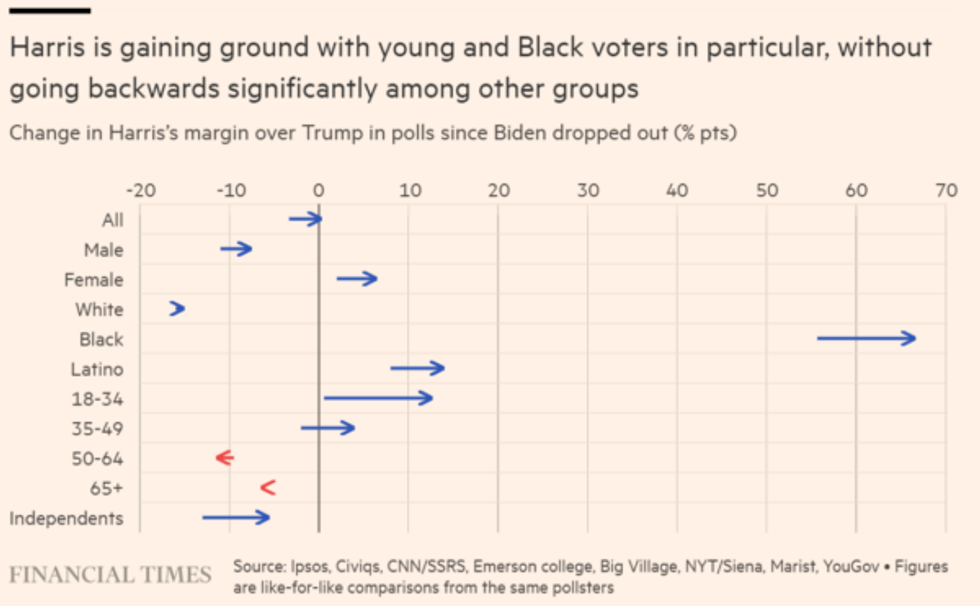 Kamala Harris is gaining ground against Donald Trump with most sub-groups of voters (Financial Times,
  Polling by Kaiser (
