SUBSCRIBE TO OUR FREE NEWSLETTER
Daily news & progressive opinion—funded by the people, not the corporations—delivered straight to your inbox.
5
#000000
#FFFFFF
To donate by check, phone, or other method, see our More Ways to Give page.


Daily news & progressive opinion—funded by the people, not the corporations—delivered straight to your inbox.
That we don't know the answer to this question is the first problem that must be addressed.
So what is the progressive working-class policy when it comes to immigration?
I don’t know the answer and neither does anyone else, because there isn’t one. Why is that?
To date there has been no serious effort to bring together the leaders of labor unions and immigrant workers centers to discuss common approaches to immigration that speak to the needs of all working people.
Further, and perhaps even more importantly, there has been no sustained educational dialogue at the local level that brings together immigrant and non-immigrant workers to discuss their hopes, fears, and desires.
To be sure there are widely shared negative positions: Opposition to separating immigrant families; opposition to creating mass detention centers; and opposition to forcibly expelling undocumented workers who are working hard and obeying the law. But there is no broad-based discussion, let alone agreement, on what a progressive working-class policy should include.
This is a disaster for progressive politics. For without addressing what is perceived widely as an immigration crisis, the field is left open to demagogues who want to divide and exploit workers for political gain.
There are several proactive and positive avenues to developing new progressive immigration policies. The first is the need to rebuild Latin American economies so that residents of those countries can find secure and sustainable employment near home. As one labor leader told me last week, we need an immediate multibillion-dollar Marshall Plan for these countries so that their people do not need to risk life and limb to come to the U.S. for incredibly low-wage jobs.
Unless a working-class approach to immigration is developed, progressive politics will become increasingly alienated from working people, and the right will make greater and greater inroads into the working class by promoting a politics of fear and resentment.
Making these changes is a tall order, but the root cause of the migrant crisis needs to be identified and discussed again and again. People are fleeing violence, dictatorships, and collapsing economies that U.S. financial assistance can help to rectify, and one could argue, that Wall Street’s wealth extraction and U.S. foreign policy maneuvers helped to create.
There is also reason to believe that non-immigrant workers increasingly support a path to citizenship for undocumented workers. In researching my book, Wall Street’s War on Workers, we uncovered a remarkable change in the attitudes of white members of the working class.
The Cooperative Elections Study, which has over one-half million respondents, asked the following highly charged question on immigration in 2010 and again in 2020:
“Do you favor or oppose granting legal status to all illegal immigrants who have held jobs and paid taxes for at least three years, and not been convicted of any felony crimes?”
In 2010, only 32.1 percent supported granting such legal status. By 2020, those who favored a pathway to legal status jumped to a remarkable 61.8 percent.
These working-class respondents, however, also want more enforcement on the border. In 2020, 72.6 percent were in favor of “increasing the number of border patrols on the U.S.- Mexican border.” This is a 5 percent increase compared to those who supported this statement in 2010.
Working people who are citizens want to see a fair and just path forward for the millions of law-abiding undocumented immigrants who are already here. But they don’t want open borders or mass unauthorized immigration.
This is not just a white worker phenomenon. Hispanic voters also seem to support a firmly policed border. That can be deduced from the enormous change in voting patterns in South Texas. Among 14 mostly Hispanic counties, Trump won 12. In 2016 he won only five. And Trump, to be sure, in the last campaign increased his focus on stopping the flow of immigrants even while threatening to deport all undocumented workers.
In the 1990s, the Labor Institute—which I direct—conducted dozens of workshops that brought together environmentalists and oil and chemical workers to discuss climate change and the regulatory elimination of toxic substances. The workshops created an educational base in both groups for the idea of Just Transition, a set of policies to help workers and communities deal with the job dislocation that was likely to result from efforts to reduce toxic chemical production and the use of fossil fuels. It also led to new organizations that brought together workers and community members, such as the Just Transition Alliance and the BlueGreen Alliance.
A similar model should be created today bringing together immigrant and non-immigrant workers in joint workshops to share with each other their concerns and hopes, and to discuss joint policies on immigrant reform.
If ever there was a time to start an on-going dialogue, this is it.
There’s no guarantee that such an educational model will, on its own, produce progressive working-class immigration policies. But it is highly doubtful that a new common direction can be built without listening to rank-and-file immigrant and non-immigrant workers. Workshops can provide a safe and productive space to frankly consider and evaluate alternatives.
One thing is certain. Unless a working-class approach to immigration is developed, progressive politics will become increasingly alienated from working people, and the right will make greater and greater inroads into the working class by promoting a politics of fear and resentment.
If ever there was a time to start an on-going dialogue, this is it. Not doing so would be just another sign that progressives are writing off the working class.
"If the work that Annunciation House conducts is illegal—so too is the work of our local hospitals, schools, and food banks," said the nonprofit organization.
A faith-based migrant aid organization that's operated in El Paso, Texas for nearly five decades said Wednesday that Republican Attorney General Ken Paxton ordered it to turn over documents about its work earlier this month—but that a lawsuit filed by Paxton has now made clear that his true goal is to shut down the group's network of shelters.
Annunciation House, which provides food and housing for refugees and undocumented immigrants, received an order from the Consumer Protection Division of Paxton's office on February 7, demanding that it turn over documents including legal service referrals, identifying information about asylum-seekers and migrants the group helped, and applications for federal funding. The organization was given one day to turn over the documents, and Paxton provided no explanation for the demand.
A request for an extension was denied by the state, and Annunciation House asked a court for a restraining order to grant it more time, as well as requesting that the court rule on which documents it had to hand over.
On Tuesday, Paxton announced he was suing Annunciation House, saying that given the group's "flagrant failure" to turn over the documents, his office "may terminate the business's right to operate in Texas."
"The [Office of the Attorney General] lawsuit seeks to revoke Annunciation House's authorization to do business in Texas and asks the court to appoint a receiver to liquidate their assets," said Paxton.
Annunciation House said that Paxton's statement made clear that his "real goal is not records but to shut down the organization," adding that the attorney general's office "has stated that it considers it a crime for a Catholic organization to provide shelter to refugees."
The group noted that "there is nothing illegal about asking a court to decide a person's rights," as it did following the February 7 request, and pointed out that public services across the country also provide aid to migrants and refugees.
"The attorney general's illegal, immoral and anti-faith position to shut down Annunciation House is unfounded," said the group. "Annunciation House has provided hospitality to hundreds of thousands of refugees for over 46 years... Annunciation House's response to the stranger is no different from that of the schools who enroll children of refugees, the clinics and hospitals who care for the needs of refugees, and the churches, synagogues, and mosques who welcome families to join in worship."
"If the work that Annunciation House conducts is illegal—so too is the work of our local hospitals, schools, and food banks," said the group.
Despite the organization's well-established record of helping to ensure refugees have temporary housing—work that it said "helps serve our local businesses, our city, and immigration officials" as well as Annunciation House's guests themselves, Paxton suggested the group's officials are "worsening illegal immigration" and facilitating human smuggling.
"The Office of the Attorney General (OAG) reviewed significant public record information strongly suggesting Annunciation House is engaged in legal violations such as facilitating illegal entry to the United States, alien harboring, human smuggling, and operating a stash house," Paxton claimed.
Jerome Wesevich, a lawyer with Texas Rio Grande Legal Aid, which is representing Annunciation House, expressed shock at the "aggressive" tone of Paxton's rhetoric about the nonprofit.
"These are church ladies," Wesevich told The Texas Tribune of the volunteers who help run Annunciation House's shelters. "He's using documents as an excuse to shut down a religious organization he doesn't agree with."
Paxton's lawsuit and threat to shut down the group follow the Texas government's attempt to circumvent federal immigration law by erecting a razor wire fence to keep migrants from crossing the U.S.-Mexico border. The state government has accused the Biden administration of perpetuating chaos and "lawlessness" at the border.
Aaron Reichlin-Melnick, policy director of the American Immigration Council, called Paxton's lawsuit "a massive escalation in Texas' war on the federal government and on people of faith who feel called by God to support the stranger."
"There are people of faith around the country, who believe that they are putting the teachings of the Bible (or other religious books) practice by providing services to migrants," said Reichlin-Melnick. "Paxton's lawsuit should send a shiver down the spine of every faith-based nonprofit in the state."
Before shelters like Annunciation House began working in conjunction with the federal government in 2020, he added, the Border Patrol and Immigration and Customs Enforcement "would just dump migrants off at the bus station after they were released from custody. It was a chaotic mess."
"I was in El Paso in 2018 and at Annunciation House itself, and saw the Border Patrol dropping off migrants there to ensure they had a place to sleep for the night," he added. "If even [the Department of Homeland Security] under the Trump administration thought they were a valuable partner, that tells you how far off base Paxton is."
A hearing on both Annunciation House's request for clarification about what documents it needs to turn over and about Paxton's call for Texas to revoke the nonprofit's registration in the state is set to take place "at some point before March 7," Wesevich told The Texas Tribune.
"Within a badly broken immigration system, the humanitarian assistance provided by Annunciation House is one of the few things that works well," said former U.S. Rep. Beto O'Rourke, a Democrat. "We in El Paso stand with the faith leaders and volunteers who lead this work and make us proud to call this border community our home."
"When you have no record of accomplishment to run on... this is what you do," said one Texas Democrat. "You put on a circus."
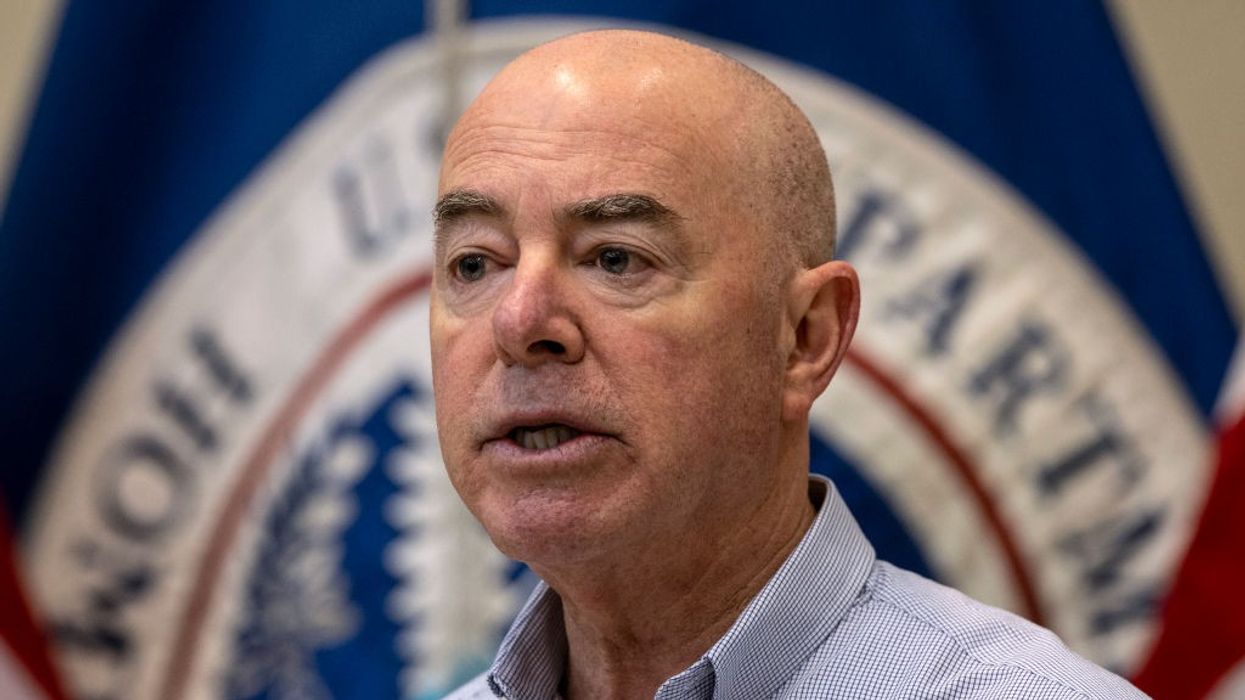
In what congressional Democrats blasted as yet another example of right-wingers in the U.S. House of Representatives creating "chaos" because they "simply can't govern," 214 Republicans voted Tuesday to impeach Homeland Security Secretary Alejandro Mayorkas.
Three Republicans—Reps. Ken Buck (Colo.), Mike Gallagher (Wis.), and Tom McClintock (Calif.)—joined all 210 Democrats present in voting against impeaching Mayorkas for his handling of immigration at the southern U.S. border. Two members of each party did not vote.
Democratic President Joe Biden, who is seeking reelection in November, said in a lengthy statement after the vote that "history will not look kindly on House Republicans for their blatant act of unconstitutional partisanship that has targeted an honorable public servant in order to play petty political games."
Congressional Progressive Caucus Chair Pramila Jayapal (D-Wash.) declared that "the 'do-nothing' Republican Party continues to waste time and resources that could be spent working for the American people on baseless, partisan attacks of Biden administration officials as they take up this sham impeachment vote of Secretary Mayorkas."
Jayapal noted that Tuesday's vote came after a failed attempt last week, when only House Majority Leader Steve Scalise (R-La.) was absent and Rep. Blake Moore (R-Utah) voted with the three Republicans and 212 Democrats who opposed impeaching Mayorkas.
"There is no question that the immigration system is broken—and what the American people want and deserve is an orderly and humane system that properly processes people and modernizes an outdated immigration system that has not been updated in over 30 years to reflect for the needs of our American economy, communities, and families," she said.
As The New York Times summarized earlier this month:
The first article of impeachment accuses Mr. Mayorkas of refusing to enforce a law that mandates the detention of migrants who lack authorization to enter the United States, and of exceeding his authority to parole those people into the country, allowing them to live and work temporarily while they wait for their immigration claims to be processed.
The second article accuses the secretary of breaching the public trust by misrepresenting the state of the border to lawmakers and hampering the Republican-led investigation into his conduct.
Congressman Joaquin Castro (D-Texas) took to the House floor to condemn the impeachment as a "sham."
"When you have no record of accomplishment to run on... this is what you do," he said. "You put on a circus."
The only other Cabinet member to ever be impeached was William Belknap, who resigned as secretary of war just before the vote in 1876. According to Time, "The Senate went forward with the trial anyway, but fell short of the two-thirds majority needed to convict."
In 2024, the Senate is narrowly controlled by Democrats, and as The Associated Press noted Tuesday, "neither Democratic nor Republican senators have shown interest in the matter and it may be indefinitely shelved to a committee."
Senate Majority Leader Chuck Schumer (D-N.Y.) said in a statement that Mayorkas' impeachment is an attempt by House Speaker Mike Johnson (R-La.) "to further appease" former President Donald Trump—the GOP presidential front-runner who has pressured congressional Republicans to abandon their battle for new border policies so he can campaign on limiting immigration.
"This sham impeachment effort is another embarrassment for House Republicans," said Schumer. "House Republicans failed to produce any evidence that Secretary Mayorkas has committed any crime. House Republicans failed to show he has violated the Constitution."
"House Republicans failed to present any evidence of anything resembling an impeachable offense," he added. "This is a new low for House Republicans."
"Our State Guard is not the governor's personal army," said one former Florida lawmaker.
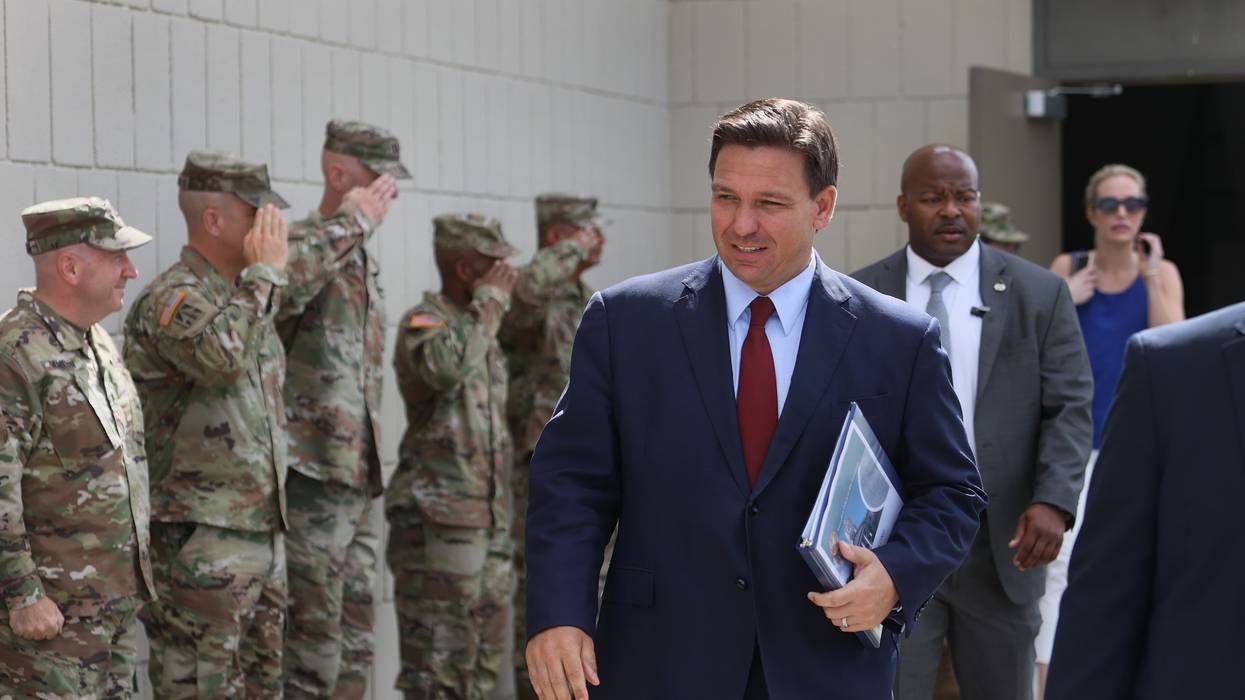
Flanked by several dozen uniformed members of Florida's State Guard and standing behind a podium displaying the words "Stop the Invasion," Republican Gov. Ron DeSantis on Thursday announced a plan to send the civilian force and other resources to Texas, where Gov. Greg Abbott's administration has been embroiled in a standoff with the White House over the U.S-Mexico border.
DeSantis said the State Guard, which he has grown over the last two years and transformed from a volunteer force meant to help citizens after hurricanes and other disasters into a militia with combat training, will deploy to Texas to help "fortify this border, help them strengthen the barricades, help them add barriers, help them add the wire that they need so that we can stop this invasion once and for all."
The governor also said he will send a battalion of the Florida National Guard to Texas.
Abbott in recent days has directed the Texas National Guard to continue putting up razor wire at the U.S.-Mexico border, following a U.S. Supreme Court ruling that allowed the Biden administration to remove the wire.
DeSantis said members of the State Guard would be sent to Texas soon under the Emergency Management Assistance Compact, a partnership between all state governments which allows Texas to give guardsmen deployed from Florida "the same arrest and law enforcement powers, right, and privileges while operating within the state limits of Texas as ordinarily afforded to law enforcement forces for the State of Texas."
The announcement came as 25 state chapters of the ACLU condemned Abbott's escalation and the support the Texas governor is getting from other Republican "enablers," including DeSantis.
"Our governors are embracing Gov. Abbott's xenophobic rhetoric and putting communities of color and immigrants in danger instead of working to improve quality of life in our states," said the ACLU chapters. "This is not standing up for our communities; it is standing against them."
The Florida governor, who ended his campaign to be the Republican presidential nominee last month, has previously sent the Florida National Guard and highway troopers to the Texas border, but the State Guard deployment marks the first time the force will be deployed outside the state.
Florida Democratic Party Chair Nikki Fried said the planned deployment was "a massive waste of resources that distracts from delivering results for Floridians" and a case of DeSantis "screaming from the sidelines for attention."
"What happened to focusing on Florida?" said Fried. "As Ron limps back to his mansion as America's biggest loser, he's desperate to grab headlines and get 'wins' on the board... This latest attempt to insert himself in the national conversation is just another political stunt with a heavy price tag for taxpayers."
Fried called on DeSantis to focus on Florida's homeowners' insurance crisis, in which insurers are raising rates partially due to the intensifying climate risks they face.
"Instead of using this legislative session to address the property insurance crisis, Ron and his Republican supermajority are back to their old tricks," said Fried. "Floridians deserve better."
As The Miami Herald reported Thursday, the Florida State Guard was originally a 200-member World War II-era force created to "pass out water bottles and other supplies after emergencies within Florida." Under DeSantis, the force has grown to 1,500 members who "wear camouflaged uniforms and are referred to as 'soldiers'" instead of deploying in "polo shirts and khakis."
DeSantis got approval from the legislature last year to deploy the State Guard for out-of-state emergencies and sent a select group to a combat training facility, as well as pouring $100 million into the force for new planes and boats.
The governor's announcement on Thursday was "exactly" what one lawmaker, state Rep. Dan Daley (D-97), was concerned DeSantis would ultimately use the State Guard for.
Members of the force are "being used as pawns in a national political game," said Daley.
"Our State Guard is not the governor's personal army and they've NEVER been sent outside Florida," added activist and former Florida lawmaker Carlos Guillermo Smith. "This is out of control."
"The idea that 5,000 or even 10,000 people might overwhelm us trivializes both what our government is capable of and our nation's capacity to welcome. Those of us living at the border know this," said one El Paso-based advocate.
Progressives on Saturday urged U.S. President Joe Biden to halt his immigration-related appeals to "a voter who doesn't exist" as he promised voters at a campaign event in South Carolina that he would immediately "shut down the border" between the U.S. and Mexico if Congress passes a bipartisan immigration bill.
Senators are expected to release the legislative text of the bill this week, but Capitol Hill sources have said the bipartisan deal—negotiated chiefly by Sens. Chris Murphy (D-Conn.), Kyrsten Sinema (I-Ariz.), and James Lankford (R-Okla.)—would include a new executive authority to halt asylum screenings on days when border crossings by undocumented immigrants reaches 5,000 over the five-day average.
Under the provision, migrants would be expelled indefinitely until crossings decreased to 3,750 per day. A set amount of asylum claims would be granted at official ports of entry, but the standard for migrants making an asylum claim would be raised, making it harder for people—many of whom have been arriving at the border after fleeing violence and poverty—to get approval to stay in the United States.
"A bipartisan bill would be good for America and help fix our broken immigration system and allow speedy access for those who deserve to be here, and Congress needs to get it done," Biden said in South Carolina, a day after the White House released a written statement on the legislation. "It'll also give me as president the emergency authority to shut down the border until it could get back under control. If that bill were the law today, I'd shut down the border right now and fix it quickly."
Immigrant rights advocates were quick to denounce Biden's promise to eliminate asylum protections for thousands of people, while U.S. House Speaker Mike Johnson (R-La.) said the bill would be "dead on arrival" if it arrives on the House floor and demanded that Biden close the border immediately with his executive authority—something Biden cannot do under federal and international law, said American Immigration Council (AIC) policy director Aaron Reichlin-Melnick.
Although Republicans have insisted on border restrictions in exchange for more military aid for Ukraine and Israel, Oklahoma Republicans passed a resolution condemning Lankford for working with Democrats on the deal.
Johnson complained that the deal would allow "as many as 150,000 illegal crossings each month (1.8 million per year) before any new 'shutdown' authority could be used. At that point, America will have already been surrendered."
"How weak do you have to think the USA is if you're claiming that adding 1.8 million undocumented immigrants a year would "surrender" the nation?" asked Reichlin-Melnick.
Meanwhile, Eleanor Acer, refugee protection director for Human Rights First, warned that former Republican President Donald Trump's anti-migration Title 42 policy already proved to "be a human rights and migration management fiasco."
The U.S. turned away migrants under Title 42 more than 2.8 million times between March 2020—when it was imposed as the coronavirus pandemic began, ostensibly to protect public health—and May 2023. Human Rights First tracked more than 10,000 cases of migrants being kidnapped or physically or sexually assaulted after being expelled under Biden's continuation of Title 42 after he took office. The Kaiser Family Foundation also reported that the policy contributed to the separation of families.
"There are real challenges at the border, and now is the moment that we need our leaders to move forward effective policy solutions that will improve port processing, support communities receiving migrants, and create lawful pathways to citizenship for Dreamers and others," said Deirdre Schifeling, chief political and advocacy officer at the ACLU, on Saturday. "But let's be clear: Cruelty is not a policy solution—and barring people from seeking protection is both callous and unworkable."
"We've already had an expulsion authority before—Title 42—and we know that it did not stop people from coming to the U.S.," added Schifeling. "Instead, we saw record numbers of families and individuals arriving at our border seeking protection, and Title 42 caused tremendous harm to people fleeing danger."
Marisa Limón Garza, executive director of Las Americas Immigrant Advocacy Center in El Paso, Texas, accused Biden of playing "political games" and demanded that he keep his campaign promises to "restore a humane and orderly asylum and immigration system."
"The idea that 5,000 or even 10,000 people might overwhelm us trivializes both what our government is capable of and our nation's capacity to welcome. Those of us living at the border know this," said Limón Garza. "One's commitment to their children is a powerful force that drives parents and children to seek a better life in the U.S... Here in the Borderland we believe in supporting families and keeping them together, not turning our backs on them or tearing them apart.
“We call on Congress and the Biden administration to reverse course and turn away from the political games that drive us toward these reckless immigration proposals," she added.
Author and historian Dan Berger compared Biden's push for new anti-immigration authority to his enthusiasm for a "tough on crime" approach by the Democratic Party three decades ago.
Biden has "won no one over" with his statements on immigration since Friday, said author and podcaster Kate Willett. "It's cruelty for recreation."
In the wake of Donald Trump, everything on the border has officially changed, yet nothing has really changed. Nothing of note is happening, even as everything happens.
On May 11th, I was with a group of people at the bottom of the Paso del Norte bridge in Ciudad Juárez, Mexico. Suddenly, I realized that I didn’t have the small change needed to cross the bridge and return to El Paso, Texas, where I was attending the 16th annual Border Security Expo. Worse yet, this was just three hours before Title 42, the pandemic-era rapid-expulsion border policy instituted by the Trump administration, was set to expire. The media was already in overdrive on the subject, producing apocalyptic scenarios like one in the New York Post reporting that “hordes” of “illegals” were on their way toward the border.
While I searched for those coins, a woman approached me, dug 35 cents out of a small purse — precisely what it cost! — and handed the change to me. She then did so for the others in our group. When I pulled a 20-peso bill from my wallet to repay her, she kept her fist clenched and wouldn’t accept the money.
Having lived, reported, and traveled in Latin America for more than two decades, such generosity didn’t entirely surprise me, though it did contradict so much of the media-generated hype about what was going on at this historic border moment. Since Joe Biden took office in 2021, the pressure on his administration to rescind Trump’s Title 42 had only grown. Now, it was finally going to happen — and hell was on the horizon.
But at that expo in El Paso that brought together top brass from the Department of Homeland Security (DHS), its border and immigration enforcement agencies, and private industry, I was learning that preparations for such a shift had been underway for years and — don’t be shocked! — the corporations attending planned to profit from it in a big-time fashion.
Seeing the phase-out of Title 42 through the lens of a growing border-industrial complex proved grimly illuminating. Border officials and industry representatives continued to insist that just on the other side of the border was a world of “cartels,” “adversaries,” and “criminals,” including, undoubtedly, this woman forcing change on me. By then, I had heard all too many warnings that, were the United States to let its guard down, however briefly, there would be an infernal “border surge.”
As I later stood in the halls of that expo, however, I became aware of another type of surge not being discussed either there or in the media. And I’m not just thinking about the extra members of the National Guard and other forces the Biden administration and Texas Governor Greg Abbott only recently sent to that very border. What I have in mind is the surge of ever higher budgets and record numbers of Customs and Border Protection (CBP) and U.S. Immigration and Customs Enforcement (ICE) contracts guaranteed to ensure that those borderlands will remain one of the most militarized and surveilled places on planet Earth.
Robo-Dogs at the Expo
Earlier that day, I found myself standing in front of the Ghost Robotics booth. There sat a vendor and, in front of him, a chrome-colored robotic dog on a puke-green carpet. Behind him, a large sign said: “Robots that Feel the World.” He was explaining to prospective customers that the robo-dog could run at a pace of up to nine miles an hour. A vendor in the adjacent booth, Persistent Systems, that claimed to connect “soldiers, sensors, unmanned systems, and cameras in a dynamic network,” was not impressed. (Those, by the way, were but two of nearly 200 companies in that large exhibition hall.). He said, “I’ll take my dog any day,” meaning his living and breathing dog.
The Ghost Robotics vendor responded earnestly, “We are not going to replace dogs!”
All around us, well-dressed corporate types, uniformed Border Patrol agents, and other police officials wandered the aisles, looking at retractable tower masts, taser demonstrations, Glock guns, and facial recognition and iris scanners, part of a border industry that’s been in a state of constant growth for two decades.
Honestly, walking through that exhibition hall was like being in a science-fiction novel that had come to life or perhaps a crystal ball for our border future. The Israel Aerospace Industries banner hovered on the rafters praising a company “Where Courage Meets Technology.” On the ground, the company highlighted its MegaPop high-powered surveillance camera.
The slogan of Tower Solutions, which sells body armor, was more typically down to earth (or do I mean sky-high?): “Speed, Strength, Stability, Elevated.” Armored Republic, which also sells body armor, offered religious fervor in a banner that said: “In a Republic There’s No King but Christ.” But Anduril, the new border darling — 11 contracts with CBP since 2018 — may have caught the enforcement future most perfectly with its “Autonomy for Border Security” banner. Autonomous sentry towers, autonomous drones, and autonomous robotic dogs were to be the true post-Title 42 future, and the exhibition hall was a crystal ball for such a time to come.
Contemplating the Ghost Robotic guy’s response, the Persistent Systems vendor then pointed at the robo-dog and said, “You can weaponize those things and they can go into barracks and blow a motherfucker’s face off.”
The Ghost Robotics vendor responded, “We’re already doing that.” Did he mean weaponizing robo-dogs or blowing a person’s face off? I had no idea.
The Budget Surge
A few hours earlier, DHS Chief Information Officer Eric Hysen assured industry officials that his agency had the “largest budget ever enacted” in its 20-year history. Formerly a Silicon Valley software engineer and program organizer for Google, he had arrived in Washington in 2014 to work in the Obama White House. The next year, he created a Digital Services Team at DHS and “never looked back.” His technocratic language had no Trumpian bluster or hyperbole. It was grounded in numbers and budgets with a bit of social justice spun in (including a mention of a program to hire more women and assurances that, no matter the invasive surveillance technology DHS was developing, privacy issues were taken quite seriously by the department).
At $29.8 billion, the CBP/ICE portion of the DHS budget he praised was not just the highest ever but a $3 billion jump above 2022, including $2.7 billion for “new acquirements in our southwestern border.” In other words, the coming surge at the border was distinctly budgetary.
For context, when Donald Trump took office in 2017 his CBP/ICE budget was $21.2 billion. By 2020, it had gone up to $25.4 billion. In other words, it took him four years to do what the Biden administration essentially did in one. The last time there had been such a jump was from $9.4 billion in 2005 to $12.4 billion in 2007, including funding for huge projects like the Secure Fence Act that built nearly 650 miles of walls and barriers, SBInet which aimed to build a virtual wall at the border (with special thanks to the Boeing Corporation), and the largest hiring surge ever undertaken by the Border Patrol — 8,000 agents in three years.
But if that’s what $3 billion meant in 2005-2007, what does it mean in 2023 and beyond? Gone was the Trump-era bravado about that “big, beautiful wall.” Hysen’s focus was on the Department of Homeland Security’s launching of an Artificial Intelligence Taskforce. A technocrat, Hysen spoke of harnessing “the power of AI to transform the department’s mission,” assuring the industry audience that “I follow technology very closely and I am more excited by the developments of AI this year than I have been about any technology since the first smartphones.”
That robo-dog in front of me caught the state of the border in 2023 and the trends that went with it perfectly. It could, after all, be controlled by an agent up to 33 miles away, according to the vendor, and apparently could even — thank you, AI — make decisions on its own.
The vendor showed me a video of just how such a dog would work if it were armed. It would use AI technology to find human forms. A red box would form around any human it detects on a tablet screen held by an agent. In other words, I asked, can the dog think?
I had in mind the way Bing’s Chatbox, the AI-powered search engine from Microsoft, had so infamously professed its love for New York Times reporter Kevin Roose. A human, using an Xbox-like controller, the vendor told me, will be able to target a specific person among those the dog detects. “But,” he reassured me, “it’s a human who ultimately pulls the trigger.”
The Title 42 Surge
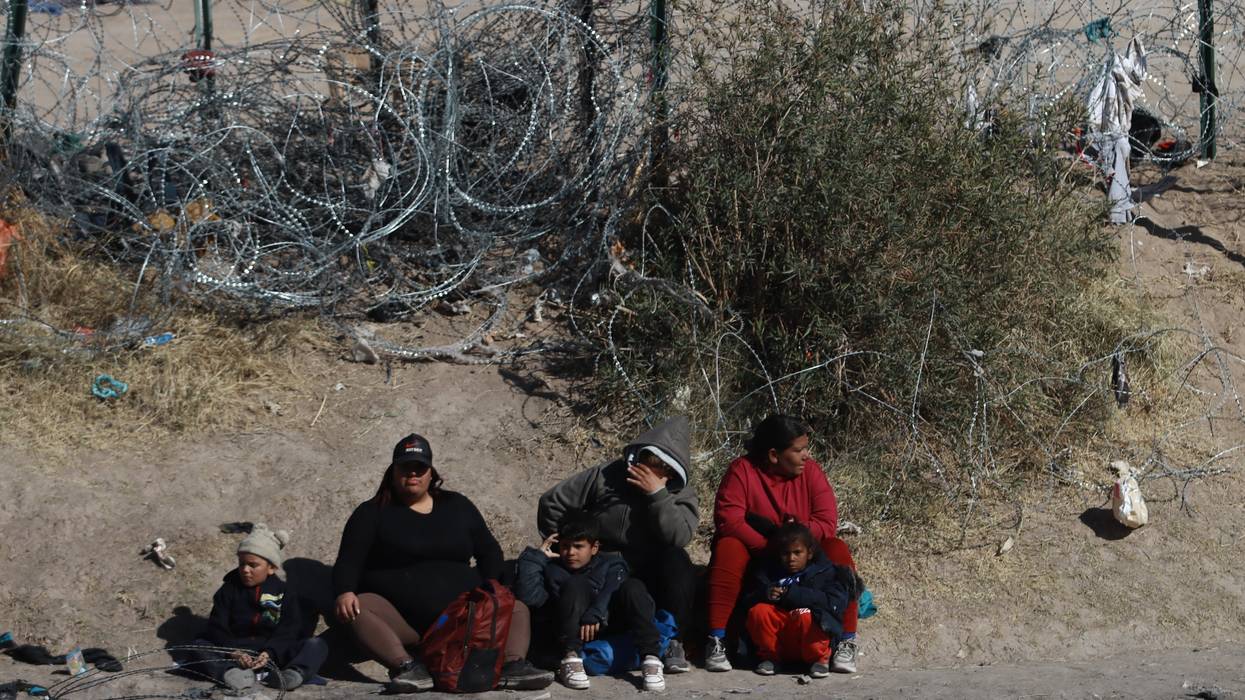
In Mexico, when I walked to a spot where the Rio Grande flowed between the two countries, I ran into a small group of migrants camped out at the side of the road. Near them was a fire filled with charred wood over which a pot was cooking. A pregnant Colombian woman told me they were providing food to other migrants passing by. “Oh,” I asked, “so you sell food?” No, she responded, they gave it away for free. Before they had been camped out for months near the immigration detention center in Ciudad Juárez where a devastating fire in March killed 40 people. Now, they had moved closer to the border. And they were still waiting, still hoping to file applications for asylum themselves.
Behind where they sat, I could see the 20-foot border wall with coiling razor wire on top. There was nothing new about a hyper-militarized border here. After all, the El Paso build-up had begun 30 years ago with Operation Hold the Line in 1993. A desert camo Humvee sat below the wall on the U.S. side and a couple of figures (Border Patrol? National Guard?) stood at the edge of the Rio Grande shouting to a Mexican federal police agent on the other side.
The clock for the supposed Title 42 Armageddon was ticking down as I then crossed the bridge back to El Paso, where more barriers of razor wire had only recently been emplaced. There was also a slew of blue-uniformed CBP agents and several jeeps carrying camouflaged members of border units. Everyone was heavily armed as if about to go into battle.
At the Border Security Expo, Hysen pointed out that fear of a Title 42 surge had resulted in an even more fortified border, hard as that might be to imagine. Fifteen hundred National Guard troops had been added to the 2,500 already there, along with 2,000 extra private security personnel, and more than 1,000 volunteers from other agencies. Basically, he insisted, they had everything more than under control, whatever the media was saying.
At another panel entitled “State of the Border,” Border Patrol Chief Raul Ortiz joked that he would prefer discussing his golf game, only reinforcing that by adding, “As all of America and the political pundits and the reporters run around and say when we lose Title 42 the sky is going to fall, it ain’t gonna fall. We will process people as we normally have during my 32-year career.”
As Department of Homeland Security Secretary Alejandro Mayorkas similarly pointed out, Title 8 authority, the pre-Title 42 enforcement program to which DHS will now return, “carries stiff consequences for irregular migration, including at least a five-year ban on reentry and potential criminal prosecution for repeated attempts to cross unlawfully.” In addition, the Biden administration expects to aggressively expand the process, including implementing a plan to ramp up enforcement far south of the border in the Darién Gap between Colombia and Panama. It’s even possible that U.S. troops will be deployed there for the job. And in a repetitive note at that expo, American officials indicated in a variety of ways that help would, above all, be needed from the corporate world.
Biden Is Already Out-Trumping Trump at the Border
Since the Department of Homeland Security was established 20 years ago, Customs and Border Protection and Immigration and Customs Enforcement have given private companies 113,276 contracts (yes, you read that right!), or on average 5,664 contracts annually, 16 per day. In the 15 years since 2008, the money spent on such contracts has amounted to $72.6 billion dollars and such figures have only been on the rise since Joe Biden entered the White House.
The 4,465 contracts CBP and ICE have agreed to so far this year (at a price of $4.1 billion) put them on pace to surpass 2022’s record-setting $7.5 billion. In 2022, CBP and ICE offered 9,909 contracts, an average of 27 per day, all of which means the Biden administration is likely to be the largest border-enforcement contractor ever.
Only recently, New York Times columnist Thomas Friedman suggested that President Biden should “out-Trump Trump” and “do everything possible to secure the border like never before — more walls, more fences, more barriers, more troops, the 82nd Airborne — whatever it takes. Make Democrats own border security.” What Friedman apparently didn’t realize was that Biden had already taken just that border path.
From his first days in office, the president had stressed technology over wall-building and (not surprisingly) received three times more campaign contributions from top companies in the border industry than Trump did in 2020. And unlike the former president’s Title 42, this policy of contracts, campaign contributions, and lobbying that will push for endlessly higher border budgets is not set to expire. Ever.
At the Edge of Everything — and Nothing At All
On the morning of May 12th, I was with border scholar Gabriella Sanchez at the very spot where the borders of Texas, New Mexico, and Chihuahua meet near El Paso. Title 42 had expired the night before and I asked her what she thought. She responded that she considered this the border norm: we’re regularly told something momentous and possibly terrible is going to happen and then nothing much happens at all.
And she was right, the predicted “surge” of migrants crossing the border actually decreased — and yet, in some sense, everything keeps happening in ways that only seem grimmer. Perhaps 100 yards from where we were standing, in fact, we soon noticed a lone man cross the international boundary and walk into the United States as if he were taking a morning stroll. Thirty seconds later, a truck sped past us kicking up gravel. For a moment, I thought it was just a coincidence, since it wasn’t an official Border Patrol vehicle.
Then, I noted an insignia on its side that included the U.S. and Mexican flags. The truck came to a skidding stop by the man. A rotund figure in a gray uniform jumped out and ran toward him while he raised his hands. Just then, a green-striped Border Patrol van also pulled up. I was surprised — though after that Border Security Expo I shouldn’t have been — when I realized that the initial arrest was being made by someone seemingly from a private security firm. (Remember, Hysen said that an extra 2,000 private security agents had been hired for the “surge.”)
In truth, that scene couldn’t have been more banal. You might have seen it on any May 12th in these years. That banality, by the way, included a sustained violence that’s intrinsically part of the modern border system, as geographer Reece Jones argues in his book Violent Borders: Refugees and the Right to Move. In the days following Title 42’s demise, an eight-year-old Honduran girl died in Border Patrol custody and a Tohono O’odham man was shot and killed by the Border Patrol. In April, 11 remains of dead border crossers were also recovered in Arizona’s Pima County desert alone (where it’s impossible to carry enough water for such a long trek).
In the wake of Donald Trump, everything on the border has officially changed, yet nothing has really changed. Nothing of note is happening, even as everything happens. And as Hysen said at that border expo meeting, big as the record 2023 border budget may be, in 2024 it’s likely to go “even further” into the stratosphere.
Put another way, at the border, we are eternally at the edge of everything — and nothing at all.
"We're going to do the wall," Donald Trump told a cheering crowd of supporters in a victory speech following the South Carolina Republican primary. He was reiterating his fanciful promise to wall off the entire U.S.-Mexico border -- and force Mexico to pay for it.
Never mind whether even Trump believes there's a chance this cornerstone of his stump speech will happen. It's the thinking behind it that's majorly flawed.
This simplistic, right-wing logic turns the victims of social problems into the perpetrators. It seeks to inflict punishment even when it won't fix anything.
Take, for example, the issue of undocumented immigration.
To Trump and his supporters, the problem is the people who cross the U.S.-Mexico border without papers. The solution is a wall. The result, they say, will be more jobs for Americans.
Sorry, it's not that simple.
First of all, Mexicans make up a little under half of undocumented immigrants -- a number that's declining. More Mexicans are leaving the United States than entering these days.
Second, two out of five undocumented immigrants came here legally as visitors and then overstayed their visas. A wall won't keep them out.
Finally, consider the jobs that undocumented workers do: They're farmworkers, slaughterhouse workers, dishwashers, house cleaners, landscapers, and so on.
For each low-wage, exploitative job, there are winners and losers.
The loser is often the immigrant doing backbreaking work for below minimum wage and without legally required labor protections. The winners are those who profit: employers, their shareholders, and consumers who buy cheap goods produced by low-wage workers.
If you eat food in this country -- unless you grow it yourself or you're on a first-name basis with the farmer who does -- you've personally benefited from undocumented immigrant labor.
Americans pay a lower share of our disposable income for food than any other nation. One reason for that is the exploitation of undocumented labor on farms and in slaughterhouses.
When Georgia and Alabama enacted strict anti-immigrant measures a few years ago, farmers in both states had crops rotting in their fields because there was no one to harvest them. Georgia turned to prison labor to fill the labor gap left by immigrants.
In other words, when undocumented labor was out of the picture, legal U.S. residents were unwilling to take the farm jobs that were left vacant voluntarily. Not for the working conditions and the wages being offered.
Is there a problem here? You bet. Will a wall fix it? Not a chance. What is the cause of the problem of undocumented immigrants? Hardly.
Undocumented immigrants are simply pawns in a more extensive system. We all are. Like everyone else, they're looking for jobs to raise their families and improve their lives.
Why do they come here illegally? For one thing, our immigration laws are fundamentally unrealistic. For Mexicans, coming to the United States legally can mean waiting for upwards of 20 years.
Moreover, Trump's "plan" (if you can call it that) won't address what's driving people out of Mexico itself, such as historically high rates of murder, extortion, kidnapping, and other crimes tied to drug trafficking.
Can we change our trade and drug policies in ways that make life easier in Mexico? Can we change our laws so employers become more apt to provide good jobs to immigrants and non-immigrants?
Maybe. But we can't do any of that with a wall.
The question shouldn't be "Who are the bad guys and how can we punish them?" It must be "What's the problem and how can we solve it?"