
SUBSCRIBE TO OUR FREE NEWSLETTER
Daily news & progressive opinion—funded by the people, not the corporations—delivered straight to your inbox.
5
#000000
#FFFFFF
To donate by check, phone, or other method, see our More Ways to Give page.


Daily news & progressive opinion—funded by the people, not the corporations—delivered straight to your inbox.
The release of Leonard Peltier after nearly half a century in prison offers a chance for a reflection on the nature of justice and how we treat each other.
“...I write today from a position rare for a former prosecutor: to beseech you to commute the sentence of a man I helped put behind bars.”
Thus begins one of the most stunning letters I have ever read, written almost four years ago by former U.S. Attorney James H. Reynolds to then-President Joe Biden, pleading with him to exonerate former American Indian Movement (AIM) leader Leonard Peltier, who had been convicted of murdering two FBI agents at South Dakota’s Pine Ridge Reservation in 1975.
In one of his last acts before leaving office, Biden did so: freeing Peltier, now 80 years old and beset with health problems, after nearly half a century in federal prison, allowing him to serve the rest of his sentence—lifetime imprisonment—from the Chippewa reservation in North Dakota that is his home. Peltier was released from prison on February 18.
Hey, big news—kind of. Much of the mainstream coverage has been careful to present it as simply a kind-hearted act by the U.S. Department of Justice, allowing an elderly, convicted murderer to spend his final years under home incarceration. It has downplayed not only the serious flaws in the case against Peltier and the worldwide demands for his release—from Amnesty International, from Pope Francis, from Nelson Mandela, and so many others—it has avoided any mention of the larger context: that white America has long been at war with the continent’s Native population, taking their land and attempting to obliterate their culture, essentially declaring them to be subhuman.
For that reason, the fact that Reynolds’ letter is now poking itself into the present news cycle is utterly mind-boggling.
The Pine Ridge shootings occurred on June 26, 1975, when two FBI agents entered the reservation to arrest a resident for stealing a pair of cowboy boots. According to Peltier-supporters’ account, the agents entered private property without identifying themselves. Many AIM members happened to be present at the time. A shootout took place—the reason uncertain—and the two agents, along with a Pine Ridge resident, were killed. The reservation was soon surrounded by about 150 police and FBI officers. Peltier, a Native rights activist, was among those arrested and eventually became the focal point of the government’s case.
Reynolds’ letter to Biden continues: “Leonard Peltier’s conviction and continued incarceration is a testament to a time and a system of justice that no longer has a place in our society. I have been fortunate enough to see this country and its prevailing attitudes about Native Americans, progress dramatically over the last 46 years.”
He then goes into detail about the case itself, explaining: “We were not able to prove that Mr. Peltier personally committed any offense on the Pine Ridge Reservation. As a result, we shifted our stance on the theories of guilt throughout the prosecution and appeal.”
Ultimately, the entirety of the case against Peltier, he writes, was that he was present at the reservation and was in possession of a weapon. There was no evidence that he shot the agents—or evidence against anyone else at the reservation. Indeed, The Guardian, writing about the case, notes that a witness who testified that she saw Peltier shoot the agents “later said she had been coerced into testifying and recanted her testimony.”
All of which sets the context for the largest point Reynolds makes to Biden, transcending the case itself and looking directly at the country’s evolving social consciousness:
“I believe,” he writes, “that a grant of executive clemency would serve the best interests of justice and the best interests of our country. In my opinion, to continue to imprison Mr. Peltier any longer, knowing what we know now, would serve to continue the broken relationship between Native Americans and the government.”
“I urge you to chart a different path in the history of the government’s relationship with its Native people through a show of mercy rather than continued indifference. I urge you to take a step toward healing a wound that I had a part in making. I urge you to commute Leonard Peltier’s sentence and grant him executive clemency.”
All I can do is let these words sit there for a moment. My God, this is a larger look at the nature of justice than I would expect from at actual member of the Department of Justice. Mr. President, let us take action now to begin healing our broken relationship with Native Americans. Let us look at ourselves!
It took Biden several years to take action on Peltier’s incarceration, and it’s not as though Biden’s commutation was also an exoneration—a declaration of his innocence... nor was it an apology for the nation’s, or for Europe’s, five centuries of land theft and cultural dehumanization of Indigenous people of the Americas.
But let me dig for a moment into the words of Peltier himself, who has written an account of how, as a nine-year-old boy, he (along with his sister and a cousin) were taken from their homes and sent off to... uh, boarding school, perhaps more accurately called dehumanization school, the point of which was to take away their language, their culture, their humanity. Upon arrival, the children were stripped naked, forced into hot showers, then “they put DDT all over us. The poison even got in our eyes and mouths.”
The children were told it was to kill lice and other insects—but in reality it was no doubt to eliminate the “Indian” in them. “They made it clear we were hated,” he wrote. “With every look, with every cruel word, they continued a war our ancestors had fought since their ancestors landed here back in 1492.” Some of the kids wound up committing suicide; they were buried in unmarked graves on the school grounds.
Peltier also noted: “We spoke our language. We sang our songs. And we prayed in our languages, all in secret.”
Proof of his guilt—he broke the rules!
He concluded his boarding school memories by writing: “You don’t treat people badly like that. I rise only when I help you rise. Despite all those beatings, I still believe it. It’s a law, like physics, and it’s true. You get nowhere being mean and disrespecting the feelings of others, especially the most vulnerable. I have seen both kinds of people and more than my share of evil ones, and I know I’m right. I rise only when I help you rise.”
This isn’t what the boarding school taught, but apparently this is what he learned. And now, his intention is to teach it to the world.
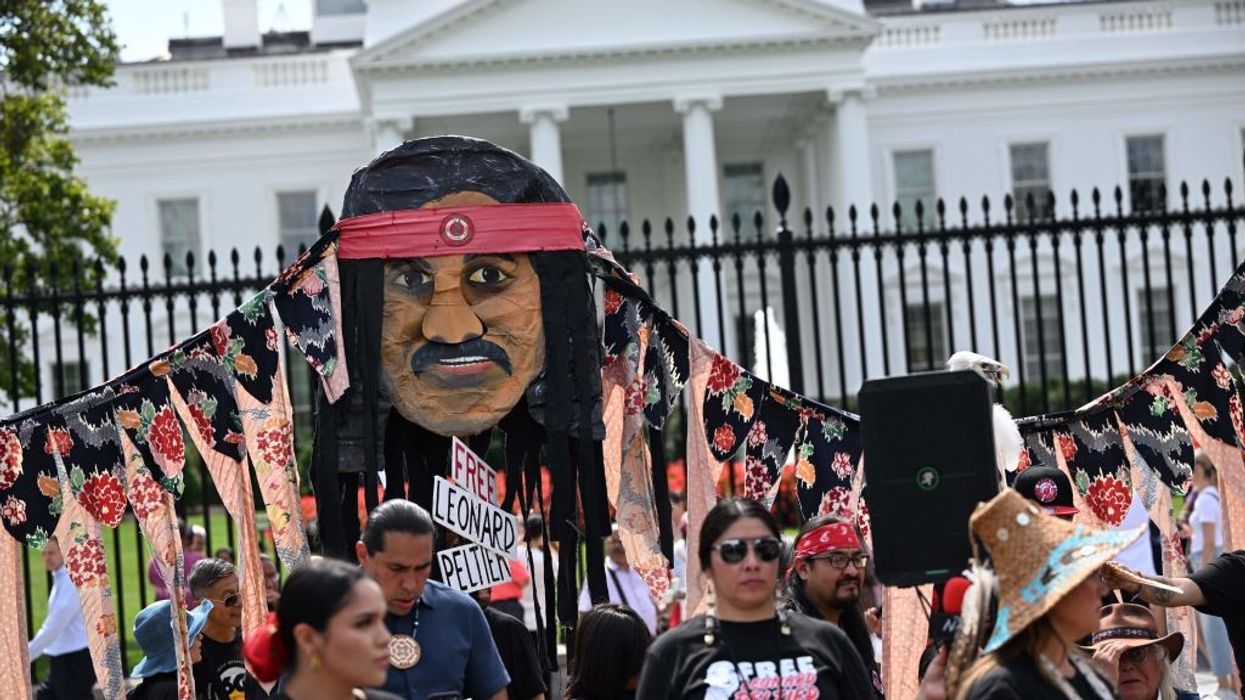
"They may have imprisoned me but they never took my spirit!" said Peltier. "I am finally going home."
Indigenous rights and criminal justice reform advocates on Tuesday celebrated as Native American political activist Leonard Peltier, who has maintained his innocence for nearly 50 years since being sentenced to life in prison for the killing of two FBI agents, walked out of a high-security prison in Florida and headed home to North Dakota.
"Today I am finally free," said Peltier in a statement to the Native news outlet Indianz.com. "They may have imprisoned me but they never took my spirit! Thank you to all my supporters throughout the world who fought for my freedom. I am finally going home. I look forward to seeing my friends, my family, and my community. It's a good day today."
Advocates for Peltier, who is 80 years old, have long called for a presidential pardon and celebrated in January when former President Joe Biden announced he was commuting Peltier's sentence. He will serve out the rest of his sentence in home confinement.
Nick Tilsen, CEO of the advocacy group NDN Collective, noted that before his conviction Peltier was one of thousands of Indigenous children who were taken from their families and sent to boarding schools, where many suffered abuse.
"He hasn't really had a home since he was taken away to boarding school," Tilsen told The Associated Press. "So he is excited to be at home and paint and have grandkids running around."
"Leonard's step outside the prison walls today marks a step toward his long overdue freedom and a step toward reconciliation with Native Americans."
Peltier, an enrolled member of the Turtle Mountain Band of Chippewa Indians in North Dakota, was convicted of two counts of first-degree murder and given two consecutive life sentences after prosecutors accused him of shooting two FBI agents at point-blank range during a confrontation at the Oglala Sioux Indian Reservation in Pine Ridge, South Dakota in 1975.
Peltier has always maintained that he did fire a gun during the confrontation, but from a distance and in self-defense. A witness who claimed that she saw Peltier shoot the agents later said she had been coerced into testifying and recanted her testimony.
Lynn Crooks, the federal chief prosecutor in the case, later admitted that the government "knew we hadn't proved" that Peltier was guilty.
The American Indian Movement, which fought for Native American treaty rights and tribal self-determination and in which Peltier was active, was subject to FBI surveillance and harassment when the shooting took place.
Kevin Sharp, an attorney and former federal judge who has represented Peltier and filed numerous clemency petitions for him, said the violent confrontation in 1975 was "unquestionably" a tragedy that was "only further compounded by the nearly 50 years of wrongful incarceration for Leonard Peltier."
"Misconduct by the government in the investigation and prosecution of Mr. Peltier has been a stain on our system of justice," said Sharp. "Leonard's step outside the prison walls today marks a step toward his long overdue freedom and a step toward reconciliation with Native Americans."
The AP reported that Peltier left USP Coleman in Sumterville, Florida in an SUV on Tuesday morning and didn't stop to speak to members of the press who were gathered outside.
Amnesty International, which has long campaigned for Peltier and considers him a political prisoner, applauded his release.
"Leonard Peltier's release is the right thing to do given the serious and ongoing human rights concerns about the fairness of his trial, his nearly 50 years behind bars, his health, and his age," Paul O'Brien, executive director of Amnesty International USA, said in a statement. "While we welcome his release from prison, he should not be restricted to home confinement."
Tilsen said that Peltier's "wrongful incarceration represented the oppression of Indigenous Peoples everywhere."
"Peltier's liberation is invaluable in and of itself," said Tilsen. "His release today is a symbol of our collective power and inherent freedom."
"The victory of freeing Leonard Peltier is a symbol of our collective strength—and our resistance will never stop," vowed one Indigenous organizer.
Just minutes before leaving office, Joe Biden on Monday commuted the life prison sentence of Leonard Peltier, the elderly American Indian Movement activist who supporters say was framed for the murder of two federal agents during a 1975 reservation shootout.
"It's finally over, I'm going home," Peltier, who is 80 years old, said in a statement released by the Indigenous-led activist group NDN Collective. "I want to show the world I'm a good person with a good heart. I want to help the people, just like my grandmother taught me."
While not the full pardon for which he and his defenders have long fought, the outgoing Democratic president's commutation will allow Peltier—who has been imprisoned for nearly a half-century—to "spend his remaining days in home confinement," according to Biden's statement, which was no longer posted on the White House website after Republican President Donald Trump took office Monday afternoon.
🚨BREAKING🚨 Leonard Peltier Granted Executive Clemency After 50 years of unjust incarceration and the tireless efforts of intergenerational grassroots organizing and advocacy, our elder and relative Leonard Peltier has been granted executive clemency.
[image or embed]
— NDN Collective ( @ndncollective.bsky.social) January 20, 2025 at 9:02 AM
"Tribal Nations, Nobel Peace laureates, former law enforcement officials (including the former U.S. attorney whose office oversaw Mr. Peltier's prosecution and appeal), dozens of lawmakers, and human rights organizations strongly support granting Mr. Peltier clemency, citing his advanced age, illnesses, his close ties to and leadership in the Native American community, and the substantial length of time he has already spent in prison," Biden explained.
Biden Interior Secretary Deb Haaland, the first Indigenous cabinet secretary in U.S. history, said in a statement: "I am beyond words about the commutation of Leonard Peltier. His release from prison signifies a measure of justice that has long evaded so many Native Americans for so many decades. I am grateful that Leonard can now go home to his family. I applaud President Biden for this action and understanding what this means to Indian Country."
Congressman Raúl Grijalva (D-Ariz.), who last month led 34 U.S. lawmakers in a letter urging clemency for Peltier, said in a statement that "for too long, Mr. Peltier has been denied both justice and the pursuit of a full, healthy life at the hands of the U.S. government, but today, he is finally able to go home."
"President Biden's decision is not just the right, merciful, and decent one—it is a testament to Mr. Peltier's resilience and the unwavering support of the countless global leaders, Indigenous voices, civil rights and legal experts, and so many others who have advocated so tirelessly for his release," Grijalva added. "While there is still much work to be done to fix the system that allowed this wrong and so many others against Indian Country, especially as we face the coming years, let us today celebrate Mr. Peltier's return home."
NDN Collective founder and CEO Nick Tilsen said Monday that "Leonard Peltier's freedom today is the result of 50 years of intergenerational resistance, organizing, and advocacy."
"Leonard Peltier's liberation is our liberation—we will honor him by bringing him back to his homelands to live out the rest of his days surrounded by loved ones, healing, and reconnecting with his land and culture," Tilsen continued.
"Let Leonard's freedom be a reminder that the entire so-called United States is built on the stolen lands of Indigenous people—and that Indigenous people have successfully resisted every attempt to oppress, silence, and colonize us," Tilsen added. "The victory of freeing Leonard Peltier is a symbol of our collective strength—and our resistance will never stop."
Amnesty International USA executive director Paul O'Brien said that "President Biden was right to commute the life sentence of Indigenous elder and activist Leonard Peltier given the serious human rights concerns about the fairness of his trial."
While Peltier admits to having participated in the June 26, 1975 gunfight at the Oglala Sioux Reservation at Pine Ridge, South Dakota, he denies killing Federal Bureau of Investigation agents Jack Coler and Ronald Williams.
As HuffPost senior political reporter Jennifer Bendery recapped Monday:
There was never evidence that Peltier committed a crime, and the U.S. government never did figure out who shot those agents. But federal officials needed someone to take the fall. The FBI had just lost two agents, and Peltier's co-defendants were all acquitted based on self-defense. So, Peltier became their guy.
His trial was rife with misconduct. The FBI threatened and coerced witnesses into lying. Federal prosecutors hid evidence that exonerated Peltier. A juror acknowledged on the second day of the trial that she had "prejudice against Indians," but she was kept on anyway.
The government's case fell apart after these revelations, so it simply revised its charges against Peltier to "aiding and abetting" whoever did kill the agents—based entirely on the fact that he was one of dozens of people present when the shootout took place. Peltier was convicted and sentenced to two consecutive life terms.
American Indian Movement (AIM) activist Joe Stuntz Killsright was also killed at Pine Ridge when a U.S. Bureau of Indian Affairs agent sniper shot him in the head after Coler and Williams were killed. Stuntz' death has never been investigated.
Some Indigenous activists welcomed Peltier's commutation while also remembering Annie Mae Pictou Aquash, an Mi'kmaq activist who was kidnapped and murdered at Pine Ridge in December 1975 by her fellow AIM members. Some of Aquash's defenders believe her killing to be an assassination ordered by AIM leaders who feared she was an FBI informant.
Before leaving office, Biden issued a flurry of eleventh-hour preemptive pardons meant to protect numerous relatives and government officials whom Trump and his allies have threatened with politically motivated legal action.
However, the outgoing president dashed the hopes of figures including Steven Donziger, Charles Littlejohn, and descendants of Ethel Rosenberg, who were
seeking last-minute pardons or commutations.
"We're not the subjugated and disenfranchised people that we were," said one Ponca elder who took part in the 1973 revolt. "Wounded Knee was an important beginning of that."
As many Native Americans on Monday marked the 50th anniversary of the militant occupation of Wounded Knee, South Dakota, participants in the 1973 uprising and other activists linked the deadly revolt to modern-day Indigenous resistance, from Standing Rock to the #LandBack movement.
On February 27, 1973 around 300 Oglala Lakota and members of the American Indian Movement (AIM), seething from centuries of injustices ranging from genocide to leniency for whites who committed crimes against Indians, occupied the hamlet of Wounded Knee on the Pine Ridge Reservation for more than two months. The uprising occurred during a period of increased Native American militancy and the rise of AIM, which first drew international attention in 1969 with the 19-month occupation of Alcatraz Island in San Francisco Bay.
"The Native people of this land after Wounded Knee, they had like a surge of new pride in being Native people," Dwain Camp, an 85-year-old Ponca elder who took part in the 1973 revolt, told The Associated Press.
"Anything that goes on, anything we do, even today with the #LandBack issue, all of that is just a continuation."
Camp said the occupation drove previously "unimaginable" changes, including the Indian Self-Determination and Education Assistance Act, the Indian Child Welfare Act, the American Indian Religious Freedom Act, and the Indian Gaming Regulatory Act.
"After we left Wounded Knee, it became paramount that protecting Mother Earth was our foremost issue," he explained. "Since that period of time, we've learned that we've got to teach our kids our true history."
Camp said the spirit of Wounded Knee lives on in Indigenous resistance today.
"We're not the subjugated and disenfranchised people that we were," he said. "Wounded Knee was an important beginning of that. And because we're a resilient people, it's something we take a lot of pride in."
Some of the participants in the 1973 uprising had been raised by grandparents who remembered or even survived the 1890 massacre of more than 200 Lakota Lakota men, women, and children by U.S. troops at Wounded Knee.
"That's how close we are to our history," Madonna Thunder Hawk, an 83-year-old elder in the Oohenumpa band of the Cheyenne River Sioux Tribe who was a frontline participant in the 1973 occupation, told Indian Country Today. "So anything that goes on, anything we do, even today with the #LandBack issue, all of that is just a continuation. It's nothing new."
Nick Tilsen, an Oglala Lakota who played a prominent role in the 2016-17 protests against the Dakota Access Pipeline at Standing Rock, North Dakota and who founded the NDN Collective, told Indian Country Today that "for me, it's important to acknowledge the generation before us—to acknowledge their risk."
"It's important for us to honor them," said Tilsen, whose parents met at the Wounded Knee occupation. "It's important for us to thank them."
Akim Reinhardt, an associate professor of history at Townson State University in Baltimore, told Indian Country Today that the AIM protests "helped establish a sense of the permanence of Red Power in much the way that Black Power had for African-Americans, a permanent legacy."
"It was the cultural legacy that racism isn't okay and people don't need to be quiet and accept it anymore," he added. "That it's okay to be proud of who you are."
Indian Country Today reports:
The occupation began on the night of Feb. 27, 1973, when a group of warriors led by Oklahoma AIM leader Carter Camp, Ponca, moved into the small town of Wounded Knee. They took over the trading post and established a base of operations along with AIM leaders Russell Means, Oglala Lakota; Dennis Banks, Ojibwe; and Clyde Bellecourt, White Earth Nation.
Within days, hundreds of activists had joined them for what became a 71-day standoff with the U.S. government and other law enforcement.
Black activist Ray Robinson, who had been working with the Oglala Sioux Civil Rights Organization, went missing during the standoff. In 2014, the FBI confirmed that Robinson died at Wounded Knee, but his body was never recovered.
AIM remains active today. Its members have participated in the fights against the Dakota Access, Keystone XL, and Line 3 pipelines, as well as in the effort to free Leonard Peltier, a former AIM leader who has been imprisoned for over 45 years after a dubious conviction for murdering two FBI agents during a separate 1975 shootout on the Pine Ridge Reservation.
Kevin McKiernan, then a rookie reporter for NPR who was smuggled into Wounded Knee after the Nixon administration banned journalists from covering the standoff, said in an interview with NPR that the #LandBack movement—spearheaded in the U.S. by NDN Collective—is a leading example of the occupation's legacy.
"And I think that there is a collective or a movement like that on every reservation with every tribe," McKiernan said. "They're going to get back, to buy back, to get donated—just do it by inches."
"That's what's going on in every inch of Indian country today," he added.
There has been an important hashtag -- #knowtheirnames -- circulating through social media recently that encourages us all to say out loud and remember the names of those murdered by a white supremacist in Charleston on June 17, 2015.
There has been an important hashtag -- #knowtheirnames -- circulating through social media recently that encourages us all to say out loud and remember the names of those murdered by a white supremacist in Charleston on June 17, 2015. Just a few months ago, the Guardian launched an interactive project, "The Counted," that names all of the victims of police violence in the United States in 2015, with a running toll in the left-hand corner (the toll was at 528 as I sat down to write these words). Saying the names of people who have lost their lives to white supremacy is something we need to remind ourselves to do, while at the same time large segments of the population generally have no problem with swimming in a lake named after proponents of slavery and Native American genocide, entering buildings named after Ku Klux Klan leaders to earn our college degrees, or spending and earning money with the faces of slave owners on them. The names of the people responsible for the deaths and oppression of large numbers of Americans are often on our lips and at our fingertips in the United States.
Popular arguments in the South, where I live now, are that buildings named after former Klan leaders and Confederates reflect the history of the South and re-naming them would "erase" or "sanitize" the past. As a scholar who studies and teaches history, I often hear students (as well as fellow academics) write off these contested names, excusing the benefactor because "everyone was racist then," "everyone owned slaves then," or, in the context of 20th-century Europe "everyone was anti-Semitic." Of course, this is categorically untrue once you take into account the enslaved, the Jewish targets of 20th-century Fascism, and the many allies who fought for the abolition of slavery and for the National Socialists in Germany to be stopped. History has the power to establish the status quo, but it also the duty of historians to expose the cracks in the monotonous facade.
While a lot of media attention has focused on South Carolina and the reckoning with the confederate flag in the past few days, the controversy over re-naming has made it to the "great white North". Recently, in my home state of Minnesota, there has been a call to rename Lake Calhoun, one of the chain of lakes that is at the center of some of the most expensive property in Minneapolis, as well as a public space that attracts thousands of visitors to its beaches and running trails. Before white colonialists settled the land, the Dakota people called this body of water Mde Maka Ska, or White Earth Lake. In the early 19th century, it was re-named for John Caldwell Calhoun (1782-1850), a man who promoted slavery, owned slaves, and was as U.S. Congressman from South Carolina, Secretary of War, as well as the seventh Vice-President of the United States, under Presidents John Quincy Adams and Andrew Jackson. Calhoun supported the 1850 Fugitive Slave Act, and was himself a slave owner. As Jon Schwarz of the Intercept has pointed out, the names and voices of the many slaves Calhoun owned, abused, and profited from have remained "voiceless" in the history of the United States, while Calhoun is remembered throughout the country, from this lake in Minneapolis, to a statue in Marion Square in Charleston, S.C., not far from the Emmanuel AME Church that was attacked. Following the massacre, the Calhoun was spray painted with the slogan "Black Lives Matter."
The terrorist act in Charleston that left Sharonda Coleman-Singleton, Rev. Clementa Pinckney, Cynthia Hurd, Tywanza Sanders, Myra Thompson, Ethel Lee Lance, Rev. Daniel L. Simmons, Rev. Depayne Middleton-Doctor, and Susie Jackson dead, opened the eyes of many Minnesotans for the first time to who John C. Calhoun was - leaving many confused as to why there was a Lake Calhoun in Minneapolis. In the wake of Charleston, a petition was started by Minneapolis resident Mike Spangenberg to rename Lake Calhoun: according to the Minneapolis Star-Tribune, the petition had over 2500 signatures by the end of the day on June 23rd.
People in the Northern United States tend to view racism and racial segregation as a Southern problem. There is a certain air of moral superiority that comes with the cold air in Minnesota - a state that has a history of progressive politics, and a pride in being well north of the Mason-Dixon. As I've followed the comments on social media around the Lake Calhoun naming question, I've noticed a lot of Minnesotans - white, middle-class, educated Minnesotans - urging caution on the question of re-naming. Some people think it doesn't really matter who John C. Calhoun was, and are loathe to change something that is familiar. To these individuals, it is immoral to "erase history" by re-naming. "Why not keep the name and use it to educate?" some have asked. They argue that re-naming is not that significant; that energy could be better spent other places. Others still note that it is a "slippery slope," and ask, "What is next - renaming Fort Snelling?"
Just as large swaths of Minnesotans had never stopped to think about who John C. Calhoun was while enjoying the lake, many of these same people have been oblivious to a struggle not just to re-name but also to raze Fort Snelling and mark it solely as a site of genocide. Dakota activists, scholars, and their allies have occupied Fort Snelling, led marches to Fort Snelling in protest of its imperialist history, and published editorials calling for its removal. The indigenous people involved in this struggle are no stranger to John C. Calhoun -- Calhoun was not only a promoter of slavery in the South, he also founded Fort Snelling, the site of U.S. military occupation used to control the Dakota people who lived in the Upper Mississippi River Valley, using it as an internment camp during the US-Dakota War of 1862.
The truth is, as indigenous scholars and activists have been telling us for at least a century, that the majority of streets, towns, lakes, forests, schools, and other government institutions are named after white men (and sometimes women) who achieved fame for colonizing the land, establishing a system of white supremacy, and annihilating indigenous people, culture, and language. The indigenous peoples of the United States have never been allowed the opportunity to decolonize, which stems from an inability of a great number of Americans to recognize they are part of a colonizing class. As many important indigenous and African-American thinkers have reminded us, communities of color are still under occupation in the United States today.
Language and naming are important tools of colonial control. In colonial India, for example, British administrators controlled the population by naming everything in English - from encouraging local people to give their children proper English names to insisting that English education was modern while learning in Sanskrit was outdated (as for the hundreds of regional and vernacular languages, those weren't even worth thinking about, except to control local populations). Buildings, streets, and schools were named after the heroes of colonial conquest. After a long struggle for independence from British rule that ended in 1947, there was a massive movement to change the names of these institutions that had once born the names of the masters. Part of the decolonial process meant that street names lost their British character, giving way to a multitude of streets named after the heroes of independence, such as M.K. Gandhi and Jawaharlal Nehru. These name changes all have, however, a particular history and politics that tell us about both the current political moment and the historical past. The changed street names are often printed above or on top of the old names - traces of the colonial past are all around the subcontinent, and have certainly not been forgotten.
India is not the only post-colonial country to engage in massive renaming campaigns. After the fall of the USSR, statues of Communist leaders were toppled all over Russia, Eastern Europe, and Central Asia, and thousands of streets named for Stalin and Lenin were either restored to their original names or given new ones. Countries throughout Latin America and Africa have also moved away from colonial names.
In contrast to the many countries once ruled by European imperial power, the United States has never had a decolonial reckoning as a nation, despite calls from movements such as the American Indian Movement and Idle No More, amongst others. Today there are numerous indigenous, African-American, and Latin@ activists and groups working to dismantle colonial language, but are held up not only by conservative groups who actively promote maintaining white supremacy, but also by mainstream and even left-of-center Liberals nostalgic for the past who are certain they can improve the conditions of the "wretched of the earth" while maintaining the status quo.
People not involved in social movements led by people of color often ask, should we really rename every one of these streets and lakes? Isn't that just asking too much? To this I reply - of course we should! Will this dismantle white supremacy? Of course not, but it will create an important note in the historical record that at this point in time a significant number of people in the United States came to understand that the history of this country is not in the official names we see on government signs, but is in what is buried underneath. The year 2015 could be remembered because Wal-Mart banned the sale of confederate flag items, South Carolina removed the confederate flag from flying in front of the state house, activists at the University of North Carolina - Chapel Hill fought successfully for the name change of Saunders Hall to Carolina Hall (though their proposed name was Hurston Hall, Carolina Hall the choice of the Board of Trustees), and all across the United States, people removed the name "Calhoun" from monuments, lakes, streets, buildings, and schools.
Calls for re-naming are happening all over the United States right now - it's not a Northern issue, a Southern issue, or a Western issue. The United States, as a nation, is past due for a conversation about what decolonization will look like. Re-naming never erases history; it only makes the historical record richer. Many involved in the petition to rename Lake Calhoun have suggested changing the name but including a historical marker that explains the legacy of the name and the movement that arose amongst the people of Minnesota to change it. That is, in my opinion, one excellent way to make history.