

5
#000000
#FFFFFF
To donate by check, phone, or other method, see our More Ways to Give page.
Daily news & progressive opinion—funded by the people, not the corporations—delivered straight to your inbox.

The closer his administration brings public resources to Republican campaigning, the more November’s midterms could become a referendum on presidential power.
On October 11, a federal judge ordered the Trump administration to stop using taxpayer funds for television ads featuring the president. Yet two commercials continued airing past the court’s deadline. By the following evening, Justice Department lawyers had apologized, explaining that agency counsel had not seen the order in time. What had been a political accusation had now become a judicial intervention. And now even the government’s response to the order was under scrutiny.
For President Donald Trump, the larger danger is electoral. His presidency has turned expansive executive authority into a political calling card. But when that authority appears to serve the president’s campaign interests rather than the public as a whole, it can become a liability. What began as a dispute over advertisements could help turn the November 3 midterms into a contest over where government ends and Trump’s political operation begins.
The polling explains why this issue is different from a familiar partisan quarrel. Eighty-six percent of Americans, including 80% of Republicans, consider taxpayer funding for election-related television advertisements featuring a president or Cabinet members inappropriate. Opposition that broad does not automatically translate into votes against Republican candidates. It does, however, suggest that the administration has stepped into territory where even loyal supporters recognize a boundary.
If elections cannot provide a meaningful check when a president turns public institutions toward his own political interests, the country risks a powerless ballot.
The White House calls the commercials public service announcements. Yet one used footage and narration almost identical to a Trump advertisement from the 2024 campaign, replacing the campaign’s sponsorship line with a government disclaimer. That resemblance is hard to reconcile with a purely informational purpose. The question for voters is not what officials call the message. It is why the government should finance a presentation that looks and sounds like electoral promotion.
Trump’s pledge to have his super PAC cover future advertising costs hardly closes the matter. The commitment does not reimburse spending already incurred, and it cannot resolve whether federal agencies were used to create and distribute messages that conferred a partisan advantage. The court order arose from a challenge by watchdog and labor groups; the Democratic National Committee has filed a separate lawsuit. Neither case needs to end in a final judgment against the administration for the episode to carry political costs. A concession made after criticism can look less like reassurance than retreat.
Disaster assistance in Ohio raises the same question in a more consequential setting. On October 2, Trump approved a major disaster declaration following severe storms in the state. The next day he appeared at a campaign rally for Republican Sen. Jon Husted, whose office had highlighted his role in seeking the declaration. Trump credited Husted and other Ohio Republicans with pressing for help. The storms were real, and the need for federal assistance should not be reduced to campaign calculations. Yet highlighting the approval beside a candidate and emphasizing his influence makes it easier to cast a public decision as a partisan reward.
The surrounding record sharpens that concern. When the Ohio declaration was granted, 15 other disaster requests remained pending. A broader review of disaster decisions during Trump’s second term found approval of roughly 80% of requests from Republican governors, compared with about 60% from Democratic governors. The figures do not prove improper motives in any single case; requests differ in their merits. But they make assurances of impartiality less persuasive when the president publicly connects relief with Republican candidates.
There is a serious defense of the administration’s conduct. Presidents of both parties advertise government programs, take credit for disaster aid, and appear alongside candidates. Officials must be allowed to explain what the government does. The White House maintains that the advertisements are public service messages and that disaster decisions are not politically motivated. Moreover, a temporary court order is not a final legal ruling.
Those arguments are relevant, but they do not answer the central objection. Taking credit for a policy is different from using public funds to broadcast messaging that resembles a campaign advertisement. Delivering disaster relief is different from presenting its approval at a rally as evidence of what a particular candidate can obtain through presidential favor. An action can be administratively defensible and still undermine confidence that government serves citizens regardless of party. That is the political vulnerability Trump cannot remove simply by insisting on legality.
The problem grows as individual episodes begin to reinforce one another. Government advertising and disaster declarations need not be legally connected to generate a common impression. Public unease also extends to restrictions on White House media access and proposals to name federal institutions after a sitting president. Democrats can connect these disputes without proving that every decision broke the law. Each new controversy then risks being read through the suspicion left by the last.
This is what makes the midterms a potential trap for Republicans. If voters judge the election mainly through the economy, immigration, taxes, or foreign policy, Trump can rely on familiar partisan divisions and the strength of his base. If the focus shifts toward whether public institutions are being used to preserve his own political influence, the constituency for criticism may widen. An independent who approves of some administration policies may still oppose campaign-style uses of public resources. So may a Republican who has no intention of abandoning the party.
That does not guarantee Democrats an electoral breakthrough. It gives them something potentially more useful than a series of lawsuits: a simple question voters can apply to otherwise unrelated decisions. Whose interests are being served when the machinery of government is deployed?
The administration could answer that question by making the public purpose and impartial criteria behind its decisions visible, rather than relying on legal defenses alone. Its ability to do so will shape whether these controversies fade or acquire a cumulative political force.
That is also what gives the ballot its power. If elections cannot provide a meaningful check when a president turns public institutions toward his own political interests, the country risks a powerless ballot—one that records votes without making power answerable to them. November will test whether that danger remains hypothetical. Trump has treated executive authority as the engine of his political strength. He may discover that voters’ willingness to draw a line between government and campaign is what ultimately determines its limits.

For the better part of a decade, progressives have heard some version of the same argument every election cycle: Fight as hard as you want in the primary. Organize. Debate. Challenge the establishment. But when Democratic voters make their choice, the fight is over. You rally behind the nominee because defeating Republicans matters more than whatever divided us in the primary. “Vote Blue No Matter Who.”
Progressives have not always embraced that bargain enthusiastically, but we have largely honored it. Now the Democratic Party is confronting a question it has rarely had to answer: What happens when the candidates progressives fought for are the ones Democratic voters choose?
That is no longer hypothetical. Abdul El-Sayed is the Democratic nominee for Senate in Michigan. Angie Nixon is the nominee in Florida. Troy Jackson is carrying the Democratic banner in Maine. William Lawrence and other progressives have won House primaries across the country. They are entering November not as protesters outside the Democratic coalition, but as Democratic nominees. And something more consequential is happening alongside those victories: Progressives are no longer simply asking Democratic leadership to respect the results. We are accumulating enough political infrastructure to make ignoring them more difficult.
Voters are demanding a Democratic Party that offers a real alternative to Trumpism, one willing to take on oligarchs, corporate power, and endless blank checks for war.
Florida offers an early glimpse of what that looks like. For weeks, progressives pressed national Democrats to invest in Nixon. She said she asked Senate Democratic leader Chuck Schumer directly for help and got a “we’ll see.” Then Sen. Bernie Sanders of Vermont announced that he would put his own campaign resources behind Nixon and other progressive nominees.
That commitment has since become tangible. Sanders has contributed directly to Nixon's campaign and is heading to Florida for a series of campaign events alongside her, with other progressive leaders, including Sen. Chris Murphy of Connecticut and Rep. Ro Khanna of California, also joining the effort.
That matters for reasons larger than the money. Bernie is putting resources behind the same principle Democrats have spent years demanding progressives honor: The primary is where we fight over the direction of the party. When voters decide, we fight for the nominee. But he was also demonstrating something new. If the existing Democratic infrastructure is reluctant to invest in candidates emerging from the progressive movement, the movement is increasingly capable of deploying infrastructure of its own.
Since then, Nixon says Schumer has stepped up his support for her campaign. While the shift cannot be attributed to progressive pressure alone, it reflects a larger reality after a decade of organizing: What began as an insurgency has become infrastructure, and infrastructure creates leverage.
With just 20 days until Election Day, the question is no longer whether progressives can win Democratic primaries.
We have.
The question now is whether Democratic leadership will invest in those nominees with the same urgency it demands from progressive voters, and what happens when those candidates arrive in Washington with a mandate of their own. The decisions Schumer and Jeffries make between now and November 3 will help determine not only who wins, but who has the power to shape what comes next.
And that question has immediate implications for Schumer, who has made clear he intends to seek another term as Senate Democratic leader after November. His political future is already the subject of renewed scrutiny, with some Democratic Senate nominees unwilling to commit to supporting him for another term.
If Schumer wants to lead a coalition increasingly shaped by candidates emerging from the progressive movement, that relationship cannot begin with a leadership vote after Election Day. It is being shaped RIGHT NOW through decisions about where Democrats invest, which nominees receive institutional support and whether progressive victories are treated as opportunities to build upon or problems to manage.
If Schumer wants to lead a coalition increasingly shaped by candidates emerging from the progressive movement, that relationship cannot begin with a leadership vote after Election Day.
The same test is playing out in the House. William Lawrence, now the Democratic nominee in Michigan’s 7th District, declined during the primary to commit to supporting Hakeem Jeffries for speaker.
But the challenge for Jeffries goes deeper than whether he supports individual progressive nominees. It is about recognizing what is changing underneath the Democratic coalition. The primary results and the organizing now underway across the country make clear that much of the energy, infrastructure and voter mobilization powering the next Democratic majority is coming from the progressive movement. Jeffries cannot watch that wave build, retreat on Medicare for All, keep courting money from Big Tech, crypto and AIPAC, and then expect progressives to rubber-stamp the old order after Election Day.
Voters are demanding a Democratic Party that offers a real alternative to Trumpism, one willing to take on oligarchs, corporate power, and endless blank checks for war. Schumer and Jeffries cannot spend the final weeks before Election Day asking progressive organizers to deliver votes, volunteers and resources, only to treat their priorities as negotiable once the ballots are counted.

With one seemingly off-hand comment, Pillay framed a comparison between a cause she has fought for her whole life on behalf of her fellow human beings and the smallness of a man who is doing his best to unravel that work.
Asked for her thoughts, after learning that the Nobel Committee had awarded her the 2026 Peace Prize, Navi Pillay added a one-liner to an appreciative response, “I’ll share the award with Trump.” The seemingly off-hand comment was anything but. Rather, it showed power and depth in its pointedness, irony, sarcasm, humor, wisdom, and humanity. Here, within the context in which it was made, is what I gleaned from the comment.
The Nobel Committee’s rationale for awarding Pillay the prize included her dedicated efforts to defend international institutions and protect human rights. As a justice on the International Criminal Court, she had secured the indictment of Israeli Prime Minister Benjamin Netanyahu for crimes against humanity committed against the people of Gaza, which amounted to genocide.
Perhaps the most obvious connection she was making with the comment was the futile gesture of Maria Corina Machado, 2025 Peace Prize winner. Machado attempted to leverage Trump’s support for her movement’s claim to the presidency of Venezuela, by sharing her Peace Prize with him—a move the Nobel Committee prohibits. In effect, Pillay was saying, ”Look what that got her, nothing.” The implication is that it is wrongheaded to believe that pandering to petty, aspiring dictators will yield anything positive for a righteous cause.
Her use of humor highlighted its essential role in dressing down bullies who blatantly seek to dominate other human beings and trample on their inherent rights.
At the same time, with her sarcastic jibe, she added emphasis to the cause for which she was awarded the prize, the defense of international institutions and protection of human rights. In citing Trump by name she implied that he is the “poster boy” for the very assault she has dedicated her life to countering, particularly through her work at the International Criminal Court and the United Nations Human Rights Commission.
Additionally, her use of humor highlighted its essential role in dressing down bullies who blatantly seek to dominate other human beings and trample on their inherent rights. Through implicit ridicule she deftly punctured an overblown ego. Whether the target of the jibe gathered the intent or not was immaterial. Others would get the gist.
Navi’s use of sarcasm also served another purpose. It eviscerated Trump’s assertions of power, making a distinction between real power that derives from righteous cause and mutual respect, and the semblance of power that comes from the fawning of sycophants. It also reinforced the absence of Trump’s moral standing as world leader and portrayed him appropriately as one for whom “I’ll scratch your back if you scratch mine” is his most notable achievement.
With one seemingly off-hand comment, Navi Pillay framed a comparison between a cause she has fought for her whole life on behalf of her fellow human beings and the smallness of a man who is doing his best to unravel an endeavor which, for a quarter of a millennium, has served as a beacon to the world for the ennoblement of humanity. More power to her!
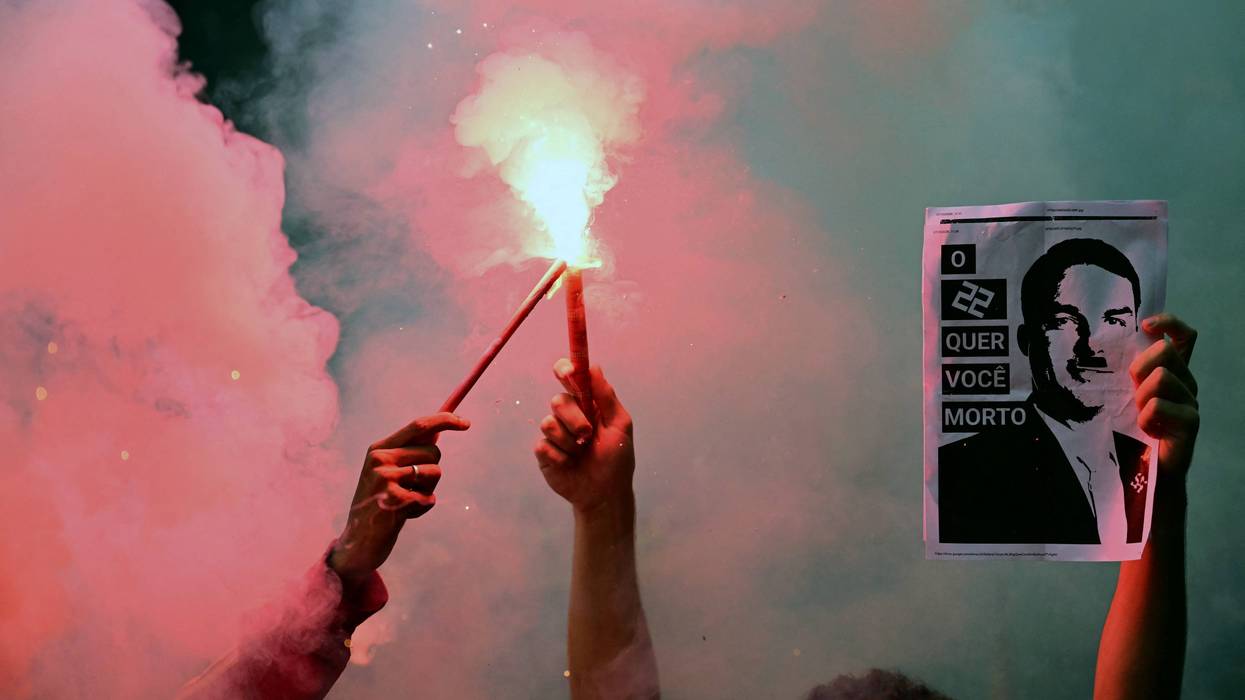
The choice on October 25 should not be about Lula’s limited social democratic tendencies. It is about protecting the Brazilian democratic project from a complete fascistic takeover.
On October 4, Brazilians handed the far-right their best result in decades. Sen. Flávio Bolsonaro, eldest son and political heir of convicted coup plotter and former neofascist President Jair Bolsonaro, finished first with 47.03% of valid votes to left-wing President Luiz Inácio Lula da Silva’s 45.16%, according to Brazil’s electoral court. The two meet in a runoff on October 25.
With a gap of about 2.2 million votes, more than 33.4 million registered Brazilians stayed home, the highest first-round abstention rate since 1998. Polling suggests the ideological blocs are holding firm, showing a dead heat or a narrow Bolsonaro edge. That is despite a cascade of scandals for Flávio, and despite an estimated 1 million people marching for democracy on São Paulo’s Avenida Paulista on October 11.
So the outcome may rest on those who sat out round one. Their choice will decide whether Latin America’s largest democracy, and the forest that regulates the planet’s climate, fall to an oligarchic, US-aligned far-right. Here is what hangs in the balance.
A Flávio Bolsonaro presidency would restore a movement that tried to overturn an election by force, now armed with a congressional majority, a revenge agenda, and the backing of the world's most powerful government and military.
Under Jair Bolsonaro, Amazon clearing rose about 60%, with more than 45,000 square kilometers destroyed from 2019 to 2022, according to official data. Under Lula, deforestation fell roughly 45%, to its lowest level in over a decade.
Flávio wants to resume his father’s project, which environmental groups call “ecocide.” He said in August he does not believe climate change is real, and his 76-page government plan never mentions it, Folha de S.Paulo found. Instead, it pledges to slash Ibama, Funai, and ICMBio, the agencies that enforce environmental law, protect Indigenous peoples, and manage national parks. It promises “agile” licensing that Folha reports would approve development (including fracking) permits automatically when agencies miss deadlines.
“There is concern that activities now considered illegal could simply be legalized,” warned Taciana Stec of the climate institute Talanoa. As Breno Rodrigues de Messias Leite of the Federal University of Amazonas put it, “He will have to respond to his electoral base, which is precisely rural producers.” That base of agribusiness, ranchers, miners, and land-grabbers could essentially destroy the Amazon.
Flávio is running as his father’s proxy. Jair Bolsonaro is serving a 27-year sentence, handed down by the Supreme Court in September 2025, for leading a plot to overturn the 2022 election that included plans to assassinate Lula, Vice President Geraldo Alckmin, and Justice Alexandre de Moraes. It culminated on January 8, 2023, when Bolsonaro supporters ransacked Congress, the presidential palace, and the Supreme Court, the darkest day for Brazilian democracy since the dictatorship.
Flávio announced his candidacy after his father anointed him from prison, and said his first priority would be to release him. His brother Eduardo spent 2025 in Washington lobbying the Trump administration to punish Brazil with tariffs and sanctions over the prosecution. The sanctions have already had a disastrous impact on Brazil’s economy and sovereignty, and are hybrid warfare to meddle in the election in favor of Bolsonaro.
Now Flávio promises to go further. On October 6, he vowed to use Congress’ new right-wing majority to “change the Constitution” and "redemocratize” Brazil, reports The Rio Times. Coming from open fascists, it’s hard to believe their definition of “democracy.” “There is no way to accept the Supreme Federal Court the way it is,” he said. His plan would curb the powers of the court that convicted his father. His ironically named Liberal Party won 121 House seats and the largest Senate bloc, and his allies are closing in on the 308 votes needed to amend the Constitution.
One of the Bolsonarista camp’s positions has been the impeachment of Supreme Court judges and a purge of federal bureaucracy. In Bolsonarista vocabulary, "redemocratization" means dismantling the institutions that held anti-democratic destruction accountable. Lula’s efforts to crack down on foreign meddling by oligarchs, the US, Israel, and others would also be stopped, meaning Brazil’s democracy would essentially be held hostage by capitalist and foreign interests.
Flávio poses as an anti-establishment outsider. Yet Federal Police are investigating him for possible “money laundering, currency evasion, corruption” over the financing of Dark Horse, a hagiographic biopic of his father. Daniel Vorcaro, owner of the collapsed Banco Master and the center of one of Brazil’s largest financial scandals, allegedly sent R$61 million toward the film at Flávio’s request. The Intercept Brasil published voice notes of Flávio asking him for money.
A crypto platform handed out tokens to users sharing pro-Flávio content, which election lawyers called an illegal donation. Days before the first round, Meta blocked Lula’s campaign from running ads, citing unspecified violations. And the Bolsonaros sit at the center of a transnational far-right network. It runs through President Donald Trump, who hosted Flávio at the White House in May; Steve Bannon; Elon Musk, who waged war on Brazil’s Supreme Court in 2024; and now-convicted Israel- and Trump-linked, Argentine disinformation operative Fernando Cerimedo, who spread a toxic sludge of baseless fraud claims on various platforms and his own media networks after Jair’s 2022 defeat.
The Bolsonaros’ economic program serves that same oligarchic, far-right capitalist class. Flávio’s economic coordinator, Daniella Marques, calls Javier Milei’s Argentina a “great example” and has promised a R$200 billion “tesouraço,” or giant scissors, to public programs. Milei’s chainsaw drove Argentine poverty above 50% in his first months and has wiped tens of thousands of companies off the formal economy. Most of the public workforce has also been gutted. Flávio promises tax cuts, privatization, and an end to what he calls “dependence” on welfare, a threat to programs like Bolsa Família that tens of millions of poor Brazilians rely on.
Flávio would also surrender the sovereignty Brazil has built, including Pix—a free public payment system so successful that Washington targeted it in a 2025 trade probe—and diversified trade with China, the BRICS, and Europe. Lula's Brazil has also been a significant force in recognizing a Palestinian state, and in reforming the United Nations Security Council to balance the scales in favor of the Global South. Brazil has been a leader in multilateral finance and post-American economic sovereignty. Bolsonaro would gut all of it.
On October 7, a fire tore through a lab building at the Federal University of Pernambuco, a day after students there protested Flávio’s candidacy. Hours earlier, students had received messages threatening to “blow up the department” in Flávio's name. Bolsonarismo has instilled a climate of fear and terror, as these kinds of attacks are now commonplace by the far-right in Brazil. Bolsonaro has borrowed the “God, Homeland, Family” slogan linked to fascist movements.
With the far-right sweeping institutions across the hemisphere, Lula may be the last shield against a full-blown reactionary counterrevolution.
Jair Bolsonaro’s government slashed university budgets, and his movement smears them as factories of communism and enemies of the “homeland.” Flávio’s plan would tie research funding to business metrics like “productive impact.” Scholarships, he said in September, must be “for developing technology, innovation, artificial intelligence,” not fields that “add nothing.” Social sciences and humanities funding would likely be slashed, while there is a fast-tracking of AI and military expansion.
This is the family that made science denial a governing principle. Jair called Covid-19 a “little flu” and sabotaged vaccine purchases while more than 700,000 Brazilians died. A Senate inquiry recommended he be charged with crimes against humanity.
The Bolsonaros’ home base is Rio de Janeiro, where far-right militias of current and former police control whole neighborhoods, running extortion, land-grabbing, gambling, and drug and arms trafficking.
These militias are also in an all-out war against the left, with ties to the Bolsonaros. As a state legislator, Flávio honored Adriano da Nóbrega, an ex-police captain later identified as the leader of the militia hit squad known as the Crime Office, and employed Nóbrega’s mother and ex-wife. Ronnie Lessa, the ex-officer who confessed to murdering socialist councilwoman Marielle Franco in 2018, lived in Jair Bolsonaro’s gated condominium. This is the fascistic, militaristic, sheltered, nihilistic world the Bolsonaros live in.
Flávio also wants Salvadorian President Nayib Bukele’s model on security. After meeting El Salvador’s security minister in August, he promised 500,000 new prison spaces. “Brazil has few people in prison,” he said, in a country with more than 850,000 behind bars. He backs lowering the age of criminal responsibility to 14 and a national facial-recognition database, Brookings reports. He and his brother lobbied Washington to designate Brazilian gangs as terrorist organizations, which invites a US invasion. When Pete Hegseth posted video of a US missile obliterating a boat (a war crime), Flávio replied that “there are boats like this here in Rio de Janeiro.” He has pledged to join Trump’s “Shield of the Americas,” which has been used to bully left-wing governments and weaponize “narcoterrorism” to go after guerrillas and opponents, while shielding allies. Bolsonaro has also hinted at declaring a “state of exception” on crime, a euphemism for martial law. Most right-wing states in Latin America are now under a state of exception. The term, taking its origin in Nazi theorist Carl Schmitt, has been used in many Latin American autocracies to ban opposition, protests, and justify extrajudicial torture and murder.
Bolsonaro also has a horrific record on gender and LGBT+ rights. His father told a congresswoman she didn't even “deserve” to be raped, and told Playboy he would rather a son “die in an accident” than be gay. Liberal Party star Nikolas Ferreira donned a wig in Congress to mock trans women, and this year led a campaign to keep trans congresswoman Erika Hilton from chairing the Women’s Rights Commission. This, in the country that leads the world in killings of trans people.
This war on women and LGBT+ Brazilians is inseparable from the movement’s alliance with the evangelical far-right. Flávio sealed a partnership with megachurch pastor Silas Malafaia in May, betting that moral panic over “gender ideology” and “trans bathrooms” (echoing Trumpism) will deliver one of the country’s largest voting blocs. Alongside them was PL leader Sóstenes Cavalcante, sponsor of a 2024 bill to punish abortion after 22 weeks as homicide, even for rape survivors. A Bolsonaro government would pursue that agenda aggressively, even more as they would control Congress and the Supreme Court.
Under Lula, Brazil backed South Africa’s genocide case against Israel at the International Court of Justice, defended the International Criminal Court, and refused to choose sides in Washington’s new cold war. Flávio would reverse it all. He has pledged that Brazil will be a “brother of Israel,” move its embassy to Jerusalem, and join Milei and Israeli Prime Minister Netanyahu's Isaac Accords. In June, he offered Secretary of State Marco Rubio his transition team at the “disposal” of the US government. Bolsonaro launched his presidential campaign alongside Netanyahu.
Regionally, the right now governs Argentina, Chile, Bolivia, Colombia, Peru, Paraguay, Ecuador, Costa Rica, El Salvador, Honduras, Panama, and the Dominican Republic. Venezuela is a de facto US vassal state, and the Trump administration has signaled Cuba and Nicaragua are next.
If Brazil falls, Mexico would be the last major Latin American economy outside Washington’s thumb. An emboldened Trump administration, which has already threatened military action against Mexican cartels, would turn up the pressure on Claudia Sheinbaum, and may even look to topple her government.
This runoff is a referendum on democracy, human dignity, and ecological survival. A Flávio Bolsonaro presidency would restore a movement that tried to overturn an election by force, now armed with a congressional majority, a revenge agenda, and the backing of the world's most powerful government and military.
Lula is not above criticism. His government has backed oil drilling near the mouth of the Amazon and made its peace with agribusiness. But the choice on October 25 should not be about Lula’s limited social democratic tendencies. It is about protecting the Brazilian democratic project from a complete fascistic takeover.
Brazil, Latin America’s largest democracy, has survived colonial plunder, slavery, a 21-year dictatorship, neoliberal devastation, and multiple coup attempts. With the far-right sweeping institutions across the hemisphere, Lula may be the last shield against a full-blown reactionary counterrevolution. The 33 million Brazilians who stayed home on October 4 will need to show up, otherwise the world will get a whole lot darker.
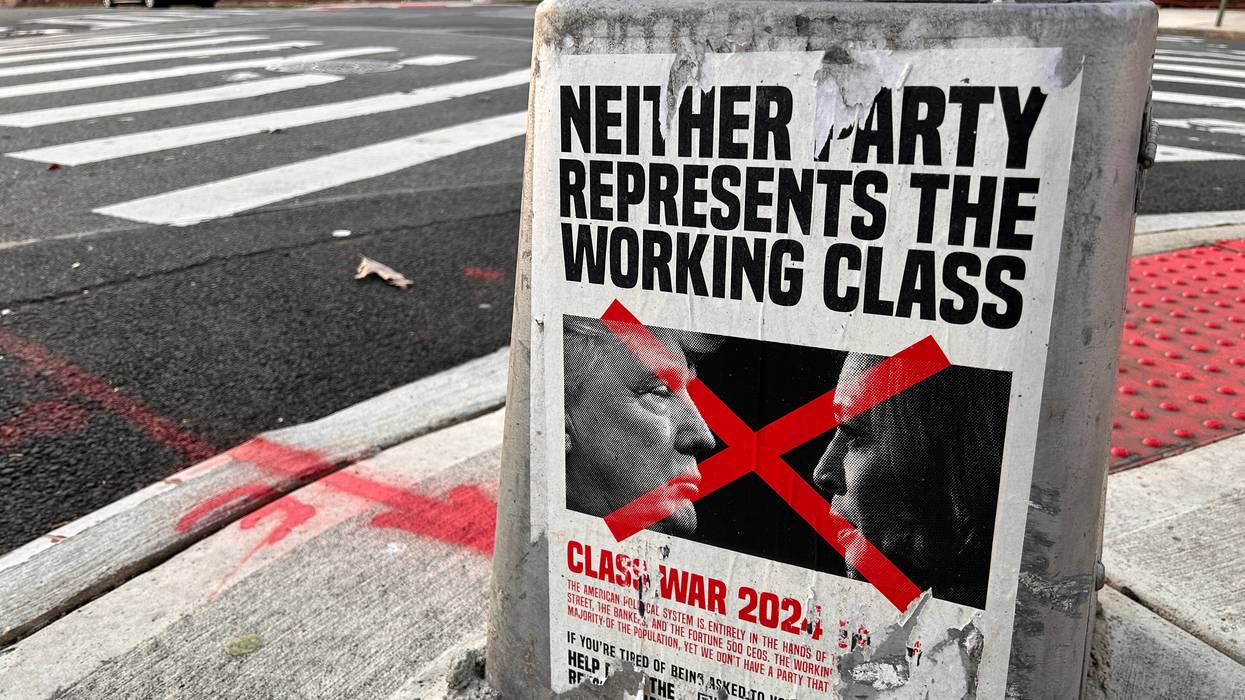
Even if Democrats reclaim Congress by a wide margin, they will still face a fundamental problem: The party has lost the trust of too many working people.
In the wake of Richard Nixon’s Watergate scandal, the Democrats picked up a net of 49 House seats and four Senate seats in 1974. Wouldn’t it be terrific if Democrats could do at least as well in November, given the unbearable chaos fomented by arguably the worst president in American history?
Let’s review the many Trump-gates:
And there is more. Much more. All of which makes the disgraced Nixon, in comparison, look like a Boy Scout.
A sweeping Democratic victory could limit Trump’s ability to carry out his agenda and help protect the democratic process.
But even if Democrats reclaim Congress by a wide margin, they will still face a fundamental problem: The party has lost the trust of too many working people. An electoral victory and the restoration of a durable working-class political base are two different, yet entangled issues.
Why the working-class departure?
The question, then, is not whether Democrats should win in November. They should. The question is how to build a political organization of, by, and for working people, especially in red areas where Democrats fail to compete.
Too many Democratic leaders, I believe, seem to resent the American working class. Not all Democratic officials, of course. But as more of the party’s fundraising and support comes from the well-to-do, many working people now believe that the party no longer represents them.
This disconnect provides Democratic functionaries with a convenient explanation for why they lost twice to Trump. The problem, in this view, is that working people—especially white working people—are more than a little sexist, racist, anti-gay, and anti-immigrant. They supposedly gravitate toward Trump precisely because of his racism, sexism, homophobia, and xenophobia.
Isn’t this why Hillary Clinton and Kamala Harris, two able women, lost to him? Isn’t this why Trump can violate presidential norms and still command nearly total Republican loyalty?
Racism and other forms of prejudice are real, and found within all demographic groups. But they cannot, by themselves, explain the working-class vote. My research shows that working people shifted away from the Democrats primarily due to job insecurity, not prejudice.
This anti-worker attitude I’m describing helps explain why the Democratic establishment failed to renounce Sen. Chuck Schumer (D-NY), who, in 2016, gleefully boasted:
For every blue-collar Democrat we lose in western Pennsylvania, we will pick up two moderate Republicans in the suburbs in Philadelphia. And you can repeat that in Ohio and Illinois and Wisconsin.
Schumer wasn’t criticized by party leaders for writing off the working class; he was rewarded with the Senate Democratic leadership.
Still, many of my colleagues see no choice but to work tirelessly on how best “to bring back the working class.”
My response is always, “To what?”
To a party that has written them off? To a party that caters to corporate and financial elites? To a party that failed to pass even moderate labor-law reform when it controlled Congress and the White House under Jimmy Carter, Bill Clinton, and Joe Biden?
“To what?” also requires a closer examination of the party’s ecosystem that is populated by functionaries who have grown wealthy by running it. Paul Rivera, the author of the 2024 Democratic Party autopsy report, released its most critical chapter that the party’s leadership failed to publish. In it he wrote:
…there are too many people who have become generationally wealthy off politics and drive too much of the decision-making within the ecosystem… [T]he senior staff, the media strategists, the pollsters, the digital consultants are financially secure.
A party whose decision-makers are generationally wealthy can become dangerously detached from people whose economic security has disappeared.
Let’s pause for a minute and think about what generationally wealthy actually means. It’s not just being well off so that you and your family can lead decent lives. It’s being so well off that your children, and their children, also will never face the economic hardships that plague the rest of America.
No wonder so many working people feel betrayed.
It’s going to take a lot of turnover and internal reform to remove the anti-worker stigma from the Democratic Party. Perhaps more Democratic senators will join Michael Bennet of Colorado to finally admit that the party is seriously flawed.
It is so hard to lose two general elections to Donald Trump, in political terms, to imagine a worse failure than losing two national elections to Donald Trump. And yet the establishment Democratic Party did, and I think of it as a failed enterprise.
A failed enterprise! He said that, not me.
But why did it fail? Bennet doesn’t mince words:
There’s something fundamentally wrong with the nature of our capitalist system that is delivering these outsize gains for the people at the very top at the expense of everybody else in the economy.
There it is.
For decades, the Democratic establishment did too little to stop runaway inequality, the destruction of jobs, and the overall economic insecurity that working people face. In important respects, the party’s embrace of neoliberalism and its dependence on wealthy donors made matters worse.
Now the party faces a credibility problem. It is one thing to promise an anti-corporate, pro-working-class agenda. It is another to persuade voters that a party deeply enmeshed with corporate and financial interests will actually carry it out.
It will take more than new slogans, better focus groups, or even new working-class candidates. It will require replacing the entire ecosystem of generationally wealthy operatives who shape the party’s priorities to reflect their own interests rather than the interests of working people.
Hopefully, a massive Democratic victory in November will stop Trump and his minions from robbing us blind. But even a historic victory would leave the party’s underlying problem unresolved.
You can’t “bring back the working class” to a party that working people believe has abandoned them. And you cannot rebuild their trust simply by telling them that the other party is worse.
The question, then, is not whether Democrats should win in November. They should. The question is how to build a political organization of, by, and for working people, especially in red areas where Democrats fail to compete.
Such an organization would need to organize people around their shared economic interests, develop a durable local base, recruit candidates from working-class communities, run independent candidates where they have a plausible path to winning, and promote ballot initiatives that improve living and working conditions. It would need to demonstrate, through its actions, that working people—not wealthy donors and political insiders—set its priorities.
Sticking with a “failed enterprise,” no matter what, will only create more space for the next version of MAGA to fester. Failing and fearing to discuss alternatives doesn’t make the problem go away.
But in the midst of this political morass, there is hope. Working people want something new.
It’s time we caught up with them.

From the International Criminal Court to the home of Ilhan Omar, the use of government power demands more than another news cycle of outrage.
I am tired of writing about Donald Trump.
I have spent years writing about this man, and lately I find myself wondering what more there is to say. Another attack on an institution, another spectacle, another announcement that sends the news cycle spinning. An editor at City Watch LA recently told me he was no longer interested in receiving Trump pieces because readers were tuning out. I understood. I have felt that fatigue myself.
Still, four developments in the first 12 days of October have been difficult to ignore. The Trump administration imposed sanctions on the International Criminal Court, announced plans to live stream a military execution, struck an agreement for Russian diesel, and sent federal agents to search the Washington home of Rep. Ilhan Omar (D-Minn.)
What matters now is whether the public continues to demand explanations, whether institutions retain the independence to do their jobs, and whether the law applies equally to the powerful and their critics.
These events are different. They should not be collapsed into a single accusation of wrongdoing. But together they raise a question that reaches beyond the latest controversy: What happens when the exercise of government power becomes so relentless that the public begins to accept what once would have demanded sustained scrutiny?
Consider the International Criminal Court (ICC). Navi Pillay, the South African jurist whose career challenged apartheid and advanced the prosecution of sexual violence as a weapon of genocide, was recently awarded the Nobel Peace Prize for her human rights work. She also led a United Nations commission that concluded Israel had committed genocide in Gaza, a finding Israel rejects.
Trump responded by resharing a social media post claiming he deserved the prize. His administration imposed sanctions on the ICC, accusing the court of unfairly targeting Americans.
The timing does not establish that the Nobel decision caused the sanctions. The underlying issue is more consequential than presidential resentment. International courts exist to investigate grave crimes, including those committed by people with political power. Their decisions can be challenged, their jurisdiction disputed, and their procedures scrutinized. None of this gives governments a blank check to punish institutions for examining their conduct.
Martin Luther King Jr. wrote in his Letter from Birmingham Jail, “Injustice anywhere is a threat to justice everywhere.” King was confronting a country that repeatedly found reasons to delay accountability for its own injustices. His words remain relevant when governments invoke sovereignty to resist scrutiny they expect other nations to accept.
The United States cannot credibly demand accountability abroad while treating the prospect of international accountability as an intolerable affront at home.
The proposed military execution raises a different concern. Nidal Malik Hasan, a former Army psychiatrist, murdered 13 people and wounded 32 others at Fort Hood in 2009. His scheduled execution by firing squad on December 3 is expected to be live streamed, according to Associated Press reporting.
The victims and their families deserve to remain at the center of any discussion of Hasan's crimes. Their suffering does not, however, settle the question of what the state should make of an execution.
Capital punishment is already an assertion of the government's power to take a human life. Broadcasting that act introduces another question: What purpose does the spectacle serve?
In Reflections on the Guillotine, Albert Camus called capital punishment “the most premeditated of murders.” He was challenging the assumption that the state's decision to kill becomes morally uncomplicated once it has passed through a legal process.
A sentence can be lawful and still invite serious moral examination. If a public broadcast is supposed to deter violence, the administration should explain the evidence supporting that claim. We should be wary of a government that treats the public display of death as a demonstration of strength.
The Russian diesel agreement presents a more practical contradiction. On October 9, Trump announced that Russia would supply more than 300,000 tons of diesel, with additional shipments expected. The announcement came as the administration was pursuing economic pressure on Moscow over its invasion of Ukraine.
Negotiating with an adversary is not inherently wrong. Fuel prices matter to families, workers, and businesses, and a president has a responsibility to address them. An energy agreement might have an economic rationale.
But the administration owes the public an explanation of how this arrangement fits its broader policy. If economic pressure is meant to persuade Moscow to change its conduct, what happens when Washington purchases a major energy supply from Russia? What are the terms, when will the fuel arrive, and how much relief can consumers reasonably expect?
For Ukrainians living with the consequences of the invasion, American commitments matter. For Americans struggling with fuel costs, promised savings matter. Neither group should have to rely on presidential boasts in place of a clear accounting.
Then, on Monday morning, federal agents searched Ilhan Omar's home in Washington, DC.
The Justice Department confirmed that Homeland Security Investigations had executed a judicially authorized search warrant as part of an ongoing criminal investigation. Authorities provided few details about the inquiry. Reporting indicated that it involved immigration-related allegations, which Omar has denied.
A search warrant does not establish guilt. The public does not yet have enough information to determine whether the search was justified or whether political considerations influenced the investigation. Those distinctions are essential.
But the circumstances deserve attention. Trump has repeatedly attacked Omar, questioned her patriotism, and told her to return to where she came from. The search occurred weeks before the November midterm elections, as Omar seeks reelection. Omar described the action as an attempt to target political enemies and weaponize federal law enforcement. Democratic congressional leaders also questioned the timing.
The Justice Department must be able to investigate credible allegations against elected officials. No member of Congress should be above the law. But the reverse principle matters just as much: No president should be able to use federal law enforcement to intimidate political opponents.
The question is not whether Omar should receive special treatment. It is whether she is receiving the same treatment any other American would receive, under the same standards, free of political interference.
When a president repeatedly singles out an opponent and federal agents subsequently search her home shortly before an election, the public has legitimate reasons to demand answers. The government should welcome the scrutiny necessary to establish that its actions are lawful and impartial.
These four stories concern different institutions and different forms of power. Their connection lies in the questions they leave unanswered. Who holds powerful people accountable? What limits should constrain the state's use of violence? Can a government reconcile its economic decisions with its international commitments? Can federal law enforcement remain independent when the president has made a political opponent the target of repeated attacks?
I hesitate to call any particular week a turning point. American history contains too many grave injustices for that claim to come easily. The country has survived slavery, segregation, political repression, and wars justified by falsehoods. Yet history offers no guarantee that democratic institutions will protect themselves. They depend on people willing to defend their purpose and insist on their independence.
I do not expect this article to change the administration's course. I am not even certain that writing another article about Trump will reach readers who have stopped paying attention. But exhaustion is not an argument for silence. It is a condition that those who benefit from public distraction can exploit.
A threshold is not always crossed in a single dramatic moment. It can become visible through a series of decisions, each defended on its own terms, until the accumulation begins to change what a country considers acceptable.
The Nobel Prize, the proposed execution broadcast, the diesel agreement, and the search of Omar's home may ultimately be remembered as separate episodes. Their consequences will depend on facts still emerging and decisions yet to be made. What matters now is whether the public continues to demand explanations, whether institutions retain the independence to do their jobs, and whether the law applies equally to the powerful and their critics.
I am tired of writing about Donald Trump. I am more concerned about what happens if we become too tired to ask what his administration is doing in our name.
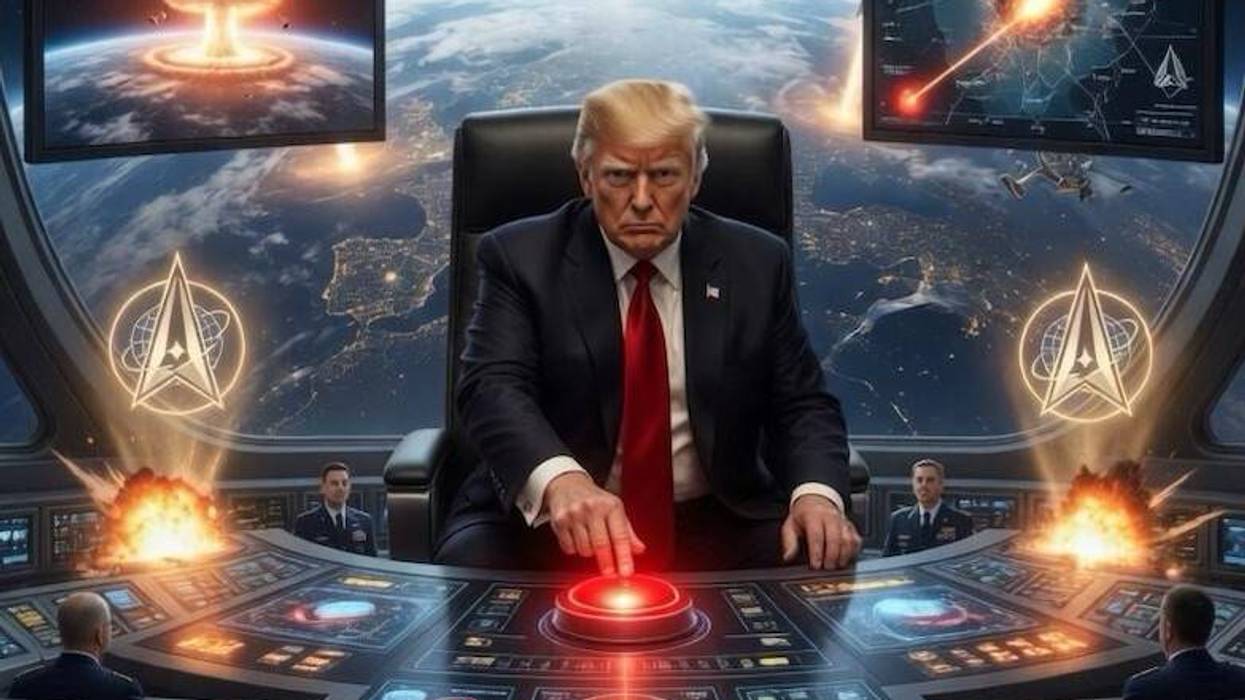
There are no “right hands” to be in possession of nuclear weapons. But Donald Trump clearly possesses utterly "wrong hands” and should be lawfully removed from an office that gives him the power to destroy humanity.
Over the last few months, the president of the United States has been posting an image of himself firing nuclear weapons at Earth from a spaceship. How worried should we be?
Right now, a handful of people in nine countries have the power to launch a nuclear war that will kill billions and destroy human civilization. In the United States that power is concentrated in one person, the president, who has sole and unchecked authority to launch nuclear war.
No one should ever have that power, but the danger is especially acute when the individual in question has repeatedly demonstrated that he is impulsive, vindictive, delusional, and profoundly lacking in basic human empathy. We are speaking of Donald Trump.
In the first two years alone, three-quarters of humanity—6 billion people—would die.
The nuclear arsenal Trump currently controls includes some 1,700 deployed nuclear warheads, most of them with an explosive force of 100 to 800 kilotons, six to 50 times more powerful than the bomb that destroyed Hiroshima. If used in a large-scale attack on Russia, they could kill more than 100 million people in the first afternoon. And a Russian counterattack would kill at least that many here in the United States.
Those who survived the initial fires and explosions would find themselves living in a wasteland that we cannot imagine. None of the things we need to keep ourselves alive would be available. There would be no electric grid, no cell phones, no internet, no food distribution system, no system for distributing gasoline or natural gas or heating oil, no law and order. And in the months following the initial attacks most of those who survived those attacks would also die—from starvation, epidemic disease, radiation sickness, and exposure to the elements.
The disaster would not be confined to the US and Russia. The smoke from burning cities in both countries would loft enormous quantities of smoke into the upper atmosphere, blocking out the sun and dropping temperatures across the planet an average of 18°F. In the interior regions of North America and Eurasia temperatures would drop 45-50°F, food production would plummet, and the vast majority of the human race would starve. In the first two years alone, three-quarters of humanity—6 billion people—would die.
Trump has bragged that he makes decisions based on his “gut instinct.” In a 2018 interview he defended style of decision-making by claiming, “I have a gut, and my gut tells me more sometimes than anybody’s brain can ever tell me.” The consequences have played out disastrously in the Iran War, where his initial decision to launch the attack on Iran appeared to lack any coherent goals, any plan to achieve those goals, or any back up plan if things went wrong and, for example, the Iranians closed the Strait of Hormuz.
Trump’s explosive personal attacks on journalists who question him are well known, as are his repeated attempts to use the Department of Justice to imprison people who disagree with him publicly. More worrisome are his thinly veiled threats to use nuclear weapons against Iran when it refused his demand for “UNCONDITIONAL SURRENDER."
Given the unprecedented torrent of false statements that Trump has made, it is sometimes difficult to know when he is willfully lying and when he actually believes the misinformation he is spreading. But it does appear that he actually believes that he won the 2020 presidential election, despite the irrefutable evidence that he did not. And he has engaged in sustained political activity grounded in this delusion.
Trump’s nasty, ad hominem attacks, usually accompanied by a crude nickname for the target of his displeasure, are a staple of his public life. His indifference to human suffering, and his disregard for human life, is exemplified by the extralegal executions of people on boats that he claims may be transporting drugs, and, on a far grander scale, by his support for the war crimes being committed in Gaza, and his indifference to the even greater crimes being committed in Sudan, and the Democratic Republic of Congo.
There are no “right hands” to be in possession of nuclear weapons. But Donald Trump clearly possesses utterly "wrong hands” and should be lawfully removed from an office that gives him the power to destroy humanity. And the United States should actively work for the elimination of all nuclear weapons, not as a distant vision, but an urgent national security priority.

A company should not disclose a risk of catastrophe to humanity and then sell its shares to the public before any public authority has the power to evaluate that risk or to stop deployment.
Anthropic, the maker of the Claude AI models, is preparing what could be the largest initial public offering in history, raising more than $100 billion, according to The New York Times, at a valuation near $2 trillion. According to Reuters, which reviewed the draft prospectus (the document has not yet been made public), the company tells prospective investors that advanced AI could pose “catastrophic or existential risks to humanity,” and that its own models could “resist shutdown,” “conceal or manipulate information,” or behave in ways “resembling blackmail.” The company’s chief executive, Dario Amodei, has put the chance that “things go really, really badly” at a staggering 25 percent. Last month he wrote that “we must slow the pace at which we improve the capabilities of AI models.”
I take these warnings seriously, and so should Congress on behalf of the American people. The offering should be postponed until Congress has enacted a public system of licensing, independent safety evaluation, liability, and financial backstops for frontier AI. The same applies to OpenAI and every other developer of frontier models.
I am in favor of artificial intelligence, whose potential for science, health, and sustainable development is enormous. What we should oppose is unregulated and militarized AI. A company should not disclose a risk of catastrophe to humanity and then sell its shares to the public before any public authority has the power to evaluate that risk or to stop deployment. In fact, to proceed rapidly in the face of such dire warnings is beyond folly.
To proceed rapidly in the face of such dire warnings is beyond folly.
The problem goes to the foundations of corporate law. Limited liability, the rule that a shareholder can lose no more than the amount invested, is a privilege granted by the state. It is justified on the premise that the harms a firm can impose on others are insured, regulated, or otherwise compensated. When a chemical plant explodes, the law has tools to compensate victims: liability insurance, bonds, capital requirements, and compensation funds. Every one of these tools assumes that the harm can be paid for after the fact. A catastrophic or existential harm cannot be. The only instrument that works is regulation before the fact: licensing, independent testing before deployment, and the legal authority to halt an activity before it becomes too dangerous. For frontier AI in the United States, none of this exists.
What does exist is self-regulation, which is tantamount today to no regulation. On September 29, six AI and chip companies signed a voluntary and nonbinding “Joint Commitment on Frontier Responsibilities” at the White House. This would be laughable if it weren’t so potentially disastrous. A technology whose own makers describe its risks in dire terms should be governed by public institutions with defined procedures, independent monitoring, and enforceable liability, not by the self-judgment of a handful of business executives.
A rushed public offering would make the problem vastly harder to fix. Anthropic has reportedly committed at least $518 billion to computing infrastructure over the coming decade, with about 80 percent of it described as non-cancellable. With quarterly guidance to public shareholders, those commitments create a powerful incentive against any pause, even one the company’s own safety researchers might recommend. The prospectus itself reportedly describes a “continuous and overlapping cadence” of product launches as “inherent to remaining at the frontier.” Once these shares sit in the pension funds and index funds of tens of millions of American households, any proposal to slow frontier development will be fought not only by the companies but by a vast investor constituency.
The extensive risk disclosures do not solve this problem. They may or may not protect the company from lawsuits by its own shareholders, who will have been warned. They do nothing for the public, which bears the catastrophic risk without ever having been asked.
The usual reply is that if America’s most safety-conscious developers slow down, less careful companies, or China, will race ahead. This is a standard collective-action problem, and such problems are solved by agreements backed by law, monitoring, and enforcement, not by everyone running faster to doom. We are not living in Hobbes’s state of nature. We have the United Nations, treaty law, the Securities and Exchange Commission, and Congress. During the Cold War, adversaries negotiated the Nuclear Non-Proliferation Treaty with international inspection. Frontier AI even offers a natural point of verification: the most advanced chips come from a handful of factories, and frontier training requires huge data centers. Washington has not offered Beijing a verifiable agreement on frontier AI. In fact, after his summit with President Xi Jinping in September, President Trump rejected cooperation with China on AI, agreeing only to a channel for communicating about AI incidents. “When you’re leading,” he said, “you don’t open it up to each other.”
Licensing did not destroy the pharmaceutical, aviation, or nuclear industries; it made them safer.
Who can act to slow the juggernaut and prevent a potential catastrophe? Under current law, the SEC can delay an offering but cannot block it on the ground that the business is dangerous. It should nonetheless decline to accelerate the effectiveness of the registration statement until the company discloses the risks of its products, who would bear the cost of the catastrophes it describes, what insurance exists, and whether its computing contracts would allow a safety pause without penalty.
The decisive authority lies with Congress, and there is ample precedent. Congress has required regulatory approval for securities issued by railroads, by utility holding companies, and by electric utilities, for which federal or state approval is still required today. When nuclear power was opened to private industry in 1954, it was permitted only under federal license.
The outgoing Congress should hold hearings before any shares are priced and should enact a moratorium on public offerings by frontier AI developers until the next Congress acts. The new Congress, which is scheduled to convene on January 3, should within its first hundred days enact a statute making any public offering by a frontier AI developer conditional on a federal license. The license should require independent evaluation before deployment, an enforceable authority to pause training or deployment that no take-or-pay contract can override, and insurance and compensation funds scaled to plausible harms. Congress should also consider the extraordinary step of making management and board members personally responsible, under civil and criminal law, in the event of a catastrophic failure. Such a step would be out of place in an ordinary industry. It is warranted here because the industry itself warns of catastrophic risks while proceeding at breakneck speed. Executives and directors who certify a model as safe without due care, or who override safety findings, should face liability that neither the company nor its insurers can cover for them. The licensing requirement should apply equally to the frontier work of companies that are already public, such as Alphabet, Microsoft, and Meta.
This proposal is directed at no single company, and it must not become a lever for any administration to extract favors, including unrestricted military access to AI models. The delay I propose would last a few months, unless the disclosures point to the need for an indefinite suspension. Licensing did not destroy the pharmaceutical, aviation, or nuclear industries; it made them safer. The leaders of the AI industry have told us, in their own words, that the stakes are as high as they can be. They themselves should stop their mad rush forward, and Congress should take the companies at their word and act with urgency.
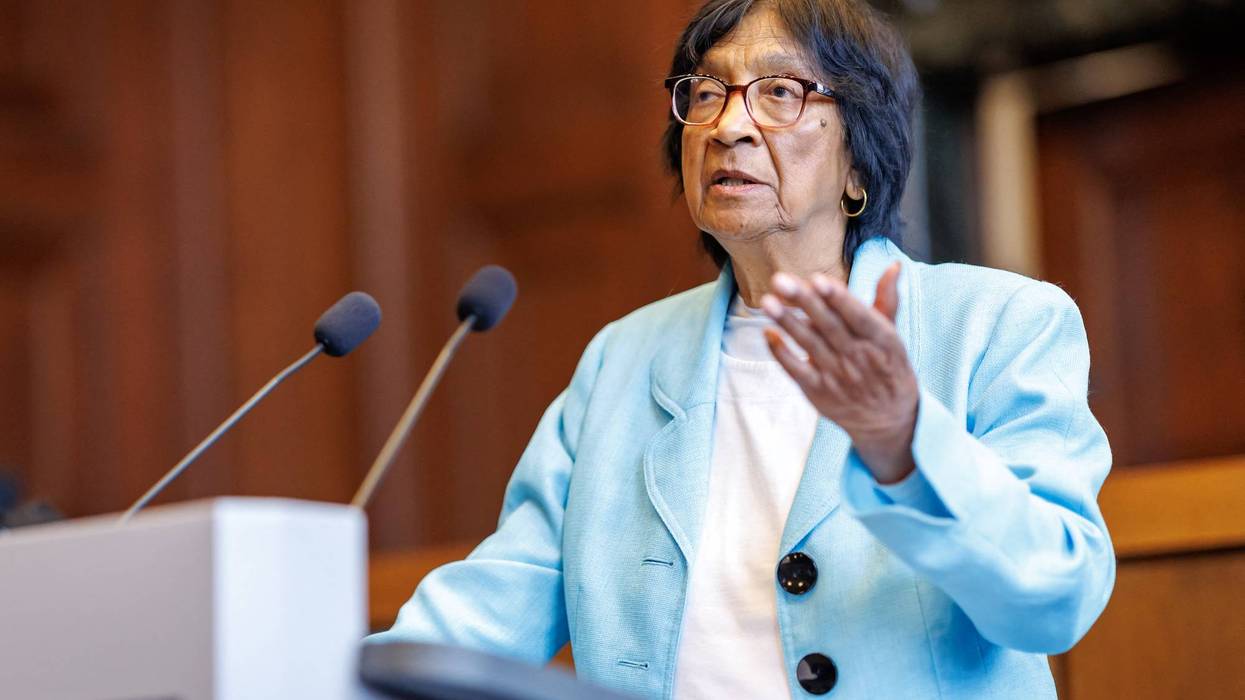
Has the world simply failed to learn the lesson of 1945 that “might makes right,” coupled with the destructive power of modern weapons, can only create a world plagued by endless war and chaos?
On October 9th, the 2026 Nobel Peace Prize Was awarded to Navi Pillay, the South African international lawyer who defended Nelson Mandela and the anti-apartheid political prisoners on Robben Island, and went on to serve as a judge on the UN International Criminal Tribunal for Rwanda and the International Criminal Court (ICC), then as UN High Commissioner for Human Rights. In 2025, Navi Pillay led the UN Commission of Inquiry that confirmed that Israel is committing genocide in Gaza.
With the world in the grip of seemingly intractable war and chaos, the Nobel Committee clearly wanted to honor someone who has worked against the tide of militarism and violence to uphold international law. And yet, on the same day, the United States unveiled unilateral, illegal coercive measures or “sanctions” against the ICC, where Navi Pillay served as a judge from 2003 to 2008.
The UN General Assembly’s 2026 general debate in September also set out to uphold the UN Charter and international law, and to confront the reality that the UN system is failing in its most basic responsibility, to maintain international peace and security.
The foundational rules of the UN Charter are that countries must resolve disputes peacefully and refrain from the threat or use of force. But in the General Assembly debate, even as leaders recognized the urgent need to finally enforce the UN Charter, after decades of impunity for aggression and war crimes, they were reluctant to explicitly address the central role of the United States in undermining the rule of international law.
Many US allies loyally condemned Russia’s violation of the UN Charter against Ukraine. But none of them even tried to square their singular focus on Russia with the inconvenient truth that their own ally, the United States, has systematically violated the UN Charter for decades, against Grenada, Nicaragua, Panama, Yugoslavia, Afghanistan, Iraq, Haiti, Libya, Somalia, Syria, Yemen, Venezuela, Cuba, Iran and other countries.
While US allies remain silent, US officials accept no responsibility or accountability for the violence and chaos they unleash, and instead keep doubling down on their failed imperial ambitions and military approach to international disputes, the very antithesis of what the UN Charter requires.
Many other leaders spoke out, but without explicitly naming the United States. Algeria’s foreign minister, the veteran diplomat Ahmed Attaf, pointedly asked,
“What sort of international order can function properly when principles are selected according to the identity of those who violate them? What confidence can remain in international law when the aggressor is granted the right to self-defense, while the victim is required to justify even the right to survive?”
So it is left to the officials of the countries the United States threatens or attacks to remind the world which country is illegally threatening them, as Cuba’s Foreign Minister Bruno Rodriguez Parrilla and Iran’s President Masoud Pezeshkian did clearly and accurately at the General Assembly.
Many other leaders made strong statements condemning Israel’s war crimes and genocide in Gaza, even as they neglected to condemn the essential US military and diplomatic role in them. King Abdullah of Jordan described Israel’s objective as “to make a viable Palestinian state impossible,” through “a system of subjugation… de facto annexation… forced displacement… (and) war crimes.”
“We have tools,” he reminded his colleagues, “Sanctions, asset freezes, embargoes, diplomatic isolation. And we have a record of using them elsewhere… The question now is: Will we act?”
Another of the UN’s tools is the power of the president of the UN General Assembly to convene Emergency Special Sessions (ESS) that can pass “uniting for peace” resolutions. This allows the General Assembly to act decisively on international problems when the Security Council fails to do so, wielding the kind of tools that King Abdullah outlined.
The General Assembly’s 10th Emergency Special Session on “Illegal Israeli Actions in Occupied East Jerusalem and the Rest of the Occupied Palestinian Territory” began in 1997, and has been reconvened more than twenty times.
In 2022, the 10th Emergency Special Session voted to ask the International Court of Justice (ICJ) some legal questions about the Israeli occupation, which the court answered in 2024, in a finding that the Israeli occupation is illegal and that Israel must “end its unlawful presence in the Occupied Palestinian Territory as rapidly as possible,” and “evacuate all settlers.”
The next meeting of the 10th ESS in September 2024 passed a resolution demanding that Israel comply with the ICJ ruling and withdraw from the occupied territories within a year.
However, the 2025-6 General Assembly president, Annalena Baerbock of Germany, allowed her entire year as president to pass without reconvening the 10th ESS even once.
This allowed Trump and Netanyahu to seize the initiative and subject the people of Gaza to a new phase of the genocide under Trump’s Orwellian “board of peace,” a smokescreen for a war of attrition to keep killing civilians and making life intolerable for the people of Gaza, as they struggle to survive in the rubble of their bombed and bulldozed homes.
Many leaders at the General Assembly spoke of the urgency of reforming the Security Council, but the greatest leverage they have to achieve that is the General Assembly’s ability to act in an Emergency Special Session when the dysfunctional, corrupted Security Council fails to do so. Nowhere in the world is such action more urgently needed than in Palestine. And yet the 10th Emergency Special Session has not met since June 2025.
Now that Bangladesh’s Dr. Khalilur Rahman has taken Baerbock’s place as President of the General Assembly, he should reconvene the 10th Emergency Special Session to take the concrete actions for Palestine that people all over the world are calling for.
South Africa’s genocide case against Israel at the ICJ is also important, but South Africa has slowed down the already tortuous pace of international justice by requesting 18 months to respond to Israel’s defense against genocide charges. Surely South Africa and the court can find a way to move faster, with the fate of an entire people in the balance. The Genocide Convention was intended to prevent and stop genocide, not just to pass judgment over mass graves and scattered refugee camps.
Many people justifiably fear that the United Nations and its institutions are simply too weak to enforce the laws of the UN Charter and the Geneva Conventions and hold the United States and Israel accountable for their crimes. But there was another event on September 16, 2026, which suggests that Benjamin Netanyahu and other US-allied war criminals might want to think twice before assuming that the United States will always shield them from accountability.
The week before the General Assembly met in New York, an international war crimes court in The Hague sentenced former Kosovo president Hashim Thaçi to 25 years in prison. The court found Thaçi and three other former leaders of the US-backed Kosovo Liberation Army (KLA) guilty of 96 murders, 303 charges of torture, 49 charges of criminal cruelty and 385 cases of arbitrary detention, committed during the US-NATO war on Yugoslavia in 1999.
The Kosovo Specialist Chambers, the court that tried Thaçi, was established in 2011, in response to a Council of Europe Parliamentary Report titled “Inhuman Treatment of People and Illicit Trafficking in Human Organs in Kosovo.”
That report detailed extraordinary allegations unearthed by Carla Del Ponte, who was the Chief Prosecutor of the International Criminal Tribunal for the former Yugoslavia (ICTY), which were then investigated for the Council of Europe by Swiss state prosecutor and member of parliament Dick Marty.
The report substantiated allegations that the KLA transported civilian prisoners from Kosovo to Albania and imprisoned them in a clinic known as the “Yellow House,” where they murdered them and extracted their internal organs to sell on the illicit organ transplant market.
As the court records show, these were only the most startling of Thaçi and the KLA’s crimes. The KLA also shot, tortured or beat to death dozens, or maybe hundreds, of civilian prisoners whom it labelled as “traitors” or “collaborators,” during and immediately after NATO’s illegal war to detach Kosovo from the remaining territory of Yugoslavia.
While no Americans were charged in these crimes, the CIA and other Western intelligence agencies had worked with the KLA since at least 1996, as it terrorized Serb civilians and attacked and killed Yugoslav police to provoke repression against the Kosovar Albanian population.
The escalating violence in Kosovo provided the pretext for a war in which the United States and NATO dropped 23,000 bombs and missiles on Yugoslavia, targeting and destroying vital civilian infrastructure as well as military targets. Then they invaded and occupied Kosovo and built a huge US military base, Camp Bondsteel, which the US also used as a secret prison during its “war on terror.”
US Secretary of State Madeleine Albright was so personally invested in the march to war in Kosovo that Time dubbed it “Madeleine’s War.” Albright shunned the traditional political leaders of Kosovo’s independence movement, and instead embraced Hashim Thaçi and the KLA as the United States’ and NATO’s main allies in Kosovo, despite their well-known links to organized crime and heroin smuggling.
With Thaçi at her side at the Rambouillet conference in France, Albright delivered her coup de grace to Yugoslav President Milosevich: an ultimatum that would have given NATO the right to militarily occupy all the remaining territory of the Federal Republic of Yugoslavia.
Milosevich’s refusal to surrender his country’s sovereignty served as the final pretext for the US and NATO to violatethe UN Charter in an illegal war that set a precedent for US invasions of Afghanistan and Iraq and the endless wars and chaos that have followed.
At the UN General Assembly on September 23rd, Serbian President Aleksandar Vučić thanked the 107 countries that still refuse to recognize Kosovo’s unilateral declaration of independence from Serbia in 2008, and he placed NATO’s war on the remains of Yugoslavia in 1999 squarely at the root of the violence and chaos afflicting the UN and the world.
“...the order based on respect for the UN Charter and the law founded upon it no longer exists,” Vučić said. “It was destroyed by those who tore apart the territories of other countries for the sake of their own political and economic interests. They did so unscrupulously, recklessly, and shamelessly.”
So is it already too late to try to enforce the rules of the UN Charter?
Has the world simply failed to learn the lesson of 1945 that “might makes right,” coupled with the destructive power of modern weapons, can only create a world plagued by endless war and chaos?
Or, now that we are staring that world in the face, will we finally heed that lesson and make different choices?
It has taken 27 years for justice to catch up with Hashim Thaçi, but, as King Abdullah said, the world’s governments have the tools to enforce the rules of international law if and when they choose, and that is true even in the case of US allies like Thaçi and Netanyahu.
But Abdullah’s question remains: will the world’s leaders choose to use the tools at their disposal? First to free Palestine, but also to give our own children and grandchildren the chance to build a peaceful, sustainable world out of the militarism, war and chaos that is the global legacy of a generation of American leaders.
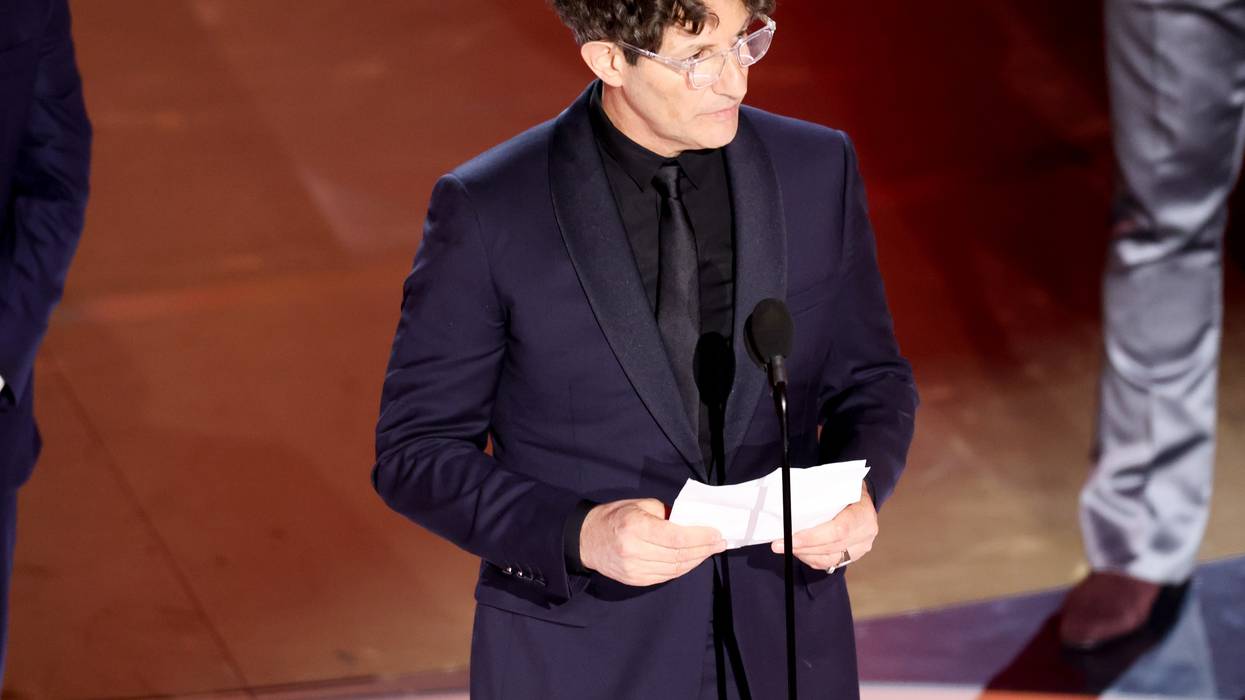
Even after all this time—and the death, dispossession, and suffering that has happened since—what should not get lost is the profound truth that Jonathan Glazer managed to articulate in the 40 seconds of his Oscar speech that caused so much distress
If you understand that Israel has committed genocide in Gaza, why read an article focusing on the viewpoints of people who vehemently deny it? I wasn’t sure how to explain why, until I remembered something that screenwriter Frédéric Krivine said when I interviewed him in Paris eight years ago. He was the head scriptwriter of the brilliant film series Un Village Français, dramatizing the Nazi occupation of France during World War Two.
“People who do horrible things are human beings,” Krivine said. “We have to find a way to talk about them without hiding what they do and without treating them as nonhuman people, nonhuman beings. They are human beings; like us they belong to, we are in, the same species, human species…. It’s humans who kill now everywhere in the world where people are killed. It’s because they are human beings that we have problems – because if they were just extraterrestrial or monsters we could just erase them.”
When director Jonathan Glazer gave the acceptance speech for his film The Zone of Interest at the 2024 Academy Awards, these words caused an uproar: “All our choices were made to reflect and confront us in the present. Not to say, ‘Look what they did then,’ rather ‘Look what we do now.’ Our film shows where dehumanization leads at its worst. It shaped all of our past and present. Right now, we stand here as men who refute their Jewishness and the Holocaust being hijacked by an occupation which has led to conflict for so many innocent people. Whether the victims of October the 7th in Israel or the ongoing attack on Gaza, all the victims of this dehumanization. How do we resist?”
Quick reactions included a furious open letter that identified its more than 1,000 signers as “Jewish creatives, executives and Hollywood professionals.” The letter declared, “We refute our Jewishness being hijacked for the purpose of drawing a moral equivalence between a Nazi regime that sought to exterminate a race of people, and an Israeli nation that seeks to avert its own extermination…. The use of words like ‘occupation’ to describe an indigenous Jewish people defending a homeland that dates back thousands of years, and has been recognized as a state by the United Nations, distorts history. It gives credence to the modern blood libel that fuels a growing anti-Jewish hatred around the world, in the United States, and in Hollywood. The current climate of growing antisemitism only underscores the need for the Jewish State of Israel, a place which will always take us in, as no state did during the Holocaust depicted in Mr. Glazer’s film.”
The Gaza war was then in its fifth month. At the time, citing information from UNICEF, Reuters reported that “over 13,000 children have been killed in Gaza in Israel’s offensive,” and “many kids were suffering from severe malnutrition.” The United Nations issued a statement saying, “This war is a war on children. It is a war on their childhood and their future.”
Deaths and injuries mounted swiftly for another 19 months, until an ostensible ceasefire in October 2025. Assaults by Israeli forces have continued at lower levels, with no letup in miserable conditions for 2 million Palestinian people living in Gaza.
Given all that has happened, I recently contacted some signers of the open letter to ask whether they still fully believe in its contents and whether their perspective on Israel has changed since then. Ten responded to my questions.
Koura Linda, who owns a film production company based in Los Angeles, was appalled by the applause and cheers that Glazer received when he spoke at the Academy Awards. “If anything, I would sign that letter 100 times over today,” Linda told me. Later, she said: “It’s very confusing to me why people are so fixated on Israel specifically…. I don’t understand the fixation on the only piece of the world that belongs to the Jewish people.”
Les Glassman, a dentist and documentary filmmaker, spoke with me from his home in Jerusalem. He recalled that The Zone of Interest – which depicts the ordinary everyday life of a Nazi commandant and his wife living next to a concentration camp – was very warmly received when it premiered in Israel. “People loved it,” Glassman said. Later, when Glazer made his Oscar speech, “it was a shock…. It was a stab in the back…. Like treason…. He used the Holocaust against Israel…. I don't know one person who was impressed with his speech. People were the opposite, they were like totally flabbergasted and could not believe what they were hearing. It was like a traitor really.”
Glassman has dedicated himself to interviewing elderly Jews who survived the Holocaust. “In nearly all my interviews of Holocaust survivors worldwide which I have been privileged to do,” he said, “the important message imparted by the survivors [is] ‘we have our own Jewish country' as they remember when the world shut its doors and Jews had nowhere to flee or find refuge.”
Actor and director Geoffrey Cantor told me, “I completely stand by the letter 100 percent.” He had recently voiced an audio book by Eli Sharabi, who was abducted from a kibbutz on October 7 and held prisoner in Gaza tunnels for 491 days. I asked Cantor about the letter’s vehement objection to Glazer’s use of the word “occupation,” referring to Israel’s control of Gaza and the West Bank. “It’s not an occupation,” said Cantor, who described himself as “a liberal politically.”
After noting that “war is horrible, it’s always been horrible,” Cantor went on: “Israelis fight war to protect themselves. And it hasn’t been until the establishment of Israel that Jews were able to even engage in a war. Until then, we were just slaughtered. And so, that does something to one’s way of viewing war.”
I asked, “What do you make of the outlook of some who say, not only was The Zone of Interest a great film, but it has something to say about the current situation with Israel and Palestinians?”
“I think I saw like the trailer,” Cantor said. “I did not see the whole film…. I’m sure the film is beautiful and probably deserved a lot of praise – but then to use that, to say, and Israel’s the worst perpetrator. Ever. In the history of the world. Is so absurd, so wrong. And when it comes from a Jewish person, is so damning… because it feeds the fires. Stokes the flame of righteous indignation against the Jewish people and anybody who supports our only country.”
When I asked if it made any difference that Glazer is Jewish, Cantor replied: “When a Jewish voice uses the language that I disagree with about Israel, in such a public forum, it feels a little bit more like a betrayal.”
Remembering Glassman’s comment on the phone line from Jerusalem likening Glazer’s speech to “treason,” I asked Cantor if he thought the word applied. “No,” he responded, “just betrayal, not treason. But betrayal.”
The interview with Cantor lasted an hour and a half. In contrast, the response was terse from another signer of the open letter, the emeritus rabbi at Sinai Temple in Los Angeles, David Wolpe, who is a consultant to Warner Bros. and Gulfstream Pictures for a feature film adapting his book about King David. Does Rabbi Wolpe still fully believe in the contents of the open letter? “Yes.” Has his perspective on Israel changed since signing it? “No.”
Interviewed separately, all of the signers said that they still completely support the open letter. They often returned to the same themes: Glazer’s speech had been a “blood libel” with “false equivalency.” Glazer had used the Holocaust to invert its true meaning while feeding into antisemitism. Hostility to Israel has gained the upper hand in U.S. media and politics. Israel is held to a much higher standard than other countries. Zionists have been increasingly besieged and subjected to hatred. Israel protects Jews from a future Holocaust. Civilian deaths in Gaza were unfortunate but Israel went extraordinarily out of its way to prevent them.
Several of the signers indicated that the open letter understates their current abhorrence of Glazer’s Oscar speech. “If anything, I am even more supportive of Israel now amidst the ever-increasing amount of anti-Israel lies, propaganda and brainwashing that is ubiquitous worldwide,” said Jonathan Geffner, a professional ventriloquist.
“Unfortunately, our letter is even more relevant today than it was back then,” said Roy Schwartz, a writer and documentary producer. “Blood libels against Israel and Jews have only escalated since. They’re rampant and unchecked, even in politics, civic orgs, and the media. Israel is subject to obsessive focus wildly disproportionate to anything else going on in the world, and it’s held to a standard that no other country is held even close to. Meanwhile, its implacable enemies and other bad players are ignored, excused, or their blatant misinformation accepted uncritically.”
Shie Rozow, an Israeli-American composer and music editor living in Los Angeles, has credits including work on 150 feature films as well as popular TV shows. “I actually wish the letter was even more strongly worded,” he said. “The only part of his speech I agree with is that dehumanization is a problem that we must confront. Whether it's in this conflict, or in our politics. And yet again he makes a false equivalency between victims of brutal terrorism that openly and clearly sought to kill anyone it could versus military action that appears to have done more to avoid the killing of civilians than practically any other military has done in history, under unprecedentedly challenging circumstances. This isn't to say the IDF is perfect, far from it. This is not the same IDF I served in. I've seen things that I couldn't imagine happening when I served over 30 years ago. And Israel has the worst, most corrupt and extremist government in its history with senior members who belong nowhere near power.”
To the host of “The Unapologetically Jewish Podcast,” Shana Meyerson, “Glazer’s speech is symptomatic of something greater and more nefarious in society: knee-trembling desperation to bend to the rabid masses and support terrorists – the murderers of his own people – in order to pass some loyalty litmus test…. He chose applause over human decency and truth. And the fact that he would actually weaponize the Holocaust to that end, makes his speech even that much more reprehensible.”
Among the signers I interviewed, references to Benjamin Netanyahu and Donald Trump were almost always negative. “I have no sympathy for Netanyahu’s approach, nor for Trump’s,” said director and producer Tommaso Cardile. “I would much prefer a moderate, diplomatic Israeli government pursuing a negotiated outcome, and I say that as someone who wants Israel to endure… What concerned me about Mr. Glazer’s speech was not his sincerity but its effect. Whatever he intended, the framing was instantly repurposed by people whose aims he does not share, at a moment when Jewish communities in Europe and the United States were already facing the sharpest rise in threats and harassment in decades. Statements from that stage don't stay in the room they’re made in. I think he underestimated that.”
Working on this article, I have strived to be fair to the people I interviewed and to convey the gist of their points of view. I found their basic outlooks to be repugnant.
What should not get lost is the profound truth that Jonathan Glazer managed to articulate in the 40 seconds of his Oscar speech that caused so much distress. The director deftly took down a kind of psychological “fourth wall” that routinely separates viewers from film. His speech, like The Zone of Interest, offered the possibility of going beyond “Look what they did then” to “Look what we do now.”
For those who heard his speech as abhorrent, Glazer’s invitation to truly examine what we do now—with tax dollars, silence, passivity or active acceptance—was a betrayal of the pretense that our society is not aiding and abetting genocide in the present day. Complacency and indifference prevail about the fate of “the other.” That way, the organized atrocities that ended 81 years ago, which can no longer be prevented, can loom incomparably more important than the organized atrocities that are happening today and might be prevented tomorrow.
During the interviews, perhaps the most disturbing responses came after my last question, when I asked whether the signers had any comment on the unequivocal conclusions of Israeli genocide reached in late 2024 by Human Rights Watch, Amnesty International and two Israeli human rights organizations, B’Tselem and Physicians for Human Rights – Israel. All those who replied were dismissive.
One response claimed that “Amnesty International and Human Rights Watch have Hamas members in their Gaza operations and are well-documented for their systematic bias against Israel,” and that “B’Tselem is also infamous for its far left, radical, anti-Israel agenda.”
Another signer said: “I imagine some of the information is true, and much of it was either outright Hamas-driven lies and propaganda or presented without full knowledge of circumstances or out of context. That's not reliable. Nor are many of the assertions and claims set forth.”
Another commented that “Israel gave polio vaccines, if there was a genocide, why are they giving polio vaccines?”
Another asserted that the four human rights organizations “have repeatedly been found to be spreading misinformation and are all angled to paint Israel in a negative light.”
Another replied, “The devastation and loss of life in Gaza is horrific but it does not come close to reaching the threshold that would warrant or support the label of genocide.”
Another sent me a video of a Holocaust survivor living in Israel, filmed at age 101, who said: “If we defend ourselves, then they tell us we’re committing genocide. Genocide is state-organized killing machine and not defense against terrorism.” And, “There is no genocide anywhere committed by us. It’s a figment of imagination of the international media and international politicians.”
Another said, “What Hamas did on October 7, 2023 was genocide. Everything since has been war.”
Across the United States, denial of Israel’s actual crimes against humanity has diminished during the 30 months since Jonathan Glazer’s speech. But a flinty core of denial still remains.
To acknowledge the genocide would be to shatter the identity of Jews who love Israel. For that matter, to acknowledge the genocide would undermine the right-wing Christians United for Israel organization, which claims 10 million members in the United States. And open acknowledgement of the genocide would render almost impossible the reflex of enormous U.S. military aid to Israel that still prevails among a large majority of Congress members.
In his 1939 film The Rules of the Game, Jean Renoir says: “The awful thing about life is this: Everyone has their reasons.”
The evidence strongly suggests a candidacy designed, whether intentionally or not, to shift significant voters from the only viable progressive candidate in this critical race: Sherrod Brown.
Despite it being full of sound and fury signifying something akin to pipe dreams, the political platform of Greg Levy is still the most progressive of all US Senate candidates in Ohio. That’s good, and that’s it.
All else strongly suggests a candidacy designed, whether intentionally or not, to shift significant voters from the only viable progressive candidate in this critical race: Sherrod Brown. The danger is that Levy may do to the 2026 Senate race in Ohio what Ralph Nader did to the 2000 Presidential race in Florida—snatch defeat out of the jaws of victory for progressive forces.
Polls show this Senate race to be highly competitive. One conducted in late September by the reputable Rasmussen Project gives Brown a slight 3-point lead over Husted, but it also reveals significant support for Levy ranging from 1% to 9% depending on the demographic. Within the 19-29 age group, Levy has an estimated 6% of the vote, and among voters without a high school diploma the support reaches 9%. His overall support currently stands at around 2%—within striking range to knock Brown out and keep the US Senate in MAGA control.
It does not get much uglier than this.
Much of Levy’s popularity, especially among the youth, stems from his pro-Palestine stance and his critique of Brown acceptance of AIPAC money. However, Levy’s campaign is also not without dubious donations. His very first recorded and largest single donation, $3500 given in early October 2025, came from Matthew Meyer, a Graduate Research Associate at Ohio State University. The monthly stipend for a GRA is $2.897. A much more troublesome campaign donation, the second largest single one, $1,041.96, came from Ada Rauschenbach, who is employed as a highly specialized communications engineer for iDirect Government, a major military contractor.
According to its corporate self-description, iDirect Government “provides mission-critical Military Satellite Communication solutions; anti-jamming capabilities and cryptographic technologies to the Department of Defense.” In January 2026, it was awarded a $151 billion contract for a sophisticated program (SHIELD) to support Trump’s wild “Golden Dome” defense system. iDirect Government also supplies an Israeli weapons manufacturer (GetSat based in Rehovot) with its advanced software used for “empowering mission success in dynamic and contested environments,” likely a reference to Gaza.
Why would anyone with his livelihood rooted in militarism donate significantly to a candidate who calls for a 90% cut to the Pentagon budget? The question is a rhetorical one, and gives credence to the proposition that MAGA militarists would love to have Levy cause Brown to be defeated.
Campaign donations are part of this nefarious strategy; deceit is another. Levy proudly identifies himself as a member of and organizer for the Party for Socialism and Liberation (PSL)—on his campaign materials, but hardly anywhere else. On his FEC candidacy form he filed as an Independent, not a PSL member. However, according go an Ohio Secretary of State Directive, “An independent candidate must actually be unaffiliated from any political party, and the required claim of unaffiliation must be made in good faith for the candidate to be qualified to run as an independent candidate.” On the Ohio ballot, Levy is identified as an “other-party” candidate, the only one with that curious designation.
Nevertheless, in countless media reports and voter guides, Levy is identified as an Independent and no mention is made of his PSL membership. An article in a Suffolk University publication even calls him a “No Party” candidate, and The Times of Israel claims he is a “DSA-endorsed Senate candidate” who is running as an Independent.
One does not build a socialist movement by failing to be identified as a socialist in the media; but being labeled an Independent attracts a wider electorate, which is precisely what Levy needs to siphon off sufficient voters from Brown. Adding to the contention that Levy’s campaign was launched to target Brown is the timing of its filing. Brown filed for candidacy on August 18, 2025, and Levy subsequently did so within a month, on September 12.
However, another filing within 4 weeks of the midterm elections revealed a sinister GOP plot designed to help assure Levy successfully plays the spoiler role of a shill candidate. On October 5, a newly formed Republican PAC (Enough Promises Ohio) with ties to Trump’s MAGA Inc. super PAC, spent $195,519.98 to Seven Farms of South Carolina for printing and mailing services in support of Gregory Lee Levy, who is explicitly mentioned in the filing; two days later the same GOP outfit invested another $215,659.58 for similar services in opposition to Brown. Seven Farms uses the same address as a political vendor that has been paid by No Going Back, another super PAC linked to Trump.
The campaign mailers, which were sent to countless likely voters in Ohio, vigorously promote Levy over Brown with phrases like “Join the Revolution,” “Free Palestine” and, “Send a Worker to the Senate.” Such slogans have been extensively used on Levy’s campaign literature and signs.
It does not get much uglier than this. Having MAGA forces spend nearly $200,000 to actively promote a nonviable socialist candidate in order to defeat a viable progressive one tells you all you need to know about this crucial election: a vote for Levy is, in effect, a vote for the fascist MAGA candidate.
After this revelation of massive MAGA support for Levy’s campaign, there is really only one honorable option for a campaign that should never have started: withdrawal.