SUBSCRIBE TO OUR FREE NEWSLETTER
Daily news & progressive opinion—funded by the people, not the corporations—delivered straight to your inbox.
5
#000000
#FFFFFF
To donate by check, phone, or other method, see our More Ways to Give page.
Daily news & progressive opinion—funded by the people, not the corporations—delivered straight to your inbox.
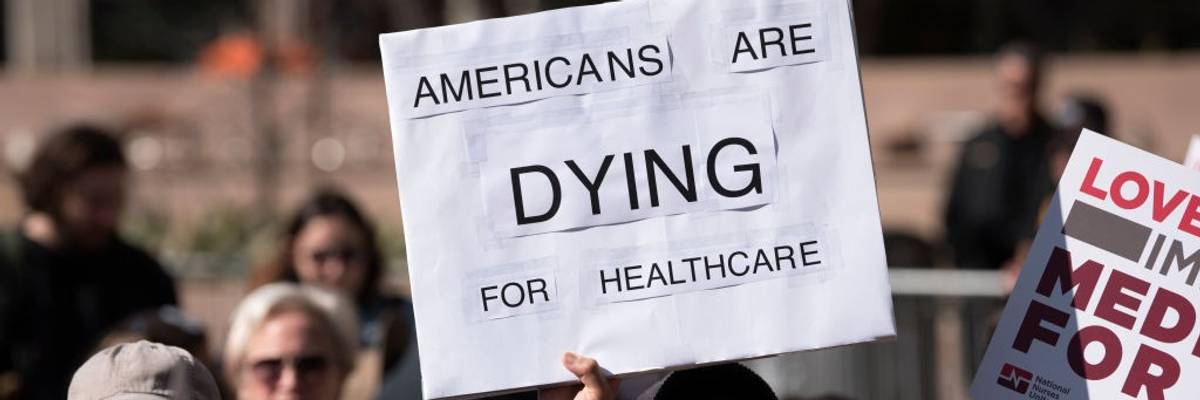
Participants hold signs in the Medicare for All Rally in Los Angeles California on February 4, 2017.
Unsurprisingly, Trump’s concepts of a plan don't even begin to reverse the damage he caused when he made massive cuts to Medicaid and the Affordable Care Act in order to fund tax cuts for billionaires.
President Donald Trump’s new “Great Health Care Plan” is anything but.
Unsurprisingly, Trump’s concepts of a plan fail to even begin to reverse the damage he caused when he made massive cuts to Medicaid and the Affordable Care Act in order to fund tax cuts for billionaires. Now, Trump and his Republican allies are trying to cover up the gaping wound they have created with a Band-Aid. At the same time, Americans are desperate for relief from Trumpflation, including rapidly rising healthcare costs.
Too many Americans struggle to get the healthcare they need even with insurance. A recent poll found that more than 1-in-3 adults in the US had skipped or postponed needed healthcare in the last 12 months because they couldn’t afford the cost. The situation is even more dire for the uninsured, with 75% of uninsured adults under age 65 reporting going without needed care because of the cost.
Shutdown negotiations and subsequent scattershot health ideas from the White House and Republicans in Congress show they have no real idea what to do when it comes to actually bringing down the cost of healthcare in America. President Trump’s half-baked plan appears doomed to fail and doesn’t even have the support of Republicans in Congress. Plus the only alternate Republican plans for healthcare that currently exist strictly serve corporations and fail to provide relief to patients.
Every other comparably wealthy country has some version of universal healthcare, and none of them would trade their systems for the wasteful and haphazard US system.
Meanwhile, the Trump administration has undertaken efforts to further privatize Medicare, including adding Medicare Advantage-style prior authorization to traditional Medicare, risking access to care for seniors by delaying and denying needed care. It also plans to place Medicare enrollees in private health contracts, similar to Medicare Advantage, where the corporations in charge are incentivized to place corporate profits ahead of patient needs.
Americans are angry about our broken healthcare system, and they want a comprehensive solution. One recent survey found that 65% of voters support a Medicare for All-style system. A similar number of voters said that the federal government right now does too little to ensure Americans can afford the healthcare they need. An in-depth study that looked across four years of data found that more than a quarter of adults went without needed care or experienced cost burdens for care they did receive over the four-year period of the study. The high cost of care and limited coverage leaves tens of millions of Americans without adequate coverage, and millions of them end up saddled with medical debt, something unheard of in other comparably wealthy countries. We need to take bold but commonsense action to finally guarantee that everyone in the US can get the healthcare they need.
Providers and hospitals are also desperate for reform. The cost of doing business in our broken healthcare system is causing hospitals to close or shutter crucial services. Providers are facing huge challenges as greedy profiteers, including private equity companies, gobble up their hospitals and medical practices and impose cost-cutting measures in the service of maximizing profits.
Fortunately, Medicare for All would address all of these issues and finally put the health of Americans ahead of corporate profits. Medicare for All would guarantee that everyone in the US can get the care they need when they need it, without financial barriers or hoops to jump through, and would be cheaper than our current system while providing coverage that is better than any commercial health insurance plan. It would do this by taking Medicare—one of the most popular parts of our healthcare system—improving it by expanding available services, ending out-of-pocket costs, and expanding it to everyone in the country.
Corporations and certain members of Congress purposefully make such a commonsense system sound like an impossible leap from America’s current broken system in order to stifle American dissatisfaction with our healthcare and keep shareholders happy. But every other comparably wealthy country has some version of universal healthcare, and none of them would trade their systems for the wasteful and haphazard US system.
We continue to see more members of Congress signing on to support Medicare for All in both the House and the Senate, and more municipalities supporting resolutions in favor of Congress passing Medicare for All. The time has come to unite around Medicare for All and build the movement that can finally make it a reality.
Dear Common Dreams reader, It’s been nearly 30 years since I co-founded Common Dreams with my late wife, Lina Newhouser. We had the radical notion that journalism should serve the public good, not corporate profits. It was clear to us from the outset what it would take to build such a project. No paid advertisements. No corporate sponsors. No millionaire publisher telling us what to think or do. Many people said we wouldn't last a year, but we proved those doubters wrong. Together with a tremendous team of journalists and dedicated staff, we built an independent media outlet free from the constraints of profits and corporate control. Our mission has always been simple: To inform. To inspire. To ignite change for the common good. Building Common Dreams was not easy. Our survival was never guaranteed. When you take on the most powerful forces—Wall Street greed, fossil fuel industry destruction, Big Tech lobbyists, and uber-rich oligarchs who have spent billions upon billions rigging the economy and democracy in their favor—the only bulwark you have is supporters who believe in your work. But here’s the urgent message from me today. It's never been this bad out there. And it's never been this hard to keep us going. At the very moment Common Dreams is most needed, the threats we face are intensifying. We need your support now more than ever. We don't accept corporate advertising and never will. We don't have a paywall because we don't think people should be blocked from critical news based on their ability to pay. Everything we do is funded by the donations of readers like you. When everyone does the little they can afford, we are strong. But if that support retreats or dries up, so do we. Will you donate now to make sure Common Dreams not only survives but thrives? —Craig Brown, Co-founder |
President Donald Trump’s new “Great Health Care Plan” is anything but.
Unsurprisingly, Trump’s concepts of a plan fail to even begin to reverse the damage he caused when he made massive cuts to Medicaid and the Affordable Care Act in order to fund tax cuts for billionaires. Now, Trump and his Republican allies are trying to cover up the gaping wound they have created with a Band-Aid. At the same time, Americans are desperate for relief from Trumpflation, including rapidly rising healthcare costs.
Too many Americans struggle to get the healthcare they need even with insurance. A recent poll found that more than 1-in-3 adults in the US had skipped or postponed needed healthcare in the last 12 months because they couldn’t afford the cost. The situation is even more dire for the uninsured, with 75% of uninsured adults under age 65 reporting going without needed care because of the cost.
Shutdown negotiations and subsequent scattershot health ideas from the White House and Republicans in Congress show they have no real idea what to do when it comes to actually bringing down the cost of healthcare in America. President Trump’s half-baked plan appears doomed to fail and doesn’t even have the support of Republicans in Congress. Plus the only alternate Republican plans for healthcare that currently exist strictly serve corporations and fail to provide relief to patients.
Every other comparably wealthy country has some version of universal healthcare, and none of them would trade their systems for the wasteful and haphazard US system.
Meanwhile, the Trump administration has undertaken efforts to further privatize Medicare, including adding Medicare Advantage-style prior authorization to traditional Medicare, risking access to care for seniors by delaying and denying needed care. It also plans to place Medicare enrollees in private health contracts, similar to Medicare Advantage, where the corporations in charge are incentivized to place corporate profits ahead of patient needs.
Americans are angry about our broken healthcare system, and they want a comprehensive solution. One recent survey found that 65% of voters support a Medicare for All-style system. A similar number of voters said that the federal government right now does too little to ensure Americans can afford the healthcare they need. An in-depth study that looked across four years of data found that more than a quarter of adults went without needed care or experienced cost burdens for care they did receive over the four-year period of the study. The high cost of care and limited coverage leaves tens of millions of Americans without adequate coverage, and millions of them end up saddled with medical debt, something unheard of in other comparably wealthy countries. We need to take bold but commonsense action to finally guarantee that everyone in the US can get the healthcare they need.
Providers and hospitals are also desperate for reform. The cost of doing business in our broken healthcare system is causing hospitals to close or shutter crucial services. Providers are facing huge challenges as greedy profiteers, including private equity companies, gobble up their hospitals and medical practices and impose cost-cutting measures in the service of maximizing profits.
Fortunately, Medicare for All would address all of these issues and finally put the health of Americans ahead of corporate profits. Medicare for All would guarantee that everyone in the US can get the care they need when they need it, without financial barriers or hoops to jump through, and would be cheaper than our current system while providing coverage that is better than any commercial health insurance plan. It would do this by taking Medicare—one of the most popular parts of our healthcare system—improving it by expanding available services, ending out-of-pocket costs, and expanding it to everyone in the country.
Corporations and certain members of Congress purposefully make such a commonsense system sound like an impossible leap from America’s current broken system in order to stifle American dissatisfaction with our healthcare and keep shareholders happy. But every other comparably wealthy country has some version of universal healthcare, and none of them would trade their systems for the wasteful and haphazard US system.
We continue to see more members of Congress signing on to support Medicare for All in both the House and the Senate, and more municipalities supporting resolutions in favor of Congress passing Medicare for All. The time has come to unite around Medicare for All and build the movement that can finally make it a reality.
President Donald Trump’s new “Great Health Care Plan” is anything but.
Unsurprisingly, Trump’s concepts of a plan fail to even begin to reverse the damage he caused when he made massive cuts to Medicaid and the Affordable Care Act in order to fund tax cuts for billionaires. Now, Trump and his Republican allies are trying to cover up the gaping wound they have created with a Band-Aid. At the same time, Americans are desperate for relief from Trumpflation, including rapidly rising healthcare costs.
Too many Americans struggle to get the healthcare they need even with insurance. A recent poll found that more than 1-in-3 adults in the US had skipped or postponed needed healthcare in the last 12 months because they couldn’t afford the cost. The situation is even more dire for the uninsured, with 75% of uninsured adults under age 65 reporting going without needed care because of the cost.
Shutdown negotiations and subsequent scattershot health ideas from the White House and Republicans in Congress show they have no real idea what to do when it comes to actually bringing down the cost of healthcare in America. President Trump’s half-baked plan appears doomed to fail and doesn’t even have the support of Republicans in Congress. Plus the only alternate Republican plans for healthcare that currently exist strictly serve corporations and fail to provide relief to patients.
Every other comparably wealthy country has some version of universal healthcare, and none of them would trade their systems for the wasteful and haphazard US system.
Meanwhile, the Trump administration has undertaken efforts to further privatize Medicare, including adding Medicare Advantage-style prior authorization to traditional Medicare, risking access to care for seniors by delaying and denying needed care. It also plans to place Medicare enrollees in private health contracts, similar to Medicare Advantage, where the corporations in charge are incentivized to place corporate profits ahead of patient needs.
Americans are angry about our broken healthcare system, and they want a comprehensive solution. One recent survey found that 65% of voters support a Medicare for All-style system. A similar number of voters said that the federal government right now does too little to ensure Americans can afford the healthcare they need. An in-depth study that looked across four years of data found that more than a quarter of adults went without needed care or experienced cost burdens for care they did receive over the four-year period of the study. The high cost of care and limited coverage leaves tens of millions of Americans without adequate coverage, and millions of them end up saddled with medical debt, something unheard of in other comparably wealthy countries. We need to take bold but commonsense action to finally guarantee that everyone in the US can get the healthcare they need.
Providers and hospitals are also desperate for reform. The cost of doing business in our broken healthcare system is causing hospitals to close or shutter crucial services. Providers are facing huge challenges as greedy profiteers, including private equity companies, gobble up their hospitals and medical practices and impose cost-cutting measures in the service of maximizing profits.
Fortunately, Medicare for All would address all of these issues and finally put the health of Americans ahead of corporate profits. Medicare for All would guarantee that everyone in the US can get the care they need when they need it, without financial barriers or hoops to jump through, and would be cheaper than our current system while providing coverage that is better than any commercial health insurance plan. It would do this by taking Medicare—one of the most popular parts of our healthcare system—improving it by expanding available services, ending out-of-pocket costs, and expanding it to everyone in the country.
Corporations and certain members of Congress purposefully make such a commonsense system sound like an impossible leap from America’s current broken system in order to stifle American dissatisfaction with our healthcare and keep shareholders happy. But every other comparably wealthy country has some version of universal healthcare, and none of them would trade their systems for the wasteful and haphazard US system.
We continue to see more members of Congress signing on to support Medicare for All in both the House and the Senate, and more municipalities supporting resolutions in favor of Congress passing Medicare for All. The time has come to unite around Medicare for All and build the movement that can finally make it a reality.