SUBSCRIBE TO OUR FREE NEWSLETTER
Daily news & progressive opinion—funded by the people, not the corporations—delivered straight to your inbox.
5
#000000
#FFFFFF
To donate by check, phone, or other method, see our More Ways to Give page.
Daily news & progressive opinion—funded by the people, not the corporations—delivered straight to your inbox.
Stefanie Spear, sspear@asyousow.org, 216-387-1609
Shareholder representative As You Sow recently filed resolutions at two of the largest integrated fossil fuel companies in the U.S. -- Exxon Mobil and Dow Inc. -- asking the companies to address the growing risks associated with investments in plastic and petrochemical infrastructure.
As You Sow's resolution with Exxon asks the company to address the potential for its petrochemical investments to become stranded due to trends including weakening demand growth for commodity plastics amidst a carbon- and plastic-constrained world, oversupply of plastic feedstocks, and rising opposition from civil society groups that have resulted in the delay of similar projects. As You Sow filed a similar resolution with Dow, noting the company's already large petrochemical presence in the Gulf Coast and its plans to expand.
"Investor concern is growing as both Exxon and Dow expand investments in plastics and petrochemicals," said Lila Holzman, Energy Program Manager of As You Sow. "These investments look increasingly risky in a world battered by climate impacts, plastic pollution, and stranded asset risk from overproduction and loss of social license. We are asking both Exxon and Dow how they will mitigate such risks."
Almost 90% of U.S. plastic capacity is concentrated along the Gulf Coast in areas that increasingly suffer from climate-induced sea level rise, storm surge, and severe storms. Petrochemical operations routinely emit hazardous pollutants including benzene, VOCs, and sulfur dioxide. Unplanned emissions occur before, during, and after extreme weather events -- posing serious health risks to surrounding communities. The implications of these risks have been seen in recent storms; during Hurricanes Harvey, Laura, and Delta, plants were flooded and forced to shut down, releasing unpermitted, unsafe levels of pollutants into the air and water.
"In spite of the risks, companies like Dow and Exxon continue to build dangerous infrastructure in zones battered by climate-strengthened storms," stated Holzman. "Both must provide assurance that nearby communities will be protected, as physical climate risks grow."
A similar As You Sow resolution filed with Exxon in 2019 and 2020 received strong support from shareholders, but no response from the company. In contrast, in 2020, Chevron Phillips Chemical Company (CPChem) responded to majority or near-majority votes at parent companies Phillips 66 and Chevron by issuing a report providing new information on its management of physical climate risks. Investors continue to seek enhancements to such reporting, as concern grows regarding the environmental impacts of plastic manufacturing, use, and disposal.
For more information on As You Sow's work on climate change, click here.
As You Sow is the nation's non-profit leader in shareholder advocacy. Founded in 1992, we harness shareholder power to create lasting change that benefits people, planet, and profit. Our mission is to promote environmental and social corporate responsibility through shareholder advocacy, coalition building, and innovative legal strategies.
One advocate called the bill an "important step forward in reducing historic, extreme, and democracy-destabilizing levels of economic inequality in America."
In a move cheered by economic justice advocates, US Sen. Ed Markey on Tuesday introduced the Senate version of the bicameral Equal Tax Act, a bill that would "create equal tax rates for all forms of income for individuals with incomes over $1 million."
"The wealthiest individuals in our society use loopholes and tax dodging schemes to avoid paying their fair share," Markey (D-Mass.) said in an introduction to the bill. "They get away with it because our tax code rewards wealth over work—giving breaks to those that trade stocks over those that punch clocks."
The legislation—which was first introduced in the House of Representatives last year by Rep. Delia Ramirez (D-Ill.)—seeks to make the tax code more fair by making billionaires and multimillionaires pay income tax on passive investments, as if they earned their money through labor, by raising the top marginal rate from the current 20% to 37%.
Right now, billionaires can pay less in taxes on their stock trades than teachers or nurses that educate our children and care for us in emergencies. My Equal Tax Act would stop rewarding wealth more than work by making the ultra-wealthy pay taxes like millions of working people.
[image or embed]
— Senator Ed Markey (@markey.senate.gov) March 17, 2026 at 2:54 PM
Specifically, the Equal Tax Act would:
"Teachers, nurses, and millions of working people are the ones who keep our country running, but our tax code rewards wealth over work,” said Markey. “The Equal Tax Act brings fairness to our tax code by requiring millionaires and billionaires to pay taxes on investment income the same way working people pay taxes on income from their labor."
Ramirez noted how plutocrats like President Donald Trump and tech titans Elon Musk, Jeff Bezos, and Mark Zuckerberg "have extorted tax benefits from the American people."
"For far too long, they have exploited an unfair tax system that makes the rich richer at the expense of working families," the congresswoman added. "It is time we ensure that the ultrawealthy pay their fair share. I am excited to work with Sen. Markey in the bicameral introduction of the Equal Tax Act to build a fairer tax system that ensures working families have everything they need to thrive."
Morris Pearl, chair of the fair taxation advocacy group Patriotic Millionaires, said in a statement, “For decades, we have been playing a game of economic Jenga where we pull from the bottom and the middle, load it all on top, and then wonder why the whole thing is about to fall down."
"We end up with an unfair system that allows for oligarchic wealth to concentrate in the hands of a few individuals," Pearl continued. "That’s because right now in America, our tax code makes people who have jobs and work for a living pay far higher tax rates than people who make money from investments or inheritances."
"The money that investors like me make passively from our wealth should not be taxed any less than the money millions of Americans make through their sweat," he asserted. "By closing major loopholes, the Equal Tax Act would ensure that the ultrarich pay income taxes just like all Americans who work for a living and have taxes deducted from their paychecks every week."
"The Patriotic Millionaires are thrilled to see Sen. Markey take this important step forward in reducing historic, extreme, and democracy-destabilizing levels of economic inequality in America," Pearl added.
"Management refuses to agree to a new contract with essential work protections and fair wages," said the workers' negotiating team.
Unionized workers with CBS News' streaming channel began a bicoastal one-day walkout Tuesday morning after unsuccessful negotiations for a "fair and just" contract under Bari Weiss, who has faced intense criticism on a range of topics since taking over as editor-in-chief.
CBS News is part of the media behemoth Paramount Skydance, which was formed in a controversial merger last August. Two months later, the company acquired Weiss' The Free Press, and CEO David Ellison appointed her to also lead all of CBS News, despite her lack of television experience.
The latest contract for the streaming channel, CBS News 24/7, expired last week, after which the workers delivered a strike pledge. Tuesday's 24-hour walkout—with rallies at CBS News Broadcast Center in New York City and at KPIX-TV CBS News Bay Area in San Francisco, California—kicked off at 6:00 am Eastern time.
"CBS News 24/7 journalists are walking off the job on both coasts today because management refuses to agree to a new contract with essential work protections and fair wages," the bargaining committee and contract action team said in a statement from Writers Guild of America East (WGAE).
"Despite multiple days of good-faith negotiations and a strike pledge signed by 95% of our members to emphasize the seriousness of our demands, management continues to offer us worse terms than in our last contracts," the team said. "We chose this field to cover the news, but we believe this work stoppage is necessary to achieve a fair contract. We eagerly await an acceptable contract offer from Paramount—which just shelled out tens of billions of dollars to acquire Warner Bros. Discovery."
Deadline explained that "the newsroom has undergone rounds of layoffs and buyouts, and more are expected. There also are fears of further downsizing when Paramount completes its deal to buy Warner Bros. Discovery, given that will leave the company with two global news outlets, CBS News and CNN."
Beth Godvik, WGAE vice president of broadcast/cable/streaming news, called out Paramount for striking a $110 billion deal with Warner Bros. Discovery while it "still hasn't guaranteed fair wages and basic job protections for the workers who make their streaming news operation run."
"Our members are walking out today to show management they stand united in their demand for a fair contract—and the WGAE is with them every step of the way," said Godvik.
As The Wrap noted:
The battle puts Weiss, an opinion journalist who had no TV news experience before she became CBS News' editor-in-chief last October, in the position of negotiating with a union under her purview for the first time. The union dispute comes as the network has already been rocked by star departures and scrutiny over its coverage.
The Free Press, the anti-woke outlet Weiss cofounded and still leads, is not unionized, while CBS News has four main bargaining units, including the Writers Guild of America-backed CBS News 24/7, which launched in 2014 and rebroadcasts CBS News shows like "60 Minutes" and "CBS Mornings" along with original shows like "The Takeout with Major Garrett."
A CBS News spokesperson told The Guardian that "we continue to negotiate in good faith and hope to reach a fair resolution quickly."
Meanwhile, multiple members of Congress expressed support for the work stoppage on social media.
"If Paramount can shell out billions of dollars to acquire Warner Bros. Discovery, then they can pay their unionized CBS staff a fair wage," said Rep. Alexandria Ocasio-Cortez (D-NY). "I stand with the CBS staff who walked out today as they fight these corporate giants for essential protections and fair contracts."
Rep. Jerry Nadler (D-NY) declared that "American workers deserve fair pay and basic protections—full stop. I stand with the 60 CBS News 24/7 journalists walking off the job today in New York and San Francisco. Paramount is finalizing a $110 BILLION deal but can't give its own workers a fair contract?"
These robots, known as "quadrupeds," are being used to patrol the sprawling energy-sucking complexes, which are increasingly being met with protest around the country.
As Americans grow fed up with the rapid encroachment of artificial intelligence data centers into their communities, tech companies are embracing a novel solution to protect their energy-sucking behemoths from danger: Even more robots... robot dogs, to be exact.
According to a report from Business Insider on Monday:
As companies pour billions into sprawling industrial campuses for cloud and AI computing, some data center operators are experimenting with four-legged bots—about the size of large dogs—that can patrol fences, inspect equipment, and flag any issues before they turn into costly outages.
These robots, known as "quadrupeds," are being used to patrol the complexes, which can sometimes reach the size of multiple football fields.
According to Fortune, tech companies are already pouring nearly $700 billion into building data centers across the US and are now spending hundreds of thousands of dollars more to enlist mechanical canines as security forces.
One model from Boston Dynamics, known as "Spot," can cost anywhere from $175,000 to $300,000. And while the technology may seem futuristic, Spot and other quadrupeds like it have already been enlisted in law enforcement and public safety for years.
Another company—Ghost Robotics—advertises its quadrupeds for "reconnaissance, intelligence, and surveillance use by the military."
With more than 5,000 data centers now in the US and 800-1,000 new ones in the process of being built, Michael Subhan, the chief growth officer for Ghost Robotics, told Business Insider he expects boom times are ahead for his industry.
As data centers expand their reach at breakneck speed, there may be more interlopers for the programmable pooches to sniff out.
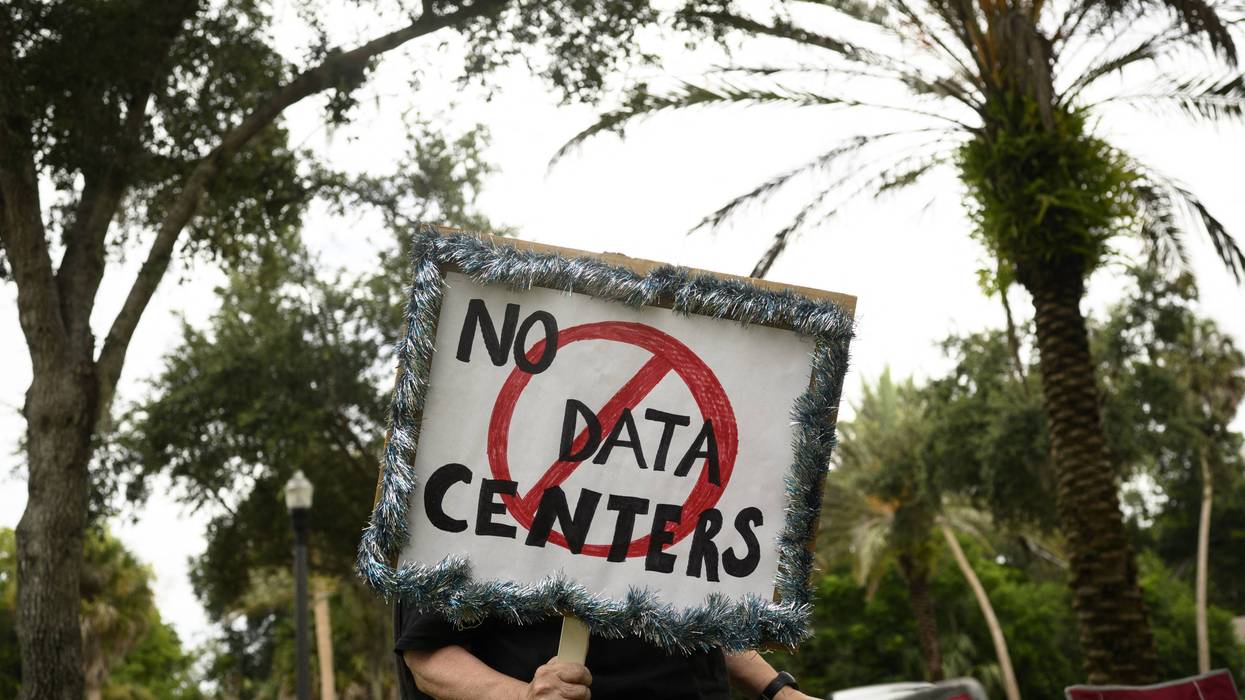
Due to skyrocketing energy costs and water shortages in places where large data centers have been built, the sites of proposed projects from Illinois to Minnesota to South Carolina have drawn crowds of dozens and even hundreds of demonstrators in recent weeks.