SUBSCRIBE TO OUR FREE NEWSLETTER
Daily news & progressive opinion—funded by the people, not the corporations—delivered straight to your inbox.
5
#000000
#FFFFFF
To donate by check, phone, or other method, see our More Ways to Give page.
Daily news & progressive opinion—funded by the people, not the corporations—delivered straight to your inbox.
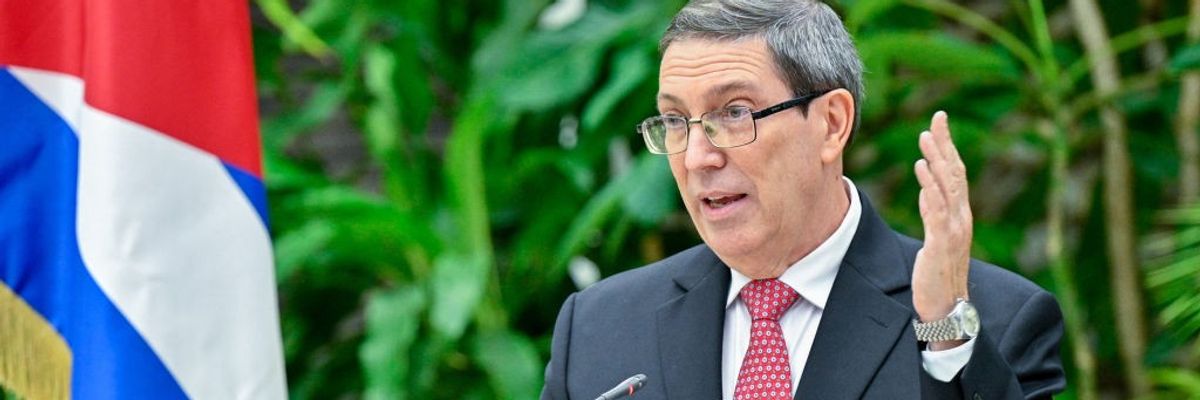
Cuban Foreign Minister Bruno Rodríguez speaks during a press conference on the impact of the U.S. embargo in Havana on September 12, 2024.
"The world has spoken—it's time for the U.S. to listen and lift the blockade."
The United Nations General Assembly on Wednesday once again overwhelmingly urged the U.S. government to end its decadeslong blockade on Cuba, with just the United States and Israel voting against the measure and Moldova abstaining.
The UNGA's other 187 members present voted to adopt the nonbinding resolution on "the necessity of ending the economic, commercial, and financial embargo imposed by the United States" against the Caribbean island.
This is the 32nd straight year that the U.N. body has approved a resolution against the embargo that began in 1962.
"The U.S. and Israel stand isolated as the only two votes against," Democratic Socialists of America's International Committee said after the Wednesday vote. "The world has spoken—it's time for the U.S. to listen and lift the blockade."
Though a few other nations have
opposed the resolution over the years, Michael Galant of Progressive International and the Center for Economic and Policy Research noted that this vote was "two genocidaires v. the world."
Israel faces a genocide case at the International Court of Justice for its yearlong assault of the Gaza Strip, which has killed at least 43,163 Palestinians and injured another 101,510, according to local officials in the Hamas-governed enclave. The U.S. Congress and Biden administration have given Israel billions of dollars in weapons and opposed U.N. cease-fire resolutions.
CodePink's Medea Benjaminresponded to the Wednesday vote with a video shared on social media, saying that Israel "loves blockades, because it's doing its own blockade of Gaza," and "is dependent on the United States to carry out its genocide."
"Now this is not just some idle vote," she said of the approved resolution. "This blockade that the U.S. maintains is a form of economic warfare. It's no exaggeration to say that now, when there is an economic crisis in Cuba, the U.S. blockade, which keeps Cuba from using the financial markets, from having normal trade with countries all over the world, is actually leading to deaths, leading to people going hungry, leading to people lacking food and medicine that are essential for their lives."
"And that's why the United States must be condemned for this ongoing horrific, inhumane, and illegal blockade," Benjamin added.
Cuba's representative delivered similar remarks to the UNGA on Wednesday. As
Reuters reported:
Cuban Foreign Minister Bruno Rodríguez said in a speech before the assembly that what is often referred to as the U.S. trade embargo is a "blockade" because the web of laws and regulations complicate financial transactions and the acquisition of goods and services not just from the United States but internationally.
"The blockade against Cuba is an economic, financial, and trade war which qualifies as genocide," said Rodriguez, charging the U.S. policies were deliberately aimed at promoting suffering among the Cuban people to force change in the government.
Some international observers praised the countries who did condemn the blockade. Middle East expert Assal Rad declared, "This is the real international community."
Manolo De Los Santos, a founder of the People's Forum and a researcher at Tricontinental: Institute for Social Research, said that "this overwhelming consensus is in contrast with the indifference of the United States, which continues to deny any responsibility for sanctions while tightening its stranglehold on Cuba."
Earlier this month, the People's Forum published a letter in The New York Times to U.S. President Joe Biden, warning that he has "exactly 90 days to reverse" former Republican President Donald Trump's "brutal policy on Cuba."
Biden was vice president a decade ago when then-President Barack Obama "opened a hopeful new chapter in U.S.-Cuba relations by taking the first steps toward normalization," the letter details. "People in both countries were optimistic that Cuba and the United States could become neighbors rather than Cold War enemies. However, Trump dismantled that policy, imposing pain and suffering on the Cuban people."
"Removing the state sponsors of terrorism designation would allow Cuba to engage in financial transactions and restore its electrical grid, as well as address shortages of food and medicine to alleviate the immense hardship faced by the Cuban people, who have endured over 62 years of economic strife under the embargo," the letter adds. "It's time to act. Let Cuba live!"
Biden faced similar pressure in August, when hundreds of legal experts and groups called on him "to comply with existing international law by ending the use of broad unilateral coercive measures" particularly in "cases such as Cuba, Iran, North Korea, Syria, and Venezuela."
The U.N. vote comes as early voting is underway for the November 5 election in which Trump is facing Biden's vice president, Kamala Harris.
Neither campaign provided details on each candidate's position when contacted by Reuters earlier this week, though Morgan Finkelstein, national security spokesperson for Harris, said that the Democrat "stands with the people of Cuba as they fight for their rights after decades of repression and economic suffering at the hands of the communist regime" and "will stand up to all authoritarians—including the very leaders that Trump has praised and embraced."
Dear Common Dreams reader, It’s been nearly 30 years since I co-founded Common Dreams with my late wife, Lina Newhouser. We had the radical notion that journalism should serve the public good, not corporate profits. It was clear to us from the outset what it would take to build such a project. No paid advertisements. No corporate sponsors. No millionaire publisher telling us what to think or do. Many people said we wouldn't last a year, but we proved those doubters wrong. Together with a tremendous team of journalists and dedicated staff, we built an independent media outlet free from the constraints of profits and corporate control. Our mission has always been simple: To inform. To inspire. To ignite change for the common good. Building Common Dreams was not easy. Our survival was never guaranteed. When you take on the most powerful forces—Wall Street greed, fossil fuel industry destruction, Big Tech lobbyists, and uber-rich oligarchs who have spent billions upon billions rigging the economy and democracy in their favor—the only bulwark you have is supporters who believe in your work. But here’s the urgent message from me today. It's never been this bad out there. And it's never been this hard to keep us going. At the very moment Common Dreams is most needed, the threats we face are intensifying. We need your support now more than ever. We don't accept corporate advertising and never will. We don't have a paywall because we don't think people should be blocked from critical news based on their ability to pay. Everything we do is funded by the donations of readers like you. When everyone does the little they can afford, we are strong. But if that support retreats or dries up, so do we. Will you donate now to make sure Common Dreams not only survives but thrives? —Craig Brown, Co-founder |
The United Nations General Assembly on Wednesday once again overwhelmingly urged the U.S. government to end its decadeslong blockade on Cuba, with just the United States and Israel voting against the measure and Moldova abstaining.
The UNGA's other 187 members present voted to adopt the nonbinding resolution on "the necessity of ending the economic, commercial, and financial embargo imposed by the United States" against the Caribbean island.
This is the 32nd straight year that the U.N. body has approved a resolution against the embargo that began in 1962.
"The U.S. and Israel stand isolated as the only two votes against," Democratic Socialists of America's International Committee said after the Wednesday vote. "The world has spoken—it's time for the U.S. to listen and lift the blockade."
Though a few other nations have
opposed the resolution over the years, Michael Galant of Progressive International and the Center for Economic and Policy Research noted that this vote was "two genocidaires v. the world."
Israel faces a genocide case at the International Court of Justice for its yearlong assault of the Gaza Strip, which has killed at least 43,163 Palestinians and injured another 101,510, according to local officials in the Hamas-governed enclave. The U.S. Congress and Biden administration have given Israel billions of dollars in weapons and opposed U.N. cease-fire resolutions.
CodePink's Medea Benjaminresponded to the Wednesday vote with a video shared on social media, saying that Israel "loves blockades, because it's doing its own blockade of Gaza," and "is dependent on the United States to carry out its genocide."
"Now this is not just some idle vote," she said of the approved resolution. "This blockade that the U.S. maintains is a form of economic warfare. It's no exaggeration to say that now, when there is an economic crisis in Cuba, the U.S. blockade, which keeps Cuba from using the financial markets, from having normal trade with countries all over the world, is actually leading to deaths, leading to people going hungry, leading to people lacking food and medicine that are essential for their lives."
"And that's why the United States must be condemned for this ongoing horrific, inhumane, and illegal blockade," Benjamin added.
Cuba's representative delivered similar remarks to the UNGA on Wednesday. As
Reuters reported:
Cuban Foreign Minister Bruno Rodríguez said in a speech before the assembly that what is often referred to as the U.S. trade embargo is a "blockade" because the web of laws and regulations complicate financial transactions and the acquisition of goods and services not just from the United States but internationally.
"The blockade against Cuba is an economic, financial, and trade war which qualifies as genocide," said Rodriguez, charging the U.S. policies were deliberately aimed at promoting suffering among the Cuban people to force change in the government.
Some international observers praised the countries who did condemn the blockade. Middle East expert Assal Rad declared, "This is the real international community."
Manolo De Los Santos, a founder of the People's Forum and a researcher at Tricontinental: Institute for Social Research, said that "this overwhelming consensus is in contrast with the indifference of the United States, which continues to deny any responsibility for sanctions while tightening its stranglehold on Cuba."
Earlier this month, the People's Forum published a letter in The New York Times to U.S. President Joe Biden, warning that he has "exactly 90 days to reverse" former Republican President Donald Trump's "brutal policy on Cuba."
Biden was vice president a decade ago when then-President Barack Obama "opened a hopeful new chapter in U.S.-Cuba relations by taking the first steps toward normalization," the letter details. "People in both countries were optimistic that Cuba and the United States could become neighbors rather than Cold War enemies. However, Trump dismantled that policy, imposing pain and suffering on the Cuban people."
"Removing the state sponsors of terrorism designation would allow Cuba to engage in financial transactions and restore its electrical grid, as well as address shortages of food and medicine to alleviate the immense hardship faced by the Cuban people, who have endured over 62 years of economic strife under the embargo," the letter adds. "It's time to act. Let Cuba live!"
Biden faced similar pressure in August, when hundreds of legal experts and groups called on him "to comply with existing international law by ending the use of broad unilateral coercive measures" particularly in "cases such as Cuba, Iran, North Korea, Syria, and Venezuela."
The U.N. vote comes as early voting is underway for the November 5 election in which Trump is facing Biden's vice president, Kamala Harris.
Neither campaign provided details on each candidate's position when contacted by Reuters earlier this week, though Morgan Finkelstein, national security spokesperson for Harris, said that the Democrat "stands with the people of Cuba as they fight for their rights after decades of repression and economic suffering at the hands of the communist regime" and "will stand up to all authoritarians—including the very leaders that Trump has praised and embraced."
The United Nations General Assembly on Wednesday once again overwhelmingly urged the U.S. government to end its decadeslong blockade on Cuba, with just the United States and Israel voting against the measure and Moldova abstaining.
The UNGA's other 187 members present voted to adopt the nonbinding resolution on "the necessity of ending the economic, commercial, and financial embargo imposed by the United States" against the Caribbean island.
This is the 32nd straight year that the U.N. body has approved a resolution against the embargo that began in 1962.
"The U.S. and Israel stand isolated as the only two votes against," Democratic Socialists of America's International Committee said after the Wednesday vote. "The world has spoken—it's time for the U.S. to listen and lift the blockade."
Though a few other nations have
opposed the resolution over the years, Michael Galant of Progressive International and the Center for Economic and Policy Research noted that this vote was "two genocidaires v. the world."
Israel faces a genocide case at the International Court of Justice for its yearlong assault of the Gaza Strip, which has killed at least 43,163 Palestinians and injured another 101,510, according to local officials in the Hamas-governed enclave. The U.S. Congress and Biden administration have given Israel billions of dollars in weapons and opposed U.N. cease-fire resolutions.
CodePink's Medea Benjaminresponded to the Wednesday vote with a video shared on social media, saying that Israel "loves blockades, because it's doing its own blockade of Gaza," and "is dependent on the United States to carry out its genocide."
"Now this is not just some idle vote," she said of the approved resolution. "This blockade that the U.S. maintains is a form of economic warfare. It's no exaggeration to say that now, when there is an economic crisis in Cuba, the U.S. blockade, which keeps Cuba from using the financial markets, from having normal trade with countries all over the world, is actually leading to deaths, leading to people going hungry, leading to people lacking food and medicine that are essential for their lives."
"And that's why the United States must be condemned for this ongoing horrific, inhumane, and illegal blockade," Benjamin added.
Cuba's representative delivered similar remarks to the UNGA on Wednesday. As
Reuters reported:
Cuban Foreign Minister Bruno Rodríguez said in a speech before the assembly that what is often referred to as the U.S. trade embargo is a "blockade" because the web of laws and regulations complicate financial transactions and the acquisition of goods and services not just from the United States but internationally.
"The blockade against Cuba is an economic, financial, and trade war which qualifies as genocide," said Rodriguez, charging the U.S. policies were deliberately aimed at promoting suffering among the Cuban people to force change in the government.
Some international observers praised the countries who did condemn the blockade. Middle East expert Assal Rad declared, "This is the real international community."
Manolo De Los Santos, a founder of the People's Forum and a researcher at Tricontinental: Institute for Social Research, said that "this overwhelming consensus is in contrast with the indifference of the United States, which continues to deny any responsibility for sanctions while tightening its stranglehold on Cuba."
Earlier this month, the People's Forum published a letter in The New York Times to U.S. President Joe Biden, warning that he has "exactly 90 days to reverse" former Republican President Donald Trump's "brutal policy on Cuba."
Biden was vice president a decade ago when then-President Barack Obama "opened a hopeful new chapter in U.S.-Cuba relations by taking the first steps toward normalization," the letter details. "People in both countries were optimistic that Cuba and the United States could become neighbors rather than Cold War enemies. However, Trump dismantled that policy, imposing pain and suffering on the Cuban people."
"Removing the state sponsors of terrorism designation would allow Cuba to engage in financial transactions and restore its electrical grid, as well as address shortages of food and medicine to alleviate the immense hardship faced by the Cuban people, who have endured over 62 years of economic strife under the embargo," the letter adds. "It's time to act. Let Cuba live!"
Biden faced similar pressure in August, when hundreds of legal experts and groups called on him "to comply with existing international law by ending the use of broad unilateral coercive measures" particularly in "cases such as Cuba, Iran, North Korea, Syria, and Venezuela."
The U.N. vote comes as early voting is underway for the November 5 election in which Trump is facing Biden's vice president, Kamala Harris.
Neither campaign provided details on each candidate's position when contacted by Reuters earlier this week, though Morgan Finkelstein, national security spokesperson for Harris, said that the Democrat "stands with the people of Cuba as they fight for their rights after decades of repression and economic suffering at the hands of the communist regime" and "will stand up to all authoritarians—including the very leaders that Trump has praised and embraced."