SUBSCRIBE TO OUR FREE NEWSLETTER
Daily news & progressive opinion—funded by the people, not the corporations—delivered straight to your inbox.
5
#000000
#FFFFFF
To donate by check, phone, or other method, see our More Ways to Give page.
Daily news & progressive opinion—funded by the people, not the corporations—delivered straight to your inbox.
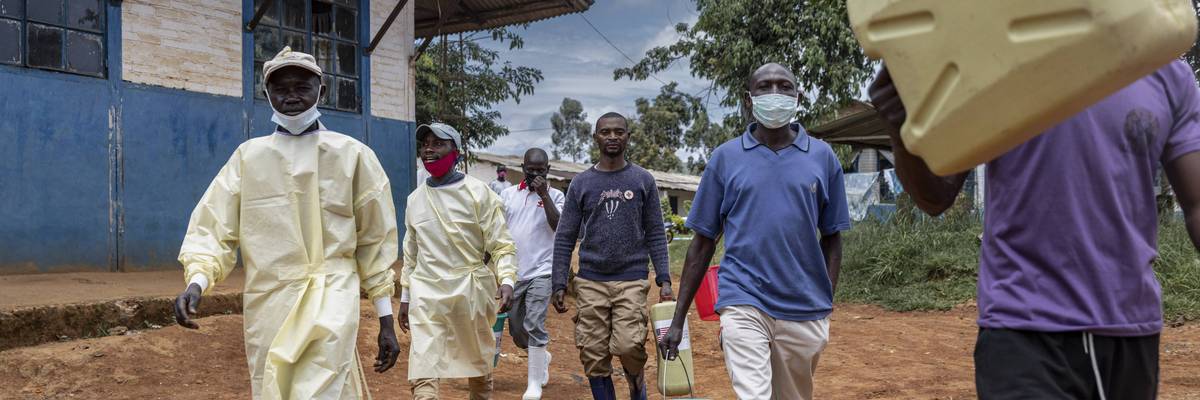
Health workers and local volunteers carry disinfectant containers and sanitation equipment outside the General Referral Hospital during the Ebola outbreak response on May 21, 2026 in Mongbwalu, Democratic Republic of Congo.
"Unsure how any US citizen would feel comfortable deploying" to help fight the outbreak, said one doctor, "knowing our government would not make sure they are okay if something happened."
The United Nations' emergency relief office on Thursday was mobilizing $60 million to fight the rapidly spreading Ebola outbreak in the Democratic Republic of Congo, with the body's under-secretary-general for humanitarian affairs saying relief teams are "fully mobilized" and "applying lessons from previous outbreaks," with a focus on building community trust and communicating with governments.
But with the Trump administration having dismantled the US Agency for International Development (USAID) and slashed funding and staffing for the Center for Disease Control and Prevention's (CDC) global efforts, the response is largely missing a key feature that helped with containment during the 2014 and 2019 outbreaks—the involvement of the US government and public health teams—and Secretary of State Marco Rubio signaled on Thursday that was unlikely to change.
In comments to the press, Rubio said the Trump administration's top priority is that Ebola doesn't reach the US—even if that means imposing travel restrictions against the guidance of the World Health Organization (WHO)—and described an approach that one disaster relief leader said was antithetical to the actions the US took in previous Ebola outbreaks.
"Our number-one objective on Ebola, before anything else, and we think it's terrible what's happening there to the people... Our number-one thing has to be, we can't have it affect the United States," said Rubio. "We can't have Ebola cases coming here."
Rubio: "We can't have ebola cases here. In fact, I think we had a flight last night headed to Detroit that was diverted." pic.twitter.com/S84FmWIq5b
— Aaron Rupar (@atrupar) May 21, 2026
The secretary of state noted that an Air France flight that had been headed for Detroit was diverted to Montreal on Wednesday after a passenger from Congo was found to have boarded the plane "in error."
The Department of Homeland Security announced new restrictions this week saying that all travelers who have been in the DRC, Uganda, and South Sudan in the past 21 days—including US citizens and permanent residents—can only enter the US through Washington Dulles International Airport.
When WHO declared the Ebola outbreak a public emergency of international concern last weekend, the agency noted that "no country should close its borders or place any restrictions on travel and trade."
"Such measures are usually implemented out of fear and have no basis in science," said WHO in its guidance, which also noted "state parties should be prepared to facilitate the evacuation and repatriation of nationals (e.g. health workers) who have been exposed" to Ebola.
Jeremy Konyndyk, president of Refugees International and a former USAID disaster relief official, said the message sent by Rubio was "insanely counterproductive."
By sending the message that the US is prioritizing that Ebola stays outside US borders above all, said Konyndyk, the Trump administration is telling "any US health workers that if they get infected trying to contain the outbreak, they won't be allowed home."
"In the 2014 outbreak we did the opposite, because we knew that posture would undermine the response and extend the outbreak," he said.
Dr. Krutika Kuppalli, who specializes in infectious diseases and deployed to West Africa in 2014 to help fight the Ebola outbreak that killed more than 11,000 people, said she did so "with the understanding that if something happened my government would take care of me."
"Unsure how any US citizen would feel comfortable deploying, knowing our government would not make sure they are okay if something happened," said Kuppalli.
The Trump administration's refusal to directly help US healthcare workers impacted by the outbreak has already resulted in two doctors being sent to European countries including Germany and the Czech Republic for treatment.
As he emphasized that Ebola cannot reach US shores, Rubio sent out messages of thanks to German and Czech officials for admitting the two medical workers to their hospitals.
With more than 170 deaths and about 750 infections suspected in the "rapidly" spreading Ebola outbreak and cases reported in Uganda as well as the DRC, public health experts are warning that the crisis is likely to "get worse before it gets better" and that its impact has likely already reached farther than initial numbers show due to a lack of surveillance on the ground.
Former CDC Director Robert Redfield told NewsNation on Thursday that "normally when we have these Ebola outbreaks, and I had three of them when I was CDC director, all of which were in the DRC, normally we recognize them when we have five, 10 cases, you know, at most."
"This one really wasn’t picked up until there was over 100 cases," he said.
WHO Director General Tedros Adhanom Ghebreyesus said Friday that the risk assessment for Ebola is "very high at the national level, high at the regional level and low at the global level."
As Common Dreams reported earlier this week, experts have pointed to President Donald Trump's cuts to foreign assistance and public health initiatives as reasons the outbreak had already spread as far as it did when the emergency was declared this week.
The State Department announced on Monday it was mobilizing $13 million in assistance to help contain the outbreak; the US spent more than $5 billion to fight to 2014 epidemic that hit several countries in West Africa.
"The United States cannot quickly reverse our abdication of leadership on the global health stage," wrote Dr. Craig Spencer, an emergency medicine physician who helped treat Ebola patients in 2014 and survived the disease himself. "But we can bolster our response to this crisis. There should be a steadfast commitment to working closely and coordinating with essential partners like the WHO. We need to mobilize funding and experts, speed up the development of new treatments, and increase resources for protective equipment and expanded testing."
Dear Common Dreams reader, It’s been nearly 30 years since I co-founded Common Dreams with my late wife, Lina Newhouser. We had the radical notion that journalism should serve the public good, not corporate profits. It was clear to us from the outset what it would take to build such a project. No paid advertisements. No corporate sponsors. No millionaire publisher telling us what to think or do. Many people said we wouldn't last a year, but we proved those doubters wrong. Together with a tremendous team of journalists and dedicated staff, we built an independent media outlet free from the constraints of profits and corporate control. Our mission has always been simple: To inform. To inspire. To ignite change for the common good. Building Common Dreams was not easy. Our survival was never guaranteed. When you take on the most powerful forces—Wall Street greed, fossil fuel industry destruction, Big Tech lobbyists, and uber-rich oligarchs who have spent billions upon billions rigging the economy and democracy in their favor—the only bulwark you have is supporters who believe in your work. But here’s the urgent message from me today. It's never been this bad out there. And it's never been this hard to keep us going. At the very moment Common Dreams is most needed, the threats we face are intensifying. We need your support now more than ever. We don't accept corporate advertising and never will. We don't have a paywall because we don't think people should be blocked from critical news based on their ability to pay. Everything we do is funded by the donations of readers like you. When everyone does the little they can afford, we are strong. But if that support retreats or dries up, so do we. Will you donate now to make sure Common Dreams not only survives but thrives? —Craig Brown, Co-founder |
The United Nations' emergency relief office on Thursday was mobilizing $60 million to fight the rapidly spreading Ebola outbreak in the Democratic Republic of Congo, with the body's under-secretary-general for humanitarian affairs saying relief teams are "fully mobilized" and "applying lessons from previous outbreaks," with a focus on building community trust and communicating with governments.
But with the Trump administration having dismantled the US Agency for International Development (USAID) and slashed funding and staffing for the Center for Disease Control and Prevention's (CDC) global efforts, the response is largely missing a key feature that helped with containment during the 2014 and 2019 outbreaks—the involvement of the US government and public health teams—and Secretary of State Marco Rubio signaled on Thursday that was unlikely to change.
In comments to the press, Rubio said the Trump administration's top priority is that Ebola doesn't reach the US—even if that means imposing travel restrictions against the guidance of the World Health Organization (WHO)—and described an approach that one disaster relief leader said was antithetical to the actions the US took in previous Ebola outbreaks.
"Our number-one objective on Ebola, before anything else, and we think it's terrible what's happening there to the people... Our number-one thing has to be, we can't have it affect the United States," said Rubio. "We can't have Ebola cases coming here."
Rubio: "We can't have ebola cases here. In fact, I think we had a flight last night headed to Detroit that was diverted." pic.twitter.com/S84FmWIq5b
— Aaron Rupar (@atrupar) May 21, 2026
The secretary of state noted that an Air France flight that had been headed for Detroit was diverted to Montreal on Wednesday after a passenger from Congo was found to have boarded the plane "in error."
The Department of Homeland Security announced new restrictions this week saying that all travelers who have been in the DRC, Uganda, and South Sudan in the past 21 days—including US citizens and permanent residents—can only enter the US through Washington Dulles International Airport.
When WHO declared the Ebola outbreak a public emergency of international concern last weekend, the agency noted that "no country should close its borders or place any restrictions on travel and trade."
"Such measures are usually implemented out of fear and have no basis in science," said WHO in its guidance, which also noted "state parties should be prepared to facilitate the evacuation and repatriation of nationals (e.g. health workers) who have been exposed" to Ebola.
Jeremy Konyndyk, president of Refugees International and a former USAID disaster relief official, said the message sent by Rubio was "insanely counterproductive."
By sending the message that the US is prioritizing that Ebola stays outside US borders above all, said Konyndyk, the Trump administration is telling "any US health workers that if they get infected trying to contain the outbreak, they won't be allowed home."
"In the 2014 outbreak we did the opposite, because we knew that posture would undermine the response and extend the outbreak," he said.
Dr. Krutika Kuppalli, who specializes in infectious diseases and deployed to West Africa in 2014 to help fight the Ebola outbreak that killed more than 11,000 people, said she did so "with the understanding that if something happened my government would take care of me."
"Unsure how any US citizen would feel comfortable deploying, knowing our government would not make sure they are okay if something happened," said Kuppalli.
The Trump administration's refusal to directly help US healthcare workers impacted by the outbreak has already resulted in two doctors being sent to European countries including Germany and the Czech Republic for treatment.
As he emphasized that Ebola cannot reach US shores, Rubio sent out messages of thanks to German and Czech officials for admitting the two medical workers to their hospitals.
With more than 170 deaths and about 750 infections suspected in the "rapidly" spreading Ebola outbreak and cases reported in Uganda as well as the DRC, public health experts are warning that the crisis is likely to "get worse before it gets better" and that its impact has likely already reached farther than initial numbers show due to a lack of surveillance on the ground.
Former CDC Director Robert Redfield told NewsNation on Thursday that "normally when we have these Ebola outbreaks, and I had three of them when I was CDC director, all of which were in the DRC, normally we recognize them when we have five, 10 cases, you know, at most."
"This one really wasn’t picked up until there was over 100 cases," he said.
WHO Director General Tedros Adhanom Ghebreyesus said Friday that the risk assessment for Ebola is "very high at the national level, high at the regional level and low at the global level."
As Common Dreams reported earlier this week, experts have pointed to President Donald Trump's cuts to foreign assistance and public health initiatives as reasons the outbreak had already spread as far as it did when the emergency was declared this week.
The State Department announced on Monday it was mobilizing $13 million in assistance to help contain the outbreak; the US spent more than $5 billion to fight to 2014 epidemic that hit several countries in West Africa.
"The United States cannot quickly reverse our abdication of leadership on the global health stage," wrote Dr. Craig Spencer, an emergency medicine physician who helped treat Ebola patients in 2014 and survived the disease himself. "But we can bolster our response to this crisis. There should be a steadfast commitment to working closely and coordinating with essential partners like the WHO. We need to mobilize funding and experts, speed up the development of new treatments, and increase resources for protective equipment and expanded testing."
The United Nations' emergency relief office on Thursday was mobilizing $60 million to fight the rapidly spreading Ebola outbreak in the Democratic Republic of Congo, with the body's under-secretary-general for humanitarian affairs saying relief teams are "fully mobilized" and "applying lessons from previous outbreaks," with a focus on building community trust and communicating with governments.
But with the Trump administration having dismantled the US Agency for International Development (USAID) and slashed funding and staffing for the Center for Disease Control and Prevention's (CDC) global efforts, the response is largely missing a key feature that helped with containment during the 2014 and 2019 outbreaks—the involvement of the US government and public health teams—and Secretary of State Marco Rubio signaled on Thursday that was unlikely to change.
In comments to the press, Rubio said the Trump administration's top priority is that Ebola doesn't reach the US—even if that means imposing travel restrictions against the guidance of the World Health Organization (WHO)—and described an approach that one disaster relief leader said was antithetical to the actions the US took in previous Ebola outbreaks.
"Our number-one objective on Ebola, before anything else, and we think it's terrible what's happening there to the people... Our number-one thing has to be, we can't have it affect the United States," said Rubio. "We can't have Ebola cases coming here."
Rubio: "We can't have ebola cases here. In fact, I think we had a flight last night headed to Detroit that was diverted." pic.twitter.com/S84FmWIq5b
— Aaron Rupar (@atrupar) May 21, 2026
The secretary of state noted that an Air France flight that had been headed for Detroit was diverted to Montreal on Wednesday after a passenger from Congo was found to have boarded the plane "in error."
The Department of Homeland Security announced new restrictions this week saying that all travelers who have been in the DRC, Uganda, and South Sudan in the past 21 days—including US citizens and permanent residents—can only enter the US through Washington Dulles International Airport.
When WHO declared the Ebola outbreak a public emergency of international concern last weekend, the agency noted that "no country should close its borders or place any restrictions on travel and trade."
"Such measures are usually implemented out of fear and have no basis in science," said WHO in its guidance, which also noted "state parties should be prepared to facilitate the evacuation and repatriation of nationals (e.g. health workers) who have been exposed" to Ebola.
Jeremy Konyndyk, president of Refugees International and a former USAID disaster relief official, said the message sent by Rubio was "insanely counterproductive."
By sending the message that the US is prioritizing that Ebola stays outside US borders above all, said Konyndyk, the Trump administration is telling "any US health workers that if they get infected trying to contain the outbreak, they won't be allowed home."
"In the 2014 outbreak we did the opposite, because we knew that posture would undermine the response and extend the outbreak," he said.
Dr. Krutika Kuppalli, who specializes in infectious diseases and deployed to West Africa in 2014 to help fight the Ebola outbreak that killed more than 11,000 people, said she did so "with the understanding that if something happened my government would take care of me."
"Unsure how any US citizen would feel comfortable deploying, knowing our government would not make sure they are okay if something happened," said Kuppalli.
The Trump administration's refusal to directly help US healthcare workers impacted by the outbreak has already resulted in two doctors being sent to European countries including Germany and the Czech Republic for treatment.
As he emphasized that Ebola cannot reach US shores, Rubio sent out messages of thanks to German and Czech officials for admitting the two medical workers to their hospitals.
With more than 170 deaths and about 750 infections suspected in the "rapidly" spreading Ebola outbreak and cases reported in Uganda as well as the DRC, public health experts are warning that the crisis is likely to "get worse before it gets better" and that its impact has likely already reached farther than initial numbers show due to a lack of surveillance on the ground.
Former CDC Director Robert Redfield told NewsNation on Thursday that "normally when we have these Ebola outbreaks, and I had three of them when I was CDC director, all of which were in the DRC, normally we recognize them when we have five, 10 cases, you know, at most."
"This one really wasn’t picked up until there was over 100 cases," he said.
WHO Director General Tedros Adhanom Ghebreyesus said Friday that the risk assessment for Ebola is "very high at the national level, high at the regional level and low at the global level."
As Common Dreams reported earlier this week, experts have pointed to President Donald Trump's cuts to foreign assistance and public health initiatives as reasons the outbreak had already spread as far as it did when the emergency was declared this week.
The State Department announced on Monday it was mobilizing $13 million in assistance to help contain the outbreak; the US spent more than $5 billion to fight to 2014 epidemic that hit several countries in West Africa.
"The United States cannot quickly reverse our abdication of leadership on the global health stage," wrote Dr. Craig Spencer, an emergency medicine physician who helped treat Ebola patients in 2014 and survived the disease himself. "But we can bolster our response to this crisis. There should be a steadfast commitment to working closely and coordinating with essential partners like the WHO. We need to mobilize funding and experts, speed up the development of new treatments, and increase resources for protective equipment and expanded testing."