
SUBSCRIBE TO OUR FREE NEWSLETTER
Daily news & progressive opinion—funded by the people, not the corporations—delivered straight to your inbox.
5
#000000
#FFFFFF
To donate by check, phone, or other method, see our More Ways to Give page.


Daily news & progressive opinion—funded by the people, not the corporations—delivered straight to your inbox.
The movement continues to end Yoon Suk Yeol’s legacy of betrayal and dismantlement of Korea’s sovereignty.
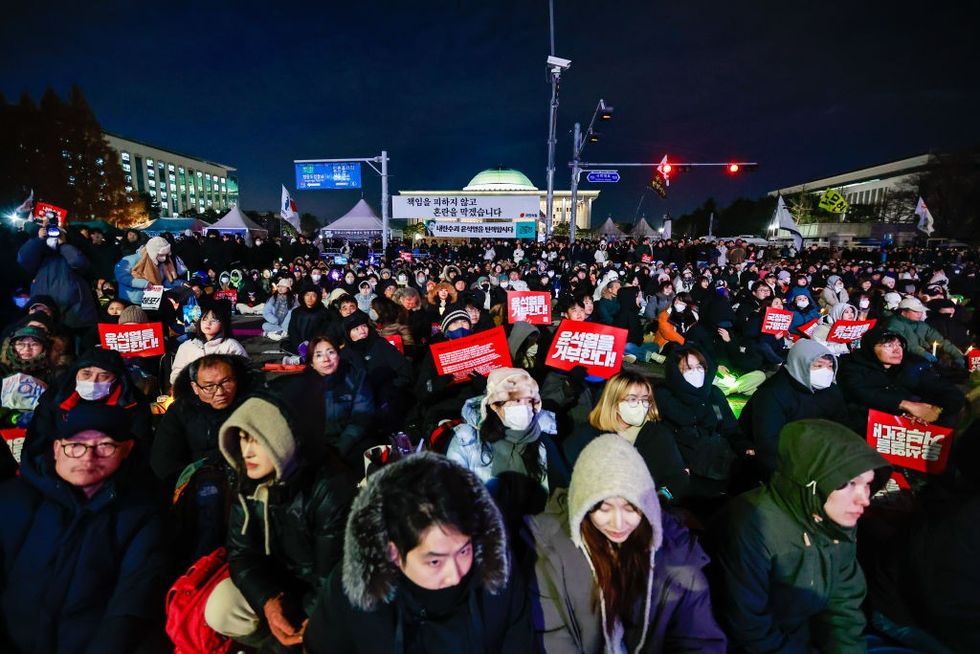
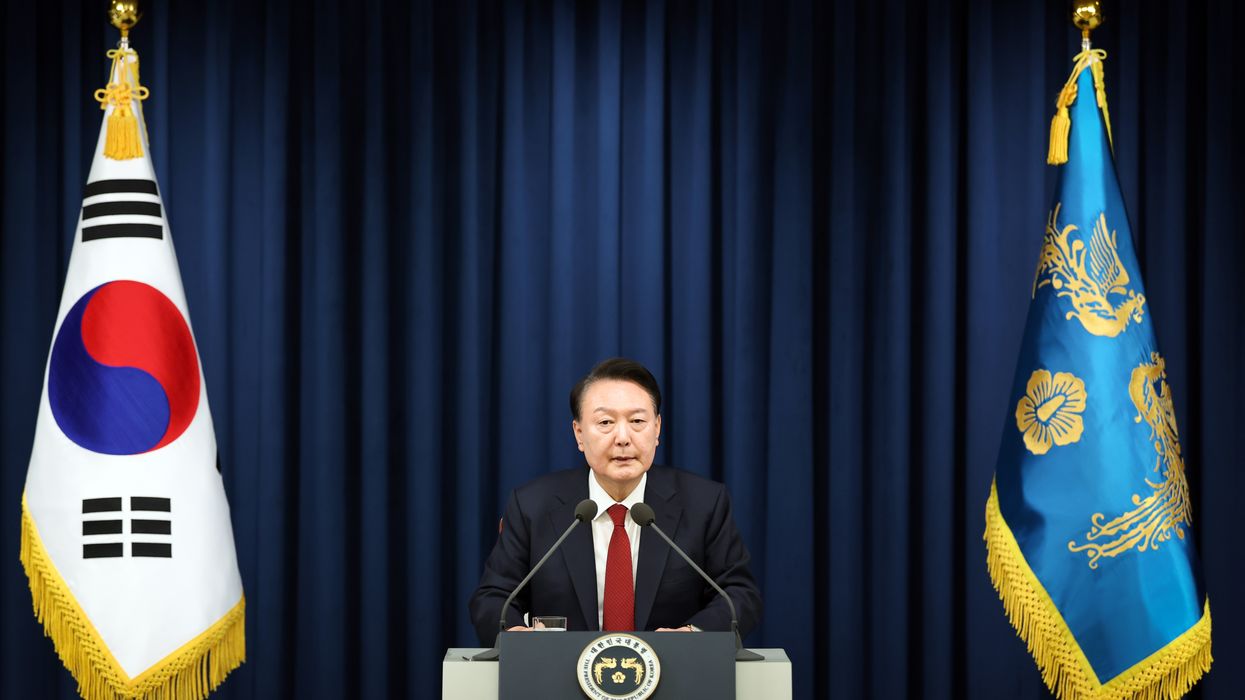
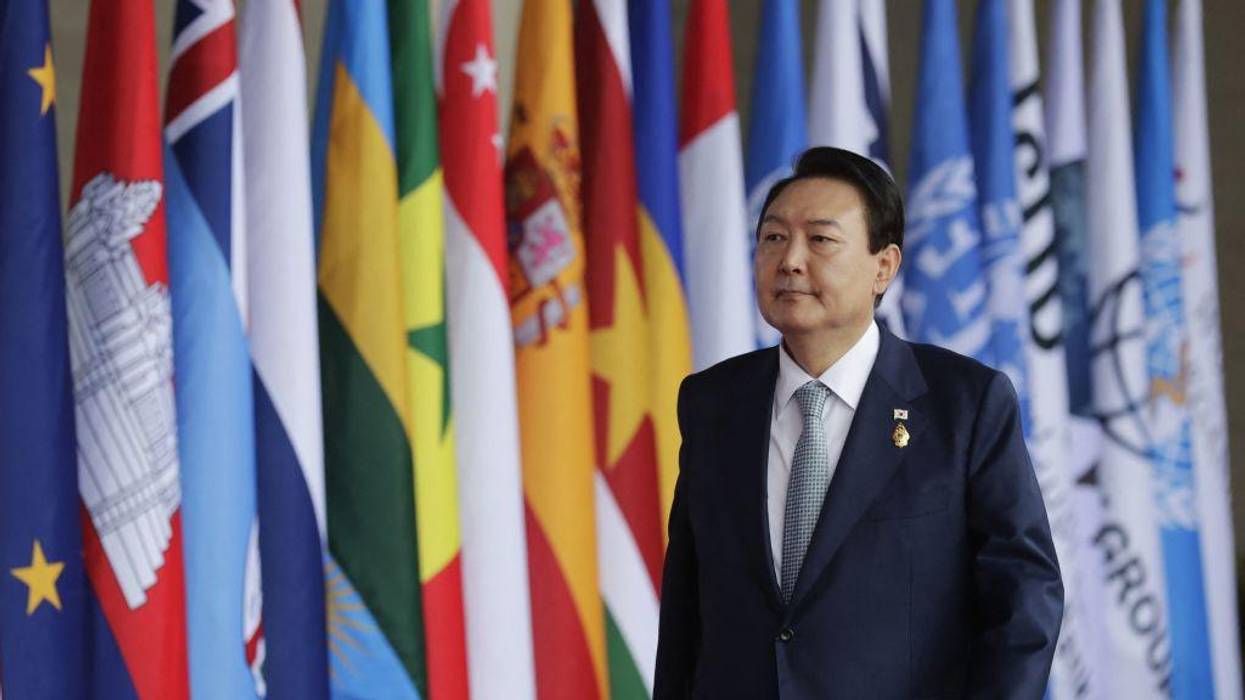
For more than 44 hours Koreans have braved freezing snowstorms to demand the arrest of the elusive Yoon Suk Yeol, who has barricaded himself inside his official residence in defiance of constitutional and legal authority. Yoon, extolled by Washington as a “champion of democracy,” has vanished from public view behind hastily erected barricades manned by security and military personnel while ignoring repeated summons from both the anti-corruption and prosecution services.
Capping a monthlong standoff with the National Assembly and the Korean public over his brazen attempted coup, Washington’s “perfect partner” has spent the past week deploying the armed military and security services at his disposal to physically prevent police from serving him with an arrest warrant for insurrectionism and abuse of authority. Investigators from the Corruption Investigation Office attempting to execute the warrant—the first against a sitting president—were forced to withdraw from the presidential compound after a five-hour standoff with the over 200 armed men deployed by Yoon.
This unprecedented drama began unfolding on the night of December 3, 2024. Amid over 250 days of intentionally destabilizing U.S.-led war games and months of massive citizen protests demanding his resignation, the deeply unpopular president put his nation under martial law for the first time since 1979, dispatching armed troops with the orders to “shoot to kill” if necessary to surround the National Assembly and prevent lawmakers from convening to rescind the order.
How can the world support Korea’s quest for democracy, peace, and true sovereignty?
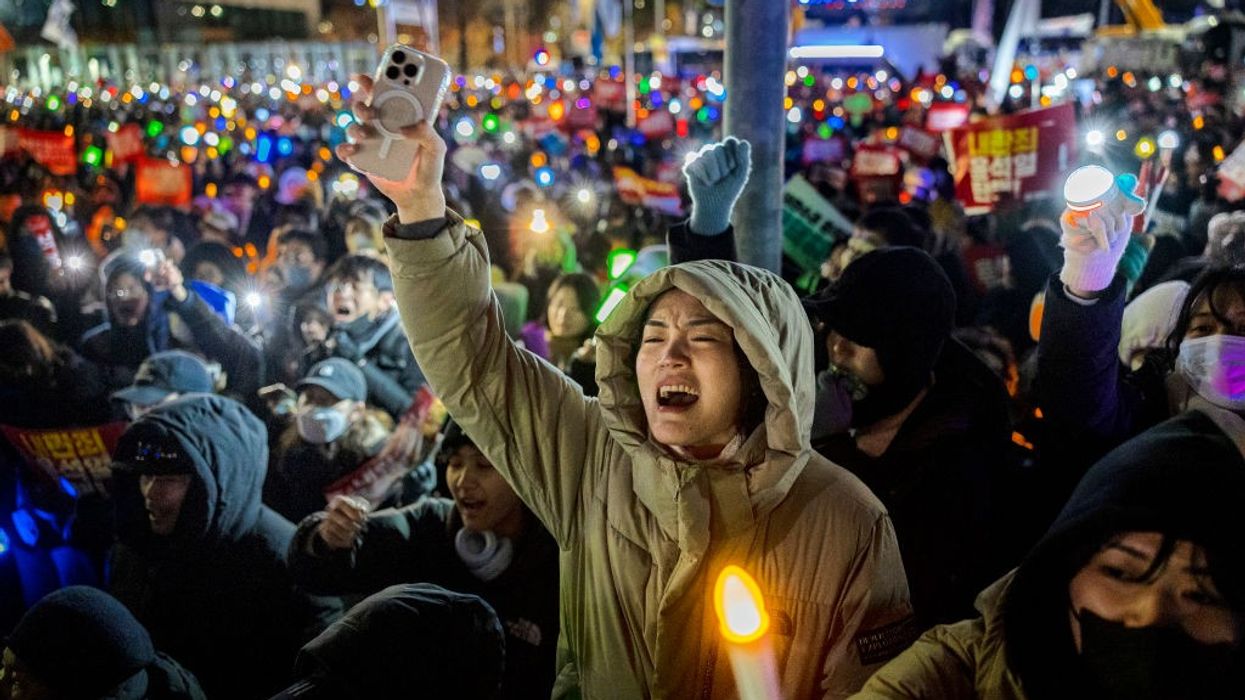
By the following night, some 2 million Koreans bearing light sticks, candles, and beacons formed a luminous sea around the National Assembly to demand the impeachment of Yoon Suk Yeol, while lawmakers clambered over fences and security barriers to gain access to the chambers. With a vote of 204 to 85, which included 12 lawmakers from the ruling People’s Power Party (PPP), the National Assembly impeached Yoon, with Democratic Party leader Lee Jae-myung declaring, “The people have proved that they are the owners of this country.”
While the Constitutional Court has 180 days to render a judgment on whether the impeachment motion is constitutional, Yoon’s rogue insurrectionism and contemptuous defiance of the rule of law is continuing, escalating tensions and instability.
Yoon’s motivation for his failed insurrection lies in the ongoing crisis of legitimacy facing his puppet government, which has eagerly acquiesced to every demand made by its American and Japanese “allies” while making a hollow mockery of Korean self-determination and ignoring the interests of the nation he swore to defend. Since assuming power in 2022 after winning the presidency by a razor-thin margin of 0.7%, Yoon has actively worked to undermine the very basis of Korean independence and democracy back to its roots during the brutal period of Japanese colonization in WWII.
Moreover, Washington’s unquenchable geopolitical ambitions, couched behind its so-called “ironclad commitment to Korea,” mandates the continuation of its policy of preferring right-wing governments at the expense of Korea’s sovereignty. This has overtly empowered and legitimized Yoon’s autocratic pursuit of power against the interests of the Korean people.
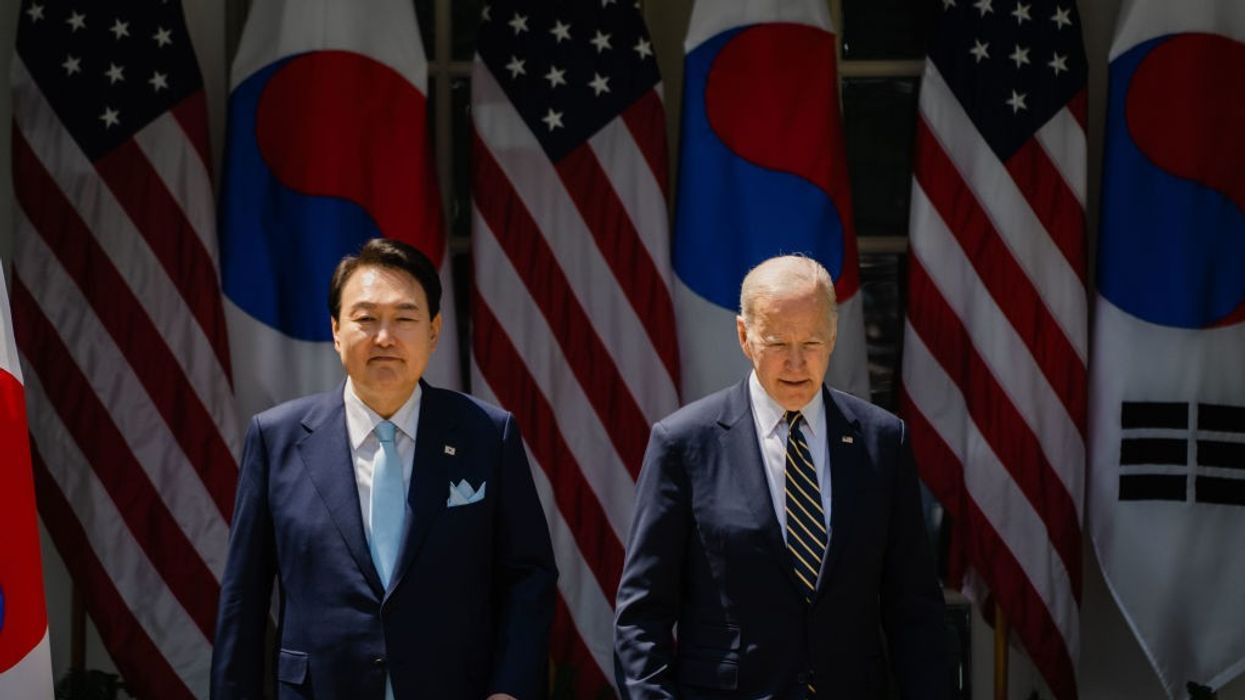
Thus, Yoon—who represented his country by sycophantically singing “American Pie” during a state dinner at the White House—has dutifully promoted the U.S.-led trilateral “Axis of War”, facilitating non-stop U.S.-led war games, and escalating tensions with Pyongyang while persecuting his domestic critics as “communists” and “anti-state forces.” His ongoing rogue behavior of defiance of the rule of law is directly related to the strong support he has received from Washington as “Biden’s man” in Seoul.
With the president suspended from power, what’s next for Korea’s “Revolution of Lights”? How can the world support Korea’s quest for democracy, peace, and true sovereignty? Demand accountability for Yoon’s legacy of authoritarianism, his continuing assault on democracy and the rule of law, and his betrayal of Korean sovereignty in service of Washington’s geopolitical ambitions. Call for a final end to Washington’s shameful history of subverting South Korean politics by abetting dangerous far-right forces that take Korea’s democracy and sovereignty hostage.
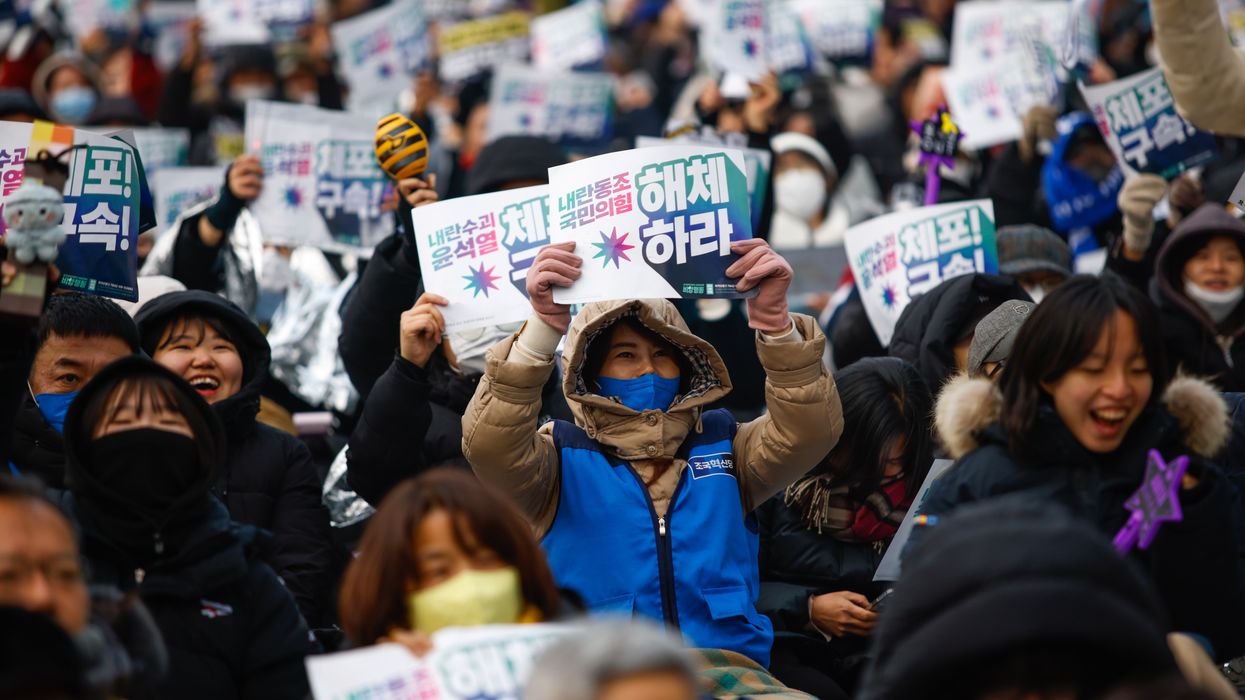
"Today, citizens witnessed democracy taking a step backward," said the Korean Confederation of Trade Unions.
A bid to impeach South Korean President Yoon Suk Yeol over his short-lived imposition of martial law failed Saturday after lawmakers from his conservative party left the National Assembly chamber and refused to take part in the vote.
Supporters of impeachment needed at least eight members of Yoon's People Power Party (PPP) to support removing the president, who apologized to the nation in a one-minute-long address Saturday morning but refused to step down after he briefly instituted martial law in a stated attempt to "eradicate shameful pro-North Korea" forces, plunging the country into a political crisis.
Yoon's gambit sparked immediate and sustained protests and was widely seen as a coup attempt.
Saturday's impeachment effort drew a massive number of people into the streets outside the National Assembly building despite below-freezing temperatures, and demonstrators voiced outrage when they learned that Yoon's allies thwarted the initial attempt to oust him. Just two PPP members returned to the National Assembly chamber to cast a ballot Saturday.
"I am so angry. I can't find the words to describe my frustration," 23-year-old Kim Hyo-lim told The New York Times. "I am devastated, but I feel honored to be a part of this historic moment for my country."
Another demonstrator said they intend to protest "every weekend" until Yoon is removed.

Organizers said roughly a million people took part in demonstrations Saturday in support of Yoon's impeachment. Many also demanded his arrest.
The Financial Times reported following the failed impeachment effort that Yoon—whose term expires in 2027—and PPP leaders "appeared to have reached a deal whereby the president would hand over political direction of the country to his party and agree to stand down at a time of the party's choosing, in return for support in the impeachment vote."
The Korean Confederation of Trade Unions (KCTU), which has over 1.1 million members, called PPP lawmakers who boycotted Saturday's vote "accomplices in treason."
"The People Power Party has turned its back on the people's wishes, effectively admitting their complicity," KCTU said in a statement posted to social media. "More than one million citizens gathered in front of the National Assembly. They came together because they cannot forgive a president who declared martial law and aimed weapons at his own people. Despite the cold winter weather, they took to the streets hoping desperately for the impeachment to pass."
"Today, citizens witnessed democracy taking a step backward," KCTU added. "They saw clearly who stands with those who would harm our democracy. The People Power Party must be dissolved. Those who protect Yoon must face consequences. It would be a grave mistake to think this can be resolved through compromise or constitutional amendments for an early resignation. Through the people's judgment, Yoon, his associates, and the People Power Party will face severe consequences."
Opposition lawmakers are expected to file a fresh impeachment motion next week as pressure mounts for Yoon to step down.
Additionally, as The Washington Post reported, "the national police have opened an investigation into Yoon on treason accusations by opposition parties and activists."
Trump’s goal will be to avoid Yoon’s outcome and instead—like Putin and Orbán did in Russia and Hungary—ensure there won’t be any meaningful opposition within the GOP to his most extreme measures when they come.
South Korean President Yoon Suk Yeol, whose declaration of a state of emergency yesterday shocked the world, has often been referred to (both within and outside of his country) as “South Korea’s Donald Trump.” A political outsider, he came to power with anti-establishment and often outrageously inflammatory rhetoric, trash talking women’s rights, “reforming” their healthcare system, and pushing hard for a neoliberal agenda that included raising the workweek from 52 to 69 hours.
In that, he reflects a growing trend among advanced democracies around the world, as decades of neoliberalism have weakened multiple nations’ abilities to sustain middle-class lifestyles while enriching an oligarch class that’s now reaching out—worldwid—to seize control of democratic governments to their own financial benefit.
Of all the events in world news over the past weeks—even more than the escalation of Russian President Vladimir Putin’s murderous crimes against Ukraine—President-elect Donald Trump and his authoritarian colleagues down at Mar-a-Lago are probably carefully watching what’s happening to Yoon and gaming out how a similar “emergency” action here in America might be recalibrated to have ultimate success.
If he wants to imitate Yoon’s initial declaration and successfully follow through on it, Trump will need to intimidate and bring to heel any Republicans who still think of themselves as more loyal to the nation and our Constitution than to him.
Yoon has now backed down in the face of opposition from the South Korean parliament; he couldn’t get one single vote from his own party in Parliament, and is now facing demands that he resign or be impeached.
The challenges Yoon faced included a 17% approval rating, the legislature having been captured by the opposition party, and, most importantly, that he had never forced the members of his own party to degrade themselves and perform acts of obedience in front of him.
Thus, when he tried this strongman move of declaring a state of emergency but had not, in fact, first set himself up as a strongman, it failed.
Trump’s goal will be to avoid Yoon’s outcome and instead—like Putin and Viktor Orbán did in Russia and Hungary—ensure there won’t be any meaningful opposition within the GOP to his most extreme measures when they come.
Yoon’s rightwing populist People Power Party (PPP) had lost control of parliament in the April elections to the more progressive Democratic Party of Korea (DPK); Trump will not have such a constraint in a few weeks when he takes the White House. Instead of fighting Democrats, Trump must figure out how to deal with opposition to his most extreme impulses from within his own Republican Party.
Thus, his putting forward outrageous, unqualified, and even occasionally anti-American candidates for cabinet positions is Trump’s first big step in the classic strongman move of softening up Republicans in the House and Senate so when the real fights—like over a state of emergency (and the martial law that could accompany it)—happen, his party members and the handful of “problem solver” quislings in the Democratic Party will have already surrendered their ability to resist him.
This, as I noted but our media seems to be ignoring, is where Yoon failed. Trump—if he’s successful at cowing Republicans in the Senate into rubber-stamping his picks or allowing recess appointments—may not have those constraints, since he will have ended opposition in the Senate, and his MAGA-seized GOP now also controls the House and the Supreme Court.
Nonetheless, if he wants to imitate Yoon’s initial declaration and successfully follow through on it, Trump will need to intimidate and bring to heel any Republicans who still think of themselves as more loyal to the nation and our Constitution than to him. Will they still exist by next February?
Yoon’s behavior serves as both a warning and a call to action: Democracies must stand vigilant against the creeping authoritarianism that threatens their core principles.
This is not a new strategy, as Timothy Snyder, Heidi Siegmund Cuda, or Ruth Ben-Ghiat will tell you in their excellent Substack newsletters.
One of the big points Fritz Thyssen made in his book I Paid Hitler was to note how he and other industrialists and politicians were required to scrape and bow before Adolf Hitler in the early months and years. There was a competition among the industrialists and German politicians alike after Hitler’s appointment as chancellor to see who could be the most publicly obsequious, slavish, and unctuous toward the new German leader.
Today in America we see a similar spectacle as politicians, media figures, business leaders, and foreign dignitaries flock to Mar-a-Lago to kiss Trump’s golden ass.
It was that exact behavior that paved the way for Hitler to shut down the German press, subserviate the Reichstag, and essentially shatter all opposition to his regime in less than half a year.
And it wasn’t just the political class who bowed to him; so, too, did most average Germans, who had become exhausted by the conflict exploding across the political spectrum and so tuned out, immersing themselves instead in sports, family, and entertainment.
As a result, every day brought a new outrage, a new norm destroyed, a new red line crossed, but each was small enough—like appointing an accused rapist and drunk or drug user to run the Justice Department or the Pentagon—that it created a buzz in the political media but wasn’t sufficient to bring even a dozen people out into the streets.
Fascism comes in on cat’s feet, step by gradual but inexorable step. It never starts with one great clashing explosion of evil or corruption that causes an entire nation to suddenly wake up and pour into the streets. There are no trumpets, drums, or cymbals. As Hemmingway wrote in The Sun Also Rises using the metaphor of bankruptcy, it happens “gradually, and then suddenly.”
It’s usually the story of an insidious gradualism, like what a German professor told Chicago reporter Milton Mayer about in 1954:
But of course this isn’t the way it happens. In between come all the hundreds of little steps, some of them imperceptible, each of them preparing you not to be shocked by the next. Step C is not so much worse than Step B, and, if you did not make a stand at Step B, why should you at Step C? And so on to Step D.
And one day, too late, your principles, if you were ever sensible of them, all rush in upon you. The burden of self-deception has grown too heavy, and some minor incident, in my case my little boy, hardly more than a baby, saying “Jew swine,” collapses it all at once, and you see that everything, everything, has changed and changed completely under your nose.
Yoon’s declaration of emergency and martial law was explicit: It banned all political activities of the National Assembly, local councils, political parties, and associations; prohibited gatherings, protests, and labor strikes; and placed the media under the authority of the Martial Law Command.
Trump has made similar threats to our media and promised to use the state’s power of guns and jails to “root out the communists, Marxists, fascists, and the radical left thugs that live like vermin within the confines of our country,” claiming, like Yoon did, that “the threat from outside forces is far less sinister, dangerous, and grave than the threat from within. Our threat is from within.”
Yoon’s effort to quickly convert South Korea into an autocratic state has so far backfired, in large part because of public opinion, a still-free press, and the courage of opposition and his own PPP politicians alike. The lesson Trump should learn from Yoon’s unsuccessful attempt is the need to avoid authoritarianism and instead embrace coalition-building, transparent governance, and a balanced approach to both domestic and foreign policy challenges.
Instead, it’s a virtual certainty that Trump is thinking Yoon should have acted before April, before the more progressive DPK took back over the parliament, and should have helped friendly oligarchs to seize the media in advance of his proclamation. And that he needs to move fast, before Democrats can regain power in the 2026 midterms that will be only 22 months away.
The resilience of democracy depends on the strength of its institutions, the vigilance of its citizens, and the commitment of its elected leaders of all parties to uphold democratic values. Yoon’s behavior serves as both a warning and a call to action: Democracies must stand vigilant against the creeping authoritarianism that threatens their core principles. As Trump’s return looms, these lessons cannot be ignored.
The summit’s much ballyhooed commitment to nuclear disarmament and nonproliferation serves more to manufacture consent for preparations for nuclear war than to reduce nuclear dangers.
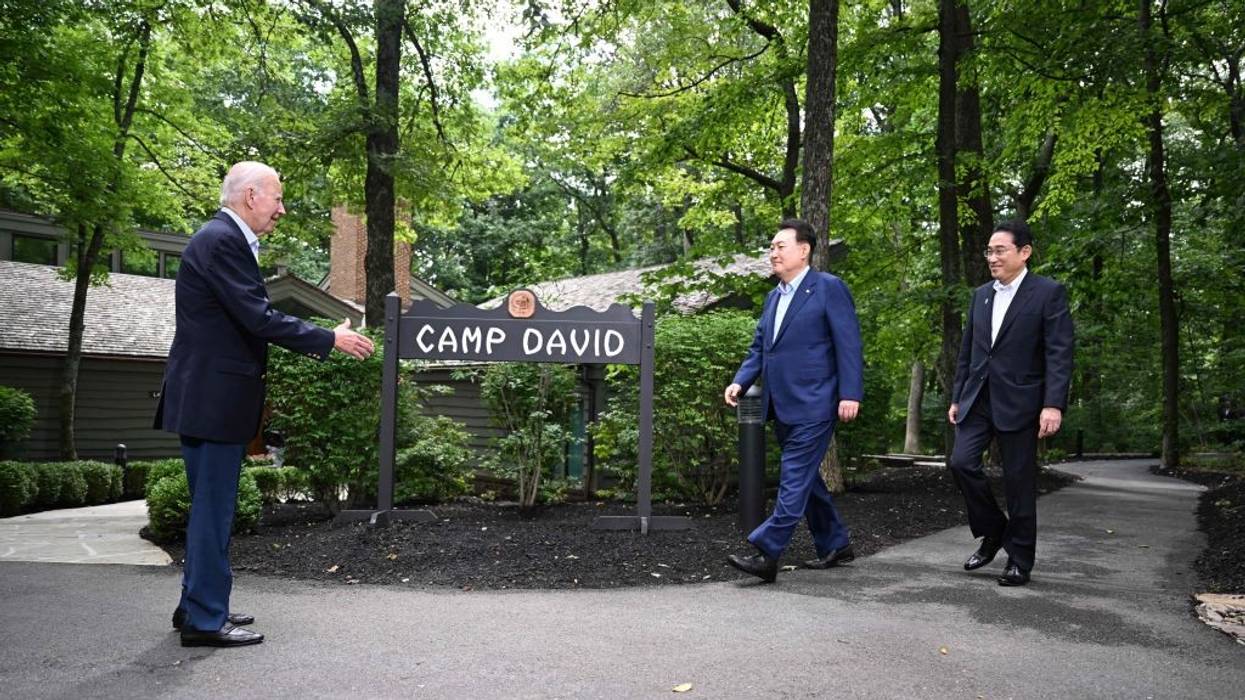
Meeting in a summit at Camp David on August 18, President Joe Biden, President Yoon Suk Yeol
of South Korea, and Prime Minister Fumio Kishida of Japan posed for photos that confirmed and broadcast a long-term trilateral alliance designed to reinforce containment of China, Russia, and North Korea.
The architect of this updated alliance structure was the coordinator for Indo-Pacific affairs in President Biden’s National Security Council, Kurt Campbell. In an earlier incarnation, he served as former President Barack Obama’s assistant secretary of state for East Asian and Pacific affairs who then led the greatest U.S. post-Cold War foreign and military transition: the pivot to Asia and the Pacific to contain and manage China’s rise. Now as he has nurtured the consolidation of the U.S.-Japan-South Korea military alliance to reinforce the pivot and to augment the AUKUS (Australia, British-U.S.) and QUAD (U.S., Japan, Australia, India) alliances in Washington’s long march to create a NATO-like Indo-Pacific alliance system. The New York Times headlined that the three-pact way will serve as a “bulwark” against China and North Korea.
Prior to the summit, Campbell announced that the August 18 summit would feature “a very ambitious set of initiatives that seek to lock in trilateral engagement, both now and into the future,” addressing “many sectors—in the security realm, in technology, and education.” In this regard, it should be recalled that the Biden National Security strategy recognizes that the U.S. cannot unilaterally maintain its global dominance, and that doing so requires alliances that integrate military, technological, and economic resources. And while there is anything but equality among the alliance partners, Japanese and South Korean elites enjoy influence and power they would not have on their own.
With these military systems in place and the almost daily provocative military “exercises” by all parties involved, an accident or miscalculation on the Korean Peninsula or in relation to Taiwan could easily escalate into a regional, even nuclear, war.
Little understood across the United States, there are two competing triangular military, economic, and technological pacts in Northeast Asia. These contending military systems, plus the Taiwan and Korean flash points, make the region, along with Ukraine, the most likely trigger for escalation to regional, and potentially nuclear, war. Each of these increasingly integrated triangular systems, the U.S.-Japan-Republic of Korea (ROK) alliance and the China-Russia-Democratic People’s Republic of Korea (DPRK) quasi alliance, has its fault lines. With Japan yet to fully face and apologize for its brutal history of colonial conquest and rule in Korea (think forced labor and systemic military prostitution in the first half of the 20th century), and with widespread resentment over unpopular ROK president Yoon’s kowtowing to Tokyo and Washington, not to mention Seoul being Beijing’s second largest national trade partner, South Korea is the weak link in the U.S.-led alliance. On the other side, as we see in the Ukraine War, Beijing’s commitment to Moscow is not “unlimited.”
As referenced above, with these military systems in place and the almost daily provocative military “exercises” by all parties involved, an accident or miscalculation on the Korean Peninsula or in relation to Taiwan could easily escalate into a regional, even nuclear, war.
Global and domestic political forces led to transforming what was long a hub (U.S.) and spokes (allied partners) alliance system to the more integrated system it is becoming. At its heart lies the Biden Administration’s National Security Strategy’s dictat that “the post-Cold War era is definitively over, and a competition is underway between the major powers to shape what comes next.” Second are fears that Russia’s invasion of Ukraine could signal an end to the post World War II/United Nations order in which national boundaries and sovereignty are for the most part respected. (The U.S. invasions of Indochina, Afghanistan, Iraq, and Panama being significant exceptions to the so-called “rules based order!”)
The alliance consolidation also takes place at a time when the Kishida government has opted to totally disregard Japan’s war-renouncing constitution. Being the world’s 10th largest military spender was not sufficient for those who fear China’s rise and North Korea’s missiles and wanted to restore Japan’s military grandeur. Kishida has committed to doubling the Self-Defense Forces budget. In harmony with U.S. alliance building, and to prepare for a time when the U.S. may reduce its Asia-Pacific commitments, Japan is deepening “security” cooperation with Australia, the Philippines, India, and Taiwan and is engaging in joint military operations as far afield as the South China Sea. That these commitments suggest the possible reprising of Tokyo’s early 20th century history as a major regional military power unsettles Beijing and some Asia-Pacific neighbors.
In Korea, the unpopular President Yoon is ruling in the tradition of Donald Trump, ignoring popular opinion, relying on his narrow but loyal right-wing base, and trading his threats to develop nuclear weapons and swallowing unresolved Japanese abuses to deepen U.S. and Japanese alliance commitments. With North Korea augmenting its nuclear arsenal and increasing the pace of its missile tests—even as the U.N. reports increased starvation in the DPRK—Seoul is hardly alone in accelerating the pace of Korean militarization. Add to this the joint Chinese-Russian naval exercises in the Sea of Japan and Asahi Shimbun’s reports that Beijing is tightening its military encirclement of Taiwan.
Among the trilateral agreements just secured at Camp David are the “commitment to consult” when “something that poses a threat to any one of us poses a threat” to the three nations—just short of NATO’s Article 5 commitment to mutual defense. Also agreed were greater intelligence sharing, annual military exercises, deepening cooperation and interdependence on missile defenses (which can provide defense but also serve as shields to reinforce first-strike nuclear swords), collaborative technological development, a framework to further integrate Southeast Asian nations into the trilateral military structure, a hotline, and annual trilateral meetings among national security advisors for “institutionalizing, deepening, and thickening the habits of cooperation” among the allies.
Decades ago, many of us sang, “When will they ever learn?” When indeed!
The summit’s much ballyhooed commitment to nuclear disarmament and nonproliferation serves more to manufacture consent for preparations for nuclear war than to reduce nuclear dangers. As we saw in the recent G7 summit, the U.S. and Japan remain committed to “nuclear deterrence.” And the nonproliferation commitment may have more to do with preventing South Korea’s and Japan’s military from becoming nuclear powers than a commitment to fulfilling their Nuclear Non-Proliferation Treaty (NPT) commitments. (Article VI of the NPT requires the original nuclear powers to engage in good faith negotiations for the complete elimination of their nuclear arsenals, which they have refused to do for 50 years. And, for 60 years, Japan’s military has asserted its right to possess nuclear weapons, and South Korean polls indicate that a majority support Seoul developing nuclear weapons.)
Decades ago, many of us sang, “When will they ever learn?” When indeed! Former Australian Prime Minister, now ambassador to the United States, Kevin Rudd, warns that we are marching toward a catastrophic and avoidable war. At the height of the last Cold War, U.S., Soviet, and European elites opted for the paradigm of Common Security diplomacy to halt and reverse the spiraling and increasingly terrifying nuclear arms race. They ended the Cold War on the basis of the recognition that security cannot be achieved by taking increasingly militarized actions against their rival, that it can only be won through difficult diplomacy that acknowledges each side’s fears and resolves and addresses them with win-win, mutually beneficial compromises and agreements.
Earlier this summer Treasury Secretary Janet Yellen observed that the world is big enough for both the U.S. and China. Let’s build on that insight, press U.S. and other leaders to engage in Common Security diplomacy, and stop wasting trillions of dollars in preparation for apocalyptic war and devote our all too limited resources to meeting human needs, including reversing that other existential threat: the climate emergency.
An earlier version of this article said that Kurt Campbell served as assistant secretary of state for East Asian and Pacific affairs under former President Bill Clinton. He actually filled this role under former President Barack Obama, and the piece has been corrected to reflect this.
Marches from South Korea to Italy called for higher wages and targeted anti-worker policies.
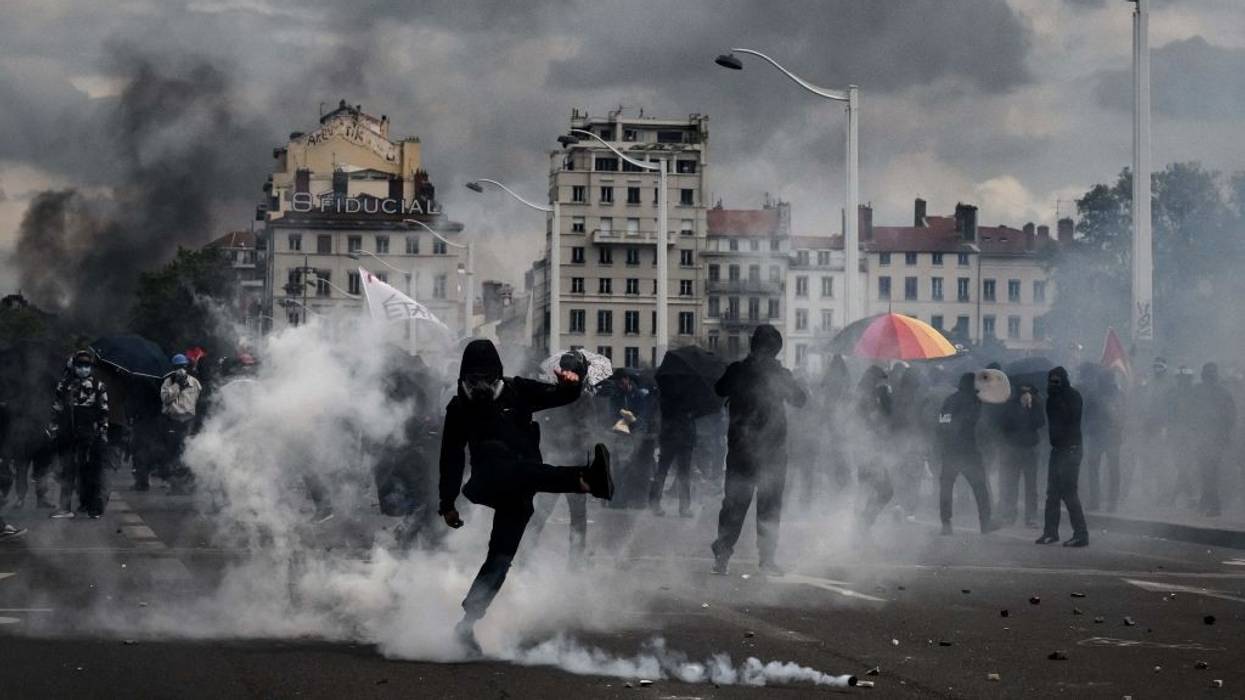
Workers from Japan to France took to the street on Monday for the largest May Day demonstrations since Covid-19 restrictions pushed people inside three years ago.
Marchers expressed frustration with both their nations' policies—such as French President Emmanuel Macron's raising of the retirement age in March—and global issues like the rising cost of living and the climate crisis.
"The price of everything has increased except for our wages. Increase our minimum wages!" one activist speaking in Seoul told the crowd, as The Associated Press reported. "Reduce our working hours!"
"The price of everything has increased except for our wages."
South Korea's protests were the largest in the nation since the pandemic, with organizers predicting 30,000 people each would attend the two biggest rallies planned for the nation's capital alone, Al Jazeera reported.
Activists there criticized right-wing President Yoon Suk Yeol, who has targeted some unions under the guise of reforming what he claims are irregularities. His government had also considered a plan to extend a cap on working hours to 69 a week, before backlash from younger Koreans forced it to reconsider in March, as CNN explained at the time. Already, scores of people die of overworking every year, so much so that there's a special word for it: "gwarosa." Some marchers called for the president to resign, Dr. Simone Chun tweeted.
In Tokyo, meanwhile, thousands demonstrated against Japanese Prime Minister Fumio Kishida's plan to double the defense budget, money they argue should go toward meeting people's basic needs, the AP reported.
Demonstrations also took place in the Philippines, where marchers demanded a higher minimum wage; Taiwan, where they wanted improved labor policies; and Indonesia, where they demanded the government repeal a job creation law they said favored business interests over environmental protections or workers' rights.
"Job Creation Law must be repealed," protester Sri Ajeng said, as the AP reported. "It's only oriented to benefit employers, not workers."
In Sri Lanka, protesters pushed back on plans to privatize state- or partially government-run businesses amidst the country's worst ever economic crisis. In Pakistan, demonstrations were prohibited in some cities due to security concerns, leading unions to hold indoor rallies in Peshawar, though an outdoor gathering in Lahore still drew large crowds.
Domestic migrant workers in Lebanon played a large role in Beirut's march, while around a dozen demonstrators in Turkey were detained by police while attempting to access Istanbul's Taksim Square, which President Recep Tayyip Erdoğan had closed to protests.
Marches also took place across Europe, with more than 70 in Spain alone, where unions called for higher wages and supported the push for a four-day work week. In Italy, protests came as Prime Minister Giorgia Meloni—the leader of the nation's most right-wing government since World War II—announced a plan to reduce anti-poverty funds and make it easier for businesses to offer short-term contracts to workers, as Al Jazeera reported further.
According to Reuters, Meloni said that "I am proud of the government choosing to celebrate May 1 [International Workers' Day] with facts instead of words."
However, leader of Italy's principal CGIL union Maurizio Landini criticized Meloni's plan and said that wages were too low in the country because of high taxes and an elevated "level of job insecurity."
In the Netherlands, it was the nation's largest union itself that faced protests from its employees, who said they would go on strike Tuesday for higher wages amidst rising inflation, which rose 10% in 2022 and is expected to rise 3% in 2023 and 2024 each. Employees of the union—FNV—want that entire jump to be covered, but the union has only offered raises of 3% to 7% this year, 5% next year, and a maximum of 5% each year after from 2025.
"FNV staff also has the right to an honest wage deal that is appropriate for these times."
"It is painful that we have to go on strike," FNV employee representative Judith Westhoek told Reuters. "But FNV staff also has the right to an honest wage deal that is appropriate for these times."
May Day in Germany began the night before with a "Take Back the Night" march to protest violence against women and LGBTQ+ people, which drew thousands, the AP reported.
Finally, in France, marches channeled lingering rage over Macron's decision to raise the retirement age from 62 to 64. Unions hoped it would be the nation's largest May Day in years. And this seemed possible, since all of the major unions were working together for just the third time since 1945, The Washington Post noted. The last time this happened—in 2009—crowds reached 1.2 million.
"I think we'll see hundreds of thousands of demonstrators, perhaps 1 million or 1.5 million," Laurent Berger, who leads the nation's largest and more moderate union CFDT, said Sunday, as France 24 reported.
Some protesters broke windows in stores and banks in Paris, the AP reported. Meanwhile, police sprayed tear gas in the capital and other French cities, while at least two journalists were caught in the crossfire, according to France 24. Videos shared on social media showed that one journalist's helmet was broken, and another was forced to the ground by tear gas.
A French court allowed police to deploy drones to monitor crowds, which NGOs and lawyers' unions said violated marchers' rights.
Anger wasn't limited to Macron. Climate activists with Extinction Rebellion Paris targeted the Louis Vuitton museum—which they argued was a "tax tool" for the company to reduce what they paid to the state—with spray paint.
They pointed to an Oxfam France report finding that the companies in the nation's CAC 40 stock index would put the world on track for 3.5°C of warming by 2100.
"This is why we ask large companies to take their responsibility and act in the fight against global warming," the group tweeted.
Support for the May Day protests also came from the world's Indigenous peoples.
"The International Indigenous Peoples Movement for Self-Determination and Liberation greets the working peoples of the world, especially our fellow Indigenous peoples, in their valiant struggle for just wages, better working conditions, and human rights," the group said in a statement. "The struggle for self-determination and liberation is not possible without linkage between Indigenous Peoples and the working class in tearing down systems of oppression and exploitation."
Update: This piece has been updated with a statement from the International Indigenous Peoples Movement for Self-Determination and Liberation.
With the support of Washington, President Yoon has pursued extreme hawkish policies directly against South Korea's national interests.
South Korea's far-right President Yoon Suk Yeol, who was elected by a narrow margin of 0.7% last year, is in Washington, D.C. this week for a state visit at the invitation of President Biden.
According to the New England Korea Peace Campaign, Boston Candlelight Action Committee, and Massachusetts Peace Action, which are preparing to hold a protest on Friday, April 28th in Cambridge, Massachusetts, during Yoon's visit to Harvard, "Since entering office, Yoon's right-wing administration has expanded costly and provocative U.S.-ROK military exercises, heightened tensions with North Korea, rolled back workers' rights, threatened to abolish the ministry of gender equality, and has taken many other actions to undermine struggles for peace and justice in South Korea."
Indeed, backed by Washington, President Yoon has pursued extreme hawkish policies directly against South Korea's national interests.
Washington's endorsement of Yoon and its support for his new National Security State directly contravenes the majority of South Korean public opinion.
Yoon's state visit comes at a time when South Korea is experiencing unprecedented crises on the political, economic, and national security fronts as a consequence of the Biden Administration's unrelenting pressure on South Korea to join the U.S. anti-China bloc.
Moreover, domestically, Yoon has installed a new National Security State, which experts refer to as the "republic of prosecution."
His administration is engaging in a massive political witch hunt of his opponents, arresting key top officials of the previous Moon administration, and targeting the opposition Democratic Party and progressive political leaders.
Yoon is using South Korea's national-security laws and red-baiting rhetoric to crack down on unions and those who are working for peace and unification.
For example, on January 28 of this year, Jeong Yu-Jin, Director of Education of the Gyongnam Progressive Alliance and a mother of two, was arrested on charges of being a North Korean spy, an allegation she has steadfastly denied. Having been arrested, detained, and forced to make a false confession without access to an attorney, she engaged in a 40-day hunger strike in detention, which she only ended after 300 Koreans joined her hunger strike in solidarity. Although the hunger strike severely harmed her health, she remains steadfast and is preparing for her trial, with her greatest fear being that her two children remain without the care of their mother indefinitely.
Yoon's eagerness to prove his administration's worth as a linchpin in Washington's new Cold War in Asia means that there will be more repression and prosecution such as this. Washington is backing a repressive political regime under an extreme far-right president whose inexperience in foreign policy and disregard for political norms is ushering in a new era of domestic and international uncertainty and risk for South Korea.
Washington's policies run directly counter to the sentiments of the majority of South Koreans, who strongly support balanced foreign relations with Russia and China, meaningful reconciliation with Japan, and peace with North Korea.
According to recent polls, 80% of Koreans oppose the degree to which Yoon has capitulated to Washington's imposition of its anti-China policy on South Korea.
Washington's endorsement of Yoon and its support for his new National Security State directly contravenes the majority of South Korean public opinion.
According to recent figures, the Yoon administration has an abysmal 19% public approval rating.
While the purpose of Yoon's state visit is to prove his relevance to U.S. imperial ambitions in Asia, Washington's increasingly heavy-handed management of its one-sided relationship with South Korea is causing it to lose the battle for the hearts and minds of the South Korean public.
South Korean President Yoon Suk Yeol stoked global alarm on Wednesday by suggesting for the first time that his country would consider building nuclear weapons or asking the United States to redeploy them in response to the threat posed by North Korea.
"It's possible that the problem gets worse and our country will introduce tactical nuclear weapons or build them on our own," Yoon said during a policy briefing with his defense and foreign ministries, according to The New York Times. "If that's the case, we can have our own nuclear weapons pretty quickly, given our scientific and technological capabilities."
"Adding more nuclear weapons into an already tense region is like pouring oil onto a grease fire."
South Korea, which previously had a nuclear program in the 1970s, would have to leave the Nuclear Nonproliferation Treaty (NPT) to develop such arms. The United States—one of the nine official nuclear-armed nations—withdrew its nukes from the country in 1991.
That same year, both Koreas signed a joint declaration agreeing not to "test, manufacture, produce, receive, possess, store, deploy, or use nuclear weapons," but, as the Times noted, the North has since "reneged on the agreement by conducting six nuclear tests since 2006."
The International Campaign to Abolish Nuclear Weapons (ICAN)—which was awarded the 2017 Nobel Peace Prize for its efforts related to the Treaty on the Prohibition of Nuclear Weapons—responded to the South Korean leader's comments on Thursday.
"Suggestions that rejecting agreed [international] law and norms to develop nuclear weapons are outrageous, and must be globally condemned," ICAN tweeted. "President Yoon Suk Yeol's remarks should be condemned, as should all nations that threaten to leave the NPT and develop nukes."
"Adding more nuclear weapons into an already tense region is like pouring oil onto a grease fire," ICAN continued. "All it does is increase the chances of a nuclear escalation."
Eliana Reynolds, a research associate for the Nuclear Information Project at the Federation of American Scientists (FAS), stressed that "nuclear weapons are not necessary to deter nuclear weapons. Entertaining this discussion does more harm than good, especially since South Korea would be the second state to ever withdraw from the NPT to build nuclear weapons, the first of which was (you guessed it) North Korea."
Tom Z. Collina, director of policy at Ploughshares Fund and co-author, with former U.S. Secretary of Defense William J. Perry, of The Button: The New Nuclear Arms Race, said: "So, let's say the U.S. redeploys nuclear weapons to South Korea. Then North Korea responds by upping its arsenal, actions, and threats. What has been gained? There is no good end to this."
Multiple experts called on the United States—which has the world's second largest nuclear arsenal, after Russia, and is a key ally of South Korea—to dissuade Yoon's government from pursuing nukes.
Yoon's comments were "a signal to the United States, and also to fellow [South Korean] conservatives who've wanted to see this option on the table," said Ankit Panda, a senior fellow in the Nuclear Policy Program at the Carnegie Endowment for International Peace. The "U.S. must be clear that extended deterrence and [South Korean] nukes cannot coexist."
James Acton, co-director of the Carnegie program, tweeted that "I think the U.S. should make clear that allies that develop their own nuclear weapons in violation of their nonproliferation obligations shouldn't expect to continue benefiting from U.S. security guarantees."
After another expert noted that South Korea may first ditch the NPT before pursuing nuclear arms, Acton highlighted possible commitments to the U.S. and "the legal dubiousness of using equipment acquired under the treaty," then said that "the big point is that I'd support withdrawing extended guarantees from any ally that withdrew from the NPT."
Dartmouth College professor Nicholas Miller, author of Stopping the Bomb: The Sources and Effectiveness of U.S. Nonproliferation Policy, suggested Thursday that Yoon may have made his nuclear remarks to influence negotiations.
"If South Korea decided to go nuclear, it would damage the NPT, trigger sanctions, threaten the alliance with the U.S., and provoke China and North Korea," Miller said. "Hence why I still tend to think it's unlikely and that these comments are for bargaining purposes."
"If South Korea decided to go nuclear, it would damage the NPT, trigger sanctions, threaten the alliance with the U.S., and provoke China and North Korea."
The Korea Herald reported Thursday that a presidential official signaled South Korea's intention to continue abiding by the NPT and said that Yoon's remarks should be understood as the president "stating his firm commitment amid the escalating threat of North Korea's nuclear weapons."
"The most important part of his comments yesterday was that, as a realistic measure at the moment, it's important to effectively strengthen extended deterrence within the security alliance between South Korea and the United States," the official said. "However, when it comes to security, the worst-case scenario must always be taken into consideration and from that perspective, he was making his commitment and determination ever clearer to protect the people as commander-in-chief against the escalating threat of North Korea's nuclear weapons."
During an Associated Press interview Tuesday at the presidential office in Seoul, Yoon also asserted that North Korean missile tests and nuclear ambitions pose a "serious threat," saying that "North Korea could have its own internal reasons, but there's no way for our country or any other country to know exactly why they are conducting such provocations."
According to the AP, "The conservative leader reiterated his call for closer security cooperation with the United States and Japan to counter the 'dangerous situation' being created by North Korea as he played down the prospect for direct negotiations like those pursued by his liberal predecessor."
"We've seen a miscalculation leading to serious wars many times in history," Yoon said. "These unlawful North Korean provocations can only result in the strengthening of [South Korea's] security response capabilities and a further strengthening of the security cooperation between South Korea, the United States, and Japan."
As the AP detailed:
In a recent newspaper interview, Yoon cited discussions with the U.S. about joint planning potentially involving U.S. nuclear assets.
Asked for further clarity Tuesday, he said the proposed plans include "tabletop exercises, computer simulations, and drills... on delivery means for nuclear weapons."
"The discussions are under way over the so-called joint planning and joint execution, and I think it's right for South Korea and the United States to cooperate because both of us are exposed to the North Korean nuclear threat," Yoon said.
After the Wednesday briefing that featured Yoon's nuclear comments, Lee Jong-sup, South Korea's defense minister, confirmed that his country and the United States are "planning to hold tabletop exercises in February between defense officials on operating means of extended deterrence under the scenario of North Korea's nuclear attacks."
Reuters reported that Lee also said the countries plan to scale up annual joint field training this year and that the U.S. is willing to "drastically expand" the scope of sensitive information shared because of the "need for it between the two sides, given that North Korea's nuclear threat has become serious not only to South Korea but also to the United States."
Meanwhile, peace advocates worldwide continue to demand diplomatic efforts. Last month, civil society groups called on Yoon, North Korean leader Kim Jong Un, and U.S. President Joseph Biden "to stop the destructive arms race, take steps now to prevent a potentially catastrophic war, and set the table for peace talks," arguing that "diplomacy is the only way to resolve this conflict."